
Unit 9 Have you ever been to a museum Section A
Ken: The most interesting museum I’ve ever been to is the American Computer Museum. They have information about different computers and who invented them. The old computers were much bigger. It’s unbelievable that technology has progressed in such a rapid way! I’ve also learned that there was a special computer. It could play chess even better than humans. I wonder how much more computers will be able to do in the future.
3. Why is the Hangzhou National Tea Museum a nice place to enjoy tea? It’s a relaxing and peaceful place near a lake. The tea art performances show how to make a perfect cup of tea with beautiful tea sets. Watching the tea preparation is just as enjoyable as drinking the tea itself.
Amy: I’ve recently been to a very unusual museum in India, the International Museum of Toilets. I just couldn’t believe my eyes when I saw so many different kinds of toilets there. The museum teaches people about the history and development of toilets. It also encourages governments and social groups to think about ways to improve toilets in the future.
2.What can you get when you are in the museum?
3a. fast reading
Which three museums do the students
talk about?
The American Computer Museum; The International Museum of Toilets; The Hangzhou National Tea Museum.
3b. Detailed reading
1. What does Ken say about the American Computer Museum? The American Computer Museum is the most interesting one. They have information about different computers and who invented them. The old computers were much bigger. It could play chess even better than humans.
Unit 9
Have you ever been to a museum?
the Palace Museum
The State Hermitage Museum, St. Petersburg
the British Museum
Xixi WБайду номын сангаасtland museum
Lead-in
1.Do you usually go to museums?
become better
uncommon
progress
unusual peaceful invent rapid
quiet
made
quick
Make more sentences using these words.
in such a rapid way 以如此快的方式 难以置信的是 It’s unbelievable that 下棋 play chess 在将来 in the future 许多不同种类的 many different kinds of …的历史和发展 the history and 鼓励某人做某事 development of 思考 encourage sb to do sth 一个令人放松和平静的地方 think about a relaxing and peaceful place
2. What can we learn at the International Museum of Toilets? The museum teaches people about the history and development of toilets. It also encourages governments and social groups to think about ways to improve toilets in the future.
4.What do you think is the most interesting museum and why ?
3c. Which of the underlined words in the passage have the following meanings?
make (something) better improve
unit9haveyoueverbeentoamuseum知识点梳理及单元复习
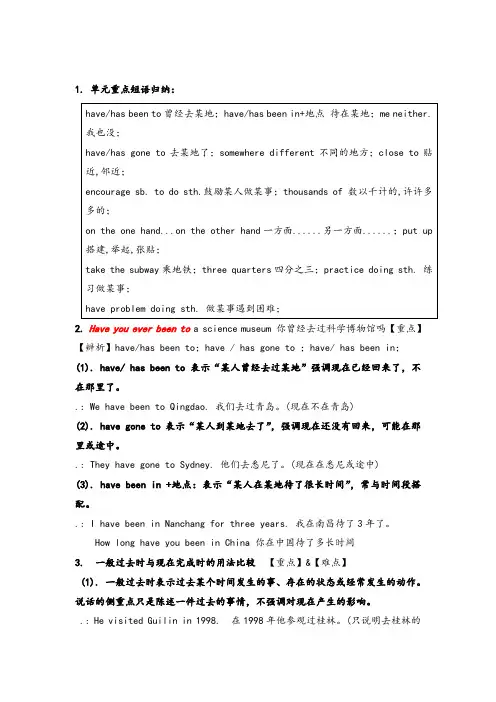
1. 单元重点短语归纳:2. Have you ever been to a science museum 你曾经去过科学博物馆吗【重点】【辨析】have/has been to;have / has gone to ;have/ has been in;(1). have/ has been to 表示“某人曾经去过某地”强调现在已经回来了,不在那里了。
.: We have been to Qingdao. 我们去过青岛。
(现在不在青岛)(2). have gone to表示“某人到某地去了”,强调现在还没有回来,可能在那里或途中。
.: They have gone to Sydney. 他们去悉尼了。
(现在在悉尼或途中)(3). have been in +地点:表示“某人在某地待了很长时间”,常与时间段搭配。
.: I have been in Nanchang for three years. 我在南昌待了3年了。
How long have you been in China 你在中国待了多长时间3. 一般过去时与现在完成时的用法比较【重点】&【难点】(1). 一般过去时表示过去某个时间发生的事、存在的状态或经常发生的动作。
说话的侧重点只是陈述一件过去的事情,不强调对现在产生的影响。
.: He visited Guilin in 1998. 在1998年他参观过桂林。
(只说明去桂林的时间)(2). 现在完成时表示动作发生在过去,对现在造成了影响或产生了结果。
不能与确定的过去时间状语连用。
.: Jill has bought a new computer. 吉尔买了一台新电脑。
I have taught here for fifteen years. 我在这儿教学已经15年了。
I have seen the film. 我看过这部电影。
(我了解这部电影的内容)I saw the film last week. 我上周看了这部电影。
人教版英语八下Unit 9 Have you ever been to a museum

2022年人教版英语八下Unit 9 Have you ever been to a museum?写作主题:talk about past experiences一,话题分析:本单元的话题是谈论过去发生的事件和经历,熟练掌握并使用现在完成时的用法。
话题主要是记述自己曾经到过的让自己印象深刻的地方,对自己这次经历,进行描述,表达自己对这次经历的感受。
重点考查学生以下能力:1.学习在记叙文中发表观点;2.使用现在完成时态;3.学会谈论自己过去的经历。
二,写作步骤:1.总分总结构。
短文通常分为三个部分:总------第一部分:开篇点题。
说出经历的名称。
分-------第二部分:介绍自己的经历。
(详细)总——第三部分:对经历的感受和体会。
2.人称:第一人称3.时态:一般现在时、一般过去时、现在完成时等。
三,词汇积累:1.have/has been to...曾去过某地2.ever曾经3.already已经4.favorite最喜欢的5.the first time首次6.be full of 充满7.space museum/history museum/art museum/water park/zoo/amusement park太空博物馆、历史博物馆、艺术博物馆、水上乐园8.fantastic精彩的9.want to go想去......10.by subway/plane/train/bike.....搭乘地铁、飞机、火车、自行车11.spend度过12.learn about学到有关......13.camp 露营14.put up a tent支起帐篷15.give up放弃16.important重要的17.learn...from从中学会18.try尝试19.the most interesting最有意思20.recently最近21.so...that如此.....那么22.decide to do决定去做某事23.be interested in...对.....感兴趣24.can’t wait to do等不及做某事25.must be一定26.uncommon不同寻常的27.in the future在未来28.try our best进我们最大的努力29.learn more about多学一些关于30. a good way to...做......的好方式31.thousands of成千上万32.full of feelings充满........感觉四,句型积累:1.I have ever been to....我曾经到过.....2.This is the first time I have been to....这是我第一次到....3.The place was very ...那个地方非常.....4.I went to there by train.我是坐火车去的。
人教版英语八下U9Have you ever been to a museum 讲义
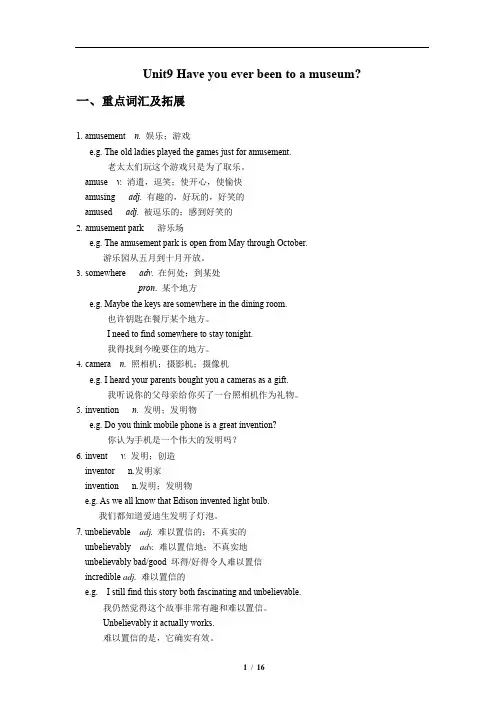
Unit9 Have you ever been to a museum?一、重点词汇及拓展1. amusement n. 娱乐;游戏e.g. The old ladies played the games just for amusement.老太太们玩这个游戏只是为了取乐。
amuse v. 消遣,逗笑;使开心,使愉快amusing adj. 有趣的,好玩的,好笑的amused adj. 被逗乐的;感到好笑的2.amusement park 游乐场e.g. The amusement park is open from May through October.游乐园从五月到十月开放。
3.somewhere adv. 在何处;到某处pron. 某个地方e.g. Maybe the keys are somewhere in the dining room.也许钥匙在餐厅某个地方。
I need to find somewhere to stay tonight.我得找到今晚要住的地方。
4.camera n.照相机;摄影机;摄像机e.g. I heard your parents bought you a cameras as a gift.我听说你的父母亲给你买了一台照相机作为礼物。
5.invention n.发明;发明物e.g. Do you think mobile phone is a great invention?你认为手机是一个伟大的发明吗?6.invent v.发明;创造inventor n.发明家invention n.发明;发明物e.g. As we all know that Edison invented light bulb.我们都知道爱迪生发明了灯泡。
7. unbelievable adj. 难以置信的;不真实的unbelievably adv. 难以置信地;不真实地unbelievably bad/good 坏得/好得令人难以置信incredible adj. 难以置信的e.g. I still find this story both fascinating and unbelievable.我仍然觉得这个故事非常有趣和难以置信。
(完整版)优秀课件unit-9-Have-you-ever-been-to-a-museum

zoo
A: Have you ever been to a zoo? B: Yes, I’ve been to a zoo.
space museum 太空馆
A: Have you ever been to a space museum? B: No, I’ve never been to a space museum.
6.He has been in London for half a month. 他来伦敦已有半个月了。
1.sb.have /has been to sp. 意为“某人曾经去过某地”,
但现在已不在那里了, ”已经回来,侧重指经历,后 可接次数, 如once, twice, three times等, 表示 “去过某地几次”, 也可和 just, never, ever等连用。
4.我了解了一些电影的知识。 I _le_a_r_n_e_d_a_b_o_u_t_ some information about movie. 5.他的粗心导致了这次失败。 His carelessness _l_e_d_ _t_o_ this failure.
选用have, has填空: 1.I __h__a_v_e_ told him the news. 2.She ___h_a_s___ come back from school. 3.You ___h_a_v_e__ won the game.
2.sb.have/has gone to sp.
意为“某人已经去某地了”, 可能在去某地的路上, 也可能到达了某地。总之, 说话时该人不在现场, 一般不用第一人称、第二人称代词作句子的主语。
3.sb.have/has been in sp.
表示“在某地呆了多少时间”, 常与时间段状语连用
Unit 9Unit_9_Have_you_ever_been_to_a_museum B 3a-3c

6. — What about these two sweaters,madam? — _____of them fits me. Could you show me another one? A. Both B. Either C. None D. Neither 7. — Where is Zhang Ming? — Oh, don’t you know he _____ to Beijing to see his parents and he’ll be back tomorrow? A. has gone B. has been C. had gone
One great thing about … is …
One
great thing about Hainan is that you can try many kinds of sweet fruit in Hainan. If you go to Hainan, I’m sure you will enjoy yourself.
(3a)
Pre-writing
Make a list of facts about your hometown or a place you have been to. Think about these topics.
Size and location:_________________ Population:_______________________ Weather:________________________
Things:___________________________
Hainan Island
Have you ever tried/seen/been…?
Unit-9--Have-you-ever-been-to-a-museum--知识整理
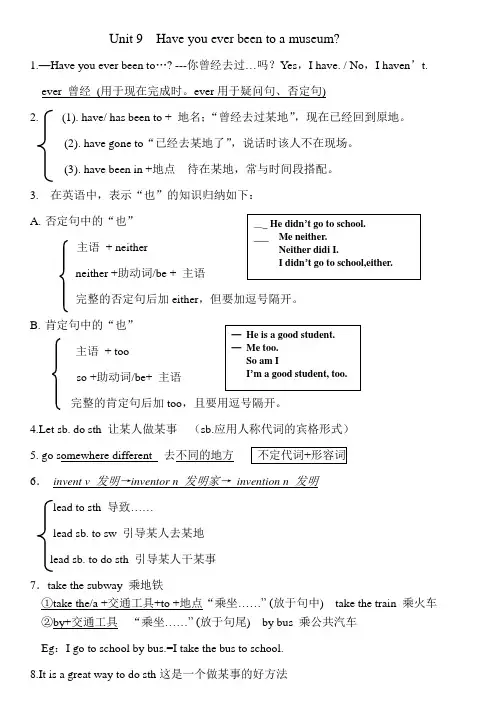
Unit 9 Have you ever been to a museum?1.—Have you ever been to …? ---你曾经去过…吗?Yes ,I have. / No ,I haven ’t. ever 曾经 (用于现在完成时。
ever 用于疑问句、否定句)2.(1). have/ has been to + 地名;“曾经去过某地”,现在已经回到原地。
(2). have gone to “已经去某地了”,说话时该人不在现场。
(3). have been in +地点 待在某地,常与时间段搭配。
3. 在英语中,表示“也”的知识归纳如下:A. 否定句中的“也”主语 + neitherneither +助动词/be + 主语 完整的否定句后加either ,但要加逗号隔开。
B. 肯定句中的“也”主语 + tooso +助动词/be+ 主语 完整的肯定句后加too ,且要用逗号隔开。
4.Let sb. do sth 让某人做某事 (sb.应用人称代词的宾格形式)5. go somewhere different 去不同的地方 6. invent v 发明→inventor n 发明家→ invention n 发明lead to sth 导致……lead sb. to sw 引导某人去某地lead sb. to do sth 引导某人干某事7.take the subway 乘地铁①take the/a +交通工具+to +地点“乘坐……” (放于句中) take the train 乘火车 ②by+交通工具 “乘坐……” (放于句尾) by bus 乘公共汽车Eg :I go to school by bus.=I take the bus to school.8.It is a great way to do sth 这是一个做某事的好方法9. go skating 去滑冰10. .on the weekend 在周末11. science museum 科学博物馆history museum 历史博物馆12.all the old movie cameras所有的古老的电影摄影机13.camp in the mountains 在大山里露营14.learn about 了解获知,得知learn about sth.了解有关……的情况15. an amusement park 一个游乐场16. the International Museum国际博物馆17. put up a tent 搭帐篷put up 搭起;举起;张贴rmation信息;资料(不可n.)some informationa piece of information 与about 连用,表示:“关于……的信息”19.It’s unbelievable that+从句“令人难以置信的……”20. make progress 取得进步make progress in 在......方面取得进步21.in such a rapid way 以如此迅猛的方式22.play chess 下棋23.be able to+V原能够做某事24.in the future在将来25.wonder 想要知道= want to know①后接从句eg:I wonder who she is.②也可接“疑问词+不定式”eg: I wonder what to do next.26.I couldn’t believe my eyes我无法相信我的眼睛。
八下新目标英语Unit_9_Have_you_ever_been_to_a_museum?
【2012贵州贵阳】 “Have you ever been to Tokyo?” “Yes, I ______ there twice. It’s a modern city.”
A. have gone B. have been C. had gone
【答案】B
考查动词时态及动词的用法。问句用的是现 在完成时,答句也应该用现在完成时,前后 时态一致。have gone意为“去过,但还没回 来”;have been意为“去了,回来了”。根 据句意:你去过东京吗?我去过两次,它是 一个现代城市。故选B.
the final.
— I think so. He ________ for it for months.
A. is preparing
B. was preparing
C. had been preparing
D. has been preparing
2. By the time he realizes he _________ into a
D. Did; show
8. — Hi, Tracy, you look pale.
— I am tired. I ______ the living room all day.
A. painted
B. had painted
C. have been painting D. have painted
C. considered D. is going to consider
7. —______ you ______ him around the museum
yet?
—Yes. We had a great time there.
A. Have ; shown
河南省八年级英语下册Unit9Haveyoueverbeentoamuseum必考知识点归纳
河南省八年级英语下册Unit9Haveyoueverbeentoamuseum必考知识点归纳单选题1、The Great Wall is a place of interest. All of us ________ there before.A.has beenB.have beenC.has goneD.have gone答案:B句意:长城是个名胜古迹。
我们所有人以前都去过那里。
考查现在完成时。
have/has been表示去过某地又回来了;have/has gone表示去了某地还没回来。
主语“All of us”是复数,用have而不用has,排除AC;根据before可知应该是去过,现在已经回来,用have been而不用have gone,排除D。
故选B。
2、—I have ________ been to Tibet. How about you?—Me. neither.A.neverB.everC.already答案:A句意:--我从没去过西藏。
你呢? --我也没有去过。
根据neither “我也没有去过”提示,可知问句是没去过,never从不,ever曾经,already已经;故选A。
3、David has never been to Australia, ________?A.hasn’t heB.doesn’t heC.has heD.does he答案:C句意:大卫从未去过澳大利亚,是吗?考查反义疑问句。
题干中“has never been”是现在完成时,助动词为has,never表否定。
反义疑问句中如果陈述句为否定,反义疑问句的后半部分应用肯定疑问句。
故选C。
4、— ________ you ever ________ to Hong Kong?— Yes, only once.A.Did; goB.Have; goneC.Do; goD.Have; been答案:D句意:——你去过香港吗?——是的,只有一次。
unit9haveyoueverbeentoamuseum教案
unit 9 have you ever been to amuseum教案1教案题目:Unit 9 "Have You Ever Been to a Museum?"教学目标:1. 学生能够掌握并正确使用本单元的词汇和短语。
2. 学生能够运用所学的句型和表达方式描述博物馆和展览。
3. 学生能够通过听说读写的综合训练,提高自己的综合语言运用能力。
教学重点:1. 本单元的词汇和短语的掌握和运用。
2. 对博物馆和展览进行描述的能力。
3. 学生的听说读写的综合训练。
教学难点:1. 对博物馆和展览进行描述的能力。
2. 学生的听说读写的综合训练。
教学准备:幻灯片、多媒体设备、展示物品、课件、练习册。
教学过程:Step 1: Warm-up (5 minutes)1. Greet the students and ask them if they have ever been to a museum.2. Show some pictures of famous museums and ask the students to name them。
3. Discuss with the students about their experiences in museums and what they have seen。
Step 2: Presentation (15 minutes)1. Present the new vocabulary and phrases related to museums and exhibitions using flashcards or pictures。
2. Introduce the target language structures through a short dialogue between a student and a teacher, using phrases like "Have you ever been to a museum?" and "What did you see there?"3. Model the pronunciation and intonation of the target language structures and have the students repeat after you。
初中英语人教版八年级下册《Unit 9 Have you ever been to a museum
Step5:language points
Learn about the language points.
(1)invent的意义和用法
(2)unbelievable的用法;
1. Key vocabulary: invent, unbelievable, progress, rapid, unusual, toilet, encourage, social, peaceful,tea art, performance, perfect,tea set, itself, collect
b,能正确使用以下常用表达:have been to have gone to
c.学会使用以下句型:
1)They have information about different computers and who invented them.
2) I have been to the American Computer Museum.
人教新目标英语八年级下册Unit9第2课时教学设计
课题
Section A 3a-3c
单元
Unit 9 Have you ever been to a museum?
学科
英语
年级
八年级下
学习
目标
一、知识与能力
词汇:
invent,unbelievable.progress.rapid,unusual., toilet.encourage,social,peaceful, tea art, performance,perfect,