
牛津译林版高中英语必修1Unit 2Growing painsWelcome to the unit文字素材9牛津译林必修1
你会和你的孩子交朋友吗
“爸妈问话不耐烦,只愿独居小房间”。
据广东某中学的一份调查表明,在接受抽样问卷的232名高一至高三学生中,有近7成高中学生与家庭成员间的“亲情淡化”。
他们从不主动与家人谈心,或只是偶尔才跟家人谈心。
而约8成的家长,感觉与孩子存在“距离”与“隔膜”,有时甚至无从沟通。
现代家长都渴望与孩子交朋友,但事实却非人愿。
为何你和孩子成不了朋友?和孩子交朋友你有何好办法?
用心灵去接近
十四五岁到十八九岁年龄段的孩子有了点独立精神,对父母不像小时候那么依赖了,有时对父母的言语表现出逆反心理。
这时,父母只要和孩子友好、平等相处,用心灵接近孩子,还是能和孩子交朋友的。
我觉得尊重孩子的独立个性很重要。
我妹妹出国前留下的衣服,女儿可以穿时,我让她穿,她坚决不穿。
开始我很生气,以前我给啥她穿啥,现在为啥犟头倔脑?后来她讲出了自己的想法,她说这是上班穿的衣服,不适合学生穿。
我第一次觉得女儿有了自己的想法。
仔细想想,孩子很听话不见得好,有独立判断能力倒是好事情。
只有引导其个性发展,她才能超越我们。
后来我让她自己安排学习计划,很多事情上放“权”给她,这倒培养了她的责任心。
要和孩子交朋友,要多站在他们的立场想问题,体会他们年龄状况下的一种心态,才能做到以心交流。
比如像早恋等问题,我都能站在他们的角度分析给他们听。
只有在同一立场上规劝才有效。
有一次,老师反映,我女儿上课吃泡泡糖。
我先问明原因,才知老师怀疑她抄同桌作业,暗地里调查她,她很委屈,就在该老师的课上故意捣蛋。
我感受到她的苦恼,站在她的角度劝她,你只有一趟趟用好成绩给老师看,老师才明白真相。
而用吃泡泡糖这种无聊办法,更让老师觉得你不聪明。
后来她果然这科成绩出类拔萃。
学点“I服了YOU”
小孩子为什么不乐意跟自己父母说心里话?那是觉得上一辈的人一定不会理解自己的处境和心情。
而一些父母,老是固执地抓着过去的“育儿”道理不放,没考虑过“代沟”出现的原因和解决方法。
时代的确不同了,但一些人生经验却是很有意义的,只是孩子们往往看不到这一点。
既然他们有这样的误解,那就解除它们,多学点时尚的东西,增加点年轻人的活力,时不时也能冒出点“分特”、“东东”、“I服了YOU”这样的青春专用语,一定能让孩子眼前一亮———老爸老妈好像并不像他们所想象的那样死板不开化。
从言行上有认同感之后,孩子们自然在思想上也会渐渐产生认同感,也就愿意把自己不开心、不理解、不明白的事情跟父母说出来,而对父母的建议也就不会再有那么大的抵触情绪了。
多给孩子发言权
与孩子保持良好的心灵沟通并非是一件难事,最主要的是看你是否把孩子当作自己的朋友。
在我国,受传统理念的束缚,很多家长在主观意识上存在着严重的父权、母权的思想。
动不动就说“大人的事,小孩别管”,“大人讲话,小孩别插嘴”之类的言语,这怎么能不产生代沟,这怎么能让孩子与你畅所欲言?
把孩子当作自己的朋友必须赋予其发言权,不管他的论点是否正确,想法是否单纯。
从小培养沟通习惯
最近,我看到报纸上讲,很多父母和子女不知道彼此的优点,我提议和儿子互相找优点。
儿子写我的优点为:有爱心、善于理解别人、学习刻苦、兴趣广泛。
我写儿子的优点为有正义感等。
叫他爸爸作评议,结论是,我们母子能相互了解
我儿子才读小学五年级,我们间像朋友一样,无话不谈。
这种沟通习惯在他懂事起就开始了。
虽然他上幼儿园时我工作很忙,但我没送他全托,再苦再累也自己带他。
那时我除了照顾好他,更多时候是他的玩伴。
他上小学后,我选择身边发生的有意义、他感兴趣的事讲给他听,他也会把学校里发生的事告诉我。
后来报上的新闻也能成为我们的谈资。
晚饭桌上,我们的所见所闻、喜怒哀乐表露无遗。
如果哪一天不交流,像缺了点什么。
因为彼此无隔阂,对他的教育都能落到“点子”上。
如果小的时候缺乏和孩子沟通,等孩子长大了,特别到了高中的敏感年龄,想要做他的朋友,我觉得那是不大可能的。
求全责备成不了朋友
朋友最近给我摊苦经,儿子和他们越来越疏远。
朋友的儿子正在读高中,父母总觉得儿子内向,见他逢人不打招呼,就当着客人的面训他没礼貌。
男孩读书不太冒尖,父母就灌输他多学本领,免得今后吃不开。
孩子住校,难得回家,回来就想看看电视,父母则千方百计抓紧时间教育他。
孩子很厌烦,说:“一直叫我回家,回来了就训我,我还不如住校。
我英文好、人缘好,你们怎么看不见?”
我对朋友说,过多的训斥会伤孩子自尊,孩子即使知道自己有缺点,也会因逆反心理而故意不改。
陪着女儿跑天下
我和女儿的关系一直都挺好,因我时常想女儿所想、急女儿所急,积极为她铺好路、创造条件。
这样女儿再处于逆反期也愿意跟我交心。
女儿作文特别好,老师常夸她有灵气有想法,但是想往更深层次挖“潜”,还需要更多的生活。
女儿还是学生,想法会单纯些,要她立刻在生活、社会的角度上得到提高比较困难,但是时常利用一些节假日的时间,陪着她出去走走,增加一些各地游历的经历,我还是能够做到的。
远到海南、哈尔滨,近到崇明东平国家森林公园,都曾经留下过我们的足迹。
虽然花了不少时间,可这样的机会很难得,很多在学习压力下谈不出来的话题,一到了陌生的外地我就能很容易地从女儿嘴巴里“套”出,而且人在外面也的确放得开,其实这些年跟女儿平等地面对面坐着聊天的情况几乎全都发生在旅途中。
像我这样的爸爸,女儿怎
么可能不跟我交朋友呢?
现在,女儿已经大学三年级了,学的是旅游景点设计,我们又有了更多的理由和机会出去“考察”、“沟通”了。
不要叫小名
在父母的眼里孩子永远是长不大的,小名或许会伴随孩子的一生。
笔者认为,要和孩子沟通,首先必须去掉叫小名这个习惯。
叫小名能让孩子感觉到家的温暖,但子女长大后就不能再用了。
尤其是对十六七岁的少年更不可取,一叫小名在孩子的心里马上会产生一种自己还没有长大或是父母亲还把他看成小孩的感觉,久而久之便会蒙上代沟阴影。
小名是孩子儿童时代的称呼,这种称呼不能伴随着他的成长。
作为家长,当孩子长大以后对孩子的称呼就要与社会相同,这样才能使他感觉到自己已经成年,从而与父母之间也就多了一份平等与沟通。
从爱好切入
记得女儿读高三时,整天埋头于书本中。
我看在眼里,记在心里,暗暗思忖,女儿是校羽毛球队员,应该从这方面切入去“诱导”她,减轻高考的压力。
第二天早晨,我轻轻摇醒女儿,邀她去打羽毛球。
她揉了揉惺忪的眼睛,一骨碌起床跟我去文化公园打球。
我们边打边谈,其乐融融。
回家的路上,我问女儿高考复习得如何。
她坦言,考大专不成问题,但要考上本科还需加把劲。
此时,我除了勉励她,还要她注重劳逸结合,并告诫她:“不会休息的人就不会工作。
”女儿理解了我话中的含义,以后每天主动邀我去打羽毛球。
结果,女儿的身心更健康了,复习效果提高了,父女间更亲近了。
(牛津译林)高一必修1英语课件:Unit2GrowingpainsWelcometotheunit
D. Rarely(很少)
E. Never
3. Do you and your parents often talk to
each other or have fun together?
A. Very often B. Often C. Sometimes
D. Rarely(很少)
E. NeLeabharlann er2. When you have a problem and want to talk to someone, who do you choose to talk to?
3. Can you describe an experience with your parents that was not pleasant?
3. What does the film mainly talk about? Look at the following pictures.
Maggie Seaver
Jason Seaver
Main characters
Carol Seaver
Mike Seaver
Ben Seaver
Chrissy Seaver
Answer the questions in 2 minutes:
1. Do you think your parents understand
you?
A. Yes B. No C. Don’t know
2. Do you often quarrel with you parents?
A. Very often B. Often C. Sometimes
6. Do they ask for your opinions over some family issues? A. Yes, very often B. Sometimes C. Never
译林牛津版高中英语 Module1 Unit2 Growing pains---welcome to the unit 教学课件 (共21张PPT)

Task 3
What’s the problem in this video?
Can you give some advice to the little bunny?
Dear Mom and Dad,
First of all, don’t shout at your mom. Both of your mother and you must calm down. Besides, you should respect and understand your mother. What’s more, you are supposed to express the inner feelings to her. Moreover, You had better tell your mom you want to have a rest after 5 days’ study. Last but not least, communicate with your mom sincerely and let her know you have grown up to make your own decisions.
Welcome to the un来自t!Task 1Discussion Time
0 0 0 12 054321 0987654321
Hours
Minutes
Seconds
Parents are angry with some behavior of the child and the child always feels wronged and misunderstood.
译林牛津英语必修1Unit2GrowingpainsWelcometotheunit学案
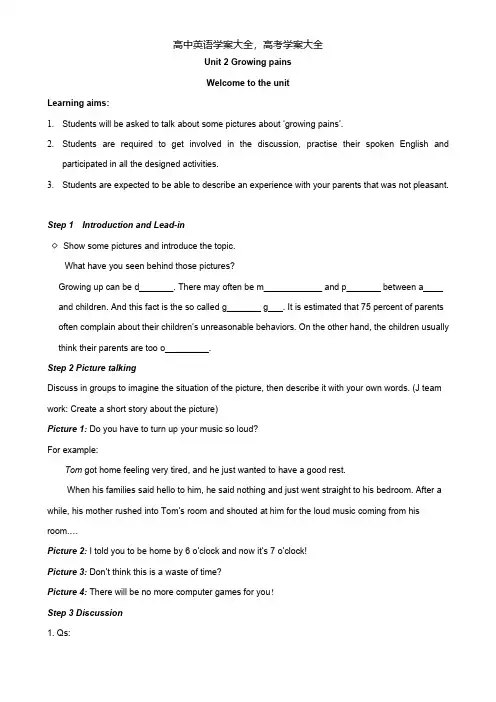
Unit 2 Growing painsWelcome to the unitLearning aims:1.Students will be asked to talk about some pictures about ‘growing pains’.2.Students are required to get involved in the discussion, practise their spoken English andparticipated in all the designed activities.3.Students are expected to be able to describe an experience with your parents that was not pleasant.Step 1 Introduction and Lead-in◇Show some pictures and introduce the topic.What have you seen behind those pictures?Growing up can be d_______. There may often be m____________ and p_______ between a____ and children. And this fact is the so called g_______ g___. It is estimated that 75 percent of parents often complain about their children’s unreasonable behaviors. On the other hand, the children usually think their parents are too o_________.Step 2 Picture talkingDiscuss in groups to imagine the situation of the picture, then describe it with your own words. (J team work: Create a short story about the picture)Picture 1: Do you have to turn up your music so loud?For example:Tom got home feeling very tired, and he just wanted to have a good rest.When his families said hello to him, he said nothing and just went straight to his bedroom. After a while, his mother rushed into Tom’s room and shouted at him for the loud music coming from his room.…Picture 2: I told you to be home by 6 o’clock and now it’s 7 o’clock!Picture 3: Don’t think this is a waste of time?Picture 4: There will be no more computer games for you!Step 3 Discussion1. Qs:1) Do you sometimes quarrel with your parents?2) Why do arguments usually happen?3) What are usually the problems with parents?Problems with parents:__________________________________________________________________________________________________________________________________2. Discussion1) Do your parents sometimes interfere in your life and make decisions for you? And How?2) Will you talk to your parents when you have a problem?3) Do your parents trust you?4) You think sometimes your parents cannot understand you and then the generation gap comes up.Do you think you understand your parents?Good parents in my eyes:______________________________________________________________________________________________________________________________5) Do you think you show respect to your parents?Do you know what your mother’ favorite food is?Do you remember your father’s and mother’s birthdays?Do you remember to call back home to express your gratitude and best wishes for them on their birthdays?When your parents don’t understand you, please try to think from the angles(角度)of your parents. ------because: Your parents truly love you!You will become parents one day!Step 4: Group Discussion1. Do you think there is a generation gap between you and your parents? If so, what is the best way to solve the problem?Positive attitude:________________________________________________________If parents and children want to get on well with each other, they should…___________________________________________________________2. Do your parents try to force you to do things you don’t like?Sample answer to it:__________________________________________________________________________________ __________________________________________________________________________________ __________________________________________________________________________________ __________________________________________________________________________________ _________3. When you have a problem and want to talk to someone, who do you choose to talk to?Sample answer to it:__________________________________________________________________________________ __________________________________________________________________________________ __________________________________________________________________________________ __________________________________________________________________________________ _________4. Describe an experience with your parents that was not pleasant.Sample answer to it:__________________________________________________________________________________ __________________________________________________________________________________ __________________________________________________________________________________ __________________________________________________________________________________ _________Step 5 Language focus:1. Do you have to turn up your music so loud?◆turn up 开大,调高;出现,露面;卷起,竖起,翻耕Turn up the radio a little. I can hardly hear the program.I was expecting him at ten, but he didn’t turn up.Turn up your trouser legs so that they won’t get wet.■拓展turn off 关掉,关闭;拐弯,使转变方向turn into变成;进入turn on 打开,发动turn out 生产;结果是;关掉;出动;驱逐turn in 交上;归还;拐入;告发;[口]上床睡觉turn back 往回走;阻挡;翻回到turn up 出现,露面;开大,调高;发现;卷起;使仰卧turn out to be 结果是;证明是turn down 关小,调低;拒绝;向下转折1) Remember ___ the lights when you leave the room .A. to turn onB. to turn upC. to turn intoD. to turn off2) It’s too noisy. Could you please______ the radio?A. turn downB. turn toC. turn onD. turn up2. Don’t you think it’s a waster of time?◆waste①[U]/n表示浪费,废物,废料。
高一英语牛津译林版必修一同步课件Unit 2 Growing pains Welcome-Reading(共83张PPT)
T
F
6. The mother thinks the father should be stricter with Daniel.
day
1. Mom and Dad were back from their holiday a week earlier.
2. Eric was happy when seeing his mother. frightene
Reading :
Expressions preview
be supposed to do with garbage can in charge go out not…anymore be hard on 应该……,应当…… 处理,处置 <美>垃圾桶 负责,掌管 (灯)熄灭 不再,再也不 对……苛刻, 对……要求严格 既然;由于
Listen to the tape and finish Part A.
1. Who are the main characters in the play?
Eric, Daniel, Mom and Dad.
2. Whyቤተ መጻሕፍቲ ባይዱwas Dad very angry with Daniel?
The room was a mess. / There was garbage all over the place.
now that
Do you know what Growing Pains means? Emotional difficulties that occur during adolescence. 青少年时期出现的感情紊乱。 (所作所为不为长者所理解)
Do you think there is a generation gap between you and your parents? Does the generation gap really exist? How do you overcome the gap?
牛津译林版高中英语必修一Unit 2《Growing pains》(Language welcome )教案
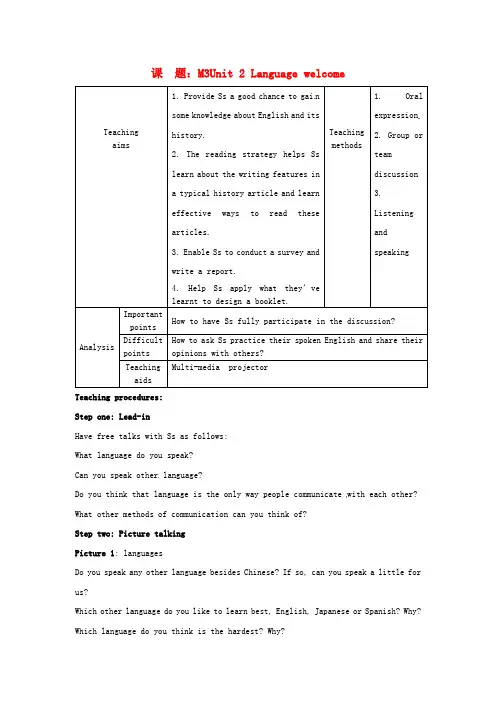
课题:M3Unit 2 Language welcome1. Provide Ss a good chance to gai nexpressionTeaching procedures:Step one: Lead-inHave free talks with Ss as follows:What language do you speak?Can you speak other language?Do you think that language is the only way people communicate with each other? What other methods of communication can you think of?Step two: Picture talkingPicture 1: languagesDo you speak any other language besides Chinese? If so, can you speak a little for us?Which other language do you like to learn best, English, Japanese or Spanish? Why? Which language do you think is the hardest? Why?Picture 2: EmotionsWhat does this emotion stand for? ( A beaming喜气洋洋的, 愉快的 smile.)What is an emotion?An intense mental state that arises subjectively rather than through conscious effort and is often accompanied by physiological changes; a strong feeling:冲the emotions of joy, sorrow, reverence, hate, and love.快乐、痛苦、尊敬、痛恨和爱的冲动When do people usually use this kind of language?(When they are talking on the Internet or sending short messages.)Could you give some more example s?(For example: ☹( :-( )stands for sadness; ☺( :))stands for happiness; :-o stands for surprise.)Picture 3: Sign languageWhat does this sign mean in Britain? (good luck)Do you thin k the same sign means the same to people all over the world? If you think so, can you show some examples and explain them?( Take the American gesture OK for example. Making a circle with one’s thumb and index finger(食指, first finger/forefinger) means ‘ money’ in Japan but ‘zero’ in France.Who needs to use sign language in their daily lives?(Deaf peo ple or those who are unable to hear)Have you ever used sign language? Is it helpful for you to communicate with others? Picture 4: BrailleA system of writing and printing for visually impaired or sightless people, in which varied arrangements of raised dots representing letters and numerals are identified by touchWhat is Braille? (A special language for blind people)Who invented Braille? ( A Frenchman called Louis Braille)Have you heard about him?What did he do for blind people? (He invented a special language for them, so itwas named after him.)Picture 5: Animal languageWhy do bees fly in circles? ( To inform their partners about food and danger)Do you believe animals can ‘talk’?If possible, ask Ss to share their stories about animal language they know.Step three: DiscussionEncourage Ss to discuss the three questions listed under the five pictures on page 21Then ask them to exchange their opinions and report their responses back to the whole class.Answers for discussion:1. WE have many other ways to exchange ideas or information.For example: Chinese people relayed fire signals at night and smoke signals in the day from one Great Wall watchtower to another in ancient times.To use pigeons to send messages in the past timeNowadays, to use the language of flowers to communicate meaningRose = love; tulip= formal announcement of love郁金香Forget-me-not = k eeping me in your memory. 勿忘草2. Chinese is the most spoken language, while English is the most widely used around the world.It’s useful to learn English if you want to travel, do business, or study abroad. What’s more, in 2008, the 29th Olympic Games will be held in Beijing. We are learning English to welcome people from other parts of the world.3. To learn English well, different people have different methods or ways.Step four: Listening1. Have Ss listen to tape and finish listening exercises on page 1042. Check answers together.Homework: 1. Go over what are learned in class.2. Do some reading on page 102教学反思:。
牛津译林版高中英语必修1Unit 2Growing painsWelcome to the unit文字素材4牛津译林必修1
Home aloneHow many kids are home alone?According to the U.S. census, one third of all school age children in the United States are, for some part of the week, latch key kids; that is, they go home to an empty house or apartment. The total number may be between five and seven million children between five and 13 years old. Marian Wright Edelman, the director of the Children's Defense Fund, thinks it's close to 16 million children. The Census Bureau found that 15% were home alone before school, 76% after school and 9% at night. Presumably, the 9% have parents who work night shifts.One-half of all children in the country age 12 to 14 are home alone an average of seven hours a week. The very poor in America are less likely to leave their children alone at home, or allow them to go home alone, than families who earn twice the poverty income. This is probably because the very poor live in less safe neighborhoods, and have fewer friends or family who can step in, in case of emergency. In spite of the hours spent on the job, working mothers spend an average of five-and-a-half hours a day with their children.Home alone - What are the effects?When latch key children are functioning well, we don't hear about them. But we do hear about the one-third of all complaints to child welfare agencies which involve latch key children. We know about the 51% who are doing poorly in school. Most teachers believe that being alone at home is the number one cause of school failure. The afternoon hours are the peak time for juvenile crime. In the last 11 years, juvenile crime has increased 48%. The Carnegie Council on Adolescent Development found that 8th graders who are alone 11 hours a week are twice as likely to abuse drugs as adolescents who are busy after school. The Council also found that teens who have sexual intercourse do it in the afternoon in the home of boys whose parents work. Unsupervised children are more likely to become depressed, smoke cigarettes and marijuana and drink alcohol. They are also more likely to be the victims of crimes. When home alone latch key children generally watch television, eat snacks, play with pets and fight with siblings.Making the decision: When is a child ready to be home alone?Personality characteristics, skills, and maturity are useful criteria for determining a child’s readiness to be home alone. Personality doesn’t generally change much with age, although children can learn to modify some of their reactions as they learn what is expected of them. There are some children who find it very difficult to be alone, some who need time and gradual exposure to become accustomed to being by themselves, and some who adapt easily.The personality characteristics of the child who is readyThe child who•is not fearful, feels at ease in the world and self confident•is calm, not excitable, when something unexpected happens•is outgoing, talks about his or her feelings and thoughts readily with parents and others•admits wrongdoing, even when expecting disapproval•has courage enough to resist pressure from friends and othersThe rate at which children acquire the skills and the milestones of maturity varies, but the following provide some general guidance.The skills of the child who is readyThe child who•can clearly state and spell his or her full name, address and telephone number•can clearly state his or her parents’ names, employers, addresses of work places, work telephone numbers•knows how to dial 911 and give information•knows not to enter home if it looks suspicious•knows what to do if he or she is followed•knows not to play alone outside the home•knows how to answer the telephone when alone at home•knows what to do in case of fire•plays “What if?” games with his or her parents•helps to make the family’s rules and knows the em ergency back-up planThe milestones of maturity of the child who is readyThe child who•Assumes responsibility with pride and pleasure•Follows directions well•Is a good problem solver•Takes initiative without being asked or reminded•Has learned “life skills” which include good conflict resolution, age appropriate competence, identity linked to real abilities and a strong sense of worth•Has good peer relationships and is involved in community service and programsMaking it work: Helping children acquire these characteristicsThe personality characteristics are innate and observable early in life. Personality traits, however, are not immutable. Parents can help children if they•offer encouragement from infancy on, correct gently, say that everyone has to learn to do certain things and this takes time, and then praise all efforts made, children will strive to please •are sensitive to and accepting of their child’s temperament and reactions. This builds the child’s confidence, sense of security, openness to new experiences, pleasure in accomplishing tasks and courage to act•discuss things with their children uncritically, accept their children’s point of view before offering alternatives, reassure children who have done wrong that they only made a mistake and are too smart to repeat it. This results in children who readily tell their parents everything that happens in their livesOn the other hand, parents who•constantly tell their children what to do and how to do it, and then remind them constantly don’t raise self starters•ask their children to do things that are too complex or require greater maturity than the child has, force their children to fail, and lose self confidence•label their children as “bad,” or “lazy” or “messy,” or any undesirable tra it, confirm that behavior. If children are labeled in this way s by their parents, whom they consider all-knowing, they assume they must indeed be “bad” or “lazy” or messy,” and the behaviors are confirmed. Criticism and hurt feelings only lead to bad beha vior; if children are made to feel bad they can’t act good!The environment and readiness: the neighborhood and the familyIn addition to the child’s readiness to be alone before or after school, certain characteristics of the home environment need to be considered. Some of these are easy to control; some are not: •the safety of the neighborhood, -- can a child safely walk home, or get from the bus to the door without risk?•are there adults nearby and accessible, always available, and familiar to the child or children? Is there a backup plan?•how much time is involved? How long must the child be alone? Is there a planned structure of activities planned for the time alone?•are there siblings? Pets? What are the ages of the siblings?•is the home equipped with dead bolts, fire extinguishers, smoke detectors, first aid kit, evacuation plan, emergency phone numbers by the telephone, flashlights and batteries, money in a hiding place known to the child, lights on timers so that the child doesn’t get home to a d ark home in winter, all liquor locked, a cell phone for the child with the important numbers in it, a hidden key or a key left with a reliable neighbor who is sure to be home?•is there time to set aside every single day for a quiet talk, a review of the day, an opportunity to tell the child how wonderfully responsible he or she is, and a willingness to help the child with whatever is current in her or his life, homework, a problem with another child at school, a wish for a special snack?Other optionsIn many communities there are activities for school age children whose parents work and cannot be at home in the afternoon. The importance of looking into these is stressed by our country’s most respected child development professionals. According to James Com er of Yale University, “the period between 10 and 15 years is a time when young people re-examine their attitudes and values. They are being pressured by peers. They need to be protected by responsible adults who will help them examine and counter some of these attitudes.”The activities available vary as does the cost. Some are more popular with children than others, and some are more rewarding, but all are preferable to sitting at home in front of the television. Things to consider:•many schools have afte r school programs, and some communities have “Y’s” which offer after school programs•some after school programs are based on sports and playing on teams•some children benefit from being tutored in certain subjects. Some schools have after-school homework programs•some children are interested in, or can become interested in lessons in a variety of skills, piano, other musical instruments, ballet, art, theatre/drama, choir, glee club•some gyms and health clubs have programs for young children•public libraries have film programs and clubs organized around interests or activities•many communities have Boys and Girls Clubs•children can volunteer to do community service•children can also tutor younger children, an activity which usually benefits the tutors even more than the tutees, and is excellent for bothThese programs can vary in cost or are free, depending upon the particular activity and the age of the child. All of them offer the opportunity to acquire skills and knowledge that are useful throughout life. Children who are not learning anything for hours every week are at a distinct disadvantage compared to children who are engaged in enriching activities.In the words of T. Berry Brazelton, of Harvard University: “During these all important bridge years between childhood and adulthood, kids really do need something constructive to do, and they also still need to have their activities supervised. Most of all, they need to know that their parents care about them, are involved in their lives, and have their best interests at heart.”。
高中英语必修1unit2growingpainswelcometotheunit(译林牛津版)省公开
Further discussion:
What do you do when you have family arguments with your parents?
Do you think there is a generation gap between you and your parents? If so, what is the best way to solve the problem?
GrowingBiblioteka painsLSLWelcome to the unit
Brainstorming
Present family albums and ask:
Do you love your parents? Do you think you have showed respect to your parents? Have you ever quarreled with your parents? What is your quarrel about?
Group work:
Work in groups of four and describe one picture with their own words.
Sharing information
Discuss the questions under the pictures in groups of four. Have several groups to report their opinions in class.
Who? Teenagers/Kids.
When? When kids are between the ages
of 3 and 5 or 8 and 12.
牛津译林版高中英语必修1Unit 2Growing painsWelcome to the unit文字素材7牛津译林必修1
成长的烦恼·你老拿自己孩子跟别人比吗孩子声音我就是我,不要拿我和别人比“……我经常都不知道自己在想什么,也不知道自己想要什么?好像从记事起,我的爸爸妈妈就不断地拿别人和我比,尤其在每次开完家长会后。
他们既然认为别人好,就让别人做他们的儿子好了。
再说我不是不想学好,我也在努力,可为什么我的成绩他们都看不到呢?我甚至都不想再呆在家里了,我讨厌任何人。
为什么他们都不能了解我呢……”这是朝阳区某中学高二学生小飞和记者聊天时说起的一段话。
记者从北京市青少年心理咨询中心了解到,目前,北京市青少年心理健康问题正呈增多的趋势,其中以高中生居多,占总数的70%,其症状主要表现为焦虑、抑郁、神经哀弱和强迫症等。
据分析认为,引发目前青少年心理健康问题增多的主要原因是,学习压力大、社会不良影响大而心理排解少。
家长苦恼别人行,你为什么就不行?小飞的妈妈一说起儿子的学习就特别激动,“我们做父母的为了什么?舍不得吃舍不得穿的,可他就不给我们争气。
你看,我那老姐们儿的孩子,比他还小一岁,学习从来就没让家长操过心!我横看竖看,我们孩子不比别人差到哪啊?别人行,他为什么不行?”记者在采访中了解到,除了在学习上对孩子要求严格外,生活上小飞的爸妈真可算是无微不至了,再困难从来没有委屈过儿子。
然而,小飞和爸妈却怎么也亲近不起来。
小飞的爸爸对记者说:“有时候我也知道孩子压力太大,可是没办法,我们不能照顾他一辈子你说对不?他现在不努力学习找个好工作,等我们一蹬腿他怎么办?”说着话,他还从抽屉里拿出一张写满字的纸来,“这是我收拾房间从地上捡到的,你看看,都写了些啥?”记者看到,这页纸好像是日记本脱线掉下来的,上面写到“……有一件事,我想不明白,我到底是进步了还是退步了。
这次月考,我在班上排名12,年级排名68,进入了前100名,总的来说,我应该是进步了。
因为上学期末,我在班上的名次是25,年级名次是152。
在努力中,我这学期进步了,可是,今天下午,我回到家,并没有得到爸爸的鼓励,而是被他狠狠地训了一顿:‘我像你这么大的时候,想上学还没条件呢!可我们为你创造这么好的条件,你就这么着来回报我们?你看看×××,人家为什么能考第一?你真让我们失望……’又来了,又来了……还有,我现在是独来独往了,我和许多人都绝交了(包括××),也没和学习差的人来往了。
高中英语 _ 牛津译林版 _ 高一上册 _ 模块1 Unit 2 Growing painswelcome to the unitPPT
``````````````````````````
从``小````,````我``````````````````````` `````````````````````````` ``````````````````````````
``````1
高中英语 _ 牛津译林版 _ 高一上册 _ 模块1 Unit 2 Growing painswelcome to the unit(共34张PPT)
Pains of Love
高中英语 _ 牛津译林版 _ 高一上册 _ 模块1 Unit 2 Growing painswelcome to the unit(共34张PPT)
Hurt felling
高中英语 _ 牛津译林版 _ 高一上册 _ 模块1 Unit 2 Growing painswelcome to the unit(共34张PPT) 高中英语 _ 牛津译林版 _ 高一上册 _ 模块1 Unit 2 Growing painswelcome to the unit(共34张PPT)
What is the boy probably doing?
He is probably playing computer games. Did the boy do well in his exams?
No.
How does his mother feel about the score? What feelings may the boy have?
She feels upset and angry. The boy may feel sorry and upset.
高中英语 _ 牛津译林版 _ 高一上册 _ 模块1 Unit 2 Growing painswelcome to the unit(共34张PPT)
译林牛津版必修1高中英语Unit2 Growing pains
wordUnit 2Growing pains〔1〕射阳县盘湾中学颜闯2007-12-3[教学内容与教学要求]一、教学内容:牛津高中英语模块一Unit 2(page 21~ page 31)二、教学要求:1.掌握和Growing pains有关的常用单词、词组与句型。
2.学习阅读技巧:reading a play。
3.语法:定语从句〔三〕[知识重点与学习难点]I. To revise some important words & expressions in Unit 1 (page 21~ page 31)A.单词:〔黑体词汇用法看《三维设计》〕explain surprisereasonscene suppose hard touch trustrude bendpunish charge1. Much to my s_________, he failed the exam.2.Customers are not s_________ to smoke here.3 .Visitors are not allowed to t_________ the exhibits.4. E_________ what this word means to us.5. Don't t_________ him — he's not telling the truth.6. Don't be too h_________ on the boy; he didn't mean to do it.7. He was punished because he was r_______ to his teacher.8. The teacher p_________ the noisy children by making them stay after school.9. The doctor in c_________ was a tall man10. She b_________(over) to pick up a book from the floor.11. The r_________ for his ing late was that he got up late12. This play is divided into three acts, and each act has three s_________.B.短语:WELE TO THE UNIT:1.______出现;露面;将(收音机等)声音调高turn down 将声音调低拒绝(关注turn 的其他短语)2.It’s_______________浪费…去做某事waste time/money (in) doing sth.浪费时间或金钱做某事3.__________________ 强迫某人做某事by force 靠武力强行READING:4._______________. 期望〔某人〕做某事5._________________ 迫不及待做某事6._________________ 采纳某人的建议7.sb. ________________ 某人应该做某事;某人被要求,期望或认为做某事8._______ /___________ 对待处理应付9.______________________某事由某人负责10._____________________ 某任负责某事11._____________〔灯,火,蜡烛等〕熄灭12._____________使某事被做〔让人〕做某事表示主语的遭遇13._________________ 值得/应当/活该做某事14.____________ 对某人苛刻=be strict with sb15.________________________ 想要做某事16._____________________ 将A看作B /把B 当作A来看待WORD POWER:17._______…=be different in…. 在…方面不同18.______________=A be different from B A 和B不同19.___________…胜任/适合…..20.___________. 适合/胜任做某事21.____________ 保持健康22.____________将A换成B________________将A 变成B23._________________. 同某人换某物24.__________…. 要/找…..II. Sentences to be recited:1.Eric runs in after it, followed by a big dog,walking very slowly.(P22)Eric sits on his bed looking at Daniel, who has his arms crossed and looks angry.(P23)followed by a big dog / walking very slowly / looking at Daniel在句中作伴随状语。