
Unit_13_We're_trying_to_save_the_earth_Section_A_4a--4c(Grammar_Focus)
5. --Do you know Mr.White well? worked -- Yes. He has __________(work) for the WWF for two years. 6. I have __________ lived (live) here since 1990. 7. -- Do you often clean your classroom? -- Yes. Our classroomis __________(clean) every cleaned day. 9.-- What's this? --It's a CD. This CD is _________(use) for learning used English. will be built 10. Anew highway in my hometown ___________ (build) next month.
4) used to 表示什么意思?后接什么? 否定句和一般疑问句的形式是什么? used to 和 be used to 的区别是什么?
used to 结构
used to意为“过去常常做某事”,指的是过去 的习惯性动作,目的在于与现在形成对照。 used to是个情态动词,其中的to是不定式符号, 后面跟动词原形。 在美式英语中: 它的疑问式是:Did +主语+use to do sth. 否定式是:主语+didn't use.
情态动词还可以表示推测: 肯定推测, 不定推测, 否定推测
4b Fill in the blanks with the appropriate
modal verbs from the box. can could would have to should must may/might People _____ _____ be may think that big things should done. However, many forget that saving the earth begins with small things. For could save electricity by example, you _____ turning off the lights when you leave a room. You _____ would also use paper or reusable bags instead of plastic bags.
(2)基本结构: am/ is/are + 现在分词 (3)标志词:now, right now, Look, Listen at present, this week, these days
(4)现在分词的构成: ①一般情况下在动词词尾加-ing。如:go--going。 ②以不发音的字母e结尾的动词,去掉e加-ing。 如: have--having。 ③以一个辅音字母结尾的重读闭音节,双写最后 一个字 母,再加-ing。如:stop--stopping。
every year.
5. He _________ has lived (live) here for 20 years.
II.用括号里所给动词的正确形式填空 is dancing 1. The girl ___________(dance) in the classroom. is having 2. It's 5 o'clock now. Mike _________ (have)dinner. Have you ever ____ been (be) to the US? 3. --_____ -- Yes, twice. 4. -- May I speak to John? has gone -- Sorry, he __________(go) to New York. he will be back in two days. 5. --Did you go to Jack's birthday? was not invited -- No,I ______________(not invite).
use to 练习
A 她过去常常周末和朋友闲逛。 used to hang out She _______________ with friends on weekends. B 他习惯于每晚睡得很晚。 is used to sleeping late/ staying up He ____________________________ at night. C. Ken used to be afraid of dogs.(改为一般疑问 句) Did Ken use to be afraid of dogs ______________________________?
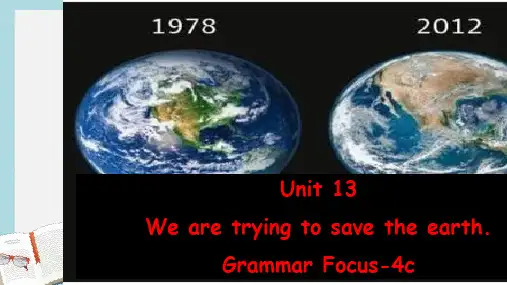
Unit 13
We are trying to save the earth.
Grammar Focus We are trying to save the earth. The river used to be so clean. Present progressive used to
The air is badly polluted. No scientific studies have shown that sharks fins are good for health.
2) 语态: 被动语态:与主动语态区别? 构成是什么? 一般现在时、一般过去时、一般将来时和 情态动词的被动语态的结构分别是什么?
被动语态 初中阶段我们学习了8种被动结构,归纳如下: (1)一般现在时的被动式:am / is / are + 过去分词 (2)现在完成时的被动式: have / has + been + 过去分词 (3)现在进行时的被动式: am/ is/ are + being + 过去分词 (4)一般过去时的被动式:was / were + 过去分词 (5)过去进行时的被动式: was / were + being + 过去分词 (6)过去完成时的被动式:had + been + 过去分词 (7)一般将来时的被动式: will / be going to be+ 过去分词 (8)含有情态动词的被动式: 情态动词+be +动词的过去分词。
the biggest clean-up project this city
____ever ________(have). had had
Joe: How many people ______ took (take) part? think (think) more than 1,000 people Ken: I _____ _____(come) to help out. came Joe: That’s fantastic! I guess everyone in this city is trying _____ (try) to improve the environment.
4a Fill in the blanks with the correct forms of the verbs in brackets.
Joe: _____ Have you ever _____ taken (take) part in an
environmental project?
Ken: Yes, I have. I ______ helped (help) with a CleanUp Day last year. It was________(consider) considered
3) 情态动词:有无人称和数的变化? 后接动词的什么形式? 情态动词有哪些?各表示什么意思?
情态动词 情态动词表示说话人对某一动作或状态的态度, 如认为“可能”、“应当”、“必要”等。 can/could能够; may/might可能、可以; would愿意、将要; shall将(第一人称); should应该; must必须 need需要; have to 不得不;
情态动词练习
1.-- ____ you pass me a pen? I'd like to write down the phone number. -- Sure. Here it is. A.Can B.Need C.Might D.Must 2. -- May I go to the cinema, Mum? -- Certainly, but you ___ be back by 11 o'clock. A.can B.may C.must D. need 3. you ___ worry about me. It's nothing serious. A.can't B.mustn't C. needn't D. won't
现在完成时:什么时候用? 结构是什么? 标志性词汇有哪些? 过去分词的构成规则?
现在完成时 (1)含义: ①表示过去发生的动作,对现在造成的影响。 ②表示过去发生的动作或存在的状态一直延 续到现在,还可能继续下去。 (2)基本结构:have / has + 过去分词 (3)标志词:already, yet, ever, never, once, twice, recently, so far, for+时间段, since+时间点/从句, in the past + 时间名词, in the last +时间名词。
4. -- Excause me. Is this the right way to the Summer Palace? -- Sorry, I'm not sure. but it ____ be. A.might B.mustn't C.can't D.must 5. The man in the office ____ be Mr.Black, because he went home just now. A.musn't B.may not C.can't D.needn't
2014人教版新目标英语九年级Unit_13_We're_trying_to_save_the_earth_Section_A_3a-3b
The earth is badly polluted. Please think of the ways that we can do.
• • • • •
• • • •
• •
close down the factories; help to clean up the river; take the bus or subway; ride a bike; bring a bag to go shopping, throw rubbish in the cans; turn off the lights when you leave a room; use paper or resusable bags; recycle books and paper; turn off the shower when you wash your hair; don't use napkins; rethink, reuse, recycle ... ...
Every species has its own reason to ['spi:ʃi:z] survive. Now that we human n.物种;种类;类型 appeared on the earth, we should [ˈhɑrməni] live in harmony with everything lives on it. Sometimes protecting n. 协调;融洽 一致;和谐 the wild animals is just a simple thing if everyone takes a small step.
Words Reviearmful to at the top of chain the food chain ecosystem industry law scientific
新人教版九年级英语下册Unit 13 We’re trying to save the earth!要点详解
Unit 13 We’re trying to save the earth!要点详解1. We’re trying to save the earth!我们正尽力拯救地球!(1) 本句时态为现在进行时,表示现阶段正在做的事情。
现在进行时所表示的动作并不一定在说话人的说话时刻进行,而是在包括说话时刻在内的一段时间当中进行。
例如:George is translating a book now. 乔治现在在翻译一本书。
(说这句话时,乔治不一定正在翻译;但在包括“说话时刻”在内的一段时间当中,乔治是在从事翻译工作。
)(2) try to do 表示“设法或尽力去做某事”,实际上做与不做,视情况而定,而try doing表示“试着做”,即动作真的进行了或正在进行,成败则视结果而定。
例如:He tried to read, but he was too tired to read much.他想设法看书,但太疲倦了,没看多少。
He tried reading, but that could not make him forget his trouble.他试着看书,但这并没使他忘记烦恼。
2. I am like this animal because I am strong and intelligent.我像这种动物,因为我强壮而聪明。
(1) like在本句中做介词,意为“像”,例如:He looks like winning the race.他看来要在比赛中获胜。
She is like her mother.她像她的妈妈。
(2) like做介词时可用very,very much,rather,quite等副词修饰。
例如:You look very much like your father.你与你父亲很相像。
3. Some of the swamps have become polluted。
一些沼泽已被污染了。
九年级英语全册-Unit-13-We’re-trying-to-save-the-earth(第2课时)教案-(新版)人教新目标版
Unit 13 We’re trying to save the earth教材分析本单元带领学生了解了一些有关地球污染,动物濒危等问题。
并且教给大家如何保护濒危动物,如何通过回收利用等方式来保护地球。
本单元主要复习语法内容为情态动词和动词形式变化。
本课主要带领大家进行语法复习,巩固语法知识。
一、三维目标(一) 知识与技能1. To learn different forms of verb.2. To understand the use of Modal Verbs.(二) 过程和方法3. To know how to use different forms of verb in different situations.4. To know how to use Modal Verbs in different situations.(三) 情感态度和价值观5. After learning this part, every student will be able to describe theirawareness of the serious situation of pullution and solutions to environmental problems using what we have learned in this lesson.教学重点1. To change forms of verb according to specific situation.2. To use Modal Verbs properly.教学难点1. To change forms of verb according to specific situation.2. To use Modal Verbs properly.二、教学策略根据本课教学目标和重点内容,教师可采用读,小组讨论,口头及书面练习等活动来引导学生进行学习。
九年级英语全册_Unit_13_We’re_trying_to_save_the_earth(第1课时)课件_(新版)人教新目标版
Cathy
情境引入 Leading-in
1 a. Look at the following pictures. Here are some words related to different kinds of pollution. What pollutions are they ?
A: The river was dirty. Even the bottom of the river is full of rubbish. B: But it used to be so clean. A: Yes, but people are littering in the river. B: Everyone in the town should play a part in cleaning it up.
noise pollution
Air pollution
water pollution
1 c Role-play the following conversation and make your own ations about the kinds of pollution above.
1b.Listen and complete the sentences
What was the problem?
dirty The river was _______.Even the bottom of the river was full of rubbish ______.There were no more fish for fishermen to catch. ____ litter into People are throwing _____ the river. Factories are putting waste into the river . _____
人教版英语九年级全册Unit13We'retryingtosavetheearth!优秀教学案例

4.对小组合作进行评价,关注学生的参与度、贡献度和团队合作效果。
(四)反思与评价
1.引导学生进行自我反思,思考自己在学习过程中的优点和不足,培养自我评价和自我改进的能力。
2.组织学生进行同伴评价,鼓励他们互相提供反馈和建议,培养评价能力和批判性思维。
3.创设问题情境,让学生面临真实的环保问题,如水资源浪费、垃圾分类等,引导学生主动思考和寻找解决方案。
4.利用多媒体技术,如视频、音频、动画等,营造生动有趣的学习氛围,激发学生的学习兴趣和积极性。
(二)问题导向
1.设计有挑战性的问题,引导学生深入思考环保问题的本质和影响。
2.通过提问和讨论,引导学生自主探究和解决问题,培养他们的批判性思维和问题境的影响。
3.总结本节课的主要内容和知识点,确保学生对环保知识有一个全面而准确的理解。
(五)作业小结
1.布置相关的作业,如研究报告、行动计划等,让学生将所学知识运用到实际生活中去。
2.要求学生在作业中提出自己的观点和解决方案,培养他们的创新思维和批判性思维能力。
3.引导学生关注环保问题的多样性和复杂性,培养他们的分析和综合能力。
4.鼓励学生提出自己的问题,激发他们的好奇心和探索精神。
(三)小组合作
1.组织学生进行小组讨论和合作,鼓励他们分享自己的观点和想法,培养合作能力和团队精神。
2.设计小组活动,如共同完成一篇关于环保的文章、策划一次环保活动等,让学生实际行动起来,提高实践能力。
3.鼓励学生在作业中积极表达自己的想法,注重培养他们的写作能力和表达能力。
4.对学生的作业进行认真批改和评价,提供及时的反馈和建议,帮助学生巩固所学知识,提高他们的学习效果。
人教版九年级英语全一册Unit_13_We're_trying_to_save_the_earth_Section_A_4a--4c(Grammar_Focus) (1)ppt
15.i事n f实ac上t 16.b被e 捕ca杀ug和ht交an易d traded 17.t.h...e..n的u数mb量er(s) of 18.s某om些e品ki种nds of 19.i在n t过he去la的st2200到to303年0 years 20.e环nv境ir保on护me组nt织al protection groups 21.s比uc如h as 22.d立ev法elop laws 23.t.h...e..s的al销e o售f 24.s到o 目far前为止 25.H帮e助lp拯sa救ve鲨th鱼e s。harks!
Joe: __H_a_v_eyou ever ______ t(atakkene) part in an environment
project ?
参加
Байду номын сангаас
Eric: Yes, I have. I ______h(ehleplepd) with a
Clean-Up Day last year. It was
C. Ken usiesdutsoebdetaofrsaliedepofindgoglsa.t(改e/ 为sta一y般in疑g u问p句)
______________________________?
Did Ken use to be afraid of dogs
4a Fill in the blanks with the correct forms of the verbs in brackets.
festival in China.
• 5. We can save electricity(电)by turning off the lights when leave a room.
UNIT13Weretryingtosavetheearth原文与翻译
UNIT13We'retryingtosavetheearth原文与翻译《牛津初中英语》充分体现了《新课标》的诸多精神。
该教材具有两大特点。
下面是小偏整理的UNIT13We'retryingtosavetheearth 原文与翻译,感谢您的每一次阅读。
UNIT13We'retryingtosavetheearth原文与翻译SectionA1bListenandcompletethesentences.Tony:Hey,Mark,maybewecouldgoswimmingintheriverlaterthi safternoon.Mark:Idon’tthinkIwanttogo,Tony.Tony:Whynot?Mark:Iwastherelastweekendandtheriverwasreallydirty.Eventh ebottomoftheriverwasfullofrubbish,andtherewerenomorefishforf ishermentocatch.Tony:Noway!Itusedtobesoclean.Infact,ithasalwaysbeentheni cestriverinthistown.Mark:Notanymore.Ithinkpeoplearethrowinglitterintotheriver. Factoriesarealsoputtingwasteintotheriver.Tony:That’sterrible!Weshouldwritetothegovernment.Theys houldclosedownthefactories.Mark:Goodidea!ButIthinkeveryoneinthistownshouldhelptocl eanuptheriver,too.Everyoneshouldplayapart,notjustthegovernm entSectionA2aListentotheinterview.thekindsofpollutionthatJasonandSusan talkabout.Interviewer:T odaywe’retalkingtoJason andSusanaboutenvir onmentalproblems.JasonandSusan,canyoutellusaboutsomeofth eproblemsyou’veseen?Jason:Ithinkoneproblemisthattheairisbadlypolluted.Ihardlye verseeblueskiesanymore.Susan:Yes,andIusedtoseethestarsclearly.Interviewer:Whatdoyouthinkhascausedthisproblem?Susan:Well,therearemorecarsontheroadthesedays.Jason:Andfactoriesthatburncoalalsopollutetheairwithalotofb lacksmoke.Interviewer:Whatotherproblemsdoyousee?Susan:Iguessthere’stoomuchrubbishandwasteinthestreets.Jason:Yes!Everydaypeoplearethrowingawaythingslikewoode nchopsticks,plasticbowlsandplasticbags.Susan:They’realsolitteringinpublicplaces,forexample,durin gpicnicsinparks.Thisisturningbeautifulplacesintouglyones.Interviewer:You’reright.Theseareseriousproble msforourenv ironment.Next,let’stalkaboutthethingswecandotohelp.SectionA2bListenagainandcompletethesentences.Interviewer:T odaywe’retalkingtoJasonandSusanaboutenvir onmentalproblems.JasonandSusan,canyoutellusaboutsomeofth eproblemsyou’veseen?Jason:Ithinkoneproblemisthattheairisbadlypolluted.Ihardlye verseeblueskiesanymore.Susan:Yes,andIusedtoseethestarsclearly.Interviewer:Whatdoyouthinkhascausedthisproblem?Susan:Well,therearemorecarsontheroadthesedays.Jason:Andfactoriesthatburncoalalsopollutetheairwithalotofb lacksmoke.Interviewer:Whatotherproblemsdoyousee?Susan:Iguessthere’stoomuchrubbishandwasteinthestreets.Jason:Yes!Everydaypeoplearethrowingawaythingslikewoodenchopsticks,plasticbowlsandplasticbags.Susan:They’realsolitteringinpublicplaces,forexample,d urin gpicnicsinparks.Thisisturningbeautifulplacesintouglyones.Interviewer:You’reright.Theseareseriousproblemsforourenv ironment.Next,let’stalkaboutthethingswecandotohelp.SectionA2dRoleplaytheconversation.JasonandSusan,whatareyourideasforsolvingtheseproblems?Well,tocutdownairpollution,weshouldtakethebusorsubwayin steadofdriving.Yeah,orrideabike.Thereareotheradvantagesofbikeriding.It'sg oodforhealthitdoesn'tanythingGreatideas!Whataboutwastepollution?Mmm,Ithinksimplethingslikebringingabagtogoshoppingcan help.Istarteddoingthatayearago.Me,tooAlso,Inevertakewoodenchopsticksorplasticforkswhen Ibuytakeawayfood.Iusetheonesathome.Andremembertothrowrubbishinthebinsandkeeppublicplace scleanandbeautifulforeveryone.Sotogether,ouractionscanmakeadifferenceandleadtoabetter future!SectionA3aReadthepassageaboutsharksandcompletethefactsheetbelow.SavetheSharks!Manyhaveheardofsharkfinsoup.Thisfamousandexpensivedis hisespeciallypopularinsouthernChina.Butdoyourealizethaty ou’r ekillingawholesharkeachtimeyouenjoyabowlofsharkfinsoup?Whenpeoplecatchsharks,theycutofftheirfinsandthrowthesha rkbackintotheocean.Thisisnotonlycruel,butalsoharmfultotheenvir onment.Withoutafin,asharkcannolongerswimandslowlydies.Sharksar eatthetopofthefo odchainintheocean’secosystem.Iftheirnumber sdroptoolow,itwillbringdangertoalloceanlife.Manybelievethatsharkscanneverbeendangeredbecausethey arethestrongestintheirfoodchain.Butinfact,around70millionshark sarecaughtandtradedinthisindustryeveryyear.Thenumbersofsomekindsofsharkshavefallenbyover90percen tinthelast20to30years.Environmentalprotectiongroupsaroundthe world,suchasWildAidandtheWWF,areteachingthepublicabout“fi nning”.Theyhaveevenaskedgovernmentstodeveloplawstostopthesal eofsharkfins.Sofar,noscientificstudieshaveshownthatsharkfinsare goodforhealth,sowhyeatthem?Helpsavethesharks!SectionB1cListenandcheck(√)thethingsthatJuliaandJacktalkabout.Jack:Turnoffthelights,Julia.Itsaveselectricity.Julia:Oh,Iusuallydothat.Iwasjustinahurry.Jack:Isee.I’vejustreadabookwh ichgivesideasabouthowweca nsavetheenvironment.Forexample,youshouldturnofftheshowerw henyou’rewashingyourhair.Julia:Oh,Iwouldneverdothat.Ihaveveryshorthair.Itonlytakesaf ewminutestowash.Whatelsedoesitsay?Jack:Youshouldtakeyourownbagswhenyougoshopping.Julia:Oh,that’seasy.I’lldothatfromnowon.Whatelse?Jack:Peopleshouldstopridingincarsandstartridingbikes.Julia:Noway!Itwouldtakeme45minutestogettoschoolbybike!Jack:Butit’sgoodfortheenvironment!Besides,Ilikeridingmybi ke.Julia:Yes,andyoualsoliveclosetoschool!SectionB1dListenagain.Check(√)thethingsthatJuliaisdoingnow,thethings shewilldointhefutureandthethingsshewouldneverdo.Jack:Turnoffthelights,Julia.Itsaveselectricity.Julia:Oh,Iusuallydothat.Iwasjustinahurry.Jack:Isee.I’vejustreadabookwhichgiveside asabouthowweca nsavetheenvironment.Forexample,youshouldturnofftheshowerw henyou’rewashingyourhair.Julia:Oh,Iwouldneverdothat.Ihaveveryshorthair.Itonlytakesaf ewminutestowash.Whatelsedoesitsay?Jack:Youshouldtakeyourownbagswhenyougoshopping.Julia:Oh,that’seasy.I’lldothatfromnowon.Whatelse?Jack:Peopleshouldstopridingincarsandstartridingbikes.Julia:Noway!Itwouldtakeme45minutestogettoschoolbybike!Jack:Butit’sgoodfortheenvironment!Besides,Ilikeridingmybi ke.Julia:Yes,andyoualsoliveclosetoschool!SectionB2bReadthepassageandcompletethechartbelow.Rethink,Reuse,Recycle!Doyouoftenthrowawaythingsyoudon’tneedanymore?Have youeverthoughtabouthowthesethingscanactuallybeputtogoodu se?Nothingisawasteifyouhaveacreativemind.Youhaveprobablyn everheardofAmyHayes,butsheisamostunusualwoman.Shelivesin ahouseintheUKthatshebuiltherselfoutofrubbish.Thewindowsanddoorscomefromoldbuildingsaroundhertow nthatwerepulleddown.Thetopofthehouseisanoldboatturnedupsi dedown.Andthegateinfrontofherhouseismadeofrocksandoldglas sbottles.AmyrecentlywonaprizefromtheHelpSaveOurPlanetSociety.Thepresidentsaid,“Amyisaninspirationtousall.”Amyisn’ttheonlyonewhoisgoodatrecycling.JessicaWongfro mHongKongusesoldclothesthatpeop ledon’twearanymoretoma kebags.Shehasbeendoingthisforafewyearsnow.Sheopenedasmallshopwhereshesellsherbags,andshehasalso setupawebsitetosellthemonline.Sheespeciallylikestouseoldjeanst omakehandbags.Herbagsarecuteanduseful.“Iplantowriteabookaboutnewwaystouseoldclothes,”shesai d.“Ihopepeoplecanreadmybookandenjoyit!”WangTaosetupasmallbusinessinShanghaifouryearsago.Heisk nownforusingironandothermaterialsfromoldcarstomakebeautifu lartpieces.Somearelargepiecesthatlooklikeanimalsorhumans,and somearesmallerpiecesyoucanputathome.Themorepopularworks canevenbeseeninartshopsaroundthecity.WangTaohopestosetupa“metalart”themeparktoshowpeop letheimportanceofenvironmentalprotection.Notonlycantheartbri nghappinesstoothers,butitalsoshowsthatevencold,hardironcanb ebroughtbacktolifewithalittlecreativity.翻译:SectionA2d采访者:贾森和苏珊,对于解决这些问题,你们有什么想法?贾森:为了减少空气污染,我们应该乘坐公共汽车或者地铁,而不是开车。
人教版九年级英语下册《Unit13 We’re trying to save the earth》(
Ø被动语态 初中阶段我们学习了七种被动结构,归纳如下:
(1)一般现在时是被动语态:am / is / are + 过去分词 (2)现在完成时的被动式: have / has + been + 过去分词 (3)现在进行时的被动式: am/ is/ are + being + 过去分词 (4)一般过去时的被动式:was / were + 过去分词 (5)过去进行时的被动式: was / were + being + 过去分词 (6)过去完成时的被动式:had + been + 过去分词 (7)一般将来时的被动式: will / be going to be+ 过去分词 (8)含有情态动词的被动式: 情态动词+be +动词的过去分词。
-- Yes. day.
Our
classroom
__is__c_le_a_n__ed_(clean)
every
9.-- What's this?
--It's a CD. This CD _________(use) for learning
English.
is used
10. Anew highway in my hometown __w__i_ll_b__e_b_u_ilt
在英式英语中:
➢ 它的疑问式应当是:Used +主语+to sth. ➢ 否定式应当是used not to.
I. 用所给词的适当形式填空。 1. The old man used t_o__b_e_ (be) a teacher. 2. We should _c_le_a_n_ (clean) the room every day. 3. Look! Tom _i_s_s_le_e_p_i_n_g (sleep) in his room. 4. Lots of trees a_r_e_p__la_n_t_e_d_ (plant) on the hill every year. 5. He _h_a_s__li_v_e_d_ (live) here for 20 ycloeucltdricity by turning off the
人教版英语九年级全册Unit13We'retryingtosavetheearth单元优秀教学案例
3.问题导向教学,培养批判性思维
本案例采用问题导向的教学策略,引导学生围绕环保问题展开思考、讨论和分析。这种教学方式有助于培养学生的批判性思维,使他们学会独立思考问题,形成自己的观点。
-结合课本对话和文章,让学生在实际语境中学习语法。
3.通过听力练习,让学生熟悉与环保相关的新闻报道、故事和对话,提高他们的听力水平。
-播放听力材料,引导学生完成相关练习,并针对难点进行讲解。
(三)学生小组讨论
1.将学生分成小组,每组选择一个环保主题,如:气候变化、水资源保护等,进行资料收集和讨论。
-要求学生用英语记录关键信息,为后续的展示做准备。
1.设计反思性问题,如:“在本章节的学习中,你学到了哪些环保知识?”“你认为自己在环保方面有哪些改变?”等,引导学生进行自我反思。
2.组织学生进行同伴评价,让他们互相提出建议,共同进步。
3.教师对学生进行综合评价,关注学生在知识、技能、情感态度与价值观等方面的表现,鼓励他们持续进步。
四、教学内容与过程
人教版英语九年级全册Unit13We'retryingtosavetheearth单元优秀教学案例
一、案例背景
随着社会的快速发展,环境问题已经成为全球关注的焦点。在这样的背景下,人教版英语九年级全册Unit13"We're trying to save the earth"单元,以环境保护为主题,旨在培养学生对环境问题的关注和责任感。本案例将结合课本内容,通过多元化的教学活动,提高学生对环境保护的认识,激发他们积极参与环保行动的热情。在教学过程中,注重运用教育专业用词,以人性化的语言引导学生进行思考与讨论,使他们在掌握英语知识的同时,也能够关注到地球的可持续发展。
Unit13_We’re_trying_to_save_the_earth!重难点全解
I have turned into a woman with strong will.She turned over and fell to sleep.afford to do sth.:买得起……,足够支付……We can’t afford to pay such a high price.be harmful to:对……有害Staying up often is harmful to your health.拓展:1. harm:n. 害处2. do harm to:对……有害at the top of:在……顶端There was not enough oxygen at the top of the mountain.He shouted at the top of his voice in order to be heard.拓展:反义词at the bottom of:在……的底端take action:采取行动The police had to take action to deal with the riots.throw away:扔掉;错过(机会等)Many people throw away cigarette ends carelessly.Don’t throw away this opportunity.拓展: 1. throw at:扔向…… 2. throw about:到处扔put sth. to good use:好好利用某物If you focus your mind on the task, your talents can be put to good use.pull…down:拆毁They are going to pull down the old building and replace it with a new shopping mall.upside down:上下颠倒The lid, turned upside down, served as a coffee table.bring back:归还;使想起Your article brought back sad memories for me.拓展:bring 词组1. bring up:抚养长大2. bring in:引进3. bring forward:提出4. bring about:带来,造成一词多义:work n.工作;(音乐、艺术)作品;工厂 v. 工作He has much work to do.他有很多工作要做。