
TPO 28 听力题目
TPO 28 听力题目1. What is the conversation mainly about?A. Criticisms about Dewey's political philosophy.B. Methods of leading a discussion group.C. Recent changes made to a reference document.D. Problems with the organization of a paper.2. Why is the student late for his meeting?A. Seeing the doctor took longer than expected.B. No nearby parking spaces were available.C. His soccer practice lasted longer than usual.D. He had problems printing his paper.3. What revisions does the student need to make to his paper? Click on 3 answers.A. Describe the influences on Dewey in more detail.B. Expand the introductory biographical sketch.C. Remove unnecessary content throughout the paper.D. Use consistent reference throughout the paper.E. Add an explanation on Dewey's view of individuality4. Why does the professor mention the political science club?A. To encourage the student run for club president.B. To point out that John Dewey was a member of a similar club.C. To suggest an activity that might interest the student.D. To indicate where the student can get help with his paper.5. Why does the professor say this?A.To find out how many drafts the student wroteB. To encourage the student to review his own workC. To emphasize the need for the student to follow the guidelinesD. To propose a different solution to the problem6. What is the lecture mainly about?A. The importance of Locke's view to modern philosophical thought.B. How Descartes' view influence trends in western philosophy.C. How two philosophers viewed foundational knowledge claims.D. The difference between foundationalism and methodological doubt.7. Why does the professor mention a houseA. To explain an idea about the organization of human knowledge.B. To illustrate the unreliability of our perception of physical objects.C. To clarify the difference between two points of view about the basis of human knowledge.D. To remind the student of a point he made about Descartes in a previous lecture.8. What did Locke believe to be the most basic type of human knowledgeA. Knowledge of one's own existence.B. Knowledge acquired through the senses.C. Knowledge human are born with.D. Knowledge passed down from previous generations.9. According to the professor, what is Decartes purpose for using methodological doubt?A. To discover what can be considered foundational knowledge claims.B. To challenge the philosophical concept of foundationalism.C. To show that one's existence cannot be proven.D. To demonstrate that Locke's views were essentially correct.10. For Decartes, what was the significance of dreaming?A. He believed that his best ideas came to him in dreams.B. He regarded dreaming as the strongest proof that humans exist.C. Dreaming supports his contention that reality has many aspects.D. Dreaming illustrates why human experience of reality cannot always be trusted.11. According to Decartes, what kind of belief should serve as foundation for all other knowledge claims?A. A belief that is consistent with what one sees and hearsB. A belief that most other people shareC. A belief that one has held since childhoodD. A belief that cannot be false12. What is the main purpose of the lecture?A. To show that some birds have cognitive skills similar to those of primates.B. To explain how the brains of certain primates and birds evolved.C. To compare the different tests that measure the cognitive abilities of animals.D. To describe a study of the relationship between brain size and cognitive ability.13. When giving magpies the mirror mark test, why did researchers place the mark on the magpies' throats?A. Throat markings trigger aggressive behaviours in other magpies.B. Throat markings are extremely rare in magpies.C. Magpies cannot see their own throats without looking into a mirror.D. Magpies cannot easily remove a mark from their throats.14. According to the professor, some corvids are known to hide theirs food. What reasons does she provide for this behaviour? Click on 2 answersA.They are ensuring that they will have food to eat at a later point in time.B. They want to keep their food in a single location that they can easily defend.C. They have been conditioned to exhibit this type of behaviour.D. They may be projecting their behavioural tendencies onto other corvids.15. What is the professor's attitude toward the study on pigeons and mirror self-recognition?A. She is surprised that the studies have not been replicated.B. She believes the study's findings are not very meaningful.C. She expects that further studies will show similar results.D. She thinks that it confirms what is know about magpies and jays.16. What does the professor imply about animals that exhibit mirror self-recognition?A. The acquired this ability through recent evolutionary changes.B. They are not necessarily more intelligent than other animals.C. Their brains all have an identical structure that governs this ability.D. They may be able to understand another animal's perspective17. According to the professor, what conclusion can be drawn from what is now known about corvids' brains?A. The area in corvids' brains that governs cognitive functions governs other functions as well.B. Corvids' brains have evolved in the same way as other birds' brains, only more repidly.C. Corvids' and primates' brains have evolved differently but have some similar cognitive abilities.D. The cognitive abilities of different types of corvids vary greatly.18. Why does the man go to see the professor?A. To learn more about his student teaching assignment.B. To discuss the best time to complete his senior thesis.C. To discuss the possibility of changing the topic of his senior thesis.D. To find out whether the professor will be his advisor for his senior thesis.19. What is the man's concern about the second half of the academic year?A. He will not have time to do the necessary research for his senior thesis.B. He will not be allowed to write his senior thesis on his topic choice.C. His senior thesis advisor will not be on campus.D. His student teaching assignment will not be complete before the thesis is due.20. What does the man imply about professor Johnson?A. His sabbatical may last longer than expected.B. His research is highly respected throughout the world.C. He is the English department's specialist on Chaucer.D. He is probably familiar with the literature of Renaissance.21. Why does the man want to write his senior thesis on The Canterbury Tales? Click on 2 answersA. He studied during his favourite course in high school.B. He has already received approval for the paper from his professor.C. He thinks that the knowledge might help him in graduate school.D. He has great admiration for Chaucer.22. Why does the professor say this?A. She is uncertain whether the man will be able to finish his paper before the end of the summer.B. She thinks the man will need to do a lot of preparation to write on a new topic.C. She wants to encourage the man to choose a new advisor for his paper.D. She wants the man to select a new topic for his paper during the summer.23. What is the lecture mainly about?A. The difference in how humans and plants sense light.B. An explanation on of an experiment on color and wavelength.C. How plants sense and respond to different wavelength of light.D. The process by which photoreceptors distinguish wavelength of light.24. According to the professor, what is one way that plant reacts to changes in the number of hours of sun light?A. The plant absorbs different wavelength of light.B. The plant begins to flower to stop flowering.C. The number of photoreceptors in the plant increases.D. The plant's rate of photosynthesis increases.25. Why does the professor think that it is inappropriate for certain wavelength of light to be named "farred"?A. Far-red wavelengths appear to be identical to red wavelength to the human eye.B. Far-red wavelengths have the same effects on plants as red wavelengths do.C. Far-red wavelengths travels shorter distance than red wavelengths do.D. Far-red wavelengths are not perceived as red by the human eye.26. What point does professor make when she discusses red light and far-red light that reaches plants?A. All of far-red light that reaches plants is used for photosynthesis.B. Plants flower more rapidly in response to far-red light than to red light.C. Plants absorb more of the red light that reaches them than of the far-red light.D. Red light is absorbed more slowly than far-red light is.27. According to the professor, how does a plant typically react when it senses a high ratio of far-red light to red light?A. It slows down its growth.B. It begins photosynthesis.C. It produces more photoreceptors.D. It stars to release its seeds.28. In the Pampas experiment, what was the function of the LEDs?A. To stimulate photosynthesis.B. To simulate red light.C. To add to the intensity of the sunlight.D. To provide additional far-red light.29. What does the professor mainly discuss?A. Evidence of an ancient civilization in central Asia.B. Archaeological techniques used to uncover ancient settlements.C. The controversy concerning an archaeological find in central Asia.D. Methods used to preserve archaeological sites in arid areas.30. What point does the professor make about mound sites?A. They are easier to excavate than other types of archaeological sites.B. They often provide information about several generations of people.C. They often contain evidence of trade.D. Most have been found what are now desert areas.31. Why does the professor compare Gonur-depe to ancient Egypt?A. To point out Gonur-depe existed earlier than other ancient civilizations.B. To emphasize that findings at Gonur-depe are evidence of an advanced civilization.C. To demonstrate that findings at those locations have little in common.D. To suggest that the discovery of Gonur-depe will lead to more research in Egypt.32. What does the professor imply about the people in Gonur-depe?A. They avoided contact with people from other areasB. They inhabited in Gonur-depe before resettling in Egypt.C. They were skilled in jewelry making.D. They modeled their city after cities in China.33. Settlements existed at Gonur-depe site for only a few hundred of years. What does the professor say might explain this fact? Click on 2 answersA. Wars with neighbouring settlements.B. Destruction caused by an earthquake.C. Changes in the course of the Murgab River.D. Frequent flooding of the Mrugab River.34. What is the professor's opinion of the future of the Gonur-depe site?A. She believes it would be a mistake to alter its original form.B. She doubts the ruins will deteriorate further.C. She thinks other sites are more deserving of researchers' attention.D. She is not convinced it will be restored.。
2016年TPO28托福口语Task3原文及参考答案

2016年TPO28托福口语Task3原文及参考答案TPO28口语T ask3题目:Keep the Music Building Open LaterCurrently, the campus music building –which has practice rooms students can reserve for playing instruments –closes nightly at nine p.m. I think the university should keep the building open until midnight. Often, student musicians want to practice their instruments later at night, and right now there’s no good place for them to do that. Also, lots of students want to use the practice rooms, so it’s often difficult to reserve one. If the building were open more hours, though, it would be easier to accommodate the large number of students who want to reserve rooms.ConversationNow listen to two students discussing the letter.Woman: Jim, did you see this letter in the paper today?Man: Yeah, I did.Woman: That would be great for us music students. Because I mean, what happens is, students keep practicing in the dorm room because they don’t have anywhere else they can go.Man: Yeah, I've done that myself a bunch of times playing my violin.Woman: Me too, and I always feel kind of bad about it, because even if you try to keep the volume down, it’s still pretty noisy, and other students are nearby in their rooms trying to sleep or study.Man: That’s true.Woman: And we really could use more time slots, especially just before the big concerts: the winter concert and the spring concert, because everybody from all sections of the orchestra needs to practice then.Man: I know, I tried to make a reservation to practice before the winter concert, but I couldn't, because other people from the orchestra had already booked every single time slot.QuestionThe woman expresses her opinion of the proposal. Brieflysummarize the proposal, then state her opinion about the proposal, and explain the reasons she gives for holding that opinion.Key Points1. prefer practice at nightTPO28口语T ask3参考答案(范文模板):The woman endorses the letter’s proposal to leave the practice rooms open until midnight. According to the letter, student musicians often want to practice late at night and they don’t really have an effective place to do that right now, and the woman reckons it’s true, saying that the only other place right now is in the dorm rooms and it can get noisy when other students are trying to sleep or study. The letter also notes that if the hours were increased for the practice rooms, it would be easier for everyone to have a turn in the practice rooms for study and the woman adds that this would be especially effective when they have concerts coming up cos so many people need to use the practice rooms to prepare and there’s usually not enough time to accommodate everyone.。
TPO-28 Reading 3解析

正确答案:A解析:第1句话是说“一个XX的标志表明白尾鹿的存在”。
第3句有一个同义的句子,“the buck rub is an obvious visual signal to us由此可得出conspicuous是obvious的同义词,因此选noticeable,引人注意的。
common, 常见的;strange,奇怪的;particular,特指的,特别的。
Q2正确答案:A解析:根据small red maple tree定位到第一段最后一句,根据The smooth bark of small red maples makes this species ideal for buck rubs确定they have smooth bark 是buck rubs的理想条件。
Q3正确答案:D解析:在第三段中的forehead rubbing studies都是例证支持主题句的内容。
主题句是第1句和第2句,大意是forehead rubbing产生气味,这种气味对于鹿之间的交流很重要。
根据第3句中the importance olfactory communication (using ordors to commuicate) in the way of life of deer was documented by a study…也可以确定鹿的研究是为了证明气味对交流的重要性。
Q4正确答案:C解析:exhibit,展现,表现,显示,显出;近义词是display。
这句话的意思是成年雄鹿在发情期前和中期有forehead rubbing,选项中“有”的近义词只有exhibit。
第二段也提到了说雄性鹿是在发情期前会用角去摩擦树皮,“Rubs are created about one to two months before the breeding season (the rut)”,所以这里应该是“显示”的意思。
TPO28听力解析—徐小欣自制
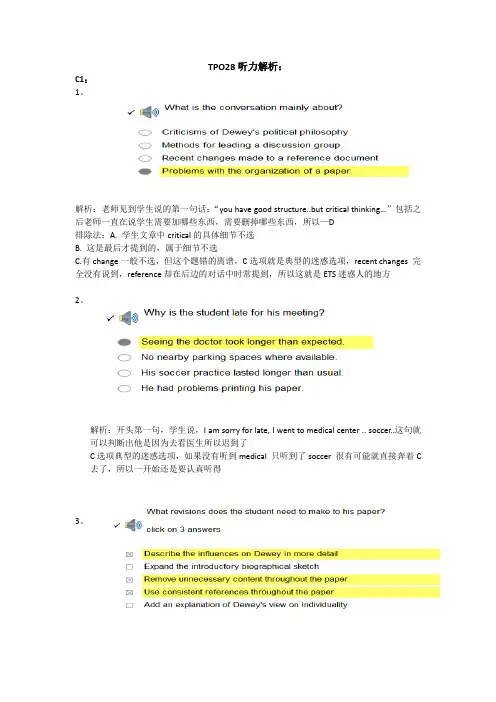
TPO28听力解析:C1:1、解析:老师见到学生说的第一句话:“you have good structure..but critical thinking…”包括之后老师一直在说学生需要加哪些东西,需要删掉哪些东西,所以—D排除法:A. 学生文章中critical的具体细节不选B. 这是最后才提到的,属于细节不选C.有change一般不选,但这个题错的离谱,C选项就是典型的迷惑选项,recent changes 完全没有说到,reference却在后边的对话中时常提到,所以这就是ETS迷惑人的地方2、解析:开头第一句,学生说,I am sorry for late, I went to medical center .. soccer..这句就可以判断出他是因为去看医生所以迟到了C选项典型的迷惑选项,如果没有听到medical 只听到了soccer 很有可能就直接奔着C 去了,所以一开始还是要认真听得3、解析:这个题呢其实就是把老师说的改正的地方都包括了,<做一二题时候还好奇怎么这篇文章信息量如此大第二题还出这么无聊的考点>,额,看到第三题瞬间明白了。
其实这个题算是比较好做,因为三个点基本上都重复了至少两遍。
A.老师说more influences critical thinking,然后学生反问了一句一样的,得到了老师确认B.最开始老师说过学生的great sketch,只是不连贯所以不需要改动,B错C.这个地方也是一问一答之后,老师在问过他有没有写完之后回看了一遍,学生说没有。
之后老师就说cut…make..clear,所以就说remove unnecessary contentD.这个点应该算是最好听清楚的,学生提问老师强调,老师说the most important thing is consistent reference 不管什么new system什么的E.Individual这个点也提到了,在最开始老师要求学生加上critical thinking处,但是老师说的是学生individual section 位置不对,应该在整篇文章的最后Ps:重复多的是考点,这个题明显体现,答案中的关键词都是听力中多次重复的内容4、解析:最后提到了political science club,让学生去lead meeting,学生很开心的答应了5、解析:重放录音题对我一向很坑爹!但是这个题因为我是笔记上有重点标注的所以印象深刻。
托福TPO28听力Conversation1文本+题目+答案解析
为了帮助大家高效备考托福,为大家带来托福TPO28听力Conversation1文本+题目+答案解析,希望对大家备考有所帮助。
托福TPO28听力Conversation1文本 Narrator: Listen to part of a conversation between a student and a professor.Student: I am so sorry I am late. Professor Mills. I just finished at the student medical center.I twisted my ankle playing soccer this morning. It took longer than I expected to see the doctor. Professor: That’s okay. Don’t worry about it. David. So let’s get started. Your paper on John Dewey’s political philosophy has a few issues I’d like to cover. You gave a great biographical sketch in the beginning. Okay. But then as you get into his political philosophy, I don’t think you’ve done enough to situate his philosophy within the time period. In other words, you haven’t connected Dewey’s philosophy to the thinking of other intellectuals of the time. Student: So I haven’t captured the most critical influences, the influences that were most significant to his political thinking? Professor: Exactly. OK. Now, look back up at the section here, where you wrote about Dewey’s view of individuality. This is all good content. But you haven’t presented the information in a systematic way. I really think this portion on individuality needs to come later, after your paragraphs on Dewey’s intellectual influences Student: After my revised paragraphs on what influenced them. Professor: Yes. Revised. Let me ask. Uh. When you were finished writing, did you go back and ask yourself if all of the material was relevant? Student: Well, no. Professor: I do think there are areas that can be cut. I guess what I am saying is that your paragraphs aren’t really presented in a logical order. The direction of your argument isn’t crystal clear. And there’s some unnecessary material getting in the way. Student: OK. Sounds like I have a lot to do. Professor: And one more thing, do you have a copy of the department’s document on the correct format for index, citations and references? Student: No. I mean, I look at it online when I was working on thisassignment.Professor: You really should print it out. You are going to need it for every paper you write in the political science department. It looks like you are getting it mix up with another referencing system. Student: Oh. Yeah. I used something different in high school. It’s so confusing switching to a new system. Professor: I know. But remember, everything needs to be consistent when it comes to referencing. It is a very important academic convention. Oh, also, I wanted to ask you… Will you be at the political science club meeting Saturday? Student: Definitely. The topic is John Dewey. Professor: Yes. Are you interested in leading part of the discussion? Tom Hayward is looking for someone to help out. I think you’ll have a lot to contribute. Student: That’ll be fun. I will give him a call. 托福TPO28听力Conversation1题目 1.What is the conversation mainly about? A. Criticisms of Dewey's political philosophy. B. Methods for leading a discussion group. C. Recent changes made to a reference document. D. Problems with the organization of a paper. 2.Why is the student late for his meeting? A. Seeing the doctor took longer than expected. B. No nearby parking spaces where available. C. His soccer practice last longer than usual. D. He had problems printing his paper. 3.What revisions does the student need to make to his paper? Click on 3 answers. A. Describe the influences on Dewey in more detail.。
TPO28-听力解析
TPO28听力解析Section 1Conversation 11.What is the conversation mainly about?A.Criticisms of Dewey’s political philosophyB.Methods for leading a discussion groupC.Recent changes made to a reference documentD.Problems with the organization of a paper答案:D解析:(0.26-0.48)Professor:So let’s get started. Your paper on John Dewey’s political philosophy has a few issues I like to cover. You get great biographical sketches in the beginning. OK, but then you get to his political philosophy. I don’t think you have done enoug h to situate his philosophy within the time period. In other words, you haven’t connected his philosophy to the thinking of other intellectuals of the time.教授说学生的paper并没有很好的将J.D的政治哲学与同时代其他知识分子的哲学所联系起来,也就是paper的organization有问题2.Why is the student late for his meeting?A.S eeing the doctor longer than expectedB.N o nearby parking spaces where availableC.H is soccer practice lasted longer than usualD.He had problems printing his paper答案:A解析:(0.12-0.22)Student: I’m so sorry I’m late Professor Mills. I have just be en to students’medical center. I pushed my ankle playing soccer this morning. It takes longer than I expected to see the doctor.同义转换3. What revision does the student need to make to his paper? (click on 3 answers)A.D escribe the influences on Dewey in more detailB.E xpand the introductory biographical sketchC.R emove unnecessary content throughout the papere consistent references throughout the paperE.Add an explanation of Dewey’s view on individuality答案:A,C,D解析:(0.48-0.56)Student: So I haven’t catch the most critical influences, the influences that were most significant to his political thinking?Professor: Exactly.(1.30-1.50)Professor: Yes, revised.Let me ask, when you finished writing, did you go back and ask yourself if all the material was relevant?Student: Well. no.Professor: I do think there are areas that can be cut. I guess what I am saying is your paragraphs are really presenting in logical order. The direction of your argument is not crystal-clear, and there is some unnecessary material getting in the way.(2.13-2.30)Professor: It looks like you get have mixed up with another reference system. Student: Oh, yeah. I used something different in high school. It’s so confusing when switching to a new system.I know. But remember, everything needs to be consistent when comes to referencing. It’s a very important academic convention.教授认为学生的paper没有描述对Dewey政治思考最重要的影响,应该添加,对应A选项。
TPO-28 Reading 1解析
Q1正确答案:D解析:该段的最后一句therefore引导的句子表示结果“大部分的水储都在接近表面的地方”,包含the pressure of the overlying rock的句子是表述原因, “在地球较深处,重叠的岩石让孔和裂缝闭合,无法存水”,也就是文章提到它的目的。
所以提到the pressure of the overlying rock的目的就是要解释为什么地下水都位于接近地表的地方,因此选D。
Q2正确答案: C解析:对应该段第2句话,“地下水的量比江河湖泊水的量多50多倍(more than 50 times)”,对应abundance,地下水更为丰富。
potability是可饮用性,原文并没有说江水不能喝,排除A。
在usefulness和cost两方面,原文也没有对二者进行比较,排除B和D。
Q3正确答案:C解析:extract,汲取,提取,取出;近义词是remove, 移开,拿掉,去掉;从词汇所在句的下一句话“含水土层可以看作是一笔水存款”,可以推断前面应该是说“可以取出水的地下水库叫作含水层”。
另外这个词的词缀ex-本身就有“出”的意思。
Q4正确答案:B解析:term作名词的意思是“术语”,较常用。
此处使用的是该词的动词形式,意思是“把…称为,把…叫做”,近义词是call。
term所在句的意思是“水或其它液体流过岩石之间孔隙的能力,被称为渗透性”。
Q5正确答案:B解析:根据关键词porosity(孔隙度)定位到该段第7句,porosity is important for water-storage capacity,B项的The amount of water that the aquifer can hold是对water-storage capacity的同义改写。
根据该段最后一句话,A项的内容由permeability of rock决定,排除A;fractures and joints have very high permeability,和porosity没有直接关系,排除C;含水层深度与porosity的关系在文中没有提及,排除D。
【精听】考古:tpo28L4
【精听】考古:tpo28L4Lecture4-ArchaeologyNarratorListen to part of a lecture in an archaeology class.ProfessorIt’s every archaeologist’s dream to find a lost civilization, to make some huge discovery, to find artifacts no one else has laid a hand on in millennia. You might think that this never happens any more, given all the research in archaeology that’s been done. But in the late twentieth century, archaeologists discovered the remains of a sophisticated people whose settlement might have been the hub of a civilization few people even thought existed.They found this site at the edge of a desert in Turkmenistan, in central Asia, where a series of mounds rise up from the plains. Now, you might remember because we’ve talked about this, archaeologists know that mounds such as these are the kinds of geological features that indicate the presence of ancient settlements. Jim?StudentUm…mounds can be different things, right? Some are burial places…ProfessorExactly. And some are the remains of cities. The inhabitants would build houses and temples you know, what have you. And over time, those buildings would fall down or be torn down and then be built over. Over time, generations of building and rebuilding in the same area would result in a large hill the size of a city. Careful excavation and documentation of layers in a mound can reveal a wealth of information about the everyday life of a people in a settlement over many periods of occupation.Now, this particular site is called Gonur-depe. What was found at Gonur-depe was amazing: the ruins of a huge palace complex, the foundations of shops and houses, the remains of thick walls and towers that fortified the city. There was even an elaborate canal system and a lot of very intricate jewelry. All these findings seem to indicate that they are the remains of an ancient civilization that was every bit as advanced as other more famous civilizations of the time. Like those in Egypt, or, or China. And the site dates back to 3,000 B.C.E.StudentDid they trade with those other civilizations? Because if they did, wouldn’t there’ve been some evidence of that? You know, an artifact found in the ruins of other civilizations?ProfessorThat’s a good question. I mentioned Jewelry, well, Jewelry have been found in Mesopotamia and at archaeological sites in modern-day Pakistan. But archaeologists didn’t know where it came from. Only after the site at Gonur-depe was excavated were archaeologists able to identify it as coming from Gonur-depe. Uh, Sheryl?StudentI wonder why nobody found this site before.ProfessorWell, before the discovery of this site, it was commonly believed that central Asia had always been occupied by mostly nomadic people. So there would be no record of major settlements. A couple of small finds have been made in the area, but really, no one had looked very hard.Now, one mystery regarding this site is that archaeological records show it was inhabited for only a few centuries.StudentWhat happened to the people who lived there?ProfessorWell, the site was close to the Murgab river, which they would have depended on for their water. And the Murgab river, which runs toward the west, is the kind of river that shifts its course over time. So one theory is that the river’s course shifted toward the South, and they simply followed it and built new towns to the South.Another theory is that they were involved in wars with neighboring settlements. But we might never know the truth.One thing we do know is that in the decades since Gonur-depe was discovered, the site has deteriorated significantly. I mean, it’s been disturbed for the first time in millennia. And being exposed to the Sun and wind has taken its toll on the ancient city.So now the question is, do we partially restore and rebuild the site before the entire thing disintegrates? It will take a lot of funding to restore it and I am not sure it’ll be made available, which would be a pity. Even a partly altered site can provide valuable information, which would be lost otherwise.。
托福TPO28听力Conversation2文本+题目+答案解析
托福TPO28听⼒Conversation2⽂本+题⽬+答案解析为了帮助⼤家⾼效备考托福,为⼤家带来托福TPO28听⼒Conversation2⽂本+题⽬+答案解析,希望对⼤家备考有所帮助。
托福TPO28听⼒Conversation2⽂本Narrator: Listen to part of a conversation between a student and a professor.Student: Hi. Sorry. I’m late. Professor Blane.Professor: No problem. Jim. So you’ve got some questions about your senior thesis requirement?Student: Yeah. I’ve got a couple of problems actually. So, the first thing is, you normally write it during the first half of the academic year. Right? In your final year of studies.Professor: Right.Student: But I have my student teaching scheduled for that time. I want to teach high school English after graduation. So I really need to give that my full attention. And I just worry that I won’t be able to if I am writing my senior thesis at the same time.I mean, it’s supposed to be 35 to 40 pages. That’s a serious commitment.Professor: You are right. But it really isn’t a problem.Student: Really?Professor: No. A lot of English majors get teacher certification, so we have students like you do their senior thesis after their student teaching. It works out well, because many students want to use a unit they taught as the basis of their paper. So you’ll just enroll in a thesis seminar for the second semester.Student: Well, that’s a big relief. But it brings us to my second problem. I’d really focus my studies on old and Middle English literature.I am even thinking about doing a graduate degree with a concentration in that after I taught for a while. So I was hoping to do my senior thesis on Chaucer, on The Canterbury Tales, because that would obviously be useful if I do go on. But …Professor: Ah. But Professor Johnson …Student: Exactly. Professor Johnson is going to be taking a sabbatical to do research in France during the second half of the year. So without him around, I am not sure how I could do a senior thesis on The Canterbury Tales. I mean, the focus of his teaching and research is unique around here.Professor: Yes. I understand. It would be difficult to do your paper without Professor Johnson around. Hmmm… would you allow me to try to sell you on an alternate plan?Student: Well, you can try. But Chaucer is sort of my hero, if you know what I mean.Professor: Well, I am teaching a course on the literature of the Renaissance in the first half of the year. It’ll meet late in the day, so it won’t interfere with your teaching. And I haven’t offered it in quite a while now, so I doubt you ever studied that period on the college level.Student: No. I haven’t.Professor: If you would be interested in taking the course, I’d be happy to give you supplemental readings, and I’d also be happy to be your advisor for your paper later on.Student: Well, I never looked at that area before, but I have always had an interest in it. So that does have a certain appeal. Professor: Well, if you do decide to go this route, I would make that decision soon and I would use this summer productively. After all, this is not going to be like taking an intro course.托福TPO28听⼒Conversation2题⽬1.Why does the man go to see the professor?A. To learn more about his student teaching assignment.B. To discuss the best time to finish his senior thesis.C. To discuss the possibility of changing the topic of his senior thesis.D. To find out whether the professor will be his advisor for his senior thesis.2.What is the man's concern about the second half of the academic year?A. He will not have time to do the necessary research for his senior thesis.B. He will not be allowed to write his senior thesis on his topic choice。
TPO28-R-3 题目
TPO 28-R-3Q1 The word ”conspicuous” in the passage is closest in meaning toA.noticeablemonC.strangeD.particularParagraph 1 is marked with an arrow>Q2 According to paragraph 1, why are small red maple trees ideal for buck rubs?A.They have smooth bark.B.They are found in the mid-eastern UnitedStates.C.They grow very slowlyD.They tend to grow in open spaces Paragraph 1 is marked with an arrow>Buck Rubs and Buck Scrapes>A conspicuous sign indicating the presence of white-tailed deer in a woodlot is a buck rub. A male deer makes a buck rub by stripping the bark (outer layer) of a small tree with its antlers. When completed, the buck rub is an obvious visual signal to us and presumably to other deer in the area. A rub is usually located at the shoulder height of a deer (one meter or less above the ground) on a smooth-barked, small-diameter (16-25 millimeters) tree. The smooth bark of small red maples makes this species ideal for buck rubs in the forests of the mid-eastern United States.Adult male deer usually produce rubs in late summer or early autumn when the outer velvet layer is being shed from their antlers. Rubs are created about one to two months before the breeding season (the rut). Hence for a long time biologists believed that male deer used buck rubs not only to clean and polish antlers but also to provide practice for the ensuing male-to-male combat during the rut. However, biologists also noted that deer sniff and lick an unfamiliar rub, which suggests that this visual mark on a small tree plays an important communication purpose in the social life of deer.Q3 The studies of forehead rubbing by deer described in paragraph 3 showed thatA.forehead rubbing encourages the growthof antlersB.mule deer and white-tailed deer behavedifferently during the rutC.the rut can occur at different times of theyearD.deer convey important informationthrough scentParagraph 3 is marked with an arrow>Q4 The word "exhibited" in the passage is closest in meaning toA.relied onB.increasedC.displayedD.preferredParagraph 3 is marked with an arrow> >Buck rubs also have a scent produced by glands in the foreheads of deer that is transferred to the tree when the rub is made. These odors make buck rubs an important means of olfactory communication between deer. The importance of olfactory communication (using odors to communicate) in the way of life of deer was documented by a study of a captive adult mule deer a few decades ago, which noted that males rubbed their foreheads on branches and twigs, especially as autumn approached.A decade later another study reported that adult male white-tailed buck exhibited forehead rubbing just before and during the rut. It was found that when a white-tailed buck makes a rub, it moves both antlers and forehead glands along the small tree in a vertical direction. This forehead rubbing behavior coincides with a high level of glandular activity in the modified scent glands found on the foreheads of male deer; the glandular activity causes the forehead pelage ( hairy covering) of adult males to be distinctly darker than in females or younger malesQ5 Why does author mention that “dogsrecognize each other via smell”?A.To point out the similarities between dogsand deerB.To argue that animals communicatethrough scent rather than through vision C.To support the claim that the scent of abuck rub serves to identify its maker to other deerD.To suggest that rubs can be detected byother speciesParagraph 4 is marked with an arrow>Q6 The word "crude" in the passage is closest in meaning toA.roughefulC.necessaryD.obviousQ7 What can be inferred from paragraph 4 about the trumpeting of bull elk?A.Trumpeting by higher-status bull elksignals their presence to other members of their species.B.Bull elk need to combine trumpeting witholfactory signals to covey information about their identity.C.Trumpeting alerts white-tailed deer to thepresence of bull elk in their vicinity.D.Trumpeting provides a better measure ofdeer presence in a given area than buck rubs do.Paragraph 4 is marked with an arrow>Q8 According to paragraph 4, the buck rubs occurring in a given area reveal all of the following information about deer EXCEPT >Forehead rubbing by male deer on buck rubs presumably sends a great deal of information to other members of the same species. First, the chemicals deposited on the rub provide information on the individual identity of an animal; no two mammals produce the same scent. For instance, as we all know, dogs recognize each other via smell. Second, because only male deer rub, the buck rub and its associated chemicals indicate the sex of the deer producing the rub. Third, older more dominant bucks produce more buck rubs and probably deposit more glandular secretions on a given rub. Thus, the presence of many well-marked rubs is indicative of older, higher-status males being in the general vicinity rather than simply being a crude measure of relative deer abundance in a given area. The information conveyed by the olfactory signals on a buck rub make it the social equivalent of some auditory signals in other deer species, such as trumpeting by bull elk.A.The individual identity of the deerB.The gender of the deerC.The likely social status of the deerD.The number of deer in the vicinity Paragraph 4 is marked with an arrow>Q9 The word "induce" in the passage isclosest in meaning to?A.increaseB.extendC.delayD.stimulateQ10 According to paragraph 5, which of the following is true about chemicals in buck rubs?A.They have to be at least two days old forfemales to be able to detect them.B.They are more effective in older buck rubsthan in fresher ones.C.They may affect fertility in female deer.D.They can be more easily detected byyoung males than adult females. Paragraph 5 is marked with an arrow> >Because both sexes of whitetails respond to buck rubs by smelling and licking them, rubs may serve a very important additional function. Fresher buck rubs (less than two days old), in particular, are visited more frequently by adult females than older rubs. In view of this behavior it has been suggested that chemicals present in fresh bucks may help physiologically induce and synchronize fertility in females that visit these rubs. This would be an obvious advantage to wide-ranging deer, especially to a socially dominant buck when courting several adult females during the autumn rut.Q11 The word "termed" in the passage is closest in meaning toA.associated withB.visible asC.known asD.provided byQ12 According to the passage, in what way do buck scrapes differ from buck rubs?A.Buck scrapes are made by both male andfemale deer.B.Buck scrapes are purely visual signals.C.Buck scrapes are made closer to thebreeding season than buck rubs.D.Buck scrapes can be smelled only by deer.Q13 Look at the four squares【■】that indicate where the following sentence could be added to the passage.This process can take a few hours to several days.Where would the sentence best fit? Click on a square【■】to insert the sentence in the passage.Q14 Directions: An introductory sentence for a brief summary of the passage is provided below. Complete the summary by selecting the >Another visual signal produced by white-tailed deer is termed a buck scrape. Scrapes consist of clearing (about 0.5 meter in diameter) and shallow depression made by pushing aside the leaves covering the ground; after making the scrape, the deer typically urinates in the depression. Thus, like a buck rub, a scrape is both a visual and an olfactory signal. Buck scrapes are generally created after leaf-fall in autumn, which is just before or during the rut. Scrapes are usually placed in open or conspicuous places, such as along as a deer trail. Most are made older males, although females and younger males (2.5 years old or less) occasionally make scrapes.THREE answer choices that express the most important ideas in the passage. Some answer choices do not belong in the summary because they express ideas that are not presented in the passage or are minor ideas in the passage. This question is worth 2 points.Buck rubs and buck scrapes are two markings made by white-tailed deer.A.The observation that deer sniff and lickbuck first led scientists to connect buck rubs with combat between adult males during the breeding season.B.As they rub the bark from trees, male deerleave behind chemicals produced by the glands in their foreheads, creating a scent that other deer can detect.C.Buck rubs and buck scrapes are visualsignals and smells that deer use to communicate a variety of information to other deer.D.The height of a buck rub, the type of treeused, and the direction in which the deer applies the rub can give different kinds of information to other deer.E.The number of buck and buck scrapes in agiven area changes as the density of the population of male deer in the area changes.F.Buck rubs are created close to the breedingseason of deer and may affect the timing of fertility in the female deer that visit the rubs.。
托福TPO28综合写作阅读原文+听力原文+满分范文
¡¡¡¡ÎªÁË°ïÖú´ó¼Ò¸ßЧ±¸¿¼Íи££¬Îª´ó¼Ò´øÀ´Íи£TPO28×ÛºÏд×÷ÔĶÁÔ-ÎÄ+ÌýÁ¦Ô-ÎÄ+Âú·Ö·¶ÎÄ£¬Ï£Íû¶Ô´ó¼Ò±¸¿¼ÓÐËù°ïÖú¡£¡¡¡¡Íи£TPO28×ÛºÏд×÷ÔĶÁÔ-ÎÄÎı¾£º¡¡¡¡Robert E. Peary was a well-known adventurer and arctic explorer who in 1909 set out to reach the North Pole. When he returned from the expedition, he claimed to have reached the pole on April 7, 1909. This report made him into an international celebrity. Though some historians have expressed doubts that Peary did in fact reach the North Pole, three arguments provide strong support for the truth of Peary's claim. First, the National Geographic Society put together a committee that was instructed to conduct a thorough investigation of Peary's records and equipment. At the end of the investigation, the committee concluded that Peary's accounts were consistent and persuasive and declared that he had indeed reached the North Pole. Second, a recent expedition provides support for Peary's claim that he reached the North Pole in only 37 days after setting out from Ellesmere Island off the coast of Greenland. Skeptics used to argue that Peary could not have traveled that fast, since even modern snowmobiles take longer to cover the same distance. However, a British explorer named Tom Avery recently made the same trek in less than 37 days. In fact, Avery used the same kind of dogsled and the same number and breed of dogs as Peary had. Thus, Peary's claims are not impossible, and he very well might have been telling the truth. Third, there are photographs taken by Peary that support his claim to have reached the North Pole. Measuring the shadows in Peary's photographs makes it possible to calculate the Surf s position in the sun. The Surf s position established from the photographs corresponds exactly to the Surf s position as it should have been at the North Pole on that day. This provides strong evidence that Peary reached the North Pole and took the photographs there.¡¡¡¡Íи£TPO28×ÛºÏд×÷ÌýÁ¦Ô-ÎÄÎı¾£º¡¡¡¡Professor£ºThere's no solid evidence that Robert Peary reached the North Pole. The arguments cited in the reading selection are not convincing.First, it is true that the National Geographic Society committee declared that Peary had indeed reached the North Pole, but the committee was not completely objective. In fact, the committee was composed of Peary's close friends who had contributed large sums of money to fund Peary's trip. Moreover, the investigation lasted only two days. And according to Peary himself, the committee did not examine his records carefully. So the committee's conclusions seem biased and therefore are not trustworthy.Second, the speed issue. Tom Avery's journey was different from Peary's in important ways. For example, Avery's sled was similar to Peary's sled, but Avery carried much less weight than Peary did, because Avery did not transport his food on the sled. Avery's food was dropped along the way by airplane. Moreover, Avery encountered highly favorable weather conditions, unlike Peary who travelled in very unfavorable conditions. So Avery's speedy trip was too different from Peary's to provide support for Peary's claims.Third, thephotographs do not prove anything. The techniques scientists use to determine the Sun's position depend on measuring the shadows in the photographs very precisely. Without a precise measurement of the shadows, we cannot establish the Sun's exact position. Now, Peary's pictures were photographed a hundred years ago using a primitive camera that took fuzzy, slightly unfocused photographs. Moreover, the photos have become faded and worn over time. As a result, the shadows in Peary's photographs look blurred and faded. Those shadows cannot be used to calculate the position of the Sun with great accuracy. So we cannot be confident the photos were really taken at the North Pole.¡¡¡¡Íи£TPO28×ÛºÏд×÷Âú·Ö·¶ÎÄ1£º¡¡¡¡Both the reading passage and the listening material discuss the authenticity of the story that Peary has been to the North Pole. Although the reading supports that claim, the lecturer refuses to believe it with three strong arguments. The reading passage presents the fact that the committee constituted by the National Geographic Society eventually proved the truth of Peary¡¯s claim through an investigation of the record as well as the facilities of that trip. However, the speaker casts doubt on the objectivity of that conclusion with the arguments that several friends of Peary who financed his trip to the North Pole were included in that committee and the investigation was only two-day period with the careless examination of his records. Moreover, the reading material displays the evidence that anther explorer, Tom Avery, succeeded to reach the North Pole with less time under the similar conditions experienced by Peary, which indicates the possibility of Peary¡¯s successful exploration. In contrast, the lecturer in the listening argues that the experience of Avery could not soundly support the probability of Peary¡¯s success due to the significant differences between the two journey that include the varied weather condition as well as the methods of food supply. Furthermore, the author of the reading states that the photographs taken by Peary at the North Pole could verify his story, since the position of the Sun estimated through evaluating the shadows in the pictures was in accordance with the natural rule. On the contrary, the listening rebuts that statement by pointing out that the quality of those pictures is in a poor condition due to the fact that they were taken by the primitive camera and seem to be unclear after nearly a hundred years, which means the measurement based on those photos could not be definitely accurate and the position of the Sun in them could not be determined without doubts.¡¡¡¡Íи£TPO28×ÛºÏд×÷Âú·Ö·¶ÎÄ2£º¡¡¡¡The reading passage proposes three arguments that provide strong support for the truth of Peary¡¯s claim¡ªhe had reached the pole. However, in the lecture, the professor shows strong doubt over all these arguments. The reading passage presents the fact that the committee constituted by the National Geographic Society eventually proved the truth of Peary¡¯s claim through an investigation of the record。