
2020届高考艺考生英语复习教师用书:必修四Unit 4 Body language
Unit 4 Body language阅读单词1.flight n. 飞行;航班 2.cheek n. 面颊 3.dash v i. 猛冲;突进 4.crossroads n. 十字路口 5.facial adj. 面部的 6.fist n. 拳头 7.yawn v i. 打呵欠 8.subjective adj. 主观的 9.rank n. 等级;军衔 10.posture n. 姿势;体态 11.cassette n. 磁带写作单词1. dormitory n. 宿舍2. major adj. 主要的3. approach v t.&v i. 接近;走近;靠近n. 接近;方法;途径4. likely adj. 可能的5. hug v i.&v t. 拥抱6. function n. 作用;功能;职能 v i. 起作用;运转7. represent v t. 代表;象征8. canteen n. 食堂9. ease n. 安逸;舒适v t. 减轻(痛苦、忧虑)10. adult n. 成年人;成人 adj. 成人的;成熟的[语境活用]1.As you know,smoking is one of the major (主要的)causes of cancer,so you'd better give it up.2.The function (作用)of smile is usually considered to show happiness.3.At the meeting they discussed three different approaches (方法)to the study of mathematics.4.As an adult (成年人),you should be responsible for your own decisions.5.Linda and I, representing (代表)our class,will take part in the contest to be held this weekend.6.The building is designed as the dormitory (宿舍)for the students.拓展单词1.statement n.陈述;说明→ state v.陈述;说明2.greet v i.&v t.迎接;问候→ greeting n.问候;招呼3.association n.社团;联系;联想→ associate v t.把……联系起来;联系→associated adj.有关联的4.curious adj.好奇的→ curiously ad v.好奇地→curiosity n.好奇;好奇心5.defend v t.保护;保卫→ defence n.防御;保卫6.misunderstand v t.误解;误会→ misunderstanding n.误解;误会7.spoken adj.口语的→ unspoken adj.(反义词)未说出口的;非口语的8.anger n.怒气;怒火→ angry adj.生气的9.truly ad v.真实地;真诚地;真正地→ true adj.真实的→truth n.真实;真理[语境活用]1.I opened the packet just to satisfy my curiosity (curious).2.It is also important to avoid irresponsible statements (state)or promises that can't be kept.3.We should stand up in defence (defend)of peace.4.An English speech association (associate)has been set up in our school.Now,we are recruiting members.5.Those who truly (true)understand the economic impact and can work to change the patterns can create a wide range of career possibilities.第一组短语识记1. defend...against 防御;保卫……以免受2. on the contrary 相反地3. be likely to 很可能……;有希望……4. in general 总的来说;通常5. at ease 舒适;快活;自由自在6. put up 举起;开起;搭建;留宿7. as well as 和……一样好;也;和语境活用1.Before the interview,the interviewer wore a bright smile on his face,putting us at ease .2. In general ,the northerners are keen on dumplings while the southerners are fond of rice.3.They put up their tents and settled down for the night.4.The pencilbox on the desk as well as the bookmarks belongs to my little sister.5.Their criticism did not discourage me. On the contrary ,I worked even harder.第二组短语识记1. be curious about 对……感到好奇的2. get close to 接近;靠近3. as if 好像4. turn one's back to 背对5. lose face 丢脸语境活用When I went to the USA for the first time,I 1. was curious about everything around me.I found it difficult to make myself understood only by spoken words.It looked 2. as if I had been in a new world.However,I was unwilling to communicate with others in case I 3. lost face .填写课本佳句1. The first person to arrive was Tony Garcia from Colombia,closely followed by Julia Smith from Britain.(不定式作后置定语)第一个到达的是从哥伦比亚来的托尼·加西亚,随后紧跟着是英国的朱莉娅·史密斯。
2. Not all cultures greet each other the same way,nor are they comfortable in the same way with touching or distance between people.(部分否定not all)各种文化背景下的人互致问候的方式不尽相同,身体接触和相互间距的程度也不尽相同。
3.However,people from places like Spain,Italy or South American countries approach others closely and are more likely to touch them.(be likely to do结构)但是,来自像西班牙、意大利或南美等国家的人会站在离别人很近的地方,而且很可能(用身体)接触对方。
1.represent vt.代表;象征;表现;描写;描绘;声称[教材原句] Yesterday,another student and I,representing our university's student association, went to the Capital International Airport to meet this year's international students.昨天,我和另一个同学代表我们大学的学生会,到首都国际机场迎接今年的国际学生。
(1)represent...as/to be... 宣称……为……;把……描绘成……represent sth.to sb. 向某人说明某事;向某人传达某事represent oneself as/to be...自称是……(2)representative n. 代表 adj. 典型的;有代表性的①She represents her mother as the kindest mother in the world.②Last but not least,I feel it an honour to represent (represent) my class to take part in the group dancing competition.[句式升级]③Tom who represented our school participated in the competition.(用现在分词作定语改写) Tom representing our school participated in the competition. 2.approach vt.& vi.接近;靠近;找……商量n.接近;方法;途径;步骤;通道[教材原句] Tony approached Julia, touched her shoulder and kissed her on the cheek!托尼走近朱莉娅,摸了摸她的肩,并亲了她的脸!(1)approach sb.on/about sth. 就某事与某人洽谈(商量、交涉)be approaching 快到了(2)at the approach of 在快到……的时候make approaches to sb. 设法接近某人approach to doing sth. 做某事的方法①(2019·北京卷)She also approached (approach) dentists to learn more about teeth cleaning.②(2018·全国卷Ⅱ)China's approach to protecting (protect) its environment offers useful lessons for agriculture and food policymakers worldwide.[完成句子]冬天临近,天气转冷。
高考英语必修4:Unit+4+Body+language4-1Part+Ⅰ+Word版含答案
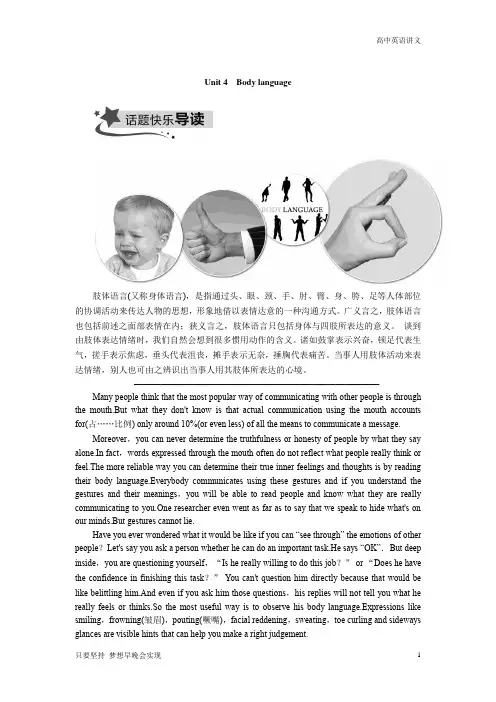
Unit 4Body language肢体语言(又称身体语言),是指通过头、眼、颈、手、肘、臂、身、胯、足等人体部位的协调活动来传达人物的思想,形象地借以表情达意的一种沟通方式。
广义言之,肢体语言也包括前述之面部表情在内;狭义言之,肢体语言只包括身体与四肢所表达的意义。
谈到由肢体表达情绪时,我们自然会想到很多惯用动作的含义。
诸如鼓掌表示兴奋,顿足代表生气,搓手表示焦虑,垂头代表沮丧,摊手表示无奈,捶胸代表痛苦。
当事人用肢体活动来表达情绪,别人也可由之辨识出当事人用其肢体所表达的心境。
————————————————————————————Many people think that the most popular way of communicating with other people is through the mouth.But what they don't know is that actual communication using the mouth accounts for(占……比例) only around 10%(or even less) of all the means to communicate a message.Moreover,you can never determine the truthfulness or honesty of people by what they say alone.In fact,words expressed through the mouth often do not reflect what people really think or feel.The more reliable way you can determine their true inner feelings and thoughts is by reading their body language.Everybody communicates using these gestures and if you understand the gestures and their meanings,you will be able to read people and know what they are really communicating to you.One researcher even went as far as to say that we speak to hide what's on our minds.But gestures cannot lie.Have you ever wondered what it would be like if you can “see through” the emotions of other people?Let's say you ask a person whether he can do an important task.He says “OK”.But deep inside,you are questioning yourself,“Is he really willing to do this job?” or “Does he have the confidence in finishing this task?” You can't question him directly because that would be like belittling him.And even if you ask him those questions,his replies will not tell you what he really feels or thinks.So the most useful way is to observe his body language.Expressions like smiling,frowning(皱眉),pouting(噘嘴),facial reddening,sweating,toe curling and sideways glances are visible hints that can help you make a right judgement.根据文章内容判断正(T)误(F)。
高中英语必修四Unit4 Body language要点解析

这公 园倒是 个适 合野 餐 的地 方 。
I s o lk l t a t S ma i r ts t n t i ey h t he o l i pia e
0 i ya a. 必 须 悄 悄 地 走 近 那 只 riw l f w y 你 t ll 鸟 . 则它会 飞走 的 。 否
te a po c fwne 随 着 冬 季 的 来 临 h p rah o itr mae a poc e os . 想 亲 近 某 人 a — k p rah st b p poc b a ot t. 为某 事 同某 人 打交 道 rah s. bu h s
ter igo ev gt l r e h i n f h eea epi .大 雪 的一 个 s t b c
J h s l ey t e i o d n t i a — o n i i l o b n L n o h s u k
cme od r 冬季来 临 时 , o s le. c 天气 更冷 了 。
We h a d t e a p o c fte t i.我 e r h p ra h o h r n a
Ou l s ma e n e o r p e e tt e rc a s t s wa th rt e r s n h
c s i tesh o cnet 我 们 班 的 同学 想 l S n h co l o ts a . 让 她代 表班级 参加学 校 的竞赛 。
Th sp i tn e r s n sa h n i g s e e i a n i g r p e e t u tn c n .
可能 的结果 就是 菜价 上涨 。
【 知识 拓展 】
l ey常 用 于 以下 两 种 结 构 中 :1s i l k 1 b/
《全程复习方略》高考英语(全国通用)总复习教师用书配套课件:必修4 Unit 4 Body language
【知识构建➡记一记】
(1)be curious about be curious to do sth. (2)from/out of curiosity meet/satisfy one’s curiosity with curiosity=curiously
对……感到好奇 渴望做某事 出于好奇 满足某人的好奇心 好奇地
was nervous about
at ease
⑤If you don’t want to ________, you’d better prepare for the coming
exam carefully.
lose face
⑥You must be careful in the rain, or you will __________slip.
【知识构建➡记一记】
represent. . . as. . .
把……描绘成……
represent oneself as/to be 自称是……
represent sth. to sb.
向某人说明某事
②She represents herself as the kindest mother in the world.
great!
defend
against
③To be honest, I ________________ making thoenstpheeeccohn,traitry’s the first time after all.
④My friend Tom felt ______ living in the city and freed to be himself.
Wang Yaping has become ________________________________
2020高考英语必修4Unit 4 Body language
必修4 Unit 4 Body languageⅠ.阅读理解AIn a foreign country, a man visited a local restaurant. He didn t speak their language. He ordered something indecipherable(难懂的) on the menu. When the waiter brought him a plate of delicious looking fried noodles, he smiled and made an OK sign at the waiter with his thumb and forefinger linked in a circle. Looking angry, the waiter then picked up the dish and threw it to his lap. What he did wrong, he wondered. Well, nothing is quite as it seems when it comes to using hand gesture in another country.Gestures have been used to replace words in many countries, and they are often specific to a given culture. Gesture may mean something complimentary in one culture, but is highly offensive in another.The gesture “thumb-up”is commonly misinterpreted. In English, it is popularly known as “thumbs up”, despite the fact that the action is commonly performed with only one hand. English-speaking Caucasians use it to signal “OK”, which is the same meaning as OK ring gesture. The two can in fact be used almost interchangeably.Avoid using this gesture in Southern Sardina or Northern Greece unless you want to invite a fight. While Americans, British and Australians would use the thumb-up to signal hitch hiking to the drivers, this message will not encourage a Greek driver or motorist to stop to give them a ride.There are no right or wrong signals,only cultural differences. Lack of cultural understanding will lead to disharmony among people from different cultures. When we know what to look for, such encounters with other cultures are actually very interesting, fascinating and fun. It is certainly a great topic to discuss over a cup of coffee and cakes.1. What did the man in the first paragraph do wrong?A.He misunderstood the waiter.B.He didn t realize cultural differences.C.He ordered something on the menu.D.He made the signal in a rude way.2. What does the underlined word in the second paragraph mean?A.Full of admiration.B.Full of aggression.C.Full of complexity.D.Full of certainty.3. What will happen if you make a thumb-up towards a man in Northern Greece?A.He will stop to give you a lift.B.He will get annoyed and fight against you.C.He will ask you to give him a lift.D.He will make the same signal towards you.4. What s the purpose of the passage?A.To explain the meaning of different gestures.B.To tell stories about different cultures.C.To advise us to have an understanding of cultural differences.D.To persuade people from different countries to live in harmony.BScreaming is one of the responses humans share with other animals. Conventional thinking suggests that what sets a scream apart from other sounds is its loudness. However,many sounds that are loud do not raise goose bumps like screams can. To find out what makes human screams unique, neuroscientist Luc Arnal and his team examined a bank of sounds containing sentences spoken or screamed by 19 adults. The result shows screams and screamed sentences had a quality called “roughness”,which refers to how fast a sound changes in loudness. While normal speech sounds only have slight differences in loudness—between 4 and 5 Hz,screams can switch very fast, varying between 30 and 150 Hz,thus considered to be rough and unpleasant.Arnal s team asked 20 subjects to judge screams as fearful or not, and found that the scariest are almost always connected with roughness. The team then studied how the human brain responds to roughness using MRI brain scanners (磁共振颅脑扫描仪). As expected, after hearing a scream, activity increased in the brain s hearing centres where sound coming into the ears is processed. But the scans also lit up in the amygdalae(脑扁桃体), the brain s fear centre.The amygdala is the area that responds to danger. When a threat is detected,our adrenalin(肾上腺素) rises, and our body prepares to react to danger. The study found that roughness isn t heard when we speak naturally, but the most annoying alarm clocks, car horns, and fire alarms possess high degrees of roughness.One potential application for this research might be to add roughness to alarm sounds to make them more effective, the same way a bad smell is added to natural gas to make it easily to be detected. Warning sounds could also be added to electric cars,which are particularly silent, so they can be efficiently detected by pedestrians.5. What is the first paragraph mainly about?A.Different types of screams.B.Specific features of screams.C.Human sounds and animal cries.D.Sound changes and screamed sentences.6. What does the underlined phrase “raise goose bumps”probably mean?A.Make people feel unpleasant.B.Make people feel cold.C.Make people rude and rough.D.Make people unique.7. What can we infer from the passage?A.Roughness is commonly heard in many artificial sounds.B.The travelling speed makes screams different from other sounds.C.Very little scientific research has been done on human screams.D.Normal human speech sounds vary between 30 to 150 Hz in loudness.8. What device may be improved with the researchers findings?A.Traffic lights.B.Security cameras.C.Smart phones.D.Smoke detectors.Ⅱ.语法填空阅读下面短文,在空白处填入1个适当的单词或括号内单词的正确形式。
2020年高考英语复习《必修四 Unit 4 Body language》:阅读理解
2020年高考英语复习《必修四Unit 4 Body language》:阅读理解ARecently,I had lunch with a young Chinese student who studies at a college in New York.He is very bright and aspiring and I enjoyed our conversation.Still I felt frustrated and useless afterwards because I was not able to provide him with any good news.Graduating at the end of this year,he asked me how he could find a job in this country and fulfill his career dreams.In recent years,students who found a job here after graduation have had to go through a cruel lottery system to obtain their HIB working visa.And the success rates have been declining year after year because of the ever growing number of st year,there were 233,000 applicants, and only 30 percent of them were lucky,less than half of the rate in 2013.And it can only become President Donald Trump's immigration policies in this country are tightening up and this trend will continue for at least the next few years.In this case,foreign students studying social sciences,a field in which starting salaries are rarely above the required amount,can kiss their visa hopes goodbye.Compared to the older generation of Chinese students,today's young people no longer consider the US as the only option.Many start to think China offers better opportunities in the longer term.This is not to say that Chinese students in the US are not interested in job opportunities here any more.A few years of work experience in the US can give them leverage when they finally land back in their home country.But if the job opportunities are largely reduced by the tightening of immigration policy,I expect there will be a decline.And if that happens,it is the American economy that will suffer from the loss of those educated,hard-working and talented immigrants.[语篇解读]本文为一篇记叙文。
2020年人教版英语必修4全册完整讲义学案(教师用书)

Unit 1Women of achievement Cultural relicsSection ⅠWarming Up and Reading—Comprehension Section ⅡWarming Up and Reading—Language Points Section ⅢLearning about Language and Using Language Section ⅣGrammar & Writing单元小结重点复习Unit 2Working the landSection ⅠWarming Up and Reading—Comprehension Section ⅡWarming Up and Reading—Language Points Section ⅢLearning about Language and Using Language Section ⅣGrammar & Writing单元小结重点复习Unit 3 A taste of English humourSection ⅠWarming Up and Reading—Comprehension Section ⅡWarming Up and Reading—Language Points Section ⅢLearning about Language and Using Language Section ⅣGrammar & Writing单元小结重点复习Unit 4Body languageSection ⅠWarming Up and Reading—Comprehension Section ⅡWarming Up and Reading—Language Points Section ⅢLearning about Language and Using Language Section ⅣGrammar & Writing单元小结重点复习Unit 5Theme parksSection ⅠWarming Up and Reading—Comprehension Section ⅡWarming Up and Reading—Language Points Section ⅢLearning about Language and Using Language Section ⅣGrammar & Writing单元小结重点复习古今中外,伟大的妇女总为人敬仰。
【精编版】2020高考英语一轮复习必修4:Unit 4 Body language知识串讲讲义
2020高考一轮复习教材串讲必修4 Unit 4 Body language讲义1.________________________n. 陈述;说明2. _______________________vi. &vt. 迎接;问候3. _______________________vt. 代表;象征4. _______________________adj. 好奇的5. _______________________vt. &vi. 接近;靠近;走近n. 接近;方法;途径6. _______________________vt. 保护;保卫7. _______________________adj. 可能的8. _______________________n. 作用;功能;职能vi. 起作用;运转9. _______________________n. 安逸;舒适vt. 减轻(痛苦;忧虑)10. _______________________adj. 主观的1. _______________________很可能……;有希望……【常用结构】_______________________可能……2. _______________________总的来说;通常【常用结构】_______________________一般说来_______________________总的来说3. _______________________舒适;快活;自由自在【常用结构】_______________________容易地,相当于easily4. _______________________丢脸【常用结构】_______________________发脾气_______________________减肥_______________________失去勇气5. _______________________背对;背弃【常用结构】_______________________不理睬6. _______________________在多数情况下【常用结构】_______________________在那种(这种)情况下_______________________在任何情况下_______________________无论如何_______________________万一,以防_______________________决不(句子用倒装语序)1._________________________________________________________________________ _______________________________________.半个小时的等待之后,他们的班机终于到了,我看到几个年轻人走进等候区,他们好奇地向四周张望。
2020人教版高中英语必修四Unit4Bodylanguageperiod1
M4 Unit4 Period1广东省梅州市蕉岭中学胡美娜Period 1Warming up and pre-readingI.Teaching goals:1.Enable the Ss to know what body language is and understand what a certain gesture of body language means in a given situation.2.Enable the Ss to act out some meanings, requirements , requests or situation given in the target language.3.Enable the Ss to express with the target language the meaning given in body language.4. Help the Ss to understand in what condition or cases, body language is used more often. And get to know cultural differences & intercultural communicationII.Teaching important points1.Make the Ss realize body language is as important a spoken written language in different cultures.2. Teach the Ss how to use body language in the most appropriate occasions and get to know cultural differences & intercultural communicationIII.Teaching difficult pointsEnable the Ss to realize the importance of body language in communication so that little or no misunderstanding may occur.V.Teaching MethodsSkimming method, task-based method, role-play method.VI.Teaching Aids:A recorder, a projector, a computer, and the blackboardVII.Teaching procedures and waysStep 1 Enjoying the songPlay the song<If you are happy> and complete the words of the song. Then sing the song together.If you’re happy and you know it, Clap your hands;If you’re happy and you know it, never be afraid to show itIf you’re happy and you know it, Stomp your feet;If you’re happy and you know it, never be afraid to show itIf you’re happy and you know it, wink your eyeIf you’re happy and you know it, never be afraid to show itStep 2 Lead-in1. Show the pictures of Charlie Chaplin and talk about them briefly.1) . Who is the funny man in the film?2) How do they express themselves? (By what they do and their facial expressions.)3) What do you call that? (Body language.)2. T:Every day we need to communicate with each other. What do we use tocommunicate ? ( language )T: What’s the purpose of language?( To express ourselves and communicate with each other )T: Do you know how many ways of communicating are used?( spoken language/ written language / body language … )3.The teacher show some body language including facial expressions and gestures , students guess.Step 3 Free talkPresent some pictures of gestures. Get the Ss to describe the actions of the gestures and tell what they mean.1.the thumb and the forefinger putting together to form a circle with the otherfingers open. (OK.)2.The left palm putting on the forefinger of the right hand. (stop )3.putting your forefinger to your lip.(be silent)4. a thumb up .(well done )5. a v-shape of the forefinger and middle finger.( May you succeed. OrCongratulations on your success)6. a clap of hands ( come on / be cheerful)T: You have all done a good job. So you see that there are many cases or situations in which body language can convey meanings as well as spoken or written languages. If you want to know more about it, let’s come to Unit 4 Body Language.Step 4 Practice in pairs (warming up)T: Just now when I came in, I saw you were smiling. And I know you’re happy. Besides,do you know any other common body language? Or can you give me some examples of body language and its meaning?Now let’s discuss in pairs about the pictures on page 25, what do the pictures mean?Ask several pairs to do the activity in front of the class.T:let’s co nclude the ways in which you can show your body language.(eye contact, facial expressions, gesture, posture and so on)So we know we can use facial expressions, postures and gestures to express ourselves instead of saying a word. (Definition for body language)Body Language is a way of communication without using any words, including gestures、facial expressions、postures and so on.Step 5 Time for FunHave Ss act out the phrases in groups without speaking. (Ss’ book ,Page 25, Part II)Then get some groups to act out in front of the class. (Have a competition among groups to see which acts best , which helps to arouse the students’ interest.)Step 6 Pre-readingTalk about the questions in pairs then check them as a whole class.Step 7 SummaryT: Let’s mak e a summary about what we have learned in this period.1.What’s body language?( a way of communicating with each other without using words, including gestures、facial expressions、postures and so on.)2.What’s the purpose of body language?( It is acted as a tool of communication and help us to make other understand us better.)3.How do you use body language? Or in what cases or situation can we use bodylanguage?1). In a football game, a basketball game, the coaches use it often2). While talking to someone who doesn’t speak my language.3). Use it while we’re talking4). A traffic police use it while working.5). Some deaf and dumb people use it often….Homework1. Surf the internet to collect more information about Body Language2. Do a research on the body language in different cultures. And try to find some vivid examples about it3. Preview the reading passage and finish the exercises on Page 27. Then prepare for role play the reading in four groups。
2020高考英语一轮复习Unit4Bodylanguage练习含解析新人教版必修44
Unit 4 Body languageⅠ.阅读理解The mysterious science of reading gestures is explained using practical explanations and clear images.Gestures are products of both genetic(遗传的) and environmental influence.Understanding our gestures is not as difficult as some people would have you believe.All human beings use them and so actually have a “built-in” ability to recognize and read it.Fingers crossedGenerally this means“wishing for good luck or fortune”.Another explanation could be seen as “here’s hoping”.The gesture probably has Christian origins where the gesture was believed to get away from evil.As such,people believe that crossing the fingers when telling a lie somehow gets away from the evil of the lie.Some historians believe that crossing your fingers is a hidden or secret way of making the Christian sign of cross—a piece way of defeating evils.As a gesture it has both good and bad meanings.Luck or lies.Waving the first fingerMothers and teachers are common users with this hand gesture.In general it is used to warn a single person.It is a change of the “you” gesture.If translated into language it would say “Stop whatever you are doing and pay attention to me.I am your superior and I am warning you!” Classified as a “silent” parent to child gesture,it is completely unacceptable in a professional environment where it willbe interpreted (诠释) as both rude and domineering(盛气凌人的).Some psychologists believe that it has a meaning of the whip.1.What can we infer from the first paragraph?A.Reading gestures is a secret.B.Gestures are formed in daily life.C.Some people make reading gestures difficult on purpose.D.It is hard to explain gestures by images.2.What does a Christian’s crossing his fingers mean?A.Showing he isn’t lucky.B.Wishing to succeed.C.Getting rid of the evil of the lie.D.Crossing the street.3.What is the purpose of your mum’s waving her first finger?A.To wish for good luck.B.To stop you.C.To praise you.D.To help you.4.Why isn’t waving the finger used in a formal occasion?A.Because it is rude.B.Because it is friendly.C.Because it is surprising.D.Because it is helpful.语篇解读:本文是说明文,主要介绍了两种手势语。
高考英语必修4:Unit+4+Body+language4-2Part+Ⅱ+Word版含答案
Part ⅡLearning about Language & Using LanguageⅠ.重点单词1.____________n.作用;功能;职能v i. 起作用;运转2.____________n. 安逸;舒适v t. 减轻(痛苦、忧虑)3.____________adj. 错误的;假的4.____________n. 拳头5.____________v i. 打呵欠6.____________adj. 主观的7.____________v i. & v t. 拥抱8.____________n. 等级;军衔[答案] 1.function 2.ease 3.false 4.fist 5.yawn 6.subjective7.hug8.rankⅡ.词汇拓展1.__________adj. 面部的→__________n. 面部;脸2.__________ad v. 真实地;真诚地;真正地→__________adj. 真实的;真正的3.__________n. 怒气;怒火→__________adj. 生气的;恼火的4.__________adj. 恭敬的→__________v i. & n. 尊敬;恭敬[答案] 1.facial;face 2.truly;true 3.anger;angry4.respectful;respectⅢ.重点短语1.up and down __________________2.feel relaxed __________________3.lose face __________________4.turn one's back to __________________5.nod the head __________________6.摇头__________________7.把目光从……上移开;不看__________________8.在大多数情况下__________________9.对某人尊重/尊敬__________________10.拥抱某人__________________[答案] 1.上上下下;来来回回 2.感觉放松 3.丢脸4.背对;背弃 5.点点头 6.shake the head7.look away from8.in most cases9.be respectful to sb.10.give a hug to sb.Ⅳ.重点句式1.even if 引导让步状语从句It is possible to “read” others around us,______________they do not intend for us to catch their unspoken communication.“读懂”我们周围的人(的心思)是有可能的,即使他们并不想让我们理解他们没有说出来的信息。