
高中英语Unit1 Great scientists文章 走近霍金 2人教版必修五
走近霍金
目前,很多科学家提出有可能存在一个能描述一切物理现象的理论,并把这一理论称为M理论,或超弦理论。
中国科学院理论物理所研究员朱传界在报告会后接受我采访时解释说,M理论又称膜(Membrane)理论、矩阵(Matrix)理论、母(Mother)理论和神秘(Mystery)理论。
它认为弦或者膜是物质组成的最基本单元,所有的基本粒子如电子、光子、中微子和夸克都是弦或膜的不同振动激发态。
它有可能将20世纪创立的两大基础理论广义相对论和量子力学完美地结合起来。
在综述了近年来M理论的最新进展后,霍金回到了报告的主题。
他着重阐述了哥德尔不完备性定理。
这一定理是数学家库尔特·哥德尔1931年证明的。
它指出,在任何公理化形式系统中,总存留着在定义该系统的公理的基础上既不能证明也不能证伪的问题。
也就是说任何一个理论都有解决不了的问题。
尽管自爱因斯坦之后科学家又发现了很多自然界的基本特征,提出了一些新理论,但霍金毫不客气地指出,目前我们关于宇宙的所有理论“既不协调,又不完善”。
这说明在物理学领域,很可能存在类似哥德尔不完备性定理的规律。
因此他认为,不太可能建立一个单一的能协调和完善地描述整个宇宙的理论。
霍金在《时间简史》和《果壳中的宇宙》中,在8月17日将近1个小时的报告中给我们描述了宇宙是什么样子的,部分回答了宇宙为什么是这个样子的。
但对于人们一直热衷的大统一理论,现在他却泼了一盆冷水。
霍金坦言自己对这个结论也有一个接受的过程。
他说以前他坚信能建立一个单一的描述整个宇宙的理论,现在他的想法变了。
就霍金8月17日提出的观点,我电话采访了中国科技大学校长朱清时院士。
他认为:“世界是多元化的。
生物具有多样性,人类文化具有多元性,宇宙也应该是多层次和复杂的。
目前,人类刚刚认识到生物多样性的重要性,我相信物理学家们也会逐渐理解到宇宙是多元化的,因而不可能用单一的理论描述它。
”
我国超弦理论专家朱传界对我说:“霍金今天提出了一个问题供大家探讨,即便霍金的结
论是正确的,物理学家也不应灰心,因为还有更多、更完善的理论需要我们去创建。
”
走近霍金
有些名气很大的人,当你走近他的时候,却发现他的形象不是那么高大,甚至有些渺小,而有些名气很大的人,当你距他越近,就会发现他越加崇高和伟大,景仰之情油然而生。
霍金就是后者。
霍金是深刻的。
在8月18日下午举行的公众科普报告“膜的新奇世界”中,霍金讲述了一个震撼人心的宇宙故事。
时间和空间究竟是什么?宇宙是怎样诞生又是怎样演化的?这一直是伟大的思想家们思考的问题。
霍金正是在爱因斯坦之后融合了20世纪的两大基础理论相对论和量子力学,研究这些最根本的问题,并取得了辉煌的成就,因而被称为“活着的爱因斯坦”。
正如报告开始前世界著名数学家丘成桐介绍的那样:“霍金被誉为自爱因斯坦以来,在重力场方面最有贡献的理论物理学家。
”
关于霍金至今没有得诺贝尔奖的问题,我国超弦理论专家朱传界对我解释说:“诺贝尔奖主要授予被证实的成果。
而霍金的成果很难被证实。
如果黑洞的推测被实验或观测证实,比如观测到黑洞辐射,而且结果与霍金的预测相符,那么我相信霍金很快就会获得诺贝尔奖。
”
对于霍金的成就,8月19日中国国家主席江泽民在中南海会见他时给予了高度评价。
江泽民高度称赞霍金倾毕生精力,为科学为人类所做出的巨大贡献。
霍金是坚强的。
他21时被诊断患上卢伽雷病(即肌萎缩性脊髓侧索硬化症,或称运动神经元疾病),这种疾病的患者将逐步丧失运动能力,通常2至3年内死亡。
他目前需要一天24小时的护理。
17年前他丧失了语言能力,从此他表达思想的唯一工具是一台电脑语音合成器。
他用仅能活动的3个手指操纵一个特制的鼠标器在电脑屏幕上选择字母、单词来造句,然后通过电脑播放出声音。
通常制造一个句子要5、6分钟,为了完成1个小时的录音演讲,他要准备约10天!
据霍金身边的工作人员介绍,霍金这次访华日程安排得非常紧张,几乎每天都有报告和会见活动,这即便对于一个60岁的健康老人也是有些吃不消的。
8月17日开幕的北京国际弦理论会议会场内很闷热,霍金的护士热得直用纸当扇子扇,但霍金却在中午坚持做了近1小时的
报告。
而8月18下午的报告霍金整整做了2个小时。
要知道为了把他安全地架上汽车就要花费5、6分钟。
霍金是乐观和幽默的。
他认为他的残疾并没有给他带来太多的障碍,相反有助于他静静地思考纯理论问题。
访华期间,不管是面对欢迎他的人群,还是面对观众,他总是要努力地微笑几下。
8月18日下午报告会组织者到他下榻的宾馆接他时,由于车内视线不好,他甚至拒绝乘坐为他特殊安排的能安放轮椅的面包车,而是坚持让护士将他抱上红旗牌小汽车,以便观赏沿途的风光。
霍金的幽默是有名的。
这在8月18日的报告中也有所体现。
他说,如果在实验室中能制造出一个小的黑洞,不要担心它会把地球吞没,因为它会很快因辐射而消失,“不过这个小黑洞会很快地让我得诺贝尔奖。
”他把宇宙比喻为一个膨胀的气球,但他希望不会有人用宇宙之针把这个气球捅破。
他甚至用电脑合成的警报声代表他的笑声,在做报告时用了2次,在报告结束时用了1次。
他甚至附和他夫人在答谢观众时现场合成了一句话:“这里很热。
(It's hot)”——他用这个双关语表达他对热情的北京观众的感谢。
霍金是友好的。
17年前他曾访问过中国。
这次访华他的感触很深。
8月18日的报告会后,霍金夫人代表他说:“我们非常感谢中国人民对我们的热情接待,我们的中国之行非常愉快。
”在他的书面致谢中,他说,在中国,他接触了很多年青的理论物理学家和数学家,给他留下了深刻的印象。
他鼓励这些年青人献身到科学事业中。
霍金会见江泽民主席时说,非常高兴在1985年访华后再次来到中国,中国在过去17年取得的巨大进步给他留下深刻印象。
他说,中国在未来的发展中要保持和发展重视基础科学的传统,因为激励年轻人投身科学研究要靠基础科学。
他表示相信,再过50年,中国有望成为领导世界科学的国家。
我在伦敦工作期间与霍金有过几次接触,参加过他的第二次婚礼。
让我感动的是,当我在北京向他提起这些往事时,他用微笑和眨眼表示问候,并抽出时间让我到他的休息室见他并合影留念。
当我告诉他中国读者很喜欢读我写他的一些文章时,他用微笑表达感谢。
他的夫人也很随和地回忆起他们婚礼时的情景。
我问她:“当你成为新娘时,我问你,你幸福吗?你回答说是的。
7年过去了,我现在还问你同样的问题,你怎么回答?”霍金夫人说:“答案是,当
然幸福了!”
霍金是大众的。
霍金没有把自己关在象牙塔里,而是努力地走近公众。
他是历史上最成功的科普作家。
《时间简史》1988年问世后,在全世界大受欢迎,被译成40多种文字,累计发行量超过2500万册,成为发行量最大的一本科普著作。
他的最新科普著作《果壳里的宇宙》获得2002年度世界最知名的科普图书奖之一安万特科学图书奖。
只要有可能,不论在世界什么地方,他都会努力地做一场公众科普报告。
目前,他还在用他独有的、艰难的输入方式为青少年撰写一本简易版的《时间简史》。
北京地铁站里的一名旅客正在翻阅霍金的著作
霍金走近中国大众引起的轰动效应是可喜的。
参加18日报告会的观众来自全国各地,多数是青少年。
一些观众在接受我采访时表示他们很受鼓励和启发,愿意投身到科学事业中。
报告会结束后,丘成桐接受我采访时评价说:“激发公众对科学的兴趣是至关重要的。
大科学家应当带头做科普。
”核物理学家陈佳洱院士说:“大科学家可以用很浅显的话讲明白很深的道理,而且他们有人格魅力,能吸引更多的年青人加入到科学研究的行列中。
”数学家杨乐院士说:“科学只有走近公众,只有被公众理解,才能发挥出对经济发展和社会进步的巨大推动作用,科学家应当带头做科普,我应向霍金学习,为科普做些贡献。
”。
高中英语 Unit 1 Great Scientists Section Ⅱ Learning ab

2017-2018学年高中英语Unit 1 Great Scientists Section ⅡLearning about Language课堂达标验收新人教版必修5编辑整理:尊敬的读者朋友们:这里是精品文档编辑中心,本文档内容是由我和我的同事精心编辑整理后发布的,发布之前我们对文中内容进行仔细校对,但是难免会有疏漏的地方,但是任然希望(2017-2018学年高中英语Unit 1 Great Scientists Section ⅡLearning about Language课堂达标验收新人教版必修5)的内容能够给您的工作和学习带来便利。
同时也真诚的希望收到您的建议和反馈,这将是我们进步的源泉,前进的动力。
本文可编辑可修改,如果觉得对您有帮助请收藏以便随时查阅,最后祝您生活愉快业绩进步,以下为2017-2018学年高中英语Unit 1 Great Scientists Section ⅡLearning about Language 课堂达标验收新人教版必修5的全部内容。
Unit 1 Great Scientists Section Ⅱ Learning about LanguageⅠ.单词拼写错误!1.Work has been begun on the _construction__of the new airport.2.This book _contributes__to our understanding of his theory.3.Who is _responsible__for the accident?4.The _firework__(烟花) exploded with a loud bang.5.Computer users from around the world reported that the _virus__(病毒) had invaded their systems。
高中英语Unit1GreatScientistsSectionⅡLearningaboutLang
补全句子 你弹奏的优美的钢琴曲激发了我的灵感。 You _in_s_p_i_re_d__m_e_____ by __p_la_y_i_n_g_t_h_e_p_ia_n_o_____ so beautifully.
重点短语
1.apart from除……之外;此外
①Apart from my parents,I have no one to believe in.
2.construction n.建设;建筑物;结构
①The new airport is still under construction. 新机场仍在修建中。 ②This is a fine construction. 这是一座完美的建筑。 ③A learner’s dictionary should give both the meanings of words and examples of the constructions in which they are used. 学生词典应该既提供词语的含义,又举出应用这些词语的结构的例子。 注意:under construction为固定用法,意思是“修建中”。
4.He wasd_e_t_er_m__in_e_d______ (determine) to find out why. 5.He found that it came from the river ___p_o_ll_u_te_d____ (pollute) by the dirty
water from London. 6.With this extra evidence John Snow was able to announce with certainty
休息时间到啦
同学们,下课休息十分钟。现在是休息时间,你们休息一下眼 睛,
高中英语 Unit 1 Great Scientists(第3课时)Reading II 新人教版必
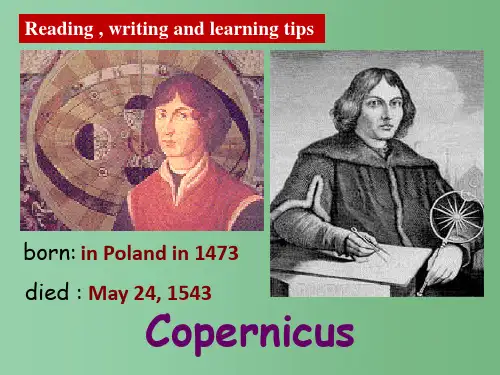
Read through the passage, and tell whether the following statements are true or false.
1. At Copernicus’ time, Christian Church was in charge of many western countries. T
Copernicus’ Revolutionary Theory
Eight Planets In the Solar System
Eight Planets In the Solar System:
Mercury Venus Earth Mars Jupiter Saturn Uranus Neptune
Read the text carefully, then answer these questions
(1)Why could he not tell about his theory? (Para 1)
Because the powerful Chistian Church would have punished him for even suggesting such an idea (2) What was his theory about? (Para 1) All his mathematical calculations led to the same conclusion: that the earth was not the centre of the solar system. Only if you put the sun there did the movements of the other planets in the sky make sense.
新人教版高中英语必修5《Unit 1 Great scientists 》精品
三、本单元教学建议
热身(Warming up)部分在学生课前预习的基础上,教 师可利用图片资料引入,也可以让学生讲述某位科学家的 故事或成就让其他学生来猜测,但讲述内容不宜过长。
读前(Pre-reading)部分建议呈现有关SARS和AIDS宣传 图片或视频资料,引导学生关注疾病与健康,然后再引出 cholera。可以分若干个讨论小组讨论如何进行科学研究, 让学生了解科学观点的形成过程。
.
三、本单元教学建议
语言学习(Learning about language)部分Exercise 1是用所 给词的正确形式填空。教师应确定学生了解这些词的意思 和用法。Exercise 2是一个拓展练习,要求学生掌握make+ 名词,在意义上等于这个名词的动词形式,例如:make a speech=speak。Exercise 3进一步训练动词make的用法。教 师 还 可 以 鼓 励 学 生 回 忆 更 多 的 有 关 于 make 的 用 法 。 Discovering useful structures是语法知识教学,教师可引导 学生在Reading中找到更多过去分词作定语和表语的用法。 Exercise 1、2&3帮助学生感知过去分词作定语和表语,并 逐步过渡到巩固和运用这种语言现象。
.
学习策略 :
通过周密观察、认真分析等、自助、自悟能力,以培 养学生调控策略;利用网络等媒体获取相关知 识来提高资源策略;通过交流表达观点来提高 运用交际策略的能力。
文化意识:
了解许多中外科学家的事迹及他们的贡献,扩 大知识面;以知识武装头脑,以文化陶冶情操。
.
Warming Up:
There are some great scientific achievements that have changed the world. Can you name some of them? What kind of role do they play in the field of science ? Do these achievements have anything in common? Match the inventions with their inventors below before you answer all these questions.
人教版必修五 unit1 great scientists- reading

1.Why couldn’t cholera be under control at first?
Neither its cause, nor its cure was understood.
2. What happened in 1854?
Cholera outbreak hit London. 3. How many people died in 10 days? 500
What causes cholera?
More details
John Snow was an expert doctor in London who attended Queen Victoria as her personal physician and was inspired by peopleexposedto cholera. Though the cause _____ and the cure it were unknown, he wanted of to face thechallenge and solve the problemts
Para5
• Finally John found the source of the water. • Where it came from?
Para5
• At last, he proved the second theory was correct by showing that cholera was spread by germs and not in a cloud of gas.
Para2
> What was the two theories explaining how the disease killed people?
高二英语Unit1 Great Scientists知识精讲 人教实验版
高二英语Unit1 Great Scientists知识精讲人教实验版一. 本周教学内容:必修5 Unit 1 Great Scientists1. 重点单词短语用法讲解2. 课文难点句解析二. 知识总结与归纳:单元内容简介:(一)主题:本单元中心话题是:如何进行科学研究与科学家的贡献(二)本单元涉及到的语法现象:过去分词短语作定语和表语三. 重点讲解与归纳:(一)重点单词与短语:1. Who put forward a theory about black holes? 谁提出了“黑洞”的理论?put forward提出;建议;推荐①Can I put you/your name forward for golf club secretary?我推荐你(提名让你)担任高尔夫球俱乐部的秘书好吗?②He puts forward several interesting plans.他提出了几项令人感兴趣的计划。
③It’s an explanation often put forward by our friend.这是我们的朋友经常做出的解释。
put 相关短语2. Draw a conclusion.得出结论。
1)conclusion(1)conclusion作名词,意为“结束,结论”。
例如:At the conclusion of the ceremony在仪式终了时(2)conclusion相关短语It is premature to make that conclusion.A. They showed little inclination to try conclusions with escaping raiders.B. I will in conclusion say a few words about my visit to Tokyo.①It is premature to make that conclusion.作出那种结论仍为时过早。
英语必修⑤-unit1-Great-scientist的课文及翻译
英语必修⑤-u n i t1-G r e a t-s c i e n t i s t的课文及翻译-CAL-FENGHAI.-(YICAI)-Company One1JOHN SNOW DEFEATS "KING CHOLERA"John Snow was a famous doctor in London — so expert, indeed, that he attended Queen Victoria as her personal physician. But he became inspired when he thought about helping ordinary people exposed to cholera. "This was the deadly disease of its day. Neither its cause nor its cure was understood. So many thousands of terrified people died every time there was an outbreak. John Snow wanted to face the challenge and solve this problem. He knew that cholera would never be controlled until its cause was found.He became interested in two theories that possibly explained how cholera killed people. The first suggested that cholera multiplied in the air. A cloud of dangerous gas floated around until it found its victims. The second suggested that people absorbed this disease into their bodies with their meals. From the stomach the disease quickly attacked the body and soon the affected person died.John Snow suspected that the second theory was correct but he needed evidence. So when another outbreak hit London in 1854, John Snow was ready to begin his enquiry. As the disease spread quickly through poor neighbourhoods, he began to gather information. In two particular streets, the cholera outbreak was so severe that more than 500 people died in 10 days. He was determined to find out why.First he marked on a map the exact places where all the dead people had lived. This gave him a valuable clue about the cause of the disease. Many of the deaths were near the water pump in Broad Street (especially numbers 16, 37, 38 and 40). He also noticed that some houses (such as 20 and 21 Broad Street and 8 and 9 Cambridge Street) had had no deaths. He had not foreseen this, so he made further investigations. He discovered that these people worked in the pub at 7 Cambridge Street. They had been given free beer and so had not drunk the water from the pump. It seemed that the water was to blame.Next, John Snow looked into the source of the water for these two streets. He found that it came from the river polluted by the dirty water from London. He immediately told the astonished people in Broad Street to remove the handle from the water pump so that it could not be used. Soon afterwards the disease slowed down. He had shown the cholera was spread by germs and not in a cloud of gas.In another part of London, he found supporting evidence from two other deaths that were linked to the Broad Street outbreak. A woman, who had moved away from Broad Street, liked the water from the pump so much that she had it delivered to her house every day. Both she and her daughter died of cholera after drinking the water. With this extra evidence John Snow was able to announce with certainty that polluted water carried the virus.To prevent this from happening again, John Snow suggested that the source of all the water supplies be examined. The water companies were instructed not to expose people to polluted water any more. Finally "King Cholera" was defeated.unit 1约翰·斯洛击败“霍乱王”约翰·斯洛是伦敦一位著名的医生——他的确医术精湛,因而成为照料维多利亚女王的私人医生。
高中英语Unit1Greatscientists单元小结教案含解析新人教版必修
Unit 1 Great scientistsYuan Longping, a worldknown Chinese agricultural expert, was born in Beijing in 1930.When he was a child, he was very clever and absorbed all the knowledge well that the teachers could teach him. After graduation, he devoted himself to agricultural study.Once he often suspected the traditional planting methods and was determined to increase rice harvest without increasing the area of fields.In the process of his study, he failed many times, but he never gave up.Apart from this, he often exposed himself to the rain and sunlight all day.At last he put forward many advanced theories and he announced to the world that he had succeeded in developing a new species that produced a 20 percent higher yields than common types of rice.He thought his life would be meaningful only if he could do something successfully.We can draw a conclusion that Yuan Longping is a great agricultural scientist.Owing to his great contribution to agriculture, he will always be remembered as “Father of Hybrid Rice”.袁隆平是世界著名的中国农业专家,他于1930年出生在北京。
高中英语 Unit 1 Great Scientists Copernicus
浙江省诸暨市草塔中学高中英语 Unit 1 Great Scientists Copernicus素材新人教版必修5Polish name: Mikolaj Kopernik. Polish astronomer and mathematician who, as a student, studied canon law, mathematics, and medicine at Cracow, Bologna, Rome, Padua, and Ferrara. Copernicus became interested in astronomy and published an early description o f his "heliocentric" model of the solar system in Commentariolus (1512). In this model, the sun was actually not exactly the center of the solar system, but was slightly offset from the center using a device invented by Ptolemy known as the equant point. The idea that the Sun was the center of the solar system was not new (similar theories had been proposed by Aristarchus and Nicholas of Cusa), but Copernicus also worked out his system in full mathematical detail. Even though the mathematics in his description was not any simpler than Ptolemy's, it required fewer basic assumptions. By postulating only the rotation of the Earth, revolution about the sun, and tilt of Earth's rotational axis, Copernicus co uld explain the observed motion of the heavens. However, because Copernicus retained circular orbits, his system required the inclusion of epicycles. Unfortunately, out of fear that his ideas might get him into trouble with the church, Copernicus delayed publication of them.In 1539, Copernicus took on Rheticus as a student and handed over his manuscript to him to write a popularization of the heliocentric theory, published as Narratio Prima in 1540. Shortly before his death, Rheticus convinced Copernicus to allow publication of his original manuscript, and De Revolutionibus Orbium Coelestium was published in 1543. Copernicus proposed his theory as a true description, not just a theory to save appearances. Unlike Buridan and Oresme, he did not think that any theory which saved appearances was valid, instead believing that there could only be a single true theory. When the work was published, however, Andreas Osiander added an unauthorized preface stating that the content was merely a device to simplify calculations.Copernicus adapted physics to the demands of astronomy, believing that the principles ofPtolemy's system were incorrect, not the math or observations. He was the first person in history to create a complete and general system, combining mathematics, physics, and cosmology. (Ptolemy, for instance, had treated each planet separately.) Copernicus's system was taught in some universities in the 1500s but had not permeated the academic world until approximately 1600. Some people, among whom John Donne and William Shakespeare were the most influential, feared Copernicus's theory, feeling that it destroyed hierarchal natural order which would in turn destroy social order and bring about chaos. Indeed, some people (such as Bruno), used Copernicus's theory to justify radical theological views.Before Copernicus formulated his theory of the solar system, astronomy in Europe had stagnated. After the Almagest had been translated into Latin, European astronomers such as the Austrian mathematician Georg von Peurbach and the German astronomer Regiomontanus proposed no new theories, attempting instead to refine the flawed system already laid out by Ptolemy. The astronomy textboo k used for teaching was still The Sphere, the same book that had been in use since the 1200s. Rather than formulating new theories, astronomers had busied themselves in "saving appearances," which consi sted of trying to patch it up Ptolemy's cumbersome and inaccurate model. Copernicus, however, wiped the slate clean in a single broad stroke, and proposed a fundamentally different model in which the planets all circled the Sun in De Revolutionibus Orbium Coelestium. While radically different from Ptolemy's model, Copernicus's heliocentric theory was hardly an original idea. Similar theories had been proposed by Aristarchus as early as the third century B. C., and Nicholas de Cu sa, a German scholar, had independently made the same assertion in a book he published in 1440. We know for a fact that Copernicus was well aware of Aristarchus's priority, since his original draft of De Revolutionibus has survived and features a passage referring to Aristarchus which Copernicus crossed out so as not to compromise the originality of his theory. In his belief that his theory was an accurate description of nature rather than just a mathematical model, Copernicu s was therefore not trulyrevolutionary.What wa s a little revolutionary was that Copernicus worked out his system in full mathematical detail in De Revolutionibus. By doing this, Copernicus went a step beyond Ptolemy, de Cusa, and Aristarchus. Ptolemy had regarded his theory as simply a mathematic tool for calculation, having no physical basis. On the other side of the coin, de Cusa and Aristarchus had proposed a purely physical model, not endeavoring to mathematically investigate its consequences. Copernicus's most significant achiev ement was his combination of mathematics and physics, adapting physics to conform to his view of astronomical truth, with a good bit of cosmology thrown in for good measure.This achievement alone, however, hardly qualifies as a "revolution." Copernicus offered mathematics which were every bit as entangled as Ptolemy's, and because he retained circular orbits, his system required the inelegant inclusion of epicycles and their accompanying complication. To Copernicus's credit, although his description was not any simpler than Ptolemy's, it did require fewer basic assumptions. In addition, Copernicus's theory explained some problems, such as the reason that Mercury and Venus are only observed close to the Sun (their orbits always kept them nearer the sun than Earth ) and Mars's retrograde motion (the Earth, traveling in its smaller orbit, overtakes Mars, causing Mars to appear to move change direction and move backward relative to distant "fixed" stars). However, like Ptolemy, Copernicus could still not explain variations in the brightness of Venus. Copernicus was the first person in history to create a complete and general system, combining mathematics, physics, and cosmology. Yet, by themselves Copernicus's achievements, do not constitute a revolution. Copernicus had been motivated to this theory by Neoplatonic and Pythagorean considerations. His reasoning seems to have been predominantly motivated by aesthetics. In his view, equally spaced planets in circular orbits would represent harmony in the universe. But Copernicus had made no observations and stated no general laws. His mathematics could describe the motion of the planets, but his theory was of a very ad hoc nature.It took the accurate observational work of Brahe, the exhaustive mathematics of Kepler, and the mathematical genius of Newton to take Copernicus's theory as a starting point, and glean from it the underlying truths and laws governing celestial mechanics. Copernicus was an important player in the development of these theories, but his work would likely have likely remained in relative obscurity without the observational work of Brahe. It would have been discarded by the wayside, until subsequent investigation brought it back to light. It is likely, in fact, that given Kepler would have independently arrived at a heliocentric theory just in the process of interpreting Brahe's data, and the scientific revolution would have been born anyway. To a large extent, then, Copernicus has achieved his pr ominent place in history through what amounted to a lucky, albeit shrewd, guess. It is therefore more appropriate to view Copernicus's achievements as a preliminary step towards scientific revolution, rather than a revolution in itself.。
英语必修⑤unit1Greatscientist的课文及翻译
JOHN SNOW DEFEAT S "KING CHOLER A"John Snow was a famous doctor in London— so expert, indeed, that he attend ed QueenVictor ia as her person al physic ian. But he became inspir ed when he though t abouthelpin g ordina ry people expose d to choler a. "This was the deadly diseas e of its day. Neithe r its causenor its cure was unders tood. So many thousa nds of terrif ied people died everytime therewas an outbre ak. John Snow wanted to face thechalle nge and solvethis proble m. He knew that choler a wouldneverbe contro lleduntilits causewas found.He became intere stedin two theori es that possib ly explai ned how choler a killed people. The firstsugges ted that choler a multip liedin the air. A cloudof danger ous gas floate d around untilit foundits victim s. The second sugges ted that people absorb ed this diseas e into theirbodies with theirmeals. From the stomac h the diseas e quickl y attack ed the body and soon the affect ed person died.John Snow suspec ted that the second theory was correc t but he needed eviden ce. So when anothe r outbre ak hit London in 1854, John Snow was readyto beginhis enquir y. As the diseas e spread quickl y throug h poor neighb ourho ods, he beganto gather inform ation. In two partic ularstreet s, the choler a outbre ak was so severe that more than 500 people died in 10 days. He was determ inedto find out why.Firsthe marked on a map the exactplaces whereall the dead people had lived. This gave him a valuab le clue aboutthe causeof the diseas e. Many of the deaths were near the waterpump in BroadStreet (especi allynumber s 16, 37, 38 and 40). He also notice d that some houses (such as 20 and 21 BroadStreet and 8 and 9Cambri dge Street) had had no deaths. He had not forese en this, so he made furthe r invest igati ons. He discov eredthat thesepeople worked in the pub at 7 Cambri dge Street. They had been givenfree beer and so had not drunkthe waterfrom the pump. It seemed that the waterwas to blame.Next, John Snow looked into the source of the waterfor thesetwo street s. He foundthat it came from the riverpollut ed by the dirtywaterfrom London. He immedi ately told the astoni shedpeople in BroadStreet to remove the handle from the waterpump so that it couldnot be used. Soon afterw ardsthe diseas e slowed down. He had shownthe choler a was spread by germsand not in a cloudof gas.In anothe r part of London, he foundsuppor tingeviden ce from two otherdeaths that were linked to the BroadStreet outbre ak. A woman, who had movedaway from BroadStreet, likedthe waterfrom the pump so much that she had it delive red to her houseeveryday. Both she and her daught er died of choler a afterdrinki ng the water. With this extraeviden ce John Snow was able to announ ce with certai nty that pollut ed watercarrie d the virus.T o preven t this from happen ing again, John Snow sugges ted that the source of all the watersuppli es be examin ed. The watercompan ies were instru ctednot to expose people to pollut ed waterany more. Finall y "King Choler a" was defeat ed.unit 1约翰·斯洛击败“霍乱王”约翰·斯洛是伦敦一位著名的医生——他的确医术精湛,因而成为照料维多利亚女王的私人医生。