
(完整word版)一般过去时和过去进行时教案及习题
一般过去时和过去进行时一、一般过去时1.基本用法表示过去某一时间发生的动作或存在的状态。
常与表示过去的时间状语连用,如:three days ago, the other day, last year等。
例:She regretted telling Jane her own affairs. 她后悔了告诉简她自己的事情。
Doctor White married very late. 怀特教授晚婚。
2.特殊用法A. 在复合句中,当描述过去将来的事情时,条件状语从句、时间状语从句和让步状语从句用一般过去时,主句用过去将来时。
如;She would give me a gift when she came again. 她再回来就给我一个礼物。
B. 表示两个紧接着发生的动作,常由以下词语连接,且用一般过去时。
如:but, and, when, as soon as, immediately, the moment, the minute, the instant等。
例:The moment she came in, she told me what had happened to her.她一进来就告诉我发生在她身上的事情。
He bought a watch but lost it. 他买了一块表,但是丢了。
C. 如果从句中有一个过去的时间状语,尽管从句中的动作先于主句发生,但从句中的谓语动词仍用过去时。
例:He told me he had a good dream last night. 他告诉我他昨晚做了一个好梦。
二、过去进行时(1)过去进行时的构成was/were+动词的现在分词(2)过去进行时的用法1.基本用法A.表示过去某一时刻或过去某一段时间内正在进行的动作。
句中经常有过去的时间点或过去动作陪衬。
例:At 9:00 last night I was watching football on TV.昨晚九点,我在看电视上的足球赛。
They were having a discussion the whole morning yesterday.昨天早上他们一直在讨论。
He went towards the fire, which was still smoking. 他走向那堆还在冒烟的火。
B. 时间状语过去进行时常与时间状语at 5:00, between 5:00 and 6:00, this time last week, then, at that moment, when/while从句等连用。
例:What were you doing when I called you? 我给你打电话时你在做什么?2.特殊用法A.为过去发生的事情提供时间背景。
例:One day two friends were walking through a forest. 有一天,两个朋友走过一片森林。
(后文整个故事发生在这一时间内)B. 表示位置移动的动词如come, go, leave, fly, set off等用过去进行时表示按计划,安排过去某时刻将要发生的动作。
例:He said they were leaving for Beijing the next day. 他说他们第二天要去北京。
C. 过去进行时中有always, forever, continually, constantly修饰时,表示说话人的赞赏或厌烦的态度。
例:He was always thinking of others. 他总是想到别人。
She was constantly finding faults with others. 她总爱给人找茬。
D. 有些动词wonder, hope, think常用过去进行时表示委婉的语气。
例:I was wondering whether you could come to join us. 我想你能否过来跟我们一起活动。
三、过去进行时与一般过去时的用法比较1.过去进行时强调动词在过去某时刻正在进行或持续,而一般过去时表示动作的完成。
例:He was writing his composition last night.他昨晚在写作文。
(不一定写完)He wrote his composition last night. 他昨晚写了一篇作文。
(已经写完)2.表示过去的状态、感觉及心理活动的静态动词(如:be, like, love, hate, fear, own, hear, see, know, want, notice)可用于一般过去时,但通常不用于进行时。
例:I hated it when a man spoke with his mouth full of food. 我讨厌人们说话时口里含着食物。
3.一般过去时与always, constantly, forever, continually 等连用,表示“过去经常性、习惯性的动作”;而过去进行时与这些词连用,表示动作的重复,常带有感情色彩。
如:He always got up at six. 他过去总是六点起床。
He was always thinking of his work. 他总是一心想到工作。
活学活用一、用所给动词的适当形式填空1.Betty (watch) TV last night.2.The Shutes usually (have) supper at 6:30.3.The boys (play football on the playground now.4.Lucy (leave) the classroom half an hour ago.5.It (snow) heavily when they left the station.6.she (fall) off the tree just now?7.It (rain) almost every day last month.8.---where you (catch) the fish?---I (catch) it in the river near the house.9.She (write) a letter to her friend last night. But I don't know whether she has finished it or not.二、句型转换1.I got up late this morning.(改为否定句)I up late this morning.2.She had a bad cold yesterday.(改为一般疑问句)she a bad cold yesterday?3.He left home twenty minutes ago? (对划线部分提问)he home ?4.The boys were playing football at 5:00 yesterday afternoon.(对划线部分提问)the boys at 5:00 yesterday morning?三、根据汉语意思完成句子1.昨天晚上迈克来的时候我正在写作业。
I my homework when Mike last night.2.安正在看电视时,她父亲回来了。
While Ann TV, her father came home.3.我敲门的时候你在干什么?What were you doing when I at the door?4.我去看她的时候她正在打扫房间。
She the room when I to see her.5.去年夏天的这个时候我正在英国度假。
I my vocation in England this time last summer.四、判断正误,不错误的部分改正过来。
1.I practiced my oral English at 8:00 yesterday evening.2.He has been here just now.3.When we had supper, the light went out.4.I first met Mary three years ago. She worked at a radio shop then.5.He always thought more of others than of himself.6.He would leave for Hefei early the next morning.7.While I saw her, she was working at the computer.8.One day, some children played volleyball near a hillside. Suddenly---9.I wrote him a letter this morning and forgot all about it.五、选择1. I him for the first time in 1988, so in 1998, I ______ him for ten years.A. met, knewB. met, had knownC. was meeting, knowD. would met, had known2. --- We should have walked to the station; it was not so far.--- Yes, a taxi necessary at all.A.wasn'tB. hadn't beenC. wouldn't beD. won't be3.--- Where did you put the car keys?--- oh, I I put them on the chair because the phone rang as I in.A.remembered; comeB. remembered; was comingC. remembered; comeD. remember; was coming4.When we met them in the street,they______to the film.A.were goingB.had goneC.would goneD.went5. The dog her on the leg when she it.A. was biting; was catchingB. bit; caughtC. bit; was catchingD. had bit; had caught6. Everybody knew that the football games if there such a terrible rain storm once more.A.would stop; would beB. would stop; had beenC. would be; wasD. would have stopped; was7.I a glass while I the dinner yesterday.A. has broken; was cookingB. was breaking; cookedC. had broken ; was cookingD. broke; was cooking8.I you not to move my dictionary ---now I can't find it.A. askedB. askC. was askingD. had asked9.—Excuse me,sir.This is a non-smoking room.—Oh,sorry.. I_____ that. I won't again.A.don't knowB.didn't knowC. won't knowD. haven't known10.---Miss Jones once music at Bardon School for ten years and now is an actress.---No wonder I often hear her sing in the garden.A.is teaching B.taught C.had taught D.has been teaching。
一般过去式和过去进行时-有答案解析

一般过去式与过去进行时1.常见形式1)一般过去时“主+was/were”或者“主+动词过去式”①I was very surprised when the Alien went into a toy shop.②The Alien was so cute!③We were on the playground when the UFO landed.④When the police arrived, the Alien disappeared suddenly.注:be动词在一般过去时中表示“是”、“在”,有意义2)过去进行时“主 + was/were + 过去分词”①We were playing football when the UFO landed?②I was eating an apple when the UFO landed?③I was reading a book when the UFO landed?注:be动词在过去进行时中只是一个符号,无意义2.用法1)一般过去时(1)表示过去某个时间发生的动作或存在的状态。
①He was at home yesterday.②I got up at six thirty yesterday morning.③I visited my aunt last weekend.(2)表示过去经常或反复发生的动作。
①My father often went to work by bus last year.②When I was a child, I often listened to music.③He always carried an umbrella.(3)常与一般过去时态连用的时间有①yesterday, yesterday morning, the day before yesterday②last night last week, last month, last year…③two days ago, three years ago…④ a moment ago=just now(刚才)⑤in 1990, (in 1998…)⑥this morning, this Monday⑦When I was 5 years old2)过去进行时(1)过去进行时常表示过去某一时刻或过去某一阶段内正在进行的动作。
四种过去时态的讲解及习题
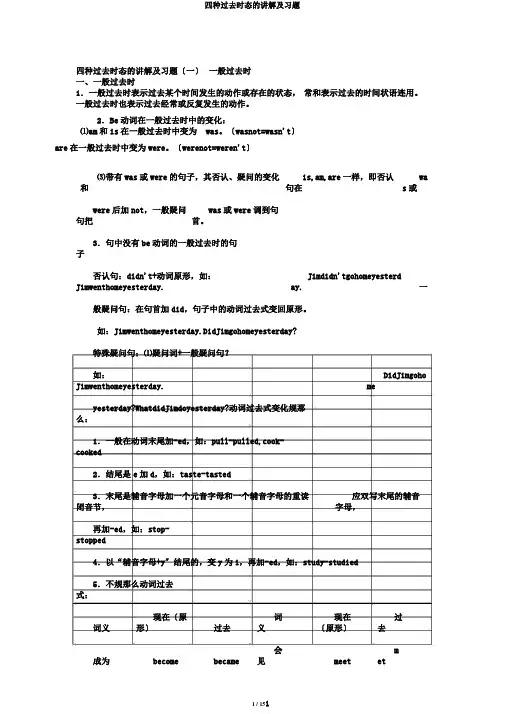
四种过去时态的讲解及习题〔一〕一般过去时一、一般过去时1.一般过去时表示过去某个时间发生的动作或存在的状态,常和表示过去的时间状语连用。
一般过去时也表示过去经常或反复发生的动作。
2.Be动词在一般过去时中的变化:⑴am和is在一般过去时中变为was。
〔wasnot=wasn't〕are在一般过去时中变为were。
〔werenot=weren't〕⑶带有was或were的句子,其否认、疑问的变化和is,am,are一样,即否认句在was或were后加not,一般疑问句把was或were调到句首。
3.句中没有be动词的一般过去时的句子否认句:didn't+动词原形,如:Jimwenthomeyesterday.Jimdidn'tgohomeyesterday.一般疑问句:在句首加did,句子中的动词过去式变回原形。
如:Jimwenthomeyesterday.DidJimgohomeyesterday?特殊疑问句:⑴疑问词+一般疑问句?如:Jimwenthomeyesterday.DidJimgoho meyesterday?WhatdidJimdoyesterday?动词过去式变化规那么:1.一般在动词末尾加-ed,如:pull-pulled,cook-cooked2.结尾是e加d,如:taste-tasted3.末尾是辅音字母加一个元音字母和一个辅音字母的重读闭音节,应双写末尾的辅音字母,再加-ed,如:stop-stopped4.以“辅音字母+y〞结尾的,变y为i,再加-ed,如:study-studied5.不规那么动词过去式:词义现在〔原形〕过去词义现在〔原形〕过去成为become became会见meetmet制造make made弯曲bendbent是are(be)were意味meanmeant躺lie lay开始beginbegan是am,is(be)was可以maymight飞fly flew忘记forgetforgot度过spend spent扫sweeps wept发现find found说speaks poke感觉feel felt睡觉sleepslept吃eat ate坐下sitsat饮drink drank唱歌singsang看见see saw将shalls hould说say said画drawd rew跑run ran做do,doesd id响、鸣ring rang来comec ame骑、乘ride rode切cutc ut捕捉catch caught选择choosechose能can could读readr ead买buy bought放置putput吹blow blew必须mustmust得到get got保持keep kept 给give gave知道know knew走go went学习learnlearned, learnt成长grow grew允许,让let let有have,has had受伤hurt hurt听hear heard4 一般过去时练习Be动词的过去时练习〔1〕一、用be动词的适当形式填空1.I_______atschooljustnow.2.He________atthecamplastweek.3.We________studentstwoyearsago.4.They________onthefarmamomentago.5.YangLing________elevenyearsoldlastyear.6.There________anappleontheplateyesterday.7.There________somemilkinthefridgeonSunday.8.Themobilephone_______onthesofayesterdayevening.二、句型转换1.Itwasexciting.否认句:________________________________________________一般疑问句:____________________________________________肯、否认答复:__________________________________________ thestudentswereveryexcited.否认句:________________________________________________一般疑问句:____________________________________________肯、否认答复:__________________________________________wereinhispocket.否认句:________________________________________________一般疑问句:____________________________________________肯、否认答复:__________________________________________Be动词的过去时练习〔2〕一、用be动词的适当形式填空1.I______anEnglishteachernow.2.She_______happyyesterday.3.They_______gladtoseeeachotherlastmonth4.HelenandNancy________goodfriends.5.Thelittledog_______twoyearsoldthisyear.6.Look,there________lotsofgrapeshere.7.There________asignonthechaironMonday..8.Today_______thesecondofJune.Yesterday______thefirstofJune.It_____Children'sDay. Allthestudents______veryexcited.二、句型转换1.Therewasacarinfrontofthehousejustnow.否认句:________________________________________________一般疑问句:____________________________________________三、中译英我的故事书刚刚还在手表旁边。
八大时态复习教案
八大时态复习教案第一章:一般现在时1.1 教学目标:让学生理解一般现在时的概念和用法。
能够正确运用一般现在时描述习惯、状态和普遍真理。
1.2 教学内容:一般现在时的定义和构成。
一般现在时的肯定句和否定句结构。
一般现在时的常用动词。
1.3 教学活动:通过例句和练习让学生熟悉一般现在时的结构。
让学生通过小组讨论和造句来练习使用一般现在时描述习惯和状态。
设计练习题检测学生对一般现在时的掌握程度。
第二章:一般过去时2.1 教学目标:让学生理解一般过去时的概念和用法。
能够正确运用一般过去时描述过去发生的动作和状态。
2.2 教学内容:一般过去时的定义和构成。
一般过去时的肯定句和否定句结构。
一般过去时的常用动词。
2.3 教学活动:通过例句和练习让学生熟悉一般过去时的结构。
让学生通过小组讨论和造句来练习使用一般过去时描述过去发生的动作和状态。
设计练习题检测学生对一般过去时的掌握程度。
第三章:一般将来时3.1 教学目标:让学生理解一般将来时的概念和用法。
能够正确运用一般将来时描述将来发生的动作和计划。
3.2 教学内容:一般将来时的定义和构成。
一般将来时的肯定句和否定句结构。
一般将来时的常用动词。
3.3 教学活动:通过例句和练习让学生熟悉一般将来时的结构。
让学生通过小组讨论和造句来练习使用一般将来时描述将来发生的动作和计划。
设计练习题检测学生对一般将来时的掌握程度。
第四章:现在进行时4.1 教学目标:让学生理解现在进行时的概念和用法。
能够正确运用现在进行时描述正在进行的动作和状态。
4.2 教学内容:现在进行时的定义和构成。
现在进行时的肯定句和否定句结构。
现在进行时的常用动词。
4.3 教学活动:通过例句和练习让学生熟悉现在进行时的结构。
让学生通过小组讨论和造句来练习使用现在进行时描述正在进行的动作和状态。
设计练习题检测学生对现在进行时的掌握程度。
第五章:过去进行时5.1 教学目标:让学生理解过去进行时的概念和用法。
能够正确运用过去进行时描述过去正在进行的动作和状态。
(word完整版)初中英语时态讲解及练习(含答案),推荐文档
时态1. 一般现在时●形式:do does(单数第三人称)●意义:一般现在时表示客观的、普遍性的真理以及经常性的事件。
●用法:A) 表示现在发生的动作、情况、状态和特征。
B) 经常性、习惯性动作。
e.g.:He always helps others. (他总是帮助别人。
)He often goes to the gym.C) 客观事实和普遍真理。
尤其要注意,如果前后文不是一般现在时,则无法保持主句、从句时态一致。
e.g.: The sun rises in the east and sets in the west.Knowledge is power.●这一用法场合一些表动作频率的时间副词连用:1). 表示肯定的频率副词:always, frequently, usually, sometimes, generally, occasionally, often etc.2). 表示否定的频率副词:never, seldom, rarely etc.➢这些副词的位置:在Be动词后,实义动词前。
e.g. He is always late.2. 一般过去时●形式:did●意义:一般过去时表示在过去的某一特定时间发生和结束的活动或情况。
●用法:A) 表示过去某个时间发生的动作或情况。
e.g.: I saw him in the library yesterday morning. (有特定的时间状语)➢yesterday, yesterday evening, last night/month/spring/year, the night before last(前天晚上),three days/months/years ago, in 1999 etc.。
这些时间状语之前不用加介词。
B) 表示过去习惯性动作,一直持续或反复发生的动作,此时可与表示拼读的时间副词连用。
e.g.: I slept for eight hours last night. (表示在过去某一段时间内持续的动作,但这动作现在已经结束了)3. 一般将来时●形式:will/shall do或be going to do●意义:一般将来时表示在未来的某个时间将要发生的某个动作或状态。
过去进行时知识点综合讲解及其习题专练(附答案)(完整版)

过去进行时知识点综合讲解及其习题专练(附答案)(完整版)一.过去进行时知识点:(一)定义:过去进行时表示过去某一时刻或某一段时间正在进行的动作;也表示过去某段时间一直存在的状态。
(二)形式:was / were + doing1. was:主语为单数(包括I)名词,代词,词组或是句子;was是am和is的过去式;2. were:主语为复数名词,代词,词组或是句子;were是are的过去式。
(三)常与表示过去的时间状语连用:1. this time yesterday/last week… 昨天或上个周……的这个时候;2. then那时;3. at that time在那个时候;4. at that moment在那个时刻;5. at 6 p.m. yesterday在昨天下午6:00;6. at the time of…在……的这个时候;7. when +过去时;8. while +过去进行时等。
e.g. I was watching TV when he called me up.They were building a bridge this time last year.They were expecting you yesterday.He was reading when the rainstorm came.While Mary was sleeping, Tom was doing his homework.(四)过去进行时中肯定句,否定句和一般疑问句的转换规则及一般疑问句的肯定及否定回答的知识点汇总。
含有be动词(was/were)的陈述句转换为一般疑问句时,直接把be动词提到句首,然后把“.”转换为“?”即可,其中第一人称I 和we要相应的转换为第二人称you。
肯定及否定回答用相对应的be 动词来回答即可,但是主语需转换为对应的人称代词(there be句型除外,直接用there来回答);若是肯定句转换为否定句,直接在be 动词后面加not,可缩写,可全称;但否定回答只能用缩写。
一般过去时与过去进行时的练习题
一般过去时与过去进行时的练习题一般过去时与过去进行时练题一、一般过去时一般过去时的时间状语包括:yesterday。
the day before yesterday。
last month。
last year。
last Sunday。
a moment ago。
two hours ago。
twenty minutes ago。
ten years ago。
in 2000.once。
in the spring of 2000等。
例句:Mr。
Green。
did you go to Three Lance and Seven Alleys last Sunday?Answer: No。
but I will visit them next week.A。
will。
go toB。
have。
been toC。
did。
go toD。
have。
gone to答案为A。
二、一般过去时的句型肯定句的结构为:主语+动词的过去式+其它。
例句:He went to the toy store ___.否定句的结构为:主语+did not(didn’t)+动词原形+其它。
例句:___’t go to the toy store ___.一般过去时的一般疑问句的构成为:Did+主语+动词原形+其它?例句1:Did you go to Beijing last week?Answer: Yes。
we did。
(No。
we ___’t.)例句2:Did you meet the businessman before?Answer: No。
I didn’t。
(Yes。
I did.)一般过去时的特殊疑问句的构成为:疑问词+did+主语+动词原形+其它?例句1:What did you do last night?Answer: ___.例句2:Where did you go last week?Answer: I went to Shanghai with my parents.三、规则规则动词的过去分词的构成规则与规则动词的过去式的构成规则相同。
一般过去时和过去进行时教案及习题
一般过去时和过去进行时教案及习题一般过去时和过去进行时一、一般过去时1.基本用法表示过去某一时间发生的动作或存在的状态。
常与表示过去的时间状语连用,如:three days ago, the other day, last year等。
例:She regretted telling Jane her own affairs. 她后悔了告诉简她自己的事情。
Doctor White married very late. 怀特教授晚婚。
2.特殊用法A. 在复合句中,当描述过去将来的事情时,条件状语从句、时间状语从句和让步状语从句用一般过去时,主句用过去将来时。
如;She would give me a gift when she came again. 她再回来就给我一个礼物。
B. 表示两个紧接着发生的动作,常由以下词语连接,且用一般过去时。
如:but, and, when, as soon as, immediately, the moment, the minute, the instant等。
例:The moment she came in, she told me what had happened to her.她一进来就告诉我发生在她身上的事情。
He bought a watch but lost it. 他买了一块表,但是丢了。
C. 如果从句中有一个过去的时间状语,尽管从句中的动作先于主句发生,但从句中的谓语动词仍用过去时。
例:He told me he had a good dream last night. 他告诉我他昨晚做了一个好梦。
二、过去进行时(1)过去进行时的构成was/were+动词的现在分词(2)过去进行时的用法1.基本用法A.表示过去某一时刻或过去某一段时间内正在进行的动作。
句中经常有过去的时间点或过去动作陪衬。
例:At 9:00 last night I was watching football on TV.昨晚九点,我在看电视上的足球赛。
(完整word)初中英语八大时态的详细讲解与练习
初中英语语法:八种时态详解与练习一.概念:英语中表示不同时间发生的动作或存在的状态,需用不同的动词形式表示,这种不同的动词形式称为时态。
二.种类:(基本时态)一般现在时一般过去时现在进行时过去进行时一般将来时过去将来时现在完成时过去完成时一般现在时一、概念:经常、反复发生的动作或行为及现在的某种状况。
二、常搭配的时间状语:always, usually, often, sometimes, every week (day, year, month…), once a week,on Sundays, etc.三、基本结构①be动词(is,am,are);②行为动词(主语是第三人称单数时谓语动词要加s或es外) 否定形式:①am/is/are+not;②此时态的谓语动词若为行为动词,则在其前加don't,如主语为第三人称单数,则用doesn't,同时还原行为动词。
一般疑问句:①把be动词放于句首;②用助动词do提问,如主语为第三人称单数,则用does,同时,还原行为动词。
例句:I go to school at 6 every morning. 每天早上我七点去上学。
Summer follows spring. 春天之后是夏天。
I learned that the earth goes around the sun when I was in primary school. 我在小学就学过地球是围绕太阳转的。
Pride goes before a fall. 骄者必败。
四、基本用法:1) 描述当前时间内经常出现、反复发生的动作或存在的状态。
在这种情景中,句子常带有表示频率的时间状语:always , everyday , often , once a week (month , year , etc.) , sometimes , seldom , usually等等,以表示句中的动作或状态是习惯性的、经常性的。
一般过去式与过去进行时-有答案
一般过去式与过去进行时1.常见形式1)一般过去时“主+was/were”或者“主+动词过去式”①I was very surprised when the Alien went into a toy shop.②The Alien was so cute!③We were on the playground when the UFO landed.④When the police arrived, the Alien disappeared suddenly.注:be动词在一般过去时中表示“是”、“在”,有意义2)过去进行时“主 + was/were + 过去分词”①We were playing football when the UFO landed②I was eating an apple when the UFO landed③I was reading a book when the UFO landed注:be动词在过去进行时中只是一个符号,无意义2.用法1)一般过去时(1)表示过去某个时间发生的动作或存在的状态。
①He was at home yesterday.②I got up at six thirty yesterday morning.③I visited my aunt last weekend.(2)表示过去经常或反复发生的动作。
①My father often went to work by bus last year.②When I was a child, I often listened to music.③He always carried an umbrella.(3)常与一般过去时态连用的时间有①yesterday, yesterday morning, the day before yesterday②last night last week, last month, last year…③two days ago, three years ago…④ a moment ago=just now(刚才)⑤in 1990, (in 1998…)⑥this morning, this Monday⑦When I was 5 years old2)过去进行时(1)过去进行时常表示过去某一时刻或过去某一阶段内正在进行的动作。
(完整版word)英语一般过去时形式讲解含答案
(完整版word)英语一般过去时形式讲解含答案一、初中英语一般过去时1.John ________ his grandma every day when she was in hospital.A. visitedB. was visitingC. visitsD. is visiting【答案】 A【解析】【点评】句意:奶奶住院时,约翰每天去看她。
奶奶住院是过去的状态,在这期间发生的约翰每天看望奶奶的动作指的是过去经常反复发生的动作,用一般过去时态,动词用过去式。
故选A。
2.- The radio says there will be a heavy storm in Mount Emei tomorrow.- Bad luck. I _________ to go there with my classmates.A. planB. will planC. planned【答案】C【解析】【分析】句意:——收音机说明天峨眉山会有大暴雨。
——真倒霉。
我和我的同学计划去那里。
根据答语Bad luck可知他在听了峨眉山有大暴雨后非常失望, 可以推测他的计划被打乱了, 而这个计划肯定是早已计划好的, 是一个过去的动作, 所以此句应用一般过去时, 谓语动词应用其过去式, 结合选项故选C。
【点评】考查一般过去时,注意时态的辨析。
3.He to play sports, but now he is interested in soccer and volleyball.A. doesn't useB. wasn't usedC. didn't useD. didn't used【答案】 C【解析】【分析】句意:他______做运动,但是现在他对足球和排球很感兴趣。
根据句意和选项可知此题考查一般过去时态的否定句式didn't+动词原形,故选C。
【点评】此题考查一般过去时态的否定句式,平时应多归纳总结各种时态,语态和句式的结构及用法。