
[职业资格类试卷]2017年下半年中学教师资格认定考试(初级英语学科知识与教学能力)真题试卷.doc
[职业资格类试卷]2017年下半年中学教师资格认定考试(初级英语学科知识与教学能力)真题试卷一、单项选择题1 The main difference between /e/ and // lies in the______.(A)tongue position(B)sound duration(C)openness of the mouth(D)shape of the lips2 _____ is the main rhyming pattern in "Mrs. White/Had a fright/In the middle of the night".(A)Assonance(B)End rhyme(C)Alliteration(D)Reverse end rhyme3 We're all keeping our______crossed that the surgeons do not find anything too serious with the patient.(A)fingers(B)thumbs(C)hands(D)feet4 When implementing the project, we______ a lot of unexpected opposition from our colleagues.(A)run for(B)make against(C)run up against(D)make away with5 The island measures about 30 miles______20 miles.(A)by(B)with(C)to(D)upon6 —Will John come to the party? —No, he won't come and______.(A)Antony neither won' t(B)won't Antony neither(C)either will Antony(D)neither will Antony7 Garbo plays the role of the queen,______ in the love she has found with Antonio. (A)rejoiced(B)rejoicing(C)being rejoiced(D)to rejoice8 _____ ministers decide to instigate an inquiry, we______welcome it.(A)Should ... would(B)Suppose ... could(C)If... would(D)Would ... will9 What is missing at the discourse level between the two sentences "Carol loves tomatoes. She was born in Africa."?(A)Reference.(B)Cohesion.(C)Coherence.(D)Substitution.10 The synonyms "charge" and "accuse" mainly differ in______.(A)emotion(B)dialect(C)formality(D)collocation11 Which of the following instructions is helpful in developing students' ability to make inferences?(A)Listen to a story and write a summary.(B)Listen to a story and work out the writer's intention.(C)Listen to the story of a boy and then draw a picture of him.(D)Listen to a story and note down the specific date of an event.12 The most suitable question type to check students' comprehension and develop their critical thinking is______.(A)rhetorical questions(B)referential questions(C)close questions(D)display questions13 Diagnostic test is often used for the purpose of(A)finding out what students know and don't know(B)measuring students' general language proficiency(C)knowing whether students have the right language aptitude(D)checking whether students have achieved the teaching objectives14 Which of the following activities is often used to develop students' speaking accuracy? (A)Identifying and correcting oral mistakes.(B)Acting out the dialogue in the text.(C)Having discussions in groups.(D)Describing people in pair.15 If a teacher asks students to make their own learning plan, he/she is trying to develop their______.(A)cognitive strategy(B)affective strategy(C)communicative strategy(D)metacognitive strategy16 When a teacher tells students that the word "dog" may imply "loyalty", he/she is teaching the______of the word.(A)denotative meaning(B)collocative meaning(C)conceptual meaning(D)connotative meaning17 Which of the following is the last step in the process of writing essays?(A)Editing the writings.(B)Writing topic sentences for paragraphs.(C)Gathering information and ideas relevant to the topic.(D)Organizing the information and ideas into a logical sequence.18 The main purpose of asking questions about the topic before listening is to______. (A)meet students' expectation(B)increase students' confidence(C)activate students' schemata(D)provide feedback on tasks19 If a teacher asks students to fill in the blanks in a passage with "that", "which" or "whom", he/she is least likely focusing on grammar at______.(A)lexical level(B)syntactic level(C)discourse level(D)morphological level20 If a teacher asks students to talk about their hobbies in groups, he/she is trying to encourage______.(A)peer correction(B)peer feedback(C)peer interaction(D)peer assessment二、简答题21 简述教材在英语教学中的两个作用,列出教师使用教材的三点注意事项。
三、教学情境分析题22 下面是一位初中英语教师在语音教学中使用的练习。
Teacher's instruction:Look at the words on the blackboard. Tick the word you hear in each sentence I read. Teacher's reads:1. I don' t like these sports.2. These pots are very dirty.3. Look at that white cord on the water.4. Mr. Smith was short.Students tick the words they hear:A B1. spots sports2. pots ports3. cod cord4. shot short根据上面所提供的教学情境,从下面四个方面作答。
(1)该片段的教学目的是什么?(2)该教师采用了哪两种教学方法?(3)该教学片段体现了哪两个语音教学的原则?(4)列出能恰当体现语音教学原则的其他三种方法。
四、教学设计题23 设计任务:请阅读下面学生信息和语言素材,设计20分钟的英语阅读教学方案。
2017下半年教师资格考试初中英语面试真题
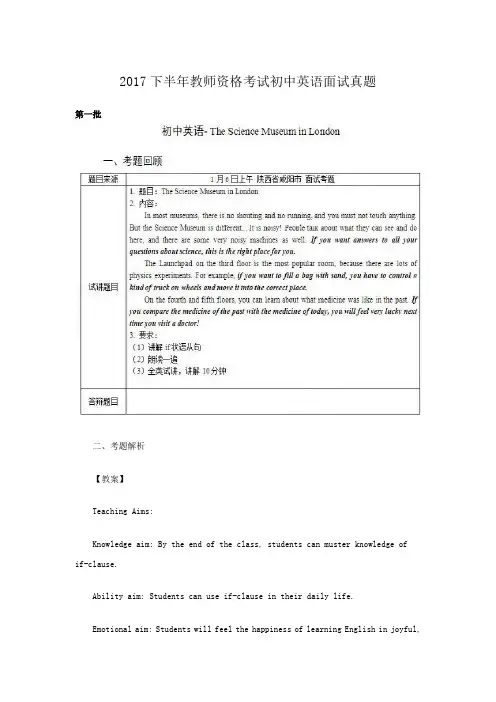
2017下半年教师资格考试初中英语面试真题第一批二、考题解析【教案】Teaching Aims:Knowledge aim: By the end of the class, students can muster knowledge ofif-clause.Ability aim: Students can use if-clause in their daily life.Emotional aim: Students will feel the happiness of learning English in joyful,free and open atmosphere, and will be confident to express in English.Teaching Key Points:Students can know the structure, function and tense of if-clause.Teaching Difficult Point:Students can put the new knowledge into practice.Teaching Methods:Tasked-based Teaching Method, Communicative Approach.Teaching Aids:The blackboardTeaching Procedures:Step 1: Lead-inGreeting with the students.Sing a song for students- if you are happy. Ask them “Did you hear the word-if”to lead in the class.Step 2: PresentationLet the students read the passage and find out sentences with “if”. Then teacher will ask students write these sentences on the blackboard. Then find out the similarities among these sentences.According to the answers from students, teacher make a brief summary:1.If-clause means condition and the main clause is the result. 2. The main clause and if-clause have the same tense. However, if it describes things in the future, the main clause uses the Simple Future Tense and if-clause use the Simple Present Tense.Step 3: PracticeRead the sentences by themselves and practice with neighbors.Step 4: ProductionUse the sentence and structure what we learned today to make a conversation with your neighbor and invite some students performance it.Step 5: Summary and homeworkSummary: Sum up what we have learned today.Homework: After class, teach these sentences to their parents.Blackboard Design:二、考题解析【教案】Teaching AimsKnowledge aim:Students can understand this short passage and master some expressions about comparative degree.Ability aim:Students will improve their reading efficiency and reading ability.Emotional aimStudents are willing to read a lot of English reading materials in their daily life.Teaching Key &Difficult PointsKey point: Students can understand comparative degree.Difficult point: foster good habit of reading English materials in their daily life.Teaching procedures:Step 1: Warming upShow two pictures of twins, encourage students to describe them in their own words and then share their answer with each other.Step 2: PresentationRead the short passage for the first time and they need to read it as fast as the can, ask them what is the main idea of this passage and students share answers.Students read the passage for the second time and ask them some more questions and ask them to pay attention to the comparative degree.Step 3: PracticeGive students some adjective or adverbial words, and ask them to write down the comparative form of these words, the one who writes most without mistakes will get a present.Step 4: ProductionStudents work in groups to describe a person with comparative degree, teacher will give them 8 minutes to prepare it and 8 minutes later, invite some students to be the story teller to introduce his or her friends.Step 5: Summary & HomeworkStudents look at the blackboard and retell the short passage to summarize this class, and the homework is that students introduce Jenny and Nancy to their friends or parents.Blackboard design第二批二、考题解析【教案】Teaching aims:Knowledge aim:Students will master the expression of date and the sentence structure: -What is ...’s birthday? -It is ...Ability aim:Students will improve their abilities of speaking and listening.Emotional aim:Students will be more confident in speaking English.Key and difficult point:Key Point: Students will master how to express a date in English.Difficult Point: Students will use the sentence structure in daily life.Teaching procedure:Step 1: Warming-up1. Greetings.2. Ask students if today is anyone’s birthday. And invite the whole class to sing a ‘Happy Birthday’ song to him or her.Step 2: Pre-listening1. Review the knowledge about ordinal numeral: write some numbers on the blackboard and ask students to change the cardinal numeral into ordinal numeral.2. Ask students to look at the picture in the textbook to predict what the dialogue may be about.Step 3: While-listening二、考题解析【教案】Teaching aims:Knowledge aim: students will know the topic of “you are never too young to start doing things that you don’t know how to do before”.Ability aim: students can increase the speaking ability through talking the topic.Emotional aim: students will develop their awareness of starting doing things as soon as possible.Key and difficult point:Key point: students can increase the speaking ability through talking the topic.Difficult point: students will develop their awareness of starting doing things as soon as possible.Teaching procedure:Step 1: Warming-upGreet the students.Show several pictures of the famous golf player Tiger Woods, the musician Mozart, and the great Brazilian soccer player Ronaldo when they are young, and let students guess who they are, then the teacher tells students that they started doing theirinterest in a young age. Then lead the topic of the class.Step 2: Pre-speakingFirstly, read the passage then conclude and make clear the topic of the speaking class— you are never too young to start doing things that you don’t know to do before. Secondly, the teacher gives several aspects of the topic, including what the event is they have experienced in a young age, when they started doing it, how they did it and what achievements they have got through it. Thirdly, the teacher gives an example. students talk about topic at several aspects above in groups.Step 3: While-speaking1. One student ask the questions about the topic at every single aspect above, the other student answer, then exchange.2. Students talk about the topic at several aspects above to their partners.3. Survey and report. One student makes a survey about the event in a young age of other group members, and take down notes.Step4: Post-speaking1. self—report: talk about the event that they started doing in a young age.2. peer—report: ask some students in different groups to have a repot of other students’ events in a young age.Step 5: Summary and HomeworkTell students we should start doing things as soon as possible.Homework: students think about more events they’d like to start.Blackboard design:二、考题解析【教案】Teaching aims:Knowledge aim: Students will master the sentence pattern “can you” and some new words such as sing, play the piano and so on.Ability aim: Students will improve their speaking ability through group work.Emotional aim: Students will take part in the class actively and be fond of learning English.Key and difficult point: Students can master the sentence pattern and words and can take part into the class actively.Teaching procedure:Step 1: Warming-upGreeting: Good morning boys and girls, this is your beloved English teacher, Jessica. How are you today? Fine, I'm too. It is snowing right now right? The weather is getting colder and colder, so put on more clothes and don't catch cold ok? Otherwise you will lag behind for your English studying.Lead-in: 展示有关音乐会的图片:Sydney Opera House/ National opera house in Beijing1)what can you see in the pictures2) Where can we do in it?3) Do you like to enjoy a music show in our school?4) Let’s take a look of today’s class: musicians wanted for school music festival.Step 2: Pre-reading图片讲解单词:sing/ dance/ play the piano/1) What can you see in the pictures: 依次展示TF boys/ ballet/ 朗朗2) What is he/ she doing in the picture? 依次引出: sing/ dance/ play the piano.3) When you sing, you make musical sounds with your voice, usually producing words that fit a tune.4) When you dance, you move your body and feet in a way that follows a rhythm, usually in time to music.5) A piano is a large musical instrument with a row of black and white keys. When you press these keys with your fingers, little hammers hit wire strings inside the piano, which vibrate to produce musical notes.Step 3: While-reading设置阅读问题:1) Which musical instruments are mentioned in the passage:The piano (Y), the trumpet (Y), the drums (Y). violin (X).2) who should you contact if you are interested: zhang heng3) The telephone number? 622-6033.Step4: Post-reading1) Do a survey: which musical instruments can your classmate play?2) Making a conversation by using the result of the survey: Do you want to go to the music festival?Blackboard design:。
2017下半年教师资格考试《初中英语学科》真题及答案

2017下半年教师资格考试《初中英语学科》真题及答案【- 教师资格考试试题及答案】2017年教师资格考试结束啦,在这里提前预祝考生们都能取得好成绩!小编为您提供《2017下半年教师资格考试《初中英语学科》真题及答案》,希望对您有所帮助!2017下半年教师资格考试《初中英语学科》真题及答案一、单项选择题1、The main difference between /e/ and…… (2分)正确答案:A. tongue position2、……is the main rhyming pattern in…… (2分)正确答案:B. End rhyme3、We're all keeping our……crossed that the surgeons do not find anything…… (2分) 正确答案:A. fingers4、When implementing the project,we…… (2分)正确答案:C. run up against5、The island measures about 30 miles…… (2分)正确答案:A. by6、——Will John come to the party? …… (2分)正确答案:D. neither will Antony7、Garbo plays the role of the queen…… (2分)正确答案:B. rejoicing8、ministers decide to instigate an inquiry…… (2分)正确答案:C. if… would9、What is missing at the discours e level between the two sentences…… (2分)正确答案:C. Coherence10、The synonyms charge and…… (2分)。
中学教师资格认定考试(初级英语学科知识与教学能力)-试卷18
中学教师资格认定考试(初级英语学科知识与教学能力)-试卷18(总分:66.00,做题时间:90分钟)一、单项选择题(总题数:20,分数:40.00)1.Many people nowadays save money to______for their old age.A.caterB.supplyC.provide √D.equip解析:考查动词辨析及固定搭配。
句意为“现在许多人存钱是为了防老”。
cater for“迎合”;supply sth to sb“为某人提供……”;provide for“准备,筹备……”;equip with“用……装备”。
C项最符合题意。
2.—Are you going to get your own car after the test? —My parents have said they'll get______for me.A.one √B.itC.thisD.that解析:考查代词。
one可以代替与前面同类不同一的实物,表示泛指,相当于a/an+名词;it代替前面的事物本身,指前面提到过的那一个;this用作代词可用以指叙述中的人或事物,即指前面提到过的人或事物或下文提及的事物;that代替与前面同类不同一的事物,但是that表示特指,相当于the+名词。
这里泛指一辆汽车,故选A。
3.The origins of human speech remain a mystery,______we have a fairly accurate idea of when writing began.A.onceB.ifC.though √D.since解析:考查连词辨析。
句意为“演讲的起源仍然是个谜团______我们对于写作的起始有了相当准确的观点”。
根据句意,前后表示转折关系,though意为“虽然,但是”,故选C。
4.Look at the timetable. Hurry up! Flight 3753______off at 15:30.A.will takeB.takes √C.is takingD.has taken解析:考查时态。
2017年下半年教师资格证考试《教育知识与能力》(中学)真题与答案
2017年下半年教师资格证考试《教育知识与能力》(中学)题解析1答案:A解析:本题考查教育学创立阶段的人物和观点的对应。
17世纪,捷克教育家夸美纽斯提出了“泛智”教育思想,他主张把一切知识教授给一切人和教育要适应自然,提出了统一的学制系统以及新颖的教学原则、教学方法。
“泛智”教育思想适应了时代和社会的需要,为创立独立的、系统的教育学奠定了基础,对西方教育理论体系的形成以及中国近现代教育的发展产生了重大影响。
因此,提出“泛智”教育思想,探讨“把一切事物教给一切人类的全部艺术”的教育家是夸美纽斯。
故A项正确。
B项:赫尔巴特是19世纪德国哲学家、心理学家,科学教育学之父。
他提出了教育性教学原则,将伦理学和心理学作为教育学的理论基础,强调教师的权威作用,形成了传统教育教师中心、教材中心、课堂中心的特点。
与题干不符,排除。
C项:赞科夫是苏联著名教育家、心理学家。
他在《教学与发展》中提出了发展性教学理论的五条教学原则,即高难度、高速度、理论知识起主导作用、理解学习过程、使所有学生包括差生都得到发展的原则。
与题干不符,排除。
D项:布鲁纳是美国教育心理学家、认知心理学家。
他在《教育过程》中强调学科结构,提出了结构主义教学理论,倡导发现式学习。
与题干不符,排除。
2答案:C解析:本题考查教育的社会属性。
教育的社会属性包括永恒性、历史性、相对独立性、长期性、生产性、民族性。
其中,教育的永恒性是指教育是人类所特有的社会现象,只要人类社会存在,教育就存在。
题干中,教育与人类社会共始终,为一切人和一切社会所必需,是新生一代的成长和社会生活的延续与发展的不可缺少的手段,均体现了教育永恒性的特征。
故C项正确。
A项:教育的阶级性是指在阶级社会,学校教育的控制权属于一定的当权阶级,当权阶级为了使教育为自己的统治服务,教育必须反映当权阶级的利益、愿望和要求,表现出鲜明的阶级性。
阶级性是教育的历史性在阶级社会中的必然反映。
与题干不符,排除。
2017下半年教师资格考试《初中英语学科》真题及答案
2017下半年教师资格考试《初中英语学科》真题及答案2017年教师资格考试结束啦,在这里提前预祝考生们都能取得好成绩!为您提供《2017下半年教师资格考试《初中英语学科》真题及答案》,希望对您有所帮助!2017下半年教师资格考试《初中英语学科》真题及答案一、单项选择题1、The main difference between /e/ and…… (2分)正确答案:A. tongue position2、……is the main rhyming pattern in…… (2分)正确答案:B. End rhyme3、We're all keeping our……crossed that the surgeons do not find anything…… (2分)正确答案:A. fingers4、When implementing the project,we…… (2分)正确答案:C. run up against5、 The is land measures about 30 miles…… (2分)正确答案:A. by6、——Will John come to the party? …… (2分)正确答案:D. neither will Antony7、Garbo plays the role of the queen…… (2分)正确答案:B. rejoicing8、ministers decide to instigate an inquiry…… (2分)正确答案:C. if… would9、 What is missing at the discourse level between the two sentences…… (2分)正确答案:C. Coherence10、The synonyms "charge" and…… (2分)正确答案:D. collocation11、Which of the following instructions is helpful indeveloping…… (2分)正确答案: B. listen to a story and work out the writer’s intention.12、The most suitable question type to check students' comprehension…… (2分)正确答案: B. referential questions13、Diagnostic test is often used for…… (2分)正确答案:A. Finding out what students know and don’t know14、……activities is of ten used to develop students's speaking (2分)正确答案:A. identifying and correcting oral mistakes15、……If a teacher asks studentes to make their own (2分)正确答案:A. Cognitive strategy16、……When a teacher tells the students that the word "dog" (2分)正确答案:D. connotative meaning17、……the last step in the process of writing essays (2分)正确答案:A. Editing the writing18、……The main purpose of asking questions about the topic before (2分)正确答案:C. activate students’ schemata19、……to fill in the blanks in a passage with "t hat","which" (2分)正确答案:B. syntactic level20、……to talk about their hobbies in groups, (2分)正确答案:C. peer interaction21、……is closed in meaning to the underlined word"brawn" (2分)正确答案:C. physical strength22、……underlined phrase"the question" in Paragraph 1 (2分)正确答案:B. Will machines eventually replace human being?23、……What makes the instructions sent by smartphones (2分)正确答案:B. Information collected and elicited by smartphones from your life.24、……Who will be most likely to suffer form (2分)正确答案:C. Individuals keeping the information about their proficiency to themselves.25、……Why will many people start to hate Big Data according to the (2分)正确答案:B. Because they facilitate performance and productivity assessment.26、What can be inferred form Paragraph 1 about criticisms…… (2分)正确答案:C. The criticisms mainly focus on the quality of non-university programs.27、Which of the following is closest in meaning to the underlined word…… (2分)正确答案:C. Achievement28、 What can be inferred from Paragraph 3? (2分)正确答案:B. The university system of the United States will be totally restructured.29、What measures have been taken by some states to deal…… (2分)正确答案:C. To expand non-university teacher education programs.30、 Wh ich of the following is true of the…… (2分)正确答案:A. They are initiated to deal with teacher shortagesand education inequities.二、简答题31、……在英语教学中的两个作用(8分),……使用教材的三点注意事项。
2017年下半年教师资格考试-中学教育知识与能力真题及答案解析
2017年下半年国家教师资格考试真题试卷《教育知识与能力》(中学)注意事项:1.考试时间为120分钟,满分为150分。
2.请按规定在答题卡上填涂.作答。
在试卷上作答无效,不予评分。
一、单项选择题(每小题列出的四个备选项中只有一个选项符合题意,请选出并将其代码填在题后的括号内。
错选、多选或未选均不得分。
本大题共21小题,每小题2分,共42分)1.提出“泛智”教育思想,探讨“把一切事物教给一切人类的全部艺术”的教育家是()A.夸美纽斯B.赫尔巴特C.赞可夫D.布鲁纳2.教育与人类社会共始终,为一切人一切社会所必需,是新生一代的成长和社会生活的延续与发展不可缺少的手段。
这表明教育具有()A.阶级性B.历史性C.永恒性D.平等性3.社会成员经由教育的培养、筛选和提高,可以在不同的社会区域、社会层次、职业岗位以及科层组织之间转换和调动。
这种教育的功能是()A.社会流动功能B.文化传递功能C.社会改造功D.人口控制功能4.法国启蒙思想家卢梭于1762年发表了小说体的教育名著,系统地阐述了他的自然主义教育思想,这部教育名著是()A.《理想国》B.《巨人传》C.《教育论》D.《爱弥儿》5.不同时期、地域、民族和阶层中生活的人的思想、品行、才能和习性,无不打上历史、地域、民族和阶层的烙印,表现出很大的差别。
这种现象表明的影响人发展的因素是()A.遗传因素B.社会环境C.教育影响D.个体实践6.教育目的的制定受到诸多因素的影响,其中决定教育目的的性质、方向和内涵的因素()A.受教育者的身心发展特点B.哲学思想和教育思想C.生产力水平和政治经济制度D.文化传统和教育传统7.李老师在教育过程中,深入了解学生,针对学生的不同发展水平、兴趣、爱好和特长。
引导学生扬长避短,发展个性,不断促进学生的自由发展。
李老师的这种做法适应了人身心发展的哪一特点()A.顺序性B.阶段性C.连续性D.差异性8.像任何事物的发展一样,学生品德的发展也是由其内部矛盾推动的。
【真题】2017下半年教师资格证考试学科专业知识《初中英语》真题及答案
2017下半年教师资格证考试《初中英语》真题及答案◇本卷共分为4大题33小题,作答时间为120分钟,总分150分,90分及格。
一、单项选择题(本大题共30小题,每小题2分。
共60分)在每小题列出的四个备选项中选择一个最佳答案。
请用2B铅笔把答题卡上对应题目的答案字母按要求涂黑。
错选、多选或未选均无分。
1Themaindifferencebetween/e/and/ə/liesinthe__________.A.tonguepositionB.sounddurationC.opennessofthemouthD.shapeofthelips参考答案:A参考解析:考查元音的发音。
根据发音时舌头在口腔中抬起的位置可分为:前元音、中元音、后元音。
根据发音时唇形的圆展可分为:圆唇元音和非圆唇元音。
根据元音的长度可分为:长元音和短元音。
根据以上分类方式,/e/可以描述为前、非圆唇、短元音,/ə/为中、非圆唇、短元音。
由此可知/e/和/ə/的主要区别为发音时舌的位置。
故选A。
2.__________isthemainrhymingpatternin"Mrs.White/Hadaflight/In themiddleofthenight".A.AssonanceB.EndrhymeC.AlliterationD.Reverseendrhyme参考答案:B参考解析:考查修辞学。
Assonance“类韵”,指的是在诗歌中相同或相似元音的重复,它的目的主要是使句子悦耳动听或强调某个音。
例如:Slowthelow gradualmoancameinthesnowing.Endrhyme“尾韵”,指词尾音素重复,如great和bait。
Alliteration“头韵”,指两个单词或两个单词以上的首字母相同,形成悦耳的读音。
例如:AMistyMorningMayhaveafineday.Reverseendrhyme“倒尾韵”,指重读音节中元音和辅音都相同,如will和wind。
2017年下半年中学教师资格认定考试(初级英语学科知识与教学能力
2017年下半年中学教师资格认定考试(初级英语学科知识与教学能力)真题试卷(题后含答案及解析)题型有:1. 单项选择题 2. 简答题 3. 教学情境分析题 4. 教学设计题 5. 阅读理解单项选择题1.The main difference between /e/ and // lies in the______.A.tongue positionB.sound durationC.openness of the mouthD.shape of the lips正确答案:A解析:考查元音的发音。
根据发音时舌头在口腔中抬起的位置可分为:前元音、中元音、后元音。
根据发音时唇形的圆展可分为:圆唇元音和非圆唇元音。
根据元音的长度可分为:长元音和短元音。
根据以上分类方式。
/e/可以描述为前、非圆唇、短元音,//为中、非圆唇、短元音。
由此可知/e/和//的主要区别为发音时舌的位置。
故选A。
2._____ is the main rhyming pattern in “Mrs. White/Had a fright/In the middle of the night”.A.AssonanceB.End rhymeC.AlliterationD.Reverse end rhyme正确答案:B解析:考查修辞学。
Assonance“类韵”,指的是在诗歌中相同或相似元音的重复,它的目的主要是使句子悦耳动听或强调某个音。
例如:Slow the low gradual moan came in the snowing.End rhyme“尾韵”,指词尾音素重复,如great和bait。
Alliteration“头韵”,指两个单词或两个单词以上的首字母相同,形成悦耳的读音。
例如:A Misty Morning May have a fine day.Reverse end rhyme“倒尾韵”,指重读音节中元音和辅音都相同,如will和wind。
2017年教师资格考试初中英语学科知识与教学能力真题及答案
2017上半年教师资格考试初中英语学科知识与教学能力真题及答案注意事项:1.考试时间120分钟,满分150分。
2.请按规定在答题卡上填涂、作答。
在试卷上作答无效,不予评分。
一、单项选择题(本大题共30小题。
每小题2分。
共砷分)在每小题列出的四个备选项中选择一个最佳答案,请用28铅笔把答题卡上对应题目的答案字母按要求涂黑。
错选、多选或未选均无分。
1. The main difference between/m/and/n/lies in _________.A. manner of articulationB. place of articulationC. voicingD. length2. _________ is the main rhyming pattern in the sentence"Alice's aunt ate apples and acorns around A ugust. "A. Reverse rhymeB. End rhymeC. AssonanceD. Alliteration3. Tom is snobbish, always _________the influential people."A. making out forB. making upC. making up toD. making up for4. Britain_________ for control of the sea in the 17th century.A. contendedB. contrivedC. contentedD. confined5, Which of the following best describes the relation between night and knight?A. metonymyB. homonymyC. antonymyD. hyponymy6. Of the people who work here, _________ are French and _________ English.A. half... halfB. the half... the halfC. a half... a halfD. a half... the half7. You'll find yourself thinking about nothing _________when you're very nervous.A. whereverB. whatsoeverC. wheneverD. however8. Mr. Johnson has a habit of asking questions _________.A. and then not listen to the answersB. but then not listen for the answersC. and then not listening to the answersD. and then doesn't listen to the answers9. On hearing the utterance "It's hot here", the listener opened the door. It is a(n) __________.A. locutionary actB. illocutionary actC. direct speech actD. perlocutionary act10. What rhetoric device is used in the sentence "Many hands make light work"?A. Synecdoche.B. Simile.C. Metaphor.D. Oxymoron.11. When the teacher attempts to elicit more information from the students by saying "And ...?","Good. A nything else ?", etc, he/she is playing the role of a__________.A. prompterB. participantC. managerD. consultant12. For more advanced learners, group work may be more appropriate than pair work for tasks that are __________.A. linguistically simpleB. structurally controlledC. cognitively challengingD. thematically non-demanding13. When you focus on "utterance function" and "expected response" by using examples like"Here you are ", "Thanks", you are probably teaching language at the__________.A. lexical levelB. sentence levelC. grammatical levelD. discourse level14. Which of the following tasks fails to encourage active language use?A. Reciting a text.B. Bargaining in a shop,C. Writing an application letter.D. Reading to get a message.15. A teacher may encourage students to __________ when they come across new words in fast reading.A. take notesB. ask for helpC. guess meaning from contextD. look up the words in a dictionary16. Which of the following statements about task design is incorrect?A. Activities must have clear and attainable objectives.B. Activities should be confined to the classroom context.C. Activities must be relevant to students' life experiences.D. Activities should help develop students' language ability.17. If someone says "I know the word", he should not only understand its meaning but also be able to pronounce, spell, and__________ it.A. explainB. recognizeC. memorizeD. use18. Teachers could encourage students to use __________ to gather and organize their ideas for writing.A. elicitingB. mind mappingC. explainingD. brainstorming19. When students are asked to go to the local museum, libraries, etc. to find out information about endangered animals and work out a plan for an exhibition, they are doing a(n)__________.A. surveyB. experimentC. projectD. presentation20. Which of the following tasks fails to develop students' skill of recognizing discourse patterns?A. Analyzing the structure of difficult sentences.B. Checking the logic of the author' s arguments.C. Getting the scrambled sentences into a paragraph.D. Marking out common openers to stories and jokes.请阅读 Passage 1,完成21-25小题。
2017下半年教师资格证《教育知识与能力》考试真题(中学)及答案
2017下半年教师资格证中学《教育知识与能力》真题及答案敏试教育导读,注意事项:1.考试时间为120 分钟,满分为150 分。
2.请按规定在答题卡上填涂、作答。
在试卷上作答无效,不予评分。
一、单项选择题(本大题共21小题,每小题2分,共42分)1.提出“泛智”教育思想,探讨“把一切事物教给一切人类的全部艺术”的教育家是()A.夸美纽斯B.赫尔巴特C.赞可D.布鲁纳2.教育人类社会共始终,为一切人一切社会所必需,是新生一代的成长和社会生活的延展与发展不可缺少的手段,这表明教育具有()A.阶级性B.历史性C.永恒性D..平等性3.社会成员经由教育的培养、筛选和提高,可以在不同的社会区域、社会层次、职业岗位以及科层组织之间的转换和调动。
这种教育的功能是( )A.社会流动功能B.文化传递功能C.社会改造功D.人口控制功能4.法国启蒙思想家卢梭于1762年发表了小说体的教育名著,系统地阐述了他的自然主义教育思想,这部教育名著是()A.《理想国》B.《巨人传》C.《教育论》D.《爱弥儿》5.不同时期、地域、民族和阶层中生活的人的思想、品行、才能和习性,无不打上历史地域、民族和阶层的烙印,表现出很大的差别。
这种现象表明的影响人发展的因素是()A.遗传因素B.社会环境D.个体实践6.教育目的的制定受到诸多因素的影响,其中决定教育目的的性质、方向和内涵的因素()A.受教育者的身心发展特点B.哲学思想和教育思想C.生产力水平和政治经济制度D.文化传统和教育传统7.李老师在教育过程中,深入了解学生,针对学生的不同发展水平、兴趣、爱好和特长。
引导学生扬长避短,发展个性,不断促进学生的自由发展。
李老师的这种做法适应了人身心发展的哪一特点?()A.顺序性B.阶段性C.连续性D.差异性8.像任何事物的发展一样,学生品德的发展也是由其内部矛盾推动的。
学生品德发展的内部矛盾是( )A.社会道德要求与学生现有品德发展水平之间的矛盾B.学习德育要求与学生现有品德发展水平之间的矛盾C.学生品德发展的社会要求与学校德育要求之间的矛盾D.学生品德发展的新需要与其现有发展水平之间的矛盾9.教学过程是一种特殊的认识过程,其区别于人类一般认识的特点是( )A.主动性、阅读性和引导性B.探索性、间接性和引导性C.间接性、引导性和简捷性D.间接性、引导性和复杂性10.2001年,教育部颁布的《基础教育课程改革纲要(试行)》规定,我国普通高中阶段的课程设置方式是( )A.以分科课程为主B.分科课程和综合课程结合C.以综合课程为主D.活动课程和学科课程结合11在一定课程理论指导下,依据培养目标和课程方案,以纲要形式编制的关于教学科目内容,教学实施建议以及课程资源开发等方面的指导性文件()B.课程标准C.教学方案D.教学指南12在某个时期内,个体对某种刺激特别敏感,过了这个时期,同样的刺激则影响很小或没有影响,这个时期称为()A.关键期B.发展期C.转折期D.潜伏期13.图1是由三个扇开和三条折现组成,但是人们会把它知觉为两个三角形和三个圆形怏的知觉特性是( )A.整体性B.选择性C.稳定性D.恒常性14.按照埃里克森人格发展理论,12-18岁个体心理发展的主要任务是()A.强化自我主动性B.培养勤奋感C.建立自我同一性D.获得亲密感15.下列教师课堂行为中,体现教师正确运用无意注意规律的是( )A.对教学重点在语音语调上予以强调B.发现个别学生上课走神时,立即点名批评C.讲课前公布学生成绩D.用彩色粉笔把黑板边缘装饰得格外醒目16.地理老师教学生记忆[亿师学考试研究院整理]“乞力马扎罗山”时,为方便学生记忆,将之戏称为“骑着马打着锣”。