
2015年6月大学英语六级考试真题(第一套)
2015年6月大学英语六级考试真题(第一套)Part II Listening Comprehension (30 minutes)Section A1. A) Prepare for his exams. B) Catch up on his work.C) Attend the concert. D) Go on a vacation.2. A) Three crew members were involved in the incident.B) None of the hijackers carried any deadly weapons.C) The plane had been scheduled to fly to Japan.D) None of the passengers were injured or killed.3. A) An article about the election. B) A tedious job to be done.C) An election campaign. D) A fascinating topic.4. A) The restaurant was not up to the speakers' expectations.B) The restaurant places many ads in popular magazines.C) The critic thought highly of the Chinese restaurant.D) Chinatown has got the best restaurant in the city.5. A) He is going to visit his mother in the hospital.B) He is going to take on a new job next week.C) He has many things to deal with right now.D) He behaves in a way nobody understands.6. A) A large number of students refused to vote last night.B) At least twenty students are needed to vote on an issue.C) Major campus issues had to be discussed at the meeting.D) More students have to appear to make their voice heard.7. A) The woman can hardly tell what she likes.B) The speakers like watching TV very much.C) The speakers have nothing to do but watch TV.D) The man seldom watched TV before retirement.8. A) The woman should have retired earlier. 4B) He will help the woman solve the problem.C) He finds it hard to agree with what the woman says.D) The woman will be able to attend the classes she wants.Questions 9 to 12 are based on the conversation you have just heard.9. A) Persuade the man to join her company. B) Employ the most up-to-date technology.C) Export bikes to foreign markets. D) Expand their domestic business.10. A) The state subsidizes small and medium enterprises.B) The government has control over bicycle imports.C) They can compete with the best domestic manufactures.D) They have a cost advantage and can charge higher prices.11. A) Extra costs might eat up their profits abroad.B) More workers will be needed to do packaging.C) They might lose to foreign bike manufacturers.D) It is very difficult to find suitable local agents.12. A) Report to the management. B) Attract foreign investments.C) Conduct a feasibility study. D) Consult financial experts.Questions 13 to 15 are based on the conversation you have just heard.13. A) Coal burnt daily for the comfort of our homes.B) Anything that can be used to produce power.C) Fuel refined from oil extracted from underground.D) Electricity that keeps all kinds of machines running.14. A) Oil will soon be replaced by alternative energy sources.B) Oil reserves in the world will be exhausted in a decade.C) Oil consumption has given rise to many global problems.D) Oil production will begin to decline worldwide by 2015.15. A) Minimize the use of fossil fuels. B) Start developing alternative fuels.C) Find the real cause for global warming. D) Take steps to reduce the greenhouse effect.Section BPassage OneQuestions 16 to 18 are based on the passage you have just heard.16. A) The ability to predict fashion trends. B) A refined taste for artistic works.C) Years of practical experience. D) Strict professional training.17. A) Promoting all kinds of American hand-made specialities.B) Strengthening cooperation with foreign governments.C) Conducting trade in art works with dealers overseas.D) Purchasing handicrafts from all over the world.18. A) She has access to fashionable things. B) She is doing what she enjoys doing.C) She can enjoy life on a modest salary. D) She is free to do whatever she wants.Passage TwoQuestions 19 to 22 are based on the passage you have just heard.19. A) Join in neighborhood patrols. B) Get involved in his community.C) V oice his complaints to the city council. D) Make suggestions to the local authorities.20. A) Deterioration in the quality of life. B) Increase of police patrols at night.C) Renovation of the vacant buildings. D) Violation of community regulations.21. A) They may take a long time to solve. B) They need assistance form the city.C) They have to be dealt with one by one. D) They are too big for individual efforts.22. A) He had got some groceries at a big discount.B) He had read a funny poster near his seat.C) He had done a small deed of kindness.D) He had caught the bus just in time.Passage ThreeQuestions 23 to 25 are based on the passage you have just heard.23. A) Childhood and family growth. B) Pressure and disease.C) Family life and health. D) Stress and depression.24. A) It experienced a series of misfortunes. B) It was in the process of reorganization.C) His mother died of a sudden heart attack. D) His wife left him because of his bad temper.25. A) They would give him a triple bypass surgery.B) They could remove the block in his artery.C) They could do nothing to help him.D) They would try hard to save his life.Section CWhen most people think of the word “education”, they think of a pupil as a sort of anim ate sausage casing. Into this empty casting, the teachers (26) stuff “education.”But genuine education, as Socrates knew more than two thousand years ago, is not (27) the stuffing of information into a person, but rather eliciting knowledge from him; it is the (28) of what is in the mind.“The most important part of education,” once wrote William Ernest Hocking, the (29) Harvard philosopher, “is this instruction of a man in what he has inside of him.”And, as Edith Hamilton has reminded us, Socrates never said, “I know, learn from me。
2015年6月英语四级考试真题及答案(第1套)
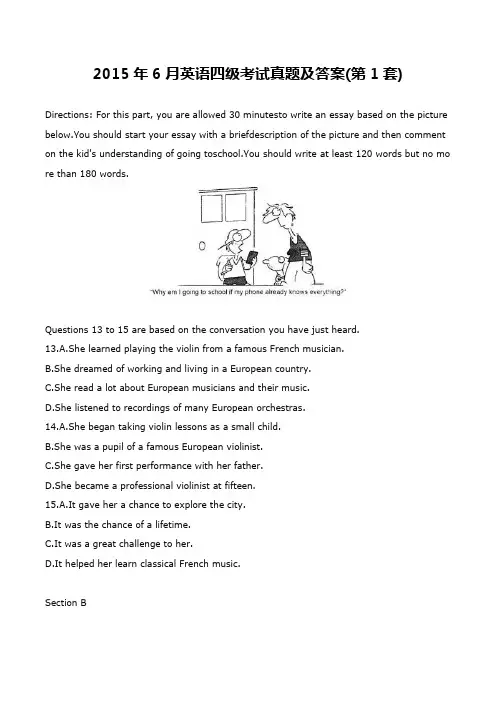
2015年6月英语四级考试真题及答案(第1套)Directions: For this part, you are allowed 30 minutesto write an essay based on the picture below.You should start your essay with a briefdescription of the picture and then comment on the kid's understanding of going toschool.You should write at least 120 words but no mo re than 180 words.Questions 13 to 15 are based on the conversation you have just heard.13.A.She learned playing the violin from a famous French musician.B.She dreamed of working and living in a European country.C.She read a lot about European musicians and their music.D.She listened to recordings of many European orchestras.14.A.She began taking violin lessons as a small child.B.She was a pupil of a famous European violinist.C.She gave her first performance with her father.D.She became a professional violinist at fifteen.15.A.It gave her a chance to explore the city.B.It was the chance of a lifetime.C.It was a great challenge to her.D.It helped her learn classical French music.Section BDirections: In this section, you will hear 3 short passages.At the end of each passage, you willhearsome questions.Both the passage and the questions will be spoken only once.After youheara question, you must choose the best answer from the four choices marked A., B), C.and D).Then mark the corresponding letter on Answer Sheet 1 with a single linethrough t he centre.Passage OneQuestions 16 to 18 are based on the passage you have just heard.16.A.There are mysterious stories behind his works.B.There are many misunderstandings about him.C.His works have no match worldwide.D.His personal history is little known.17.A.He moved to Stratford-on-Avon in his childhood.B.He failed to go beyond grammar school.C.He was a member of the town council.D.He once worked in a well-known acting company.18.A.Writers of his time had no means to protect their works.B.Possible sources of clues about him were lost in a fire.C.His works were adapted beyond recognition.D.People of his time had little interest in him.Passage TwoQuestions 19 to 21 are based on the passage you have just heard.19.A.Theft.B.Cheating.C.Air crash.D.Road accidents.20.A.Learn the local customs.B.Make hotel reservations.C.Book tickets well in advance.D.Have the right documents.21.A.Contact your agent.B.Get a lift if possible.e official transport.D.Have a friend meet you.Passage ThreeQuestions 22 to 25 are based on the passage you have just heard.22.A.Cut down production cost.B.Sell inexpensive products.C.Specialise in gold ornaments.D.Refine the taste of his goods.23.A.At a national press conference.B.During a live television interview.C.During a local sales promotion campaign.D.At a meeting of top British businesspeople.24.A.Insulted.B.Puzzled.C.Distressed.D.Discouraged.25.A.The words of some businesspeople are just rubbish.B.He who never learns from the past is bound to fail.C.There should be a limit to one's sense of humour.D.He is not laughed at, that laughs at himself first.Section CDirections: In this section, you will hear a passage three times.When the passage is read fo r thefirsttime, you should listen carefully for its general idea.When the passage is read for t hesecondtime, you are required to fill in the blanks with the exact words you have justheard.Finally,when the passage is read for the third time, you should check what youhave writt en.Looking at the basic biological systems, the world is not doing very well.Yet economicindica tors show the world is (26) Despite a slow start at the beginning of the eighties, globalec onomic output increased by more than a fifth during the (27) The economy grew, tradein creased, and millions of new jobs were created.How can biological indicators show the 28 o feconomic indicators?The answer is that the economic indicators have a basic fault: they show no differencebetw een resource uses that(29) progress and those uses that will hurt it.The main measureof economic progress is the gross national product (GNP).(30), this totals the value of allgoods and services produced and subtracts loss in value of factories and equipment.Developed ahalf-century ago, GNP helped (31) a common wa y among countries of measuring change ineconomic output.For some time, this seemed to work (32 )well, but serious weaknesses arenow appearing.As indicated earlier, GNP includes loss in va lue of factories and equipment, but itdoes not(33 )the loss of natural resources, including nonrenewable resources such as oil orrenewable res ources such as forests.This basic fault can produce a(34 )sense of national economic health.According to GNP,for example, countries that overcut for ests actually do better than those that preserve theirforests.The trees cut down are counte d as income but no subtraction is made for (35 )theforests.Section ADirections: In this section, there is a passage with ten blanks.You are required to select on eword for each blank from a list of choices given in a word bank following the passage.Read thepassage through carefully before making your choices.Each choice in the bank is identified by aletter.Please mark the corresponding letter for each item on Answer Sheet2 with a single linethrough the centre.You may not use any of the words in the bank more than onc e.Questions 36 to 45 are based on the following passage.The U.S.Department of Education is making efforts to ensure that all students have equalac cess to a quality education.Today it is(36) the launch of the Excellent Educators for AllInitiative.The initiative will help states a nd school districts support great educators for thestudents who need them most."All children are(37 )to a high-quality education regardless of their race, zip code orfamily income.It is (38 )important that we provide teachers and principals the support theyneed to help students re ach their full (39)," U.S.Secretary of Education Arne Duncan said."Despite the excellent work and deep(40 )of our nation's teachers and principals, students inhigh-poverty, high- minority schools are unfairly treated across our country.We have to dobetter.Local leaders and educators will (41 )their own creative solutions, but we must worktogether to (42) our focus on how to bette r recruit, support and(43) effective teachersand principals for all students, especially the kids who need them most."Today's announcement is another important step forward in improving access to a qualitye ducation, a (44 )of President Obama's year of ter today, Secretary Duncan will leada roundtable dis cussion with principals and school teachers from across the country about the(45 )of working in high-need schools and how to adopt promising practices for supportinggreat e ducators in these schools.A.AnnouncingB.beneficialC.challengesmitmentponentF.contestsG.criticallyH.developI.distributingJ.enhanceK.entitledL.potentialM.properlyN.qualifiedO.retainSection BDirections: In this section, you are going to read a passage with ten statements attached to it.Eachstatement contains information given in one of the paragraphs.Identify the paragrap hfrom which the information is derived.You may choose a paragraph more than once.Eachp aragraph is marked with a letter.Answer the questions by marking thecorresponding letter onAnswer Sheet 2.The Changes Facing Fast FoodA)Fast-food firms have to be a thick-skinned bunch.Health experts regularly criticise thems everelyfor selling food that makes people fat.Critics even complain that McDonald's, whosel ogosymbolises calorie excess, should not have been allowed to sponsor the World Cup.Thes earethings fast-food firms have learnt to cope with.But not perhaps for much longer.Theburgerbusiness faces more pressure from regulators at a time when it is already adaptingstrat egies inresponse to shifts in the global economy.B)Fast food was once thought to be recession-proof.When consumers need to cut spending, the logicgoes, cheap meals like Big Macs and Whoppers become even more attractive.Such "trading down"proved true for much of the latest recession, when fast-food companies pick ed upcustomers who could no longer afford to eat at casual restaurants.Traffic was boosted inAmerica, the home of fast food, with discounts and promotions, such as $1 menus and c heapcombination meals.C)As a result, fast-food chains have weathered the recession better than their moreexpensi ve competitors.In 2009 sales at full-service restaurants in America fell by more than 6% , b ut total sales remained about the same at fast-food chains.In some markets, such as Japan ,France and Britain, total spending on fast food increased.Same-store sales in America atMc Donald's, the world's largest fast-food company, did not decline throughout thedownturn.Pa nera Bread, an American fast-food chain known for its fresh ingredients, performedwell, too , because it offers higher-quality food at lower prices than restaurants.D)But not all fast-food companies have been as fortunate.Many, such as Burger King, have seen sales fall.In a severe recession, while some people trade down to fast food, many oth erseat at home more frequently to save money.David Palmer, an analyst at UBS, a bank, s ayssmaller fast- food chains in America, such as Jack in the Box and Carl's Jr., have been h itparticularly hard in this downturn because they are competing with the global giantMcDon ald's, which increased spending on advertising by more than 7% last year as others cutbac k.E)Some fast-food companies also sacrificed their own profits by trying to give customersbet ter value.During the recession companies set prices low, hoping that once they had tempte dcustomers through the door they would be persuaded to order more expensive items.But i nmany cases that strategy did not st year Burger King franchisees (特许经营人)sued (起诉)the company over its double-cheeseburger promotion, claiming it was unfair for them to berepuired to sell these for $1 when they cost$1.10 to make.In May a judge ruled in favour ofBurger King.Nevertheless, the company may still be cursing its decision to promote chea pchoices over more expensive ones because items on its "value menu" now account for aro und20% of all sales, upfrom 12% last October.F)Analysts expect the fast-food industry to grow modestly this year.But the downturn isma kingcompanies rethink their strategies.Many are now introducing higher-priced items toenti ce (引诱)consumers away from $1 specials.KFC, a division of Yum! Brands, which also ownsTaco Belland Pizza Hut, has launched a chicken sandwich that costs around $5.And in MayBurger Kingintroduced barbecue (烧烤)pork ribs at $7 for eight.G)Companies are also trying to get customers to buy new and more items, includingdrinks. McDonald's started selling better coffee as a challenge to Starbucks.Its " McCafe" linenowac counts for an estimated 6% of sales in America.Starbucks has sold rights to its Seattle'sBes tcoffee brand to Burger King, which will start selling it later this year.H)As fast-food companies shift from "super size" to "more buys", they need to keepcustom er traffichigh throughout the day.Many see breakfast as a big opporttmity, and not justfor f atty food.McDonald's will start selling porridge (粥)in America next year.Breakfast has thep otential to bevery profitable, says Sara Senatore of Bernstein, a research firm, because the margins can be high.Fast-food companies are also adding midday and late-night snacks, su ch asblended drinks andwraps.The idea is that by having a greater range of things on the menu,"wecan sell to consumersproducts they want all day," says Rick Carucci., the .chief financial officerof Yum ! Brands.I)But what about those growing waistlines? So far, fast-food firms have cleverly avoidedgovernmentregulation.By providing healthy options, like salads and low-calorie sandwiches,th ey have at leastgiven the impression of doing something about helping to fight obesity (肥胖症).These offeringsare not necessarily loss-leaders, as they broaden the appeal of outlets to groups of diners thatinclude some people who don't want to eat a burger.But customers ca nnotbe forced to ordersalads instead of fries.J)In the future, simply offering a healthy option may not be good enough."Every packaged-food and restaurant company I know is concerned about regulation right now," saysMr.Pal mer of UBS.America's health-reform bill, which Congress passed this year, requiresrestaura nt chains with 20 ormore outlets to put the calorie-content of items they serve on themenu .A study by the NationalBureau of Economic Research, which tracked the effects onStarbuc ks of a similar calorie-postinglaw in New York City in 2007, found that the averagecalorie-c ount per transaction fell 6% andrevenue increased 3% at Starbucks stores where aDunldn Donuts outlet was nearby--a sign, it issaid, that menu-labelling could favour chainsthat hav e more healthy offerings.K)In order to avoid other legislation in America and elsewhere, fast-food companies willhav e tocontinue innovating (创新).Walt Riker of McDonald's claims the change it has made in itsmenumeans it offers more healthy items than it did a few years ago."We probably sell morevegetables,more milk, mo re salads, more apples than any restaurant business in the world," hesays.But therecent pr oposal by a county in California to ban McDonald's from including toys inits high-calorie"Ha ppy Meals", because legislators believe it attracts children to unhealthyfood, suggests there isa lot more left to do.46.Some people propose laws be made to stop McDonald's from attaching toys to its foods pecials for children.47.Fast-food finns may not be able to cope with pressures from food regulation in the nearf uture.48.Burger King will start to sell Seattle's Best coffee to increase sales.49.Some fast-food firms provide healthy food to give the impression they are helping totac kle the obesity problem.50.During the recession, many customers turned to fast food to save money.51.Many people eat out less often to save money in times of recession.52.During the recession, Burger King's promotional strategy of offering low-priced items oft enproved ineffective.53.Fast-food restaurants can make a lot of money by selling breakfast.54.Many fast-food companies now expect to increase their revenue by introducing higher-p riceditems.55.A newly-passed law asks big fast-food chains to specify the calorie count of what theyse rve on the menu.Section CDirections: There are 2 passages in this section.Each passage is followed by some question sorunfinished statements.For each of them there are four choices marked A., B), C.andD ). Youshould decide on the best choice and mark the corresponding letter on AnswerSheet 2 with asingle line through the centre.Passage OneQuestions 56 to 60 are based on the following passage.If you think a high-factor sunscreen (防晒霜)keeps you safe from harmful rays, you may bewrong.Research in this week's Nature sho ws that while factor 50 reduces the number ofmelanomas(黑瘤)and delays their occurrence, it can't prevent them.Melanomas are the mostaggressive sk in cancers.You have a higher risk if you have red or blond hair, fair skin, blue orgreen eyes, or sunburn easily, or if a close relative has had one.Melanomas are more common ifyou ha ve periodic intense exposure to the sun.Other skin cancers are increasingly likely withlong-t erm exposure.There is continuing debate as to how effective sunscreen is in reducing melanomas theevid ence is weaker than it is for preventing other types of skin cancer.A 2011 Australian studyo f 1,621 people found that people randomly selected to apply sunscreen daily had half the r ateof melanomas of people who used cream as needed.A second study, comparing 1,167 p eoplewith melanomas to 1,101 who didn't have the cancer, found that using sunscreen rout inely,alongside other protection such as hats,long sleeves or staying in the shade, did give someprotection.This study said other forms of sun protection not sunscreen seemed mostb eneficial.The study relied on people remembering what they had done over each decade oft heir lives, so it's not entirely reliable.But it seems reasonable to think sunscreen givespeopl e a false sense of security in the sun.Many people also don't use sunscreen properly applying insufficient amounts, failing toreap ply after a couple of hours and staying in the sun too long.It is sunburn that is mostworryin g recent research shows five episodes of sunburn in the teenage years increases the riskof all skin cancers.The good news is that a combination of sunscreen and covering up can reduce melanomara tes, as shown by Australian figures from their slip-slop-slap campaign.So if there is a heatw ave this summer, it would be best for us, too, to slip on a shirt, slop on (抹上)sunscreen andslap on a hat.56.What is people's common expectation of a high-factor sunscreen?A.It will delay the occurrence of skin cancer.B.It will protect them from sunburn.C.It will keep their skin smooth and fair.D.It will work for people of any skin color.57.What does the research in Nature say about a high-factor sunscreen?A.It is ineffective in preventing melanomas.B.It is ineffective in case of intense sunlight.C.It is ineffective with long-term exposure.D.It is ineffective for people with fair skin.58.What do we learn from the 2011 Australian study of 1,621 people?A.Sunscreen should be applied alongside other protection measures.B.High-risk people benefit the most from the application of sunscreen.C.Irregular application of sunscreen does women more harm than good.D.Daily application of sunscreen helps reduce the incidence of melanomas.59.What does the author say about the second Australian study?A.It misleads people to rely on sunscreen for protection.B.It helps people to select the most effective sunscreen.C.It is not based on direct observation of the subjects.D.It confirms the results of the first Australian study.60.What does the author suggest to reduce melanoma rates?ing both covering up and sunscreen.B.Staying in the shade whenever possible.ing covering up instead of sunscreen.D.Applying the right amount of sunscreen.Passage TwoQuestions 61 to 65 are based on the following passage.Across the rich world, well-educated people increasingly work longer than the less-skilled.S ome65% of American men aged 62-74 with a professional degree are in theworkforce, compared with32% of men with only a high-school certificate.This gap is part of adeepening divide between the well-educated well -off and the unskilled poor.Rapidtechnological advance has raised the incomes of the highly skilled while squeezing those of theunskilled.The consequences, for individuals and society, are profound.The world is facing an astonishing rise in the number of old people, and they will livelonger than ever before.Over the next 20 years the global population of those aged 65 ormore willalmost double, from 600 million to 1.1 billion.The experience of the 20th century,when gre ater longevity (长寿)translated into more years in retirement rather than more yearsat work, has persuaded many observers that this shift will lead to slower economic growth,while the swelling ranks of pensioners will create government budget problems.But the notion of a sharp division between the working young and the idle old misses a new trend, the growing gap between the skilled and the unskilled.Employment rates are fallinga mong younger unskilled people, whereas older skilled folk are working longer.The divide is most extreme in America, where well-educated baby-boomers (二战后生育高峰期出生的美国人)areputting off retirement while many less-skilled younger people have dropped out of th eworkforce.Policy is partly responsible.Many European governments have abandoned policies that used to encourage people to retire early.Rising life expectancy (预期寿命), combined with thereplacement of generous defmed-benefit pension plans with less gen erous defined-contribution ones, means that even the better-off must work longer to have a comfortableretirement.But the changing nature of work also plays a big role.Pay has risen sharply for thehighly educated, and those people continue to reap rich rewards into old ag e because thesedays the educated elderly are more productive than the preceding generati on.Technologicalchange may well reinforce that shift: the skills that complement computers , frommanagement knowhow to creativity, do not necessarily decline with age.61.What is happening in the workforce in rich countries?A.Younger people are replacing the elderly.B.Well-educated people tend to work longer.C.Unemployment rates are rising year after year.D.People with no college degree do not easily find work.62.What has helped deepen the divide between the well-off and the poor?A.Longer life expectancies.B.A rapid technological advance.C.Profound changes in the workforce.D.A growing number of the well-educated.63.What do many observers predict in view of the experience of the 20th century?A.Economic growth will slow down.ernment budgets will increase.C.More people will try to pursue higher education.D.There will be more competition in the job market.64.What is the result of policy changes in European countries?A.Unskilled workers may choose to retire early.B.More people have to receive in-service training.C.Even wealthy people must work longer to live comfortably in retirement.D.People may be able to enjoy generous defined-benefits from pension plans.65.What is characteristic of work in the 21st century?puters will do more complicated work.B.More will be taken by the educated young.C.Most jobs to be done will be the creative ones.D.Skills are highly valued regardless of age.Directions: For this part, you are allowed 30 minutesto translate a passage from Chinese in to English.You should write your answer on Answer Sheet2.中国是世界上最古老的文明之一。
2015年6月英语六级真题(第一套)

2015年6月大学英语六级考试真题(第一套)Part I Writing (30 minutes)Directions: For this part, you are allowed 30 minutes to write an essay commenting on the saying "Knowledge is a treasure, but practice is the key to it." You can give an example or two to illustrate your point of view. You should write at least 150 words but no more than 200 words.Part II Listening Comprehension (30 minutes)Section ADirections: In this section, you will hear 8 short conversations and 2 long conversations. At the end of each conversation, one or more questions will be asked about what was said. Both the conversation and the questions will be spoken only once. After each question there will be a pause. During the pause, you must read the four choices marked A), B), C) and D), and decide which is the best answer. Then mark the corresponding letter on Answer Sheet 1 with a single line through the centre.注意:此部分试题请在答题卡1上作答。
6月大学英语六级真题答案完整版卷一
6月大学英语六级真题答案完整版卷一2015年6月大学英语六级真题答案完整版(卷一)一、听力试题长对话一9. C) Export bikes to foreign markets.10. B) The government has control over bicycle imports.11. A) Extra costs might eat up their profits abroad.12. C) Conduct a feasibility study.长对话二13. B) Anything that can be used to produce power.14. D) Oil production will begin to decline worldwide by 2025.15. B) Start developing alternative fuels.短文1 答案16. A) The ability to predict fashion trend.17. D) Purchasing handicrafts from all over the world.18. B) She is doing what she enjoys doing.短文2 答案19. B) Get involved in his community.20. A) Deterioration in the quality of life.21. D) They are too big for individual efforts.22. C) He had done a small deed of kindness.23. B) Pressure and disease.24. A) It experienced a series of misfortunes.25. C) They could do nothing to help him.26. are supposed to27. inserting28. drawing-out29. distinguished30. spark31. flame32. schooling33. controversies34. are concerned with35. dissatisfaction36 N swept37 B displaced38 I prosperity39 H productive40 C employed41 F jobless42 M shrunk43 A benefits44 E impact45 D eventually56 C) Unemployment57 D) Pour money into the market through asset buying.58 B) Deflation.59 C) Tighten financial regulation.60 C) She is one of the world’s greatest economists.(B和C 有争议)二、阅读试题36 N swept37 B displaced38 I prosperity39 H productive40 C employed41 F jobless42 M shrunk43 A benefits44 E impact45 D eventually56 C) Unemployment57 D) Pour money into the market through asset buying.58 B) Deflation.59 C) Tighten financial regulation.60 C) She is one of the world’s greatest economists.(B和C 有争议)三、翻译中国传统的待客之道要求饭菜丰富多样,客人吃不完,中国宴席上典型的菜单包括开席的一套凉菜及其后的热菜,例如肉类、鸡鸭、蔬菜等。
2015年6月英语四级考试真题(第一套).doc
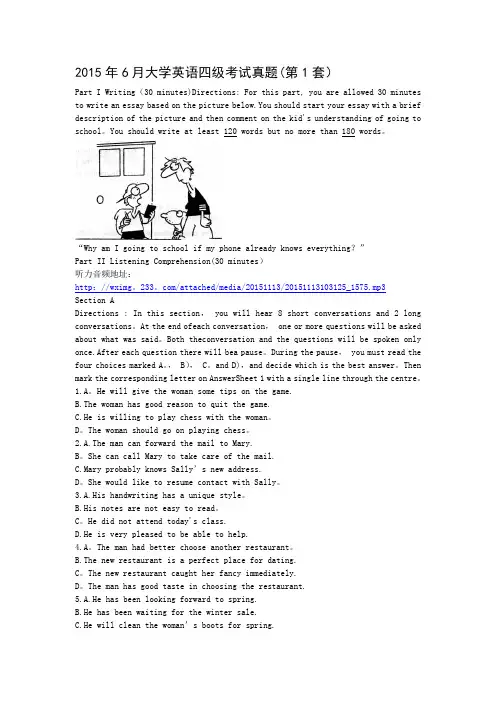
2015年6月大学英语四级考试真题(第1套)Part I Writing(30 minutes)Directions: For this part, you are allowed 30 minutes to write an essay based on the picture below.You should start your essay with a brief description of the picture and then comment on the kid's understanding of going to school。
You should write at least 120 words but no more than 180 words。
“Why am I going to school if my phone already knows everything?”Part II Listening Comprehension(30 minutes)听力音频地址:http://wximg。
233。
com/attached/media/20151113/20151113103125_1575.mp3Section ADirections : In this section, you will hear 8 short conversations and 2 long conversations。
At the end ofeach conversation, one or more questions will be asked about what was said。
Both theconversation and the questions will be spoken only once.After each question there will bea pause。
2015年6月大学英语6级真题(三套全)
2015年6月大学英语六级考试真题(第一套)When the right person is holding the right job at the right moment, that person's influence is greatly expanded. That is the position in which Janet Yellen, who is expected to be confirmed as the next chair of the Federal Reserve Bank (Fed) in January, now finds herself. If you believe, as many do, that unemployment is the major economic and social concern of our day, then it is no stretch to think Yellen is the most powerful person in the world right now.Throughout the 2008 financial crisis and the recession and recovery that followed, central banks have taken on the role of stimulators of last resort, holding up the global economy with vast amounts of money in the form of asset buying. Yellen, previously a Fed vice chair, was one of the principal architects of the Fed's $3.8 trillion money dump. A star economist known for her groundbreaking work on labor markets, Yeilen was a kind of prophetess early on in the crisis for her warnings about the subprime(次级债)meltdown. Now it will be her job to get the Fed and the markets out of the biggest and most unconventional monetary program in history without derailing the fragile recovery.The good news is that Yellen, 67, is particularly well suited to meet these challenges. She has a keen understanding of financial markets, an appreciation for their imperfections and a strong belief that human suffering was more related to unemployment than anything else.Some experts worry that Yellen will be inclined to chase unemployment to the neglect of inflation. But with wages still relatively flat and the economy increasingly divided between the well-off and the long-term unemployed' more people worry about the opposite, deflation(通货紧缩)that would aggravate the economy's problems.Either way, the incoming Fed chief will have to walk a fine line in slowly ending the stimulus. It must be steady enough to deflate bubbles(去泡沫)and bring markets back down to earth but not so quick that it creates another credit crisis.Unlike many past Fed leaders, Yellen is not one to buy into the finance industry's argument that it should be left alone to regulate itself. She knows all along the Fed has been too slack on regulation of finance.Yellen is likely to address right after she pushes unemployment below 6%, stabilizes markets and makes sure that the recovery is more inclusive and robust. As Princeton Professor Alan Blinder says' "She's smart as a whip, deeply logical, willing to argue but also a good listener. She can persuade without creating hostility." AH those traits will be useful as the global economy's new power player takes on its most annoying problems.56. What do many people think is the biggest problem facing Janet Yellen?A) Lack of money. B) Subprime crisis. C) Unemployment. D) Social instability.57. What did Yellen help the Fed do to tackle the 2008 financial crisis?A) Take effective measures to curb inflation.B) Deflate the bubbles in the American economy.C) Formulate policies to help financial institutions.D) Pour money into the market through asset buying.58. What is a greater concern of the general public?A) Recession. B) Deflation. C) Inequality. D) Income.59. What is Yellen likely to do in her position as the Fed chief?A) Develop a new monetary program. B) Restore public confidence.C) Tighten financial regulation. D) Reform the credit system.60. How does Alan Blinder portray Yellen?A) She possesses strong persuasive power.B) She has confidence in what she is doing.C) She is one of the world's greatest economists.D) She is the most powerful Fed chief in history.Passage TwoAir pollution is deteriorating in many places around the world. The fact that public parks in cities become crowded as soon as the sun shines proves that people long to breathe in green, open spaces. They do not all know what they are seeking but they flock there, nevertheless. And, in these surroundings, they are generally both peaceful and peaceable. It is rare to see people fighting in a garden. Perhaps struggle unfolds first, not at an economic or social level, but over the appropriation of air, essential to life itself. If human beings can breathe and share air, they don't need to struggle with one another.Unfortunately, in our western tradition, neither materialist nor idealist theoreticians give enough consideration to this basic condition for life. As for politicians, despite proposing curbs on environmental pollution, they have not yet called for it to be made a crime. Wealthy countries are even allowed to pollute if they pay for it.But is our life worth anything other than money? The plant world shows us in silence what faithfulness to life consists of. It also helps us to a new beginning, urging us to care for our breath, not only at a vital but also at a spiritual level. The interdependence to which we must pay the closest attention is that which exists between ourselves and the plant world. Often described as "the lungs of the planet", the woods that cover the earth offer us the gift of breathable air by releasing oxygen. But their capacity to renew the air polluted by industry has long reached its limit. If we lack the air necessary for a healthy life, it is because we have filled it with chemicals and undercut the ability of plants to regenerate it. As we know, rapid deforestation combined with the massive burning of fossil fuels is an explosive recipe for an irreversible disaster.The fight over the appropriation of resources will lead the entire planet to hell unless humans learn to share life, both with each other and with plants. This task is simultaneously ethical and political because it can be discharged only when each takes it upon herself or himself and only when it is accomplished together with others. The lesson taught by plants is that sharing life expands and enhances the sphere of the living, while dividing life into so-called natural or human resources diminishes it. We must come to view the air, the plants and ourselves as the contributors to the preservation of life and growth, rather than a web of quantifiable objects or productive potentialities at our disposal. Perhaps then we would finally begin to live, rather than being concerned with bare survival.61. What does the author assume might be the primary reason that people would struggle with each other?A) To get their share of clean air. B) To pursue a comfortable life.C) To gain a higher social status. D) To seek economic benefits.62. What does the author accuse western politicians of?A) Depriving common people of the right to clean air.B) Giving priority to theory rather than practical action.C) Offering preferential treatment to wealthy countries.D) Failing to pass laws to curb environmental pollution.63. What does the author try to draw our closest attention to?A) The massive burning of fossil fuels.B) Our relationship to the plant world.C) The capacity of plants to renew polluted air.D) Large-scale deforestation across the world.64. How can human beings accomplish the goal of protecting the planet according to the author?A) By showing respect for plants. B) By preserving all forms of life.C) By tapping all natural resources. D) By pooling their efforts together.65. What does the author suggest we do in order not just to survive?A) Expand the sphere of living. B) Develop nature's potentials.C) Share life with nature. D) Allocate the resources.Part III Reading Comprehension (40 minutes)Questions 56 to 60 are based on the following passage.I'll admit I've never quite understood the obsession(难以破除的成见)surrounding genetically modified (GM) crops. To environmentalist opponents, GM foods are simply evil, an understudied, possibly harmful tool used by big agricultural businesses to control global seed markets and crush local farmers. They argue that GM foods have never delivered on their supposed promise, that money spent on GM crops would be better channeled to organic farming and that consumers should be protected with warning labels on any products that contain genetically modified ingredients. To supporters, GM crops are a key part of the effort to sustainably provide food to meet a growing global population. But more than that, supporters see the GM opposition of many environmentalists as fundamentally anti-science, no different than those who question the basics of man-made climate change.For both sides, GM foods seem to act as a symbol: you're pro-agricultural business or anti-science. But science is exactly what we need more of when it comes to GM foods, which is why I was happy to see Nature devote a special series of articles to the GM food controversy. The conclusion: while GM crops haven't yet realized their initial promise and have been dominated by agricultural businesses, there is reason to continue to use and develop them to help meet the enormous challenge of sustainably feeding a growing planet.That doesn't mean GM crops are perfect, or a one-size-fits-all solution to global agriculture problems. But anything that can increase farming efficiency一the amount of crops we can produce per acre of land一will be extremely useful. GM crops can and almost certainly will be part of thatsuite of tools' but so will traditional plant breeding, improved soil and crop management一and perhaps most important of all, better storage and transport infrastructure(基础设施), especially in the developing world. (It doesn't do much good for farmers in places like sub-Saharan Africa to produce more food if they can't get it to hungry consumers.) I'd like to see more non-industry research done on GM crops—not just because we'd worry less about bias, but also because seed companies like Monsanto and Pioneer shouldn't be the only entities working to harness genetic modification. I'd like to see GM research on less commercial crops, like com. I don't think it's vital to label GM ingredients in food, but I also wouldn't be against it一and industry would be smart to go along with labeling, just as a way of removing fears about the technology.Most of all, though, I wish a tenth of the energy that's spent endlessly debating GM crops was focused on those more pressing challenges for global agriculture. There are much bigger battles to fight.56. How do environmentalist opponents view GM foods according to the passage?A) They will eventually ruin agriculture and the environment.B) They are used by big businesses to monopolize agriculture.C) They have proved potentially harmful to consumers' health.D) They pose a tremendous threat to current farming practice.57. What does the author say is vital to solving the controversy between the two sides of the debate?A) Breaking the GM food monopoly. B) More friendly exchange of ideas.C) Regulating GM food production. D) More scientific research on GM crops.58. What is the main point of the Nature articles?A) Feeding the growing population makes it imperative to develop GM crops.B) Popularizing GM technology will help it to live up to its initial promises.C) Measures should be taken to ensure the safety of GM foods.D) Both supporters and opponents should make compromises.59. What is the author's view on the solution to agricultural problems?A) It has to depend more and more on GM technology.B) It is vital to the sustainable development of human society.C) GM crops should be allowed until better alternatives are found.D) Whatever is useful to boost farming efficiency should be encouraged.60. What does the author think of the ongoing debate around GM crops?A) It arises out of ignorance of and prejudice against new science.B) It distracts the public attention from other key issues of the world.C) Efforts spent on it should be turned to more urgent issues of agriculture.D) Neither side is likely to give in until more convincing evidence is found.Passage TwoQuestions 61 to 65 are based on the following passage.Early decision —you apply to one school, and admission is binding —seems like a great choice for nervous applicants. Schools let in a higher percentage of early-decision applicants, which arguably means that you have a better chance of getting in. And if you do, you're done with thewhole agonizing process by December. But what most students and parents don't realize is that schools have hidden motives for offering early decision.Early decision, since it's binding, allows schools to fill their classes with qualified students; it allows ad-missions committees to select the students that are in particular demand for their college and know those students will come. It also gives schools a higher yield rate, which is often used as one of the ways to measure college selectivity and popularity.The problem is that this process effectively shortens the window of time students have to make one of the most important decisions of their lives up to that point. Under regular admissions, seniors have until May 1 to choose which school to attend; early decision effectively steals six months from them, months that could be used to visit more schools, do more research, speak to current students and alumni(校友)and arguably make a more informed decision.There are, frankly, an astonishing number of exceptional colleges in America, and for any given student, there are a number of schools that are a great fit. When students become too fixated(专注)on a particular school early in the admissions process, that fixation can lead to severe disappointment if they don't get in or, if they do, the possibility that they are now bound to go to a school that, given time for further reflection, may not actually be right for them.Insofar as early decision offers a genuine admissions edge, that advantage goes largely to students who already have numerous advantage. The students who use early decision tend to be those who have received higher-quality college guidance, usually a result of coming from a more privileged background. In this regard, there's an argument against early decision, as students from lower-income families are far less likely to have the admissions know-how to navigate the often confusing early deadlines.Students who have done their research and are confident that there's one school they would be thrilled to get into should, under the current system, probably apply under early decision. But for students who haven't yet done enough research, or who are still constantly changing their minds on favorite schools, the early-decision system needlessly and prematurely narrows the field of possibility just at a time when students should be opening themselves to a whole range of thrilling options.61. What are students obliged to do under early decision?A) Look into a lot of schools before they apply. B) Attend the school once they are admitted.C) Think twice before they accept the offer. D) Consult the current students and alumni.62. Why do schools offer early decision?A) To make sure they get qualified students.B) To avoid competition with other colleges.C) To provide more opportunities for applicants.D) To save students the agony of choosing a school.63. What is said to be the problem with early decision for students?A) It makes their application process more complicated.B) It places too high a demand on their research ability.C) It allows them little time to make informed decisions.D) It exerts much more psychological pressure on them.64. Why are some people opposed to early decision?A) It interferes with students' learning in high school.B) It is biased against students at ordinary high schools.C) It causes unnecessary confusion among college applicants.D) It places students from lower-income families at a disadvantage.65. What does the author advise college applicants to do?A) Refrain from competing with students from privileged families.B) Avoid choosing early decision unless they are fully prepared.C) Find sufficient information about their favorite schools.D) Look beyond the few supposedly thrilling options.。
2015年6月英语四级考试真题(第一套)
自主招生模拟试题三刘娜Section A〔每题2 分,共30分Directions: In this section, there is a passage with ten blanks.You are required to select one word for each blank from a list of choices given in a word bank following the passage.Read the passage through carefully before making your choices.Each choice in the bank is identified by a letter.Please mark the corresponding letter for each item on Answer Sheet2 with a single line through the centre.You may not use any of the words in the bank more than once.Questions 36 to 45 are based on the following passage.The U.S.Department of Education is making efforts to ensure that all students have equal access to a quality education.Today it is 36 the launch of the Excellent Educators for All Initiative.The initiative will help states and school districts support great educators for the students who need them most."All children are 37 to a high-quality education regardless of their race, zip code or family income.It is 38 important that we provide teachers and principals the support they need to help students reach their full 39 ," U.S.Secretary of Education Arne Duncan said." Despite the excellent work and deep 40 of our nation's teachers and principals, students in high-poverty, high- minority schools are unfairly treated across our country.We have to do better.Local leaders and educators will 41 their own creative solutions, but we must work together to 42 our focus on how to better recruit, support and 43 effective teachers and principals for all students, especially the kids who need them most."Today's announcement is another important step forward in improving access to a quality education, a 44 of President Obama's year of ter today, Secretary Duncan will lead a round table discussion with principals and school teachers from across the country about the 45 of working in high-need schools and how to adopt promising practices for supporting great educators in these schools.A.AnnouncingB.beneficialC.challengesmitmentponentF.contestsG.criticallyH.developI.distributingJ.enhanceK.entitled L.potential M.properly N.qualified O.retainSection B 〔每题3 分共30分Directions: In this section, you are going to read a passage with ten statements attached to it.Each statement contains information given in one of the paragraphs.Identify the paragraph from which the information is derived.You may choose a paragraph more than once.Each paragraph is marked with a letter.Answer the questions by marking the corresponding letter on Answer Sheet 2.The Changes Facing Fast FoodA.Fast-food firms have to be a thick-skinned bunch.Health experts regularly criticise them severely for selling food that makes people fat.Critics even complain that McDonald's, whose logo symbolizes calorie excess, should not have been allowed to sponsor the World Cup.These are things fast-food firms have learnt to cope with.But not perhaps for much longer.The burger business faces more pressure from regulators at a time when it is already adapting strategies in response to shifts in the global economy.B>Fast food was once thought to be recession-proof.When consumers need to cut spending, the logic goes, cheap meals like Big Macs and Whoppers become even more attractive.Such "trading down"proved true for much of the latest recession, when fast-food companies picked up customers who could no longer afford to eat at casual restaurants.Traffic was boosted in America, the home of fast food, with discounts and promotions, such as $1 menus and cheap combination meals.C>As a result, fast-food chains have weathered the recession better than their more expensive competitors.In 2009 sales at full-service restaurants in America fell by more than 6% , but total sales remained about the same at fast-food chains.In some markets, such as Japan, France and Britain, total spending on fast food increased.Same-store sales in America at McDonald's, the world's largest fast-food company, did not decline throughout the downturn.Panera Bread, an American fast-food chain known for its fresh ingredients, performed well, too, because it offers higher-quality food at lower prices than restaurants.D>But not all fast-food companies have been as fortunate.Many, such as Burger King, have seen sales fall.In a severe recession, while some people trade down to fast food, many others eat at home more frequently to save money.David Palmer, an analyst at UBS, a bank, says smaller fast- food chains in America, such as Jack in the Box and Carl's Jr., have been hit particularly hard in this downturn because they are competing with the global giant McDonald's, which increased spending on advertising by more than 7% last year as others cut back.E.Some fast-food companies also sacrificed their own profits by trying to give customers better value.During the recession companies set prices low, hoping that once they had tempted customers through the door they would be persuaded to order more expensive items.But in many cases that strategy did not st year Burger King franchisees <特许经营人>sued <起诉>the company over its double-cheeseburger promotion, claiming it was unfair for them to be required to sell these for $1 when they cost$1.10 to make.In May a judge ruled in favour of Burger King.Nevertheless, the company may still be cursing its decision to promote cheap choices over more expensive ones because items on its "value menu" now account for around 20% of all sales, up from 12% last October.F.Analysts expect the fast-food industry to grow modestly this year.But the downturn is making companies rethink their strategies.Many are now introducing higher-priced items to entice <引诱>consumers away from $1 specials.KFC, a division of Yum! Brands, which also owns Taco Bell and Pizza Hut, has launched a chicken sandwich that costs around $5.And in May Burger King introduced barbecue <烧烤>pork ribs at $7 for eight.panies are also trying to get customers to buy new and more items, including drinks.McDonald's started selling better coffee as a challenge to Starbucks.Its " McCafe" line now accounts for an estimated 6% of sales in America.Starbucks has sold rights to its Seattle's Best coffee brand to Burger King, which will start selling it later this year.H.As fast-food companies shift from "super size" to "more buys", they need to keep customer traffic high throughout the day.Many see breakfast as a big opportunity, and not just for fatty food.McDonald's will start selling porridge <粥>in America next year.Breakfast has the potential to be very profitable, says Sara Senatore of Bernstein, a research firm, because the margins can be high.Fast-food companies are also adding midday and late-night snacks, such as blended drinks and wraps.The idea is that by having a greater range of things on the menu, "we can sell to consumers products they want all day," says Rick Carucci., the .chief financial officer of Yum ! Brands.I.But what about those growing waistlines? So far, fast-food firms have cleverly avoided government regulation.By providing healthy options, like salads and low-calorie sandwiches, they have at least given the impression of doing something about helping to fight obesity <肥胖症>.These offerings are not necessarily loss-leaders, as they broaden the appeal of outlets to groups of diners that include some people who don't want to eat a burger.But customers cannot be forced to order salads instead of fries.J.In the future, simply offering a healthy option may not be good enough."Every packaged-food and restaurant company I know is concerned about regulation right now," says Mr.Palmer of UBS.America's health-reform bill, which Congress passed this year, requires restaurant chains with 20 or more outlets to put the calorie-content ofitems they serve on the menu.A study by the National Bureau of Economic Research, which tracked the effects on Starbucks of a similar calorie-posting law in New York City in 2007, found that the average calorie-count per transaction fell 6% and revenue increased 3% at Starbucks stores where a Dunldn Donuts outlet was nearby--a sign, it is said, that menu-labelling could favour chains that have more healthy offerings.K.In order to avoid other legislation in America and elsewhere, fast-food companies will have to continue innovating <创新>.Walt Riker of McDonald's claims the change it has made in its menu means it offers more healthy items than it did a few years ago."We probably sell more vegetables,more milk, more salads, more apples than any restaurant business in the world," he says.But the recent proposal by a county in California to ban McDonald's from including toys in its high-calorie"Happy Meals", because legislators believe it attracts children to unhealthy food, suggests there is a lot more left to do.46.Some people propose laws be made to stop McDonald's from attaching toys to its food specials for children.47.Fast-food firms may not be able to cope with pressures from food regulation in the near future.48.Burger King will start to sell Seattle's Best coffee to increase sales.49.Some fast-food firms provide healthy food to give the impression they are helping to tackle the obesity problem.50.During the recession, many customers turned to fast food to save money.51.Many people eat out less often to save money in times of recession.52.During the recession, Burger King's promotional strategy of offering low-priced items often proved ineffective.53.Fast-food restaurants can make a lot of money by selling breakfast.54.Many fast-food companies now expect to increase their revenue by introducing higher-priced items.55.A newly-passed law asks big fast-food chains to specify the calorie count of what they serve on the menu. Section CDirections: There are 2 passages in this section.Each passage is followed by some questions or unfinished statements.For each of them there are four choices marked A., B>, C.and D >.You should decide on the best choice and mark the corresponding letter on Answer Sheet 2 with a single line through the centre.Passage OneQuestions 56 to 60 are based on the following passage.If you think a high-factor sunscreen <防晒霜>keeps you safe from harmful rays, you may be wrong.Research in this week's Nature shows that while factor 50 reduces the number of melanomas<黑瘤>and delays their occurrence, it can't prevent them.Melanomas are the most aggressive skin cancers.You have a higher risk if you have red or blond hair, fair skin, blue or green eyes, or sunburn easily, or if a close relative has had one.Melanomas are more common if you have periodic intense exposure to the sun.Other skin cancers are increasingly likely with long-term exposure.There is continuing debate as to how effective sunscreen is in reducing melanomasthe evidence is weaker than it is for preventing other types of skin cancer.A 2011 Australian study of 1,621 people found that people randomly selected to apply sunscreen daily had half the rate of melanomas of people who used cream as needed.A second study, comparing 1,167 people with melanomas to 1,101 who didn't have the cancer, found that using sunscreen routinely, alongside other protection such as hats,long sleeves or staying in the shade, did give some protection.This study said other forms of sun protectionnot sunscreenseemed most beneficial.The study relied on people remembering what they had done over each decade of their lives, so it's not entirely reliable.But it seems reasonable to think sunscreen gives people a false sense of security in the sun.Many people also don't use sunscreen properlyapplying insufficient amounts, failing to reapply after a couple of hours and staying in the sun too long.It is sunburn that is most worryingrecent research shows five episodes of sunburn in the teenage years increases the risk of all skin cancers.The good news is that a combination of sunscreen and covering up can reduce melanoma rates, as shown by Australian figures from their slip-slop-slap campaign.So if there is a heat wave this summer, it would be best for us, too, to slip on a shirt, slop on <抹上>sunscreen and slap on a hat.56.What is people's common expectation of a high-factor sunscreen?A.It will delay the occurrence of skin cancer.B.It will protect them from sunburn.C.It will keep their skin smooth and fair.D.It will work for people of any skin color.57.What does the research in Nature say about a high-factor sunscreen?A.It is ineffective in preventing melanomas.B.It is ineffective in case of intense sunlight.C.It is ineffective with long-term exposure.D.It is ineffective for people with fair skin.58.What do we learn from the 2011 Australian study of 1,621 people?A.Sunscreen should be applied alongside other protection measures.B.High-risk people benefit the most from the application of sunscreen.C.Irregular application of sunscreen does women more harm than good.D.Daily application of sunscreen helps reduce the incidence of melanomas.59.What does the author say about the second Australian study?A.It misleads people to rely on sunscreen for protection.B.It helps people to select the most effective sunscreen.C.It is not based on direct observation of the subjects.D.It confirms the results of the first Australian study.60.What does the author suggest to reduce melanoma rates?ing both covering up and sunscreen.B.Staying in the shade whenever possible.ing covering up instead of sunscreen.D.Applying the right amount of sunscreen.Passage TwoQuestions 61 to 65 are based on the following passage.Across the rich world, well-educated people increasingly work longer than the less-skilled.Some65% of American men aged 62 -74 with a professional degree are in the workforce, compared with32% of men with only a high-school certificate.This gap is part of a deepening divide between the well-educated well-off and the unskilled poor.Rapid technological advance has raised the incomes of the highly skilled while squeezing those of the unskilled.The consequences, for individuals and society, are profound.The world is facing an astonishing rise in the number of old people, and they will live longer than ever before.Over the next 20 years the global population of those aged 65 or more will almost double, from 600 million to 1.1 billion.The experience of the 20th century, when greater longevity <长寿>translated into more years in retirement rather than more years at work, has persuaded many observers that this shift will lead to slower economic growth, while the swelling ranks of pensioners will create government budget problems.But the notion of a sharp division between the working young and the idle old misses a new trend, the growing gap between the skilled and the unskilled.Employment rates are falling among younger unskilled people, whereas older skilled folk are working longer.The divide is most extreme in America, where well-educated baby-boomers <二战后生育高峰期出生的美国人>are putting off retirement while many less-skilled younger people have dropped out of the workforce.Policy is partly responsible.Many European governments have abandoned policies that used to encourage people to retire early.Rising life expectancy <预期寿命>, combined with the replacement of generous defined-benefit pension plans with less generous defined-contribution ones, means that even the better-off must work longer to have a comfortable retirement.But the changing nature of work also plays a big role.Pay has risen sharply for the highly educated, and those people continue to reap rich rewards into old age because these days the educated elderly are more productive than the preceding generation.Technological change may well reinforce that shift: the skills that complement computers, from management know how to creativity, do not necessarily decline with age.61.What is happening in the workforce in rich countries?A.Younger people are replacing the elderly.B.Well-educated people tend to work longer.C.Unemployment rates are rising year after year.D.People with no college degree do not easily find work.62.What has helped deepen the divide between the well-off and the poor?A.Longer life expectancies.B.A rapid technological advance.C.Profound changes in the workforce.D.A growing number of the well-educated.63.What do many observers predict in view of the experience of the 20th century?A.Economic growth will slow down.ernment budgets will increase.C.More people will try to pursue higher education.D.There will be more competition in the job market.64.What is the result of policy changes in European countries?A.Unskilled workers may choose to retire early.B.More people have to receive in-service training.C.Even wealthy people must work longer to live comfortably in retirement.D.People may be able to enjoy generous defined-benefits from pension plans.65.What is characteristic of work in the 21st century?puters will do more complicated work.B.More will be taken by the educated young.C.Most jobs to be done will be the creative ones.D.Skills are highly valued regardless of age.Passage ThreeAmong the more colorful characters of Leadville's golden age were H.A.W. Tabor and his second wife, Elizabeth McCourt, better known as "Baby Doe". Their history is fast becoming one of the legends of the Old West. Horace Austin Warner Tabor was a school teacher in Vermont. With his first wife and two children he left Vermont by covered wagon in 1855 to homestead in Kansas. Perhaps he did not find farming to his liking, or perhaps he was lured by rumors of fortunes to be made in Colorado mines. At any rate, a few years later he moved west to the small Colorado mining camp known as California Gulch, which he later renamed Leadville when he became its leading citizen. "Great deposits of lead are sure to be found here." he said.As it turned out, it was silver, not lead, that was to make Leadville's fortune and wealth. Tabor knew little about mining himself, so he opened a general store, which sold everything from boots to salt, flour, and tobacco. It was his custom to "grubstake" prospective miners, in other words, to supply them with food and supplies, or "grub", while they looked for ore, in return for which he would get a share in the mine if one was discovered. He did this for a number of years, but no one that he aided ever found anything of value.Finally one day in the year 1878, so the story goes, two miners came in and asked for "grub". Tabor had decided to quit supplying it because he had lost too much money that way. These were persistent, however, and Tabor was too busy to argue with them. "Oh help yourself. One more time won't make any difference," He said and went on selling shoes and hats to other customers. the two miners took $17 worth of supplies, in return forwhich they gave Tabor a one-third interest in their findings. They picked a barren place on the mountainside and began to dig. After nine days they struck a rich vein of silver. Tabor bought the shares of the other two men, and so the mine belonged to him alone. This mine, known as the "Pittsburgh Mine," made $1,300,000 for Tabor in return for his $17 investment.Later Tabor bought the Matchless Mine on another barren hillside just outside the town for $117,000.This turned out to be even more fabulous than the Pittsburgh, yielding $35,000 worth of silver per day at one time. Leadville grew. Tabor became its first mayor, and later became lieutenant governor of the state.66. Leadville got its name for the following reasons EXCEPT______.A. because Tabor became its leading citizenB. because great deposits of lead is expected to be found thereC. because it could bring good fortune to TaborD. because it was renamed67. The word "grubstake" in paragraph 2 means______.A. to supply miners with food and suppliesB. to open a general storeC. to do one's contribution to the development of the mineD. to supply miners with food and supplies and in return get a share in the mine, if one was discovered68. Tabor made his first fortune_____.A. by supplying two prospective miners and getting in return a one-third interest in the findingsB. because he was persuaded by the two miners to quit supplyingC. by buying the shares of the otherD. as a land speculator69. The underlying reason for Tabor's life career is______.A. purely accidentalB. based on the analysis of miner's being very poor and their possibility of discovering profitable mining siteC. through the help from his second wifeD. he planned well and accomplished targets step by step70. If this passage is the first part of an article, who might be introduced in the following part?A. Tabor's life.B. Tabor's second wife, Elizabeth McCourt.C. Other colorful characters.D. Tabor's other careers.Passage fourIs there enough oil beneath the Arctic National Wildlife Refuge〔保护区<ANWR> to help secure America’s energy future ? President Bush certainly thinks so. He has argued that tapping ANWR’s oil would help ease California’s electricity crisis and provide a major boost to the country’s energy independence. But no one knows for sure how much crude oil lies buried beneath the frozen earth with the last government survey, conducted in 1998, projecting output anywhere from 3 billion to 16 billion barrels.The oil industry goes with the high end of the range, which could equal as much as 10% of U.S. consumption for as long as six years. By pumping more than 1 million barrels a day from the reserve for the next two three decades, lobbyists claim, the nation could cut back on imports equivalent to all shipments to the U.S. from Saudi Arabia. Sounds good. An oil boom would also mean a multibillion-dollar windfall〔意外之财in tax revenues, royalties〔开采权使用费and leasing fees for Alaska and the Federal Government. Best of all, advocates of drilling say , damage to the environment would be insignificant . "We’ve never had a document case of oil rig chasing deer out onto the pack ice." says Alaska State Representative Scott Ogan .Not so far, say environmentalists. Sticking to the low end of government estimates, the National Resources Defense Council says there may be no more than 3.2 billion barrels of economically recoverable oil in the coastal plain of ANWR, a drop in the bucket that would do virtually nothing t o ease America’s energy problems. Andconsumers would wait up to a decade to gain any benefits, because drilling could begin only after much bargaining over leases, environmental permits and regulatory review. As for ANWR’s impact on the California power c risis, environmentalists point out that oil is responsible for only 1% of the GoldenState’s electricity output –and just 3% of the nation’s.71. What does President Bush think of tapping oil in ANWR?A> It will exhaust the nation’s oil reserves.B> It wil l help secure the future of ANWR.C> It will help reduce the nation’s oil importsD> It will increase America’s energy consumption72. We learn from the second paragraph that the American oil industry _______A> believes that drilling for oil in ANWR will produce high yieldsB> tends to exaggerate America’s reliance on foreign oilC> shows little interest in tapping oil in ANWRD> expects to stop oil imports from Saudi Arabia73. Those against oil drilling in ANWR argue that _________A> it can cause serious damage to the environmentB> it can do little to solve U.S. energy problemsC> it will drain the oil reserves in the Alaskan regionD> it will not have much commercial value74. What do the environmentalists mean by saying "Not so fast" <Line 1, Para .3>?A> Oil exploitation takes a long timeB> The oil drilling should be delayedC> Don’t be too optimisticD> Don’t expect fast returns75. It can be learned from the passage that oil exploitation beneath ANWR’s frozen earth ______.A> remains a controversial issueB> is expected to get under way soonC> involves a lot of technological problemsD> will enable the U.S. to be oil independent美国教育部正在努力确保所有学生享有接受高质量教育的乎等权利:今天,它<36>宣布开始实施"为所有学生提供优秀教育工作者"的活动方案。
大学英语六级卷一真题2015年6月
大学英语六级卷一真题2015年6月(总分:710.50,做题时间:120分钟)一、Part I Writing (30 minutes)(总题数:1,分数:106.50)1.Directions: For this part, you are allowed 30 minutes to write an essay commenting on the saying “Knowledge is a treasure, but practice is the key to it.” You can give one example or two to illustrate your point of view. You should write at least 150 words but no more than 200 words. (分数:106.50)__________________________________________________________________________________________ 正确答案:( Would you want a doctor to operate on you who has only learned about operations from a textbook? The answer to this is obviously a resounding “No!” Knowledge gained from books must always be complemented by knowledge gained from actual experience, to be of real value. For me actually practicing a particular action or experiment myself and experiencing the result, leaves a much deeper and lasting impression than what I get from simply reading or listening. If I read about how to write an essay or listened to someone talk about writing an essay, I still wouldn’t feel that I knew how to write an essay until I wrote one for myself. It is the case, however, that writing the essay would be based on the methods I learned intellectually. The same can be said for other skills, like sports, for example. A person can know all the rules of a game, associated skills and strategies, but until that person gets on a court with a ball in motion, the theory remains flat, useless. To sum up, as to theoretical knowledge and practical skills, the latter is certainly more important. Just as British churchman Thomas Fuller put it, “Knowledge is a treasure, but practice is the key to it.” )解析:二、Part II Listening Comprehension (30 minutes) (总题数:1,分数:56.80)(分数:56.80)A.Prepare for his exams.B.Catch up on his work.C.Attend the concert. √D.Go on a vacation.解析:W: Can you come to the concert with me this weekend or do you have to prepare for exams? M: I still have a lot to do. But maybe a break will do me good. Q: What will the man probably do? 对话中女士问男士这周末能否和她一起去听音乐会。
2015年6月大学英语六级考试真题(卷一)
2015年6月大学英语六级考试真题(一)Part I Writing(30minutes) Directions:For this part,you are allowed30minutes to write an essay commenting on the saying“Knowledge is a treasure,but practice is the key to it.”You can give an example or two to illustrate your point of view.You should write at least150words but no more than200words.注意:此部分试题请在答题卡1上作答。
PartⅡListening Comprehension(30minutes) Section ADirections:In this section,you will hear8short conversations and2long conversations.At the end of each conversation, one or more questions will be asked about what was said.Both the conversation and the questions will be spoken only once.After each question there will be a pause.During the pause,you must read the four choices marked A),B)9C)and D),and decide which is the best answer.Then mark the corresponding letter on Answer Sheet1with a single line through the centre.注意:此部分试题请在答题卡1上作答。
2015年6月大学英语六级真题及答案(第一套)
2015年6月英语六级真题及答案(第一套)Part I Writing (30 minutes)Directions: For this part, you are allowed 30 minutes to write an essay commenting on the saying"Knowledge is a treasure, but practice is the key to it. " You can give an example or two to illustrate your point of view. You should write at least 150 words but no more than 200 words.注意:此部分试题请在答题卡1上作答。
PartⅡListening Comprehension (30 minutes)听力音频地址:/englishlistening/CET6/zhenti/2015-12-20/411536.htmlSection ADirections: In this section, you will hear 8 short conversations and 2 long conversations. At the end of each conversation, one or more questions will be asked about what was said. Both the conversation and the questions will be spoken only once. After each question there will be a pause. During the pause, you must read the four choices marked A., B., C. and D ), and decide which is the best answer. Then mark the corresponding letter on Answer Sheet 1 with a single line through the centre.注意:此部分试题请在答题卡1上作答。
2015年6月英语六级考试真题及答案(卷一完整版)
Writing:"Knowledge is a treasure, but practice is the key to it."参考范文:第二段,解释引言。
中心句+两个原因+举例。
举例应用对比法。
第三段,总结该引言的合理+两个理由+展望未来。
短对话1. C. Attend the concert.2. D. None of the passengers were injured or killed.3. A. An article about the election.9. C) Export bikes to foreign markets.长对话二19. B) Get involved in his community.20. A) Deterioration in the quality of life.21. D) They are too big for individual efforts.22. C) He had done a small deed of kindness.23. B) Pressure and disease.24. A) It experienced a series of misfortunes.25. C) They could do nothing to help him.26. are supposed to27. inserting31. flame32. schooling33. controversies34. are concerned with35. dissatisfaction近!41. F. jobless 根据后面but所接信息可推出该空应该为负面色彩形容词,jobless 最合适42. M. shrunk 同样根据but以及more,可以推出该空为shrunk43. A. benefits 与dislocating effect相对应的应该是一个正面的复数名词,或通过but解题B) The intuitive answer is that some works of art…C) Cutting, a professor at Cornell University, …K) The intrinsic quality of a work of art is starting to…51.D) Cutting believes his experiment offers…52.L)A s tudy in the Br i t i sh Journa l of Aes the t i cs sugges t s…I)"Say ing tha t cul tu ra l ob jec t s have va lue,"56. C.Unemployment于很重要的位置,而失业是如今的【主要】社会和经济话题。