
2009年同等学力英语真题
2009年同等学力人员申请硕士学位英语水平全国统一考试试题Paper One 试卷一(90 minutes)PartⅠDialogue Communication (10 minutes,10 points,1 for each)(略)PartⅡVocabulary (20 minutes,10 points,0. 5 for each)Section ADirections: In this section there are 10 sentences,each with one word or phrase underlined. Choose the one from the 4 choices marked A, B, C and D that best keeps the meaning of the sentence. Then mark the corresponding letter with a single bar across the square brackets on your machine-scoring ANSWER SHEET.11. The applications of genetic engineering are abundant and choosing one appropriate for thiscase can be rather difficult.A. plentifulB. sufficientC. adequateD. countable12. The newly elected president has pledged $ 13 million to the automobile industry for itssurvival.A. preparedB. promisedC. disposedD. delivered13. The Americans recognize that the UN can be the channel for greater diplomatic activity.A. mediumB. placeC. resortD. tunnel14. The growth of part-time and flexible working pattern allows more women to take advantageof job opportunities.A. catch up withB. make use ofC. cast light onD. get rid of15. Nobody can help but be fascinated by the world into which he is taken by the science fiction.A. impressedB. amusedC. puzzledD. attracted16. Senator James Meeks has called off a boycott of Chicago Public Schools, organized to protestIllinois education funding system.A. reclaimedB. proposedC. canceledD. indulged17. The new book focuses on the concept that to achieve and maintain total health, people needphysical, social and emotional well-being.A. attainB. gainC. acquireD. gather18. The 16 percent fare increase would bring Chicago fares in line with those of other big cities.A. in agreement withB. in cooperation withC. in connection withD. in association with19. It is true that London is often sunless, damp and raw, though the occasional sunny days seemall the more attractive by contrast.A. mildB. chillyC. cloudyD. moist20. Like flowers that have been waiting all winter to blossom, tourists are eager to burst forthwith their cameras.A. surviveB. breezeC. bloomD. reviveSection BDirections: In this section, there are 10 incomplete sentences. For each sentence there 4 choices marked A, B, C and D. Choose the one that best completes the sentence. Then mark the corresponding letter with a single bar across the square brackets on your machine- scoring ANSWER SHEET.21. A large______ of the sunlight never reaches the earth while infra-red heat given off by theearth is allowed to escape freely.A. rationB. proportionC. rateD. fraction22. It is amusing that she______ her father's bad temper as well as her mother's good looks.A. inheritedB. retainedC. preservedD. maintained23. ______ the few who have failed in their examination, all the other students in the hall are invery high spirits.A. In spite thatB. But forC. Apart fromD. For the sake of24. The decline in moral standards, which has long concerned social analysts, has at last______the attention of average Americans.A. clarifiedB. cultivatedC. characterizedD. captured25. Our neighbor Uncle Johnson is a stubborn man. Needless to say,we tried______ to make himchange his mind.A. in shortB. in secretC. in vainD. in danger26. The western media was astonished to see that China’s GDP______ by almost 40% just in twoyears’ time.A. flourishedB. floatedC. soaredD. roared27. Unemployment seems to be the______ social problem in this area and may undermine socialstability.A. prevalentB. primitiveC. previousD. premature28. Many people, when ill, see their doctors and ask them to______ something that will makethem fell better.A. describeB. prescribeC. reviseD. devise29. Facing growing costs and shrinking tax______, the government is now threatening to cutfunding for environmental protection programs.A. budgetB. collectionC. profitD. revenue30. Research shows heavy coffee drinking is______ a small increase in blood pressure, but notenough to increase the risk for high blood pressure.A. compared withB. associated withC. attributed toD. referred toPart ⅢReading Comprehension (45 minutes,30 points,1 for each)Directions:There are 5 passages in this part. Each passage is followed by 6 questions or unfinished statements. For each of them there are 4 choices marked A, B, C and D. Choose the best one and mark the corresponding letter with a single bar across the square brackets on your machine-scoring ANSWER SHEET.Passage OneThe other day my son asked me if he could ride up to his elementary school on his bike and meet his friend. He wanted the both of them to ride back to our house so they could play video games and jump on trampoline (蹦床).I have to admit, part of me wanted to say no. We can go pick him up or his parents can bring him over here,I thought. But my son is eleven years old now. And after all,I do let him ride his bike to school. But I also drive my daughter to school and I can see him on the way, making sure he is getting there safely.My husband thinks I am too overprotective. I don’t dare to let my children walk anywhere without one of us going along. As you pull out of our neighborhood, there is a shopping center across the street. My son always asks if he can ride his bike or walk over to the drugstore by himself. But crossing that street is just too dangerous. The cars fly around the corner like they’re driving in a car race. What if he gets hit? What if some teenage bullies are hanging out in the parking lot?I want so much to give my children the freedom that I enjoyed having when I was growing up but I hesitate to do so because there are dangers around every corner. Too many kidnaps,too many sex offenders. I went online and discovered there are 41 sex offenders in my area alone.I honestly don’t think my mom worried about such things when her children were young.Growing up in the 1970s was indeed a different time. I never wore a helmet (头盗)when I rode a bike. We were all over the neighborhood, on our bikes and on foot, coming home for dinner and then back out again until dark. We rode in the back of the truck, didn’t wear seatbelts. I walked to and from school every day....31. What did the author fell reluctant to let her son do?A. Meet his friend.B. Play video games.C. Jump on the trampoline.D. Ride his bike on streets.32. What does the author mean when she says “But my son is eleven years old now”?A. He is old enough to be given some freedom now.B. He is a bit too young to go out alone.C. He has reached the legal age for riding a bike.D. He can’t protect himself from road hazards.33. Given her husband's attitude towards bringing up kids, he would most probably_____.A. drive his son to school to ensure safetyB. follow his son all the way to school and backC. give his son more freedom in deciding what to doD. ask the other boy’s parents to bring him over here34. Which of the following is NOT considered by the author as a potential threat to kids?A. Teenage bullies.B. The drugstore.C. Child abusers.D. Cars racing by.35. What can we infer from the last paragraph?A. The social security back in the 1970s was no better than it is today.B. Today’s children enjoy more freedom than those in the 1970s.C. Children today are more obedient to their parents.D. Children in the 1970s enjoyed more freedom than those today.36. What is the author’s main purpose in writing this passage?A. To compare today's social environment with that of the 1970s.B. To show her concern over the increasing crime rate in her neighborhood.C. To describe her hesitation as to how much freedom she should give her son.D. To express her worries about both safety and security in her area.Passage TwoAbout a century ago more people would not have appreciated the study of a foreign language as they do today. Gone are those days when patriotism towards one’s own language was major obstacle to learning foreign languages, a time when most nations were trying to throw their alien rulers out of their countries in their freedom struggles. Gone are those days when people were proud of their mother or father tongues and considered that their native languages alone will suffice the need to survive. Language skills today have become as important as other business and career skills like IT,vocational or professional skills. Thus learning a foreign language today has become essential for an individual whether it is for careers, growing a business, or even to make an impression.All that one needs to possess these days is a drive to learn a foreign language and there are all kinds of institutes and courses that teach various foreign languages like French, German, Spanish, and Japanese. Today’s world economy has bridged the barriers of race, sex, color and religion and the world has become a smaller place. Today’s businesses also demand language skills to expand and grow in other countries. Tens and hundreds of businesses world wide are expanding and growing their businesses by promoting them in countries other than their countries of origin. The tremendous growth of the Internet has further increased the demand for language skills. In Canada an official rule also says that all commercial establishments must have their websites created both in English and French, the official languages of the country.Language can also ease race and border barriers. You are more welcome in an alien nation if you know the language of the people there and can converse in their tongue. People in these countries immediately respect you and think you care about their culture as much as they do because in any culture language is the key identity.37. One of the reasons for not studying a foreign language in the past is______ .A. it was too difficultB. it was not allowedC. it was seen as disloyaltyD. it was taught by foreign rulers38. According to the article, which of the following is true?A. People’s language skills are better than in the past.B. Foreign language skills are of vital importance.C. It’s easier nowadays to learn a foreign language.D. People today are not proud of their native language.39. What does “to make an impression” (Paragraph 1) probably mean?A. To remember things.B. To express ideas.C. To show respect.D. To be liked by others.40. The world has become smaller because of______.A. business expansionB. the growth of the InternetC. a globalized economyD. the learning of foreign languages41. According to the article, the growth of the Internet requires______.A. more foreign language skillsB. more bilingual websitesC. better command of EnglishD. more commercial establishments42. People in a foreign country will treat you with more respect if you speak their language because______.A. they think you love their countryB. they think you understand their cultureC. it’s easier for them to communicate with youD. they believe you are a good language learnerPassage ThreeYou may have wondered why the supermarkets are all the same. It is not because the companies that operate them lack imagination. It is because they all aim at persuading people to buy things.In the supermarket,it takes a while for the mind to get into a shopping mode. This is why the area immediately inside the entrance is known as the “decompression zone”. People need to slow down and look around, even if they are regulars. In sales terms this area is a bit of a loss, so it tends to be used more for promotion.Immediately inside the first thing shoppers may come to is the fresh fruit and vegetables section. For shoppers, this makes no sense. Fruit and vegetables can be easily damaged, so they should be bought at the end, not the beginning, of a shopping trip. But what is at work here? It turns out that selecting good fresh food is a way to start shopping, and it makes people fell less guilty about reaching for the unhealthy stuff later on.Shoppers already know that everyday items, like milk, are invariable placed towards the back of a store to provide more opportunities to tempt customers. But supermarkets know shoppers know this, so they use other tricks, like placing popular items halfway along a section so that people have to walk all along the aisle looking for them. The idea is to boost “dwell time”: the length of time people spend in a store.Traditionally retailers measure “footfall” as the number of people entering a store is known, but those numbers say nothing about where people go and how long they spend there. But nowadays,a piece of technology can fill the gap : the mobile phone. Path Intelligence, a British company tracked people’s phones at Gun wharf Quays, a large retail centre in Portsmouth not by monitoring calls, but by plotting the positions of handsets as they transmit automatically to cellular networks. It found that when dwell time rose 1 % sales rose 1. 3%.Such techniques are increasingly popular because of a deepening understanding about how shoppers make choices. People tell market researchers that they make rational decisions about what to buy, considering things like price, selection or convenience. But subconscious forces,involving emotion and memories,are clearly also at work.43. In Paragraph 2,”decompression zone” is the area meant to______ .A. offer shoppers a place to have a restB. prepare shoppers for the mood of buyingC. encourage shoppers to try new productsD. provide shoppers with discount information44. Putting fruit-and-vegetable section near the entrance takes advantage of shoppers______.A. common senseB. shopping habitsC. concerns with timeD. shopping psychology45. Path Intelligence uses a technology to______.A. count how many people enter a storeB. measure how long people stay at a storeC. find out what people buy in a storeD. monitor what people say and do in a store46. What happened at Gun wharf Quays showed that sales ______.A. was in direct proportion to dwell timeB. was reversely linked to dwell timeC. was affected more by footfall than by dwell timeD. was affected more by dwell time than by footfall47. The author argues that shoppers_______.A. exert more influence on stores than they imagineB. are more likely to make rational choices than they knowC. tend to make more emotional decisions than they thinkD. have more control over what they buy than they assume48. The best title for the passage is______.A. New Technology Boosts Stores’ SalesB. How Shoppers Make Choices in StoresC. Rational and Irrational Ways of ShoppingD. The Science behind Stores,ArrangementsPassage FourA very important world problem is the increasing number of people who actually inhabit this planet. The limited amount of land and land resources will soon be unable to support the huge population if it continues to grow at its present rate.So why is this huge increase in population taking place? It is really due to the spread of the knowledge and practice of what is becoming known as “Death Control”. You have no doubt heard of the term “Birth Control”. “Death Control” is something rather different. It recognizes the work of the doctors and scientists who now keep alive people who,not very long ago,would have died of a variety of then incurable diseases. Through a wide variety of technological innovations that include farming methods and the control of deadly diseases, we have found ways to reduce therate at which we die. However, this success is the very cause of the greatest threat to mankind.If we examine the amount of land available for this ever-increasing population, we begin to see the problem. If everyone on the planet had an equal share of land,we would each have about 50,000 square meters. This figure seems to be quite encouraging until we examine the amount of usable land we actually have. More than three-fifths of the world’s land cannot produce food.Obviously, with so little land to support us, we should be taking great care not to reduce it further. But we are not! Instead, we are consuming its “capital”一its nonrenewable fossil fuels and other mineral deposits that took millions of years to form but which are now being destroyed in decades. We are also doing the same with other vital resources not usually thought of as being nonrenewable such as fertile soils, groundwater and the millions of other species that share the earth with us.It is a very common belief that the problems of the population explosion are caused mainly by poor people living in poor countries who do not know enough to limit their reproduction. This is not true. The actual number of people in an area is not as important as the effect they have on nature. Developing countries do have an effect on their environment, but it is the populations of richer countries that have a far greater impact on the earth as a whole.49. According to the article, what contributes to the population increase?A. Birth explosion.B. Birth Control.C. Death Control.D. Technological innovations.50. The word “incurable” in Paragraph 2 means______.A. commonB. epidemicC. untreatableD. unknown51. There isn’t enough land to support human beings because______.A. there are more seas than land in the worldB. most of the world’s land is unusableC. the world’s land has already been taken upD. the world’s land is not distributed equally52. In Paragraph 4 the writer implies that fertile soils are______.A. limitedB. renewableC. productiveD. nonrenewable53. What does “to limit their reproduction” in the last paragraph mean?A. To control death.B. To produce less goods.C. To increase production.D. To practice birth control.54. What do you think the writer is really concerned about?A. Long life spans.B. Population increase.C. Overuse of resources.D. The success of “Death Control”Passage FiveAll day long, you are affected by large forces. Genes influence your intelligence and willingness to take risks. Social dynamics unconsciously shape your choices. Instantaneous perceptions set off neutral reactions in your head without you even being aware of them.Over the past few years, scientists have made a series of exciting discoveries about how these deep patterns influence daily life. Nobody has done more to bring these discoveries to publicattention than Malcolm Gladwell.Gladwell’s new book Outliers seems at first glance to be a description of exceptionally talented individuals. But in fact, it’s another book about deep patterns. Exceptionally successful people are not lone pioneers who created their own success, he argues. They are the lucky beneficiaries of social arrangements.Gladwell’s noncontroversial claim is that some people have more opportunities than others. Bill Gates was lucky to go to a great private school with its own computer at the dawn of the information revolution.Gladwell’s book is being received by reviewers as a call to action for the Obama Age. It could lead policy makers to finally reject policies built on the assumption that people are coldly rational profit-maximizing individuals. It could cause them to focus more on policies that foster relationships, social bonds and cultures of achievement.Yet, I can’t help but feel that Gladwell and others who share his emphasis are preoccupied with the coolness of the discoveries. They’ve lost sight of the point at which the influence of social forces ends and the influence of the self-initiating individual begins.Most successful people begin with two beliefs : the future can be better than the present ,and I have the power to make it so. They were often showered by good fortunes,but relied at crucial moments upon achievements of individual will. These people also have an extraordinary ability to consciously focus their attention. Control of attention is the ultimate individual power. People who can do that are not prisoners of the stimuli around them. They can choose from the patterns in the world and lengthen their time horizons.GladwelT’s social determinism overlooks the importance of individual character and individual creativity. And it doesn’t fully explain the genuine greatness of humanity’s talents. As the classical philosophers understood, examples of individual greatness inspire achievement more reliably than any other form of education.55. In Paragraph 2, “these deep patterns” refers to all of the following EXCEPT______.A. genesB. social dynamicsC. instantaneous perceptionsD. neutral reactions56. According to the author, GladwelT’s new book Outliers is mainly______.A. a descriptive study of exceptionally talented individualsB. about the importance of social arrangements to personal successC. to discuss why some people have more opportunities than othersD. to explain why Bill Gates is much luckier than others57. It can be seen from Paragraph 5 that Gladwell’s book______.A. has become quite influentialB. is beginning to influence Obama’s policiesC. has received severe criticismsD. assumes that people just pursue maximum profits58. According to the author, the most fundamental individual power is______.A. individual willB. control of attentionC. a good characterD. exceptional creativity59. The author believes that individual greatness is more closely related to______.A. social forces and genesB. good luck and educationC. individual character and creativityD. individual genes and good education60. This passage is probably a______.A. book reviewB. book reportC. political essayD. news reportPart ⅣCloze (15 minutes,15 points,1 for each)Directions:In this part, there is a passage with 15 blanks. For each blank there are 4 choices marked A, B, C and D. Choose the best answer for each blank and mark the corresponding letter with a single bar across the square brackets on your machine-scoring ANSWER SHEET.Nuclear energy is an efficient and convenient substitute for conventional forms of energy which were found in special geographical locations. Large amounts of 61 and effort are required to 62 these locations. Once the sites are found, men and equipment must be brought to tap and use these sources of energy. However,a large proportion of such sites are found only in far and 63 places. This increases the difficulties of 64 these forms of energy. With nuclear energy, such difficulties are not present. Nuclear reactors can easily be built anywhere,and man does not have to compete with the 65 of nature in order to obtain the energy. For equal amounts of energy, nuclear energy is much more convenient and inexpensive to obtain than conventional sources of energy.With nuclear energy, the amount of pollution is greatly reduced. 66 the production of nuclear energy is based on the fission (裂变)of atoms, pollution is kept to a very low level. The energy produced in the reactors is converted into heat and electricity, and these have 67 or no pollution at all. Conventional forms of fuel,68 ,produce large amounts of pollution.Production of nuclear energy uses the 69 of the fission of atoms;thus, 70 amounts of energy can be obtained from it. The world’s reserves of oil, coal and natural gas are running 71 at a tremendous rate and current estimates predict that 72 of the 21st century, most of these conventional fuels will be used up. Nuclear energy is the exception 73 this gloomy prediction. Through splitting and fusing atoms, large amounts of energy can be produced, and 74 this process can go on and on until all our energy needs are satisfied. The 75 of nuclear energy as a boundless source of energy is indeed great and we must harness it whenever possible as conventional fuels will not be around much longer.61. A. incentive B. capital C. interest D. currency62. A. point B. recognize C. identify D. label63. A. isolated B. single C. sole D. solitary64. A. detecting B. selecting C. harnessing D. concentrating65. A. potentials B. powers C. strengths D. forces66. A. If B. While C. Though D. Since67. A. little B. much C. more D. less68. A. as a result B. in general C. on the other hand D. in effect69. A. process B. rule C. principle D. function70. A. incomplete B. definite C. infinite D. defined71. A. out B. up C. away D. down72. A. at the end B. by the end C. in the end D. to the end73. A. in B. for C. of D. to74. A. substantially B. additionally C. effectively D. theoretically75. A. use B. potential C. popularity D. transformationPaper Two 试卷二(60 minutes)PartⅠTranslation (30 minutes, 20 points,10 for each section)Section ADirections: T ranslate the following passage into Chinese. Write your translation on the ANSWER SHEET.Third-hand smoke is tobacco smoke contamination that lingers in carpets, clothes and other materials hours or even days after a cigarette is put out. According to a study, a large number of people,particularly smokers have no idea that third-hand smoke is a health hazard for people. Of the 1,500 smokers and nonsmokers surveyed, the vast majority agreed that second-hand smoke is dangerous. But when asked whether they agreed with the statement, “Breathing air in a room today where people smoked yesterday can harm your health,” only 65% of nonsmokers and 43% of smokers answered “yes”.Section B(略)PartⅡWriting (30 minutes,15 points)Directions:In this part,you are to write -within 30 minutes a composition of no less than 150 words under the title of “My Opinion about Blog”. Your composition should be based on the clues given below. Please remember to write it clearly on the COMPOSITION SHEET.Blog is an on-line diary that one keeps on his frequently updated personal web page. Blog often reflects the personality and experiences of the author.1. Introductory remarks.2. My opinion about blog:For or against, and reasons, ORWhat I think blog can do.3. Conclusion.。
2009年考研英语真题原文与答案完整版

2009年考研英语真题原文及答案完整版Section I Use of EnglishDirections:Read the following text. Choose the best word(s) for each numbered blank and mark A, B, C or D on ANSWER SHEET 1. (10 points)Research on animal intelligence always makes me wonder just how smart humans are. 1 the fruit-fly experiments described in Carl Zimmer's piece in the Science Times on Tuesday. Fruit flies who were taught to be smarter than the average fruit fly 2 to live shorter lives. This suggests that 3 bulbs burn longer, that there is an 4 in not being too terrifically bright.Intelligence, it 5 out, is a high-priced option. It takes more upkeep, burns more fuel and is slow 6 the starting line because it depends on learning - a gradual 7 - instead of instinct. Plenty of other species are able to learn, and one of the things they've apparently learned is when to 8 .Is there an adaptive value to 9 intelligence? That's the question behind this new research. I like it. Instead of casting a wistful glance 10 at all the species we've left in the dust I.Q.-wise, it implicitly asks what the real 11 of our own intelligence might be. This is 12 the mind of every animal I've ever met.Research on animal intelligence also makes me wonder what experiments animals would 13 on humans if they had the chance. Every cat with an owner, 14 , is running a small-scale study in operant conditioning. we believe that 15 animals ran the labs, they would test us to 16 the limits of our patience, our faithfulness, our memory for terrain.They would try to decide what intelligence in humans is really 17 , not merely how much of it there is. 18 , they would hope to study a 19 question: Are humans actually aware of the world they live in? 20 the results are inconclusive.1. [A] Suppose [B] Consider [C] Observe [D] Imagine2. [A] tended [B] feared [C] happened [D] threatened3. [A] thinner [B] stabler [C] lighter [D] dimmer4. [A] tendency [B] advantage [C] inclination [D] priority5. [A] insists on [B] sums up [C] turns out [D] puts forward6. [A] off [B] behind [C] over [D] along7. [A] incredible [B] spontaneous [C]inevitable [D] gradual8. [A] fight [B] doubt [C] stop [D] think9. [A] invisible [B] limited [C] indefinite [D] different10. [A] upward [B] forward [C] afterward [D] backward11. [A] features [B] influences [C] results [D] costs12. [A] outside [B] on [C] by [D] across13. [A] deliver [B] carry [C] perform [D] apply14. [A] by chance [B] in contrast [C] as usual [D] for instance15. [A] if [B] unless [C] as [D] lest16. [A] moderate [B] overcome [C] determine [D] reach17. [A] at [B] for [C] after [D] with18. [A] Above all [B] After all [C] However [D] Otherwise19. [A] fundamental [B] comprehensive [C] equivalent [D] hostile20. [A] By accident [B] In time [C] So far [D] Better stillSection II Reading ComprehensionPart ADirections:Read the following four texts. Answer the questions below each text by choosing A, B, C or D. Mark your answers on ANSWER SHEET 1. (40 points)Text1Habits are a funny thing. We reach for them mindlessly, setting our brains on auto-pilot and relaxing into the unconscious comfort of familiar routine. "Not choice, but habit rules the unreflecting herd," William Wordsworth said in the 19th century. In the ever-changing 21st century, even the word "habit" carries a negative connotation.So it seems antithetical to talk about habits in the same context as creativity and innovation. But brain researchers have discovered that when we consciously develop new habits, we create parallel synaptic paths, and even entirely new brain cells, that can jump our trains of thought onto new, innovative tracks.But don't bother trying to kill off old habits; once those ruts of procedure are worn into the hippocampus, they're there to stay. Instead, the new habits we deliberately ingrain into ourselves create parallel pathways that can bypass those old roads."The first thing needed for innovation is a fascination with wonder," says Dawna Markova, author of "The Open Mind" and an executive change consultant for Professional Thinking Partners. "But we are taught instead to 'decide,' just as our president calls himself 'the Decider.' " She adds, however, that "to decide is to kill off allpossibilities but one. A good innovational thinker is always exploring the many other possibilities."All of us work through problems in ways of which we're unaware, she says. Researchers in the late 1960 covered that humans are born with the capacity to approach challenges in four primary ways: analytically, procedurally, relationally (or collaboratively) and innovatively. At puberty, however, the brain shuts down half of that capacity, preserving only those modes of thought that have seemed most valuable during the first decade or so of life.The current emphasis on standardized testing highlights analysis and procedure, meaning that few of us inherently use our innovative and collaborative modes of thought. "This breaks the major rule in the American belief system - that anyone can do anything," explains M. J. Ryan, author of the 2006 book "This Year I Will..." and Ms. Markova's business partner. "That's a lie that we have perpetuated, and it fosters commonness. Knowing what you're good at and doing even more of it creates excellence." This is where developing new habits comes in.21. The view of Wordsworth habit is claimed by beingA. casualB. familiarC. mechanicalD. changeable.22. The researchers have discovered that the formation of habit can beA. predictedB. regulatedC. tracedD. guided23." ruts"(in line one, paragraph 3) has closest meaning toA. tracksB. seriesC. characteristicsD. connections24. Ms. Markova's comments suggest that the practice of standard testing ?A, prevents new habits form being formedB, no longer emphasizes commonnessC, maintains the inherent American thinking modelD, complies with the American belief system25. Ryan most probably agree thatA. ideas are born of a relaxing mindB. innovativeness could be taughtC. decisiveness derives from fantastic ideasD. curiosity activates creative mindsText 2It is a wise father that knows his own child, but today a man can boost his paternal (fatherly) wisdom - or at least confirm that he's the kid's dad. All he needs to do is shell our $30 for paternity testing kit (PTK) at his local drugstore - and another $120 to get the results.More than 60,000 people have purchased the PTKs since they first become available without prescriptions last years, according to Doug Fog, chief operating officer of Identigene, which makes the over-the-counter kits. More than two dozen companies sell DNA tests Directly to the public , ranging in price from a few hundred dollars to more than $2500.Among the most popular : paternity and kinship testing , which adopted children can use to find their biological relatives and latest rage a many passionate genealogists-and supports businesses that offer to search for a family's geographic roots .Most tests require collecting cells by webbing saliva in the mouth and sending it to the company for testing. All tests require a potential candidate with whom to compare DNA.But some observers are skeptical, "There is a kind of false precision being hawked by people claiming they are doing ancestry testing," says Trey Duster, a New York University sociologist. He notes that each individual has many ancestors-numbering in the hundreds just a few centuries back. Yet most ancestry testing only considers a single lineage, either the Y chromosome inherited through men in a father's line or mitochondrial DNA, which a passed down only from mothers. This DNA can reveal genetic information about only one or two ancestors, even though, for example, just three generations back people also have six other great-grandparents or, four generations back, 14 other great-great-grandparents.Critics also argue that commercial genetic testing is only as good as the reference collections to which a sample is compared. Databases used by some companies don't rely on data collected systematically but rather lump together information from different research projects. This means that a DNA database may differ depending on the company that processes the results. In addition, the computer programs a company uses to estimate relationships may be patented and not subject to peer review or outside evaluation.26.In paragraphs 1 and 2 , the text shows PTK's ___________.[A]easy availability[B]flexibility in pricing[C] successful promotion[D] popularity with households27. PTK is used to __________.[A]locate one's birth place[B]promote genetic research[C] identify parent-child kinship[D] choose children for adoption28. Skeptical observers believe that ancestry testing fails to__________.[A]trace distant ancestors[B] rebuild reliable bloodlines[C] fully use genetic information[D] achieve the claimed accuracy29. In the last paragraph ,a problem commercial genetic testing faces is __________.[A]disorganized data collection[B] overlapping database building30. An appropriate title for the text is most likely to be__________.[A]Fors and Againsts of DNA testing[B] DNA testing and It's problems[C]DNA testing outside the lab[D] lies behind DNA testingText 3The relationship between formal education and economic growth in poor countries is widely misunderstood by economists and politicians alike progress in both area is undoubtedly necessary for the social, political and intellectual development of these and all other societies; however, the conventional view that education should be one of the very highest priorities for promoting rapid economic development in poor countries is wrong. We are fortunate that is it, because new educational systems there and putting enough people through them to improve economic performance would require two or three generations. The findings of a research institution have consistently shown that workers in all countries can be trained on the job to achieve radical higher productivity and, as a result, radically higher standards of living.Ironically, the first evidence for this idea appeared in the United States. Not long ago, with the country entering a recessing and Japan at its pre-bubble peak. The U.S. workforce was derided as poorly educated and one of primary cause of the poor U.S. economic performance. Japan was, and remains, the global leader in automotive-assembly productivity. Yet the research revealed that the U.S. factories of Honda Nissan, and Toyota achieved about 95 percent of the productivity of their Japanese countere pants a result of the training that U.S. workers received on the job.More recently, while examing housing construction, the researchers discovered that illiterate, non-English- speaking Mexican workers in Houston, Texas, consistently met best-practice labor productivity standards despite the complexity of the building industry's work.What is the real relationship between education and economic development? We have to suspect that continuing economic growth promotes the development of education even when governments don't force it. After all, that's how education got started. When our ancestors were hunters and gatherers 10,000 years ago, they didn't have time to wonder much about anything besides finding food. Only when humanity began to get its food in a more productive way was there time for other things.As education improved, humanity's productivity potential, they could in turn afford more education. This increasingly high level of education is probably a necessary, but not a sufficient, condition for the complex political systems required by advanced economic performance. Thus poor countries might not be able to escape their poverty traps without political changes that may be possible only with broader formal education. A lack of formal education, however, doesn't constrain the ability of the developing world's workforce to substantially improve productivity for the forested future. On the contrary, constraints on improving productivity explain why education isn't developing more quickly there than it is.31. The author holds in paragraph 1 that the important of education in poor countries ___________.[A] is subject groundless doubts[B] has fallen victim of bias[C] is conventional downgraded[D] has been overestimated32. It is stated in paragraph 1 that construction of a new education system __________.[A]challenges economists and politicians[B]takes efforts of generations[C] demands priority from the government[D] requires sufficient labor force33.A major difference between the Japanese and U.S workforces is that __________.[A] the Japanese workforce is better disciplined[B] the Japanese workforce is more productive[C]the U.S workforce has a better education[D] ]the U.S workforce is more organize34. The author quotes the example of our ancestors to show that education emerged __________.[A] when people had enough time[B] prior to better ways of finding food[C] when people on longer went hung[D] as a result of pressure on government35. According to the last paragraph , development of education __________.[A] results directly from competitive environments[B] does not depend on economic performance[C] follows improved productivity[D] cannot afford political changesText 4The most thoroughly studied in the history of the new world are the ministers and political leaders of seventeenth-century New England. According to the standard history of American philosophy, nowhere else in colonial America was "So much important attached to intellectual pursuits " According to many books and articles, New England's leaders established the basic themes and preoccupations of an unfolding, dominant Puritan tradition in American intellectual life.To take this approach to the New Englanders normally mean to start with the Puritans' theological innovations and their distinctive ideas about the church-important subjects that we may not neglect. But in keeping with our examination of southern intellectual life, we may consider the original Puritans as carriers of European culture adjusting to New world circumstances. The New England colonies were the scenes of important episodes in the pursuit of widely understood ideals of civility and virtuosity.The early settlers of Massachusetts Bay included men of impressive education and influence in England. `Besides the ninety or so learned ministers who came to Massachusetts church in the decade after 1629,There were political leaders like John Winthrop, an educated gentleman, lawyer, and official of the Crown before he journeyed to Boston. There men wrote and published extensively, reaching both New World and Old World audiences, and giving New England an atmosphere of intellectual earnestness.We should not forget , however, that most New Englanders were less well educated. While few crafts men or farmers, let alone dependents and servants, left literarycompositions to be analyzed, The in thinking often had a traditional superstitions quality.A tailor named John Dane, who emigrated in the late 1630s, left an account of his reasons for leaving England that is filled with signs. sexual confusion, economic frustrations , and religious hope-all name together in a decisive moment when he opened the Bible, told his father the first line he saw would settle his fate, and read the magical words: "come out from among them, touch no unclean thing , and I will be your God and you shall be my people." One wonders what Dane thought of the careful sermons explaining the Bible that he heard in puritan churched.Mean while , many settles had slighter religious commitments than Dane's, as one clergyman learned in confronting folk along the coast who mocked that they had not come to the New world for religion . "Our main end was to catch fish. "36. The author notes that in the seventeenth-century New England___________.[A] Puritan tradition dominated political life.[B] intellectual interests were encouraged.[C] Politics benefited much from intellectual endeavors.[D] intellectual pursuits enjoyed a liberal environment.37. It is suggested in paragraph 2 that New Englanders__________.[A] experienced a comparatively peaceful early history.[B] brought with them the culture of the Old World[C] paid little attention to southern intellectual life[D] were obsessed with religious innovations38. The early ministers and political leaders in Massachusetts Bay__________.[A] were famous in the New World for their writings[B] gained increasing importance in religious affairs[C] abandoned high positions before coming to the New World[D] created a new intellectual atmosphere in New England39. The story of John Dane shows that less well-educated New Englanders were often __________.[A] influenced by superstitions[B] troubled with religious beliefs[C] puzzled by church sermons[D] frustrated with family earnings40. The text suggests that early settlers in New England__________.[A] were mostly engaged in political activities[B] were motivated by an illusory prospect[C] came from different backgrounds.[D] left few formal records for later referencePart BDirections:Directions: In the following text, some sentences have been removed. For Questions (41-45), choose the most suitable one from the list A-G to fit into each of the numbered blank. There are two extra choices, which do not fit in any of the gaps.Mark your answers on ANSWER SHEET 1. (10 points)Coinciding with the groundbreaking theory of biological evolution proposed by British naturalist Charles Darwin in the 1860s, British social philosopher Herbert Spencer put forward his own theory of biological and cultural evolution. Spencer argued that all worldly phenomena, including human societies, changed over time, advancing toward perfection. 41.____________.American social scientist Lewis Henry Morgan introduced another theory of cultural evolution in the late 1800s. Morgan, along with Tylor, was one of the founders of modern anthropology. In his work, he attempted to show how all aspects of culture changed together in the evolution of societies.42._____________.In the early 1900s in North America, German-born American anthropologist Franz Boas developed a new theory of culture known as historical particularism. Historical particularism, which emphasized the uniqueness of all cultures, gave new direction to anthropology. 43._____________ .Boas felt that the culture of any society must be understood as the result of a unique history and not as one of many cultures belonging to a broader evolutionary stage or type of culture. 44._______________.Historical particularism became a dominant approach to the study of culture in American anthropology, largely through the influence of many students of Boas. But a number of anthropologists in the early 1900s also rejected the particularist theory of culture in favor of diffusionism. Some attributed virtually every important cultural achievement to the inventions of a few, especially gifted peoples that, according to diffusionists, then spread to other cultures. 45.________________.Also in the early 1900s, French sociologist ?mile Durkheim developed a theory of culture that would greatly influence anthropology. Durkheim proposed that religious beliefs functioned to reinforce social solidarity. An interest in the relationship between the function of society and culture-known as functionalism-became a major theme in European, and especially British, anthropology.[A] Other anthropologists believed that cultural innovations, such as inventions, had a single origin and passed from society to society. This theory was known as diffusionism.[B] In order to study particular cultures as completely as possible, Boas became skilled in linguistics, the study of languages, and in physical anthropology, the study of human biology and anatomy.[C] He argued that human evolution was characterized by a struggle he called the "survival of the fittest," in which weaker races and societies must eventually be replaced by stronger, more advanced races and societies.[D] They also focused on important rituals that appeared to preserve a people's social structure, such as initiation ceremonies that formally signify children's entrance into adulthood.[E] Thus, in his view, diverse aspects of culture, such as the structure of families, forms of marriage, categories of kinship, ownership of property, forms of government, technology, and systems of food production, all changed as societies evolved.[F]Supporters of the theory viewed as a collection of integrated parts that work together to keep a society functioning.[G] For example, British anthropologists Grafton Elliot Smith and W. J. Perry incorrectly suggested, on the basis of inadequate information, that farming, pottery making, and metallurgy all originated in ancient Egypt and diffused throughout the world. In fact, all of these cultural developments occurred separately at different times in many parts of the world.Part CDirections:Read the following text carefully and then translate the underlined segments into Chinese. Your translation should be written carefully on ANSWER SHEET 2. (10 points) There is a marked difference between the education which every one gets from living with others, and the deliberate educating of the young. In the former case the education is incidental; it is natural and important, but it is not the express reason of the association.46It may be said that the measure of the worth of any social institution is its effect in enlarging and improving experience; but this effect is not a part of its original motive. Religious associations began, for example, in the desire to secure the favor of overruling powers and to ward off evil influences; family life in the desire to gratify appetites and secure family perpetuity; systematic labor, for the most part, because of enslavement to others, etc. 47Only gradually was the by-product of the institution noted, and only more gradually still was this effect considered as a directive factor in the conduct of the institution. Even today, in our industrial life, apart from certain values of industriousness and thrift, the intellectual and emotional reaction of the forms of humanassociation under which the world's work is carried on receives little attention as compared with physical output.But in dealing with the young, the fact of association itself as an immediate human fact, gains in importance.48 While it is easy to ignore in our contact with them the effect of our acts upon their disposition, it is not so easy as in dealing with adults. The need of training is too evident; the pressure to accomplish a change in their attitude and habits is too urgent to leave these consequences wholly out of account. 49Since our chief business with them is to enable them to share in a common life we cannot help considering whether or no we are forming the powers which will secure this ability. If humanity has made some headway in realizing that the ultimate value of every institution is its distinctively human effect we may well believe that this lesson has been learned largely through dealings with the young.50 We are thus led to distinguish, within the broad educational process which we have been so far considering, a more formal kind of education -- that of direct tuition or schooling. In undeveloped social groups, we find very little formal teaching and training. These groups mainly rely for instilling needed dispositions into the young upon the same sort of association which keeps the adults loyal to their group.Section Ⅲ WritingPart A51. Directions:Write an essay of 160-200 words based on the following drawing. In your essay, you should1) describe the drawing briefly,2) explain its intended meaning, and then3) give your comments.You should write neatly on ANSHWER SHEET 2. (20 points) Part B52. Directions:In your essay, you should1) describe the drawing briefly,2) explain its intended meaning, and then3) give your comments.You should write neatly on ANSHWER SHEET 2. (20 points) 答案Section I Use of English1-5 BADBC 6-10 ADCBD11-15 DBCDA 16-20 CBAACSection II Reading ComprehensionPart A21-25 ABCAA 26-30 ACDAB31-35 DBBAC 36-40 BBDACPart B41-45 CEABGPart C46. 可以说,任何社会制度的价值在于它对扩大和改进经验方面的影响,但是这种影响并不是它原来的动机的一部分。
2009同等学力英语考试阅读真题
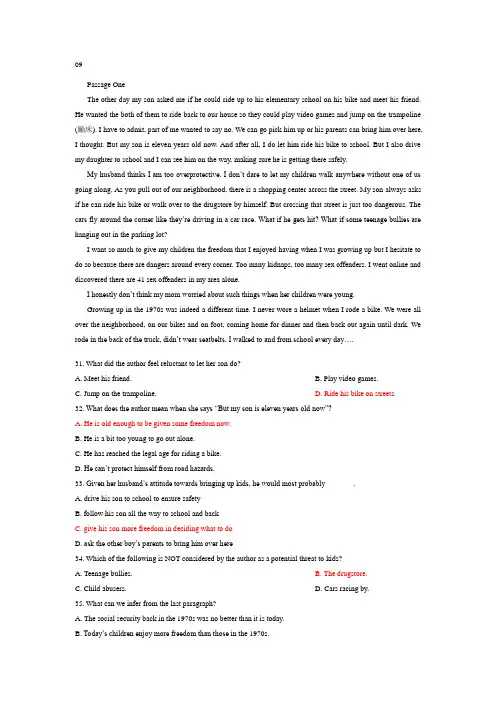
09Passage OneThe other day my son asked me if he could ride up to his elementary school on his bike and meet his friend. He wanted the both of them to ride back to our house so they could play video games and jump on the trampoline (蹦床). I have to admit, part of me wanted to say no. We can go pick him up or his parents can bring him over here, I thought. But my son is eleven years old now. And after all, I do let him ride his bike to school. But I also drive my daughter to school and I can see him on the way, making sure he is getting there safely.My husband thinks I am too overprotective. I don’t dare to let my children walk anywhere without one of us going along. As you pull out of our neighborhood, there is a shopping center across the street. My son always asks if he can ride his bike or walk over to the drugstore by himself. But crossing that street is just too dangerous. The cars fly around the corner like they’re driving in a car race. What if he gets hit? What if some teenage bullies are hanging out in the parking lot?I want so much to give my children the freedom that I enjoyed having when I was growing up but I hesitate to do so because there are dangers around every corner. Too many kidnaps, too many sex offenders. I went online and discovered there are 41 sex offenders in my area alone.I honestly don’t think my mom worried about such things when her children were young.Growing up in the 1970s was indeed a different time. I never wore a helmet when I rode a bike. We were all over the neighborhood, on our bikes and on foot, coming home for dinner and then back out again until dark. We rode in the back of the truck, didn’t wear seatbelts. I walked to and from school every day….31. What did the author feel reluctant to let her son do?A. Meet his friend.B. Play video games.C. Jump on the trampoline.D. Ride his bike on streets.32. What does the author mean when she says “But my son is eleven years old now”?A. He is old enough to be given some freedom now.B. He is a bit too young to go out alone.C. He has reached the legal age for riding a bike.D. He can’t protect himself from road hazards.33. Given her husband’s attitude towards bringing up kids, he would most probably _______.A. drive his son to school to ensure safetyB. follow his son all the way to school and backC. give his son more freedom in deciding what to doD. ask the other boy’s parents to bring him over here34. Which of the following is NOT considered by the author as a potential threat to kids?A. Teenage bullies.B. The drugstore.C. Child abusers.D. Cars racing by.35. What can we infer from the last paragraph?A. The social security back in the 1970s was no better than it is today.B. Today’s children enjoy more freedom than those in t he 1970s.C. Children today are more obedient to their parents.D. Children in the 1970s enjoyed more freedom than those today.36. What is the author’s main purpose in writing this passage?A. To compare today’s social environment with that of the 1970s.B. To show her concern over the increasing crime rate in her neighborhood.C. To describe her hesitation as to how much freedom she should give her son.D. To express her worries about both safety and security in her area.Passage TwoAbout a century ago more people would not have appreciated the study of a foreign language as they do today. Gone are those days when patriotism towards one’s own language was a major obstacle to learning foreign languages, a time when most nations were trying to throw their alien rulers out of their countries in their freedom struggles.Gone are those days when people were proud of their mother or father tongues and considered that their native languages alone will suffice the need to survive. Language skills today have become as important as other business and career skills like IT, vocational or professional skills. Thus learning a foreign language today has become essential for an individual whether it is for careers, growing a business, or even to make an impression.All that one needs to possess these days is a drive to learn a foreign language and there are all kinds of institutes and courses that teach various foreign languages like French, German, Spanish, and Japanese. Today’s world economy has bridged the barriers of race, sex, color and religion and the world has become a smaller place. Today’s businesses also demand language skills to expand and grow in other countries. Tens a nd hundreds of businesses worldwide are expanding and growing their businesses by promoting them in countries other than their countries of origin. The tremendous growth of the Internet has further increased the demand for language skills. In Canada an official rule also says that all commercial establishments must have their websites created both in English and French, the official languages of the country.Language can also ease race and border barriers. You are more welcome in an alien nation if you know the language of the people there and can converse in their tongue. People in these countries immediately respect you and think you care about their culture as much as they do because in any culture language is the key identity.37. One of the reasons for not studying a foreign language in the past is ______.A. it was too difficultB. it was not allowedC. it was seen as disloyaltyD. it was taught by foreign rulers38. According to the article, which of the following is true?A. People’s language skills are better than in the past.B. Foreign language skills are of vital importance.C. It’s easier nowadays to learn a foreign language.D. People today are not proud of their native language.39. What does “to make an impression” (Paragraph 1) probably mean?A. To remember things.B. To express ideas.C. To show respect.D. To be liked by others.40. The world has become smaller because of _________.A. business expansionB. the growth of the InternetC. a globalized economyD. the learning of foreign languages41. According to the article, the growth of the Internet requires _________.A. more foreign language skillsB. more bilingual websitesC. better command of EnglishD. more commercial establishments42. People in a foreign country will treat you with more respect if you speak their language because ______.A. they think you love their countryB. they think you understand their cultureC. i t’s easier for them to communicate with youD. they believe you are a good language learnerPassage ThreeYou may have wondered why the supermarkets are all the same. It is not because the companies that operate them lack imagination. It is because they all aim at persuading people to buy things.In the supermarket, it takes a while for the mind to get into a shopping mode. This is why the area immediately i nside the entrance is known as the “decompression zone”. People need to slow down and look around, even if they are regulars. In sales terms this area is a bit of a loss, so it tends to be used more for promotion.Immediately inside the first thing shoppers may come to is the fresh fruit and vegetables section. For shoppers, this makes no sense. Fruit and vegetables can be easily damaged, so they should be bought at the end, not the beginning, of a shopping trip. But what is at work here? It turns out that selecting good fresh food is a way to start shopping, and it makes people feel less guilty about reaching for the unhealthy stuff later on.Shoppers already know that everyday items, like milk, are invariably placed towards the back of a store to provide more opportunities to tempt customers. But supermarkets know shoppers know this, so they use other tricks, like placing popular items halfway along a section so that people have to walk all along the aisle looking for them. The idea is to boost “dwell time”: the length of time people spend in a store.Traditionally retailers measure “footfall”, as the number of people entering a store is known, but those numbers say nothing about where people go and how long they spend there. But nowadays, a piece of technology can fill the gap: the mobile phone. Path Intelligence, a British company tracked people’s phones at Gunwharf Quays, a large retail centre in Portsmouth—not by monitoring calls, but by plotting the positions of handsets as they transmit automatically to cellular networks. It found that when dwell time rose 1% sales rose 1.3%.Such techniques are increasingly popular because of a deepening understanding about how shoppers make choices. People tell market researchers that they make rational decisions about what to buy, considering things like price, selection or convenience. But subconscious forces, involving emotion and memories, are clearly also at work.43. In Paragraph 2, “decompression zone” is the area meant to _______.A. offer shoppers a place to have a restB. prepare shoppers for the mood of buyingC. encourage shoppers to try new productsD. provide shoppers with discount information44. Putting fruit-and-vegetable section near the entrance takes advantage of shoppers’ ________.A. common senseB. shopping habitsC. concerns with timeD. shopping psychology45. Path Intelligence uses a technology to _______.A. count how many people enter a storeB. measure how long people stay at a storeC. find out what people buy in a storeD. monitor what people say and do in a store46. What happened at Gunwharf Quays showed that sales _______.A. was in direct proportion to dwell timeB. was reversely linked to dwell timeC. was affected more by footfall than by dwell timeD. was affected more by dwell time than by footfall47. The author argues that shoppers ______.A. exert more influence on stores than they imagineB. are more likely to make rational choices than they knowC. tend to make more emotional decisions than they thinkD. have more control over what they buy than they assume48. The best title for the passage is ________.A. New Technology Boosts Stores’ SalesB. How Shoppers Make Choices in StoresC. Rational and Irrational Ways of ShoppingD. The Science behind Stores’ ArrangementsPassage FourA very important world problem is the increasing number of people who actually inhabit this planet. The limited amount of land and land resources will soon be unable to support the huge population if it continues to grow at its present rate.So why is this huge increase in population taking place? It is really due to the spread of the knowledge and practice of what is becoming known as “Death Control”. You have no doubt heard of the term “Birth Control”. “Death Control” is something rat her different. It recognizes the work of the doctors and scientists who now keep alive people who, not very long ago, would have died of a variety of then incurable diseases. Through a wide variety of technological innovations that include farming methods and the control of deadly diseases, we have found ways to reduce the rate at which we die. However, this success is the very cause of the greatest threat to mankind.If we examine the amount of land available for this ever-increasing population, we begin to see the problem. If everyone on the planet had an equal share of land, we would each have about 50,000 square metres. This figure seems to be quite encouraging until we examine the amount of usable land we actually have. More than three-fifths of the wor ld’s land cannot produce food.Obviously, with so little land to support us, we should be taking great care not to reduce it further. But we are not! Instead, we are consuming its “capital”— its nonrenewable fossil fuels and other mineral deposits that took millions of years to form but which are now being destroyed in decades. We are also doing the same with other vital resources not usually thought of as being nonrenewable such as fertile soils, groundwater and the millions of other species that share the earth with us.It is a very common belief that the problems of the population explosion are caused mainly by poor people living in poor countries who do not know enough to limit their reproduction. This is not true. The actual number of people in an area is not as important as the effect they have on nature. Developing countries do have an effect on their environment, but it is the populations of richer countries that have a far greater impact on the earth as a whole.49. According to the article, what contributes to the population increase?A. Birth explosion.B. Birth Control.C. Death Control.D. Technological innovations.50. The word “incurable” in Paragraph 2 means ______.A. commonB. epidemicC. untreatableD. unknown51. Th ere isn’t enough land to support human beings because ______.A. there are more seas than land in the worldB. most of the world’s land is unusableC. the world’s land has already been taken upD. the world’s land is not distributed equally52. In Paragraph 4 the writer implies that fertile soils are ______.A. limitedB. renewableC. productiveD. nonrenewable53. What does “to limit their reproduction” in the last paragraph mean?A. T o control death.B. To produce less goods.C. To increase production.D. To practice birth control.54. What do you think the writer is really concerned about?A. Long life spans.B. Population increase.C. Overuse of resources.D. The success of “Death Control”.Passage FiveAll day long, you are affected by large forces. Genes influence your intelligence and willingness to take risks. Social dynamics unconsciously shape your choices. Instantaneous perceptions set off neutral reactions in your head without you even being aware of them.Over the past few years, scientists have made a series of exciting discoveries about how these deep patterns influence daily life. Nobody has done more to bring these discoveries to public attention than Malcolm Gladwell.Gladwell’s new book Outliers seems at first glance to be a description of exceptionally talented individuals. But in fact, it’s another book about deep patterns. Exceptionally successful people are not lone pioneers who created their own success, he argues. They are the lucky beneficiaries of social arrangements.Gladwell’s noncontroversial claim is that some people have more opportunities than others. Bill Gates was lucky to go to a great private school with its own computer at the dawn of the information revolution.Gladwell’s book is being r eceived by reviewers as a call to action for the Obama Age. It could lead policy makers to finally reject policies built on the assumption that people are coldly rational profit-maximizing individuals. It could cause them to focus more on policies that foster relationships, social bonds and cultures of achievement.Yet, I can’t help but feel that Gladwell and others who share his emphasis are preoccupied with the coolness of the discoveries. They’ve lost sight of the point at which the influence of social f orces ends and the influence of the self-initiating individual begins.Most successful people begin with two beliefs: the future can be better than the present, and I have the power to make it so. They were often showered by good fortunes, but relied at crucial moments upon achievements of individual will. These people also have an extraordinary ability to consciously focus their attention. Control of attention is the ultimate individual power. People who can do that are not prisoners of the stimuli around them. They can choose from the patterns in the world and lengthen their time horizons.Gladwell’s social determinism overlooks the importance of individual character and individual creativity. And it doesn’t fully explain the genuine greatness of humanity’s talents. As the classical philosophers understood, examples of individual greatness inspire achievement more reliably than any other form of education.55. In Paragraph 2, “these deep patterns” refers to all of the following EXCEPT _______.A. genesB. social dynamicsC. instantaneous perceptionsD. neutral reactions56. According to the author, Gladwell’s new book Outliers is mainly _______.A. a descriptive study of exceptionally talented individualsB. about the importance of social arrangements to personal successC. to discuss why some people have more opportunities than othersD. to explain why Bill Gates is much luckier than others57. It can be seen from Paragraph 5 that Gladwell’s book _______.A. has become quite influentialB. is beginning to influence Obama’s policiesC. has received severe criticismsD. assumes that people just pursue maximum profits58. According to the author, the most fundamental individual power is _______.A. individual willB. control of attentionC. a good characterD. exceptional creativity59. The author believes that individual greatness is more closely related to _______.A. social forces and genesB. good luck and educationC. individual character and creativityD. individual genes and good education60. This passage is probably a _______.A. book reviewB. book reportC. political essayD. news reportPart III Reading Comprehension (30 points)31. D 32. A 33. C 34. B 35. D 36. C37. C 38. B 39. D 40. C 41. A 42. B43. B 44. D 45. B 46. A 47. C 48. D49. C 50. C 51. B 52. D 53. D 54. C55. A 56. B 57. A 58. B 59. C 60. A。
2009年同等学力英语真题解析

2009年同等学力人员申请硕士学位英语水平全国统一考试试题Paper One 试卷一PartⅠDialogue Communication(略)PartⅡVocabularySection A11. 【答案】A【解析】abundant:丰富的,充裕的。
A项“丰富的,充足的,多的”;B项“足够的,充足的,充分的”;C项“足够的,充足的”;D项“可数的”。
因此正确答案为A项。
【译文】基因工程技术的应用非常丰富,选择一种适合这种情况的相当困难12. 【答案】B【解析】pledge:保证,发誓。
A项“准备”;B项“答应给予、C项“(以处置、送人、出售等方式)把……处理掉”;D项“投递,交出”。
因此正确答案为B项。
【译文】新当选的总统承诺要投入1300万美元拯救汽车工业。
13. 【答案】A【解析】channel:渠道,途径。
A项“媒介”;B项“地方”;C项“常去的地方”;D 项“隧道,地道”。
因此正确答案为A项。
【译文】美国承认联合国会成为更大外交活动的渠道。
14. 【答案】B【解析】take advantage of:利用。
A项“赶做,补做,抓紧处理(某事)”;B项“利用”;C项“使……显得更加清楚,使……更易于理解”;D项“去掉,排除,除去(某物)”。
因此正确答案为B项。
【译文】增长的业余时间以及灵活的工作模式允许更多的妇女好好利用工作机会。
15. 【答案】D【解析】fascinate:迷住;强烈地吸引住。
A项“给……留下深刻印象,使钦佩,使感动”;B项“(使)觉得有趣,使发笑,使高兴”;C项“使迷惑不解,使困惑,使伤脑筋”;D项“吸引”。
因此正确答案为D项。
【译文】没有人能够忍住不被科幻小说迷人的世界所吸引。
16. 【答案】C【解析】call off:停止,放弃。
A项“要求归还,收回”;B项“提议”;C项“取消”;D项“纵容”。
因此正确答案为C项。
【译文】参议员詹姆士·米克取消了芝加哥公立大学的一场联合抵制。
2009英语二考研真题
2009英语二考研真题In recent years, the number of students taking the English postgraduate entrance exam, also known as the English two exam, has been steadily increasing. This exam is a crucial step for students seeking to pursue further studies or enhance their English proficiency. Today, we will analyze and discuss the 2009 English two exam, exploring its content, structure, and the skills required to excel in the examination.1. Overview of the ExamThe 2009 English two exam consisted of two parts, Reading Comprehension and Translation/Composition. It aimed to assess the candidates' reading comprehension abilities, as well as their translation and writing skills.2. Reading ComprehensionThe reading comprehension section contained four passages of varying lengths and difficulty levels. Each passage was followed by several questions to test the candidates' understanding of the main ideas, critical thinking skills, and ability to infer information from the text. The passages covered a wide range of topics, including literature, history, science, and sociology.To perform well in this section, candidates needed to develop efficient reading strategies, such as skimming and scanning, to quickly locate relevant information. Additionally, they needed to build a strong vocabulary and understanding of idiomatic expressions to handle the complex language usedin the passages. Practice and exposure to a variety of English texts could greatly contribute to success in this section.3. Translation/CompositionThe translation/composition section required candidates to demonstrate their mastery of both written and translation skills. It consisted of two parts: Chinese-to-English translation and English composition.The Chinese-to-English translation part tested candidates' ability to accurately translate Chinese sentences or paragraphs into grammatically correct English. It required not only a deep understanding of the content but also a proficiency in English sentence structures and vocabulary. To excel in this part, candidates needed to practice regularly, expand their vocabulary, and familiarize themselves with various sentence patterns commonly used in English writing.The English composition part assessed candidates' ability to write a coherent and cohesive essay. They were given a topic or prompt and were required to organize their thoughts logically, provide sufficient supporting details, and use appropriate linking words to enhance the overall flow of the essay. Developing strong writing skills involved consistent practice, reading extensively, and seeking feedback to improve grammar, vocabulary, and overall writing style.4. Preparation Tips for SuccessTo prepare for the 2009 English two exam or any similar examination, candidates can follow these strategies:a) Develop a study plan: Allocate specific time each day to focus on different sections of the exam.b) Read extensively: Engage in a wide range of reading materials, including articles, books, and newspapers, to improve reading comprehension and vocabulary.c) Practice past papers: Solve previous exam papers to become familiar with the exam format and gain confidence in tackling similar questions effectively.d) Seek guidance and feedback: Enroll in preparatory courses or work with a tutor to receive guidance, tips, and feedback on your performance.e) Time management: During the exam, manage your time wisely by allocating a specific amount for each section to avoid rushing or leaving questions unanswered.In conclusion, the 2009 English two exam was a comprehensive assessment of candidates' reading comprehension, translation, and composition skills. By focusing on developing efficient reading strategies, expanding vocabulary, practicing translation exercises, and honing writing skills, candidates could enhance their chances of success in this examination. The key lies in consistent practice, exposure to various English texts, and seeking guidance where necessary.。
2009年考研英语真题

2009年考研英语真题1. IntroductionThe 2009 Graduate Entrance Examination for English (考研英语) is an important examination that tests the English proficiency of students applying for graduate programs in China. This article aims to provide an overview and analysis of the 2009 exam.2. Exam StructureThe 2009 exam consisted of three sections: listening comprehension, reading comprehension, and translation. Each section tested different skills and knowledge of the English language.2.1 Listening ComprehensionThe listening comprehension section tested the ability of the candidates to understand spoken English. It consisted of multiple-choice questions based on short conversations and long passages. The questions ranged from understanding specific details to overall comprehension of the audio material.2.2 Reading ComprehensionThe reading comprehension section tested the candidates’ ability to read and understand written English. It consisted of multiple-choice questions based on short passages and longer texts. The questions assessed the candidat es’ understanding of the main ideas, supporting details, and vocabulary usage.2.3 TranslationThe translation section tested the candidates’ ability to translate English sentences into Chinese. It required a good understanding of both English and Chinese language structures and proper usage of vocabulary.3. Analysis of the Exam3.1 Listening ComprehensionThe listening comprehension section in the 2009 exam was challenging, with a variety of question types and difficulty levels. The short conversations tested the candidates’ ability to understand everyday spoken English, while the longer passages required more in-depth comprehension. Timing was crucial, as candidates had limited time to listen and answer the questions.3.2 Reading ComprehensionThe reading comprehension section featured a mix of short passages and longer texts on various topics, such as science, history, and literature. The questions were designed to assess the candidates’ ability to comprehend the main ideas, draw logical inferences, and understand vocabulary in context. Some questions required close reading and analysis, making this section quite demanding.3.3 TranslationThe translation section tested the candidates’ language proficiency and translation skills. They were required to accurately translate English sentences into Chinese, taking into account the context and meaning of the original text. This section required a good understanding of both languages and the ability to convey concepts accurately.4. Preparation TipsHere are some tips for candidates preparing for the 2009 English exam:4.1 Listening Comprehension•Practice listening to various audio materials (such as podcasts or news broadcasts) to improve your listening skills.•Familiarize yourself with different English accents to ensure you can understand them during the exam.•Take mock listening exams to simulate the actual test conditions and improve your speed and accuracy.4.2 Reading Comprehension•Read a variety of English texts, including articles, essays, and academic papers, to expand your vocabulary and improve readingcomprehension.•Practice summarizing and analyzing the main ideas and supporting details of the texts you read.•Take timed reading comprehension tests to improve your speed and efficiency.4.3 Translation•Enhance your language skills by practicing translation exercises regularly.•Read and analyze translated texts to understand different translation techniques and strategies.•Familiarize yourself with specific vocabulary and expressions commonly used in the translation section of the exam.5. ConclusionThe 2009 Graduate Entrance Examination for English was a comprehensive test of English proficiency. Candidates needed a strong foundation in listening, reading, and translation skills to perform well. By understanding the exam structure and following the preparation tips provided, candidates could improve their chances of success in the exam.。
2009年考研英语真题及答案

2009年考研英语真题和答案Section I Use of EnglishDirections:Read the following text. Choose the best word(s) for each numbered blank and mark A, B, C or D on ANSWER SHEET 1. (10 points)Research on animal intelligence always makes me wonder just how smart humans are. 1 thefruit-fly experiments described in Carl Zimmer’s piece in the Science Times on Tuesday. Fruit flies who were taught to be smarter than the average fruit fly 2 to live shorter lives. This suggests that 3 bulbs burn longer, that there is an 4 in not being too terrifically bright.Intelligence, it 5 out, is a high-priced option. It takes more upkeep, burns more fuel and is slow 6 the starting line because it depends on learning — a gradual 7 — instead of instinct. Plenty of other species are able to learn, and one of the things they’ve apparently learned is when to 8 .Is there an adaptive value to 9 intelligence? That’s the question behind this new research. I like it. Instead of casting a wistful glance 10 at all the species we’ve left in the dust I.Q.-wise, it implicitly asks what the real 11 of our own intelligence might be. This is 12 the mind of every animal I’ve ever met.Research on animal intelligence also makes me wonder what experiments animals would 13 on humans if they had the chance. Every cat with an owner, 14 , is running a small-scale study in operant conditioning. we believe that 15 animals ran the labs, they would test us to 16 the limits of our patience, our faithfulness, our memory for terrain. They would try to decide what intelligence in humans is really 17 , not merely how much of it there is. 18 , they would hope to study a 19 question: Are humans actually aware of the world they live in? 20 the results are inconclusive.1. [A] Suppose [B] Consider [C] Observe [D] Imagine2. [A] tended [B] feared [C] happened [D] threatened3. [A] thinner [B] stabler [C] lighter [D] dimmer4. [A] tendency [B] advantage [C] inclination [D] priority5. [A] insists on [B] sums up [C] turns out [D] puts forward6. [A] off [B] behind [C] over [D] along7. [A] incredible [B] spontaneous [C]inevitable [D] gradual8. [A] fight [B] doubt [C] stop [D] think9. [A] invisible [B] limited [C] indefinite [D] different10. [A] upward [B] forward [C] afterward [D] backward11. [A] features [B] influences [C] results [D] costs12. [A] outside [B] on [C] by [D] across13. [A] deliver [B] carry [C] perform [D] apply14. [A] by chance [B] in contrast [C] as usual [D] for instance15. [A] if [B] unless [C] as [D] lest16. [A] moderate [B] overcome [C] determine [D] reach17. [A] at [B] for [C] after [D] with18. [A] Above all [B] After all [C] However [D] Otherwise19. [A] fundamental [B] comprehensive [C] equivalent [D] hostile20. [A] By accident [B] In time [C] So far [D] Better stillSection II Reading ComprehensionPart ADirections:Read the following four texts. Answer the questions below each text by choosing A, B, C or D. Mark your answers on ANSWER SHEET 1. (40 points)Text1Habits are a funny thing. We reach for them mindlessly, setting our brains on auto-pilot and relaxing into the unconscious comfort of familiar routine. “Not choice, but habit rules the unreflecting herd,” William Wordsworth said in the 19th century. In the ever-changing 21st century, even the word “habit” carries a negative connotation.So it seems antithetical to talk about habits in the same context as creativity and innovation. But brain researchers have discovered that when we consciously develop new habits, we create parallel synaptic paths, and even entirely new brain cells, that can jump our trains of thought onto new, innovative tracks.But don’t bother trying to kill off old habits; once those ruts of procedure are worn into the hippocampus, they’re there to stay. Instead, the new habits we deliberately ingrain into ourselves create parallel pathways that can bypass those old roads.“The first thing needed for innovation is a fascination with wonder,” says Dawna Markova, author of “The Open Mind” and an executive change consultant for Professional Thinking Partners. “But we are taugh t instead to ‘decide,’ just as our president calls himself ‘the Decider.’ ” She adds, however, that “to decide is to kill off all possibilities but one. A good innovational thinker is always exploring the many other possibilities.”All of us work through p roblems in ways of which we’re unaware, she says. Researchers in the late 1960 covered that humans are born with the capacity to approach challenges in four primary ways: analytically, procedurally, relationally (or collaboratively) and innovatively. At puberty, however, the brain shuts down half of that capacity, preserving only those modes of thought that have seemed most valuable during the first decade or so of life.The current emphasis on standardized testing highlights analysis and procedure, meaning that few of us inherently use our innovative and collaborative modes of thought. “This breaks the major rule in the American belief system —that anyone can do anything,” explains M. J. Ryan, author of the 2006 book “This Year I Will...” and Ms. Markova’s business partner. “That’s a lie that we have perpetuated, and it fosters commonness. Knowing what you’re good at and doing even more of it creates excellence.” This is where developing new habits comes in.21. The view of Wordsworth habit is claimed by beingA. casualB. familiarC. mechanicalD. changeable.22. The researchers have discovered that the formation of habit can beA. predictedB. regulatedC. tracedD. guided23.” ruts”(in line one, paragraph 3) has closest meaning toA. tracksB. seriesC. characteristicsD. connections24. Ms. Markova’s comments suggest that the practice of standard testing ?A, prevents new habits form being formedB, no longer emphasizes commonnessC, maintains the inherent American thinking modelD, complies with the American belief system25. Ryan most probably agree thatA. ideas are born of a relaxing mindB. innovativeness could be taughtC. decisiveness derives from fantastic ideasD. curiosity activates creative mindsText 2It is a wise father that knows his own child, but today a man can boost his paternal (fatherly) wisdom –or at least confirm that he’s the kid’s dad. All he needs to do is shell our $30 for paternity testing kit (PTK) at his local drugstore – and another $120 to get the results.More than 60,000 people have purchased the PTKs since they first become available without prescriptions last years, according to Doug Fog, chief operating officer of Identigene, which makes the over-the-counter kits. More than two dozen companies sell DNA tests Directly to the public , ranging in price from a few hundred dollars to more than $2500.Among the most popular : paternity and kinship testing , which adopted children can use to find their biological relatives and latest rage a many passionate genealogists-and supports businesses that offer to search for a family’s geographic roots .Most tests require collecting cells by webbing saliva in the mouth and sending it to the company for testing. All tests require a potential candidate with whom to compare DNA.B ut some observers are skeptical, “There is a kind of false precision being hawked by people claiming they are doing ancestry testing,” says Trey Duster, a New York University sociologist. He notes that each individual has many ancestors-numbering in the hundreds just a few centuries back. Yet most ancestry testing only considers a single lineage, either the Y chromosome inherited through men in a father’s line or mitochondrial DNA, which a passed down only from mothers. This DNA can reveal genetic information about only one or two ancestors, even though, for example, just three generations back people also have six other great-grandparents or, four generations back, 14 other great-great-grandparents.Critics also argue that commercial genetic testing is only as good as the reference collections to which a sample is compared. Databases used by some companies don’t rely on data collected systematically but rather lump together information from different research projects. This means that a DNA database may differ depending on the company that processes the results. In addition, the computer programs a company uses to estimate relationships may be patented and not subject to peer review or outside evaluation.26.In paragraphs 1 and 2 , the text shows PTK’s ___________.[A]easy availability[B]flexibility in pricing[C] successful promotion[D] popularity with households27. PTK is used to __________.[A]locate one’s birth place[B]promote genetic research[C] identify parent-child kinship[D] choose children for adoption28. Skeptical observers believe that ancestry testing fails to__________.[A]trace distant ancestors[B] rebuild reliable bloodlines[C] fully use genetic information[D] achieve the claimed accuracy29. In the last paragraph ,a problem commercial genetic testing faces is __________.[A]disorganized data collection[B] overlapping database building30. An appropriate title for the text is most likely to be__________.[A]Fors and Againsts of DNA testing[B] DNA testing and It’s problems[C]DNA testing outside the lab[D] lies behind DNA testingText 3The relationship between formal education and economic growth in poor countries is widely misunderstood by economists and politicians alike progress in both area is undoubtedly necessary for the social, political and intellectual development of these and all other societies; however, the conventional view that education should be one of the very highest priorities for promoting rapid economic development in poor countries is wrong. We are fortunate that is it, because neweducational systems there and putting enough people through them to improve economic performance would require two or three generations. The findings of a research institution have consistently shown that workers in all countries can be trained on the job to achieve radical higher productivity and, as a result, radically higher standards of living.Ironically, the first evidence for this idea appeared in the United States. Not long ago, with the country entering a recessing and Japan at its pre-bubble peak. The U.S. workforce was derided as poorly educated and one of primary cause of the poor U.S. economic performance. Japan was, and remains, the global leader in automotive-assembly productivity. Yet the research revealed that the U.S. factories of Honda Nissan, and Toyota achieved about 95 percent of the productivity of their Japanese countere pants a result of the training that U.S. workers received on the job.More recently, while examing housing construction, the researchers discovered that illiterate,non-English- speaking Mexican workers in Houston, Texas, consistently met best-practice labor productivity standards despite the complexity of the building industry’s work.What is the real relationship between education and economic development? We have to suspect that continuing economic growth promotes the development of education even when governments don’t force it. After all, that’s how education got started. When our ancestors were hunters and gatherers 10,000 years ago, they didn’t have time to wonder much about anything besides finding food. Only when humanity began to get its food in a more productive way was there time for other things.As education improved, humanity’s productivity potential, they could in turn afford more education. This increasingly high level of education is probably a necessary, but not a sufficient, condition for the complex political systems required by advanced economic performance. Thus poor countries might not be able to escape their poverty traps without political changes that may be possible only with broader formal education. A lack of formal education, however, doesn’t constrain the ability of the developing world’s workforce to substantially improve productivity for the forested future. On the contrary, constraints on improving productivity explain why education isn’t developing more quickly there than it is.31. The author holds in paragraph 1 that the important of education in poor countries___________.[A] is subject groundless doubts[B] has fallen victim of bias[C] is conventional downgraded[D] has been overestimated32. It is stated in paragraph 1 that construction of a new education system __________.[A]challenges economists and politicians[B]takes efforts of generations[C] demands priority from the government[D] requires sufficient labor force33.A major difference between the Japanese and U.S workforces is that __________.[A] the Japanese workforce is better disciplined[B] the Japanese workforce is more productive[C]the U.S workforce has a better education[D] ]the U.S workforce is more organize34. The author quotes the example of our ancestors to show that education emerged __________.[A] when people had enough time[B] prior to better ways of finding food[C] when people on longer went hung[D] as a result of pressure on government35. According to the last paragraph , development of education __________.[A] results directly from competitive environments[B] does not depend on economic performance[C] follows improved productivity[D] cannot afford political changesText 4The most thoroughly studied in the history of the new world are the ministers and political leaders of seventeenth-century New England. According to the standard history of American philosophy, nowhere else in colonial America was “So much important attached to intellectual pursuits ” According to many books and articles, New England’s leaders established the basic themes and preoccupations of an unfolding, dominant Puritan tradition in American intellectual life.To take this approach to the New Englanders normally mean to start with the Puritans’ theological innovations and their distinctive ideas about the church-important subjects that we may not neglect. But in keeping with our examination of southern intellectual life, we may consider the original Puritans as carriers of European culture adjusting to New world circumstances. The New England colonies were the scenes of important episodes in the pursuit of widely understood ideals of civility and virtuosity.The early settlers of Massachusetts Bay included men of impressive education and influence in England. `Besides the ninety or so learned ministers who came to Massachusetts church in the decade after 1629,There were political leaders like John Winthrop, an educated gentleman, lawyer, and official of the Crown before he journeyed to Boston. There men wrote and published extensively, reaching both New World and Old World audiences, and giving New England an atmosphere of intellectual earnestness.We should not forget , however, that most New Englanders were less well educated. While few crafts men or farmers, let alone dependents and servants, left literary compositions to be analyzed, The in thinking often had a traditional superstitions quality. A tailor named John Dane, who emigrated in the late 1630s, left an account of his reasons for leaving England that is filled with signs. sexual confusion, economic frustrations , and religious hope-all name together in a decisive moment when he opened the Bible, told his father the first line he saw would settle his fate, and read the magical words: “come out from among them, touch no unclean thing , and I will be your God and you shall be my people.” One wonders what Dane thought of the carefu l sermons explaining the Bible that he heard in puritan churched.Mean while , many settles had slighter religious commitments than Dane’s, as one clergyman learned in confronting folk along the coast who mocked that they had not come to the New world for religion . “Our main end was to catch fish. ”36. The author notes that in the seventeenth-century New England___________.[A] Puritan tradition dominated political life.[B] intellectual interests were encouraged.[C] Politics benefited much from intellectual endeavors.[D] intellectual pursuits enjoyed a liberal environment.37. It is suggested in paragraph 2 that New Englanders__________.[A] experienced a comparatively peaceful early history.[B] brought with them the culture of the Old World[C] paid little attention to southern intellectual life[D] were obsessed with religious innovations38. The early ministers and political leaders in Massachusetts Bay__________.[A] were famous in the New World for their writings[B] gained increasing importance in religious affairs[C] abandoned high positions before coming to the New World[D] created a new intellectual atmosphere in New England39. The story of John Dane shows that less well-educated New Englanders were often__________.[A] influenced by superstitions[B] troubled with religious beliefs[C] puzzled by church sermons[D] frustrated with family earnings40. The text suggests that early settlers in New England__________.[A] were mostly engaged in political activities[B] were motivated by an illusory prospect[C] came from different backgrounds.[D] left few formal records for later referencePart BDirections:Directions: In the following text, some sentences have been removed. For Questions (41-45), choose the most suitable one from the list A-G to fit into each of the numbered blank. There are two extra choices, which do not fit in any of the gaps.Mark your answers on ANSWER SHEET 1.(10 points)Coinciding with the groundbreaking theory of biological evolution proposed by British naturalist Charles Darwin in the 1860s, British social philosopher Herbert Spencer put forward his own theory of biological and cultural evolution. Spencer argued that all worldly phenomena, including human societies, changed over time, advancing toward perfection. 41.____________.American social scientist Lewis Henry Morgan introduced another theory of cultural evolution in the late 1800s. Morgan, along with Tylor, was one of the founders of modern anthropology. In his work, he attempted to show how all aspects of culture changed together in the evolution of societies.42._____________.In the early 1900s in North America, German-born American anthropologist Franz Boas developed a new theory of culture known as historical particularism. Historical particularism, which emphasized the uniqueness of all cultures, gave new direction to anthropology.43._____________ .Boas felt that the culture of any society must be understood as the result of a unique history and not as one of many cultures belonging to a broader evolutionary stage or type of culture.44._______________.Historical particularism became a dominant approach to the study of culture in American anthropology, largely through the influence of many students of Boas. But a number of anthropologists in the early 1900s also rejected the particularist theory of culture in favor of diffusionism. Some attributed virtually every important cultural achievement to the inventions of a few, especially gifted peoples that, according to diffusionists, then spread to other cultures.45.________________.Also in the early 1900s, French sociologist ?mile Durkheim developed a theory of culture that would greatly influence anthropology. Durkheim proposed that religious beliefs functioned to reinforce social solidarity. An interest in the relationship between the function of society and culture—known as functionalism—became a major theme in European, and especially British, anthropology.[A] Other anthropologists believed that cultural innovations, such as inventions, had a single origin and passed from society to society. This theory was known as diffusionism.[B] In order to study particular cultures as completely as possible, Boas became skilled in linguistics, the study of languages, and in physical anthropology, the study of human biology and anatomy.[C] He argued that human evolution was characterized by a struggle he called the “survival of the fittest,” in which weaker races and societies must eventually be replaced by stronger, more advanced races and societies.[D] They al so focused on important rituals that appeared to preserve a people’s social structure, such as initiation ceremonies that formally signify children’s entrance into adulthood.[E] Thus, in his view, diverse aspects of culture, such as the structure of families, forms of marriage, categories of kinship, ownership of property, forms of government, technology, and systems of food production, all changed as societies evolved.[F]Supporters of the theory viewed as a collection of integrated parts that work together to keep a society functioning.[G] For example, British anthropologists Grafton Elliot Smith and W. J. Perry incorrectly suggested, on the basis of inadequate information, that farming, pottery making, and metallurgy all originated in ancient Egypt and diffused throughout the world. In fact, all of these cultural developments occurred separately at different times in many parts of the world.Part CDirections:Read the following text carefully and then translate the underlined segments into Chinese. Your translation should be written carefully on ANSWER SHEET 2. (10 points)There is a marked difference between the education which every one gets from living with others, and the deliberate educating of the young. In the former case the education is incidental; it is natural and important, but it is not the express reason of the association.46It may be said that the measure of the worth of any social institution is its effect in enlarging and improving experience; but this effect is not a part of its original motive. Religious associations began, for example, in the desire to secure the favor of overruling powers and to ward off evil influences; family life in the desire to gratify appetites and secure family perpetuity; systematic labor, for the most part, because of enslavement to others, etc. 47Only gradually was the by-product of the institution noted, and only more gradually still was this effect considered as a directive factor in the conduct of the institution. Even today, in our industrial life, apart from certain values of industriousness and thrift, the intellectual and emotional reaction of the forms of human association under which the world's work is carried on receives little attention as compared with physical output.But in dealing with the young, the fact of association itself as an immediate human fact, gains in importance.48 While it is easy to ignore in our contact with them the effect of our acts upon their disposition, it is not so easy as in dealing with adults. The need of training is too evident; the pressure to accomplish a change in their attitude and habits is too urgent to leave these consequences wholly out of account. 49Since our chief business with them is to enable them to share in a common life we cannot help considering whether or no we are forming the powers which will secure this ability. If humanity has made some headway in realizing that the ultimate value of every institution is its distinctively human effect we may well believe that this lesson has been learned largely through dealings with the young.50 We are thus led to distinguish, within the broad educational process which we have been so far considering, a more formal kind of education -- that of direct tuition or schooling. In undeveloped social groups, we find very little formal teaching and training. These groups mainly rely for instilling needed dispositions into the young upon the same sort of association which keeps the adults loyal to their group.Section Ⅲ WritingPart A51. Directions:Write an essay of 160-200 words based on the following drawing. In your essay, you should1) describe the drawing briefly,2) explain its intended meaning, and then3) give your comments.You should write neatly on ANSHWER SHEET 2. (20 points)Part B52. Directions:In your essay, you should1) describe the drawing briefly,2) explain its intended meaning, and then3) give your comments.You should write neatly on ANSHWER SHEET 2. (20 points)答案Section I Use of English1—5 BADBC 6—10 ADCBD11—15 DBCDA 16—20 CBAACSection II Reading ComprehensionPart A21—25 ABCAA 26—30 ACDAB31—35 DBBAC 36—40 BBDACPart B41—45 CEABGPart C46. 可以说,任何社会制度的价值在于它对扩大和改进经验方面的影响,但是这种影响并不是它原来的动机的一部分。
2009年考研英语真题答案完整版
2009年考研英语真题答案完整版:1-10 BADBC BDCAB11-20 CADDA DCBBD21-25 BDAAA26-30 ACAAB31-35DBBCC36-40 DDDAC41-45 35216Part CDirections:Read the following text carefully and then translate the underlined segments into Chinese. Your translation should be written carefully on ANSWER SHEET 2. (10 points)There is a marked difference between the education which every one gets from living with others, and the deliberate educating of the young. In the former case the education is incidental; it is natural and important, but it is not the express reason of the association.46It may be said that the measure of the worth of any social institution is its effect in enlarging and improving experience; but this effect is not a part of its original motive. Religious associations began, for example, in the desire to secure the favor of overruling powers and to ward off evil influences; family life in the desire to gratify appetites and secure family perpetuity; systematic labor, for the most part, because of enslavement to others, etc. 47Only gradually was the by-product of the institution noted, and only more gradually still was this effect considered as a directive factor in the conduct of the institution. Even today, in our industrial life, apart from certain values of industriousness and thrift, the intellectual and emotional reaction of the forms of human association under which the world's work is carried on receives little attention as compared with physical output.But in dealing with the young, the fact of association itself as an immediate human fact, gains in importance.48 While it is easy to ignore in our contact with them the effect of our acts upon their disposition, it is not so easy as in dealing with adults. The need of training is too evident; the pressure to accomplish a change in their attitude and habits is too urgent to leave these consequences wholly out of account. 49Since our chief business with them is to enable them to share in a common life we cannot help considering whether or no we are forming the powers which will secure this ability.If humanity has made some headway in realizing that the ultimate value of every institution is its distinctively human effect we may well believe that this lesson has been learned largely through dealings with the young.50 We are thus led to distinguish, within the broad educational process which we have been so far considering, a more formal kind of education -- that of direct tuition or schooling. In undeveloped social groups, we find very little formal teaching and training. These groups mainly rely for instilling needed dispositions into the young upon the same sort of association which keeps the adults loyal to their group.46题有人说,测量任何学校的价值是扩大和提高经验的影响,这种影响是最初动机的一部分47题只有逐渐注意机构的副产品,并且逐渐增多,它才能初人民认为是机构产品的一个直接因素。
2009考研英语真题及答案
Section Ⅰ Use of EnglishDirections:Read the following text. Choose the best word(s) for each numbered blank and mark A, B, C or D on ANSWER SHEET 1. (10 points)Research on animal intelligence always makes us wonder just how smart humans are. 1 the fruit-fly experiments described by Carl Zimmer in the Science Times. Fruit flies who were taught to be smarter than the average fruit fly 2 to live shorter lives. This suggests that 3 bulbs burn longer, that there is a(n) 4 in not being too bright.Intelligence, it 5 , is a high-priced option. It takes more upkeep, burns more fuel and is slow 6 the starting line because it depends on learning—a(n) 7 process—instead of instinct. Plenty of other species are able to learn, and one o f the things they’ve apparently learned is when to 8 .Is there an adaptive value to 9 intelligence? That’s the question behind this new research. Instead of casting a wistful glance 10 at all the species we’ve left in the dustI.Q.-wise, it implicitly asks what the real 11 of our own intelligence might be. This is12 the mind of every animal we’ve ever met.Research on animal intelligence also makes us wonder what experiments animals would 13 on humans if they had the chance. Every cat with an owner, 14 , is running a small-scale study in operant conditioning. We believe that 15 animals ran the labs, they would test us to 16 the limits of our patience, our faithfulness, our memory for locations. They would try to decide what intelligence in humans is really 17 , not merely how much of it there is. 18 , they would hope to study a(n) 19 question: Are humans actually aware of the world they live in? 20 the results are inconclusive.1.[A]Suppose [B]Consider [C]Observe [D]Imagine2.[A]tended [B]feared [C]happened [D]threatened3.[A]thinner [B]stabler [C]lighter [D]dimmer4.[A]tendency [B]advantage [C]inclination [D]priority5.[A]insists on [B]sums up [C]turns out [D]puts forward6.[A]off [B]behind [C]over [D]along7.[A]incredible [B]spontaneous [C]inevitable [D]gradual8.[A]fight [B]doubt [C]stop [D]think9.[A]invisible [B]limited [C]indefinite [D]different10.[A]upward [B]forward [C]afterward [D]backward11.[A]features [B]influences [C]results [D]costs12.[A]outside [B]on [C]by [D]across13.[A]deliver [B]carry [C]perform [D]apply14.[A]by chance [B]in contrast [C]as usual [D]for instance15.[A]if [B]unless [C]as [D]lest16.[A]moderate [B]overcome [C]determine [D]reach17.[A]at [B]for [C]after [D]with18.[A]Above all [B]After all [C]However [D]Otherwise19.[A]fundamental [B]comprehensive [C]equivalent [D]hostile20.[A]By accident [B]In time [C]So far [D]Better stillSection Ⅱ Reading ComprehensionPart ADirections:Read the following four texts. Answer the questions below each text by choosing A, B, C or D. Mark your answers on ANSWER SHEET 1. (40 points)Text 1Habits are a funny thing. We reach for them mindlessly, setting our brains on auto-pilot and relaxing into the unconscious comfort of familiar routine. “Not choice, but habit rules the unr eflecting herd,” William Wordsworth said in the 19th century. In the ever-changing 21st century, even the word “habit” carries a negative implication.So it seems paradoxical to talk about habits in the same context as creativity and innovation. But brain researchers have discovered that when we consciously develop new habits, we create parallel paths, and even entirely new brain cells, that can jump our trains of thought onto new,innovative tracks.Rather than dismissing ourselves as unchangeable creatures of habit, we can instead direct our own change by consciously developing new habits. In fact, the more new things we try—the more we step outside our comfort zone—the more inherently creative we become,both in the workplace and in our personal lives.Bu t don’t bother trying to kill off old habits; once those ruts of procedure are worn into the brain, they’re there to stay. Instead, the new habits we deliberately press into ourselves create parallel pathways that can bypass those old roads.“The first thing needed for innovation is a fascination with wonder,” says Dawna Markova, author of The Open Mind. “But we are taught instead to ‘decide,’ just as our presi dent calls himself ‘the Decider’.” She adds, however, that “to decide is to kill off all possib ilities but one. A good innovational thinker is always exploring the many other possibilities.”All of us work through problems in ways of which we’re unaware, she says. Researchers in the late 1960s discovered that humans are born with the capacity to approach challenges in four primary ways: analytically, procedurally, relationally (or collaboratively) and innovatively. At the end of adolescence, however, the brain shuts down half of that capacity, preserving only those modes of thought that have seemed most valuable during the first decade or so of life.The current emphasis on standardized testing highlights analysis and procedure, meaning that few of us inherently use our innovative and collaborative modes of thought. “This breaks the major rule in the American belief system—that anyone can do anything,” explains M. J. Ryan, author of the 2006 book This Year I Will…and Ms. Markova’s business partner. “That’s a lie that we have perpetuated, and it fosters commonness. Knowing what you’re good at and doing even more of it creates excellence.” This is where developing new habits comes in.21.In Wordsworth’s view, “habits” is characterized by being______[A] casual. [B] familiar. [C] mechanical. [D] changeable.22.Brain researchers have discovered that the formation of new habits can be______[A] predicted. [B] regulated. [C] traced. [D] guided.23.The word “ruts” (Paragraph 4) is closest in meaning to______[A] tracks. [B] series. [C]characteristics. [D] connections.24.Dawna Markova would most probably agree that______[A] ideas are born of a relaxing mind.[B] innovativeness could be taught.[C] decisiveness derives from fantastic ideas.[D] curiosity activates creative minds.25.Ryan’s comments suggest that the practice of standardized testing______[A] prevents new habits from being formed.[B] no longer emphasizes commonness.[C] maintains the inherent American thinking mode.[D] complies with the American belief system.Text 2It is a wise father that knows his own child, but today a man can boost his paternal (fatherly) wisdom —or at least confirm that he’s the kid’s dad. All he needs to do is shell out $ 30 for a paternity testing kit (PTK) at his local drugstore — and another $ 120 to get the results.More than 60,000 people have purchased the PTKs since they first became available without prescriptions last year, according to Doug Fog, chief operating officer of Identigene, which makes the over-the-counter kits. More than two dozen companies sell DNA tests directly to the public, ranging in price from a few hundred dollars to more than $ 2,500.Among the most popular: paternity and kinship testing, which adopted children can use to find their biological relatives and families can use to track down kids put up for adoption. DNA testing is also the latest rage among passionate genealogists —and supports businesses that offer to search for a family’s geographic roots.Most tests require collecting cells by swabbing saliva in the mouth and sending it to the company for testing. All tests require a potential candidate with whom to compare DNA.But some observers are skeptical. “There’s a kind of false precision being hawked by people claiming they are doing ancestry testing,” says Troy Duster, a New York University sociologis t. He notes that each individual has many ancestors — numbering in the hundreds just a few centuries back. Yet most ancestry testing only considers a single lineage, either the Y chromosome inherited through men in a father’s line or mitochondrial DNA, whi ch is passed down only from mothers. This DNA can reveal genetic information about only one or two ancestors, even though, for example, just three generations back people also have six other great-grandparents or, four generations back, 14 other great-great-grandparents.Critics also argue that commercial genetic testing is only as good as the reference collections to which a sample is compared. Databases used by some companies don’t rely on data collected systematically but rather lump together information from different research projects. This means that a DNA database may have a lot of data from some regions and not others, so a person’s test results may differ depending on the company that processes the results. In addition, the computer programs a company uses to estimate relationships may be patented and not subject to peer review or outside evaluation.26.In Paragraphs 1 and 2, the text shows PTK’s______[A] easy availability. [B] flexibility in pricing.[C] successful promotion. [D] popularity with households.27.PTK is used to______[A] locate one’s birth place.[B] promote genetic research.[C] identify parent-child kinship. [D] choose children for adoption.28.Skeptical observers believe that ancestry testing fails to______[A] trace distant ancestors. [B] rebuild reliable bloodlines.[C] fully use genetic information. [D] achieve the claimed accuracy.29.In the last paragraph, a problem commercial genetic testing faces is______[A] disorganized data collection. [B] overlapping database building.[C] excessive sample comparison. [D] lack of patent evaluation.30.An appropriate title for the text is most likely to be______[A] Fors and Againsts of DNA Testing. [B] DNA Testing and Its Problems.[C] DNA Testing Outside the Lab. [D] Lies Behind DNA Testing.Text 3The relationship between formal education and economic growth in poor countries is widely misunderstood by economists and politicians alike. Progress in both areas is undoubtedly necessary for the social, political and intellectual development of these and all other societies; however, the conventional view that education should be one of the very highest priorities for promoting rapid economic development in poor countries is wrong. We are fortunate that it is, because building new educational systems there and putting enough people through them to improve economic performance would require two or three generations. The findings of a research institution have consistently shown that workers in all countries can be trained on the job to achieve radically higher productivity and, as a result, radically higher standards of living.Ironically, the first evidence for this idea appeared in the United States. Not long ago, with the country entering a recession and Japan at its pre-bubble peak, the U. S. workforce was derided as poorly educated and one of the primary causes of the poor U. S. economic performance. Japan was, and remains, the global leader in automotive-assembly productivity. Yet the research revealed that the U. S. factories of Honda, Nissan, and Toyota achieved about 95 percent of the productivity of their Japanese counterparts — a result of the training that U. S. workers received on the job.More recently, while examining housing construction, the researchers discovered that illiterate, non-English-speaking Mexican workers in Houston, Texas, consistently met best-practice labor productivity standards despite the complexity of the building industry’s work.What is the real relationship between education and economic development? We have to suspect that continuing economic growth promotes the development of education even when governments don’t force it. After all, that’s how education got started. When our ancestors were hunters and gatherers 10,000 ye ars ago, they didn’t have time to wonder much about anything besides finding food. Only when humanity began to get its food in a more productive way was there time for other things.As education improved, humanity’s productivity potential increased as well. When the competitive environment pushed our ancestors to achieve that potential, they could in turn afford more education. This increasingly high level of education is probably a necessary, but not a sufficient, condition for the complex political systems required by advanced economic performance. Thus poor countries might not be able to escape their poverty traps without political changes that may be possible only with broader formal education. A lack of formal education, however, doesn’t constrain the ability of the developing world’s workforce to substantially improve productivity for the foreseeable future. On the contrary, constraints on improving productivity explain why education isn’t developing more quickly there than it is.31.The author holds in Paragraph 1 that the importance of education in poor countries______[A] is subject to groundless doubts. [B] has fallen victim of bias.[C] is conventionally downgraded. [D] has been overestimated.32.It is stated in Paragraph 1 that the construction of a new educational system______[A] challenges economists and politicians.[B] takes efforts of generations.[C] demands priority from the government.[D] requires sufficient labor force.33.A major difference between the Japanese and U. S. workforces is that______[A] the Japanese workforce is better disciplined.[B] the Japanese workforce is more productive.[C] the U. S. workforce has a better education.[D] the U. S. workforce is more organized.34.The author quotes the example of our ancestors to show that education emerged______[A] when people had enough time. [B] prior to better ways of finding food.[C] when people no longer went hungry. [D] as a result of pressure on government.35.According to the last Paragraph, development of education______[A] results directly from competitive environments.[B] does not depend on economic performance.[C] follows improved productivity.[D] cannot afford political changes.Text 4The most thoroughly studied intellectuals in the history of the New World are the ministers and political leaders of seventeenth-century New England. According to the standard history of American philosophy, nowhere else in colonial America was “so much importance attached to intellectual pursuits.” According to many books and articles, New England’s leaders established the basic themes and preoccupations of an unfolding, dominant Puritan tradition in American intellectual life.To take this approach to the New Englanders normally means to start with the Puritans’ theological innovations and their distinctive ideas about the church—important subjects that we may not neglect. But in keeping with our examination of southern intellectual life, we may consider the original Puritans as carriers of European culture, adjusting to New World circumstances. The New England colonies were the scenes of important episodes in the pursuit of widely understood ideals of civility and virtuosity.The early settlers of Massachusetts Bay included men of impressive education and influence in England. Besides the ninety or so learned ministers who came to Massachusetts churches in the decade after 1629, there were political leaders like John Winthrop, an educated gentleman, lawyer, and official of the Crown before he journeyed to Boston. These men wrote and published extensively, reaching both New World and Old World audiences, and giving New England an atmosphere of intellectual earnestness.We should not forget, however, that most New Englanders were less well educated. While few craftsmen or farmers, let alone dependents and servants, left literary compositions to be analyzed, it is obvious that their views were less fully intellectualized. Their thinking often had a traditional superstitious quality. A tailor named John Dane, who emigrated in the late 1630s, left an account of his reasons for leaving England that is filled with signs. Sexual confusion, economic frustrations, and religious hope—all came together in a decisive moment when he opened the Bible, told his father that the first line he saw would settle his fate, and read the magical words: “Come out from among them, touch no unclean thing,and I will be your God and you shall be my people.” One wonders what Dane thought of the careful sermons explaining the Bible that he heard in puritan churches.Meanwh ile, many settlers had slighter religious commitments than Dane’s, as one clergyman learned in confronting folk along the coast who mocked that they had not come to the New World for religion. “Our main end was to catch fish.”36.The author holds that in the seventeenth-century New England______[A] Puritan tradition dominated political life.[B] intellectual interests were encouraged.[C] politics benefited much from intellectual endeavors.[D] intellectual pursuits enjoyed a liberal environment.37.It is suggested in Paragraph 2 that New Englanders______[A] experienced a comparatively peaceful early history.[B] brought with them the culture of the Old World.[C] paid little attention to southern intellectual life.[D] were obsessed with religious innovations.38.The early ministers and political leaders in Massachusetts Bay______[A] were famous in the New World for their writings.[B] gained increasing importance in religious affairs.[C] abandoned high positions before coming to the New World.[D] created a new intellectual atmosphere in New England.39.The story of John Dane shows that less well-educated New Englanders were often______[A] influenced by superstitions.[B] troubled with religious beliefs.[C] puzzled by church sermons.[D] frustrated with family earnings.40.The text suggests that early settlers in New England______[A] were mostly engaged in political activities.[B] were motivated by an illusory prospect.[C] came from different intellectual backgrounds.[D] left few formal records for later reference.Part BDirections:In the following text, some sentences have been removed. For Questions 41-45, choose the most suitable one from the list A-G to fit into each of the numbered blanks. There are two extra choices, which do not fit in any of the blanks. Mark your answers on ANSWER SHEET 1. (10 points) Coinciding with the groundbreaking theory of biological evolution proposed by British naturalist Charles Darwin in the 1860s, British social philosopher Herbert Spencer put forward his own theory of biological and cultural evolution. Spencer argued that all worldly phenomena, including human societies, changed over time, advancing toward perfection. (41) ____________________American social scientist Lewis Henry Morgan introduced another theory of cultural evolution in the late 1800s. Morgan helped found modern anthropology — the scientific study of human societies, customs and beliefs—thus becoming one of the earliest anthropologists. In hiswork, he attempted to show how all aspects of culture changed together in the evolution of societies. (42)____________________In the early 1900s in North America, German-born American anthropologist Franz Boas developed a new theory of culture known as historical particularism. Historical particularism, which emphasized the uniqueness of all cultures, gave new direction to anthropology. (43) ____________________ Boas felt that the culture of any society must be understood as the result of a unique history and not as one of many cultures belonging to a broader evolutionary stage or type of culture. (44) __________________ Historical particularism became a dominant approach to the study of culture in American anthropology, largely through the influence of many students of Boas. But a number of anthropologists in the early 1900s also rejected the particularist theory of culture in favor of diffusionism. Some attributed virtually every important cultural achievement to the inventions of a few, especially gifted peoples that, according to diffusionists, then spread to other cultures. (45) ____________________ Also in the early 1900s, French sociologist Emile Durkheim developed a theory of culture that would greatly influence anthropology. Durkheim proposed that religious beliefs functioned to reinforce social solidarity. An interest in the relationship between the function of society and culture became a major theme in European, and especially British, anthropology.[A]Other anthropologists believed that cultural innovations, such as inventions, had a single origin and passed from society to society. This theory was known as diffusionism.[B]In order to study particular cultures as completely as possible, he became skilled in linguistics, the study of languages, and in physical anthropology, the study of human biology and anatomy.[C]He argued that human evolution was characterized by a str uggle he called the “survival of the fittest,” in which weaker races and societies must eventually be replaced by stronger, more advanced races and societies.[D]They also focused on important rituals that appeared to preserve a people’s social structure, such as initiation ceremonies that formally signify children’s entrance into adulthood.[E]Thus, in his view, diverse aspects of culture, such as the structure of families, forms of marriage, categories of kinship, ownership of property, forms of government, technology, and systems of food production, all changed as societies evolved.[F]Supporters of the theory viewed culture as a collection of integrated parts that work together to keep a society functioning.[G]For example, British anthropologists Grafton Elliot Smith and W. J. Perry incorrectly suggested, on the basis of inadequate information, that farming, pottery making, and metallurgy all originated in ancient Egypt and diffused throughout the world. In fact, all of these cultural developments occurred separately at different times in many parts of the world.Part CDirections:Read the following text carefully and then translate the underlined segments into Chinese. Your translation should be written carefully on ANSWER SHEET 2.(10 points)There is a marked difference between the education which everyone gets from living with others, and the deliberate educating of the young. In the former case the education is incidental; it is natural and important, but it is not the express reason of the association. (46) It may be said that the measure of the worth of any social institution is its effect in enlarging and improving experience, but this effect is not a part of its original motive. Religious associations began, for example, in the desire to secure the favor of overruling powers and to ward off evil influences;family life in the desire to gratify appetites and secure family perpetuity; systematic labor, for the most part, because of enslavement to others, etc. (47) Only gradually was the by-product of the institution noted, and only more gradually still was this effect considered as a directive factor in the conduct of the institution. Even today, in our industrial life, apart from certain values of industriousness and thrift, the intellectual and emotional reaction of the forms of human association under which the world's work is carried on receives little attention as compared with physical output.But in dealing with the young, the fact of association itself as an immediate human fact, gains in importance. (48) While it is easy to ignore in our contact with them the effect of our acts upon their disposition, it is not so easy as in dealing with adults. The need of training is too evident; the pressure to accomplish a change in their attitude and habits is too urgent to leave these consequences wholly out of account. (49) Since our chief business with them is to enable them to share in a common life we cannot help considering whether or not we are forming the powers which will secure this ability.If humanity has made some headway in realizing that the ultimate value of every institution is its distinctively human effect we may well believe that this lesson has been learned largely through dealings with the young.(50) We are thus led to distinguish, within the broad educational process which we have been so far considering, a more formal kind of education —that of direct tuition or schooling. In undeveloped social groups, we find very little formal teaching and training. These groups mainly rely for instilling needed dispositions into the young upon the same sort of association which keeps the adults loyal to their group.Section ⅢWritingPart A51.Directions:Restrictions on the use of plastic bags have not been so successful in some regions. “White pollution” is still going on. Write a letter to the editor(s) of your local newspaper to1) give your opinions briefly, and2) make two or three suggestions.You should write about 100 words on ANSWER SHEET 2.Do not sign your own name at the end of the letter. Use “Li Ming” instead.Do not write the address. (10 points)Part B52.Directions:Write an essay of 160-200 words based on the following drawing. In your essay, you should1) describe the drawing briefly,2) explain its intended meaning, and then3) give your comments.You should write neatly on ANSHWER SHEET 2. (20 points)。
2009年考研英语真题(英一二通用)-高清版含答案
2009年考研英语真题(英一二通用)-高清版含答案Section I Use of EnglishDirections:Read the following text.Choose the best word(s)for each numbered blank and mark A,B,C or D on ANSWER SHEET1.(10points)Research on animal intelligence always makes us wonder just how smart humans are.1the fruit-fly experiments described by Carl Zimmer in the Science Times.Fruit flies who were taught to be smarter than the average fruit fly2to live shorter lives.This suggests that3bulbs burn longer,that there is a(n)4in not being too bright.Intelligence,it5,is a high-priced option.It takes more upkeep,burns more fuel and is slow6the starting line because it depends on learning–a(n) 7process–instead of instinct.Plenty of other species are able to learn,and one of the things they’ve apparently learned is when to8.Is there an adaptive value to9intelligence?That’s the question behind this new research.Instead of casting a wistful glance10at all the species we’ve left in the dust I.Q.-wise,it implicitly asks what the real11of our own intelligence might be.This is12the mind of every animal we’ve ever met.Research on animal intelligence also makes us wonder what experiments animals would13on humans if they had the chance.Every cat with an owner,14, is running a small-scale study in operant conditioning.We believe that15animals ran the labs,they would test us to16the limits of our patience,our faithfulness, our memory for locations.They would try to decide what intelligence in humans is really17,not merely how much of it there is.18,they would hope to study a(n)19question:Are humans actually aware of the world they live in?20the results are inconclusive.1.[A]Suppose[B]Consider[C]Observe[D]Imagine2.[A]tended[B]feared[C]happened[D]threatened3.[A]thinner[B]stabler[C]lighter[D]dimmer4.[A]tendency[B]advantage[C]inclination[D]priority5.[A]insists on[B]sums up[C]turns out[D]puts forward6.[A]off[B]behind[C]over[D]along7.[A]incredible[B]spontaneous[C]inevitable[D]gradual8.[A]fight[B]doubt[C]stop[D]think9.[A]invisible[B]limited[C]indefinite[D]different10.[A]upward[B]forward[C]afterward[D]backward11.[A]features[B]influences[C]results[D]costs12.[A]outside[B]on[C]by[D]across13.[A]deliver[B]carry[C]perform[D]apply14.[A]by chance[B]in contrast[C]as usual[D]for instance15.[A]if[B]unless[C]as[D]lest16.[A]moderate[B]overcome[C]determine[D]reach17.[A]at[B]for[C]after[D]with18.[A]Above all[B]After all[C]However[D]Otherwise19.[A]fundamental[B]comprehensive[C]equivalent[D]hostile20.[A]By accident[B]In time[C]So far[D]Better stillSection II Reading ComprehensionPart ADirections:Read the following four texts.Answer the questions below each text by choosing A,B,C or D.Mark your answers on ANSWER SHEET1.(40points)Text1Habits are a funny thing.We reach for them mindlessly,setting our brains on auto-pilot and relaxing into the unconscious comfort of familiar routine.“Not choice, but habit rules the unreflecting herd,”William Wordsworth said in the19th century.In the ever-changing21st century,even the word“habit”carries a negative implication.So it seems paradoxical to talk about habits in the same context as creativity and innovation.But brain researchers have discovered that when we consciously develop new habits,we create parallel paths,and even entirely new brain cells,that can jump our trains of thought onto new,innovative tracks.Rather than dismissing ourselves as unchangeable creatures of habit,we can instead direct our own change by consciously developing new habits.In fact,the more new things we try–the more we step outside our comfort zone–the more inherently creative we become,both in the workplace and in our personal lives.But don’t bother trying to kill off old habits;once those ruts of procedure are worn into the brain,they’re there to stay.Instead,the new habits we deliberately press into ourselves create parallel pathways that can bypass those old roads.“The first thing needed for innovation is a fascination with wonder,”says Dawna Markova,author of The Open Mind.“But we are taught instead to‘decide’,just as our president calls himself‘the Decider’.”She adds,however,that“to decide is to kill off all possibilities but one.A good innovational thinker is always exploring the many other possibilities.”All of us work through problems in ways of which we’re unaware,she says. Researchers in the late1960s discovered that humans are born with the capacity to approach challenges in four primary ways:analytically,procedurally,relationally(or collaboratively)and innovatively.At the end of adolescence,however,the brain shuts down half of that capacity,preserving only those modes of thought that have seemed most valuable during the first decade or so of life.The current emphasis on standardized testing highlights analysis and procedure, meaning that few of us inherently use our innovative and collaborative modes of thought.“This breaks the major rule in the American belief system–that anyone can do anything,”explains M.J.Ryan,author of the2006book This Year I Will...and Ms. Markova’s business partner.“That’s a lie that we have perpetuated,and it fosters commonness.Knowing what you’re good at and doing even more of it creates excellence.”This is where developing new habits comes in.21.In Wordsworth’s view,“habits”is characterized by being[A]casual.[B]familiar.[C]mechanical.[D]changeable.22.Brain researchers have discovered that the formation of new habits can be[A]predicted.[B]regulated.[C]traced.[D]guided.23.The word“ruts”(Para.4)is closest in meaning to[A]tracks.[B]series.[C]characteristics.[D]connections.24.Dawna Markova would most probably agree that[A]ideas are born of a relaxing mind.[B]innovativeness could be taught.[C]decisiveness derives from fantastic ideas.[D]curiosity activates creative minds.25.Ryan’s comments suggest that the practice of standardized testing[A]prevents new habits from being formed.[B]no longer emphasizes commonness.[C]maintains the inherent American thinking mode.[D]complies with the American belief system.Text2It is a wise father that knows his own child,but today a man can boost his paternal(fatherly)wisdom–or at least confirm that he’s the kid’s dad.All he needs to do is shell out$30for a paternity testing kit(PTK)at his local drugstore–and another $120to get the results.More than60,000people have purchased the PTKs since they first became available without prescriptions last year,according to Doug Fogg,chief operating officer of Identigene,which makes the over-the-counter kits.More than two dozen companies sell DNA tests directly to the public,ranging in price from a few hundred dollars to more than$2,500.Among the most popular:paternity and kinship testing,which adopted children can use to find their biological relatives and families can use to track down kids put up for adoption.DNA testing is also the latest rage among passionate genealogists–and supports businesses that offer to search for a family’s geographic roots.Most tests require collecting cells by swabbing saliva in the mouth and sending it to the company for testing.All tests require a potential candidate with whom to compare DNA.But some observers are skeptical.“There’s a kind of false precision being hawked by people claiming they are doing ancestry testing,”says Troy Duster,a New York University sociologist.He notes that each individual has many ancestors–numbering in the hundreds just a few centuries back.Yet most ancestry testing only considers a single lineage,either the Y chromosome inherited through men in a father’s line or mitochondrial DNA,which is passed down only from mothers.This DNA can reveal genetic information about only one or two ancestors,even though, for example,just three generations back people also have six other great-grandparents or,four generations back,14other great-great-grandparents.Critics also argue that commercial genetic testing is only as good as the reference collections to which a sample is compared.Databases used by some companies don’t rely on data collected systematically but rather lump together information from different research projects.This means that a DNA database may have a lot of data from some regions and not others,so a person’s test results may differ depending on the company that processes the results.In addition,the computer programs a company uses to estimate relationships may be patented and not subject to peer review or outside evaluation.26.In Paragraphs1and2,the text shows PTK’s[A]easy availability.[B]flexibility in pricing.[C]successful promotion.[D]popularity with households.27.PTK is used to[A]locate one’s birth place.[B]promote genetic research.[C]identify parent-child kinship.[D]choose children for adoption.28.Skeptical observers believe that ancestry testing fails to[A]trace distant ancestors.[B]rebuild reliable bloodlines.[C]fully use genetic information.[D]achieve the claimed accuracy.29.In the last paragraph,a problem commercial genetic testing faces is[A]disorganized data collection.[B]overlapping database building.[C]excessive sample comparison.[D]lack of patent evaluation.30.An appropriate title for the text is most likely to be[A]Fors and Againsts of DNA Testing.[B]DNA Testing and Its Problems.[C]DNA Testing Outside the Lab.[D]Lies Behind DNA Testing.Ironically,the first evidence for this idea appeared in the United States.Not long ago,with the country entering a recession and Japan at its pre-bubble peak,the U.S.workforce was derided as poorly educated and one of the primary causes of the poor U.S.economic performance.Japan was,and remains,the global leader in automotive-assembly productivity.Yet the research revealed that the U.S.factories of Honda,Nissan,and Toyota achieved about 95percent of the productivity of their Japanese counterparts –a result of the training that U.S.workers received on the job.More recently,while examining housing construction,the researchers discovered that illiterate,non-English-speaking Mexican workers in Houston,Texas,consistently met best-practice labor productivity standards despite the complexity of the building industry’s work.What is the real relationship between education and economic development?We have to suspect that continuing economic growth promotes the development of education even when governments don’t force it.After all,that’s how education got started.When our ancestors were hunters and gatherers 10,000years ago,they didn’t have time to wonder much about anything besides finding food.Only when humanity began to get its food in a more productive way was there time for other things.As education improved,humanity’s productivity potential increased as well.When the competitive environment pushed our ancestors to achieve that potential,they could in turn afford more education.This increasingly high level of education is probably a necessary,but not a sufficient,condition for the complex political systems required by advanced economic performance.Thus poor countries might not be able to escape their poverty traps without political changes that may be possible only with broader formal education.A lack of formal education,however,doesn’t constrain the ability of the developing world’s workforce to substantially improve productivity for the foreseeable future.On the contrary,constraints on improving productivity explain why education isn’t developing more quickly there than it is.Text 3The relationship between formal education and economic growth in poor countries is widely misunderstood by economists and politicians alike.Progress inboth areas is undoubtedly necessary for the social,political,and intellectualdevelopment of these and all other societies;however,the conventional view thateducation should be one of the very highest priorities for promoting rapid economic development in poor countries is wrong.We are fortunate that it is,because buildingnew educational systems there and putting enough people through them to improve economic performance would require two or three generations.The findings of a research institution have consistently shown that workers in all countries can be trained on the job to achieve radically higher productivity and,as a result,radicallyhigher standards of living.31.The author holds in Paragraph1that the importance of education in poorcountries[A]is subject to groundless doubts.[B]has fallen victim of bias.[C]is conventionally downgraded.[D]has been overestimated.32.It is stated in Paragraph1that the construction of a new educational system[A]challenges economists and politicians.[B]takes efforts of generations.[C]demands priority from the government.[D]requires sufficient labor force.33.A major difference between the Japanese and U.S.workforces is that[A]the Japanese workforce is better disciplined.[B]the Japanese workforce is more productive.[C]the U.S.workforce has a better education.[D]the U.S.workforce is more organized.34.The author quotes the example of our ancestors to show that education emerged[A]when people had enough time.[B]prior to better ways of finding food.[C]when people no longer went hungry.[D]as a result of pressure on government.35.According to the last paragraph,development of education[A]results directly from competitive environments.[B]does not depend on economic performance.[C]follows improved productivity.[D]cannot afford political changes.Text4The most thoroughly studied intellectuals in the history of the New World are the ministers and political leaders of seventeenth-century New England.According to the standard history of American philosophy,nowhere else in colonial America was“so much importance attached to intellectual pursuits.”According to many books and articles,New England’s leaders established the basic themes and preoccupations of an unfolding,dominant Puritan tradition in American intellectual life.To take this approach to the New Englanders normally means to start with the Puritans’theological innovations and their distinctive ideas about the church–important subjects that we may not neglect.But in keeping with our examination of southern intellectual life,we may consider the original Puritans as carriers of European culture,adjusting to New World circumstances.The New England colonies were the scenes of important episodes in the pursuit of widely understood ideals of civility and virtuosity.The early settlers of Massachusetts Bay included men of impressive education and influence in England.Besides the ninety or so learned ministers who came to Massachusetts churches in the decade after1629,there were political leaders like John Winthrop,an educated gentleman,lawyer,and official of the Crown before he journeyed to Boston.These men wrote and published extensively,reaching both New World and Old World audiences,and giving New England an atmosphere of intellectual earnestness.We should not forget,however,that most New Englanders were less well educated.While few craftsmen or farmers,let alone dependents and servants,left literary compositions to be analyzed,it is obvious that their views were less fully intellectualized.Their thinking often had a traditional superstitious quality.A tailor named John Dane,who emigrated in the late1630s,left an account of his reasons for leaving England that is filled with signs.Sexual confusion,economic frustrations,and religious hope–all came together in a decisive moment when he opened the Bible, told his father that the first line he saw would settle his fate,and read the magical words:“Come out from among them,touch no unclean thing,and I will be your God and you shall be my people.”One wonders what Dane thought of the careful sermons explaining the Bible that he heard in Puritan churches.Meanwhile,many settlers had slighter religious commitments than Dane’s,as one clergyman learned in confronting folk along the coast who mocked that they had not come to the New World for religion.“Our main end was to catch fish.”36.The author holds that in the seventeenth-century New England[A]Puritan tradition dominated political life.[B]intellectual interests were encouraged.[C]politics benefited much from intellectual endeavors.[D]intellectual pursuits enjoyed a liberal environment.37.It is suggested in Paragraph2that New Englanders[A]experienced a comparatively peaceful early history.[B]brought with them the culture of the Old World.[C]paid little attention to southern intellectual life.[D]were obsessed with religious innovations.38.The early ministers and political leaders in Massachusetts Bay[A]were famous in the New World for their writings.[B]gained increasing importance in religious affairs.[C]abandoned high positions before coming to the New World.[D]created a new intellectual atmosphere in New England.39.The story of John Dane shows that less well-educated New Englanders wereoften[A]influenced by superstitions.[B]troubled with religious beliefs.[C]puzzled by church sermons.[D]frustrated with family earnings.40.The text suggests that early settlers in New England[A]were mostly engaged in political activities.[B]were motivated by an illusory prospect.[C]came from different intellectual backgrounds.[D]left few formal records for later reference.Part BDirections:In the following text,some segments have been removed.For Questions41-45, choose the most suitable one from the list A-G to fit into each of the numbered blanks. There are two extra choices,which do not fit in any of the blanks.Mark your answers on ANSWER SHEET1.(10points)Coinciding with the groundbreaking theory of biological evolution proposed by British naturalist Charles Darwin in the1860s,British social philosopher Herbert Spencer put forward his own theory of biological and cultural evolution.Spencer argued that all worldly phenomena,including human societies,changed over time, advancing toward perfection.(41)American social scientist Lewis Henry Morgan introduced another theory of cultural evolution in the late1800s.Morgan helped found modern anthropology–the scientific study of human societies,customs and beliefs–thus becoming one of the earliest anthropologists.In his work,he attempted to show how all aspects of culture changed together in the evolution of societies.(42)In the early1900s in North America,German-born American anthropologist Franz Boas developed a new theory of culture known as historical particularism. Historical particularism,which emphasized the uniqueness of all cultures,gave new direction to anthropology.(43)Boas felt that the culture of any society must be understood as the result of a unique history and not as one of many cultures belonging to a broader evolutionary stage or type of culture.(44)Historical particularism became a dominant approach to the study of culture in American anthropology,largely through the influence of many students of Boas.But a number of anthropologists in the early1900s also rejected the particularist theory of culture in favor of diffusionism.Some attributed virtually every important cultural achievement to the inventions of a few,especially gifted peoples that,according to diffusionists,then spread to other cultures.(45)Also in the early1900s,French sociologistÉmile Durkheim developed a theory of culture that would greatly influence anthropology.Durkheim proposed that religious beliefs functioned to reinforce social solidarity.An interest in the relationship between the function of society and culture became a major theme in European,and especially British,anthropology.[A]Other anthropologists believed that cultural innovations,such as inventions,hada single origin and passed from society to society.This theory was known asdiffusionism.[B]In order to study particular cultures as completely as possible,he becameskilled in linguistics,the study of languages,and in physical anthropology,the study of human biology and anatomy.[C]He argued that human evolution was characterized by a struggle he called the“survival of the fittest,”in which weaker races and societies must eventually be replaced by stronger,more advanced races and societies.[D]They also focused on important rituals that appeared to preserve a people’ssocial structure,such as initiation ceremonies that formally signify children’s entrance into adulthood.[E]Thus,in his view,diverse aspects of culture,such as the structure of families,forms of marriage,categories of kinship,ownership of property,forms of government,technology,and systems of food production,all changed as societies evolved.[F]Supporters of the theory viewed culture as a collection of integrated parts thatwork together to keep a society functioning.[G]For example,British anthropologists Grafton Elliot Smith and W.J.Perryincorrectly suggested,on the basis of inadequate information,that farming, pottery making,and metallurgy all originated in ancient Egypt and diffused throughout the world.In fact,all of these cultural developments occurred separately at different times in many parts of the world.Part CDirections:Read the following text carefully and then translate the underlined segments into Chinese.Your translation should be written clearly on ANSWER SHEET2.(10 points)There is a marked difference between the education which every one gets from living with others and the deliberate educating of the young.In the former case the education is incidental;it is natural and important,but it is not the express reason of the association.(46)It may be said that the measure of the worth of any social institution is its effect in enlarging and improving experience,but this effect is not a part of its original motive.Religious associations began,for example,in the desire to secure the favor of overruling powers and to ward off evil influences;family life in the desire to gratify appetites and secure family perpetuity;systematic labor,for the most part,because of enslavement to others,etc.(47)Only gradually was the by-product of the institution noted,and only more gradually still was this effect considered as a directive factor in the conduct of the institution.Even today,in our industrial life,apart from certain values of industriousness and thrift,the intellectual and emotional reaction of the forms of human association under which the world’s work is carried on receives little attention as compared with physical output.But in dealing with the young,the fact of association itself as an immediate human fact,gains in importance.(48)While it is easy to ignore in our contact with them the effect of our acts upon their disposition,it is not so easy as in dealing with adults.The need of training is too evident and the pressure to accomplish a change in their attitude and habits is too urgent to leave these consequences wholly out of account.(49)Since our chief business with them is to enable them to share in a common life we cannot help considering whether or not we are forming the powers which will secure this ability.If humanity has made some headway in realizing that the ultimate value of every institution is its distinctively human effect we may well believe that this lesson has been learned largely through dealings with the young.(50)We are thus led to distinguish,within the broad educational process which we have been so far considering,a more formal kind of education–that of direct tuition or schooling.In undeveloped social groups,we find very little formal teaching and training.These groups mainly rely for instilling needed dispositions into the young upon the same sort of association which keeps adults loyal to their group.Section III WritingPart A51.Directions:Restrictions on the use of plastic bags have not been so successful in some regions.“White Pollution”is still going on.Write a letter to the editor(s)of your local newspaper to1)give your opinions briefly,and2)make two or three suggestions.You should write about100words on ANSWER SHEET2.Do not sign your own name at the end of the e“Li Ming”instead.Do not write the address.(10points)Part B52.Directions:Write an essay of160-200words based on the following drawing.In your essay, you should1)describe the drawing briefly,2)explain its intended meaning,and then3)give your comments.You should write neatly on ANSWER SHEET2.(20points)2009年全真试题答案Section Ⅰ Use of English1.B2.A3.D4.B5.C6.A7.D8.C9.B 10.D 11.D 12.B 13.C 14.D 15.A 16.C 17.B 18.A 19.A 20.C Section Ⅱ Reading ComprehensionPart AText 1 21.C 22.D 23.A 24.D 25.AText 2 26.A 27.C 28.D 29.A 30.BText 3 31.D 32.B 33.B 34.C 35.CText 4 36.B 37.B 38.D 39.A 40.CPart B41.C 42.E 43.A 44.B 45.GPart C46.虽然我们可以说衡量任何一个社会机构价值的标准是共在丰富和完善人生(经验)方面所起的作用,但这种作用并不是我们最初的动机的组成部分。
2009年考研英语真题(含答案解析)
2009年全国硕士研究生入学统一考试英语试题Section I U se of EnglishDirections:Read the following text. Choose the best word(s) for each numbered blank and mark A, B, C or D on ANSWER SHEET 1. (10 points)Research on animal intelligence always makes me wonder just how smart humans are.1the fruit-fly experiments described in Carl Zimmer's piece in the Science Times on Tuesday. Fruit flies who were taught to be smarter than the average fruit fly 2 to live shorter lives. This suggests that 3bulbs burn longer, that there is an 4 in not being too terrifically bright.Intelligence, it 5 out, is a high-priced option. It takes more upkeep, burns morefuel and is slow 6 the starting line because it depends on learning —a gradual 7— instead of instinct. Plenty of other species are able to learn, and one of the things they've apparently learned is when to8.Is there an adaptive value to9intelligence? That's the question behind this newresearch. I like it. Instead of casting a wistful glance10 at all the species we'veleft in the dust I.Q.-wise, it implicitly asks what the real11of our own intelligencemight be. This is12 the mind of every animal I've ever met.Research on animal intelligence also makes me wonder what experiments animals would13 on humans if they had the chance. Every cat with an owner, 14, is running asmall-scale study in operant conditioning. we believe that 15animals ran the labs,they would test us to 16 the limits of our patience, our faithfulness, our memory for terrain. They would try to decide what intelligence in humans is really 17 , not merely how much of it there is. 1819 question: Are humans actually aware of the world they live in?20 the results are inconclusive.1. [A] Suppose [B] Consider [C] Observe [D] Imagine2. [A] tended [B] feared [C] happened [D] threatened3. [A] thinner [B] stabler [C] lighter [D] dimmer4. [A] tendency [B] advantage [C] inclination [D] priority5. [A] insists on [B] sums up [C] turns out [D] puts forward6. [A] off [B] behind [C] over [D] along7. [A] incredible [B] spontaneous [C] inevitable [D] gradual8. [A] fight [B] doubt [C] stop [D] think9. [A] invisible [B] limited [C] indefinite [D] different10. [A] upward [B] forward [C] afterward [D] backward11. [A] features [B] influences [C] results [D] costs12. [A] outside [B] on [C] by [D] across13. [A] deliver [B] carry [C] perform [D] apply14. [A] by chance [B] in contrast [C] as usual [D] for instance15. [A] if [B] unless [C] as [D] lest16. [A] moderate [B] overcome [C] determine [D] reach17. [A] at [B] for [C] after [D] with18. [A] Above all [B] After all [C] However [D] Otherwise19. [A] fundamental [B] comprehensive [C] equivalent [D] hostile20. [A] By accident [B] In time [C] So far [D] Better stillSection II Reading ComprehensionPart ADirections:Read the following four texts. Answer the questions below each text by choosing A, B, C or D. Mark your answers on ANSWER SHEET 1. (40 points)Text 1Habits are a funny thing. We reach for them mindlessly, setting our brains on auto-pilot and relaxing into the unconscious comfort of familiar routine. "Not choice, but habit rules the unreflecting herd," William Wordsworth said in the 19th century. In the ever-changing 21st century, even the word "habit" carries a negative connotation.So it seems antithetical to talk about habits in the same context as creativity and innovation. But brain researchers have discovered that when we consciously develop new habits, we create parallel synaptic paths, and even entirely new brain cells, that can jump our trains of thought onto new, innovative tracks.But don't bother trying to kill off old habits; once those ruts of procedure are worn into the hippocampus, they're there to stay. Instead, the new habits we deliberately ingrain into ourselves create parallel pathways that can bypass those old roads."The first thing needed for innovation is a fascination with wonder," says Dawna Markova, author of "The Open Mind" and an executive change consultant for Professional Thinking Partners. "But we are taught instead to 'decide,' just as our president calls himself 'the Decider.' " She adds, however, that "to decide is to kill off all possibilities but one.A good innovational thinker is always exploring the many other possibilities."All of us work through problems in ways of which we're unaware, she says. Researchers in the late 1960 covered that humans are born with the capacity to approach challenges in four primary ways: analytically, procedurally, relationally (or collaboratively) and innovatively. At puberty, however, the brain shuts down half of that capacity, preserving only those modes of thought that have seemed most valuable during the first decade or so of life.The current emphasis on standardized testing highlights analysis and procedure, meaning that few of us inherently use our innovative and collaborative modes of thought. "This breaks the major rule in the American belief system — that anyone can do anything," explains M. J. Ryan, author of the 2006 book "This Year I Will..." and Ms. Markova's business partner. "That's a lie that we have perpetuated, and it fosters commonness. Knowing what you're good at and doing even more of it creates excellence." This is where developing new habits comes in.21. The view of Wordsworth habit is claimed by being ________.A. casualB. familiarC. mechanicalD. changeable22. The researchers have discovered that the formation of habit can be ________A. predictedB. regulatedC. tracedD. guided23. "ruts"(in line one, paragraph 3) has closest meaning to ________A. tracksB. seriesC. characteristicsD. connections24. Ms. Markova's comments suggest that the practice of standard testing ________?A, prevents new habits form being formedB, no longer emphasizes commonnessC, maintains the inherent American thinking modelD, complies with the American belief system25. Ryan most probably agree thatA. ideas are born of a relaxing mindB. innovativeness could be taughtC. decisiveness derives from fantastic ideasD. curiosity activates creative mindsText 2It is a wise father that knows his own child, but today a man can boost his paternal (fatherly) wisdom –or at least confirm that he's the kid's dad. All he needs to do is shell our $30 for paternity testing kit (PTK) at his local drugstore – and another $120 to get the results.More than 60,000 people have purchased the PTKs since they first become available without prescriptions last years, according to Doug Fog, chief operating officer of Identigene, which makes the over-the-counter kits. More than two dozen companies sell DNA tests Directly to the public , ranging in price from a few hundred dollars to more than $2500.Among the most popular : paternity and kinship testing , which adopted children can use to find their biological relatives and latest rage a many passionate genealogists-and supports businesses that offer to search for a family's geographic roots .Most tests require collecting cells by webbing saliva in the mouth and sending it to the company for testing. All tests require a potential candidate with whom to compare DNA.But some observers are skeptical, "There is a kind of false precision being hawked by people claiming they are doing ancestry testing," says Trey Duster, a New York University sociologist. He notes that each individual has many ancestors-numbering in the hundreds just a few centuries back. Yet most ancestry testing only considers a single lineage, either the Y chromosome inherited through men in a father's line or mitochondrial DNA, which a passed down only from mothers. This DNA can reveal genetic information about only one or two ancestors, even though, for example, just three generations back people also have six other great-grandparents or, four generations back, 14 other great-great-grandparents.Critics also argue that commercial genetic testing is only as good as the reference collections to which a sample is compared. Databases used by some companies don't rely on data collected systematically but rather lump together information from different research projects. This means that a DNA database may differ depending on the company that processes the results. In addition, the computer programs a company uses to estimate relationships may be patented and not subject to peer review or outside evaluation.26. In paragraphs 1 and 2, the text shows PTK's ___________.[A] easy availability[B] flexibility in pricing[C] successful promotion[D] popularity with households27. PTK is used to __________.[A] locate one's birth place[B] promote genetic research[C] identify parent-child kinship[D] choose children for adoption28. Skeptical observers believe that ancestry testing fails to__________.[A] trace distant ancestors[B] rebuild reliable bloodlines[C] fully use genetic information[D] achieve the claimed accuracy29. In the last paragraph, a problem commercial genetic testing faces is __________.[A] disorganized data collection[B] overlapping database building[C] excessive sample comparison[D] lack of patent evaluation30. An appropriate title for the text is most likely to be__________.[A] Fors and Againsts of DNA testing[B] DNA testing and It's problems[C] DNA testing outside the lab[D] lies behind DNA testingText 3The relationship between formal education and economic growth in poor countries is widely misunderstood by economists and politicians alike progress in both area is undoubtedly necessary for the social, political and intellectual development of these and all other societies; however, the conventional view that education should be one of the very highest priorities for promoting rapid economic development in poor countries is wrong. We are fortunate that is it, because new educational systems there and putting enough people through them to improve economic performance would require two or three generations. The findings of a research institution have consistently shown that workers in all countries can be trained on the job to achieve radical higher productivity and, as a result, radically higher standards of living.Ironically, the first evidence for this idea appeared in the United States. Not long ago, with the country entering a recessing and Japan at its pre-bubble peak. The U.S. workforce was derided as poorly educated and one of primary cause of the poor U.S. economic performance. Japan was, and remains, the global leader in automotive-assembly productivity. Yet the research revealed that the U.S. factories of Honda Nissan, and Toyota achieved about 95 percent of the productivity of their Japanese counterparts -- a result of the training that U.S. workers received on the job.More recently, while examining housing construction, the researchers discovered that illiterate, non-English- speaking Mexican workers in Houston, Texas, consistently met best-practice labor productivity standards despite the complexity of the building industry's work.What is the real relationship between education and economic development? We have to suspect that continuing economic growth promotes the development of education even when governments don't force it. After all, that's how education got started. When our ancestors were hunters and gatherers 10,000 years ago, they didn't have time to wonder much about anything besides finding food. Only when humanity began to get its food in a more productive way was there time for other things.As education improved, humanity's productivity potential, they could in turn afford more education. This increasingly high level of education is probably a necessary, but not a sufficient, condition for the complex political systems required by advanced economic performance. Thus poor countries might not be able to escape their poverty traps without political changes that may be possible only with broader formal education. A lack of formal education, however, doesn't constrain the ability of the developing world's workforce to substantially improve productivity for the forested future. On the contrary, constraints on improving productivity explain why education isn't developing more quickly there than it is.31. The author holds in paragraph 1 that the important of education in poor countries___________.[A] is subject groundless doubts[B] has fallen victim of bias[C] is conventional downgraded[D] has been overestimated32. It is stated in paragraph 1 that construction of a new education system __________.[A] challenges economists and politicians[B] takes efforts of generations[C] demands priority from the government[D] requires sufficient labor force33. A major difference between the Japanese and U.S workforces is that __________.[A] the Japanese workforce is better disciplined[B] the Japanese workforce is more productive[C] the U.S workforce has a better education[D] the U.S workforce is more organize34. The author quotes the example of our ancestors to show that education emerged __________.[A] when people had enough time[B] prior to better ways of finding food[C] when people on longer went hung[D] as a result of pressure on government35. According to the last paragraph , development of education __________.[A] results directly from competitive environments[B] does not depend on economic performance[C] follows improved productivity[D] cannot afford political changesText 4The most thoroughly studied in the history of the new world are the ministers and political leaders of seventeenth-century New England. According to the standard history of American philosophy, nowhere else in colonial America was "So much important attached to intellectual pursuits " According to many books and articles, New England's leaders established the basic themes and preoccupations of an unfolding, dominant Puritan tradition in American intellectual life.To take this approach to the New Englanders normally mean to start with the Puritans' theological innovations and their distinctive ideas about the church-important subjects that we may not neglect. But in keeping with our examination of southern intellectual life, we may consider the original Puritans as carriers of European culture adjusting to New world circumstances. The New England colonies were the scenes of important episodes in the pursuit of widely understood ideals of civility and virtuosity.The early settlers of Massachusetts Bay included men of impressive education and influence in England. `Besides the ninety or so learned ministers who came to Massachusetts church in the decade after 1629,There were political leaders like John Winthrop, an educated gentleman, lawyer, and official of the Crown before he journeyed to Boston. There men wrote and published extensively, reaching both New World and Old World audiences, and giving New England an atmosphere of intellectual earnestness.We should not forget , however, that most New Englanders were less well educated. While few crafts men or farmers, let alone dependents and servants, left literary compositions to be analyzed, The in thinking often had a traditional superstitions quality. A tailor named John Dane, who emigrated in the late 1630s, left an account of his reasons for leaving England that is filled with signs. sexual confusion, economic frustrations , and religious hope-all name together in a decisive moment when he opened the Bible, told his father the first line he saw would settle his fate, and read the magical words: "come out from among them, touch no unclean thing , and I will be your God and you shall be my people." One wonders what Dane thought of the careful sermons explaining the Bible that he heard in puritan churched.Meanwhile, many settles had slighter religious commitments than Dane's, as one clergyman learned in confronting folk along the coast who mocked that they had not come to the New world for religion . "Our main end was to catch fish. "36. The author notes that in the seventeenth-century New England___________.[A] Puritan tradition dominated political life.[B] intellectual interests were encouraged.[C] Politics benefited much from intellectual endeavors.[D] intellectual pursuits enjoyed a liberal environment.37. It is suggested in paragraph 2 that New Englanders__________.[A] experienced a comparatively peaceful early history.[B] brought with them the culture of the Old World[C] paid little attention to southern intellectual life[D] were obsessed with religious innovations38. The early ministers and political leaders in Massachusetts Bay__________.[A] were famous in the New World for their writings[B] gained increasing importance in religious affairs[C] abandoned high positions before coming to the New World[D] created a new intellectual atmosphere in New England39. The story of John Dane shows that less well-educated New Englanders were often__________.[A] influenced by superstitions[B] troubled with religious beliefs[C] puzzled by church sermons[D] frustrated with family earnings40. The text suggests that early settlers in New England__________.[A] were mostly engaged in political activities[B] were motivated by an illusory prospect[C] came from different backgrounds.[D] left few formal records for later referencePart BDirections:Directions: In the following text, some sentences have been removed. For Questions (41-45), choose the most suitable one from the list A-G to fit into each of the numbered blank. There are two extra choices, which do not fit in any of the gaps.Mark your answers on ANSWER SHEET 1. (10 points)Coinciding with the groundbreaking theory of biological evolution proposed by British naturalist Charles Darwin in the 1860s, British social philosopher Herbert Spencer put forward his own theory of biological and cultural evolution. Spencer argued that all worldly phenomena, including human societies, changed over time, advancing toward perfection.41.____________.American social scientist Lewis Henry Morgan introduced another theory of cultural evolution in the late 1800s. Morgan, along with Tylor, was one of the founders of modern anthropology. In his work, he attempted to show how all aspects of culture changed together in the evolution of societies.42._____________.In the early 1900s in North America, German-born American anthropologist Franz Boas developed a new theory of culture known as historical particularism. Historical particularism, which emphasized the uniqueness of all cultures, gave new direction to anthropology. 43._____________.Boas felt that the culture of any society must be understood as the result of a unique history and not as one of many cultures belonging to a broader evolutionary stage or type of culture. 44._______________.Historical particularism became a dominant approach to the study of culture in American anthropology, largely through the influence of many students of Boas. But a number of anthropologists in the early 1900s also rejected the particularist theory of culture in favor of diffusionism. Some attributed virtually every important cultural achievement to the inventions of a few, especially gifted peoples that, according to diffusionists, then spread to other cultures. 45.________________.Also in the early 1900s, French sociologist Émile Durkheim developed a theory of culture that would greatly influence anthropology. Durkheim proposed that religious beliefs functioned to reinforce social solidarity. An interest in the relationship between the function of society and culture—known as functionalism—became a major theme in European, and especially British, anthropology.[A] Other anthropologists believed that cultural innovations, such as inventions, had asingle origin and passed from society to society. This theory was known as diffusionism.[B] In order to study particular cultures as completely as possible, Boas became skilledin linguistics, the study of languages, and in physical anthropology, the study of human biology and anatomy.[C] He argued that human evolution was characterized by a struggle he called the "survivalof the fittest," in which weaker races and societies must eventually be replaced by stronger, more advanced races and societies.[D] They also focused on important rituals that appeared to preserve a people's socialstructure, such as initiation ceremonies that formally signify children's entrance into adulthood.[E] Thus, in his view, diverse aspects of culture, such as the structure of families, formsof marriage, categories of kinship, ownership of property, forms of government, technology, and systems of food production, all changed as societies evolved.[F] Supporters of the theory viewed as a collection of integrated parts that work togetherto keep a society functioning.[G] For example, British anthropologists Grafton Elliot Smith and W. J. Perry incorrectlysuggested, on the basis of inadequate information, that farming, pottery making, and metallurgy all originated in ancient Egypt and diffused throughout the world. In fact, all of these cultural developments occurred separately at different times in many parts of the world.Part CDirections:Read the following text carefully and then translate the underlined segments into Chinese. Your translation should be written carefully on ANSWER SHEET 2. (10 points)There is a marked difference between the education which everyone gets from living with others, and the deliberate educating of the young. In the former case the education is incidental; it is natural and important, but it is not the express reason of the association.(46) It may be said that the measure of the worth of any social institution is its effectin enlarging and improving experience; but this effect is not a part of its original motive. Religious associations began, for example, in the desire to secure the favor of overruling powers and to ward off evil influences; family life in the desire to gratify appetites and secure family perpetuity; systematic labor, for the most part, because of enslavement to others, etc. (47) Only gradually was the by-product of the institution noted, and only more gradually still was this effect considered as a directive factor in the conduct of the institution. Even today, in our industrial life, apart from certain values of industriousness and thrift, the intellectual and emotional reaction of the forms of human association under which the world's work is carried on receives little attention as compared with physical output.But in dealing with the young, the fact of association itself as an immediate human fact, gains in importance. (48) While it is easy to ignore in our contact with them the effect of our acts upon their disposition, it is not so easy as in dealing with adults. The need of training is too evident; the pressure to accomplish a change in their attitude and habits is too urgent to leave these consequences wholly out of account. (49) Since our chief business with them is to enable them to share in a common life we cannot help considering whether or no we are forming the powers which will secure this ability.If humanity has made some headway in realizing that the ultimate value of every institution is its distinctively human effect we may well believe that this lesson has been learned largely through dealings with the young.(50) We are thus led to distinguish, within the broad educational process which we have been so far considering, a more formal kind of education -- that of direct tuition or schooling. In undeveloped social groups, we find very little formal teaching and training. These groups mainly rely for instilling needed dispositions into the young upon the same sort of association which keeps the adults loyal to their group.Section ⅢWritingPart A51. Directions:Restrictions on the use of plastic bags have not been so successful in some regions. "White pollution "is still going on. Write a letter to the editor(s) of your local newspaper togive your opinions briefly andmake two or three suggestionsYou should write about 100 words. Do not sign your own name at the end of the letter. Use "Li Ming" instead. You do not need to write the address.Part B52. Directions:In your essay, you should1) describe the drawing briefly,2) explain its intended meaning, and then3) give your comments.You should write neatly on ANSHWER SHEET 2. (20 points)2009年考研英语真题答案Section I: Use of English (10 points)Section II: Reading Comprehension (60 points)Part A (40 points)Part B (10 points)Part C (10 points)46. 虽然我们可以说衡量任何一个社会机构价值的标准是其在丰富和完善人生方面所起的作用,但这种作用并不是我们最初的动机的组成部分。