
化学专业英语化合物的命名
Cu2O: copper(I) oxide 或cuprous oxide
CuO: copper(II) oxide或cupric oxide
10
Naming nonmetal ions (anions)
1. Monatomic anions
Anion’s name = Element’s root -ide
for example:
H2CO3 Carbonic acid
H2SO4 Sulfuric acid
H3PO4 Phosphoric acid
HNO3 Nitric acid
HClO4 Perchloric acid
HCl
Hydrochloric acid
26
(2). Meta- and hypo-acid ( its salt-ite)
Common Transition Elememt
Fe : iron Mn : manganese Cu: copper Zn: zinc Hg: mercury Ag: silver Au: gold
6
2 化合物的命名
化合物的命名顺序都是根据化学式从左往右读, 这与中文读法顺序是相反的。表示原子个数时使用 前缀 (1)mono-,(2)di -,(3)tri- ,(4)tetra – ,(5)penta(6)hexa-,(7)hepta-, (8)octa-,(9)nona-,(10)deca-,但 是在不会引起歧义时,这些前缀都尽可能被省去。
For example:
Cl- Chloride
Br- Bromide I- Iodide S2- Sulfide
O2- Oxide
OH- Hydroxide CN- Cyanide H- Hydride
11
2. Polyatomic oxyanions
(1). Acid radicals for normal salt (正酸根 -ate )
H2SO4 sulfuric acid HNO3 nitric acid HPO3 metaphosphoric acid
H2SO3 sulfurous acid HNO2 nitrous acid S2O32- thiosulfate ion
28
H2SO4 sulfuric acid HCl hydrogen chloride or hydrochloric acid
17
非金属氢化物
除了水和氨气使用俗称water,ammonia以外,其它的非金属氢化物 都用系统名称,命名规则根据化学式的写法不同而有所不同。
(1)对于卤族和氧族氢化物,H在化学式中写在前面,因此将其看成与 另一元素的二元化合物。
举例: HF hydrogen fluoride HCl hydrogen chloride
HBr hydrogen bromide HI hydrogen iodide
H2S hydrogen sulfide H2Se hydrogen selenide H2Te hydrogen telluride (2)对于其它族的非金属氢化物,H在化学式中写在后面,可加后缀ane,氮族还可加-ine
for example:
NaHSO4 Sodium hydrogen sulfate
Na2HPO4 Disodium hydrogen phosphate
NaH2PO4 Sodium dihydrogen phosphate
Ca(HSO4)2 Calcium bisulfate
NaHCO3 Sodium hydrogencarbonate
Acid = Central element’s root -ous + acid
for example:
H2SO3 H3PO3 HNO2 HClO HClO2
Sulfurous acid Phosphorous acid Nitrous acid Hypochlorous acid Chlorous acid
for example:
FeO oxide)
Fe2O3 Fe3O4 Pb3O4 Na2O2
Iron(II) oxide (Ferrous
Iron(III) oxide (Ferric oxide) Ferroferric oxide Trilead tetroxide Sodium peroxide
27
含氧酸与含氧酸根阴离子
采用前后缀的不同组合显示不同价态的含氧酸和含氧酸根阴离子,价态 相同的含氧酸及含氧酸根阴离子具有相同的前缀,不同的后缀。
高某酸 per-ic
正酸 –ic
亚酸 -ous 次酸 hypo-ous
高某酸根 per-ate 正酸根 –ate 亚酸根 -ite 次酸根hypo-ite
FeSO4 KMnO4
iron(II) sulfate potassium permanganate 21
(2) 酸式盐:(Acidic salts)同正盐的读法,酸根中的H读 做hydrogen,氢原子的个数用前缀表示。
Acidic salt = Cation + hydrogen + anion
NaNH4SO4 Sodium ammonium sulfate
KNaCO3:
potassuim
sodium
NaNH4HPO4: sodium ammonium hydrogenphosphate
carbonate
24
5)水合盐:结晶水读做water或hydrate 如 AlCl3∙6H2O: aluminum chloride 6-water
Anion’s name = Central Element’s root ate
for example:
ClO3- Chlorate PO43- Phosphate SO42- Sulfate
IO3- Iodate NO3- Nitrate CO32- Carbonate
12
(2). Acid radicals for meta-salts (亚酸根 -ite )
举例: PH3: phosphine或phosphane SbH3: stibine或stibane CH4: methane B2H6: diborane
AsH3: arsine或arsane BiH3: bismuthane SiH4: silane
18
无氧酸
命名规则:hydro-词根-ic acid 举例: HCl: hydrochloric acid H2S : hydrosulfuric acid
16
2. Nonmetal oxide
Nonmetal oxide = n-Nonmetal element + n-oxide
for example:
CO Carbon monoxide CO2 Carbon dioxide SO3 Sulfur trioxide N2O3 Dinitrogen trioxide P2O5 Diphosphorus pentoxide N2O4 Dinitrogen tetroxide (tetra-,mono-后缀中的a,o在后一o之前省去) 有些物质常用俗称,如NO: nitric oxide N2O: nitrous oxide
Anion’s name = Central element’s root -ite
for example: ClO2- Chlorite PO33- Phosphite SO32- Sulfite
IO2- Iodite NO2- Nitrite
13
(3). Acid radicals for hypo-salts (次酸根 ite )
其它的前缀还有 ortho-正 meta- 偏 thio-硫代
举例: HClO4 perchloric acid HClO3 chloric acid HClO2 chlorous acid HClO hypochlorous acid
ClO4- perchlorate ion ClO3- chlorate ion ClO2- chlorite ion ClO- hypochlorite ion
20
4.盐(Salts)
(1). 正盐(Normal salt) :根据化学式从左
往右分别读出阳离子和阴离子的名称。
Normal salt = Cation + anion
for example:
HgSO4 Hg2SO4 KNO3 Na2CO3 NaClO
Mercury(II) sulfate Mercury(I) sulfate Potassium nitrate Sodium carbonate Sodium hypochlorite
Anion’s name = Per-central Element’s root -ate
for example:
ClO4IO4MnO4-
Perchlorate Periodate Permanganate
15
Naming compounds
1. Metal oxide
Metal oxide = Cation + oxide
Mn2+ Manganese(II)
9
对于有变价的金属元素,除了可用前缀来表示以外,更 多采用 罗马数字来表示金属的氧化态,或用后缀-ous表示低价,-ic 表示高价。
如
FeO: iron(II) oxide 或 ferrous oxide
Fe2O3: iron (III) oxide或ferric oxide
7
Naming metal ions (cations) for metal oxides, bases and salts
化学专业英语

一、元素和单质的命名“元素”和“单质”的英文意思都是“element”,有时为了区别,在强调“单质”时可用“free element”。
因此,单质的英文名称与元素的英文名称是一样的。
下面给出的既是元素的名称,同时又是单质的名称。
Fe : iron Mn : manganese Cu: copper Zn: zinc Hg: mercury Ag: silver Au: gold二化合物的命名:化合物的命名顺序都是根据化学式从左往右读,这与中文读法顺序是相反的。
表示原子个数时使用前缀:mono-di -tri- tetra -penta- hexa-hepta- octa-,nona-, deca-,但是在不会引起歧义时,这些前缀都尽可能被省去。
1.化合物正电荷部分的读法:直呼其名,即读其元素名称。
如CO: carbon monoxide Al2O3: aluminium oxideN2O4:Di nitrogen tetroxide对于有变价的金属元素,除了可用前缀来表示以外,更多采用罗马数字来表示金属的氧化态,或用后缀-ous表示低价,-ic表示高价。
如FeO: iron(II) oxide 或ferrous oxide Fe2O3: iron (III) oxide或ferric oxideCu2O: copper(I) oxide 或cuprous oxide CuO: copper(II) oxide或cupric oxide2.化合物负电荷部分的读法:2.1二元化合物:常见的二元化合物有卤化物,氧化物,硫化物,氮化物,磷化物,碳化物,金属氢化物等,命名时需要使用后缀-ide,如:fluoride,chloride,bromide,iodide,oxide ,sulfide ,nitride, phosphide, carbide,hydride; OH -的名称也是用后缀-ide:hydroxide,非金属氢化物不用此后缀,而是将其看成其它二元化合物(见2。
专业英语-化合物的英文命名
Rn Radon
4
Common Transition Elememt
Fe : iron Mn : manganese Cu: copper Zn: zinc Hg: mercury Ag: silver Au: gold
5
2 化合物的命名
化合物的命名顺序都是根据化学式从左往右读, 这与中文读法顺序是相反的。表示原子个数时使用 前缀 (1)mono-,(2)di -,(3)tri- ,(4)tetra – ,(5)penta(6)hexa-,(7)hepta-, (8)octa-,(9)nona-,(10)deca-,但 是在不会引起歧义时,这些前缀都尽可能被省去。
Mn2+ Manganese(II)
8
对于有变价的金属元素,除了可用前缀来表示以外,更 多采用 罗马数字来表示金属的氧化态,或用后缀-ous表示低价,-ic 表示高价。
如
FeO: iron(II) oxide 或 ferrous oxide
Fe2O3: iron (III) oxide或ferric oxide
HBr hydrogen bromide HI hydrogen iodide
H2S hydrogen sulfide H2Se hydrogen selenide H2Te hydrogen telluride (2)对于其它族的非金属氢化物,H在化学式中写在后面,可加后缀ane,氮族还可加-ine
15
2. Nonmetal oxide
Nonmetal oxide = n-Nonmetal element + n-oxide
for example:
CO Carbon monoxide CO2 Carbon dioxide SO3 Sulfur trioxide N2O3 Dinitrogen trioxide P2O5 Diphosphorus pentoxide N2O4 Dinitrogen tetroxide (tetra-,mono-后缀中的a,o在后一o之前省去) 有些物质常用俗称,如NO: nitric oxide N2O: nitrous oxide
化学专业英语

一、元素和单质的命名“元素”和“单质”的英文意思都是“element”,有时为了区别,在强调“单质”时可用“free element”。
因此,单质的英文名称与元素的英文名称是一样的。
下面给出的既是元素的名称,同时又是单质的名称。
2过渡元素和单质Fe : iron Mn : manganese Cu: copper Zn: zinc Hg: mercury Ag: silver Au: gold二化合物的命名:化合物的命名顺序都是根据化学式从左往右读,这与中文读法顺序是相反的。
表示原子个数时使用前缀:mono-di -tri- tetra -penta- hexa-hepta- octa-,nona-, deca-,但是在不会引起歧义时,这些前缀都尽可能被省去。
1.化合物正电荷部分的读法:直呼其名,即读其元素名称。
如CO: carbon monoxide Al2O3: aluminium oxideN2O4:Di nitrogen tetroxide对于有变价的金属元素,除了可用前缀来表示以外,更多采用罗马数字来表示金属的氧化态,或用后缀-ous表示低价,-ic表示高价。
如FeO: iron(II) oxide 或ferrous oxide Fe2O3: iron (III) oxide或ferric oxideCu2O: copper(I) oxide 或cuprous oxide CuO: copper(II) oxide或cupric oxide2.化合物负电荷部分的读法:2.1二元化合物:常见的二元化合物有卤化物,氧化物,硫化物,氮化物,磷化物,碳化物,金属氢化物等,命名时需要使用后缀-ide,如:fluoride,chloride,bromide,iodide,oxide ,sulfide ,nitride, phosphide, carbide,hydride; OH -的名称也是用后缀-ide:hydroxide,非金属氢化物不用此后缀,而是将其看成其它二元化合物(见2。
专业英语课件 ——化合物英文命名
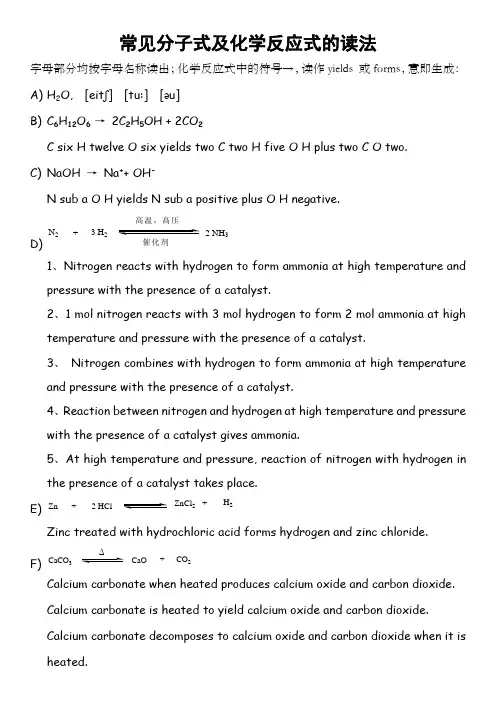
常见分子式及化学反应式的读法字母部分均按字母名称读出;化学反应式中的符号→,读作yields 或forms ,意即生成: A) H 2O, [eit ʃ] [tu:] [əu] B) C 6H 12O 6 → 2C 2H 5OH + 2CO 2C six H twelve O six yields two C two H five O H plus two C O two. C) NaOH → Na ++ OH -N sub a O H yields N sub a positive plus O H negative.D)1、Nitrogen reacts with hydrogen to form ammonia at high temperature and pressure with the presence of a catalyst.2、1 mol nitrogen reacts with 3 mol hydrogen to form 2 mol ammonia at high temperature and pressure with the presence of a catalyst.3、 Nitrogen combines with hydrogen to form ammonia at high temperature and pressure with the presence of a catalyst.4、Reaction between nitrogen and hydrogen at high temperature and pressure with the presence of a catalyst gives ammonia.5、At high temperature and pressure, reaction of nitrogen with hydrogen in the presence of a catalyst takes place. E)Zinc treated with hydrochloric acid forms hydrogen and zinc chloride. F)Calcium carbonate when heated produces calcium oxide and carbon dioxide. Calcium carbonate is heated to yield calcium oxide and carbon dioxide. Calcium carbonate decomposes to calcium oxide and carbon dioxide when it is heated.N 2+3 H 22 NH 3高温,高压催化剂Zn+2 HClZnCl 2+H 2CaCO 3CaO+CO 2Δ化合物命名1、无机物命名无机化合物英文名称的基本构词规律:◆在化合物命名时常用的英文数目词头:•mono-(1), ['mɒnəʊ]•di-(2), [dai]•tri-(3), [trai]•Tetra-(4), ['tetrə]•penta-(5), ['pentə]•hexa-(6),•hepta-(7),•Octa-(8),•nona-(9), ['nəunə]•deca-(10),•undeca-(11),•dodeca-(12)。
化工专业英语有机物命名
一些常见烷基的名称
烷基
—CH3 —C2H5
—(CH2)2CH3
普通命名法
IUPAC命名
中文 英文 名名
简 中文 英文 简
写名
名写
甲基 methyl Me 甲基 Methyl Me
乙基 ethyl
Et 乙基 Ethyl Et
正丙基 n-propyl n-Pro 丙基 Propyl Pro
—CH(CH3)2 异丙基 i-propyl i-Pro 1-甲基 1-methylehtyl 乙基
烷基
普通命名法
IUPAC命名
中文名 英文名 简写 中文名 英文名 简写
—(CH2)3CH3
正丁基
—CH(CH3)CH2CH3 仲丁基
—CH2CH(CH3)2 异丁基
n-butyl s-butyl i-butyl
n-Bu 丁基
s-Bu i-Bu
1-甲基 丙基
2-甲基 丙基
butyl Bu
1-methylpropyl 2-methylpropyl
其中,二甲醚常简称为甲醚(methyl ether),正 如乙醚(ethyl ether)一样 。
▪五单环芳香烃的命名 1-丁基-4-甲基苯
▪单环芳香烃是指苯及其衍生物。IUPAC(国际纯 粹与应用化学联合会 )规定了芳香环母体名称及编 码,命名时在母体名前加上取代基的位次和名 称即可。如:
▪ 硝基(-NO2 ) nitro
烷基
—C(CH3)3 —(CH2)4CH3
—(CH2)2CH(CH3)2
—CH2C(CH3)3
普通命名法
IUPAC命名
中文名 叔丁基 正戊基
异戊基 新戊基
英文名
化学专业英语-无机化合物的命名
Answer: pentacarbonyliron(0)
Solution: Since it is a neutral complex, it is named in the same way as a complex cation. The common name of this compound, iron carbonyl, is used more often.
Anionic Ligands
Names
Neutral Ligands
Names
Br-
bromo
NH3
ammine
F-
fluoro
H2O
aqua
O2-
oxo
NO
Nitrosyl
OH-
Hydroxo
CO
Carbonyl
CN-
cyano
O2
dioxygen
C2O42-
oxalato
N2
dinitrogen
Tin
Stannate
Examples Give the systematic names for the following coordination compounds:
1. [Cr(NH3)3(H2O)3]Cl3
Answer: triamminetriaquachromium(III) chloride
Vocabulary
1. coordination compound
配位化合物
2. complex
络合物
3. formula ( formulae 复数)
分子式, 公式
4. ligand
配体
5. cation
化学工程与工艺专业英语有机物命名3-1
把醚看成烃的烷氧衍生物,把余下的碳数较少的烷氧(RO−)作取代基,如 有不饱和烃基存在时,选不饱和程度较大的烃基作为母体:
烷氧基的英文名称在相应烷基名称后面加词尾“氧基”即“oxy”,低于5个 碳的烷氧基的英文名称将烷基中英文词尾“yl”省略。
1-甲氧基丁烷 1-methoxybutane
苯甲醚 methoxybenzene
对苯二酚 1, 4-benzenediol
烷基词尾-e
+
-ol
=
相应的醇
邻苯二酚 1, 2-benzenediol
间苯二酚 1, 3-benzenediol
2-萘酚 2-naphthalenol
1-萘酚 1-naphthalenol
3-溴苯酚 3-bromophenol
4-甲基苯酚 4-methylphenol
CH CH3 OH
1-苯基乙醇 1-phenyl-hexanol
分子中含有两个或多个相同官能团时,命名应选官能团最多的长链为主链, 然后根据主链的碳原子数称为某n醇(或某n醛、某n酮、某n酸等),n是主链 上官能团的数目。英文命名时,用di表示二,tri表示三,di、tri插在特征词尾前。 例如二醇(−diol)、三醇(−triol)。编号时要使主链上所有官能团的位置号尽 可能小。最后按名称格式写出全名。
苯甲醇 phenylmethanol
3-苯基-2-丁醇 3-phenyl-2-butanol
2-氯甲基-1-丁醇 2-chloromethyl-1-butanol
C H3C H2C H2C H C H2O H C H C H C H3 C H3 C H3
3,4-二甲基-2-丙基-1-戊醇
3,4-dimethyl-2-propyl-1-pentanol
专业英语(无机化合物命名 )
(5) Acids derived from binary compounds 由二元化合物得到得酸 For binary compounds with hydrogen as the positive ion, place the term hydro at the front of the stem of the negative ion, the letter ic at the end of the stem, and add the word acid. 以H作为阳离子,在成酸元素之前加hydro, 成酸元素之后改 ic , 再加acid. Eg: HCl: hydrochloric acid H2S: hydrosulfuric adic
不同氧化度的二元化合物
- 过氧化物: peroxide [pəˈr ɔkˈsad] O22ɪ
H2O2: hydrogen peroxide •超氧化物: superoxide [ˈsju:p ˈ ə ɔksaid] O2-
KO2: Potassium superoxide
[pəˈtæsi əm]
(4) Exceptions that use the ide endings These polyatomic ions take the ending ide even though more than two elements are present: -Hydroxide (OH-) -Cyanides(CN-) ['saiənaid] -Ammonium (NH4+) Eg: NH4I : Ammonium iodide Ca(OH)2: Calcium hydroxide KCmon Transition Elememts
应用化学专业英语 -无机化学命名
(3) 基本元素有多种价态 酸:最低氧化态(次酸) 基础元素(前缀 hypo-, 后缀 -ous) +acid 较低氧化态(亚酸) 基础元素加后缀-ous + acid 较高氧化态 (正酸) 基础元素加后缀-ic + acid 最高氧化态(高酸) 基础元素(前缀 per-, 后缀 -ic) +acid 盐:最低氧化态 阳离子元素 + 基础元素(前缀 hypo-, 后缀 -ite) 较低氧化态 阳离子元素 + 基础元素加后缀-ite 较高氧化态 阳离子元素 + 基础元素加后缀-ate 最高氧化态 阳离子元素 + 基础元素(前缀 per-, 后缀 -ate)
16. K4[Fe(CN)6]; 17. CuSO4· 5H2O 18. Cu2(OH)2CO3 19. NaNH4SO4
1. (NH4)2CO3: ammonium carbonate 2. N2O: nitrogen(Ⅰ) oxide; nitrous oxide ; laughing gas 3. H2SO4: sulphuric acid 4. P4O6 diphosphorus trioxide 5. Al2O3 Aluminum oxide 6. SnCl4 tin(Ⅳ) chloride; stannic chloride; tin terachloride 7. KHSO4 Potassium hydrogen sulfate 8. Cu2S copper(I) sulphide; dicopper sulphide 9. HClO4 perchloric acid
含氧酸及其盐:
(1) 基本元素仅有一种氧化态
酸:基本元素加后缀-ic +acid 例:H2CO3 carbonic acid 盐:阳离子元素+基础元素加后缀-ate 例:Na2CO3 sodium carbonate (2) 基本元素有两种氧化态 酸:基础元素加后缀(-ous 低价态,-ic 高价态) + acid HNO2:nitrous acid HNO3: nitric acid 盐:阳离子元素+基础元素加后缀( -ite低价态,-ate 高价态) NaNO2: Co(NO3)2: sodium nitrite cobalt(II) nitrate or cobaltous nitrate
(完整版)化学专业英语常用词汇
(完整版)化学专业英语常用词汇☆常用: ppm: parts per millionppb: parts per billion pH: potential of hydrogen1. 化合物的命名:规则:金属(或某些非金属)元素+阴离子名称(1)MgCl2 magnesium [m?ɡ’ni:zj ?m] chloride (2)NaNO2sodium nitrite [‘naitrait](3)KNO3 potassium[p ?’t?si ?m] nitrate [‘naitreit] (4)硝酸nitric acid(5)NaHCO3 sodium hydrogen carbonate练习:FeBr2 ? (NH4)2SO4 ? NH4H2PO4KMnO4亚硫酸sulfurous acidH2SNO2 有机物命名Hydrocarbon{Aliphatic hydrocarbon; Aromatic Hydrocarbon}Aliphatic hydrocarbon (脂肪烃){Alkane (烷); Alkene(烯); Alkyne(炔)}Alcohol 醇Aldehyde 醛Ketone [‘ki:t?un] 酮Carboxylic acid 羧酸Aromatic hydrocarbon(芳香烃){benzene (苯) hydroxybenzene(酚) quinone(醌)无机物中关于数字的写法mono-, di-, tri-, tetra-, penta- hexa-, hepta-, octa-, nona-, deca-一,二,三,四,五,六,七,八,九,十有机物中关于数字的写法meth-, eth-, prop-, but-, pent-, hex-,甲乙丙丁戊已hept-, oct-, non-, dec-, cyclo-, poly-庚辛壬葵环聚练习甲烷乙炔丙酮丁醇戊烷己烯庚醛辛烷2-甲基壬酸 3,5-二乙基癸醇Lithium [‘liθi?m] n.锂Beryllium [b?’rilj?m] n.铍(Be)Sodium [‘s?udi?m] n.钠Potassium [p?’t?si?m] 钾Rubidium [ru:’bidi?m] 铷Caesium [‘si:zi?m] 铯Nucleus[‘nju:kli s] 原子核,是nuclear的复数Halogen[‘h?l?d??n] 卤素general chemistry 普通化学positive[‘p?z?tiv] ion 阳离子orbital electron 轨道电子effective nuclear charge 有效核电荷atomic radius 原子半径,raddi的复数ionic radius 离子半径negative ion 阴离子electron cloud 电子云Van der Waals non-bounded radius单质分子晶体中相邻分子间两个非键合原子核间距离的一半称为范德华半径metallic [mi’t?lik] character[‘k?rikt?] 金属特性electropositive [I’lektr?u’p?z?tiv] a.带正电的Ionization [‘ai?nai’zei??n] energy 电离能carbon 碳germanium[d??:’meini?m] 锗tin [tin] 锡 lead [led] 铅sodium[‘s?udi?m] 钠magnesium[m?ɡ’ni:zj?m] 镁silicon [‘silik?n] 硅chlorine [’kl?:ri:n] 氯nonmetallic [‘n?nmi’t?lik]adj.n.非金属的,非金属Electronegativity 电负性Metallic oxide 金属氧化物Metallic hydroxide [hai’dr?ksaid] 金属氢氧化物Hydroxyl [hai‘dr?ksil] ions 氢氧根离子insoluble[in’s?ljubl] 不溶解的Ionic [ai‘?nik] adj. 离子的Transition element 过渡元素Basicity [b?’sisiti] n. 碱性,碱度Oxyacid [,?ksi’?sid] 含氧酸Carbonate [‘kɑ:b?neit] 碳酸盐Nitrate [‘naitreit] 硝酸盐Sulphate [‘s?lfeit] 硫酸盐 = sulfateAmphoteric [,?mf?’terik] adj.两性的Acid [‘?sid] n. adj.alkali [‘?lk?lai] n.adj.Hydration [hai’drei??n] 水合作用Hydrolyze [‘haidr?laiz] vi. 水解Oxysalt [‘?ksis?:lt] 含氧酸盐Complex 络合物,复合物句子理解1) Metals are electropositive and have a tendency to loss electrons, if suppliedwith energy: M M+ + e. 金属是电正性的,如果供给能量,有失去电子的趋势。