
八年级英语下册第五单元知识点整理
八年级英语下册第五单元知识点整理一、重要词汇与句子1、助动词do 用于条件状语从句或答语中起省略作用, 可使句子更简练、(1)--- I think I’m going to take the bus to the party 、--- If you do , you’ll be late 、(2) --- Do you like reading harry potter ?--- No , I don’t 、But my sister does 、2、have a good \ great \ wonderful time == have fun == enjoy oneself玩得很高兴\ 过得很愉快I had a good \ great \ wonderful time in the park yesterday 、==I had fun in the park yesterday 、== I enjoyed myself in the park yesterday 、3、let sb、\ sth、in 让某人\ 某物进来Why not let him in ?You’d better open the windows and let some fresh air in 、4、organize 动词, “组织, 安排, 筹备”They are going to organize a picnic 、organization 名词, “组织, 机构”She works for a voluntary organization helping homeless people 、organizer 名词, “组织者, 建立者”The organizers of the concert said they had a great success 、5、take away 拿走, 取走take ( an active ) part in (积极) 参加take off 起飞, 脱下take …to …把…、、带到……take turns to do sth 轮流做某事take a look ( at ) 瞧一瞧take exercise 做运动take notes 做笔记take a rest 休息take one’s temperature 量体温take it easy 别着急, 别紧张take over 接管6、a good time to do sth 做某事得好时间March is a good time to plant trees 、Autumn is a good time to travel 、7、remind sb、of sth、提醒某人做某事If I forget , please remind me to write to my mother 、8、around the world == all over the world 在世界各地\ 全世界Football is very popular around the world \ all over the world 、His dream is to travel around china 、9、make a living === for a living 谋生In this city he drives a taxi to make a living \ for a living、What does your father do to make a living \ for a living ?make a living ( by ) doing sth 、以做某事谋生The old man makes a living (by) hunting 、10、提建议得句子Why not do sth ? 为什么不做某事?Why don’t you do sth ? 为什么不做某事?What about \ how about doing ? 做某事怎么样?Would you like to do sth ? 您想\ 愿意做某事吗?Shall we do sth ? 我们去做某事, 好吗?Let’s do sth , shall we ? 让我们做某事, 好吗?Do you want to do sth ? 您想去做某事吗?11、seem like sth 瞧起来像……It seems like years since I last saw you 、自从我上次见到您以后, 好象就是过了好几年、Those cards seemed like many little flags 、那些卡片瞧起来好象许多小旗子。
Seem like doing sth 、瞧起来像做某事He seemed like forgetting what had happened 、12、chance 名词, “机会, 机遇”We have\ get a good chance of winning the match 、There is little chance of meeting him again 、by chance = by accident 偶然地We met him by chance yesterday 、take a chance on sth 、在……上冒险you shouldn’t take a chance on that 、13、all the time 总就是, 一直They are singing the same song all the time 、You can hear them talking and laughing all the time 、He stayed at home all the time last night其它短语: in time 及时on time 准时at times 有时at that time 在那时at the same time 同时once upon a time 从前as time goes on 随着时间地推移take one’s time 不着急watch one’s time 等待时机14、have a difficult time ( in ) doing sth、难于做某事, 做某事有困难== have problems ( in) doing sth、== have trouble ( in ) doing sth、We have a difficult time working out the problem 、They have some problems getting to the top of the mountain 、15、against 介词, “反对, 不同意, 抵抗, 对抗, 对……不利”反意词for, “赞成”There were 20 votes (票) for him and 12 against him 、They sailed against the wind 、她们顶风航行、You need to wear a coat against the cold 、您需要穿上外套防寒、He is standing against the wall 、她靠墙站着、He hit against a tree 、她撞到了树上、We are going to play a basketball match against Class Two on Sunday 、16、forget 忘记forget sth 忘记某物forget to do sth 忘记去做某事forget doing sth、忘记做了某事leave sth somewhere 把某物忘在某处I forgot to turn off the light when I left、I forgot telling him the message and told him again 、--- Did you forget your homework ? --- Yes, I left it at home 、17、in class 在课堂上, 上课时in the class 在班上, 在班里We must listen to the teachers carefully in class 、They can do some activities in class 、There are 45 students in the class 、18、too much 太多代替或修饰不可数名词, 或修饰动词much many 太多代替或修饰可数名词much too 太, 非常后接形容词或副词He says too much but does little 、there is too much rain in summer 、I have too many rules at home 、He has drunk too much and drives much too fast 、19、exercise (1) 不可数名词, “锻炼, 练习”A lot of exercise is good for your health 、You need to do more exercise to keep health 、(2 ) 可数名词, “体操, 运动”We do morning exercises ( 早操) every day 、Eye exercises ( 眼保操) are important to students 、(3 ) 动词, “锻炼”how often do you exercise ?20、can \ be able to(1) can 没有人称得变化, 但有现在时can 与过去时could 两种时态(2) be able to 有人称得变化, 也有现在时am\is\are able to,过去时was\were able to 与一般将来时will be able to 得变化、21、make ( a lot of ) money 挣(许多) 钱22、get a (good ) education 接受(良好)教育二、if引导得条件状语从句、(一) if 引导得条件状语从句与主句时态得呼应、1、如果主句就是一般将来时, 从句要用一般现在时代替一般将来时、(1) 从句就是肯定句, 主语就是第三人称单数时, 行为动词后面要加s \ es 、否则, 动词用原形、(2) 从句就是否定句, 主语就是第三人称单数时, 用doesn’t + 行为动词原形、否则, 用don’t + 行为动词用原形、We’ll have a picnic if it doesn’t rain tomorrow 、If it rains , I will stay at home 、I’ll go with you if you don’t want to go alone 、If we have the party today , half the class won’t come 、2、如果主句含有must , may , can 等情态动词, 从句也用一般现在时、If you drive too fast , you may have an accident 、You must stop if the traffic light is red 、3、如果主句就是祈使句, 从句也用一般现在时、Be careful with your homework if you don’t want to make mistakes 、(二) if引导条件状语从句与if引导宾语从句时得区别、1、if引导宾语从句时, 表示“就是否, 时不就是”、位于及物动词之后、if引导条件状语从句时, 表示“假如, 如果” , 位于句首或句末I don’t know if he will come tomorrow 、if he comes , I’ll call you 、2、在if引导得宾语从句中, 如果主句就是一般现在时, 宾语从句得时态根据需要确定; 如果主句就是一般过去时, 宾语从句也要用过去得时态、而在if引导得条件状语从句中, 要用一般现在时、I don’t know if it will rain tomorrow 、He asked if I could help him 、I can help you if I am free(三) if引导得条件状语从句练习题选择题1、--I hear Anna will give up learning the piano 、--- If she ______ , her parents will be mad at her 、A、willB、doesC、doD、is2、–I hear Jack Chan will come to Laiwu next week 、---Really ? ________ he comes , my younger sister will be very happy 、A、ifB、untilC、unlessD、before3、I bet Mr black will come to help us if he _______ too busy tomorrow 、A、isB、will beC、won’t beD、isn’t选词填空1、What ________ ( will \ would ) happen if they miss the bus ?2、If we have the meeting tomorrow , he _____ ( do, will ) not come 、3、If we watch a video , I __________ ( am \ will be ) bored 、4、Let’s go hiking if it ________ ( doesn’t \ won’t ) rain on Sunday 、5、Can you tell me if it _________ ( will rain \ rains ) tomorrow 、仿照例句把两句合为一句、1、You think you’re going to visit New York city 、You will see some tall buildings 、--- If you visit New York city, you’ll see some tall buildings 、2、You are going to eat and drink more 、You will be fatter 、3、They are going to do more exercise 、Their health will be better 、4、You are going to let me watch TV 、I will stay at home 、5、Chinese team are going to be champions 、I will be very excited 、。
英语八年级下册第五单元笔记

英语八年级下册第五单元笔记一、重点单词。
1. beginning.- 名词,“开始;开端”。
例如:At the beginning of the movie, there was a big explosion.(在电影开始的时候,有一场大爆炸。
)- 其动词形式是begin,begin to do sth.或者begin doing sth.表示“开始做某事”,如:He begins to study/studying English at 7 every day.(他每天7点开始学习英语。
)2. heavily.- 副词,“在很大程度上;大量地;猛烈地”。
常用来修饰动词或形容词。
例如:It rained heavily last night.(昨晚雨下得很大。
)3. strange.- 形容词,“奇特的;奇怪的;陌生的”。
如:There is a strange noise in the room.(房间里有一个奇怪的声音。
)- 其名词形式是stranger,“陌生人”。
例如:Don't talk to strangers.(不要和陌生人说话。
)4. wind.- 名词,“风”,是不可数名词。
如:The wind is blowing strongly.(风刮得很猛。
)- 其动词形式为“wind”,读音为[waɪnd],表示“蜿蜒;曲折前行;缠绕”,例如:The river winds through the mountains.(这条河蜿蜒穿过山脉。
)5. report.- 名词,“报告;报道”。
例如:I read a report about the accident in the newspaper.(我在报纸上读到了一篇关于这个事故的报道。
)- 动词,“报道;公布”。
如:The journalist reported the news on TV.(这位记者在电视上报道了这条新闻。
人教版八年级下册英语Unit 5 知识点语法归纳总结
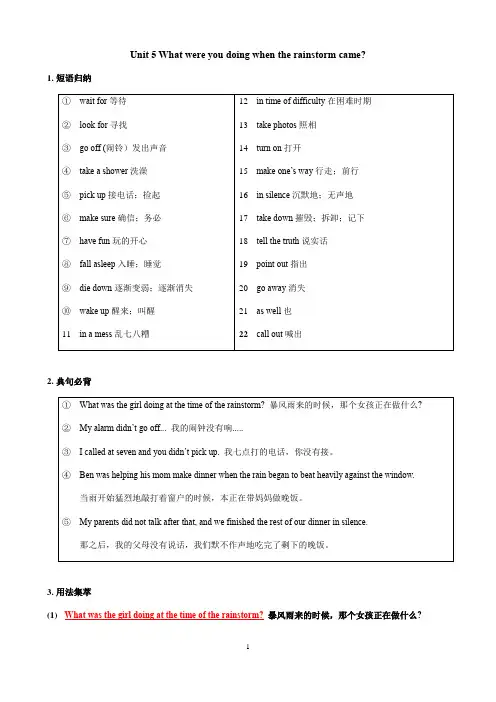
Unit 5 What were you doing when the rainstorm came?1.短语归纳2.典句必背3.用法集萃(1)What was the girl doing at the time of the rainstorm?暴风雨来的时候,那个女孩正在做什么?❖本句是特殊疑问句,时态是过去进行时,结构是“What+was/were+主语+doing+其他?”,用于询问某人在过去的某个时间正在做的事情。
例:—What were you doing at nine o’clock yesterday evening? 昨天晚上九点你正在做什么?—I was watching TV at home. 我正在家里看电视。
❖拓展:过去进行时描述过去某个时刻正在发生的动作或存在的状态,结构是“was/ were+动词的现在分词”。
例:When I got home my mother was cooking. 我到家的时候我妈妈正在做饭(2)My alarm didn’t go off... 我的闹钟没有响.....❖go off意为“(闹钟)发出响声”例:My alarm goes off at six every morning. 我的闹钟每天早晨6点响。
❖归纳:go off还有“离开”和“变质”之意。
例:Bob went off to get a drink. 鲍勃拿饮料去了。
Meat goes off quickly in hot weather. 热天肉变质得快。
❖拓展:go的短语(3)I called at seven and you didn’t pick up. 我七点打的电话,你没有接。
❖pick up意为“接电话”。
pick up有如下含义:(4)I called again at eight and you didn’t answer then either. 我八点再打来,你也没接。
八年级下册英语第五单元知识点
八年级下册英语第五单元知识点
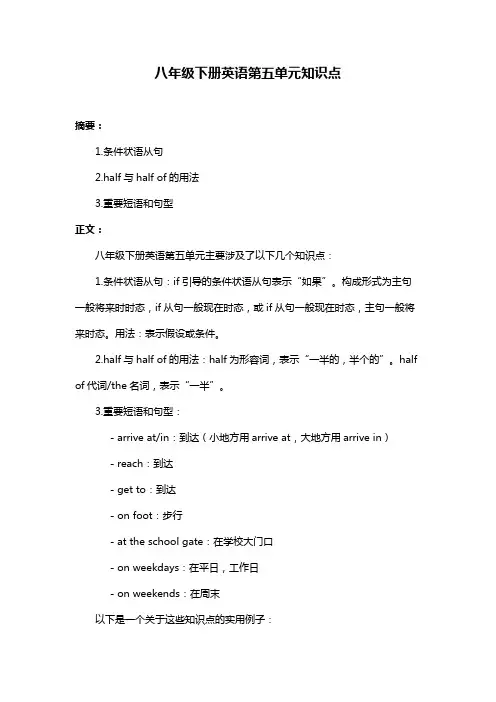
摘要:
1.条件状语从句
2.half与half of的用法
3.重要短语和句型
正文:
八年级下册英语第五单元主要涉及了以下几个知识点:
1.条件状语从句:if引导的条件状语从句表示“如果”。
构成形式为主句一般将来时时态,if从句一般现在时态,或if从句一般现在时态,主句一般将来时态。
用法:表示假设或条件。
2.half与half of的用法:half为形容词,表示“一半的,半个的”。
half of代词/the名词,表示“一半”。
3.重要短语和句型:
- arrive at/in:到达(小地方用arrive at,大地方用arrive in)
- reach:到达
- get to:到达
- on foot:步行
- at the school gate:在学校大门口
- on weekdays:在平日,工作日
- on weekends:在周末
以下是一个关于这些知识点的实用例子:
假设你是一名学生,有一天你告诉你的朋友:“如果明天不下雨,我们就去公园玩耍。
”这句话中就用到了条件状语从句。
另外,如果你说:“我有一半的作业已经完成了。
”这就是使用了half这个形容词。
而在描述到达某个地方的方式时,你可以用arrive at(如:我昨天到达北京),或reach(如:我昨天到达北京),也可以说get to(如:我昨天到达北京)。
学习这些知识点有助于提高你的英语水平,更好地应对日常学习和生活中的各种场景。
八年级英语下册Unit 5 What were you doing when the rainstorm came重点知识点
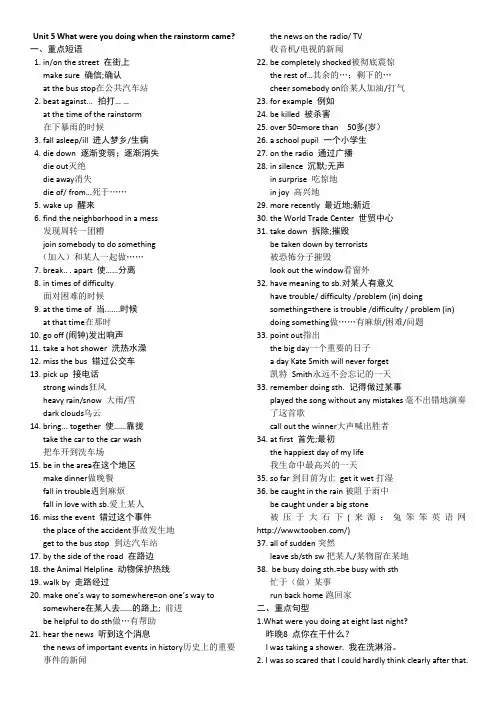
Unit 5 What were you doing when the rainstorm came?一、重点短语1. in/on the street 在街上make sure 确信;确认at the bus stop在公共汽车站2. beat against... 拍打… …at the time of the rainstorm在下暴雨的时候3. fall asleep/ill进人梦乡/生病4. die down 逐渐变弱;逐渐消失die out灭绝die away消失die of/ from…死于……5. wake up 醒来6. find the neighborhood in a mess发现周转一团糟join somebody to do something(加入)和某人一起做……7. break.. . apart 使……分离8. in times of difficulty面对困难的时候9. at the time of 当.......时候at that time在那时10. go off (闹钟)发出响声11. take a hot shower 洗热水澡12. miss the bus 错过公交车13. pick up 接电话strong winds狂风heavy rain/snow 大雨/雪dark clouds乌云14. bring... together 使……靠拢take the car to the car wash把车开到洗车场15. be in the area在这个地区make dinner做晚餐fall in trouble遇到麻烦fall in love with sb.爱上某人16. miss the event 错过这个事件the place of the accident事故发生地get to the bus stop 到达汽车站17. by the side of the road 在路边18. the Animal Helpline 动物保护热线19. walk by 走路经过20. make one’s way to somewhere=on one’s way tosomewhere在某人去……的路上; 前进be helpful to do sth做…有帮助21. hear the news 听到这个消息the news of important events in history历史上的重要事件的新闻the news on the radio/ TV收音机/电视的新闻22. be completely shocked被彻底震惊the rest of…其余的…;剩下的…cheer somebody on给某人加油/打气23. for example 例如24. be killed 被杀害25. over 50=more than 50多(岁)26. a school pupil 一个小学生27. on the radio 通过广播28. in silence 沉默;无声in surprise 吃惊地in joy 高兴地29. more recently 最近地;新近30. the World Trade Center 世贸中心31. take down 拆除;摧毁be taken down by terrorists被恐怖分子摧毁look out the window看窗外32. have meaning to sb.对某人有意义have trouble/ difficulty /problem (in) doingsomething=there is trouble /difficulty / problem (in)doing something做……有麻烦/困难/问题33. point out指出the big day一个重要的日子a day Kate Smith will never forget凯特Smith永远不会忘记的一天33. remember doing sth. 记得做过某事played the song without any mistakes毫不出错地演奏了这首歌call out the winner大声喊出胜者34. at first 首先;最初the happiest day of my life我生命中最高兴的一天35. so far到目前为止get it wet打湿36. be caught in the rain被阻于雨中be caught under a big stone被压于大石下(来源:兔笨笨英语网/)37. all of sudden突然leave sb/sth sw把某人/某物留在某地38.be busy doing sth.=be busy with sth忙于(做)某事run back home跑回家二、重点句型1.What were you doing at eight last night?昨晚8 点你在干什么?I was taking a shower. 我在洗淋浴。
人教版八年级英语下册第五单元知识点汇总总结
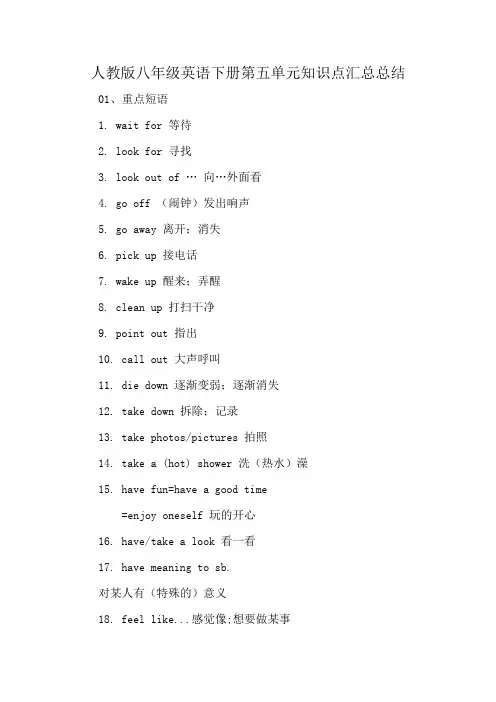
人教版八年级英语下册第五单元知识点汇总总结01、重点短语1. wait for 等待2. look for 寻找3. look out of … 向…外面看4. go off (闹钟)发出响声5. go away 离开;消失6. pick up 接电话7. wake up 醒来;弄醒8. clean up 打扫干净9. point out 指出10. call out 大声呼叫11. die down 逐渐变弱;逐渐消失12. take down 拆除;记录13. take photos/pictures 拍照14. take a (hot) shower 洗(热水)澡15. have fun=have a good time=enjoy oneself 玩的开心16. have/take a look 看一看17. have meaning to sb.对某人有(特殊的)意义18. feel like...感觉像;想要做某事19. make sure 务必,确保20. beat against 敲打21. fall asleep 进入梦乡22. break … apart 使…支离破碎23. turn on打开 (反:turn off关上)24. listen to the radio 听收音机25. get to = arrive in/at 到达26. make one’s way to 前往;费力前行27. to tell the truth 说实话28. walk by 路过29. at the time of …在…的时候30. in a mess 凌乱不堪;乱七八糟31. in times of difficulty 在困难时期32. because of 因为33. in history 在历史上34. in silence 沉默,无声35. at first 起初;起先36. by the side of …在…旁边37. the rest of …剩余的38. each other 互相39. for example 例如40. as well 也02、重点句子Grammar Focus 句子1. What were you doing at eight last night?昨天晚上8点你在做什么?I was taking a shower.我在洗淋浴。
八年级英语下册第五单元的知识点

八年级英语下册第五单元的知识点1.If引导的条件状语从句:1)构成:if引导的条件状语从句表示“如果…”。
构成形式为“主句+一般将来时时态+if从句+一般现在时态”,或“If从句+一般现在时态,主句+一般将来时态”。
2)用法:表示假设或条件2.half 与half of的用法:1)half the class中的“half”为形容词,意思“一半的,半个的”2) “half of+代词/the+名词”中的half为名词,意思为“一半,半个”。
当该构造在句子作主语时,谓语动词必须和该词组中的代词或名词保持数的一致。
即当代词或名词为单数时,谓语动词用第三人称单数形式;假设所接名词或代词为复数,那么谓语动词用复数形式。
3. all the time与always: all the time是个副词性的短语,意思为“一直”“始终”,表示某一特定阶段开始一直到完毕,不表示频度,多置于句末。
除此,all the time还有“不断”的意思;always为表示频度的副词,意思为“总是”,表示动作的反复,状态的继续,中间没有连续,其反义词为never。
它与进展时态连用时,常翻译成“总是”,“老是”,带有赞美,厌烦,不满等感情色彩。
4.Enough的用法:1)enough to do sth表示“足够…可以做…”2)enough也可以用“for+宾语+to do sth的构造”3)enough 修饰名词时前面不用冠词4)当主语是代词时,enough可以作表语。
当主语是名词时,enough不能做表语。
5.Choose的用法:1)choose+名词意思为“选择…”;2)choose+between/from从…中选择;3)choose to do选择做某事6.Exercise的用法:1)运动,锻炼,是不可数名词2)体操,练习,是可数名词。
3)动词,使….运动7.wear, put on, have on, dress: wear“穿着”“戴着”,表示状态,是延续性动词,一般现在时表示经常状态,现在进展时表示暂时状态;put on“穿上”“戴上”,表示动作,是非延续性动词;have on“穿着”“戴着”,表示状态可以与wear互换;dress“穿上”“穿着”,既表示状态,也表示动作,既可以作及物动词,也可以作不及物动词。
八年级下册英语第五单元知识点
八年级下册英语第五单元的知识点包括但不限于以下几个方面:
1. 重点词汇:包括动词如“去散步”、“去跑步”、“去游泳”,名词如“日记”,形容词如“忙碌的”、“有精神的”、“健康的”等。
2. 重点短语:如“make a reservation for dinner”,意为“为晚餐预定位置”。
3. 句子结构:本单元涉及到的句子结构包括现在进行时、一般现在时、一般过去时等。
例如,“We are leaving for the airport at 3:00pm.”,意为“我们下午3点出发去机场。
”,“I am meeting my friend tomorrow.”,意为“明天我要和朋友见面。
”,“I have a busy day today.”,意为“我今天很忙。
”
4. 语法知识:第五单元还介绍了副词修饰动词的用法,如“I usually go to school on foot.”,意为“我通常走路去学校。
”,“He can swim very fast.”,意为“他游泳游得很快。
”。
5. 日常用语:本单元涉及到的日常用语包括“How are you?”,“What's new?”,“Can you help me with...?”,“Is there anything new in...?”,“Could you please...?”。
6. 写作技能:学习写日记和会议记录也是本单元的重点之一。
在写作过程中,需要注意日记的格式和会议记录的要点。
以上是八年级下册英语第五单元的主要知识点,希望对您有所帮助。
最全面人教版八年级下册英语第五单元知识点归纳总结
Unit 5 What were you doing when the rainstorm came?一、词汇与短语◆重点单词A部分1.rainstorm 暴风雨n.2.window 窗;窗户n.3.alarm 闹钟n.4.flashlight 手电筒;火炬n. 5.suddenly 突然;忽然adv.6.match 火柴n.7.strange 奇特的;奇怪的adj.8.against 倚;碰;撞prep. 9.storm 暴风雨n.10.asleep 睡着adj.11.begin 开始v.12.rise 升起;增加;提高v.&n. 13.heavily 在很大程度上;大量地adv.14.fallen 倒下的;落下的adj. 15.wind 风n.16.apart 分离;分开adv. 17.light 光;光线;光亮n.18.icy 覆盖着冰的;冰冷的adj. 19.report 报道;公布v.&n.20.kid 开玩笑;欺骗v.21.area 地域;地区n.22.beat 敲打;打败v.23.wood 木;木头n.B部分1.realize 理解;领会;认识到v.2.recently 不久前;最近adv. 3.passage 章节;段落n.4.terrorist 恐怖主义者;恐怖分子n. 5.pupil 小学生n.6.date 日期;日子n. 7.completely 彻底地;完全地adv.8.tower 塔;塔楼n.9.shocked 惊愕的;受震惊的adj.10.truth 实情;事实n. 11.silence 沉默;缄默;无声n.◆重点短语A部分1.pick up ( = pick up the phone) 接电话2.have a look 看一看3.die down逐渐变弱;逐渐消失4.at the bus stop 在公交车站5.go off (闹钟)发出响声6.wait for 等待7.go to work 去上班8.rain heavily 下大雨9.see sb. doing sth. 看见某人正在做某事10.begin to do sth. 开始做某事11.take a shower 洗淋浴12.at that time 在那时13.so many times 这么多次14.feel like 感觉像15.need help with sth. 需要……(方面)帮助16.make sure 确保17.with no light outside 外面没有灯光18.help sb. (to) do sth. 帮助某人做某事19.put……over……把……覆盖在……上20.make dinner 做晚饭21.put sth. on the table 把某物放在桌子上22.play a card game 玩纸牌游戏23.beat heavily against the windows 猛烈地敲打着窗户24.get to the place of the accident 到达事故发生地25.have fun 玩得愉快26.wake up 醒来;叫醒27.at first 起初;起先28.in times of difficulty 在困难时29.fall asleep 进入梦乡;睡着30.right away 立刻;马上31.go outside with sb. 和某人一起出去32.in the library 在图书馆33.find sth. in a mess 发现……一片狼藉34.on the street 在大街上35.break sth. apart 把某物折断(或分开)B部分1.in silence 沉默;无声2.in history 在历史上3.take down 拆除;往下拽;记录4.remember doing sth. 记得做过某事5.make one's way 前往;费力地前进6.look out of the window 向窗外看7.the school basketball competition 学校篮球比赛8.have meaning to sb.对某人来说有意义9.walk by 从旁边经过10.point sth. out to sb. 向某人指岀某物11.by the side of the road 在路边12.go away 离开13.at the event 在这次活动中14.as well 也15.be late for 迟到16.call out the winner 宣布获胜者17.on this day 在这一天18.10 minutes ago 十分钟前19.on April 4 在四月四日20.be completely shocked 完全震惊了21.an important event 一次重要的事件22.the rest of 其余的23.on the radio 在收音机上◆重点句子A部分1.What were people doing yesterday at the time of the rainstorm?昨天暴风雨来临时人们正在干什么?2.when the rain storm suddenly came, what were you doing?当暴风雨突然来临时,你正在做什么?3.So while you were sleeping, I called Jenny and she helped me.因此在你睡觉的时候,我打电话给珍妮,她帮了我。
新版八年级英语下册第五单元知识点归纳
新版八年级英语下册第五单元知识点归纳新版八年级英语下册第五单元知识点归纳Unit hat ere u ding hen the rainstr ae?一基础知识讲解hat ere peple ding esterda at the tie f the rainstr?昨天当暴风雨临的时候人们正在做些什么?【解析1】过去进行时过去进行时态⑴用法:①过去某个时间正在发生的动作He as ing at six last night 昨天晚上六点,他正在做饭。
②过去某段时间正在发生的动作I as staing here fr arh t a last ear去年从3月到月,我一直呆在这里。
⑵与过去进行时连用的时间状语,常见的有at nine last night/ at that tie= then/at this tie esterda /或有hen the teaher ae in/ hile he as reading的提示⑶过去进行时的构成:as\ere +现在分词⑷过去进行时的四个基本句型肯定句He as ing at six last night否定句He as nt ing at six last night一般疑问句as he ing at six last night?两回答es ,he as N, he asn’t特殊疑问句hat as he ding at six last night?⑸过去进行时的固定句型i as reading hen the teaher ae in 当老师进的时候,吉姆正在读书。
i as reading hile ate as athing TV在凯特正在看电视的同时,吉姆正在读书。
i ae in hile ate as athing TV 在凯特正在看电视的时候,吉姆进了。
⑹请比较He athed TV last night (过去时间last night, 用一般过去时)He as athing TV at nine last night (过去时间last night+点时间at nine, 用过去进行时)【2013浙江杭州4】Sall t a pht f her friends hile the _________ puter gaesA plaB are plaing have plaed D ere plaing【2013黑龙江绥化3】unle ____ bs in the r at this tie esterdaA as seeingB is reading as reading【2013黑龙江齐齐哈尔3】hat ____ u _____ hen the aptain ae in?A are; dingB did; d ere; ding巩固练习:用所给动词的适当形式填空1 N i’s sister __________________(read) nespapers2He __________________(ath)TV at nine last night3He __________________(ath)TV last night4 hat __________________the tins __________________(d) then?— ________Lil ______________(dra) a at hen the teaher ae in ? — N, she _________6 __________________u __________________(have) supper at that tie?7 a __________________(nt read) a b at nine esterda evening8 N i __________________(pla) basetball n the plagrund(操场)9 hat ___________________ he _______________ (d) at nine ’l last night10 The ___________________ (listen) t the usi at that tie11 hen the teaher ae in, the students ___________________ (read) the text12 e ___________________ (ath) TV hen suddenl the telephne rang13 Her ther ____________() hile her father as athing TV【解析2】at the tie f 在的时候(常用于过去进行时)【解析3】rainstr n 暴风雨rainat 雨衣raindrp雨滴2 alar didn’t g ff s I ___ up late 我的闹钟没有响,因此我____晚了。
人教版八年级下册英语Unit5知识点总结
人教版八年级下册英语Unit5知识点总结一、语法知识点A部分知识点1.过去进行时❶ 去进行时的构成及用法过去进行时由“助动词(was/were)+动词-ing”构成,表示在过去某一时刻或某一时间段正在进行的动作。
这一特定的过去时间除有上下文暗示以外,一般用过去的时间状语来表示。
如:then, at that time, at this time yesterday, at 10:00 yesterday morning, all right以及when/while从句等。
❶ 表示过去时间点正在进行的动作。
此时常伴明确的过去时间点等。
eg:She was reading a book at this time yesterday.昨天这个时候她正在看书。
(过去时间点正在进行的动作)I was watching TV then. 那时我正在看电视。
(过去时间点正在进行的动作)❶ 表示过去的某个阶段持续的动作。
eg:She was watching TV when the phone rang.(过去一段时间内持续的动作)她正在看电视,这时电话铃响了。
❶ 表示这一阶段反复发生的动作,带有褒贬感情色彩。
此时常伴有频度副词always等。
eg:The girl was always changing her mind.(过去反复发生的动作,带有感情色彩)这个女孩老是改变主意。
❶ 表示过去动作延迟到以后发生,即用过去进行表过去将来,此类动词是一些位置的变化的词。
eg:He told me that he was going soon.(过去进行表将来)他告诉我他很快就要走了。
❶ 过去进行时的一般疑问句句型:Be(Was/Were)+主语+现在分词+其他?肯定回答:Yes,主语+be(was/were).否定回答:No,主语+be(was/were) not.eg:--Were you cooking at that time? 那时,你在做饭吗?--Yes, I were.是的。