
1.2 Unit 4 Inventions and Inventors 教案(北师大版九年级全册)
授课时间:12.20
Unit 4 Inventions and Inventors Roundup 4
教学目标:
1. 知识目标:1)复习动词的一般现在时,一般过去时,一般将来时的被动语态及带有情态
动词的被动语态的构成和用法。
2)复习短语be made of和be made from;be used for和be used by在被动语态中的不同含义,要求学生口头和笔头掌握。
2. 能力目标:1)能口笔头对物体成份,功能,用途进行简单描述。
2)能读懂常用物品的简单功能,成份和使用说明。
3)能写出含有被动语态的句子和简单文段。
3.文化意识:了解历史上中外的重大发明及发明者对中外文化发展的影响及作用。
对比中文
和英文在表达被动语态时的异同。
4.学习策略:通过观察、理解、归纳,运用的过程发现语言规律,并利用语言规律解决实际
问题,培养学生自主学习的能力。
教学内容:
1. 话题:Inventions
2. 词汇:be made of, be made from; be used for, be used by.
3.语法:复习一般现在时,一般过去时,一般将来时的被动语态及带有情态动词的被动语态
的构成和用法。
教学重点:复习被动语态的用法。
教学用具:录音机,课件,多媒体
教学步骤:
I.Lead in
Step1 教师设置问题导入本课内容:
T: In Unit4, we have learned a lot of inventions. Do you remember them? Who can tell us some of them?
S: 学生先说出学过的几个发明。
T: Let me show you some pictures.
Step2 教师在投影上打出一些图片,帮助学生回忆本单元的词汇,教师提示:
T: Let’s read them together
S:学生集体朗读词汇。
( fridge, microwave oven, photocopier, gunpowder, kite, tea-drinking, wheelbarrow)
(bulb, keyboard, plane, train, typewriter, )
II.Review Passive V oice:
1.复习被动语态的结构和意义:
Step1. 复习含有被动语态的句子
1)T: Match the pictures with correct sentences.
The food is heated in the oven.
Paper was made in China in 105 AD.
Very few people will be killed by future cars.
Milk should be kept in the fridge.
2)T: Check the answers:
S: 教师要求学生根据图片选择句子。
Step2.教师要求学生再次朗读句子。
Step3.教师要求学生观察句子,并归纳结构。
T: Could you tell me the same parts of each sentence?
S; passive voice: be+ V. (pp)
2.操作被动语态:
Step1. 复习有关家用电器的词汇:
T: Almost everyday,many people use the electrical machines, do you know them? (展示投影) S: fridge, microwave oven, photocopier, camera
Step2. 用被动语态说出句子。
T: Do you know what they are used for?
S: A fridge is used for storing food.
A microwave oven is used for heating food.
A photocopier is used for doing a photocopier work.
A camera is used for taking photos.
Step3. 复习be made of/from.
1.复习词汇.
T: What are these things?
What are they made of/from?
S: watch, pencil, butter, paper
S: The watch is made of steel.
The pencil is made of wood.
Butter is made from milk.
Paper is made from trees.
Step4. 复习将来时的被动语态。
T:你能设想一下将来我们使用什么日用品吗? ( T: Can you imagine what our life will be like in the future?)
打出一些图片,给学生一些提示.(T: Can you make sentences with the words or phrases according to the pictures?)
S:学生看图片说出:
A Robot will be used in our family.
Flying cars will be invented in fifty years.
A personal web page will be used by everyone.
Spaceships will be used for traveling to other planets.
Step5. 复习含有情态动词的被动语态。
T: 平时生活中, 你注意到这些标志了吗? 他们都代表什么意思? (Have you ever seen these signs ? What’s meaning of each sign?)
S:学生小组讨论
T:每组检查两对
1)Bicycles can not be left here.
2)The flowers should be watered.
3)All the pictures mustn’t be taken here.
4)Cigarettes mustn’t be smoked here.
Step6. 被动语态在实际生活中的运用。
T: 设计一个教室的场景,告诉学生明天有外国朋友来参观,有什么需要我们做?S:小组讨论后发言。
III. Do some exercises about passive voice:
一. 填空: (Fill in blanks)
1. Nowadays, personal computers______ _______(find) in many homes.
2. Wheelbarrows________ first ______ ( use) a long time ago, during Han dynasty.
3. The World Wide Web_______ ________ (develop) by Tim Berners-Lee in 1990.
4. _____The first umbrellas _____ (make) in China?
5. Last year, the Great Wall of China _______ _______ ( visit) by millions of tourists.
6. Today, Chinese ______ _______ (speak) by more and more people around the world.
7. The garden _____ _______(not, water) once a week.
8. When ______ paper first________ ( invent)?
二. 看图并描述: ( Can you say something about the pictures? )
1. Clothes was washed this morning.
2. This old typewriter is used for writing letters.
3. These bottles are made of glass.
4. The windows were broken last night.
5. Some new cars will be made in the factory in a few days.
6. Your bag can be left here. He was taken to the hospital this morning.
7. The medicine is used by the doctor to treat the patient.
V. Homework for today:
1. Review Unit4
2. Copy the sentences on page54 in textbook.
3. Do exercise 2, 3, 4, 6 on page55 in textbook.
板书设计:
课后自评:。
北师大版九年级英语上册Unit4InventionsandInventors优质教案Lesson14
Step 1 Revision1)Ask the following questions for the students to discuss:(1)C ould you pleas e tell me how many families use Microwave ovenstoday?(2)How many of you have go t Microwave ovens at home? Who can tell mehow a Microwave oven works?(3)Who can tell me why the plate doesn’t get hot when I cook something inmy Microwave oven?…2)Ask the students to describe the usage of the facilities in the classroom ingroups, and then present in class.Step 2 Warming-up1) Present the picture of Cailun, and ask the students to discuss the following:Wh o is he?In which dynasty did he live in?What did he contribute to Chinese culture?2)Today in this lesson we’re about to learn more about papermaking and some other ancient inventions.Step 3 Part 1 1.11)Ask the students to look at the pictures in the book and discuss the questions inpairs.2)Ask two pairs to talk before class.Step 3 Part 1 1.2&1.31)Encourage the students to discuss what the three different titles imply to them?What does each one focus on talking about?2)Ask them to look briefly through the text and ch oose the best title.3)Read again and complete the text with the correct form of the given verb s.Step 4 Part 1 1.4 & 1.51)Ask the students to practice the questions and answers in 1.4 in pairs.2)Encourage them to present their qu estions and answers in class.3)Ask the students to conclude the usage of the passive voice in this lesson andcompare it with the usage in Lesson 13.4)Emphasize the difference between the present tense and past tense of passivevoice.Step 5 Part 1.61)Ask the students to read and complete the sentences in this part individually.2)Encourage them to write their own sentences with the past tense of passive voiceaccording to the conclusion of Step 4.3)Students present their sentences in class.Step 6 Homework1)Roundup 4 Exercise 1&22)Workbook P168 Exercise 1&23) Optional homeworkPlease collect informa tion about an invention to give a speech on, imitating the text in part 1.3. The students will get the chance to present their speeches next class.B教学重点1)继续巩固一般过去时的被动语态。
Unit_4_Inventions_and_Inventors教案AlwKHU
T: Read Para.1 and find the answer.
2. To choose a proper title for the passage
The cause of air pollution
Cars in the future
Problems of future cars
Q5:How will the cars be driven without gas?
5.What aspects(方面)about future cars arementioned(提到) in opinion 1?
Size, color, decoration inside the car, speed,
教学难点
学生能正确使用一般将来时被动语态描述未来汽车的特点
教学资源
课本,黑板,学案;计算机媒体
教学过程
教学环节与
时间安排
教与学的过程
设计意图
Warm-up
(3min)
1.老师总结话题下词汇,并用图片带领学生复习:
ancient inventions:magic squares;printing;wheelbarrows;compass;kites;umbrella;gunpowder; papermaking
2.What’rethe advantages of future cars in opinion 2?
T出示选项供学生选择
A. It can reduce(减少)the pollution.
B. It can save the energy(节约能源).
C. It can keep people safe.
初中英语:unit 4 inventions 教案
Does the flying car depend on petrol?。学生给出正确回答后,教
师可以补充:It uses solar power instead of petrol.。学生认读和理
解单词instead of和petrol。
unit 4 inventions
Period5writing
教学内容
Listening (p. 54), Writing (p. 60)
教学目标
语言知识
1.认读和理解单词advertisement, funny, create, dust, special, wing, instead of , petrol和短语keep…off, at the same time等。
教师和学生分享有趣而奇特的小发明,然后鼓励学生进行讨论,找出身边类似的有趣而奇特的小发明,并说出要介绍一个发明,需要强调哪些信息,告诉学生:Today, you can create a new or special invention of your own.,从而自然过渡到Writing板块,并展出spidergram,强化写作的模块。
2.进一步熟悉和理解“发明与技术”的话题。
语言技能
1.听前理解图片信息,听中捕捉关键信息。
2.运用“蛛网图”组织写作素材。
学习策略
利用图片等非文本信息理解主题内容,在学习中善于模仿,举一反三。
教学重点
在听的过程中捕捉关键信息。
教学难点
运用“蛛网图”构思写作内容及结构。
教学过程
教学过程
教学过程
Step 1greeting and free talk
九年级英语:Unit 4 Inventions and Inventors(教学方案)

( 英语教案 )学校:_________________________年级:_________________________教师:_________________________教案设计 / 精品文档 / 文字可改九年级英语:Unit 4 Inventions and Inventors(教学方案) Learning English is conducive to making friends, chatting or working together with foreigners, and learning English is very useful for traveling abroad.九年级英语:Unit 4 Inventions andInventors(教学方案)unit 4 inventions and inventors【本讲教育信息】一. 教学内容:book 15 unit 4 (i)学会用动词的被动语态描述物体的使用方法,构成成份和功能作用。
二. 教学重点:1. 动词一般现在时被动语态。
2. 动词一般过去时被动语态。
3. 动词一般将来时被动语态。
4. 情态动词的被动语态5. 重点词汇三. 具体内容:(一)被动语态是动词的一种特殊形式,表示句子中的主语是动词的承受者,也就是动作的对象。
一般说来,只有需要动作对象的及物动词才有被动语态。
被动语态的用法:1)当我们不知道谁是动作的执行者时,或者没有必要指出谁是动作的执行者时,e.g. printing was introduced into europe from china.a new bridge will be built here next year.2)当我们关心动作的承受者但也关心动作的执行者时,用by 加动作的执行者。
e.g. the town was destroyed by an earthquake.英语动词的被动语态由助动词be+及物动词的过去分词构成。
(新)北师大九上《Unit 4 Inventions and Inventors》教案L15
教师姓名:牛红利学校:教师年龄:35 教龄:12 职称:中教一级课题:设计思路本课根据《英语课程标准》对阅读语篇教学的要求,以学生感兴趣的预测未来的汽车开展方向为主要内容,由导入到主体教学采用任务型教学,充分发挥所给文章的作用,调动学生阅读的欲望,从而使其积极主动地参与到阅读学习中来。
教材分析本单元内容主要是围绕创造与创造者话题展开,并围绕话题内容进行被动语态的语法教学。
这是初中阶段要求掌握的语法工程。
本课内容以预测未来的汽车开展方向为话题,在一般过去时/一般现在时被动语态已学习的根底上,第一课时主要通过任务性阅读来了解未来的汽车开展方向,通过阅读获取所需信息;在理解文章的根底上,感悟并提炼出语法现象,总结出一般将来时被动语态语法结构,进而在真实的创造中自然地运用所学新知,进行学探索、创造与交流。
学情分析1.原有的认知结构:学生在本课前已学习了一般将来时的主动语态及一般现在时/一般过去时的被动语态。
2.学生情况:本班大局部学生根底知识较好,他们对与自己生活相关的话题感兴趣,乐于探索新事物。
教学目标知识目标:1〕学习重点词汇:warn, control, disagree, production, comfortably, motor 2〕阅读文章获取主要信息,学习动词一般将来时被动语态的构成。
能力目标:1〕通过阅读,了解并掌握专家对未来汽车开展的两种不同观点.2〕运用所学知识,发挥自己的想象力,能够设计并提出自己简单的小创造的设想。
情感目标:通过对学技术开展的了解,培养学生的学探索精神。
教学重点和难点〔一〕教学重点阅读文章获取主要信息,学习动词一般将来时被动语态的构成。
〔二〕教学难点能够应用本节课所学知识介绍自己小组设计的未来汽车。
教学资源实物投影仪,计算机及自制教学课件,复印好的课堂活动纸。
教学过程教学步骤教师活动学生活动设计意图时间安排Lead-in Show the pictures andlead students to talkabout them.Talk about the pictures. To lead the students’attention into cars . 2’Pre-reading 1.Lead the students todiscuss two questions.①.Is the use of cars amajor cause of airpollution in your city?Task 1:Discuss the questions inpairs.To lead the students intothe topic and arousetheir interest. 5’Lesson 15 Very few people will be killed by future cars. (Ⅰ) While-reading Task:1.Match the words with the definitions:F.thing produced or madeG.:DGBCAFE )2. Read the passage again and complete the table.Opinion1附件二第二课时教材分析本课是北师大版《初中英语》八年级下册教材第5单元,话题为家庭生活。
Module 2 Unit 4 Inventions 教案1-公开课-优质课(上教版八上精品)
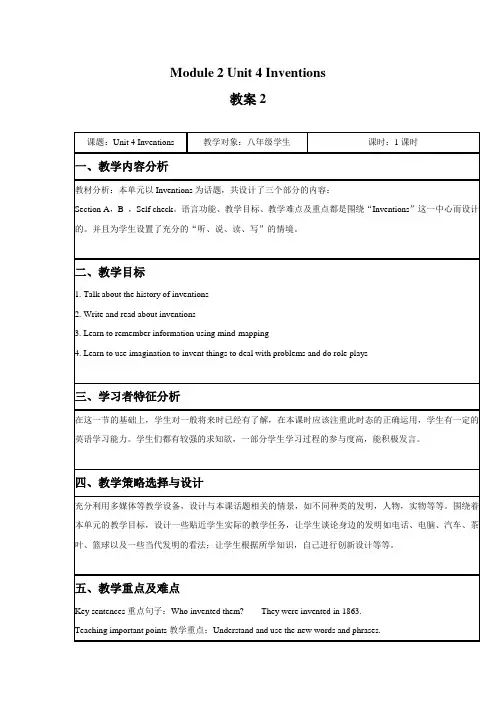
1.Talk about the history of inventions
2.Write and read about inventions
3.d-mapping
4.Learn to use imagination to invent things to deal with problems and do role plays
Show the cards to the students one by one. Correct their mistakes in pronunciation and understanding.
参与单词检测游戏
小游戏是一个小高潮,气氛顿时活跃,在愉快的氛围中,学生也很快理解了相关的知识。
Step Ⅲ Doing group work
三、学习者特征分析
在这一节的基础上,学生对一般将来时已经有了解,在本课时应该注重此时态的正确运用,学生有一定的英语学习能力。学生们都有较强的求知欲,一部分学生学习过程的参与度高,能积极发言。
四、教学策略选择与设计
充分利用多媒体等教学设备,设计与本课话题相关的情景,如不同种类的发明,人物,实物等等。围绕着本单元的教学目标,设计一些贴近学生实际的教学任务,让学生谈论身边的发明如电话、电脑、汽车、茶叶、篮球以及一些当代发明的看法;让学生根据所学知识,自己进行创新设计等等。
Look at the things on page 68. Number them in the order of their invention.
A:I think the telephone was invented before the car.
B:Well, I think the telephone was invented after the car.
八年级英语 Unit 4 Inventions教学设计
A Teaching Plan for Unit 4 Inventions
Listening & Speaking
Teaching aims:
1.Students will know how to do listening part
2.Students will be able to talk about an invention in four aspects: inventor, time, life
before and after it.
3.Students can learn to have good cooperation with one another in group work.
2.Mine Map
教学反思:本节课是一节听说课,从生活中出现的一些有意思的发明物入手,
吸进学生的注意力,提高学生的学习兴趣,然后进行听力的教学训练,通过看图说话,看图来预测将要听到的内容的方式,做好这些准备后再来做听力的训练,提高学习效率,达到学习目标。
以小组竞争的教学模式,增强组内学生之间的合作意识,和组间的竞争意识。
在最后的小组讨论展示的环节,组内分工明确,大家都很积极地展示本组抽到的发明物,达到了预期的效果。
不足之处是课堂前半部分的节奏稍慢,如果能都在紧凑些会更好。
Module 2 Unit 4 Inventions 教案1
参与单词检测游戏
小游戏是一个小高潮,气氛顿时活跃,在愉快的氛围中,学生也很快理解了相关的知识。
Step Ⅲ Doing group work
Look at the things on page 68. Number them in the order of their invention.
A:I think the telephone was invented before the car.
B:Well, I think the telephone was invented after the car.
感受新发明在日常生活中的意义,学习本课时新单词
运用师生问答的方式将学生自然地带到本课时的主题上来。
Step II Card Game
Ask the students to play a card game to help them remember the new vocabulary of this unit.
T: Close your books. Here are some cards. On each card there is a word with English spelling. When I hold up a card, you must tell me what it means in Chinese, how to read it and some words related to it. Are you clear?
Read and remember.
牛津深圳版英语八上Unit 4《Inventions》单元教学设计
牛津深圳版英语八上Unit 4《Inventions》单元教学设计一. 教材分析《Inventions》是牛津深圳版英语八上Unit 4的主题单元,主要讨论了与人们生活息息相关的发明创造。
本单元通过介绍各种发明,让学生了解科技发展对人类生活的影响,培养他们的创新意识。
教材内容包含了各种发明的历史背景、诞生过程以及其对现代社会的意义。
通过对本单元的学习,学生可以提高听、说、读、写等方面的能力,拓展视野,激发对科学和创新的热爱。
二. 学情分析学生在进入八年级时,已经掌握了英语学习的基本技能,具备一定的听、说、读、写能力。
然而,对于一些较高级的词汇和语法结构,他们可能还较为陌生。
因此,在教学过程中,教师需要关注学生的个体差异,充分调动他们的学习积极性,引导他们主动参与课堂活动。
同时,教师还需关注学生的思维发展,鼓励他们提出自己的观点,培养他们的创新意识。
三. 教学目标1.知识目标:学生能掌握与发明创造相关的词汇和表达方式,了解各种发明的历史背景和现代意义。
2.能力目标:学生能在日常生活中运用所学知识进行交流,提高听、说、读、写等方面的能力。
3.情感目标:学生能激发对科学和创新的热爱,培养创新意识。
四. 教学重难点1.重点:学生能熟练运用本单元所学词汇和表达方式进行交流。
2.难点:学生能理解并运用一些较高级的词汇和语法结构。
五. 教学方法1.任务型教学法:通过设定各种任务,让学生在实践中运用所学知识。
2.情境教学法:创设各种情境,让学生在真实的环境中学习英语。
3.合作学习法:鼓励学生分组讨论,培养他们的团队协作能力。
六. 教学准备1.教材:《牛津深圳版英语八上Unit 4》2.多媒体设备:电脑、投影仪、音响等3.教学素材:与发明创造相关的图片、视频等4.作业布置:提前为学生准备相关的练习题七. 教学过程1.导入(5分钟)教师通过展示一些与发明创造相关的图片或视频,引导学生谈论自己对发明的看法,激发学生的学习兴趣。
高三英语Inventors and inventions上课学习上课学习教案
高三英语Inventors and inventions教案XX年《高考风向标》•英语目录第一部分教材梳理必修一Unit1Friendship单元要点预览语言要点词语辨析词性变化重点单词重点词组重点句子课文要点课文词汇填空课文大意概括课文佳句背诵与仿写单元自测Unit2 Englisharoundtheworld 单元要点预览语言要点词语辨析词性变化重点单词重点词组重点句子课文要点课文词汇填空课文大意概括课文佳句背诵与仿写单元自测Unit3Traveljournal单元要点预览语言要点词语辨析词性变化重点单词重点词组重点句子课文要点课文词汇填空课文大意概括课文佳句背诵与仿写单元自测Unit4Earthquakes单元要点预览语言要点词语辨析词性变化重点单词重点词组重点句子课文要点课文词汇填空课文大意概括课文佳句背诵与仿写单元自测Unit5 Nelsonmandela—amodernhero单元要点预览语言要点词语辨析词性变化重点单词重点词组重点句子课文要点课文词汇填空课文大意概括课文佳句背诵与仿写单元自测必修二Unit1 culturalrelics单元要点预览语言要点词语辨析词性变化重点单词重点词组重点句子课文词汇填空课文大意概括课文佳句背诵与仿写单元自测Unit2 TheolympicGames 单元要点预览语言要点词语辨析词性变化重点单词重点词组重点句子课文要点课文词汇填空课文大意概括课文佳句背诵与仿写单元自测Unit3computers单元要点预览词语辨析词性变化重点单词重点词组重点句子课文要点课文词汇填空课文大意概括课文佳句背诵与仿写单元自测Unit4 wildlifeprotection 单元要点预览语言要点词语辨析词性变化重点单词重点词组重点句子课文要点课文词汇填空课文大意概括课文佳句背诵与仿写单元自测Unit5music单元要点预览语言要点词语辨析词性变化重点单词重点词组重点句子课文要点课文词汇填空课文大意概括课文佳句背诵与仿写单元自测必修三Unit1 Festivalsaroundtheworld 单元要点预览语言要点词语辨析词性变化重点单词重点词组重点句子课文要点课文词汇填空课文大意概括课文佳句背诵与仿写单元自测Unit2 Healthyeating单元要点预览语言要点词语辨析词性变化重点单词重点词组重点句子课文要点课文词汇填空课文大意概括课文佳句背诵与仿写单元自测Unit3 ThemillionPoundBankNote 单元要点预览语言要点词语辨析词性变化重点单词重点词组重点句子课文要点课文词汇填空课文大意概括课文佳句背诵与仿写单元自测……第二部分语法专题专题一冠词专题二名词专题三代词专题四数词专题五形容词和副词专题六介词专题七情态动词专题八非谓语动词专题九动词和动词短语专题十动词的时态专题十一动词的语态专题十二句子种类专题十三名词性从句专题十四定语从句专题十五状语从句专题十六倒装句和省略句专题十七强调句专题十八虚拟语气专题十九主谓一致专题二十直接引语和间接引语第三部分高考题型讲练听力完形填空语法填空阅读理解信息匹配基础写作读写任务第一部分教材梳理选修八Unit3Inventorsandinventions单元要点预览(旨在让同学整体了解本单元要点)词汇部分词语辨析.discover/find/invent2.hope/wish/expect3.bear/endure/stand/tolerate4.setoff/setout/setabout词形变化.mercyn.仁慈,宽容mercifuladj.宽恕的mercilessadj.残忍的;无情的2.abruptadj.突然的,意外的;唐突的,鲁莽的abruptlyadv.突然地;粗鲁地3.expectvt.期待,预期,指望expectationn.期待,预料,指望,展望unexpected.adj.想不到的,未预料unexpectedlyadv.出乎意料地,想不到地4.freezev.冻结,结冰n.冻结;冰冻期freezingn.冰点adj.冰冻的,严寒的/5.practisevt.&vi.实行;练习;实习practicen.练习,实习,实践,习俗practicaladj.实际的,实践的,实用的重点单词.distinguish辨别;辨认;(常与from,between连用)区别;区分2.convenientadj.便利的,方便的3.seizevt.抓住,捉住;占据;(指强烈的感情)突然影响或控制(某人)4.filen.[c]文件;档案vt.把……归档5.hangvt.&vi.悬挂,附着vt.吊死,绞死重点词组.callup征召;召集服兵役;唤起;使人回忆;带入心中;打电话给某人2.setaboutsth/doingsth开始(某工作);着手做某事3.nowandthen/again时而;偶尔;有时4.outoforder次序颠倒;发生故障5.getthrough用完,消耗掉;(设法)做或完成某事;通过;与某人联系6.ringback回复电话7.incase因为可能发生某事;以防万一;万一重点句型.ThefirstthingItriedtodowastoseeiftherewereprod uctsthatmighthelpme,butthereonlyseemedtobepowdersde signedtokillsnakes.2.Betweentheoutsideandinsidewallsofthebowlthereisso mejelly,whichfreezeshardwhencooled.重点语法复习过去分词做表语和宾语补足语(见语法部分)语言要点(模块)Ⅰ.词语辨析.discover/find/invent【解释】discover表示“偶然”或“经过努力”发现客观存在的事物、真理或错误。