
2020春外研版八年级英语下册课件-Module 4模块知识点归纳
Module 4 Seeing the doctor
I haven't done much exercise since I got my computer. 必背单词
1. ill (adj.) 不健康的,有病的→illness (n.) 疾病
2. since (prep.) 自……以来(since后跟时间点)→(conj.) 自……以来
3. take (v.) (用机器)测定,量取,拍摄;(尤指有规律地)吃,喝→took(过
去式)→taken(过去分词)
4. health (n.) 健康→healthy (adj.) 健康的
5. cough (n.) 咳嗽(v.) 咳嗽
6. fever (n.) 发烧;发热
7. headache (n.) 头痛
8. stomach (n.) 腹部;肚子
9. ache (n.) 痛;疼痛
10. toothache (n.) 牙痛
11. cold (n.) 感冒;伤风
必背短语
12. catch a cold 感冒
13. take one's temperature 给某人量体温
14. too much 太多
15. be harmful to 对……有危害
16. such as 比如;例如
17. do some exercise 参加锻炼
18. see the doctor 看医生
必背句子
19. How can I help you?
我怎样才能帮助你?
20. How long have you been like this?
你这样有多长时间了?
21. That's the problem!
那就是问题所在!
22. Take it three times a day.
一天吃三次。
We have played football for a year now.
必背单词
1. well (adj.) 健康的→(adv.) 好地
2. active (adj.) 积极的,活跃的→more active(比较级)→most active(最高级)
3. sleepy (adj.) 困的,想睡的→sleep (v.) 睡觉
4. daily (adj.) 每天的;天天的→day (n.) 白天
5. weak (adj.) 弱的;虚弱的→strong(反义词)强壮的
6. illness (n.) 病;疾病→ill (adj.) 有病的
7. awful (adj.) 极讨厌的;极坏的→awfully (adv.)极坏地
8. heart (n.) 心;心脏
9. pet (n.) 宠物;宠畜
10. member (n.) 成员;会员
11. condition (n.) 状况;身体状况
12. then (adv.) 当时;那时
13. exercise (v.) 运动;锻炼
14. perhaps (adv.) 可能;也许
必背短语
15. take sb. for a walk 带某人去散步
16. feel fit 感觉健康
17. take part in 参加
18. in excellent condition 健康状况很好
19. on the underground 乘地铁
20. all over 全身
必背句子
21. I have had him for three months now and I feel really healthy.
至今我和他相伴已经有三个月了,我感觉确实健康了。
22. Since then,it has become part of my life.
从那时起,它就成了我生活的一部分。
23. Perhaps I am too weak to do any exercise.
可能是我身体太虚弱了不能参加锻炼。
Language in use
必背短语
1. for the first time 第一次
2. from time to time 偶尔,有时
3. in the past 在过去
4. all one's life 某人的一生
5. turn off 关闭,关上
6. so that 以便;为的是
必背句子
7. I do not know how to stop and become fitter and healthier.
我不知道怎样才能停止(这样做),变得更强壮,更健康。
8. I do not want to spend all my life sitting in a chair.
我不想在椅子上度过一生。
9. Walking has helped you get fitter,so why not ask a friend to walk to school with you?
步行已经帮助你更强壮了,所以为什么不邀请一个朋友和你一起步行上学呢?。
2020春外研版八年级英语下册Module 4 教案+教案设计+单元测试+译文+知识点归纳+阅读(付,60)
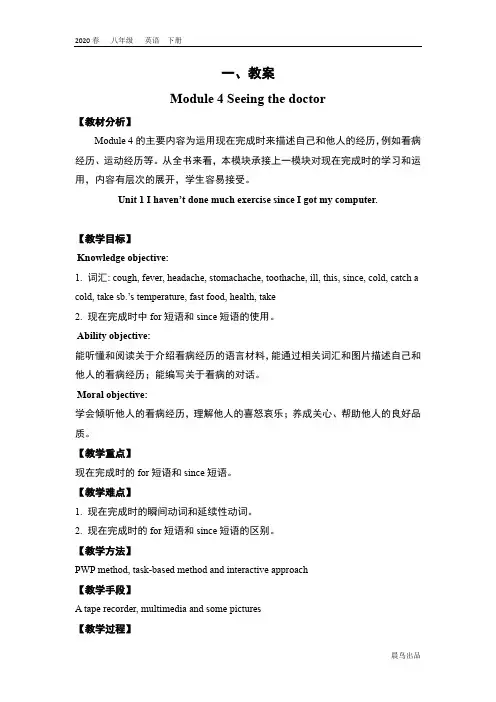
一、教案Module 4 Seeing the doctor【教材分析】Module 4的主要内容为运用现在完成时来描述自己和他人的经历,例如看病经历、运动经历等。
从全书来看,本模块承接上一模块对现在完成时的学习和运用,内容有层次的展开,学生容易接受。
Unit 1 I haven’t done much exercise since I got my computer.【教学目标】Knowledge objective:1. 词汇: cough, fever, headache, stomachache, toothache, ill, this, since, cold, catch a cold, take sb.’s temperature, fast food, health, take2. 现在完成时中for短语和since短语的使用。
Ability objective:能听懂和阅读关于介绍看病经历的语言材料,能通过相关词汇和图片描述自己和他人的看病经历;能编写关于看病的对话。
Moral objective:学会倾听他人的看病经历,理解他人的喜怒哀乐;养成关心、帮助他人的良好品质。
【教学重点】现在完成时的for短语和since短语。
【教学难点】1. 现在完成时的瞬间动词和延续性动词。
2. 现在完成时的for短语和since短语的区别。
【教学方法】PWP method, task-based method and interactive approach【教学手段】A tape recorder, multimedia and some pictures【教学过程】Teaching Procedures:Step 1 Lead-inSs look at the pictures and answer the questions.Step 2 Consolidate new wordsLook and say. The teacher shows the pictures of new words and let the students to say as quickly as possible.Step 3 Match the words in the box with the pictures.1. Look at the words first.2. Choose the right word for each picture.Step 4 Listening1. Listen to Part 2 and check what’s wrong with Betty and Daming.Keys: Betty: headache stomach acheDaming: cough fever toothache2. Listen to Part 3 and answer the two questions:1) Have Daming got a cold?2) What kind of food does Daming usually eat?Keys:1) No, he hasn’t.2)Fast food.Step 5 Reading1.Please find out sentences which have for or since in the dialogue.Keys: 1. I’ve been ill for about three days!2. I haven’t done much exercise since I got my computer last year.2.Now complete the table about Daming.3.Read Part 3 and mark T or F.Keys: FFFTTStep 6 Everyday EnglishLet Ss say what they have learnt in the passage.Step 7 Language pointsSs should master the main points from the passage in Part 3. If possible, let the students to say at first.1. I feel ill. 我感觉我生病了。
外研版英语八年级下册module 4重点知识归纳
期中复习巩固-外研版八年级下册module 4重点知识归纳【重点词汇】well/good两者都可以表示“好”的意思。
比较级和最高级都为better和best. (1)well是副词,用于修饰动词。
例如:Tom speaks Chinese well. 汤姆的汉语说得好。
He sings well. 他唱得好。
(2)good作形容词,用作定语或表语。
例如:She is a good doctor. 她是个好医生。
His pronunciation is very good. 他的语音很好。
(3)well作形容词时,指的是健康状况良好。
例如:He is quite well. 他身体好。
I hope you will be well soon. 我希望你很快好起来。
take sb’s temperaturetake sb’s temperature意为“量某人的体温”。
此处take作动词,意为“(用机器)测定;量取”。
例如:The doctor took Tom’s temperature and examined his ears and throat.医生给Tom量了体温然后检查他的耳朵和嗓子。
【拓展】take作动词,还可意为“拍摄;(尤指有规律地)吃,喝;乘,坐”。
例如:We are taking lots of photos on the Great Wall.我们正在长城上拍很多的照片。
She takes medicine three times every day. 她每天吃三次药。
You can take a plane to Shanghai.你可以乘飞机去上海。
take part intake part in意为“参加”,常指参加群众性的活动、会议、劳动、游行等,往往指参加者持有积极的态度,起一定作用。
take part in之后接名词或动名词。
例如:I didn’t take part in the sports meeting yesterday because I was ill.我没有参加昨天的运动会,因为我病了。
外研版八年级下册Module 4知识点整理

外研版八年级下册Module 4知识点整理一.重点单词cough n.咳嗽;v.咳嗽fever n.发烧;发热headache n.头痛stomach n.腹部;肚子toothache n.牙痛ill adj.不健康的;有病的since prep.自……以来;conj.自……以来cold n.感冒;伤风health n.健康(状况)heart n.心;心脏active adj.积极的;活跃的pet n.宠物;宠畜member n.成员;会员condition n.状况sleepy adj.困的;想睡的daily adj.每天的;天天的weak adj.弱的;虚弱的illness n.病;疾病awful adj.极讨厌的;极坏的perhaps adv.可能;也许二.重点短语1.stomach ache胃痛;腹痛2.catch a cold感冒3.take sb's temperature量某人的体温4.take part(in sth.) 参加,参与(某事)5.in excellent condition健康状况良好6.feel awful 感到不舒服7.all over 浑身,到处8.too much 太多9.such as像;例如10.by underground坐地铁11.in hospital住院12.go running跑步三.用法集萃1.stop doing sth.停止做某事2.Why don't we do sth.?我们为何不做某事呢?3. too+adj. +to do sth. 太……而不能做某事4.What(+a/an)+形容词十名词十主语十谓语(+其他)!5.“疑问词十不定式”作宾语6.What about doing sth.?做某事怎么样?四.重点句型1. How long have you been like this? 你这样多久了?2.-How can I help you? 需要我帮忙吗?-I've got a bad cough.我咳嗽得厉害。
外研版八年级英语下册Module 4知识点

Module 4 Seeing the doctor必背短语1.stomach ache 胃痛,腹痛2. catch a cold 感冒3. take sb's temperature 给某人量体温4.fast food 快餐5.do exercise 做运动6. too much 太多7. be harmful to 对……有危害8. such as 比如;例如9.take the medicine服药10.three times a day 一天三次11. see the doctor 看医生12. take sb. for a walk 带某人去散步13. feel fit 感觉很强健14. take part in 参加15. in excellent condition 健康状况很好16. on the underground 乘地铁17. all over 全身18.feel awful 感到不舒服19.go for a run 去跑步20.get to work 开始工作21.since then 从那时起22. all one's life 某人的一生23. with a smile on one’s face 面带微笑24. for the last few years 在最近的的几年里25. look after=take care of 照顾,照料必背用法1. How can I help you? = What can I do for you? 有什么事?2. ill生病的 be ill He has been ill for 4 days.sick生病的 be sick =be ill a sick man 一个病人3. have / catch a cold感冒 have a bad cold:患重感冒have a fever发烧 have a high / low fever发高 / 低烧have a cough: 咳嗽have a toothache:牙痛have a stomachache 胃痛have a headache 头痛4. 1)ache n. 疼痛,局部持续性疼痛headache, earache2) pain n. 疼痛,长时间不间断的疼痛,in great pain3) hurt v. 疼痛;受伤,身体部位或精神受伤My head hurts. I have got a headache. I have a pain in my head. 我头痛。
外研版八年级下册Module 4 复习课件(共48张PPT)
11.去跑步 go for a run
12.感到不舒服feel awful
13.浑身all over
14太···而不能too…to…
U2 重点短语 检查
1.锻炼______________ 2.带某人散步________________ 3 决定做某事_____________ 4 参加________ 5.健康状况良好_________ 6.在过去的几年里________ 7.乘地铁_______ 8. 成为···的一部分________ 9.骑车上班________ 10.日常运动________ 11.去跑步_________ 12.感到不舒服___________ 13.浑身____________ 14太···而不能__________
[拓展] ill和sick都可做形容词,表“生病的,不舒服的”,两者都可
作表语。
如:He is ill / sick. 他生病了。
两者作定语时,表达的意义不一样:
如:He is a sick man. 他是个多病的人。 He is an ill man. 他是个坏人。
2. I’ve got a stomach ache and my head hurts.
MODULE 4 SEEING THE DOCTOR 复习课
学习目标
Presentation
1、背过本单元的单词、重点短语及句子。 2、复习语法知识点 3.习题练习
单词识记
cough n.&v. 咳嗽 fever n. 发烧;发热 headache n. 头痛 stomach n. 腹部;肚子
this
2积极的;活跃的 adj. 4成员;全员 n. 6状况;身体状况 n. 8困的;想睡的 adj. 10弱的;虚弱的adj. 12运动;锻炼v. 14感到不舒服 16可能;也许
外研版8年级下模块4知识点
外研初二下学期Module4 辅导模块要点原文If you want to turn on the recorder, …[要点] turn on 意为“打开(自来水、煤气等)”或“开(电灯、电视等的电源)”。
相关的短语有:turn off“关掉”或“切断”;turn down“调小开关”,“关小音量”;turn up“调大开关”,“使音量变大”。
这里的on, off, up和down都是副词,如果宾语是代词则放在短语的中间;如果宾语是名词,可以放在中间,也可以放在后面。
选择正确答案:1. He forgot _____ the radio, so he missed the programme.A. to turn onB. to turn offC. turning onD. turning off原文He picked up a dish from the table, …[要点] 这里的pick up意为“拿起;捡起”,其中up是副词。
[现场练兵] 翻译下面的句子:2. 请帮我把那支钢笔捡起来。
__________________________________________原文… and bit him on the hand.[要点] bite的意思是“咬;咬伤”,其过去式为bit。
“咬伤某人的某个部位”在英语中表达为“bite + sb. + in(或on) + the +(身体的某)部位”。
一般身体部位比较硬而突出的地方或强调接触人体的表面,用介词on,如:on the head(back,nose,shoulder,chest等);一般在软而凹的部位用介词in,如:in the face (eye, stomach等)。
类似的词有hit(打), touch(碰)和pat(拍)等。
选择正确答案:3. An insect(昆虫) ____ the boy on ____ hand when he was watching the game.A. bite; hisB. bit; hisC. bite; theD. bit; the原文“So my advice is this: …” suggests Mr Jackson.[要点点击] suggest意为“建议;提出”,后常接名词、代词或动名词作宾语。
新版外研版八年级英语下册Module 4知识点总结及练习(无答案)【实用版】
(新版)八年级英语下册Modul e 4学习材料1. 构词法:身体部位的某些名词+ ache(疼痛)→构成短语为:have (got) / get a……表示“患了……病”(考点):head+ache=headache / stomach+ache=stomachachetooth+ache=toothache / back+ache=backache2. ill 和sick都代表“生病的,有病的”(考点):① ill :一般放在系动词后面作表语,不能放在名词前修饰名词作定语,叫叙述形容词ill (形容词)—(名词) illness 病,疾病② sick :既可在系动词后面作表语,也能放在名词前修饰名词作定语,叫状态形容词例题:( ). The nurse looked after the __________ chil d.A. illB. illnessC. sickD. healthful( ). You’d better put on your coat, or you’ll get __________.A. illB. illnessC. sickD. healthful( ). That boy had to drop out of school because of his _____________.A. illB. illnessC. sickD. healthful3. since :自从……以来到现在(现在完成时中的“表持续”意义的重要标志)(考点):①. since + 时间点:表示从过去某一时刻起一直到现在② since + 时间状语从句:表示从过去某一时刻起一直到现在;并且从句必须用过去时例题:( ). I’ve been in Beijing since _____________.A. ten yearsB. 2003C. ten—yearD. I begin to work there( ). They have been good friends since they ___________ first time.A. meetB. metC. have metD. meeting4. 现在完成时的标志词:(考点):①表结果:already / just / always / yet / not……yet②表经历:ever / never / before / once (twice)、many times③表持续:since +时间点(时间状语从句) / ever since …… / for +时间段/ so farin the past…… / during the last……④当现在完成时表持续与可持续时间段状语连用时,要求把“瞬间动词转为持续状态”例如:成为:become→ be→ have been 结束完成:finish→ be over→ have been over 借东西:borrow→ keep→ have kept 买东西:buy→ have→ have had关闭:close→ be cl osed→ have been cl osed 来:come→ be here→ have been here开,打开:open→ be open→ have been open 去,离开:go / leave→ be away→ have been away 起床:get up→ be up→ have been up 开始:begin→ be on→ have been on丢失:l ose→ be lost→ have been l ost 结婚:marry→ be married→ have been married 死:die→ be dead→ have been dead 参加,加入:join→ be in→ have been injoin→ be a……member ( be a member of……) 例题:( ). I _______________ in Beijing since I _______________ China.A. have come; cameB. came ; cameC. have been; cameD. have come; have come( ). They ________________ for ten years.A. marriedB. marryC. have marriedD. have been married5. Have you caught a col d?(考点):have a col d 和catch a col d的区别:have a col d:表示“感冒”的持续状态,相当于:have got a col dcatch a cold:表示“感冒”的行为结果,不能与表示持续的时间状语连用。
八年级英语下module 4 new technology全模块重难点讲解外研版
Module 4 New Technology一. 教学内容:Module 4 New Technology二. 重点内容:If 引导的条件状语从句三. 具体内容:(一)语法知识If引导条件状语从句。
在含有条件状语从句的主从复合句中,当主句谓语动词以某种形式表示将来时间概念时,条件状语从句中的谓语动词通常要用一般现在时代替一般将来时。
此句中主句为用祈使句表将来,if引导的状语从句用一般现在时。
If you see him , give him this letter .如果你见到他的话,把这封信给他。
(二)知识拓展:引导条件状语从句最常用的连词是if,由if引导的条件状语从句表示在某种条件下某事很可能发生。
如:If you ask him,he will help you .如果你请他帮忙,他会帮你的。
If you fail in the exam , you will let him down .如果你考试不及格,你会让他失望的。
另外,if从句还表示不可实现的条件或根本不可能存在的条件,也就是一种虚拟的条件或假设,从句多用一般过去时或过去完成时。
如:If I were you , I would invite him to the party .如果我是你,我会邀请他参加聚会。
I would have arrived much earlier if I had not been caught in the traffic .如果没有堵车,我会到的早一点儿。
那么,除了if之外,是否还有其他连词也可以引导条件状语从句呢?回答是肯定的,不仅有,还有很多。
这些词由于出现的频率较小,且用法较复杂一些,所以不为大家所熟知罢了。
下面就这些词的用法以例句的形式进行一下简单总结。
(1)unless conj . 除非,若不,除非在……的时候You will fail to arrive there in time unless you start earlier .如果你不早点动身,你就不能及时赶到那儿。
2020春外研版八年级英语下册Module 4 教案+教案设计+单元测试+译文+知识点归纳+阅读(付,60)
一、教案Module 4 Seeing the doctor【教材分析】Module 4 的主要内容为运用现在完成时来描述自己和他人的经历,例如看病经历、运动经历等。
从全书来看,本模块承接上一模块对现在完成时的学习和运用,内容有层次的展开,学生容易接受。
Unit 1 I haven’t done much exercise since I got my computer.【教学目标】Knowledge objective:1. 词汇: cough, fever, headache, stomachache, toothache, ill, this, since, cold, catch a cold, take sb.’s temperature, fast food, health, take2. 现在完成时中for 短语和since 短语的使用。
Ability objective:能听懂和阅读关于介绍看病经历的语言材料,能通过相关词汇和图片描述自己和他人的看病经历;能编写关于看病的对话。
Moral objective:学会倾听他人的看病经历,理解他人的喜怒哀乐;养成关心、帮助他人的良好品质。
【教学重点】现在完成时的for 短语和since 短语。
【教学难点】1. 现在完成时的瞬间动词和延续性动词。
2. 现在完成时的for 短语和since 短语的区别。
【教学方法】PWP method, task-based method and interactive approach【教学手段】A tape recorder, multimedia and some pictures【教学过程】Teaching Procedures:Step 1 Lead-inSs look at the pictures and answer the questions.Step 2 Consolidate new wordsLook and say. The teacher shows the pictures of new words and let the students to say as quickly as possible.Step 3 Match the words in the box with the pictures.1. Look at the words first.2. Choose the right word for each picture.Step 4 Listening1. Listen to Part 2 and check what’s wrong with Betty and Daming.cough Fever headache stomachache toothache BettyDamingKeys: Betty: headache stomach acheDaming: cough fever toothache2. Listen to Part 3 and answer the two questions:1) Have Daming got a cold?2) What kind of food does Daming usually eat?Keys:1) No, he hasn’t.2)Fast food.Step 5 Reading1. Please find out sentences which have for or since in the dialogue.Keys: 1. I’ve been ill for about three days!2. I haven’t done much exercise since I got my computer last year.2. Now complete the table about Daming.Illness He’s got a stomach ache and his head hurts.How long Since Friday.Why Because he has fast food and no breakfast, and he hasn’tdone much exercise.What to do First, stop eating fast food and have breakfast every day.Second, get some exercise.3. Read Part 3 and mark T or F.Keys: FFFTTStep 6 Everyday EnglishLet Ss say what they have learnt in the passage.Step 7 Language pointsSs should master the main points from the passage in Part 3. If possible, let the students to say at first.1. I feel ill. 我感觉我生病了。
外研版八年级英语下Module 4单词、知识梳理
外研版八年级英语下Module 4单词、知识梳理01 Moudle 4 单词【重点单词】1. cough [kɒf]咳嗽(n.);咳嗽(v.)2. fever ['fi:və(r)]发烧;发热3. headache [ˈhedeɪk]头痛4. stomach ['stʌmək]腹部;肚子5. ache [eɪk]痛;疼痛6. stomach ache牙痛7. ill [ɪl]不健康的;有病的8. this [ðɪs]这,这个(刚提到的人或物)9. since [sɪns]自…以来;从…以来10. cold [kəʊld]感冒;伤风11. catch a cold[kætʃ]感冒12. take [teɪk](用机器)测定,量取;有规律的吃、喝13. take sb. temperature[ˈtemprətʃə(r)]量某人的体温14. fast food[fu:d]快餐食品15. health [helθ]健康(状况)16. well [wel]健康的17. heart [hɑ:t]心脏18. active [ˈæktɪv]积极的;活跃的19. pet [pet]宠物;宠畜20. member [ˈmembə(r)]成员;会员21. take part in参加,参与(某事)22. condition[kənˈdɪʃn]状况;身体状况23. in excellent condition[ˈeksələnt]健康状况很好24. sleepy['sli:pɪ]想睡的;困的25. then [ðen]当时;那时26. daily ['deɪlɪ]每天的;天天的27. weak[wi:k]弱弱的;虚弱的28. illness[ˈɪlnɪs]病;疾病29. exercise ['eksəsaɪz]运动;锻炼30. awful [ˈɔ:fl]极讨厌的;极坏的31. feel awful感到不舒服32. all over浑身;到处33. perhaps [pəˈhæps]可能;也许Moudle4课文视频外研版八年级下册Module 4 Unit 1 课文动画外研版八年级下册Module 4 Unit 2 课文动画Moudle 4知识梳理【重点短语】1. catch a cold / have a cold 感冒catch a cold 侧重患感冒的动作,属于短暂性动词短语have a stomach ache胃痛have a bad cold 重感冒have a cough咳嗽have a fever 发烧have a toothache 牙疼have a headache头痛2. do much exercise 经常性的锻炼do sports 做运动3. be harmful to 对......有害be helpful to 对….有好处be good to 对…友好be bad to 对…..不友好be good for 对….有好处be bad for 对…..有坏处4. such as 例如for example例如5. three times a say 一天三次6.spend in doing sth 花时间做某事7. take one’s temperature 量体温8. fast food 快餐9. in front of 在......前面10. look after 照顾,照料11. take sb for a walk 带某人散步12. feel bit/ health 感觉健康13. by underground 乘地铁on the underground14. ride to work 骑车去上班15. decide to do sth 决定做某事16. take part in 参加17. in the last few years 在过去的几年里18. be too+形容词+to do sth 太......不能做......19. from time to time 不时地20. set up 建立21. be ill 生病feel ill 感觉生病了22. go for a run 去散步23. feel awful 感觉不舒服24. all over 浑身; 遍及25. rather than (与其...)倒不如;是...而不是26. turn off 关掉27. have a pain in... (某身体部位)疼痛【重点句型】1. Now I get exercise by taking him for a walk every day. 现在每天通过带它去散步我得到了锻炼。