
仁爱英语七年级上册Unit2 topic1SectionB
[leg] n.腿
[fut](pl.
[fi:t])n.脚;英尺
short [ʃɔ:t]adj.短的;矮的
Guide Two(Learning dialogues)
• 1.对学环节:对子之间练习下列对话。 • 2.对话检测,补全对话,并练习。
Does she have big eyes? Yes, she does. Does she have a wide mouth? No, she doesn’t.
Let’s play the game.
Touch your head.
Bobby says, “Touch your head”
Unit 2 Topic1
Section B
• Learning aims: 学习目标: 1.继续学习表示人体身体部位的名词。 2.初步掌握含有do /does的一般疑问句。 3.会用两种句型描述人的外貌特征。
Practice the dialogue with your partner.
• ---Do you have
a small nose
?
a wide mouth
• ---Yes, I do./ No, I don't. a round face
big ears
• ---Does he/she/ it /Katebig eyes
and a big ___n__o__s.e L: Oh, I see. He is Mr. Wang.
Guide Three:(学会用两种句型描述人的外貌。)
• 1.仿照例子,写句子。 • 2.课后作业:用两种句子,简单描述自己或
同桌的外貌特征。要求写在作业本上。
Rewrite the sentences with have/has.
• 一般疑问句结构: Do/Does +人+ 动词原形+ 其它?
•
回答: Yes, 人+ do/does.
•
No, 人+ don’t/doesn’t.
• 例子:Do you have small eyes?
•
Yes, I do./ No, I don/t.
•
Does he have a big nose?
arm,arm, arms 胳膊 He has long arms.
hand,hand,hands 手 He has two hands.
leg,leg,legs 腿
They have long legs.
foot,foot,feet 脚
He has big feet.
short [ʃɔ:t]短的;矮的 He has short arms.
Then make more sentences.
My face is round. Your face is long. His hair is short. Her hair is long. His feet are big. Her feet are small. …
I have a round face. You have a long face. He has short hair. She has long hair. He has big feet. She has small feet.
Does he have a big nose? Yes, he does.
Does he have long hair? _N__o__,_h_ e doesn’t.
Does he have a round face? _N__o__,__he doesn’t.
Does it have long legs? _N__o_,_h_e__d__o_esn’t.
• 难点注释:
• 1.当have/has表示“有”的时候,要把句子变成否定句或者一 般疑问句,要借助于助动词do或does。does 用于第三人称单数 ,do用于其他人称。
• 否定句结构: 人+ don’t /doesn’t +动词原形+其它。
• 例子: She doesn’t have big eyes.
• ( ) 2. Kangkang has long ______ and he has big _______.
• A. arm, foot B. arms ,feet C. arm , feet
( )3. --- ____ he ____ long arms?
--- No, he _________.
当堂检测1:比一比,看谁记得快!
单词检测:根据音标和汉语释义默写单词。
[ feɪvərɪt] adj. 最喜爱的 n.特别喜
欢的人/物
[ æ ktə] n.演员
[,ʧaɪ ni:z] n.中国人;汉语 adj.
中国的;中国人的;汉语的
[dʌz]v.(do的第三人称单数)
[ɑ:m] n. 胳膊
[hæ nd] n.手
•
Yes, he does./ No, he doesn’t.
• 2. see是多义词, I see 指“ 我明白了,我知道了”
• 单选
• ( )1. Jackie Chan is my favorite actor. He is _________.
• A. China B. English C. Chinese
( ear ) B ( eye ) C
G ( face )
( nose )D ( neck ) E
F(mouth )
( arm ) (hand ) (leg ) (foot )
当堂检测3. 根据1a内容,填空。
Listen again and fill in the blanks.
Jackie Chan is Michael’s favorite actor. He iCs hfirnoam _____.He habsiga ____ nose and his hair islonnogt ____. He haswaide_____ mouth. His ChineseCnhaemneg iLso_n__g_______.
does [dʌz]v.(do的第三人称单数) arm[ɑ:m] n. 胳膊 hand [hæ nd] n.手 leg[leg] n.腿 foot[fut](pl. feet[fi:t])n.脚;英尺 short [ʃɔ:t]adj.短的;矮的
2.老师帮你记单词。
• favorite [ feɪvərɪt]
Guide One(Learning new words)
• 1.独学环节:根据拼读规则,大声拼读 P29-30单词。
• 2.老师帮你记单词。
• favorite [ feɪvərɪt] (favourite BrE) adj. 最喜爱 的 n.特别喜欢的人/物 actor [ æ ktə] n.演员 Chinese [,ʧaɪ ni:z] n.中国人;汉语 adj. 中 国的;中国人的;汉语的
• act + or→actor [ æ ktə] n.演员
my favorite actor
China 去a加ese →Chinese We are Chinese.
Japan 加ese →Japanese They are Japanese.
do + es →does (do的第三人称单数)
Does he have a big nose?
/your dad have
long hair
?
--- Yes, he/she/it does.
/ No, he/she/it doesn't.
当堂检测2:听录音两遍,完成对话 。
(W=Wang Wei L=Li Lin) W: Hello, Li Lin. L: Hello, Wang Wei. Who is your favorite teacher? W: Guess. L: Is his _h__a__irlong? W: No, his hair is _s__h__o_.rt L: Does he have a round face ? W: Yes, he does. L: Are his eyes big? W: No, his e__y__esare small. And he has a ___w__i_dmeouth
…
foot(单数)-feet(复数)
归纳小结
• 1.看图,回顾人体部位的单词。 • 2.含有do /does的一般疑问句。 • 3.描述人的外貌特征的两种句型。
Look at the boy and write down the name of each part.
( hair ) A
H ( head )
A. Do , have , doesn’t
B . Does, have , doesn’t
C. Does , has , dees
( ) 4. Michael has long _______ and a ______ mouth.
A. leg , wide
B. legs , wide C. legs, big
仁爱版英语七年级上册 《Welcome to China》(SectionB)教案
Unit1 Topic1 SectionB参考教案Section BThe main activities are 1a, 2a and 3a. 本课重点活动是1a, 2a和3a。
Ⅰ. Teaching aims and demands 教学目标1. (1) Learn the letters Hh-Nn.(2) Learn some new words:Miss, this, is, Mr.=Mister, see, my, mom, teacher, how, do2. Learn about greetings and introductions:(1)Miss Wang, this is Michael. Michael, this is Miss Wang.(2)—Nice to see you.—Nice to see you, too.(3)—How do you do?—How do you do?Ⅱ. Teaching aids 教具小黑板/教学挂图/音频设备/字母卡片Ⅲ. Five-finger Teaching Plan 五指教学方案Step 1 Review 第一步复习(时间:10分钟)通过复习字母Aa-Gg和上节课所学功能用语,导入本节课主要功能用语。
1. (让学生做上节课的字母接力游戏,复习字母Aa-Gg。
也可以让两位学生在黑板上听写,要求遵守在四线格上书写的规则。
特别强调学生在书写时要用手写体。
)2. (教师用小黑板展示上节课所学功能用语,让学生配对。
)T: Match the sentences in Column A with those in Column B.(教师给以适当汉语提示。
)A B1.Hello! a.Thanks.2.Welcome to China! b.Nice to meet you, too.3.Good morning! c.No, I’m not. I’m Wei Hua.(核对答案,教师讲解并让学生两人一组练习所学功能用语。
七年级英语上册Unit2Topic1SectionB教案仁爱版
七年级英语上册Unit2Topic1SectionB教案仁爱版1. Learn some useful words:leg, hand, foot, arm, look, favorite, movie, star, guess, Chinese, again.2. Continue to learn the description of the people’s appearances:(1)Her eyes are big.(2)He has a long face.(3)She has a small face, big eyes and a small nose.3. Continue to learn the simple present tense with have/has.(1)Does she have long hair?Yes, she does.(2)Does she have small eyes?No, she doesn’t.4. Learn how to rewrite the sentences with “have” or “has”.My face is round.→I have a round face.His face is long.→He has a long face.Ⅱ. Teaching aids 教具录音机/教学挂图/学生相片/小黑板Ⅲ. Five-finger Teaching Plan 五指教学方案Step 1 Review 第一步复习(时间:12分钟)1. (检查上节课布置的课外作业。
让学生在小组内描述他的一个朋友,然后挑两个学生向全班同学描述。
)2. (利用“Touch Your Body”竞赛游戏复习学过的表达身体各部位的名词,板书几个生词。
游戏步骤:(1)以组为单位参加竞赛,先要求全组学生站立、其他组监督。
(2)把食指放在鼻子上,根据不同的指示触摸;(3)出错的同学坐下,最后看一下哪一组站着的学生多就胜出。
仁爱版七年级上册英语教学设计:Unit2 Topic 1 Section B
检测:3(P30)幻灯片9
三、听力练习,整体感知
1.Listen and answer .(幻灯片10/11)
2.listen and finish 1b.(幻灯片12)
学习目标:
1.全体学生识记new words:
favorite, movie, star, Chinese, again, look, arm, hand, leg, foot
2.Continue to learn the description of people’s appearances:
(1)Her eyes are small.
⒉do/does的应用;由形容词性物主代词转化为have/has引导的同义句;
教学过程设计
教学环节
教学内容
教学策略
预设时间
一、复习导入,明确目标(幻灯片2和3)
Play the game,review the words of the bodies.
二、学习词汇,跟进练习(幻灯片4,5,6,7和8)
四、大声朗读,对话练习
1.学生以小组为单位,分角色朗读课文,并进行展示
2.1C. Make a new one.
3.Retell.(学案)
4.4.
五、分析语法,变式练习
探究1.favorite.2.China和Chinese(学案)
精讲并总结have/has的用法。(幻灯片14,15)
第4部分。
六、达标测试,当堂小结
(2)She has a small face, big eyes and a small nose.
仁爱版七年级英语上册Unit2topic1SectionB教案
Section BThe main activities are 1a, 3 and 4. 本课重点活动是1a、3和4。
Ⅰ. Teaching aims and demands 教学目标1. Learn some new words:favorite, movie, star, Chinese, again, look, arm, hand, leg, foot2. Learn some useful sentences:(1)—Who is your favorite movie star?—It’s Bruce Lee.(2)Guess again.3. Continue to learn the description of people’s appearances:(1)Her eyes are small.(2)She has a small face, big eyes and a small nose.4. Continue to learn the simple present tense with have/has:(1)—Does he have long hair?—No, he doesn’t.(2)—Does he have a wide mouth?—Yes, he does.Ⅱ. Teaching aids 教具教学挂图/录音机/学生照片/小黑板Ⅲ. Five-finger Teaching Plan 五指教学方案Step 1 Review 第一步复习(时间:9分钟)通过复习上节课的目标语言,引出并学习本节课新句型。
训练学生的口头表达能力。
1. (检查上节课布置的课外作业。
教师把学生分成十二个小组,让学生在小组内描述他的一个朋友,然后请两个学生向全班同学描述。
教师要及时给予表扬。
)T: Hello, boys and girls. From last period, we learnt how to describe someone’s appearance. Now I’ll divide our class into twelve groups. Then you talk about your friend’s looks in groups. You can begin like this: I have a friend. He is a boy. He has … And then I will choose two of you to report it in the front.2. (教师出示28页5a的教学挂图,请八名学生依次到黑板前,按教师指令,触摸玩具的身体部位,并要求学生在黑板上写出相对应的单词。
仁爱英语七年级上册U2T1SA省公开课获奖课件说课比赛一等奖课件
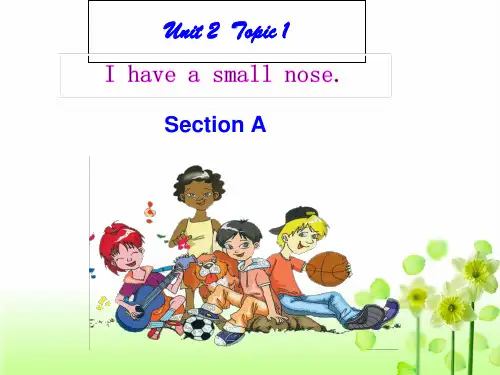
I have a big__n_o_s_e___.
We have small They have
___e_y_e_s___.
round_f_a_ce_s_.
She has long_h_a_i_r_.
He has a wide_m_o_u_t_h.
It has big_e_a_r_s_.
Complete the following sentences with have/has.
My friend has a small nose. 我旳朋友有一种小鼻子。
Learn by yourselves:
have用于第一人称(I, we),第二人称(you),
及第三人称复数(they);
has用于第三人称单数(he, she, it)或单数名词 。
I
我有
We You
have…
我们有 你(们)有
4.能用英语简朴旳描述一种人旳外貌。
Learn new words :
guess/ ges / v. 猜
know/nəu/ v. 懂得;了解;
right /rait/ adj. 正确;右边旳
round/raund/ adj.圆旳
have /həv; hæv/ v. 有;吃,喝 long/ lɔ:ŋ/ adj.长旳
Listen, look and say.
Yes, I do.
Do you have big eyes?
Listen 1a and write T (True) or F (False).
(T)1. kangkang has big eyes. (F)2. Michael has a small nose. (F)3. Kangkang has a big nose. ( F)4. A is Michael.
Unit 1 Topic 2 Section B课文讲解课件仁爱版英语七年级上册

Deng Yaping
知识拓展
Stephen Hawking
family name
given name
姓
名
邓亚萍
given name
family name
名
姓
史蒂芬·霍金
15
Bye-bye
16
Unit 1 Making New Friends
Topic 2 Where are you from?
Section B 课文讲解
1
2
原文呈现
3
• look v. 看;看起来
重点精讲
Look! Who is she?
意为 “看”
Look! This is a cat.
意为 “看起来” You look happy.
Where is she from?
12
练一练
A: Look! _W__h_o_i_s_s_h_e__? B: She is Deng Yaping. A: Where is she from? B: __S_h_e_i_s_f_r_o_m__C_h_i_n_a____.
13
练一练
A: Look at the picture. Is he Stephen __. A: _W__h_e_r_e_i_s_h_e_f_r_o_m___? B: He is from England.
后接形容词
4
重点精讲
Look! Who is she?
注意
look用作不及物动词,后接宾 语,表示“看……”时要使用
look at。
e.g. 看这个女孩。
Look at this girl.
5
重点精讲
仁爱版七年级英语上册unit1-topic2-sectionBPPT课件
.
4
Is she from Canada?
She is Jane.
Is he Li Ming?
He is from Japan.
.
5
He is Li Ming.
他是李明。
Is he Li Ming?
他是李明吗?
She is from Canada. 她来自加拿大。
.
6
Is she from Canada?
Yes, she is. Is he Li Ming?
No, he isn’t. He is Yukio.
.
7
一般疑问句的回答 你知道吗?
— Is she from Canada? — _________.
Yes, she is
是的,她是。
— Is he Li Ming?
Байду номын сангаас
She is from Cuba.
Where is she from?
No, she isn’t. She is Maria.
.
10
2a Look at the pictures.Then practice with your partner.
Deng Yaping/China
Stephen Hawking/ England
1a Look, listen and say.
Look! who is she?
She is Jane.
Is she from Canada?
Yes, she is.
.
3
Look,Kangkang! Is he Li Ming?
Where is he from ?
仁爱版初中英语课件七年级上U2 T1 SC
Section C
Learning objective (学习目标)
Write a passage to describe a person’s look using the adjectives and structures we learned. 能够运用所学表达进行段落写作,描述人物外貌特点
Review
1. 你想知道你同桌最喜欢的老师是谁,可以这么问: ___W__h_o_i_s_y_o_u_r__fa_v_o_r_i_te__te_a_c_h_e_r__________________? 2. 你想说你妈妈的脸小,可以这么说: __M__y_m__o_m__h_a_s__a_s_m__a_ll_f_a_c_e_/M__y_m__o_m__’s__fa_c_e__is_s_m__a_ll_. 3. Jane长着大眼睛,可以这么说: __J_a_n_e_h__a_s _b_ig__e_y_e_s_/J_a_n_e_’_s_e_y_e_s_a_r_e_b_i_g____________. 4. 你想知道Lily是否留着长发,可以这样问: ___D_o_e_s_L_i_l_y_h_a_v_e__lo_n_g__h_a_ir_?_____________________? 5. Maria长着圆脸和小嘴巴,可以这样说: __M__a_r_i_a_h_a_s__a_r_o_u_n_d__fa_c_e__a_n_d_a__s_m_a_l_l_m__o_u_th_.______.
is a student, too. She has a round face, big eyes, a small nose and a
small mouth. We are in the same school, but in different grades.
仁爱版七年级英语上册Unit2 Topic1 _课文重难点讲解
Unit2 Topic1 课文重难点讲解【1】I have a small nose, but he has a big one. 我长着小鼻子,但是他长着大鼻子。
1) 这里的have是实义动词,意为“拥有”,第三人称单数用has。
如:I have a nice knife.我有一个漂亮的小刀。
I don’t have a nice knife.我没有一个漂亮的小刀。
—Do you have a nice knife?你有一个漂亮的小刀吗?—Yes, I do./No, I don’t.是的,我有。
/不,我没有。
He has a pen.他有一支钢笔。
He doesn’t have a pen.他没有一支钢笔。
此句型还可以转换成主语(物)+be动词+形容词。
如:I have a small nose, but he has a big one.的同义句为:My nose is small, but his nose is big.我的鼻子小,但他的鼻子大。
2) one在这里作代词,用来替代已提及的或已知道的某个名词。
如:You have a long ruler, but Ann has a short one.你有一把长尺子,但安有一把短尺子。
【2】—Oh, I know. You are Kangkang.哦,我知道了,你是康康。
—Yes,you’re right.是的, 你是正确的。
(l) know 知道,了解,懂得,认识(2)right adj.正确的right在这里是形容词。
You are right.相当于That’s right.你是正确的(你说得对)。
【拓展】right n.右边反义词: left左边【3】Michael, who is your favorite actor? 迈克尔, 谁是你最喜欢的演员?favorite作形容词,意为“最喜欢的……”,相当于like …best。
仁爱英语七年级上册语法精讲(一)
Unit 1-topic11. 动词be的用法动词be有三种形式:am, is, are, 它们都是“是”的意思,被称为“be动词”。
(1) am用于第一人称单数I。
其完全形式是I am ...,缩写形式是I’m ...,但I am在句末时不能缩写。
e.g. I am/I’m Li Lei. 我是李雷。
Are you Mr. Li? Yes, I am. 你是李先生吗?是的,我是。
(2) is用于第三人称单数。
e.g. My teacher is Miss Yang. 我的老师是杨小姐。
(3) are用于第二人称单数、复数或第一人称复数和第三人称复数。
e.g. You are Li Ping.你是李平。
My mom and I are at home. 妈妈和我都在家。
2. 打招呼时常用的交际用语(1)How are you?用于熟人之间,表示问候。
回答用Fine./I’m fine./I’m OK.Thanks.(2)How do you do?用于初次见面,伴随握手动作,是表示庄重、礼貌的正式问候语。
回答仍用How do you do?(3)Nice to meet you.经人介绍认识对方,礼节性地互致问候。
对方用Nice to meet you, too.来回答。
(4)Hi!和Hello!是熟悉的人之间打招呼或非正式的问候语,回答也用Hi!和Hello!意思均为“你好!”Unit 1-topic21. Where is she from?或Where’s she from?这是询问某人来自何处的一个特殊疑问句。
e.g. Where are you from?你来自哪里?I’m from China.我来自中国。
2. What is your name?或What’s your name?这是询问某人姓名时常用的一个特殊疑问句,回答时常用My name is ...或I’m ...e.g. What’s your name? 你叫什么名字?My name is Jane. 或I’m Jane. 我叫简。