
【新教材】5.2 Reading and Thinking 教学设计-人教版高中英语必修第二册
Unit 5 Music
Period 2 Reading and Thinking
The Virtual Choir教学设计
This lesson focuses on the history or development of a virtual choir. Through the timeline, the students are easily guided to sort out what they need to make a virtual choir and know the history or development of the virtual choir. On the basis, the students are encouraged to try to make a virtual choir and uploaded the Internet.
1.Read quickly to get basic information about the hero Eric Whitacre; read carefully to understand the history or development of the virtual choir.
2.Understand the meaning of some languages in the context of the text through question guidance, such as “Many people do not have close friends or contacts who have the same interest in music.” and so on.
3.Through summarizing the text, we can find ways and processes of making virtual choirs and try to make a virtual choir.
1.Get basic information about Eric; read deeply to understand the history and development of the virtual choir.
2. Understand what the function of the virtual choir is and how to make a virtual choir.
3. Understand the meaning of some languages in the context of the text through question guidance, such as “Many people do not have close friends or contacts who have the same interest in music.” and so on.
Step 1 Leading-in
1.Answer the following questions.
Q1:Do you know the Apps like Tik Tok and Quick Hand?
Q2: Do you want to make a Tik Tok video or a Quick Hand video?
2.Play a Tik Tok video
Step 2: Understanding the title
Q1:What does the title mean ?
Q2: Is the article a narration or exposition? Why?
Q3: Can you change the title ? If you can, what is the title?
Step 3: Scanning the whole text and getting the basic information
1. Answer the following questions.
Q1:Who came up with the idea for a virtual choir?
Q2: Where did Eric studied the musical composition?
Q3: What is his song?
2. Find the main idea of each paragraph
3. Deal with some new words.
Step 4: Reading carefully to get detailed information
Para 1 How to make a virtual choir
1. Preparation
A. tools: a virtual camera; an Internet connection
B. hero/heroin: friends or some individuals who have the same interests
2. Process
3. Review
1. become part of global community
2. be a positive influence on the lives of many people
Para 2--3 The history /How to develop(Time order)
Time What happened
Step 5: Discussion
1. How is a virtual choir different from other choirs? Who can take part in it ?
2. What are the advantages and disadvantages of being a member of a virtual choir? Step 6: Homework
1. Make a music choir with others by using Tik Tok or Quick Hand.
2. Finish P5
3.。
《Unit 5 Reading and Thinking》示范课教案【高中英语人教版】
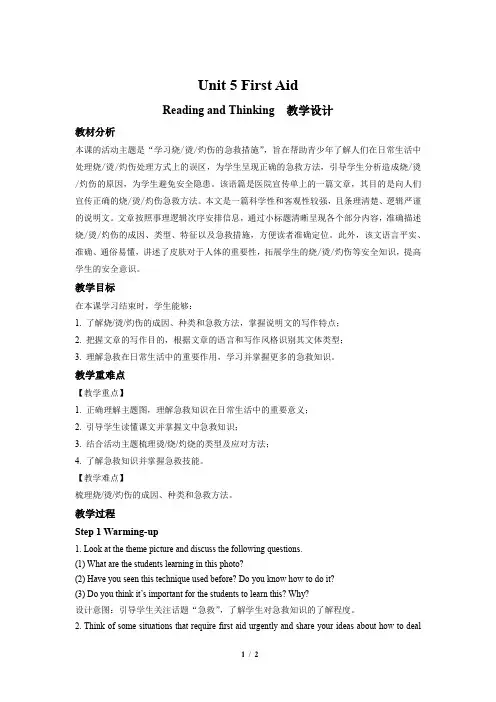
Unit 5 First AidReading and Thinking 教学设计教材分析本课的活动主题是“学习烧/烫/灼伤的急救措施”,旨在帮助青少年了解人们在日常生活中处理烧/烫/灼伤处理方式上的误区,为学生呈现正确的急救方法,引导学生分析造成烧/烫/灼伤的原因,为学生避免安全隐患。
该语篇是医院宣传单上的一篇文章,其目的是向人们宣传正确的烧/烫/灼伤急救方法。
本文是一篇科学性和客观性较强,且条理清楚、逻辑严谨的说明文。
文章按照事理逻辑次序安排信息,通过小标题清晰呈现各个部分内容,准确描述烧/烫/灼伤的成因、类型、特征以及急救措施,方便读者准确定位。
此外,该文语言平实、准确、通俗易懂,讲述了皮肤对于人体的重要性,拓展学生的烧/烫/灼伤等安全知识,提高学生的安全意识。
教学目标在本课学习结束时,学生能够:1. 了解烧/烫/灼伤的成因、种类和急救方法,掌握说明文的写作特点;2. 把握文章的写作目的,根据文章的语言和写作风格识别其文体类型;3. 理解急救在日常生活中的重要作用,学习并掌握更多的急救知识。
教学重难点【教学重点】1. 正确理解主题图,理解急救知识在日常生活中的重要意义;2. 引导学生读懂课文并掌握文中急救知识;3. 结合活动主题梳理烫/烧/灼烧的类型及应对方法;4. 了解急救知识并掌握急救技能。
【教学难点】梳理烧/烫/灼伤的成因、种类和急救方法。
教学过程Step 1 Warming-up1. Look at the theme picture and discuss the following questions.(1) What are the students learning in this photo?(2) Have you seen this technique used before? Do you know how to do it?(3) Do you think it’s important for the students to learn this? Why?设计意图:引导学生关注话题“急救”,了解学生对急救知识的了解程度。
《Unit 2 Reading and Thinking》示范课教案【高中英语人教版】

Unit 2 Bridging CulturesReading and Thinking 教学设计教材分析内容分析:本单元的主题是“文化沟通与交流”。
本节课分为两个部分:1.通过讨论主题图(国外大学课堂的场景),引出留学生在沟通中外文化,架起中国与世界的桥梁的话题。
阅读板块主题是“阅读交换学生Xie Lei的留学经历”。
阅读语篇是一篇刊登在伦敦一所大学校报上的文章,讲述中国商科留学生Xie Lei初到国外时遇到种种困难和挑战(具体表现为语言障碍、想家、学术要求以及中外教学方式的差异带来的挑战)并逐渐适应新环境的经历(参与文化沟通与交流,包括体验、适应当地文化,和向身边人介绍中国文化)。
Xie Lei的学习和生活经历反映了大多数留学生初到国外时的真实体验,和如何应对并适应文化冲击(culture shock)。
学生在阅读过程中感受不同文化碰撞产生的新奇感和危机感,理解留学生发挥着向世界讲述中国故事,传播中国文化,提升我国国际影响力的重要作用。
同时理解青年人在帮助“世界看中国”,让世界感受中华文化之美的过程中获得文化自信。
教学目标在本课学习结束时,学生能够:1. 理解跨文化交流在当今时代的特殊意义;2. 通过校报文章了解商科学生Xie Lei的英国留学经历,遇到的问题和应对策略;3. 理解中国文化的魅力,坚定文化自信;4.谈论留学生在跨文化沟通和文化传播中的特殊身份和作用;教学重难点【教学重点】1.正确理解主题图,理解文化沟通和交流对个人的深远意义;2.引导学生读懂校报文章,了解交换学生的留学经历和适应过程;3.引导学生思考留学生在文化传播中的角色及中外文化环境和教学模式的差异;【教学难点】把握报刊文章的结构和写作特点,梳理文章的明线(参与文化沟通与交流的经历)和暗线(情感体验的变化)。
教学过程Step 1 Warming-up1. Look at the theme picture and discuss the following questions.(1) What does Bridging Cultures mean?(2) What do you think this unit is about?(3) What are the young people doing in the picture?(4) How is the girl on the left different from others?(5) How do you think her life differs from that in her home country?2. Appreciate and understand the quote on the theme picture.3. Try to answer the following questions.(1) Why do you think people are not the same after seeing the moon shining on the other side of the world?(2) Do you have such an experience? If not, what kind of people may feel this way?(3) Have you ever dreamed of going abroad for further education? If so, can you list some of your dream universities?4. Look at some pictures of highly reputable universities.设计意图:通过讨论主题图,引出单元话题,同时激发学生思考文化沟通与交流对个人及社会的意义。
【新教材】5.2 Reading and Thinking 教学设计-人教版高中英语必修第三册
Unit 5 The value of moneyPeriod 2 Reading and Thinking 教学设计The Reading section is the third scene of the first act in the play. The rich merchant brothers made a bet about giving a million pound note to a poor man who had nothing and was honest and reliable and to see what would happen. Finally they found Henry Adams, an American boy who was down and out on the streets of London.Teachers can guide students to understand and feel the language of drama through the development of drama plots.1.Talk about short stories and dramas.2.Learn how to act out a play3.Learn how to request and order food4.Learn model words and polite expressions1. Guide students to grasp the problem characteristics of the script.2. Analyze the characters' emotions and personalities through such information as dialogue, ecology, tone and action, and infer their subtext, so as to deeply understand the text content.Multi-media, textbook, notebooks.Step 1: Warming upIf a rich person gives you a large amount of money to use as you like, for example, one million pound, what will you do? Why?Varied answers.Buy a big houseBuy a fancy car.Donate money to the people in need…..Step2: Fast reading tasksRead the passage quickly and t ell the statements a fact (F) or an opinion (O) after a fast reading._____ Henry wants to find a job in London._____ Henry is given an envelop by the two brothers._____ Henry is an unlucky young man._____ The servant is called James._____ Henry is foolish to go and meet the two brothers.FFOFOStep3: Scan for details.Read through the scenes and then answer some questions1. Where does Henry Adams come from? Does he know much about London?2. What did he do in America?3. Why did he land in Britain?1.Henry comes from San Francisco. No, he doesn’t know London at all.2.He worked for a mining company.3.He was sailing out the bay when he was carried out to sea by a strong wind and was survived by a ship for London.Step4 : Read and sum up how Henry’s feelings change during the conversationHow he feelsAngry, irritatedto open the Irritated that he cannotopen the envelope at oncehe wants a job Unhappy to be givenmoney rather thanworking for itnot to open the Interested and curiousStep 5 Find all the examples of polite requests. Then rewrite them in informal language.1. Would you step inside a moment, please?2 Good morning, sir, would you please come in?Come in, pleaseHello, please come in.3. Permit me to lead the way, sir.4. How do you do, Mr. …er …?Let me show you the wayHello Mr. …5. May we ask what you’re doing in this country?6. I wonder, Mr. Adams, if you’d mind …Why are you in EnglandMr. Adams, is it OK ifStep 6: Critical thinking:1.Why do you think that the brothers chose Henry for their bet?•it was his first visit to London so nobody knew him.•He had no money so he would have to rely on the bank note.•They thought he looked honest because he asked for a job and not charity.2.What kind of person do you think Henry is? Why do you think so? Find the original sentences in the passage to prove Henry’s characteristicHonest:It is my first trip here.Well, to be honest, I have none. (no money)Well, I can’t say that I have any plans.I don’t want your charity. I just want an honest job.Hardworking:•I earned my passage by working as an unpaid hand.•Could you offer me some kind of work here?•I don’t want your charity, I just want an hone st job.•Careless:I landed in Britain by accident.Step 7:Consolidation.•Find Henry•Roderick and Oliver were I .making a bet when they saw Henry, a poor young man.•Know Henry•About a month ago, Henry was sailing and later he found himself carried out to sea by a strong wind. Fortunately, he 2.was spotted by a ship. And it was the ship that brought him to 3.England•Offer money to Henry•Oliver and Roderick gave Henry a letter and told him that there was money in it. They4.persuaded him to accept it, and made him5.promise that it wouldn't be opened until 2o'clock.Step 8:Language pointsa large amount of: a large quantity of; a great deal ofe.g. They bought a large amount of furniture before they moved their new house.make a bet: make an arrangement to risk money, etc. on an event of which the result is doubtful. e.g. We made a bet on the result of the match.permit sb to do something: allow somebody to do somethinge.g. My mother doesn’t permit me to ride in the street after it rained.by accident: as a result of chancee.g. I only found it by accident.stare at: look at somebody or something with the eyes wide open in a fixed gaze( in astonishment, wonder, fear, etc)to be honest: to tell you the truth; to be franke.g. To be honest, I don’t think we have a chance of winning.Step7 Homework:What do you think will happen to Henry? Will the bank-note help him or get him into trouble?。
《Unit 5 Reading and Thinking》教学设计【高中英语人教版】

Unit 5 PoemsReading and Thinking 教学设计教材分析本课是阅读课,主题是“欣赏不同形式的英文诗歌”(Appreciate different forms of English poems)。
该阅读语篇是一篇说明文,语篇结构是“总—分—总”的模式。
文章第一段简要概括了诗歌这种文学体裁的价值、意义及特点,点明该语篇的核心内容是介绍几种简单的诗歌形式。
文章第二至第五段则分别描述了童谣、清单诗、五行诗、俳句的特点,同时还列举了相关的诗作供学生学习。
第六段提及了唐诗英译,列举了我国唐代诗人王建的《望夫石》。
最后的段落则鼓励学生模仿创作英文诗歌。
教学目标在本课学习结束时,学生能够:1.总结出阅读语篇的文本结构;2.抓住英文诗歌的特点,掌握赏析英文诗的方法;3.了解几种简单的诗歌形式,掌握诗歌的基本特征和语言特点。
教学重难点【教学重点】1. 引导学生通过理解文章内容,总结出阅读语篇的结构特点;2. 指导学生学会识别几种简单的英文诗歌形式,概括和梳理不同诗歌的特点;3. 指导学生学会利用表格梳理文本信息,对几种诗歌形式的名称、特点和相关诗作等信息进行整理和归纳。
【教学难点】能梳理和概括不同诗歌的特点,学会辨别英文诗歌中的意象、韵律、节奏及修辞手法,启发学生赏析诗歌作品,表达对诗歌的感受。
教学过程Step 1 Warming-up1. Look at the picture and discuss the following questions.(1) What can you see in the picture?(2) If you were walking in a forest and came to a crossroad like this, what would you do? Why?设计意图:引导学生观察并讨论主题图,并将学生代入场景思考自己的决策。
2. Understand the quote.(1) Do you understand the poem lines in the photo? Can you use your own words to explain them?(2) Why does the writer take the road less travelled by?(3) What difference do you think it has made to the writer?(4) What emotion or feeling do you think the poet wanted to convey?设计意图:赏析引言中的诗歌,让学生谈论对这几句诗的理解,挖掘诗歌的深层含义。
【教案】Unit 5 Reading and thinking 说课教案人教版(2019)必修第一册
高中英语人教版必修一第5单元教学设计教学内容分析这一部分的语篇所涉及的主题语境为“人与社会”,介绍了汉字书写体系的历史演变过程。
该教学文本主要聚焦于汉字与中华文明得以传承的关系,其标题和开篇首段直接点明主题——中华文明得以传承数千年的重要原因之一就是汉字书写体系的不断发展。
作者运用明暗线交织的叙述手法,通过介绍汉字的发展史,突出了汉字书写体系对中华文明传承所起到的重要作用(如:时间上连接过去与现在、空间上连接生活在不同地域的人们、连接语言与艺术以及连接中国与世界等),借此表达了作者对汉字和中华文化的自信心和自豪感。
教学目标在本节课的学习后,学生能够:(1)运用抓取关键词、寻找主题句、概括推理等阅读技巧,厘清文本结构,把握文本主旨要义,梳理文本主要信息。
(2)在了解汉字书写体系发展史的基础上,总结概括影响汉字书写体系发展的主要因素、汉字书写体系的功能及汉字书写体系和中华文明的关系(即汉字书写体系的文化意义)。
(3)深入探究题目中的“CONNECTING THE PAST AND THE PRESENT”及文中的关键词句(例如,文中反复出现的“still”),深刻领会汉字书写体系对中华文明的传承作用,并进一步探讨汉字书写体系的多重作用。
(4)通过探讨“如何对外介绍中国汉字体系,传播中国传统文化”这一话题,运用所学语言表达个人观点,发展思维品质,增强传承中华文明的意识。
在以上教学目标中,厘清文本结构、把握文本主旨要义是教学的基本立足点,而对汉字书写体系的影响因素、功能和意义的概括,以及对汉字体系的介绍和对中国文化传播途径的探讨是教学的重难点。
【设计意图】在多层次教学目标的指引下,教师在设计教学活动时可以有方向、有针对性地对学生进行阅读教学指导,通过教、学、评一体化,全面系统地保证英语阅读教学的综合效果。
教学思路设计基于对教学内容的分析,本课例的设计思路如下:以探索汉字书写体系为活动主题,遵循“学习理解、实践应用、迁移创新”的学习活动观,从“读前预设语篇、读中挖掘内涵、读后迁移知识”三个层次由浅入深地解读语篇,通过教、学、评一体化的实施,帮助学生有效获取、梳理、提炼和整合文本信息,培养阅读素养,提高语言表达能力,促进学生思维的发展。
Reading and Thinking 教案 高中英语人教版(2019)选择性必修第二册
共案个案Unit 5 SCIENCE AND SCIENTISTSReading and Thinking一、教学目标1. Enable the Ss to get to know some knowledge about Cholera.2. Enable the Ss to understand the passage well.3. Let the Ss learn some reading skills by scanning and skimming.4.To learn from the great scientists and develop thenoble spirits.二、教学重难点1.To figure out the structure of the text.2.To identify the purpose and the intended readers.3.Enable the students to practice some reading skills.三、教学过程Step 1 Warming-upName some famous scientists you know and tell something about them.Step 2 Reading1.Do you know how these scientists prove a new idea inscientific research? Discuss in small groups the stages insetting out a new scientific idea. What order would youput them in?2.Circle the key words to put the stages in order.3.What will be talked about from the title?1.Who was John Snow?2.How did John Snow defeat King Cholera?3.What is King Cholera?4.The structure of this passageStep 4 Exercisesplete the chart2.Write A-E in the blanks.3.Write out the questions according to the answers.教后反思(不少于100字)。
Reading and thinking阅读课教学设计-高中英语人教版
While-reading
Activity 1: Timed reading and scanning
Let’s Ss checkout their predict through a fast reading in 3 minutes and find out the topic sentence of each paragraph.
2019人教版高中英语必修一U5阅读课教学设计
The Chinese Writing System: The Past and The Present
Textbook
2019 PEP Book 1
Time
45 min
Teaching Type
New teaching
for reading
Preparation
3.Ss will be able to use extraction and inductive thinking to understand the development history ofChinese characters writing system and importance of theChinese character writing system in the inheritance ofChinese civilization;
TeachingObjectives
1.Ss will be able to grasp the new words andphrasessuch as “base,symbol,variety, appreciate,global affairs...”
2.Ss will be able to use skimming and scanning to learn to improve the ability to read and quickly extract information;
【公开课教案】Unit 5 Reading and Thinking人教版(2019)必修第二册
B2 U5 The Virtual Choir读思课(一)教学分析1、教学内容分析What:本课选自人教版高中新版教材必修二第五单元的reading and thinking。
文章The Virtual Choir,描述了作曲家Eric Whitacre在大学时期参加唱诗班,被莫扎特的古典音乐所打动,并受到了女孩演唱视频的启发,进而创造了“虚拟合唱团”(The virtual choir)。
合唱团以音乐为桥将世界各地的人连结起来,打破语言、民族、地域的隔阂,共同歌唱美好世界。
How:本文的体裁为说明文,以说明为主,以叙事为辅。
文章共有四段,从结构上可分为三部分。
第一部分(Para. 1)介绍说明了虚拟合唱团的组织形式、积极作用及影响;第二部分(Para. 2, 3)按照时间顺序叙述创始人Whitacre的故事以及虚拟合唱团的产生、发展过程;第四段部分(Para. 4)总结虚拟合唱团的意义。
明线介绍虚拟合唱团的产生发展过程,暗线说明音乐的作用。
文章结构清晰,段与段之间衔接自然合理。
在语义衔接上,在第二部分的叙述中,作者以时间为线索进行叙述,使用大量表示时间的词,如”over the next 10 years” ”in...” ”since then”等等使叙述脉络清晰。
同时,本文巧妙地使用分词作状语的句型,如”Moved by...” “Inspired,...”,从语法表意功能上体现音乐对人的鼓舞和积极影响,促进主题意义的表达,同时也使句与句之间过渡自然、连接紧密,语言简洁明了。
在说明方法上,文章多次运用引言和数据,使信息说明更加真实有效。
教材中也使用了虚拟合唱团表演的现场图片更加直观地说明音乐能够突破时空限制,跨越民族、跨越国家、跨越地域,起到连接人心的作用,从而实现对主题意义的诠释和升华。
Why:作者通过对虚拟合唱团组织形式以及其产生发展的历程,旨在增进学生对虚拟合唱团这种互联网大环境下新型音乐形式的了解,在感受互联网的强大功能的同时,突破学生对音乐功能和作用的传统认知,挖掘探究其背后音乐的内在深层力量——在互联网时代,音乐可以突破时空限制,以其强大的力量鼓舞人心、凝结人心。
Unit 5 Period 2 Reading and Thinking教案
The meal was very ordinary.
out of ordinary
The new test should enable doctors to detect the disease early.
enable sb to do sth
In the past this process of transition has often proven difficult.
What caused Eric Whitacre to fall in love with classical music? What gave him the inspiration to make his first virtual choir?
keys:
A virtual choir is different from other choirs because you don't need to be together and you don't need a studio. This means anyone can take part anywhere.
Reading
Step 6
Pair work
Teacher encourages students to use the key words and phrases learnt to discuss with their partner about the following topics:
Discuss the question in groups.
Whitacre formed the Virtual Youth Choir for UNICEF. _____________ young people from __________ countries sang "What If".
【教案】Unit 5 Reading and Thinking 教学设计-人教版选择性必修第二册
Unit 5 FIRST AIDReading and Thinking: First Aid for Burns文本简析本单元阅读文本的话题是日常生活中遇到烫伤烧伤的急救知识,旨在让高中生了解烫伤和烧伤的原因、类型、不同等级的特征以及相应的急救措施,判断烫伤和烧伤急救措施的正确与否,以期在现实生活中遇到紧急情况时能做出正确的急救处理。
文本为医院宣传小册子,属于说明性文体,有鲜明的说明文特征。
文章语言简洁易懂,结构清晰明了,采用不同的字体和颜色以及其它版面特征来区分不同的内容。
标题“First Aid for Burns”是整个文本的主题。
引入部分陈述了皮肤的功能和重要性,从而让读者明白烫伤和烧伤急救的重要性。
主体部分分别介绍了烫伤和烧伤的原因、类型、不同等级的特征以及急救措施,以便读者尽量避免烫伤和烧伤,并在紧急情况下根据不同等级的伤势采用合适的急救措施。
在进行教学设计时,教师要帮助学生找出说明文的文体特征,梳理关于急救话题类的语言,其中包括有关伤势以及与急救措施相关的表达。
本文的主旨句、例证以及对比等表达方式都是很好的逻辑思维训练载体。
此外,本课需首要关注的文化要素和思维品质是学生能够理解急救知识在保障人身安全方面的重要意义,加强自身在紧急情况下发挥的作用,提高青少年关心他人安危的意识和公民素质。
教学设计(共2课时)第1课时一、教学内容理解全文,识别文本的文体特征,明确文本的主要内容和结构,重点了解烫伤和烧伤的原因和伤势分级。
二、课时目标1. 通过快速阅读获取文本的主旨大意、梳理篇章结构。
2. 通过略读、扫读确定文本的语言特征和文体类型,了解宣传册的文本特征。
3. 通过研读文本的相关内容,能用英语有逻辑地讲述皮肤的功能、烫伤和烧伤的原因,并比较不同程度伤势的特征。
三、教学过程Activity 1: Activating background knowledge related to first aid techniques 本活动旨在为落实课时目标1做准备。