
四年级下英语(一年级起点)全册基础知识清单
Unit 1 My Neighborhood基础知识清单一、单词Across from 对面next to 紧邻between在···之间restaurant 餐馆post office 邮局grocery杂货店turn left 左转turn right 右转go straight 直走crossroad 十字路口neighborhood邻居send发送get得到money钱get to 到达before在··之前leave离开toy玩具hospital医院book shop书店school 学校supermarket 超市ball 球药店drugstore 理发店Hairdresser’s 咖啡店Coffee Shop 加油站Gas Station 二、短语左转turn left 右转turn right 在··之间between 到达get to 和··挨着next to 在第一个十字路口at the first crossroad 喝咖啡drink coffee 对面across from 在···前面in front of 在···后边behind 到达arrive at药店drugstore 理发店Hairdresser’s 咖啡店Coffee Shop 加油站Gas Station三、句子1.打扰一下,请问医院在哪里Excuse me. Where is the hospital?2.直走,就在你的右边,挨着餐馆Go straight. It’s on your right. It’s next to the restaurant.3.打扰一下,请问邮局怎么走?Excuse me. How can I get to the post office?4.直走,然后在第一个十字路口左转,它在书店和杂货店之间Go straight. Turn left at the first crossroad. It’s between the bookshop and the grocery.5.银行在哪里?Where is the bank?6.直走,然后左转,挨着超市.Go straight. Turn left. It’s next to the supermarket.7.打扰一下,请问电影院怎么走?Excuse me. How can I get to the cinema?8.直走,然后右转,在杂货店和书店之间。
Excuse me. And turn right. It’s between the grocery and the bookshop.9.打扰一下,请问附近有邮局吗?Go straight. Is there a post office in the neighborhood?10.是的,有.Yes, there is11.怎么能到呢?How can I get there?12.直走然在在第一个十字路口左转,就在书店和杂货店之间.Go straight. Then Turn left at the first crossroad. It’s between the bookshop and the grocery.13.谢谢Than you.14.不用客气You’re welcome.15.比尔让lucky给他的朋友寄一本书Bill ask Lucky to send a book to his friend.16.Lucky,去银行取点钱,然后在4:30之前到达邮局Lucky, get some money from the bank, then get to the post office before 4:30. 17.Lucky在3:30离开。
Lucky leaves at 3:30.18.Lucky走进了一家餐馆,在这吃了一个汉堡包.Lucky goes into a restaurant. There he eats a hamburger.19.然后它看见餐馆对面有家玩具店。
Then he sees a toy shop across from the restaurant.20.Lucky想要一个玩具,所以他买了一个球。
Lucky wants a toy,so he buy a ball.21.最后,它到达了邮局,但是已经5:00了。
Finally he gets to the post office, but it’s 5:00.22.她们直走然后在第二个十字路口左转They go street and turn left at the second crossroads.23.Joy的妈妈去Happy Shop 买了一双鞋Joy’s mom goes to happy shop to buy a pair of shoes.24.最后,她去超市,在这买了一些晚餐的食物。
Finally, she goes to the supermarket. She buys some food for dinner there.25.他看见餐馆对面有一家玩具店26.If you sick, you can go to the drugstore buy medicine.27.You can go to the Hairdresser’s for a haircut.28.You can drink coffee in a Coffee Shop. It’s delicious29.You can buy gas in the Gas Station. You can also buy some candy and drinks there,too.30.我就在你的身后I’m right behind you.31.我在餐馆前面I am in front of the restaurant.32.你能看见杂货店吗?在邮局对面,去那里。
Can you see a grocery? It’s across from the post office. Go there.33.David很失落,他再一次打电话给Bob,Bob给他更多的指示。
David is very upset. He calls Bob again. Bob gives him more directions34.David终于到达了博物馆David has finally arrived at the museum. But where is Bob? He calls him again.Unit 2 Cities基础知识清单一、单词城市city 街道street 宾馆hotel 广场square 买玩具buy toys 忙碌的busy 车站station 地方place 事物thing 停留stay 星star 国王king 中心的central 博物馆museum 梦dream二、短语体育中心sports centre 买玩具buy toys 看电影see a film 去划船go boating 照相take photos 很多a lot of 坐公交车take a bus 步行on foot 看电影see a film 尝试做try to do 吃冰激凌have some ice-cream三、句子1、体育中心怎么走?How can I get to the sports centre?2、你可以坐地铁You can take the subway.3、打扰一下,请问玩具店在哪里?我如何能到?Excuse me, Where is the toy shop? How can I get there?4、在Banana街上,你可以坐公交车It’s on Banana Street. You can take a bus.5、打扰一下,广场在哪里?Excuse me. Where is the square?6、在酒店对面It’s across from the hotel.7、城市里有一个体育中心There is a sports Centre in the city.8、城市里有一个大广场There is a big square in the city.9、打扰一下,请问玩具店在哪里?我想要买一些玩具。
Excuse me。
Where is the toy shop? I want to buy some toys. 10、在banana街上,那里有很多有趣的玩具。
It’s on Banana Street. There are a lot of interesting there.11、你可以坐公交车,玩具店在电影院和一个公园之间。
You can take a bus. The toy shop is between a cinema and a park.12、太好啦!然后我也可以去看电影和划船。
Great! Then I can see a film and go boating, too.13、这里有很多有趣的地方可以看,很多事情可以做。
There are many fun places to see and things to do.14、你可以在那里打球和游泳。
You can play ball games and swim there。
15、在那里可以做什么?What can you do there?16、你可以在那里放风筝和照相。
You can fly kites and take photos.17、体育中心在哪里?Where is the sports center?18、看,这是我的城市的地图。
Look, this is a map of my city.19、我经常和我的父母去公园划船。
I often go boating with my parents in the park.20、Amsterdam是一个自行车城市Amsterdam is a bicycle city.21、这里的自行车比汽车多,很多道路都只有自行车同行。
There are more bicycles than cars. Many roads are only for bicycles.22、London有世界上最大的地铁。
London has the biggest subway in the world.23、Copenhagen是一个非常适合步行的城市。
2024年小学四年级英语下册知识点资料
2024年小学四年级英语下册知识点资料
以下是2024年小学四年级英语下册的知识点资料:
1. 单词拼写:复习上册的单词拼写,包括动物、食物、家庭成员等常见单词。
2. 数字和计数:学习1000以内的数字和计数,包括基数词和序数词的应用。
3. 问路和指路:学习问路和指路的表达方式,包括如何描述方向和位置。
4. 基本句型:学习基本的英语句型,如主语+谓语动词等,以及一般疑问句和否定句
的构造。
5. 时间和日常活动:学习如何表达时间和日常活动,包括用英语描述一天的活动流程。
6. 介词和地点词:学习如何使用介词和地点词,以描述位置关系和方位。
7. 身体部位和感觉:学习英语中常用的身体部位和感觉的表达方式。
8. 季节和天气:学习四季和常见天气的英语表达方式。
9. 形容词和比较级:学习形容词和比较级的用法和构造方式。
10. 食物和饮料:学习常见食物和饮料的英语名称。
这些是2024年小学四年级英语下册的一些基本知识点,希望对您有所帮助!。
四年级下册英语知识清单

四年级下册英语知识清单
以下是四年级下册英语知识清单的一些常见的内容:
1. 日常用语和问候语
2. 时间和日期的表达方式
3. 数字和基本的算术运算
4. 形容词和副词的用法
5. 介词的用法和常见短语
6. 名词的单数和复数形式
7. 人称代词和物主代词
8. 动词的现在时态和过去时态
9. 一般现在时的陈述句、疑问句和否定句
10. 一般过去时的陈述句、疑问句和否定句
11. 物品的颜色、大小和形状的描述
12. 季节和天气的表达方式
13. 家庭成员和描述家庭关系的词汇
14. 城市和乡村的特征及相关词汇
15. 学科和学校设施的词汇
16. 衣物和穿着的词汇
17. 常见食物和饮料的名称
18. 动物和植物的名称
19. 交通工具和旅行的词汇
20. 常用的动作动词和动作短语
这只是一些常见的知识点,具体的教材内容可能会有所不同。
建议根据具体教材内容进行学习和复习。
外研社(一年级起)英语四年级下册学习重点整理
外研社(一年级起)英语四年级下册学习重
点整理
词汇重点
- 研究并掌握每个单元的核心词汇
- 理解和应用常见的动词、形容词、副词以及连词
语法重点
- 研究并掌握基本的句子结构,包括主谓结构、陈述句、疑问句和否定句
- 熟练掌握一般现在时、一般过去时和将来时的用法和变化规则
- 理解和应用基本的形容词和副词比较级的用法
听力重点
- 培养听懂简短对话和问题的能力
- 提高听懂日常生活中关于时间、地点、人物和活动的问题的能力
- 研究听懂简短故事并提取关键信息的能力
口语重点
- 练运用学过的词汇和句型进行简单的日常会话
- 学会表达自己的观点、感受和喜好
- 提高与他人交流和合作的能力
阅读重点
- 通过阅读短文和故事,培养理解和抽取关键信息的能力
- 学会根据文中提供的信息回答问题
- 提高阅读时的语音和语调的表达能力
写作重点
- 练书写短文和简单的句子,描述自己的家庭、朋友和学校生活
- 学会运用所学词汇和语法结构进行基本的写作对话和情景
以上是外研社(一年级起)英语四年级下册的学习重点整理。
通过重点的学习和实践,学生们将能够提高听说读写的能力,更好地运用英语进行交流和表达。
四年级下英语(一年级起点)全册基础知识清单
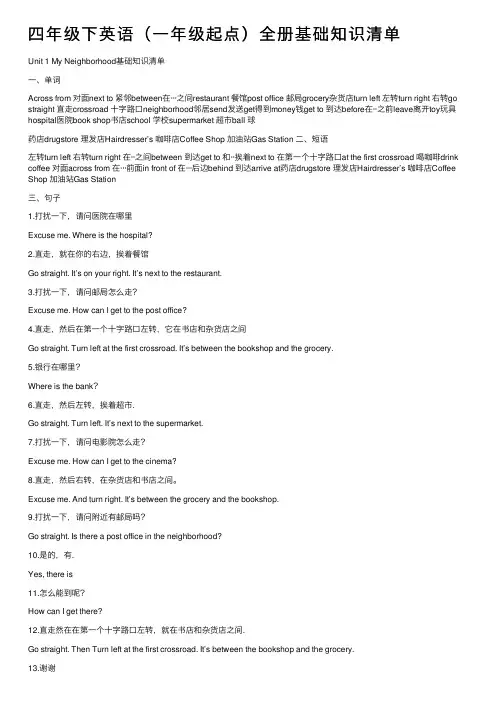
四年级下英语(⼀年级起点)全册基础知识清单Unit 1 My Neighborhood基础知识清单⼀、单词Across from 对⾯next to 紧邻between在···之间restaurant 餐馆post office 邮局grocery杂货店turn left 左转turn right 右转go straight 直⾛crossroad ⼗字路⼝neighborhood邻居send发送get得到money钱get to 到达before在··之前leave离开toy玩具hospital医院book shop书店school 学校supermarket 超市ball 球药店drugstore 理发店Hairdresser’s 咖啡店Coffee Shop 加油站Gas Station ⼆、短语左转turn left 右转turn right 在··之间between 到达get to 和··挨着next to 在第⼀个⼗字路⼝at the first crossroad 喝咖啡drink coffee 对⾯across from 在···前⾯in front of 在···后边behind 到达arrive at药店drugstore 理发店Hairdresser’s 咖啡店Coffee Shop 加油站Gas Station三、句⼦1.打扰⼀下,请问医院在哪⾥Excuse me. Where is the hospital?2.直⾛,就在你的右边,挨着餐馆Go straight. It’s on your right. It’s next to the restaurant.3.打扰⼀下,请问邮局怎么⾛?Excuse me. How can I get to the post office?4.直⾛,然后在第⼀个⼗字路⼝左转,它在书店和杂货店之间Go straight. Turn left at the first crossroad. It’s between the bookshop and the grocery.5.银⾏在哪⾥?Where is the bank?6.直⾛,然后左转,挨着超市.Go straight. Turn left. It’s next to the supermarket.7.打扰⼀下,请问电影院怎么⾛?Excuse me. How can I get to the cinema?8.直⾛,然后右转,在杂货店和书店之间。
外研社一年级起点小学四年级英语下册知识点
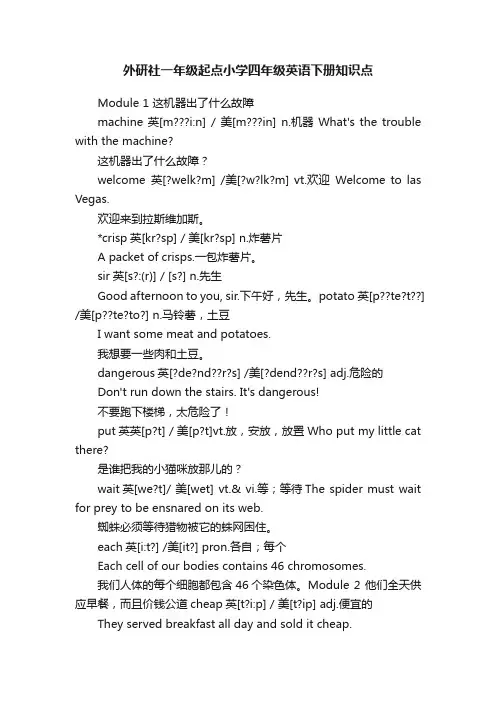
外研社一年级起点小学四年级英语下册知识点Module 1 这机器出了什么故障machine英[mi:n] / 美[min] n.机器What's the trouble with the machine?这机器出了什么故障?welcome英[?welk?m] /美[?w?lk?m] vt.欢迎Welcome to las Vegas.欢迎来到拉斯维加斯。
*crisp英[kr?sp] / 美[kr?sp] n.炸薯片A packet of crisps.一包炸薯片。
sir英[s?:(r)] / [s?] n.先生Good afternoon to you, sir.下午好,先生。
potato英[p??te?t??] /美[p??te?to?] n.马铃薯,土豆I want some meat and potatoes.我想要一些肉和土豆。
dangerous英[?de?nd??r?s] /美[?dend??r?s] adj.危险的Don't run down the stairs. It's dangerous!不要跑下楼梯,太危险了!put英英[p?t] / 美[p?t]vt.放,安放,放置Who put my little cat there?是谁把我的小猫咪放那儿的?wait英[we?t]/ 美[wet] vt.& vi.等;等待The spider must wait for prey to be ensnared on its web.蜘蛛必须等待猎物被它的蛛网困住。
each英[i:t?] /美[it?] pron.各自;每个Each cell of our bodies contains 46 chromosomes.我们人体的每个细胞都包含46个染色体。
Module 2 他们全天供应早餐,而且价钱公道cheap英[t?i:p] / 美[t?ip] adj.便宜的They served breakfast all day and sold it cheap.他们全天供应早餐,而且价钱公道。
四年级下册英语课本基础知识点
四年级下册英语课本基础知识点1. 课文理解本册课本内容主要涵盖了以下几个主题:- 人物介绍:通过研究课文中的人物介绍,学生能够了解到不同人物的基本信息,如姓名、年龄、职业等。
- 家庭:学生将了解到不同家庭成员的身份、关系以及常用的家庭用语,比如亲人的称呼、问候语等。
- 学校:通过研究课文中的学校场景,学生将获得关于学校设施、校园生活以及学校活动的基本知识。
- 交通与旅行:学生将研究有关不同交通工具的名称、用途以及相关的旅行常识,如旅行的准备工作、路线规划等。
2. 语法知识点本册课本中还包含了一些基础的语法知识点,如:- 人称代词:将学生引入基本的人称代词,如I、you、he、she 等。
学生将学会正确使用这些代词进行信息交流。
- 简单句:让学生研究如何构造简单的英语句子,包括主语、谓语和宾语的使用。
- 动词时态:介绍一些常见的动词时态,如一般现在时、一般过去时等。
这将帮助学生准确地描述动作发生的时间和状态。
- 介词和介词短语:学生将研究一些基本的介词和介词短语,如in、on、at等。
这将有助于学生描述地点、时间、方式等。
3. 词汇积累通过本册课文的研究,学生将增加一些常用的英语词汇,包括但不限于:- 人物词汇:如mother、father、teacher等。
- 家庭成员词汇:如brother、sister、grandmother等。
- 学校相关词汇:如classroom、library、lunch等。
- 交通工具词汇:如car、bus、train等。
- 旅行相关词汇:如ticket、hotel、passport等。
学生应该使用课文中的例句和练题来加深对这些词汇的理解和掌握。
4. 课后练本册课本还提供了一些课后练,以帮助学生巩固所学知识,提升研究效果。
学生可以根据教师的指导完成这些练题,并及时纠正错误,提高自己的研究能力。
以上是关于四年级下册英语课本基础知识点的简要介绍。
希望能对学生的学习有所帮助,让他们在英语学习过程中获得更多的知识和信心。
外研社(一年级起)英语四年级下册知识点汇总
四年级下册Module 1知识汇总一、词汇machine 机器welcome 欢迎crisp 炸薯片sir 先生potato 马铃薯,土豆dangerous 危险的put 放,安放,放置wait 等;等待each 各自,每个二、句子1. These machines make crisps. 这些机器做薯条。
2. —What does this machine do, sir? 这个机器是做什么的,先生?—It washes the potatoes. 它是洗土豆的。
3. Don’t touch the machines, please! 请不要触摸这些机器!4. They are dangerous. 它们很危险。
5. You can each have a bag of crisps. 你们每人可以得到一包薯条。
6. Don’t feed the baby. 不要给那个婴儿喂食。
7. Play with the baby! 和婴儿一起玩。
8. Don’t write on the books. 不要在书上写字。
9. Don’t walk on the grass! 不要踩草坪。
10. Be quiet, please! 请安静!三、句型结构1. Don’t + 动词原形+ 其他. 用于提醒某人不要做某事。
eg: Don’t make noise in class. 不能在课堂上喧闹。
2. 动词原形+ 其他. 祈使句,表示让(请)某人做某事。
eg: Hold on, please. 请稍等。
Be careful! 小心!四年级下册Module 2 知识汇总一、词汇cheap 便宜的expensive 昂贵的send 发送;寄email 电子邮件cost 花费;价钱为hundred 一百二、句子1. I’ve got a new hat. 我有一顶新帽子。
2. —What colour is it? 它是什么颜色的?—It’s pink. 它是粉色的。
部编版小学四年级英语下册全册知识点总结整理归纳
部编版小学四年级英语下册全册知识点总结整理归纳一、语音知识1. 学习并掌握字母组合 "oo" 在单词中的发音,如:look, book, good 等。
2. 学习并掌握字母组合 "er" 在单词中的发音,如:pen, dog, teacher 等。
二、词汇知识1. 动物类词汇:cat, dog, panda, tiger, elephant, giraffe 等。
2. 颜色类词汇:red, yellow, blue, green, black, white 等。
3. 家庭成员类词汇:father, mother, brother, sister, grandma, grandpa 等。
4. 食物类词汇:apple, banana, orange, cake, ice cream, rice 等。
5. 水果类词汇:apple, banana, orange, grape, watermelon, pineapple 等。
6. 数字类词汇:one, two, three, four, five, six, seven, eight, nine, ten 等。
三、语法知识1. 一般现在时:描述经常性和习惯性动作,如:I often go to school by bus.2. 一般过去时:描述过去发生的动作或状态,如:I visited my grandparents last weekend.3. 一般将来时:描述将来要发生的动作或计划,如:I will go to the zoo tomorrow.四、功能句型1. 询问姓名:What's your name?2. 询问年龄:How old are you?3. 询问颜色:What color is it?4. 询问数量:How many do you have?5. 询问喜好:What do you like?五、情景交际1. 打招呼:Hello, nice to meet you.2. 询问天气:What's the weather like today?3. 询问时间:What time is it?4. 道别:Goodbye, see you tomorrow.六、文化知识1. 了解西方节日:Valentine's Day, Easter 等。
外研版小学英语一起四年级下册知识点汇总
外研版小学英语一起四年级下册知识点汇总1. 单词和词组- 本册单元 1 中的重要单词和词组有:apple、banana、watermelon、orange、grape、bread、milk、tea、hamburger、hot dog、I like 、me too、not bad.- 本册单元 2 中的重要单词和词组有:tomato、potato、carrot、cabbage、pear、strawberry、chicken、beef、fish、egg、noodle、rice、potato chips、salad、I don’t like、How about 、I’m sorry、one more time.- ...2. 语法- 本册单元1 中的语法重点是介词in、on、under 和量词some、a glass of.- 本册单元 2 中的语法重点是物主代词 my、your、his、her 和谓语动词有关的疑问句。
3. 句型- 本册单元 1 中的重点句型有:I like apples.、I like bananas.、I like watermelons.、Do you like grapes?、Yes, I do.、No, I don’t.- 本册单元 2 中的重点句型有:I like tomatoes.、I like carrots.、I like potatoes.、Do you like cabbage?、Yes, I do.、No, I don’t.4. 听力和口语- 本册单元 1 中的听力和口语部分主要包括日常食物的表达和对喜好的表达。
- 本册单元 2 中的听力和口语部分主要包括日常蔬菜的表达和对喜好的询问和回答。
5. 阅读和写作- 本册单元 1 中的阅读部分包括简单的对话和填空题,写作部分主要是书写单词和句子。
- 本册单元 2 中的阅读部分包括简单的短文和选择题,写作部分主要是书写句子和回答问题。
外研社(一年级起)英语四年级下册教材重点梳理
外研社(一年级起)英语四年级下册教材重点梳理Unit 1: At the Zoo- Vocabulary: animals, lion, elephant, giraffe, kangaroo, monkey - Sentence structures: "What animals can you see?" "I can see a lion/elephant/giraffe/kangaroo/monkey."Unit 2: In the Garden- Vocabulary: flowers, tree, grass, butterfly, bee, ladybird- Sentence structures: "What can you see in the garden?" "I can see flowers/a tree/grass/a butterfly/a bee/a ladybird."Unit 3: My Body- Vocabulary: head, eyes, nose, mouth, ears, hair- Sentence structures: "What can you see on your face?" "I can see my head/eyes/nose/mouth/ears/hair."Unit 4: Daily Routines- Vocabulary: get up, wash, brush, eat, go to school, sleep- Sentence structures: "What do you do in themorning/afternoon/evening?" "I (get up/wash/brush/eat/go toschool/sleep)."Unit 5: At the Supermarket- Vocabulary: apple, banana, orange, watermelon, pineapple, grapes - Sentence structures: "What fruits can you see at the supermarket?" "I can see (apples/bananas/oranges/watermelons/pineapples/grapes)."Unit 6: Time- Vocabulary: clock, hour, minute, morning, afternoon, evening- Sentence structures: "What time is it?" "It is (number) o'clock in the (morning/afternoon/evening)."Unit 7: Our School- Vocabulary: classroom, teacher, student, desk, chair, blackboard - Sentence structures: "What can you see in the classroom?" "I can see (a classroom/a teacher/students/desks/chairs/a blackboard)."Unit 8: My Family- Vocabulary: father, mother, brother, sister, grandpa, grandma- Sentence structures: "Who is in your family?" "In my family, there is my (father/mother/brother/sister/grandpa/grandma)."Unit 9: Our World- Vocabulary: sun, moon, stars, sky, earth, cloud- Sentence structures: "What can you see in the sky?" "I can see the (sun/moon/stars/sky/earth/cloud)."Unit 10: Festivals- Vocabulary: New Year, Easter, Halloween, Christmas, birthday, festival- Sentence structures: "What festivals do you celebrate?" "I celebrate (New Year/Easter/Halloween/Christmas/my birthday)."Unit 11: Let's Play- Vocabulary: ball, kite, jump rope, doll, toy car, teddy bear- Sentence structures: "What toys do you like to play with?" "I like to play with (a ball/a kite/a jump rope/a doll/a toy car/a teddy bear)."Unit 12: Food and Drinks- Vocabulary: sandwich, hamburger, pizza, ice cream, juice, milk - Sentence structures: "What do you like to eat/drink?" "I like to eat (a sandwich/a hamburger/a pizza/ice cream) and drink (juice/milk)."Unit 13: Weather- Vocabulary: sunny, rainy, cloudy, windy, snowy, hot- Sentence structures: "What is the weather like today?" "Today, it is (sunny/rainy/cloudy/windy/snowy/hot)."Unit 14: Jobs- Vocabulary: doctor, teacher, policeman, firefighter, musician, artist- Sentence structures: "What do you want to be when you grow up?" "I want to be a(doctor/teacher/policeman/firefighter/musician/artist)."Unit 15: Travel- Vocabulary: plane, train, bus, car, boat, bike- Sentence structures: "How do you like to travel?" "I like to travel by (plane/train/bus/car/boat/bike)."Unit 16: My Home- Vocabulary: bedroom, living room, kitchen, bathroom, garden, house- Sentence structures: "Describe your home." "I have (a bedroom/a living room/a kitchen/a bathroom/a garden) in my (house)."Unit 17: Colors- Vocabulary: red, yellow, blue, green, orange, purple- Sentence structures: "What is your favorite color?" "My favorite color is (red/yellow/blue/green/orange/purple)."Unit 18: Numbers- Vocabulary: one, two, three, four, five, six- Sentence structures: "Can you count to (number)?" "Yes, I can count to (one/two/three/four/five/six)."Unit 19: Shapes- Vocabulary: circle, triangle, square, rectangle, diamond, star- Sentence structures: "What shapes can you see?" "I can see a (circle/triangle/square/rectangle/diamond/star)."Unit 20: Happy Birthday!- Vocabulary: cake, candle, present, party hat, balloon, song- Sentence structures: "What do you like about birthdays?" "I like (cakes/candles/presents/party hats/balloons/songs) on birthdays."以上是《外研社(一年级起)英语四年级下册》教材的重点梳理。