
人教版八年级英语上册Unit7 2a2e说课稿
Unit 7 Do you think you will have your own robot?
Section B 2a—2e
尊敬的各位老师:
中午好!很高兴有机会与大家分享我的说课。
今天我说课的内容是人教版英语八年级上册7单元Section B 2a—2e的阅读部分。
下面我将从教材,学情,教法,学法,教学过程这五个方面进行说课。
一、说教材
1、本课分析
本课的标题是:Do you think you will have your own robot?是一篇以机器人为话题的阅读文章。
通过设置读前预热、读中理解、读后检测,让学生了解机器人的由来、发展过程、对人类生活产生的重大影响,引导学生关注生活,展望未来,崇尚科学,从而对学生进行适当的情感态度教育。
2.根据新课程标准及本课内容,我确定以下教学目标:
知识目标:
(1)熟练掌握四会单词和短语:human, servant, fall down等等.
(2)学习谈论未来,并预测在未来机器人将像什么样和机器人将可以做什么等。
能力目标:
(1)提高学生阅读能力,即通过略读确定段落大意,通过精读获取细节信息。
(2)学会描述未来的机器人。
情感目标:引导学生崇尚科学,相信未来,探索和创造美好世界。
3、根据以上分析,我确定本课的重点是:掌握本课时出现的生词及表达方式;阅读短文,获得相关信息,提高学生的综合阅读能力。
难点:阅读文章并完成不同的任务;能掌握一定的阅读方法。
二.说学情
经过前面听说以及语法教学,学生对本单元的目标已经有了较好的掌握,能够较好的运用目标语言表达自己的思想,这为接下来的阅读课打下来良好的基础。
另外,文本的话题是机器人,时代感很强,大部分学生会感兴趣。
但是,我们的学生阅读量不是很大,视野也不够宽阔,同时学生在阅读策略和效率上还有待提高,需要老师设置一系列的教学环节进行有效地指导。
三.说教法
新课程倡导让学生充分感知,积极参与,合作探究,因此我将主要使用以下三大教学法:1、任务型教学法:整个教学过程都是通过学习和阅读的任务进行的。
在这个过程中,学生将成为真正的主人,教师仅仅起了引导的作用。
2、直观教学法:通过不同的机器人图片激发学生的兴趣。
3、小组合作法:小组通过讨论机器人现在看起来像什么,能做什么,猜测将来的机器人,培养学生的合作精神,促进共同进步。
四.说学法
学生可以使用的阅读策略(strategies):预测,关键词,思维导图,最终提高阅读能力。
五、说教学过程
Step1 Lead in
通过展示几张关于机器人的图片,询问机器人看起来像什么,可以做什么,引入课文的整体阅读,激发学生的阅读兴趣。
图片的设置由易到难,由已知到未知,突破新单词这个重点。
询问What's the title of the passage?What is the picture about? What is the passage about?即在教师的引导下,学生根据文章标题及图片猜测文章大意。
Skimming(略读)学生4分钟快速阅读文章,找出段落大意,完成课文2b的连线任务。
在核对答案后,教师通过询问学生你们是从哪找到的答案,来贯彻此环节的阅读策略:即通过每个段落的首句或最后一句确定段落大意。
Careful reading(精读)进入阅读环节中的Careful reading环节时,为了降低语篇难度,也为节约时间,我进行了分段教学,即给课文的每个段落设计不同的任务,让学生带着任务去阅读。
由于一,二段篇幅较短,我把他们放在一起。
首先,男生朗读第一段,女生朗读第二段,共同找出问题答案。
paragraph 1、2
do the robots look like in the movies?
can the robots do for people?
3. Where are the robots already working?
4. What kinds of jobs do the robots do? Why?
接下来,老师请一名优秀的学生大声朗读第三段,其它学生从文中寻找合适的单词,完成2d的填空,补全这段缩写,此任务难度较大,所以我采用的是pair work形式, 即学生可通过与搭档合作找出答案。
最后,全班一起阅读第四段并完成判断正误的练习。
此任务难度不大,所以我会请中等偏下的学生回答,提高其自信心。
Step4 After reading
为拓展学生思维,调动其积极性,并为复述课文做铺垫,我对教材2e的活动进行了适当调整,即把回答问题换成了一个思维导图,并让小组进行讨论。
教师对小组的讨论结果作出正面引导。
如要相信科学,一切皆有可能等,此环节落实了情感态度价值观目标。
接下来,根据思维导图,引导学生复述课文,此任务难度较大,教师会先做示范,并且在学生复述的过程中给与适当的帮助。
Step 5. Homework:
针对学生素质的差异,我布置了两项作业:1. 画出你认为未来机器人样子的图片,并就此写一篇80字左右的短文(内容包括机器人的外形及功能)。
2 根据本节课所学的阅读技巧,完成一篇阅读理解题。
这样做既可以增加学生的兴趣,又可以复习今天所学知识。
最后,请看我的板书设计,我将新词汇呈现在黑板左边,文章内容以思维导图的形式呈现在中间,小组评价机制在黑板右边,这样能不仅让学生有种美感,也能熟知本课的重点.
以上就是我的说课,谢谢!。
Unit7SectionB(2a-2e)教案人教版英语八年级上册
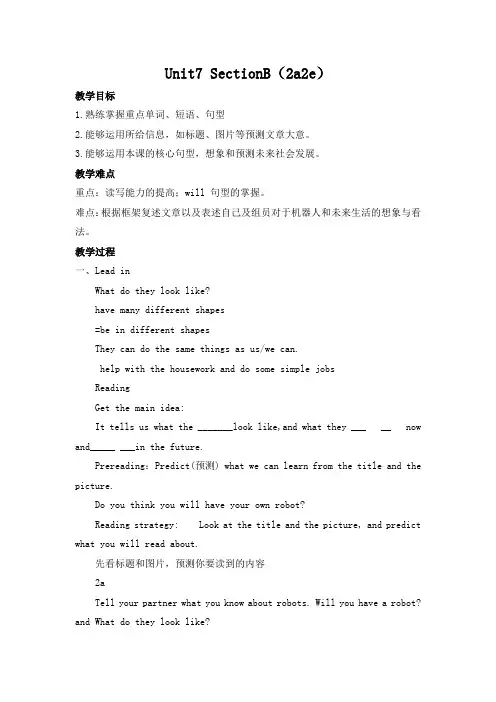
Unit7 SectionB(2a2e)教学目标1.熟练掌握重点单词、短语、句型2.能够运用所给信息,如标题、图片等预测文章大意。
3.能够运用本课的核心句型,想象和预测未来社会发展。
教学难点重点:读写能力的提高;will 句型的掌握。
难点:根据框架复述文章以及表述自己及组员对于机器人和未来生活的想象与看法。
教学过程一、Lead inWhat do they look like?have many different shapes=be in different shapesThey can do the same things as us/we can.help with the housework and do some simple jobsReadingGet the main idea:It tells us what the _______look like,and what they ___ __ now and_____ ___in the future.Prereading:Predict(预测) what we can learn from the title and the picture.Do you think you will have your own robot?Reading strategy: Look at the title and the picture, and predict what you will read about.先看标题和图片,预测你要读到的内容2aTell your partner what you know about robots. Will you have a robot? and What do they look like?Do it like this.I will/won't have a robot.It may look like...Predicting (预测)What can we learn from the title and the picture?A. It’s about a science fiction(科幻)movie.B. It’s about the robot scientist James White.C. It’s about the robots in the future.Task1 Look through the notice to find the general idea.Match each paragraph with the question it discusses.Scanning: Robots todayRead Para. 1carefully and fill in the blanks.Some robots look like___________They can___________________ and_________They arelike______________Scanning: Robots todayRead Para. 2 carefully and answer the questions.1. Where are the robots already working?In factories.2. Will the robots get bored?No, they won’t.Para 3 :Robots in the futureSome scientists think that in the future they will make robots more look like ________ .For example, some robots in Japan can _______and________. They think robots will even be able to ________like humans in 25 to 50 years.Other scientists think it will be _______ to make robots really _____ like a human. For example, James White thinks robots will never be able to _____ _____and ______ where they are.Para 4 : Robots in the futureRead and Mark True or False.1.Some scientists believe that there will be robots in the future.2.These new robots will have many different shapes.3. If buildings fall down with people inside, these snake robots can help look for people under the buildings.puters and rockets also seemed impossible years ago. 课堂练习同学们做exercisesthank you。
八年级上Unit7SectionB(2a-2e)说课

八年级上Unit7 SectionB(2a-2e)说课一:教材分析:本节课是初二英语下册 Unit 7Will people have robots? Section B部分的内容,本单元所谈论的话题是谈论未来的世界。
Section B是在Section A基础上的拓展。
2a-2e是一个整体的阅读板块。
该单元阅读语篇谈论的是未来机器人的发展的话题,其中涉及到机器人过去和现在的状况,并主要介绍了两派科学家催未来机器人的发展的不同的预测。
通过2a的读前活动到2b-2d读中活动再到2e的读后讨论拓展活动,比如匹配段落大意、将句子放回原文、根据原文内容回答问题、进行拓展性语言训练和运用等任务链活动,旨在帮助学生在掌握语篇信息的同时,发展相应的阅读技能,提升阅读策略。
二:教学目标分析:1.教学目标:根据新课标的教学理念,从素质教育的要求出发,结合本课的教学内容和学生的语言水平,本节课的核心任务是。
学生要达到以下目标:①语言知识目标:●掌握并正确使用下列词汇: humans,factory,shape,side,holiday,word,pollute,plant,believe,disagree,fall,dangerous,possible,impossible●能正确使用下列常用表达:play a part ,space station, over and over again , hundreds of, fall down,look for…●能正确使用will表述一般将来时,谈论将要发生的事。
②技能目标:●能运用快速阅读和精读技巧,学会迅速并准确找到所需有效信息;●学习归纳文章的主旨大意能运用快速阅读和精读技巧,学会迅速并准确找到所需有效信息;●学习归纳文章的主旨大意③.情感态度目标:使学生关注国际高科技的发展,产生对科学的兴趣和学习科学的愿望;同时能够看到事物的两面性,全面看科技发展给我们带来的利弊模块四:2.教学重点:根据标题推测文章内容的阅读方法,了解机器人的外形和功能,掌握重点单词和词组。
人教版八年级上 第七单元 Section B(2a—2b)说课讲稿
Unit7 Will people have robots?SectionB (2a---2e) 说课稿Good morning, everyone,Today, I’m very pleased to have such an opportunity to share some of my teaching ideas with you.My topic today is taken from Unit 7 Section B(2a—2b). I have decided to say the lesson from four parts:Part One ——Analyzing teaching material1. Status and functionThis unit is focused on the topic of making predictions. Learn to use the simple future tense to talk about the future. This lesson is reading course. The reading material is main about robots in the future. Through learning in this class, students can understand and use the simple future tense better. At the same time by studying this passage, we can further improve the students' abilities of listening, speaking, reading and writing.2. Teaching aims and demands.1)Knowledge objectsa. Enable the Ss to remember the new words:human, servant, dangerous, factory, believe, disagree, even, shape, fall down, possible.b. Get the Ss to be familiar with the sentence pattern and phrases: sentences:They help with the housework.Some can help to build cars.Scientists are now trying to make robots look like humans.It will be difficult to make them think like a human.Phrases: in the future, get bored, be able to, wake up, disagree with, fall down, hundreds of, look for.2).Ability objectsa. To develop the Ss’ abilities of listening, speaking, reading and writing.b. To train the students how to use their own words to express their ideas.c. Cultivate their ability to discover, analyze and solve problems.3).Moral objectsa. Encourage the students to be more creative and try to make contributions to making new inventions in the future.b. Love to know more knowledge about robots and dare to express their opinions in English.c. Arouse their interest in learning English.3. Teaching important points.a. To master the usage of the key words and phrases.b. To develop good reading habits and use the knowledge to write articles.c. Improve students’ reading skills.4. Teaching difficult pointsa. Read and find the corresponding information according to the requirements.b. Enable students to use the new words and phrases to express their own ideas.5. Teaching aidsMulti-media computer, pointpower, tape recorder and so on.Part Two ——Teaching methodsAs we all know: the main instructional aims of learning English in the Middle School is to cultivate students’ abilities of listening, speaking, reading, writing and their good sense of the English language. So in this lesson I’ll mainly use “Task-based” teaching method. That is to say, I’ll let the students get a better understanding of the key structures. I’ll give the students some tasks and arrange some kinds of activities, like retelling.Part Three ——Learning methods.1. Teach Ss how to be successful language learners.2. Teach Ss how to develop the reading skill.3. Get the Ss to form good learning habits.Part Four —— Teaching stepsStep1. Warm-up and Lead-in1. Read and match wordsShow the key words and phrases, students match these words.Purpose of my designing:In this way, the students can remember the words better and it is helpful to the following study.2. Discussion. Show some pictures of robots, ask students what they look like and what they can do?I will say: in this lesson, we will learn an article about robots. Would you like to read it? Then write the title on the Bb.Purpose of my designing: In this way, it can lead into the new lesson and cause students are interested in the leaning of this article.Step2. Reading (2b)1. SkimmingTask ITell Ss to read the article in 2b quickly and get the main idea.Task II. Find out the topic sentence of each paragraph. Students match each paragraph with the questions it discusses in 2b.Purpose of my designing: This step is to make the students get the main idea of the article and each paragraph. It can help the students understand the article. 2. Careful reading(1).Students read the article and complete the form, deepen the understanding of the article.(2).2c. Complete the sentences about what robots can do now.3. Read carefully and thoroughly (Key structures and difficult points learning).Student read again and find out the important sentences, phrases and difficult to understand sentences or words. Students and teachers work together to answer. Students try to remember these sentences, and phrases. Write some important sentences, phrases on the Bb.E.g. in the future, get bored, be able to, wake up, disagree with, fall down, hundreds of, look for, over and over again, try to do sth. :努力或尽力做某事, make sb. do sth. :使或让某人做某事, help (to) do sth.:帮助做某事Purpose of my designing:In this way, the students can grasp the important phrases and sentence patterns. It is helpful for students to write their articles later.Step3. Consolidation(1). Listen to the recorder, read and fill in the blanks according to the passage one by one. I should ask more students to fill and read the passage.(2).2d. Fill in the paragraph with words from the article.Purpose of my designing: By practicing using these new words and phrases, the students will master the use of them better.Step4. Application of taskAccording to the completed form in the careful reading, say something about the robots in the movies, today, and in the future.Purpose of my designing: By retelling, get the students to practice their speaking ability again.Step5. Written communication(2e)Encourage the students to write about their own robots according to the following questions.What kinds of animal robots might look like in the future?What do you think these robots will be able to do?E.g. I want to have a robot in the future. It will look like a____. It will be able to___, and it will also be able to help me________________..........Step6. Homework1. Read the passage after class.2. Finish the writing work after class.Blackboard DesignUnit7 Will people have robots?Section B (2a---2e)key sentence structures:the simple future tense:will +v.1. help with :帮助某事2. help (to) do sth. :帮助做某事3. try to do sth. :努力或尽力做某事4. make sb. do sth. :使或让某人做某事5. It will be/is/was +ad +to do sth. : 做某事….Phrases: in the future, get bored, be able to, wake up, disagree with, fall down.。
英语人教版八年级上册Unit7 Section B 2a- 2e 课程教学设计

T: Read the passage again. This time you should read the passage and fill in the blanks in thisparagraphwith words in the article.
Pre-reading: Meet robots.走进机器人
1.Play games;Ask Ss to listen and guess: T: What kind of robot is it?
Get some Ss think and answer the questions.
2.Present some new words on the big screen.e.g.
Ⅴ. Group work(5`)
Post-reading: Imagine robots.畅想机器人
Ask some Ss what their life will be in the future. And talk about the robots in the future.
T: What will robots look like in 100 years?
Work in groups. Tell your partnerwhatyou know about robots.What dothey look like and whatcanthey do? Ask some Ssdescribethe robots they know.
Ⅱ. Lead in (5`)
S:I think robots will look likecapsin100years.They willhelp me fly in the sky.
人教版八年级英语上册Unit7 2a2e说课稿

Unit 7 Do you think you will have your own robot?Section B 2a—2e尊重的列位老师:中午好!很快乐有机遇与大伙儿分享我的说课。
今天我说课的内容是人教版英语八年级上册7单元Section B 2a—2e的阅读部份。
下面我将从教材,学情,教法,学法,教学进程这五个方面进行说课。
一、说教材一、本课分析本课的题目是:Do you think you will have your own robot?是一篇以机械人为话题的阅读文章。
通过设置读前预热、读中明白得、读后检测,让学生了解机械人的由来、进展进程、对人类生活产生的重大阻碍,引导学生关注生活,展望以后,崇尚科学,从而对学生进行适当的情感态度教育。
2.依照新课程标准及本课内容,我确信以下教学目标:知识目标:(1)熟练把握四会单词和短语:human, servant, fall down等等.(2)学习谈论以后,并预测在以后机械人将像什么样和机械人将能够做什么等。
能力目标:(1)提高学生阅读能力,即通过略读确信段落大意,通过精读获取细节信息。
(2)学会描述以后的机械人。
情感目标:引导学生崇尚科学,相信以后,探讨和制造美好世界。
3、依照以上分析,我确信本课的重点是:把握本课时显现的生词及表达方式;阅读短文,取得相关信息,提高学生的综合阅读能力。
难点:阅读文章并完成不同的任务;能把握必然的阅读方式。
二.说学情通过前面听说和语法教学,学生对本单元的目标已经有了较好的把握,能够较好的运用目口号言表达自己的思想,这为接下来的阅读课打下来良好的基础。
另外,文本的话题是机械人,时期感很强,大部份学生会感爱好。
可是,咱们的学生阅读量不是专门大,视野也不够宽敞,同时学生在阅读策略和效率上还有待提高,需要老师设置一系列的教学环节进行有效地指导。
三.说教法新课程提倡让学生充分感知,踊跃参与,合作探讨,因此我将要紧利用以下三大教学法:一、任务型教学法:整个教学进程都是通过学习和阅读的任务进行的。
八年级上英语第七单元说课稿

Unit7 Will people have robots?SectionB (2a---2e) 说课稿Good morning, everyone,Today, I’m very pleased to have such an opportunity to share some of my teaching ideas with you.My topic today is taken from Unit 7 Section B(2a—2b). I have decided to say the lesson from four parts:Part One ——Analyzing teaching material1. Status and functionThis unit is focused on the topic of making predictions. Learn to use the simple future tense to talk about the future. This lesson is reading course. The reading material is main about robots in the future. Through learning in this class, students can understand and use the simple future tense better. At the same time by studying this passage, we can further improve the students' abilities of listening, speaking, reading and writing.2. Teaching aims and demands.1)Knowledge objectsa. Enable the Ss to remember the new words:human, servant, dangerous, factory, believe, disagree, even, shape, fall down, possible.b. Get the Ss to be familiar with the sentence pattern and phrases: sentences:They help with the housework.Some can help to build cars.Scientists are now trying to make robots look like humans.It will be difficult to make them think like a human.Phrases: in the future, get bored, be able to, wake up, disagree with, fall down, hundreds of, look for.2).Ability objectsa. To develop the Ss’ abilities of listening, speaking, reading and writing.b. To train the students how to use their own words to express their ideas.c. Cultivate their ability to discover, analyze and solve problems.3).Moral objectsa. Encourage the students to be more creative and try to make contributions to making new inventions in the future.b. Love to know more knowledge about robots and dare to express their opinions in English.c. Arouse their interest in learning English.3. Teaching important points.a. To master the usage of the key words and phrases.b. To develop good reading habits and use the knowledge to write articles.c. Improve students’ reading skills.4. Teaching difficult pointsa. Read and find the corresponding information according to the requirements.b. Enable students to use the new words and phrases to express their own ideas.5. Teaching aidsMulti-media computer, pointpower, tape recorder and so on.Part Two ——Teaching methodsAs we all know: the main instructional aims of learning English in the Middle School is to cultivate students’ abilities of listening, speaking, reading, writing and their good sense of the English language. So in this lesson I’ll mainly use “Task-based” teaching method. That is to say, I’ll let the students get a better understanding of the key structures. I’ll give the students some tasks and arrange some kinds of activities, like retelling.Part Three ——Learning methods.1. Teach Ss how to be successful language learners.2. Teach Ss how to develop the reading skill.3. Get the Ss to form good learning habits.Part Four —— Teaching stepsStep1. Warm-up and Lead-in1. Read and match wordsShow the key words and phrases, students match these words.Purpose of my designing:In this way, the students can remember the words better and it is helpful to the following study.2. Discussion. Show some pictures of robots, ask students what they look like and what they can do?I will say: in this lesson, we will learn an article about robots. Would you like to read it? Then write the title on the Bb.Purpose of my designing: In this way, it can lead into the new lesson and cause students are interested in the leaning of this article.Step2. Reading (2b)1. SkimmingTask ITell Ss to read the article in 2b quickly and get the main idea.Task II. Find out the topic sentence of each paragraph. Students match each paragraph with the questions it discusses in 2b.Purpose of my designing: This step is to make the students get the main idea of the article and each paragraph. It can help the students understand the article. 2. Careful reading(1).Students read the article and complete the form, deepen the understanding of the article.(2).2c. Complete the sentences about what robots can do now.3. Read carefully and thoroughly (Key structures and difficult points learning).Student read again and find out the important sentences, phrases and difficult to understand sentences or words. Students and teachers work together to answer. Students try to remember these sentences, and phrases. Write some important sentences, phrases on the Bb.E.g. in the future, get bored, be able to, wake up, disagree with, fall down, hundreds of, look for, over and over again, try to do sth. :努力或尽力做某事, make sb. do sth. :使或让某人做某事, help (to) do sth.:帮助做某事Purpose of my designing:In this way, the students can grasp the important phrases and sentence patterns. It is helpful for students to write their articles later.Step3. Consolidation(1). Listen to the recorder, read and fill in the blanks according to the passage one by one. I should ask more students to fill and read the passage.(2).2d. Fill in the paragraph with words from the article.Purpose of my designing: By practicing using these new words and phrases, the students will master the use of them better.Step4. Application of taskAccording to the completed form in the careful reading, say something about the robots in the movies, today, and in the future.Purpose of my designing: By retelling, get the students to practice their speaking ability again.Step5. Written communication(2e)Encourage the students to write about their own robots according to the following questions.What kinds of animal robots might look like in the future?What do you think these robots will be able to do?E.g. I want to have a robot in the future. It will look like a____. It will be able to___, and it will also be able to help me________________..........Step6. Homework1. Read the passage after class.2. Finish the writing work after class.Blackboard DesignUnit7 Will people have robots?Section B (2a---2e)key sentence structures:the simple future tense:will +v.1. help with :帮助某事2. help (to) do sth. :帮助做某事3. try to do sth. :努力或尽力做某事4. make sb. do sth. :使或让某人做某事5. It will be/is/was +ad +to do sth. : 做某事….Phrases: in the future, get bored, be able to, wake up, disagree with, fall down.。
英语人教版八年级上册unit7sectionB2b-2e说课稿
英语人教版八年级上册unit7sectionB2b-2e说课稿Unit 7 Do you think you will have your own robot?Section B 2a-2e湖北省宜昌市第九中学阮娇杨Good morning, everyone,Today, I’m very pleased to have such an opportunity to share some of my teaching ideas with you. My topic today is taken from Go for it Grade 8 unit 7. I have decided to talk about it from six parts:Part 1:The analysis of learning conditionThe students are from Grade 8 in junior high school. As high school students, they have achieved certain English level and they have the ability to get the basic idea of the reading. Since they are in Grade 8, they are easily activated and want to air their own opinions on the topic. Although they are not familiar with the topic of robots, I think they may be interested in this topic. But there some still some difficult sentences for them to understand.Part 2:The analysis of teaching materialThe teaching material is the reading part from Go for it Grade 8 unit 7. The topic of this passage is about the life in the future. This passage mainly introduces the development of robots. The topic is new to students and it may be difficult for them to say something about robots.1. Aims and demandsKnowledge objects:1)Talk about what robots look like and what robots can do.2)Read and use the new phrases, such as be able to, hundreds of, over and over again,disagree with, fall down, look for.3)Use the future tense to make predictions.Ability objects:1)Skim for the main idea and scan for the details.2)Understand the main idea of the passage and learn some important phrases and sentencepatterns.Emotional objects:1) Improve the students’ interest of learning English.2) Encourage students to predict their future robots.2. Key points.1)Enable the students to use the new words and phrases to talk about robots.2)Get an overall understanding of the passage.3. Difficult points1)Develop their reading skills such as skimming, scanning and summarizing.2)Try to write about their future robots.Part 3:Teaching aids.1.Multimedia devices2.PPT documentsPart 4:Teaching methods1. Task-based Approach2. Cooperative ApproachPart 5:Teaching procedures:Part 1 Pre-ReadingStep 1 Warming upAt the beginning of the class, I will show them the learning objects to help them know about what they will learn in this lesson.Then, I will show them a picture of a robot in movies and some robots around us to tell them robots are everywhere today.Play a game “That’s true” to check if they have know well about robots.Play a video and have a memory game after watching it to let students talk about what robots do in the video.Step 2 Lead-inLook at the picture in 2b to let students guess what these robots can do to lead in this lesson.Part 2 While-ReadingStep 3 Fast-readingTask 1 find out the main idea of each paragraph.there are four paragraphs in this passage. Ask students to go through the passage quickly and find out what each paragraph talks about?” to lead in this task. According to this task, students can get an overall understanding of the passage.It is a little difficult. So the teacher will give them 1 minute to discuss in groups and them check the answers. After checking answers, teacher will ask some students to tell how they get the main idea of each paragraph to summarize the reading strategies.Step 4 Detail-readingTask 2 Let students read the whole article carefully along with the tape to know more about robots and then fill in the blanks about what robots look like in the past, today and in the future.First, let students do it by themselves and then ask them to check the answers in groups. Finally, the teacher will ask some groups to read their answers.Task 3Let students have a jigsaw reading between boys and girls. Let boys read the underlined sentences and girls read the rest. After reading carefully ask them to find out what robots cando in the past, today and in the future.First, let students do it by themselves and then ask them to check the answers in groups. Finally, the teacher will ask some groups to read their answers.The teacher will say “there are some important phrases in the passage” to lead in the next part.Step 5 Language points learningTask 4 Match phrases with their English meanings.First, the teacher will show some English phrases and their English meanings on the screen. Ask students to match the phrases with their meanings.After checking the answers, the teacher will show them Chinese meanings and ask students to say the English phrases. Then ask students to read them again.Finally, play a game “which apple is falling down”,which shows apples with Chinese meanings of those phrases to check if students can tell the English phrase .Task 5 Understand and make sentences with these sentences patterns.First,the students will work in groups of six to understand the three sentences。
人教版八年级英语上册Unit7SectionB2a2e教学设计
4.口语表达能力有待提高,部分学生害怕犯错,不愿意主动开口说英语,导致口语交流能力较弱;
5.阅读理解能力有待加强,学生在阅读过程中对文章细节和主旨大意的把握不够准确。
针对以上学情,教师在教学过程中应关注学生的个体差异,采用分层教学和个性化指导,激发学生的学习兴趣,提高他们的英语水平。同时,注重培养学生的听力、口语、阅读和写作能力,使他们在全面提高英语素养的同时,更好地适应未来的学习和发展。
二、学情分析
八年级的学生在英语学习方面已经有了一定的基础,他们掌握了基本的词汇和语法知识,具备了一定的听说读写能力。在此基础上,他们对英语学习仍存在以下特点:
1.学生对英语学习兴趣浓厚,但学习积极性有待提高。部分学生课堂参与度不高,需要教师关注和引导;
2.学生的英语水平参差不齐,部分学生词汇量较小,语法掌握不扎实,影响了他们对文章的理解和表达;
3.针对阅读理解,设计相关练习题,引导学生运用阅读策略,提高阅读能力。
4.布置写作任务,让学生用过去时态描述一个过去的经历或事件,巩固所学知识。
(五)总结归纳
1.教师带领学生回顾本节课所学内容,总结一般过去时、过去进行时和过去完成时的用法。
2.让学生分享在本节课中的收获和感悟,鼓励他们用所学知识描述过去经历。
三、教学重难点和教学设想
(一)教学重难点
1.重点:本章节的重点在于让学生掌握与过去事件相关的动词时态,包括一般过去时、过去进行时和过去完成时,并能运用这些时态描述过去的经历和事件。
2.难点:难点在于学生对过去时态的准确运用,特别是在听力理解和口语表达中的运用。此外,如何引导学生通过阅读策略提高阅读理解能力,也是本章节的教学难点。
八年级英语上册 Unit 7 Will people have robots?(第2课时)说课稿
八年级英语上册 Unit 7 Will people have robots?(第2课时)说课稿一. 教材分析《八年级英语上册》Unit 7 “Will people have robots?” 是人教版新目标英语教材的一个单元。
本单元主要围绕未来科技的发展,特别是机器人在日常生活中的应用进行讲解。
通过本单元的学习,学生可以掌握一般将来时的被动语态,提高自己的听说读写能力,并激发他们对未来科技的想象和思考。
二. 学情分析八年级的学生已经掌握了英语学习的基本语法和词汇,具备一定的听说读写能力。
他们对新科技充满好奇,善于接受新鲜事物,但同时也可能对一些抽象的概念和语言表达感到困惑。
因此,在教学过程中,我们需要关注学生的个体差异,因材施教,激发他们的学习兴趣和积极性。
三. 说教学目标根据《义务教育英语课程标准》和教材内容,本节课的教学目标如下:1.知识目标:学生能够掌握一般将来时的被动语态,理解与未来科技相关的词汇和表达。
2.能力目标:学生能够在真实情境中运用所学知识进行交流,提高听说读写能力。
3.情感目标:激发学生对未来的想象和思考,培养他们对科技发展的积极态度。
四. 说教学重难点1.教学重点:学生能够熟练运用一般将来时的被动语态进行表达。
2.教学难点:学生能够准确理解与未来科技相关的词汇和表达,以及在真实情境中运用所学知识进行交流。
五. 说教学方法与手段本节课采用任务型教学法,结合情境教学法和分组合作学习法,利用多媒体教学手段,激发学生的学习兴趣,提高他们的参与度和积极性。
六. 说教学过程1.导入:通过展示一段关于未来科技的短片,引发学生对未来的想象,激发他们的学习兴趣。
2.呈现:教师通过PPT展示本节课的主要内容,引导学生关注一般将来时的被动语态和与未来科技相关的词汇。
3.操练:学生分组进行角色扮演,运用所学知识进行对话,教师给予指导和反馈。
4.巩固:学生完成一组有关未来科技的练习题,检测他们对知识的掌握程度。
人教版八年级英语上册Unit7SectionB(2a2e)教学设计
设想:采用分层教学,针对不同水平的学生设计难易适度的听力任务。同时,教授学生关注关键词、预测听力内容和抓住主旨等技巧,提高学生的听力水平。
3.重难点三:情感态度的培养。学生在面对挫折和困难时,容易产生消极情绪,影响学习效果。
2.小组合作:将学生分成小组,进行讨论、分享和展示。培养学生的团队合作意识,提高学生的口语表达能力。
3.互动交流:设计角色扮演、辩论等课堂活动,让学生在实际操作中运用所学知识,提高语言运用能力。
4.激励评价:采用积极评价,关注学生的点滴进步,激发学生的学习积极性。同时,鼓励学生自评、互评,培养其自我反思和批判性思维。
1.教师引导学生复习一般过去时态,通过举例讲解现在完成时态的用法。
师:First, let's review the simple past tense. Now, let's move on to the present perfect tense. It's used to talk about actions that have been completed recently or have an effect on the present.
1.教师将学生分成小组,让他们用现在完成时态讨论以下话题:
话题1:Talk about your dreams and goals.
话题2:Share your experiences of achieving or failing to achieve a goal.
2.学生在小组内进行讨论,教师巡回指导,关注学生的语言运用情况。
师:It's great to have dreams. Today, we're going to learn how to talk about our dreams and goals using the past tense and the present perfect tense.