
冀教版五年级英语下册第一单元知识总结
驻操营小学五年级下册单元重点句型,请同学们妥善保存,认真学习,加油!
Unit 1单词:亲爱的同学们,下面的单词,你会默写了吗?O(∩_∩)O~
look看see看见point指sleep睡觉draw画画man男士woman女士baby婴儿some一些now现在snack小吃man(复数)—men woman(复数)—women
baby(复数)—babies loud大声的(反义词)—quiet安静的quick快的(反义词)—slow慢的
短语:
1.look out+名词:向…外看例如:詹妮正向窗外看。
Jenny is looking out the window of the train.
2.look at+名词:看…… 例如:请看黑板。
Please look at the blackoard.
3.表示大小、高矮的形容词和表示颜色的形容词修饰一个名词时,顺序是:大小、高矮+颜色+名词
例如:一棵高的绿树a tall green tree
4.point at指着have fun玩的开心draw a picture画一幅画play cards 玩纸牌
read a book读一本书sing a song唱一首歌
5. a+单数名词a banana一个香蕉
an+单数名词(元音a,e,i,o,u开头)an apple一个苹果
some+复数名词/不可数名词some eggs一些鸡蛋some water一些水
6.现在进行时:肯定形式:主语+be(am/is/are)+动词现在分词(动词ing形式)+其他。
例如:I am watching TV.我正在看电视。
否定形式:主语+be(am/is/are)+not+动词现在分词(动词ing形式)+其他。
例如:I am not watching TV.我没正在看电视。
疑问形式:be(am/is/are)+主语+动词现在分词(动词ing形式)+其他?
例如:Are you watching TV.你正在看电视吗?
句子:下面的句子你会讲了吗?O(∩_∩)O~
1.詹妮正向窗外看。
Jenny is looking out the window of the train.
2.她看到了什么?What does she see?
3.看!我看到了一棵高的绿树。
Look! I see a tall green tree.
4.詹妮正指着一个红色的小学校。
Jenny is pointing at the little red school.
5.请不要指。
Please don’t point.
6.你正在做什么?What are you doing?
7.我正在读一本书。
I am reading a book.
8.谁正在唱歌?Who is singing?
9.这是谁?Who is this ?
10.这是一位女士。
This is a woman.
11.在火车上这位女士正坐在珍妮的后面。
This woman is sitting behind Jenny on the train.
12.谁正在唱歌?Who is singing?
13.是詹妮正在唱歌吗?Is Jenny singing?
14.婴儿正在做什么?What is the baby doing now?
15.婴儿正在哭泣。
The baby is crying.
16.谁口渴了?Who is thirsty?
17.我口渴了。
I’m thirsty.
18.你想要喝些什么?What would you like to drink?
19.你想要一杯茶吗?Would you like a cup of tea?
20.肯定回答:Yes,please.否定回答:No , thanks.
21.谁饿了?Who is hungry ?
22.你想吃点什么?What would you like to eat?
23.我想要一个橘子。
I would like an orange , please.
24.你想要吃些什么?What would you like to eat?
25.我想要一些水果。
I would like some fruit, please.
26.谁正在笑? Who is laughing?
27.坐在我后面的那个男人正在笑。
The man behind me is laughing.
28.他正在和他的朋友玩纸牌。
He is playing cards with his friends.。
冀教版五年级英语下册第一单元复习资料
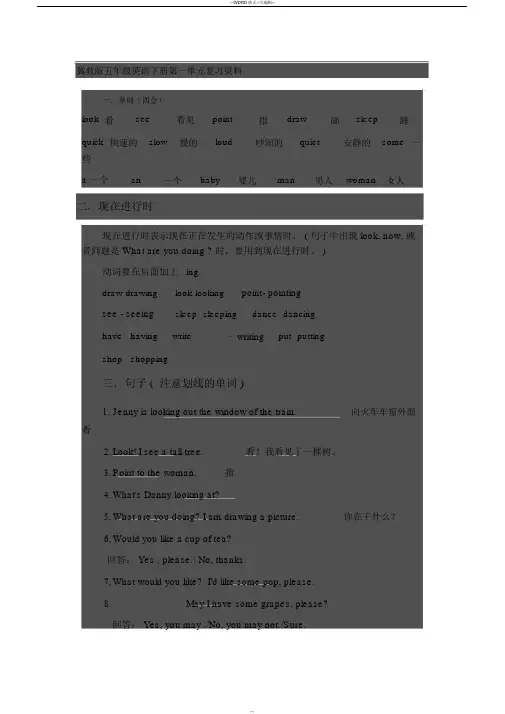
冀教版五年级英语下册第一单元复习资料一.单词(四会)look看see看见point指draw画sleep睡quick快速的slow慢的loud吵闹的quiet安静的some一些a 一个an一个baby婴儿man男人woman女人二.现在进行时现在进行时表示现在正在发生的动作或事情时, ( 句子中出现 look, now, 或者问题是 What are you doing ? 时,要用到现在进行时。
)动词要在后面加上ingdraw-drawing see - seeing look-lookingsleep- sleepingpoint- pointingdance- dancinghave - having write– writing put- puttingshop - shopping三.句子 ( 注意划线的单词 )1. Jenny is looking out the window of the train.向火车车窗外面看2.Look! I see a tall tree.看!我看见了一棵树。
3.Point to the woman.指4.What's Danny looking at?5.What are you doing? I am drawing a picture.你在干什么?6.Would you like a cup of tea?回答: Yes , please.\ No, thanks.7.What would you like?I'd like some pop, please.8.May I have some grapes, please?回答: Yes, you may ./No, you may not./Sure.四.Some and a 和 anSome and a 和 an ,使用时候要分清;一般单数要用 a,苹果橘子鸡蛋冰淇淋, an an是例外;两个以上或不可数, some some不要忘。
冀教版五年级英语下册知识点2024

冀教版五年级英语下册知识点2024Unit 1 Lesson 1本单元主要介绍的是浅显易懂的问候语,以下是一些基本的语句:•Good morning/afternoon/evening! (早上/下午/晚上好!)•How are you? (你好吗?)•Fine, thank you. (很好,谢谢。
)•What’s your name? (你叫什么名字?)•My name is _____ . (我的名字是 _____ 。
)•Nice to meet you. (很高兴见到你。
)•Where are you from? (你来自哪里?)•I’m from _____ . (我来自 ____ 。
)Unit 2 Lesson 2本单元学习的是数字和时间的表达方式,以下是一些常见的表达方式:•数字:–one, two, three, four, five, six, seven, eight, nine, ten (1到10)–eleven, twelve, thirteen, fourteen, fifteen, sixteen, seventeen, eighteen, nineteen, twenty (11到20)–thirty, forty, fifty, sixty, seventy, eighty, ninety, one hundred (30到100)•时间:–What time is it? (现在几点钟了?)–It’s _____ . (现在是 _____ 点钟。
)Unit 3 Lesson 3本单元学习的是简单的家庭成员和职业,以下是一些常见的词汇:•家庭成员:–mother, father, sister, brother, grandmother, grandfather (母亲,父亲,姐妹,兄弟,祖母,祖父)•职业:–teacher, doctor, police officer, musician, artist, farmer (老师,医生,警察,音乐家,艺术家,农民)Unit 4 Lesson 4本单元学习的是简单的交通工具和指示方向的用语,以下是一些常见的词汇:•交通工具:–car, boat, bus, bike, train, plane (汽车,船,公共汽车,自行车,火车,飞机)•指示方向:–Go straight. (直走。
冀教版五年级下册英语第一单元复习资料
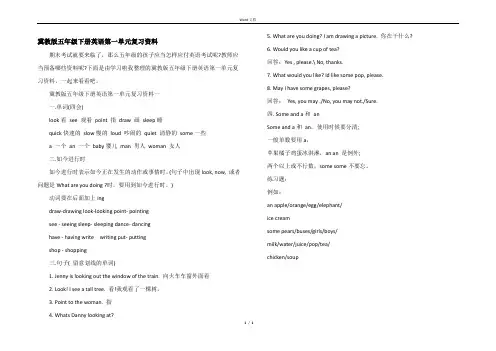
Word 文档1 / 1冀教版五年级下册英语第一单元复习资料期末考试就要来临了,那么五年级的孩子应当怎样应付英语考试呢?教师应当预备哪些资料呢?下面是由学习啦我整理的冀教版五年级下册英语第一单元复习资料,一起来看看吧。
冀教版五年级下册英语第一单元复习资料一 一.单词(四会)look 看 see 观看 point 指 draw 画 sleep 睡quick 快速的 slow 慢的 loud 吵闹的 quiet 清静的 some 一些 a 一个 an 一个 baby 婴儿 man 男人 woman 女人 二.如今进行时如今进行时表示如今正在发生的动作或事情时,(句子中出现look, now, 或者问题是What are you doing ?时,要用到如今进行时。
) 动词要在后面加上ingdraw -drawing look -looking point - pointing see - seeing sleep - sleeping dance - dancing have - having write writing put - putting shop - shopping三.句子( 留意划线的单词)1. Jenny is looking out the window of the train. 向火车车窗外面看2. Look! I see a tall tree. 看!我观看了一棵树。
3. Point to the woman. 指4. Whats Danny looking at?5. What are you doing? I am drawing a picture. 你在干什么?6. Would you like a cup of tea? 回答:Yes , please.\ No, thanks.7. What would you like? Id like some pop, please. 8. May I have some grapes, please?回答: Yes, you may ./No, you may not./Sure. 四. Some and a 和 anSome and a 和 an ,使用时候要分清; 一般单数要用a ,苹果橘子鸡蛋冰淇淋,an an 是例外; 两个以上或不行数,some some 不要忘。
五年级下册英语冀教版第单元总结(一)
五年级下册英语冀教版第单元总结(一)资深创作者撰写的五年级下册英语冀教版第单元总结前言在五年级下学期的英语教材中,第单元是一个重要的学习内容。
本文将从多个方面对这一单元进行总结。
正文本单元内容概述•本单元主要涉及生活常识相关的主题,如健康饮食、健康习惯等。
•单元内共包含单元导知识、学科生字、课文学习、初会和上传继续等多个板块。
单元导知识•在单元导知识板块,学生可以初步了解本单元所涉及的主题背景知识,如何保持健康和良好的生活习惯等。
•这部分内容提供了一些实用的提示和建议,帮助学生更好地理解并应用在日常生活中。
学科生字•本单元的学科生字涵盖了与健康生活相关的词汇,帮助学生扩展他们的词汇量。
•学生应通过课堂教学和课后学习,掌握并应用这些生字,以提高他们的英语沟通能力。
课文学习•课文学习部分包含了几篇相关的阅读材料,如《Good Habits》、《How to Keep Fit》等。
•学生需要通过阅读和理解这些课文,掌握其中的重点内容,并学习相关的语法知识和句型结构。
初会和上传继续•在初会板块,学生通过与同学的交流,进一步了解相关话题,并参与讨论和分享。
•在上传继续板块,学生可以通过课后作业和小组活动,加深对所学内容的理解和掌握,并培养团队合作的能力。
结尾通过五年级下册英语冀教版第单元的学习,学生不仅能够扩展和巩固他们的英语基础知识,还能够培养健康生活的意识和良好的学习习惯。
本篇总结涵盖了本单元的重要内容和学习方式,有助于学生更好地理解和掌握相关知识。
本单元的教学亮点•引入生活常识:本单元的教学内容贴近学生的日常生活,涉及健康饮食和保持良好生活习惯等方面的主题,更易于学生理解和应用。
•多样化的教学形式:通过课堂教学、小组讨论、课后作业等不同形式,激发学生的学习兴趣,促进学生的参与度和学习效果。
•强调实践操作:本单元的学习内容注重实践操作,学生不仅需要通过阅读理解课文,还需要应用所学知识进行实际操作,培养实际应用能力。
冀教版五年级下册英语知识点

冀教版五年级下册英语知识点2019年小学英语冀教版五年级下册知识汇总: Unit 1一、词汇run跑sorry对不起,不好意思(道歉时用)jump跳;跳跃sing唱;演唱dance跳舞sit坐down向下;朝下;沿着stand站立;直立up向上;在上面see看见;明白;会见(过去式为saw)look看;瞧look out of从......向外看look at看(某人或某物)boy男孩girl女孩now现在draw画picture图画;照片woman女人baby婴儿cry哭;哭泣;喊叫talk交谈;讨论man男人sleep睡觉;入睡who谁hungry饥饿的water水tea茶candy糖果二、句子1. Please don’t jump / sing / dance!请不要跳/唱歌/跳舞!2. Jenny is looking out of the window on the train. 珍妮在火车上正看着窗外。
3. — What are you doing now?你现在在做什么?— I’m drawing a picture. 我正在画画。
4. — Would you like some fruit?你想要一些水果吗?— Yes, please. I’d like an apple and an orange. 是的,麻烦了。
我想要一个苹果和一个橙子。
5. — Would you like some water?你想要喝点水吗?— No, thanks. I’d like some tea, please.不了,谢谢。
我想要喝茶,麻烦了。
6. I’m not hungry, and I’m not thirsty. 我不饿也不渴。
7. She’s reading the newspaper. 她正在看报纸。
三、句型结构①祈使句的否定形式Please don’t + 动词原形 + 其他.eg: Please don’t speak loudly. 请不要大声喧哗。
冀教版五年级英语下册全册教案第一单元知识点总结

IntroductionThis article is a summary of the knowledge points covered in thefirst unit of the fifth grade English textbook of the Jijiao edition. The unit focuses on introducing learners to words and phrases thatare commonly used in everyday conversation. Through a structured learning process, the unit aims to develop learners' listening, speaking, reading, and writing skills. The article will discuss the content of the unit and highlight the key knowledge points that learners need to understand.Unit 1: Good HabitsThe first unit of the Jijiao edition fifth-grade English textbook focuses on instilling good habits in learners. The unit aims to help learners understand the importance of cultivating good habits andthe role they play in leading a healthy and fulfilling life. Theunit covers the following topics:1.Greetings: The unit introduces learners to different ways ofgreeting people, such as "hello," "good morning," "goodafternoon," and "good evening." Learners also learn how torespond to a greeting by using phrases like "how are you?" and"I'm fine, thank you."2.Asking for and providing information: Learners learn how to askfor information by using phrases like "could you tell me?" and"do you know?" The unit also covers how to provide information, such as a person's name, age, and nationality.3.Discussing daily routines: Learners learn how to talk aboutdaily routines, including activities they do in the morning,afternoon, and evening. They also learn how to talk about their hobbies and interests.4.Giving instructions: The unit covers how to give instructionsusing imperatives, for example, "brush your teeth," "wash yourhands," and "put on your shoes."5.Describing people: The unit discusses how to describe people'sphysical appearance, such as their height, weight, and haircolor. Learners also learn how to describe people'spersonalities using adjectives such as kind, friendly, andhelpful.Key Knowledge Points1.Vocabulary: Learners need to learn and understand the vocabularycovered in the unit, including greetings, daily routines,hobbies and interests, and descriptive adjectives.2.Grammar: Learners need to understand the grammar rules thatunderpin the unit, such as using imperatives to giveinstructions and using adjectives to describe people's physical appearance and personalities.3.Pronunciation: Learners need to practice their pronunciation ofthe vocabulary covered in the unit to ensure they are able tocommunicate effectively.4.Intonation: Learners need to practice intonation, which is therise and fall of the voice when speaking, to help them conveythe correct meaning and emotions.5.Listening and speaking skills: Learners need to practicelistening and speaking skills by engaging in classroomactivities, group work, and role-playing exercises.ConclusionThe first unit of the Jijiao edition fifth-grade English textbook is an essential foundation for learners to develop language skills. By learning the vocabulary, grammar, pronunciation, and intonation covered in the unit, learners are better equipped to communicate effectively and confidently in English. The unit not only helps learners develop language skills but also instills good habits and positive attitudes towards learning. Through a structured learning process, the unit encourages learners to embrace language learning as an enjoyable and enriching experience.。
五年级下册英语冀教版第单元总结
五年级下册英语冀教版第单元总结
第一单元:Let's Learn
本单元是五年级下册英语的第一单元,主要围绕学习英语的方式与方法展开教学。
本单元共包含以下主要内容。
1. 学习英语字母表:学习英语字母表的发音和书写顺序,并通过学习拼读单词来巩固字母的学习。
2. 学习英语数字:学习英语数字的读法和写法,并通过数字的大小比较和运算来巩固数字的学习。
3. 学习日常用语:学习一些日常用语,如问候语、介绍自己和他人的基本信息等。
4. 学习英语歌曲:通过学习英语歌曲来提高对英语的听力和口语表达能力。
5. 培养英语学习兴趣:通过多种方式培养学生对英语学习的兴趣,如游戏、竞赛等。
学生可以通过以下几种方式来巩固本单元的学习内容。
1. 大声朗读英语字母表:学生可以尝试使用正确的发音和书写顺序,大声朗读英语字母表。
2. 接龙拼读单词:老师可以给出一个单词,并让学生根据给出
的字母表顺序,接龙拼读出更多的单词。
3. 数数游戏:学生可以用英语进行数数游戏,如数数水果、数数教室里的物品等。
4. 创作问候语:学生可以尝试创作自己的问候语,并与同学分享。
5. 听英语歌曲:学生可以选择一些简单的英语歌曲来听,帮助提高听力和口语表达能力。
总之,本单元主要是通过学习字母、数字和日常用语,培养学生对英语学习的兴趣,并通过听、说、读、写的多种方式来提高学生的英语综合能力。
教师可以通过多样化的教学方法和活动来巩固学生的学习成果。
五年级下册英语冀教版1~2单元知识点总结(一)
五年级下册英语冀教版1~2单元知识点总结(一)前言五年级下册英语冀教版1~2单元知识点总结文稿是为了帮助教师和学生更好地掌握和理解这些知识点。
在本文中,我将从单元内容、语法和词汇等方面进行概括和总结,以帮助读者更好地准备和教授这些知识点。
正文第一单元:Places and Weather单元概述•介绍常见地点和天气的表达方式重点内容•学习问路和指路的表达方式•学习描述天气的词汇和句子语法重点•There is/are句型的正确使用•形容词的比较级和最高级形式•疑问词的使用:What/Where/How第二单元:Food and Drinks单元概述•介绍常见食物和饮料的名称和表达方式重点内容•学习询问和回答食物和饮料的偏好•学习描述食物的味道和外观语法重点•Would like句型的正确使用•不可数名词和可数名词的区别•形容词的使用:tasty, delicious结尾通过对五年级下册英语冀教版1~2单元知识点的总结,我们可以看出这些内容对于学生来说都是非常重要的。
掌握这些知识点将有助于学生提高他们的英语能力和运用能力。
同时,教师在教授这些知识点时,可以根据本文提供的重点内容和语法重点进行教学设计和教学活动。
希望这份总结对教师和学生有所帮助,并促进他们在学习英语的过程中取得更好的成绩。
第一单元:Places and Weather单元概述•学习与常见地点有关的词汇和表达方式•学习与天气有关的词汇和表达方式重点内容•学习问路和指路的表达方式,如:Excuse me, where is the library?•学习描述天气的词汇,如:sunny, cloudy, rainy•学习用句子描述天气,如:It’s sunny today.语法重点•There is/are 句型的正确使用,如:There is a park in front of my house.•形容词的比较级和最高级形式,如:hot, hotter, hottest •疑问词的使用:What/Where/How,如:What’s the weather like today? Where is the supermarket?第二单元:Food and Drinks单元概述•学习与常见食物和饮料有关的词汇和表达方式•学习询问和回答食物和饮料的偏好重点内容•学习询问和回答关于食物和饮料的问题,如:What would you like for breakfast? I would like a cup of tea.•学习描述食物的味道和外观:tasty, delicious•学习常见食物和饮料的名称,如:pizza, juice, apple语法重点•Would like 句型的正确使用,如:I would like a hamburger, please.•不可数名词和可数名词的区别,如:milk (不可数)vs. apples (可数)•形容词的使用:tasty, delicious,如:The food at this restaurant is delicious.希望本文的知识点总结对于教师和学生在学习和教授五年级下册英语冀教版1~2单元内容时有所帮助。
冀教版五年级英语下册单元知识必备清单
冀教版五年级英语下册单元知识必备清单Unit 1 Going to Beijing单元知识必备清单Lessons 1~3重点词汇run 跑jump 跳;跳跃sing 唱;演唱dance 跳舞sit 坐down 向下;朝下;沿着stand 站立;直立up 向上;在上面boy 男孩look 看;瞧girl 女孩now 现在draw 画picture 图画;照片woman 女人baby 婴儿cry 哭;哭泣;喊叫talk 交谈;讨论man 男人sleep 睡觉;入睡see 看见;明白;会见(过去式为saw) sorry 对不起,不好意思(道歉时用)重点短语arrive at 到达sit down 坐下stand up 站立;起立look out of 从……向外看look at 看(某人或某物) draw a picture 画画read a book 看书sing a song 唱歌talk to sb. 和某人聊天重点句型1 (1) Please don’t sit down. 请不要坐下。
(2) Please stand up.请站起来。
解读: 祈使句是用于表达命令、请求、劝告或建议等的句子。
常见的祈使句结构:2 —Jenny, what are you doing now?詹妮,你现在在干什么?—I am drawing a picture. 我在画画。
解读: 问句是询问对方正在做什么事,答句也要用现在进行时。
现在进行时表示现在正在进行的动作或存在的状态。
句型结构:—What + be 动词+ 主语+ doing + 其他?—主语+ be 动词+ 动词的-ing 形式+ 其他.Unit 1 Going to Beijing单元知识必备清单Lessons 4~6重点词汇who 谁hungry 饥饿的water 水tea 茶candy 糖果重点短语would like 想要some water 一些水very much 很,非常read the newspaper 看报纸play cards 玩牌,打扑克have fun 玩得高兴play with... 和……一起玩get the tickets 取票look for 寻找重点句型1 —Would you like some fruit?你想要一些水果吗?—Yes, please./No, thanks.是的,谢谢。
最新冀教版英语五年级下册知识点总结
最新冀教版英语五年级下册知识点总结第一单元短语:go to Beijing 去北京at the train station 在火车站 want to 想要sit down 坐下 stand up 起立 go straight 直走 ride bike 骑车 look out of 向外看 on the train在火车 look at 看见 draw a picture 画画 read. a book读书sing a song 唱歌 have breakfast吃早点 fly a kite 放风筝 here you are 给你read the newspaper 读报 have fun 玩得高兴 play with 跟…玩play cads 打牌 go on a trip to Beijing去北京旅行 get the tickets 买票how much 多少钱 have a good trip一次美妙的旅行 listen to music 听音乐句子:1.Please don‘t jump!不要跳2.A:What are you doing ?你在干什么?B:I’m reading a book.我正在读书.3.A:Who is singing ?谁在唱歌? B:The girl is singing.这个女孩在唱歌.4.A:Who is hungry ?谁饿了?B:I’m hungry.我饿了.5.A:W ould you like some fruit? 你想要点水果吗?B:Y es,please/No,thanks.6.A:What would you like? 你想要点什么?B:I’d like some candy.我想要点糖果.7. A:What is the baby doing ?这个婴儿在干什么?B:The baby is crying.这个婴儿在哭. 第二单元短语:arrive in到达 in the afternoon在下午 on the way 在路上 in the park 在公园play football 踢足球 do T ai Chi 打太极 take a picture 照相Don’t worry 别担心look in 向里看 be careful 小心 need to 需要 far from远离 on the way back回去的路上go for a walk去散步 too many 太多 be afraid 害怕 on the street 在街上 buy …for买…给how old 多少岁 how long多长 be going to 将要 more than 超出 go on 继续 on the Great W all 在长城句子:1.There are many people in the park.有许多人在公园.2.Some children are playing football.一些孩子在踢足球.3.A:How old is the Palace Museum?故宫博物馆有多久历史?B:It’s about six hundred years old.4.Jenny buys a kite for her sister.詹妮给她的妹妹买了一个风筝.5.A:May I take your picture?我可以给你拍照吗? Sure .6.What time is it?=What`s the time? It`s 2:30 现在几点了?现在2:30.第三单元短语:a picture of the Palace Museum 一张故宫的图片 send…to 寄……给 on the left/right在左/右边在电脑上 excuse me 打扰了 turn left 左转 at the traffic lights 在交通灯处at the post office在邮局 write…to…给某人写什么 good idea 好主意 go back home 回家see you soon 回头见at the end 最后all the best 万事如意 a very big city一个非常大的城市on February 8在二月八号 time to go home该回家了 go bac回加拿大句子:1.A postcard has a picture on it.明信片上有一张图片.2.He wants to send a letter to his father.他想给他的爸爸寄一封信.3.Where do you write on a postcard? On the left.你把内容写在哪里?在左边.Where do you put the address? On the right.你把地址写在哪里?在右边.4. What a great trip!多么棒的一次旅行 What a fun trip!多么有趣的一次旅行5.A:Where is the post office?邮局在哪里?B:Go straight.Turn left at the traffic lights.直走,在交通灯处向左转.6. A:How much is this ?这个多少钱?B:T wo yuan.2元7. An email is fast.电子邮件是快的 A postcard is slow.明信片是慢的8.A:How’s the weather in Canada?加拿大的天气怎么样B: It’s snowy(sunny).有雪(晴朗)第四单元短语:walk to school步行去学校 watch TV 看电视 watch a film 看电影last night 昨晚 go home 回家 the first day 第一天 the second day 第二天 the third day 第三天 the fourth day 第四天 go shopping 去购物on Sundays 在星期天 last year 去年 this week 这一周last week 下一周 try on 试穿(衣物) too small 太小put it on the wall 挂在墙上 write back 回信Y ou’不用谢send sb.sth.给某人某物 send sth .to sb. 把某物给某人 fall into 掉进句子:1.Did you have a nice trip? 你的旅行愉快吗?Y es, I had a great trip.2.A:What did you do?你做了什么? B: W e went to the cinema yesterday.3.What happened? 怎么了? B: He hurt his tail.他伤了他的尾巴.动词现在分词:shop - shopping sit-sitting fall-falls-falling swim-swimmingtalk-talking do-doing play-playing like-liking dance- dancing draw-drawing look-looking point- pointing see –sees- seeing sleep- sleeping have–has- having write–writing put-putting feel-feels-feeling wait-waiting动词的过去式:miss(过去时)+ed 想念 walk(过去时)+ed 步行 want(过去时)+ed 想要 look(过去时)+ed 看watch(过去时)+ed看call(过去时) +ed 叫happen(过去式)+ed 发生want(过去式)+ed想要help(过去式)+ed 帮助 like(过去时) +d 喜欢 shop(过去时)shopped购物 do(过去时)did做have(过去时)had 有hurt(过去式) hurt do(过去式)did buy(过去式)bought go(过去时) went去 see(过去时) saw看见 eat(过去时) ate吃 hurt(过去式) hurt受伤this (复数) these that (复数) those have(单三) has ask(反义词)answer happy(反义词)sadright(反义词) wrong fast(反义词) slow。