
人教版七年级英语下册 unit3 section b 2a-2c(共20张ppt)
How do you get to school ? PPaerrtioBd(2Oan-2ee()1a-1c)
Warming-up: Memory game
Groups1-3: Please find the words about
transportation(交通) and write down in your groups !
Words review
year afraid
like villager
leave dream
true come true
n. 年;岁 adj. 害怕;畏惧 prep. 像;怎么样 n. 村民 v.离开 n. 梦想;睡梦 v. 做梦 adj. 真的;符合事实的 实现;成为现实
2a
Look at the picture and title below.
2011年12月4日,由于强台风引发 水库水位上涨,海南省儋州市最 偏远黎苗寨的公路被淹,
当地村庄里的孩子们只能乘竹筏 渡过这条最深处可达2米多的河去 上学。由于只有一条缆绳,
孩子们只能等对岸的船过来之后 才能走。
villager
every school day
2010年10月28日,合肥一位老人带领着邻居 和孩子们通过工地附近陡峭崎岖的小路前往 学校。
Which group can write more!
bridge
cross the river
洪水过后,剩下了一条支离 破碎的危桥,留给孩子们一 段曲折艰辛的上学学路。除 了自然因素造成的困难,部 分地区中小学布局不合理、 政府未能及时出资应对等原 因也不容忽视。从中不难想 象,边远贫困地区学生目前 的求学困境。
上开凿出来的路前往汉源县古路村小学送冬衣。 只有政府和社会的真正重 bridge and leave the
这条路是村里与外界联系的唯一通道。20多年 来,古路村小学一直由一个代课教师守护着。 后来,又有几名志愿者加入学校。
视和全力投入,才能让这 些孩子脚下的路
village...
不再那么艰险。图为2011年
6月14日,云南省禄劝中村
小学,一个行走在求学路
上的孩子。
Warming-up: Memory game
Groups4-6: Please find the numbers and write down in
your groups (in English ) !
Which group can write more!
Read the words and expressions loudly.
Words review
cross river many village between between…and… bridge boat
ropeway
v. 横过;越过 n. 河;江 adj.&pron. 许多 n. 村庄;村镇 prep. 介于……之间 在……和……之间 n. 桥 n. 小船 n. 索道
cross the river
no boats
go on a ropeway
love school
their dream never leave the village
Homework:
How do your parents go to work?
Guess what the pasreful reading
Read paragraph 1 to answer the question.
2. Why do they go to school by ropeway? There is no bridge, and the river runs too quickly for boats.
He is a teacher,but he's like a father.
2013年3月11日,贵州毕节地区,半 坡小学校长护送学生走过悬崖峭壁上 的小路。
They are not afraid!
She has a dream...
2008年10月15日,四川雅安,志愿者穿过峭壁 造成上学难的原因有很多,She wants to have a
2009年3月3日,武汉市黄陂区蔡店乡 姚蔡河,断桥下游约100米处,老师 在河中为孩子们铺过河石。
姚蔡河上面一座连通两岸的小桥于 2008年7月2日被洪水冲垮,此后一直 无人修复。
go on a ropeway
boat
The river runs too quickly for boats.
2007年12月,云南省怒江州福贡县马吉乡中 心小学兄弟俩靠飞索过江上学。事情曝光后, 经社会捐助,当地建起了几座“爱心桥”。
ways of getting to school
many students
easy
a very big river
students in one small village
one 11-yearold boy
many of the students and villagers
difficult
no bridge
Line 8 L5-7 Yes, he does. L11-12
L13-14
再读文章,从中选择单词完成句子
difficult big
quickly afraid
true
cross the river to school, many students, be (not) afraid, easy/difficult to get to school, between … and …, come true The river runs too quickly for boats. go on a ropeway to cross the river to school, love to play with my classmates, many of the students…, like a father It is their dream to have a bridge.
人教版七年级英语下unit3SectionB

Section B
3a Read the description and match them with the animals.
Molly This is Molly. She is
twelve years old. She is from Africa. She likes to play with her friends and eat grass.
fruit. 改为eat或to climb → climbing 8. Penguins from the South Pole.
前面加are或come 9. —What do you like elephants? Why
—Because they are friendly. 10. We can see many animal in the zoo.
5. The music sounds r_e_l_a_x_in_g_ (relax).
Ⅲ. 根据短文及首字母提示, 补全单词。
This is Larry. He’s (1) f _r_o_m_ Africa. He’s six (2) y____ eoaldr.sHe is (3)l___ . Hazey usually (4)s_le_e_p_s20 hours every day. He likes (5)e_a_ti_n_g_ meat, and he likes to (6)p_la_y_ with his friends. He’s kind of popular in the (7)z_o_o_. Many people like this interesting (8)a_n_im__a_l_.
人教版七年级英语下册 Unit3 Section B(2a-2c)预习-训练案
兼词 13.n.梦想;睡梦 v.做梦_d_r_e_a_m___ 14. adj.& pron.许多_m__a_n_y___________
二、常用短语
1.在……和……之间__b_e_tw__e_e_n_…__a_n_d_…_______ 2.对许多学生来说_f_o_r_m__a_n_y__s_tu_d_e_n_t_s_____ 3.一个11岁的男孩__o_n_e_/_a_n_1_1_-_y_e_a_r_-o_l_d__b_o_y 4.每一个上学的日子__e_v_e_r_y_s_c_h_o_o_l_d_a_y______ 5.实现_c_o_m__e_t_r_u_e____________
There 10.___is_________ a very big river between their school and the village. There is no 11.__b_r_i_d_g_e_____. And the river runs so 12._q_u__ic_k_l_y_____ that boats can't go across it. So the students go on a ropeway to cross the river to school.
二、辨析:be far from离……远,具体路程+away from, from…to… 从……到…… 1.学校离我家很远。 My school is _____f_a_r_f_ro_m______________ my home. 2.学校离我家20千米。 My school is 20 kilometers ____a_w__a_y_f_r_o_m__________ my home.
2021年人教版七年级英语下册Unit3 Section B1精品课件 32张
Dialogue 3:
bike
A: How do you see your friends?
B: Well, I’d like to ride the bike.
That’s free!
What do you know about Nina?
1a Match the words with the pictures.
1. _b_ bus stop 3. _c_ bus station 2. _a_ train station 4. _d_ subway station
1b
Tell your partner how you get to school. Imagine you use two type of transportation.
Name
Nina
Age
14
Lifestyle Exercise, eat vegetables every day
Nationality American
Live in
New Street, New York
Transportati First, -on to school
Next,
Then, Finally,
subway station. Then I take the subway.
Pair work
Pretend(假如) it’s 2050. How do you get there? (Use 2 0r 3 Kinds of transportation).
1c Listen and check the things that Mary wants to know.
七年级-人教版-英语-下册-[学习任务单]Section-B-(2a-2c)
![七年级-人教版-英语-下册-[学习任务单]Section-B-(2a-2c)](https://360docs-1393072327.cos.ap-beijing.myqcloud.com/d8315158e97101f69e3143323968011ca300f785.webp)
Unit 12 What did you do last weekend? (Period 4)Section B (2a-2c)班级_________ 姓名_________学习目标学完这一课,你能够掌握:1.词汇:high、high school、ago、India、tent、put up、moon、each other、surprise、get a surprise、snake、scared、move、shout to ...、start、jump、up and down、wake、wake ... up、into、forest、ear;2.能力:根据标题和插图预测文章的主旨大意的能力;用一般过去时讲述过去发生的事情;3.交际功能:使用“Last weekend was interesting but scary.”“We went camping in a small village in India.”“When we looked out of our tent, we saw a big snake sleeping near the fire.”“This was a very useful lesson for me.”等句型谈论周末发生的事情。
课前学习任务【学习任务】词汇检测1.adj. & adv.高的(地)__________2.中学;高中__________3.adv.以前__________4.n.印度__________5.n.帐篷__________6.搭起;举起__________7.n.月亮__________8.互相;彼此__________9.n.惊奇;惊讶v.使吃惊__________10.吃惊__________11.n.蛇__________12.adj.惊慌的;吓坏了的__________13.v.移动__________14.对……大声喊叫__________15.v.开始;着手__________16.v.跳;跃__________17.上上下下;起伏__________18.v.弄醒;醒__________19.把……弄醒__________20.prep.到……里面;进入__________21.n.森林__________22.n.耳朵__________课堂学习任务【学习任务一】1.What kinds of animals are people sometimes afraid of? Why? Make a list.Animals people are sometimes afraid of Why【学习任务二】1.快速阅读2b的短文,选出每段的主旨大意。
人教版英语七年级下册课时培优练:Unit 3 Section B (2a-2d)
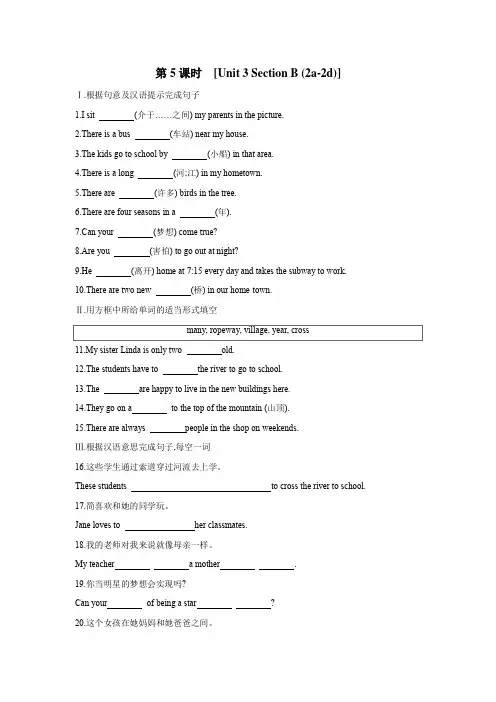
第5课时[Unit 3 Section B (2a-2d)]Ⅰ.根据句意及汉语提示完成句子1.I sit (介于……之间) my parents in the picture.2.There is a bus (车站) near my house.3.The kids go to school by (小船) in that area.4.There is a long (河;江) in my hometown.5.There are (许多) birds in the tree.6.There are four seasons in a (年).7.Can your (梦想) come true?8.Are you (害怕) to go out at night?9.He (离开) home at 7:15 every day and takes the subway to work.10.There are two new (桥) in our home-town.Ⅱ.用方框中所给单词的适当形式填空11.My sister Linda is only two old.12.The students have to the river to go to school.13.The are happy to live in the new buildings here.14.They go on a to the top of the mountain (山顶).15.There are always people in the shop on weekends.Ⅲ.根据汉语意思完成句子,每空一词16.这些学生通过索道穿过河流去上学。
These students to cross the river to school.17.简喜欢和她的同学玩。
Jane loves to her classmates.18.我的老师对我来说就像母亲一样。
七年级-人教版-英语-下册-Unit-1-Section-B-(2a-2c)
1.I can speak English and I can also play soccer. 我会说英语,也会踢足球。
辨析 also 与 too
置于情态动词、助动词、be 动词之后,实义动词之 also 前,是正式用语,用于肯定句中
置于句尾,常用于口语中,且用于肯定句中,其前常 too 加逗号与句子其他部分隔开
Read the second ad and fill in the form.
Requirements not busy after school, speak English
Work contents (工作内容) help with sports for English-speaking students
No, I can’t, but I can ...
also people home
be good with ... make make friends
adv. 也;而且 n. 人;人们 n. 家;活动本部 adv. 到家;在家 善于应付……的;对……有办法 v. 使成为;制造 结交朋友
today help (sb.) with sth. center weekend on the weekend teach
Work in groups of three. Ask and answer. Then make a report.
What can you do? Which ad are you interested in? ...
I like playing chess very much and I’m good at talking. I think I can help old people, so I want to go to the old people’s home.
七年级下册人教版英语七下Unit 2 Section B(2a-2c)(共28张PPT)
Mary is my sister. She usually gets up at six thirty. Then she always takes a shower and eats a good breakfast. After that, she goes to school at eight thirty. At twelve, she eats lots of fruit and vegetables for lunch. After lunch, she sometimes plays volleyball. She always eats ice-cream after dinner. She knows it’s not good for her, but it tastes good! In the evening, she does her homework and usually swims or takes a walk. At nine thirty, she goes to bed.
当either…or…连接两个名词作主语时,谓语动词的时态和数应与最近的一个相 匹配。
Either you or he is right. 不是你对就是他对。 Either he or you are right. 不是他对就是你对。
either…or和or的区别和用法
来看两个例子:
She will come either today or tomorrow. 她不是今天来就是明天来。
1) be good for …表示“对……有益;对……有好处”; be bad for…表示“对……有害;对……有坏处”。
It’s good for our health to go to bed early and get up early. 早睡早起对我们的健康有好处。 Smoking is bad for your health. (吸烟无益健康。)
人教版初中英语七年级下册 Section B 2a—2c-“十校联赛”一等奖
人教版新目标英语七年级下册Unit3 How do you get to schoolSectionB (2a—2c)海南省儋州市第二中学徐婷婷课题:Unit 3How do you get to school教材:人教版新目标英语7年级下授课教师:海南省儋州市第二中学徐婷婷教材简析:本单元中心话题是“谈论如何去某地。
本单元的目的在于让学生能够运用一般现在时学会描述人们日常出行的主要方式。
本节课课型定为阅读课,同时兼顾写作,需要完成Section B (2a-2c)的知识内容及情感升华。
熟练应用how引导的特殊疑问句,表示乘坐何种交通工具的方式并且能表达采用怎样的交通方式去某地。
教学目标:1. 掌握生词:cross, river, village, villager, between…and…, bridge, boat, ropeway, afraid, like, dream, come true2. 能够运用不同的阅读策略完成不同的任务;帮助学生学会寻找信息以及根据关键词讲述故事。
3. 了解城市和一些偏远地区出行方式的不同,体会交通不便给人们生活带来的不易,教育学生懂得珍惜现在幸福的学习环境,培养关爱他人,奉献社会的精神教学重点:通过进行读、写的训练,来提高学生们综合运用所学知识的能力。
教学难点:1. 能够掌握并运用不同的阅读策略完成不同的任务。
2. 学会提取重要信息,根据关键词讲述故事。
教学方法:情景创设法,任务型教学法Unit 3 How do you get to schoolSection B (2a-2c)Step1. Warming upⅠ. Warming- up and revision1. Greet Ss as usual.2. Free talkT: How’s the weather todayS: It’s raining.T: Because of the bad weather , I took the bus to school. How did you get to school this morning【设计意图:由天气谈论到出行方式,学生复习之前的学习内容,并活跃气氛。
Unit3第4课时Section B2a-2c(精品课件)-七年级英语下册同步备课系列(人教版)
Lead-in
There is a big river between their village and school. so those students go on a ropeway to cross the river to school.
I ride my bike to school.
I take my father’s car to school.
It’s (easy/difficult) for us to go to school.
Lead-in
They live in a smally village (村子). It’s (easy/difficult) for us to go to school.
What's their dream?
It’s their dream to have a bridge.Can their dream come true(实现)?
to leave(离开) their village?
to go to university(大学)?
to have a bridge
Fast-reading
Read the story and choose the best title.
STUDENT LIFE | 2010-04-20How do you get to school? Do you walk or ride a bike? Do you go by bus or by train? For many students, it is easy to get to school. But for the students in one small village in China, it is difficult. There is a very big river between their school and the village. There is no bridge and the river runs too quickly for boats. So these students go on a ropeway to cross the river to school. One 11-year-old boy, Liangliang, crosses the river every school day. But he is not afraid because he loves school. “I love to play with my classmates. And I love my teacher. He’s like a father to me.” Many of the students and villagers never leave the village. It is their dream to have a bridge. Can their dream come true?
七年级-人教版-英语-下册-[学习任务单]Unit-4-Section-B-(2a-2c)
Unit 4 Don’t eat in class. (Period 4)Section B (2a-2c)班级_________ 姓名_________ 学完这一课,你能够掌握:1.词汇:make one’s bed 、dirty 、kitchen 、more 、noisy 、relax 、read 、terrible 、feel 、strict 、be strict (with sb.)、remember 、follow 、follow the rules 、luck2.能力:(1)根据文章特点和活动要求使用寻读策略,阅读短文并提取关键信息(2)英文求助信的文体特征3.交际功能:熟练使用情态动词谈论规章制度 【学习任务一】词汇检测。
1.铺床________2.adj. 脏的________3.n. 厨房________4.adj. & pron. 更多(的)________5.adj. 吵闹的________6.v. 放松;休息________7.v. 读;阅读________8.adj. 非常讨厌的;可怕的________9.v. 感受;觉得________ 10.adj. 严格的;严厉的________ 11.v. (对某人)要求严格________ 12.v. 记住;记起________ 13.v. 遵循;跟随________ 14.遵守规则________ 15.n. 幸运;运气________【学习任务二】阅读Section B 2b 中的内容,根据汉语提示写出英文句子。
1.规则太多了!______________________________________________________________2.现在起床整理床铺!______________________________________________________________ 学习目标课前学习任务3.不要把脏盘子留在厨房里!______________________________________________________________ 4.我跑着去学校因为我不能迟到。