
江苏省新沂市第二中学七年级英语下册 Unit 2 Neighbours复习教案1 (新版)牛津版
教学目标
1.To revise some useful phrases and language points.
2.To revise some useful sentences and do some exercises.
重点
To revise some useful phrases and language points.
4、在你们社区周围
5、分享他们的一技之长
6、帮助我们解决各种困难
7、开会
8、帮助病人
9、一位工程师
10、听起来像是好主意
11、准备做某事/乐于做某事
12、将来
13、我们所有的团体成员
14、打扫卫生/读些书
15、做某事是幸运的
16、远离她的家
17、请人修他的自行车
18、需要帮助他们的困难
19、担心某物/担心(不)做某事
Revision
当堂作业
课外作业
教学札记
20、使你感觉更好
21、检修他们的电脑
22、找人修理像坏自行车之类的东西
23、像个大家庭
24、随身携带一把雨伞
25、感觉身体好
Important sentences:
1.I’m afraid they won’t welcome visitors like you.
解析:I’m afraid用于礼貌或正式的道歉、对不起、恐怕等,一般做插入语。
someone不定代词,意为“某人”,表示人,相当于somebod y.
注:当someone等不定代词作主语时,谓语动词要用第三人称单数。
核心语法。(见书本P118)
will和be going to构成的一般将来时
Pay a ttention to the grammar.
板书设计
Unit 2 Neighbours
形容词修饰不定代词时,应该放在不定代词的后面,例如:
something wro ng有问题的事情;
nothing interesting没有什么有趣的。
something beautiful漂亮的东西
4.My cousin Annie’s bicycle is broken, so she’s going to asksomeoneto fixit。
help sb. with sth. = help sb. (to) do sth.帮助某人解决某种困难
3.There’s something wrong with my computer.
There’s something wrong with sth表示“某物坏了,有毛病了”
批注:在讲解的时候可以把形容词修饰不定代词的位置给孩子拓展一下:
I’m afraid not恐怕不行,表示认为对方的意见可能不会发生,是委婉的否定。
Revise the words and phrases.
Translate thephr ases and sentences:
教
学
过
程
教学内容
个案调整
教师主导活动
学生主体活动
2.They help us with all kinds of problems .
难点
To revise some useful sentences and do some exercises.
教法及教具
教
学
过
程
教学内容
个案调整
教sion
Important phrases :
1、拜访我们的新邻居
2、穿什么去参加晚会
3、怎样 设计他们的家园
七年级英语下册 Unit 2 Neighbours Reading 1教案 (新版)牛津版-(新版)
Unit 2 NeighboursReading (1)Teaching aims:1. Understand the knowledge about the centre of a town.2. Can introduce in English.Teaching contents:Words: helpful, munity, skill, problem, something, engineer,check, broken, someone, fix, anyone, college, luckySentences: They help us with all kinds of problems.There’s something wrong with my puter.I’m going to ask a puter engineer to check it.Some college students are ready to help.Teaching steps:Step1. ReviewT: Where do you live? How many buildings are there in your neighbourhood? How many floors do they have? When you’re ill, where do you go? ......encourage the students to answer with their own words.Step 2. Presentation1.T: I’m very lucky to have many good neighbours. They have different skills and can do many different things. They’re also very helpful. When they’re free, they often go to the munity centre to help others.Write ‘lucky skills helpful munity centre’ on the blackboard.2. Present the poster of the flat and new knowledge.Sample conversationS1: Excuse me, there’s something wrong with my puter. Can you help me?S2: Yes, I’m an engineer. I’m good at checking puters. I can help you.S1: Thank you very much.S3: Excuse me, I have to go outside. Who can help me look after my daughter.S4: I’m a volunteer. Can I help you take care of your child?S3: It’s very kind of you. Thank you.Step 4. Presentation1.Introduce the passage to the students, then ask them to answer the questions. T: To make our neighbourhood a better place to live, we should help each other as possible as we can. Simon is talking about his neighbours with Amy. Please read their conversation and answer the questions: What happens when Simon has problems? Give the students two minutes to read the dialogue then answer.2.Play the tape, then ask them to plete the table.3.Ask the students to read the dialogue then do the exercise of part B2.T: Amy is writing something about Simo n’s neighbours. Write a T if the sentences is true or an F if it is false.1.Ask the students to act the dialogue.T: Shall we do a role-play activity? Work in a group of four. Suppose one of you is Simon and the others are volunteers at Simon’s munity cent re. Tell us your skills and introduce what you can do to help your neighbours.2.Sample conversationT: Hello, I’m Simon. I live in a big munity. There are some volunteers in it.They have different skills and they’re very helpful. Look, this is…, this is…and this is…S1: Hi, I’m…I’m an engineer. I can…I’m good at…I can help you with…S2: Hi, I’m…S3: Hi, I’m…T: I’m very lucky to have a munity centre like that.3.Divide the students into groups to make dialogues.4.Ask the students to act.。
七年级下册英语Unit 2 Neighbours 教案(牛津版)

七年级下册英语Unit 2 Neighbours 教案(牛津版)七年级下册英语Unit 2 Neighburs 教案(牛津版)Unit 2 Neighbursele t the unit新导入通过反映邻里关系的图片入手,对学生进行提问。
1 hat an u see in the 4 pitures?2 an u tell e sething abut eah piture?然后,导入本单元话题“neighbrs”。
新讲授Step 1 Disussin1 hat an u see in the pitures?2 an u tell e sething abut eah piture?Step 2 Ne rds教师出示生词及音标带领学生齐读,并解释单词的用法。
Step 3 Part A here an u find these peple?ath the ith the plaes rite the rret letters in the bxesStep 4 As and anserA: hat’s his/her b?B: He/She is a/anStep Part B1 A is asing Sin abut his neighbrhd hat are these questins abut?Please listen t the tape and rite dn1 here d u live?2 H an buildings are there in ur neighbrhd?3 hat d u have arund ur neighbrhd?4 D u lie living there?2 Listen t the tape and fill in the blansSin lives in a (1) ___ in it Garden in Ninth Street There are abut (2) ___ buildings in his (3) ______________ st f the have (4) ___ flrs It’s () _____ fr Sin and his neighbrs t live there, beause there are se superarets, (6) __________, a shl and a (7) _______es: flat, 20, neighbrhd, 14, gd, restaurant, hspital3 Listen t the tape again and anser the questins1 here’s Siin’s flat?2 H an buildings are there in his neighbrhd?3 H an flrs d the buildings have?4 hat des Sin have arund his neighbrhd?hat des Sin thin f his neighbrhd?es: It’s in it Garden in Ninth StreetAbut 20 buildingst f the have 14 flrsSuperarets, restaurants, a shl and a hspitalHe thins it’s gd t live in a neighbrhd lie thatStep 6 Pair r and disussin1 r in pairs and ae up ur n nversatin abut ur neighbrhd2 r ith ur partner ae a dialgue lie this neA: here d u live?B: I live inA: Are there an buildings arund ur neighbrhd?B:A: hat are the?B: The areA: D u lie live there?B:A: B the a, hat’s ur father?B: He is a/an He rs inA: hat abut ur ther?B: SheA: D the have an tie t pla ith u?B:Step 7 L at the flash1) Anser the questins arding t the vide2) ath the vide again and fill in the blansStep 8 Her一、翻译下面的句子。
2024年unit2精彩教案牛津译林英语七年级下册

2024年unit2精彩教案牛津译林英语七年级下册教案名称:Unit2"Neighbours"教学目标:1.让学生掌握本单元的生词和短语,了解重点句型。
2.培养学生用英语描述邻居和周围环境的能力。
3.培养学生的合作精神和创新意识。
教学重点:1.生词和短语:nextdoor,nextto,acrossfrom,behind,infrontof 等。
2.重点句型:Whereis?It's;Whois?He/Sheis。
教学难点:1.空间方位词汇的运用。
2.描述邻居和周围环境的表达方式。
教学过程:一、导入1.利用多媒体展示一幅描绘社区环境的图片,让学生观察并描述图片中的事物。
2.引导学生用英语表达图片中的空间方位,如nextdoor,nextto 等。
二、生词和短语学习1.教师领读生词和短语,让学生跟读并模仿发音。
2.学生自主朗读生词和短语,巩固记忆。
3.设计一些小游戏,如“单词接龙”,让学生在游戏中复习生词。
三、重点句型学习1.教师通过演示,让学生理解Whereis?It's;Whois?He/Sheis的用法。
2.学生进行角色扮演,练习使用重点句型描述邻居和周围环境。
3.教师选取一些学生的描述,进行点评和纠正。
四、课堂活动1.分组活动:学生自由组成小组,每组选择一个社区环境,用英语描述该环境中的邻居和建筑。
2.各组展示成果,其他学生认真倾听并进行评价。
3.教师选取优秀的小组,给予表扬和奖励。
五、巩固练习1.完成课后练习题,巩固本节课所学内容。
2.学生自主编写一段描述自己社区环境的英语短文,要求运用本节课所学词汇和句型。
六、课后作业1.复习本节课所学生词和短语,熟读重点句型。
2.完成课后练习题。
3.家长签字确认,确保学生完成作业。
教学反思:本节课通过生动的图片导入,激发学生的学习兴趣。
在教学过程中,注重学生的参与和互动,让学生在轻松愉快的氛围中学习英语。
通过课堂活动和巩固练习,使学生能够熟练运用所学知识描述邻居和周围环境。
江苏省新沂市第二中学七年级英语下册 总复习教案2 (新版)牛津版
复习教学目标1.To revise some useful phrases and language points.2.To revise the simple future tense .重点To revise some useful phrases andlanguage points.难点To revise the simple futuretense .教法及教具教学过程教学内容个案调整教师主导活动学生主体活动Phrases :(1)友好且乐于助人(2) 它们中的一些(3) 在社区中心(4)分享他们不同的技能(5)开会(6)一些大学生(7)购物(8)打扫他们的公寓(9)生火Important sentences:1.I’m afraid they won’t welcomevisitors like you.解析: I’m afraid 用于礼貌或正式的道歉、对不起、恐怕等,一般做插入语。
I’m afraid not 恐怕不行,表示认为对方的意见可能不会发生,是委婉的否定。
2. They help us with all kinds ofprob lems.help sb. with sth. = help sb. (to) dosth. 帮助某人解决某种困难3. There’s something wrong with mycomputer.There’s something wrong with sth表示“某物坏了,有毛病了”形容词修饰不定代词时,应该放在不定代词的后面,例如:something wrong 有问题的事情;nothing interesting 没有什么有趣的。
something beautiful 漂亮的东西(10)使某人做某事(11)担心(12)办公室职员(13)她的大哥哥(14)离她家远(15)在将来(16)一名电脑工程师(17)乘火车(18)帮助病人Revise the words andphrases.Translate the phrases andsentences:教学过程教学内容个案调整教师主导活动学生主体活动4. My cousin Annie’s bicycle is broken, soshe’s going to ask someone to fix it。
七年级英语下册 Unit 2 Neighbours知识点精讲(下)牛津版

2. job 工作
job,可数名词,意为某一具体的“工作”,复数形式是
work 不可数名词名词,意为职位之内具体的工作
例:他能在城市里能找到一份工作。
问职业:
What is your father?
=What’s your father’s job?
=What does your father do?
A. good; sick B. good; ill C. well; sick D. well; good
7. sound vi. 听起来
精品
.
sound 系动词:听起来 名词:声音(人,动物,东西等发出的声音)
○1 系动词+形容词
/
/
/
/
+ good, bad, terrible(糟糕的), great
D. women doctors; are
3. below 在…下面
基本含义
用法辨析
above “在…之上”
强调高于某一点或某一物体,不一定在垂直上方
below “在…下面”
强调低于某一点或某一物体,不一定在垂直下方
onห้องสมุดไป่ตู้
“在…之上”
强调某物在另一物体的表面,两者接触
over “在…之上”
多指某物在另一物体的正上方,两者不接触,但强调垂直
A. bad B. well C. beautiful D. terrible
A. sea-ill B. sea-sick C. ill-sick D. sick-sea
5. He always gets angry. He has an______ temper(脾气).
A. sick B. ill C. good D. bad
七年级英语下册 Unit 2 Neighbours知识点精讲(上)牛津版
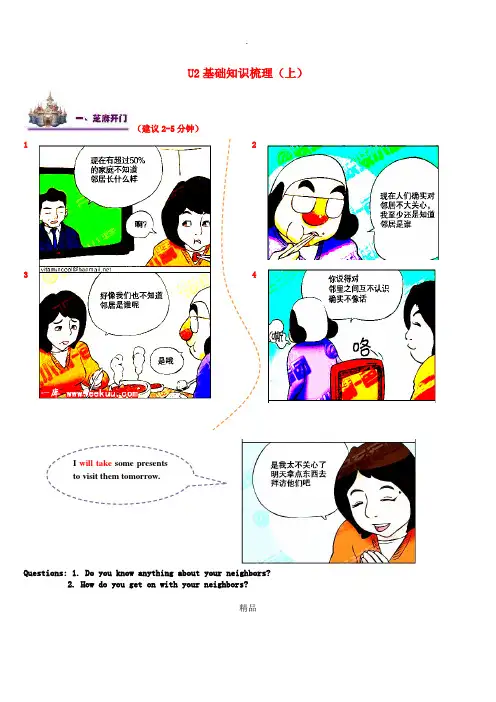
U2基础知识梳理(上)(建议2-5分钟)1 23 4I will take some presentsto visit them tomorrow.Questions: 1. Do you know anything about your neighbors?2. How do you get on with your neighbors?精品一、词汇Words1.___________ 邻居(英式英语)neighbor为美式英语neighbor用作名词,意为“邻居”,指居住在同一座楼、同一小区、同一街区的人数其复数形式是___________.2.like 像,相似,类似(1)like用作介词,指某人或某物“像,相似,类似”。
常用的固定搭配有像…样子______________________;看起来像______________________;例1:我不欢迎像你这样的人。
____________________________________________例2:这个女孩看起来像她的父亲。
____________________________________________(2) like 也可以用作动词,表示“喜欢”之意,常用的固定搭配:like sb/sth 喜欢某人/某物_______________ 喜欢做某事(习惯)_______________ 喜欢做某事(具体的事)练习:1. He_______ his father because he wants to speak English______ his father.A. like; likeB. likes; likesC. likes; likeD. like; likes2. I need a bike_________.A. like youB. like yourC. like yoursD. likes you3. John, ______ his father, _______ playing basketball.A. likes; likeB. like; likesC. likes; likesD. like; like4. Do you like any sports like_______, _______ or________?A. swimming; playing basketball; runB. swimming;playing basketball; runningC. swim;play basketball; runD. to swim; to play basketball; to run3.waiter (参观等)服务员名词,意为“(餐馆等)服务员”,是由动词wait 加后缀-er构成的,其对应词为___________,意为“女侍者,女服务员”。
七年级英语下册《Unit 2 Neighbours》复习教案 (新版)牛津版
《Unit 2 Neighbours》一、教学目标:复习第二单元内容二、教学重点:复习第二单元内容三、教学难点:复习第二单元内容四、达标检测:一.选择题1. — What’s your favourite , Tom?— I like playing football.A. fruitB. sportC. hobbyD. shopping2. —Do you enjoy _______with your classmates on the Internet?A. to talkingB. talkC. talkingD. to talk3. The girl has_________ to do today.A. lots of homeworkB. a lot of homeworksC. a lot homeworkD. lots of homeworks4. They_________ at school.A. have lunchB. have a lunchC. have a breakfastD. have the breakfast5. — your father often TV at home?—No, he is too busy.A. Is; watchB. Do; watchC. Does; watchD. Do; watches6. Millie, do you enjoy _______in the sea?A.to swimB. swimsC. swimmingD. to swimming7.A. don’t live inB. doesn’t live inC. don’t lives inD.8. Tony is a quiet student, he is active(活跃的) in class.A.soB. andC. butD. or9. Don’t go _______ today. There are too many people in the pool.A. shoppingB. climbingC. swimmingD. running10. Kitty enjoys playing volleyball. It her happy.A. makeB. makesC. takeD. takes二根据句意及首字母或汉语提示完成单词。
七年级英语下册 Unit 2 Neighbours Reading 2教案 (新版)牛津版
Neighbours
Step I 复习
1、想学生展示社区内的各种活动的图片,帮助他们复习前一课时的内容。
2、对能力较强的学生,教师可以稍加改变B1部分的句子,增加描述的语言,指导
他们选择短语完成句子。
Step II 呈现
1、为学生播放录音,让他们集体跟读。
2、再次播放录音,让学生分角色朗读。
3、指导学生完成B3部分的练习,巩固对课文的理解。
4、组织学生两人一组进行朗读。
Step IV 展示
1、指导学生两人一组。
分别扮演Simon和Amy进行对话表演。
教师说: Now, let’s do
a role-play. Suppose one of you is Simon. The other is Amy. Try to act out the conversation.
2、指导学生开展角色扮演活动,并在小组内进行准备。
教师要鼓励学生进行合理改变,然后选择不同层次的学生进行汇报。
Step V 家庭作业
1、熟读课文,争取复述或背诵。
2、记忆词汇、词组和句型。
3、完成教师布置的书面练习。
4、预习grammar。
1。
江苏省新沂市第二中学七年级英语下册 Unit 2 Neighbou
Neighbours教学目标1. To know what is a good neighbour like2. How to talk about the neighbours freely重点To know the topic of the unit“neighbours”难点To grasp the sentences:I’m going to visit our newneighbours.教法及教具教学过程教学内容个案调整教师主导活动学生主体活动Step 1: Warm-upFree talkWhere do you live ,a flat or a house?How many buildings are there ?What do you have around your neighbourhood?Do you like living there?Step2. PresentationDo you know what are your neighbours andwhere do they work?Talk about in this way:One of my neighbours is a….. and he/sheworks in a …..The more the betterStep3 Practice:Talk about your neighbourhood in pairsStep 4 PresentationWhat is Eddie like in your memory?Listen and answer two questions:1.What is Hobo going to do?2.Do you welcome a neighbour like Eddie? Why?Have a free talk.Ask and answer one byone.Ask and answer.Listen and answer.Act out the dialogue.Listen, read and answer教学内容个案调整教学过程教师主导活动学生主体活动Step 5 Consolidation1 Talk about your life in the neighbourhood:(1) Do you often talk with your neighbours?(2)Do you often play with your neighbours?(3)Do you like visiting them?(4)Do they often visit your home?(5)Do you think they’re good visitors?2 Discuss what you think a good neig hbour shouldbe like3 Learn a p roverb about neighbours.4 Work in groups and di scuss: What can you do foryour neighbours?Step 6 Homework1.熟读本课时所学内容,记忆词汇、词组、句型。
七年级英语下册《Unit 2 Neighbours》Reading 1教案 (新版)牛津版-(新版)
Unit 2 NeighboursTeaching aims and demands:Knowledge objects:1.To learn the new words and expressions in the dialogue.2.To understand the dialogue.Ability object:1.To read the new words correctly.2.To say something on how to help the young and the old.Emotion object:To learn to help each other where you live and stay.Key and difficult points:New words and expressions in the dialogue.Teaching methods:Discussion and co-operative approachTeaching procedures:Step1: Lead inEnjoy a MV《pleasant sheep and big big wolf》.Purpose: Make the class relaxed and attract students’ attention.Step2:Pre-reading1.Talk about what pleasant lamb and slow sheep are like.2.Show pictures of students’ volunteer activity at school and the problem they may haveat home.3.Show three posters and let students get to know more problems they may have. Purpose: present new words and learn some main information in the dialogue.Step3:While-reading1.Skim and answer two questions.2.Read quickly and fill in blanks. Finish partB1.3.Scan and finish Part B2.4.Read carefully, and get more details to fill in the table.Purpose: make students know specific information in Simon’s neighbourhood and practise reading skills.Step4:Post-reading1.Talk about what we can do for the old and the young..2.Students report their ideas.3. Sublimation: share two sayings with students.Purpose:let students speak out and get their feedback.Step5:Homework.1.Try to recite the dialogue .2.Write a short passage about“My neighbours” .Blackboard design:Unit 2 NeighboursReading 1problemengineer check fixskill college brokenVolunteerSomething is broken.There is something wrong with....Something doesn’t work. Teaching reflection:。