
2013人教版七年级英语下册Unit3
Unit 3 How do you get to school?单元要览本单元的话题是“交通”,功能为“谈论如何到达某地”。
通过本单元的教学,要引导学生掌握重点句式“How do you get to…?”“I get to…”“How long does it take to…”“Ittakes…”“How far is it…?”“It's…”并学会用本单元所学的词汇和句式来表达交通方式,谈论如何到达某地,询问到某地有多远,表达从某地到某地需要多长时间,了解世界各地的学生是怎样去上学的,并培养学生帮助别人指路、乐于助人的意识。
本单元的教学内容见下表。
本单元的课时安排与具体教学建议如下:Period l Section A(la-lc)I.教学准备1.教师:课件,录音机和磁带,教学挂图,各种交通工具的图片或简笔画。
2.学生:搜集一些自己喜欢的交通工具的图片,调查用的表格。
Ⅱ.教学目标1.通过看图说话、师生问答、听录音、角色扮演、猜谜语、简笔画等形式,掌握本课时描述交通工具的单词train,bus,subway,ride,bike和短语take the subway。
2.通过师生问答、角色扮演等形式,学会“How do you get to…?”“Iget to...”“Howloes she/he get to…?”“She/He takes the subway to…”等句型,并能用英语谈论、描述交通工具,表达如何乘坐交通工具去某地。
Ⅲ,教学重点学习各种交通工具的表达方式;了解有关的交通知识。
Ⅳ.教学难点学会用how提问某人如何去某地,并会用学过的知识作答。
V.教学步骤Step l:Revision&Warming-up建议1:通过师生自由交际进行复习与热身,同时让学生回忆以前学过的表示交通工具名称的单词。
学生通过小学英语的学习,已经初步了解一些简单的有关交通工具的英语单词。
通过师生谈论交通工具可以使学生对本课的话题感兴趣,并且有一种成就感和自豪感,同时实现新旧知识的衔接。
For example:T:Do you have a bike?Ss:Yes,we do.T:Do you go to school by bike?Ss:Yes,we do.T:I go to work by bike,too. Today we'll learn some kinds of transportation,OK?Ss:OK.建议2:让学生做根据简笔画猜交通工具的游戏进行热身。
教师在黑板上画出某种交通工具的一部分,然后让学生猜是哪一种交通工具,看谁猜得既对又快。
(游戏的目的是活跃课堂气氛,充分调动学生学习的积极性,培养学生学习英语的兴趣;同时达到巩固旧知识、进而引出要学习的新知识的目的。
)For example:T:I will draw some kinds of transportation on the blackboard. Can you guess what theyare? When you give me the correct answer,I will write the words on the blackboard.(教师画公共汽车、火车、自行车、地铁等交通工具,让学生去猜。
)Ss:bus,train,bike,subway…建议3:通过唱歌进行复习与热身。
1.Enjoy an English song Over The Mountains.2. Ask them "How many kinds of transportation are in the song? Do you remember?"Show the words:ride a bike,take the subway一(通过看Flash短片,听英语歌曲,来引入一些交通工具,让学生积极主动地思考,并用多媒体以增加其趣味性,近而达到事半功倍的效果。
)Step 2:Present the new words建议1:教师通过图片向学生呈现新单词。
(以图片的形式呈现新单词,更直观,更便于学生记忆。
)For example: T:Look at Picture l.What's this in Chinese?Ss:“火车”。
T:What's this in English? Do you know?Ss:Yes. It's a train.T:Spell it,please.Ss:T-R-A-I-N,train.(教师可以采用此法呈现本课时其他的词汇。
然后进行短语训练take the train,takethe bus,take the subway,ride a bike)For example:T:I take the train to school. How do you get to school?Sl:l ride my bike.T:How do you get to school?S2:I take the subway to school.T:How do you get to school?S3:I take the bus.建议2:通过“猜谜语”的方式向学生呈现新单词。
For example:T:What kind of transportation is it? It's very useful. You may ride it to school.Ss:A bike.T:Many people take it to work in the city.It's just like a big box.Ss;A bus.T:It is like a train but goes under the ground.Ss:A subway.(通过有趣的猜词游戏,让学生在热闹的课堂气氛中学会并掌握新词汇。
教师可以采此法呈现本课时其他的词汇。
)Step 3:Practice the new words1.让学生把la部分的单词与对应的交通图画连接起来。
2.教师呈现本课时课本中la部分的图片,然后让学生用英语说出该图片中交通工具名称。
For example:T:Look at the picture. What's this in English?Ss:Bus.T:Spell it,please.Ss: B-U-S,bus;(教师可以采用此法练习本课时其他的词汇,然后让学生与学生之间进行练习。
)3.让学生做连线题,对词汇进行进一步的练习和巩固。
4.教师向学生呈现一些名人的图片,通过师生问答让学生说出他们去工作的方式。
T:How does Yao Ming/Zhou Jielun/Liu Yifei get to work? Can you guess?Sl:Yao Ming rides the bike to work every day.S2:2hou Jielun takes the subway to work.S3:Liu Yifei walks to work.S4:,.(通过给学生展示喜闻乐见的明星图片,激发学生猜的兴趣,进而让学生将所学的知识脱口而出,不但练习了句型和词汇,也增加了学生的语言训练量,同时活跃了课堂气氛。
)NStep 4:Listening1.让学生听lb部分的录音,把数字写在上面图画的人物旁边。
2.核对答案。
可先让一个学生站起来展示自己的答案,然后教师询问其他同学的修改或补充意见,最后教师出示正确答案。
3.让学生跟读录音,目的是让学生能够正确地读、说新词汇,为下一步的同伴表演打下良好的说的基础。
4.让学生与同伴分角色表演对话,目的是培养学生的口头表达能力。
Step 5:Present the conversation建议l:教师通过与学生谈论教材插图,向学生呈现下列句型“How do you get to…?”“I get to…”“How does she/he get to…?”“She/He takes the subway to…,‟For example:T:I take the bus to go to school. How do you get to school,Bob?Bob:l walk to school.T:How does Bob get to school?Ss:He walks to school.T:How do you get to schooI,John?John:I ride a bike to school.T:How does John get to school?Ss:He rides a bike to school.建议2:通过看电影短片,让学生进一步巩固所学的表示交通工具的词汇。
利用多媒体复习所学的单词,并自然地引出本课时的句型“How do you get to…?”“I get to…”“How does she/he get to…?”“She/He takes the subway to…‟‟(这样能激发学生的学习兴趣,寓教于乐,从而让学生学得更轻松。
)~Step 6:Practice the conversation建议1:让学生用lc部分所提供的短语和句型编写对话、练习新句型。
T! Look at lc. Practice the conversation below. Then make conversations about the othertransportation in the picture.W.ork in pairs according to the sample conversation.For example:Sl:How do you get to school?S2:I take the subway to school.Sl:How does.he get to school?S3:He takes the subway to school.T:Who can act your conversation?S4:1 can…建议2:教师利用多媒体向学生呈现一组图片,然后让学生根据图片进行问答。
①ride a bike ②take the bus ④take the trainSl:Look at Picture l. How does she get to school?S2:She rides a bike to school.Sl:Look at Picture 2. How do they get to school?S2:They take the bus to school.Sl:Look at Picture 3. How does she get to work?S2:She takes the train to work.Step 7 :Additional task建议l:How do your family get to school or work? Make a survey and give a report.For example:There are four people in my family. They are my father,my mother,my sister and I. Myfather takes the bus to work. My mother rides a bike to work. And my sister takes the sub-way to school. But I walk to school.建议2:Make a survey Ask some classmates the question:"How do you get toFor example:Bob takes the bus to school and Yang Lan rides her bike to school. But Lily walks toschool…Step 8:SummaryAsk one of the students to say what they have learned today.Step 9:Homework对你的老师做个调查,询问他们是怎样来上班的?填写调查表格。
新人教版七年级下册(2013年春使用)_《Unit_3_Is_this_your_pencil》课件_Section_B
5. The ________ isn’t mine. It’s baseball
Jack’s.
6. — What are they? keys
— They’re a set ofID cards _____.
7. Eric lost his school ________.
二、从B栏中选择A栏正确的应答语。 A栏 1. What’s this in English? d ) ( 2. Is that your pencil box? (a ) 3. Are those Linda’s books? e( ) b ) 4. Who’s that girl? ( 5. How do you spell your name? ( c ) B栏 a. Yes, it is. b. She’s my cousin. c. It’s J-A-C-K. d. It’s an eraser. e. No, they aren’t.
Write the school things you know.
pen, ruler pencil eraser pen book dictionary notebook pencil box schoolbag school ID card watch
Complete the chart with pronouns.
规则总结
类别 第一人称 第二人称 第三人称 人称代 人称代 词主格 词宾格 I me you she you her 形代 my your her his 名代 mine yours hers
第三人称
he
him
his
Look at the picture and write conversations.
初中英语人教版七年级下册Unit 3 How do you get to school知识点

七年级英语下册Unit3知识点Section A1.Take the train/bus/subway “坐火车/公共汽车/地铁”句型:乘坐某种交通工具去...Take a 交通工具 to 地点= go to 地点 by 交通工具= walk/drive/fly ... to 地点= go to 地点 on/in a(an/the) 交通工具Eg: I will take a plane to Beijing.= I will go to Beijing by plane.= I will fly to Beijing.= I will go to Beijing in a plane.“我将坐飞机去北京。
”注意:1)subway在英式英语中意为“地下通道”。
英式英语的“地铁”是underground 2)train作名词时,意为“火车”Train作动词时,意为“训练”Eg: They trained the dog to sniff out drugs.“他们训练狗嗅出毒品。
”2.Ride a bike to 地点= go to 地点 by bike= ride to 地点“骑自行车去某地”Eg: Tony rides a bike to school every day.= Tony goes to school by bike every day.= Tony rides to school every day.“托尼每天骑自行车去学校。
”注意:ride 作动词时,意为“乘车,搭乘”ride也可作名词,意为“(乘车或骑车的)短途旅行”;常用词组:give sb. a ride “让......搭车”;go for a ride “去兜风”Eg: Can you give me a ride?“你能让我搭一下车吗?”3.Walk作动词时,意为“步行;行走”,常用短语walk to ... “走路去......”Eg: They walk to the park.“他们走路去公园。
人教版七年级下册英语Unit 3 知识点语法归纳总结

人教版七年级下册英语Unit 3 知识点语法归纳总结Unit 3 How do you get to school?In this unit。
we will learn how to talk about n and how to describe our daily commute to school.1.Phrases to remember:Get to school: Arrive at schoolTake the subway: Use the subway as nRide a bike: Use a bicycle as nHow far: The distance een two placesFrom home to school: The distance een home and schoolEvery day: DailyTake the bus: Use the bus as nLeave Beijing for Shanghai: Depart from Beijing to Shanghaieful sentences:How do you get to school。
I ride my bike to school.How far is it from your home to school?How long does it take you to get to school?For many students。
it is easy to get to school.age:1) How to express n:How do you get to school?When describing n。
we usually use ns such as "by" (without "a/the").BusThink ofeen。
Unit3词汇精讲及短语人教版七年级英语下册

1.get to 到达例句:你怎么到学校?(G7下,U3,P13) How do you get to school?【注意】:当地点是副词home/here/there等时,to要省略。
例句:到家要多久?(G7下,U3,P15) How long does it take to get home?【扩展】:get to= arrive in/at或reach arrive at+小地点arrive in +大地点reach +地点(及物动词直接接地点)2.train/trem/cn.火车------复数trains短语:go to...by train=go to... on a/the train= take a/ the train to ...乘火车去……例句:你怎么去学校?How do you go to school?I take the train the school.=I go to school by train/ on the train3.bus Cn.公共汽车--------复数buses短语:go to...by bus=go to... on a/the bus= take a/ the bus to ...乘公交车去……例句:他坐公交车上班。
He takes the bus to work=He goes to work by bus/on the bus.例句:你的朋友们坐公交车上学吗?Do your friends go to school by bus?4. subway Cn. 地铁------复数subways例句:我骑自行车去地铁站。
短语:go to...by subway=go to... on the subwaytake the subway to...乘地铁去......例句:我们乘地铁去公园we take the subway to the park.=we go to the park by subway/on the subway.5.ride vt.骑cn.旅程------过去式rode 单三形式rides-----现在分词riding 骑手(cn.) rider短语:ride a /the /one’s bike(s) to== go to …by bike=go to… on a /the bike 骑直行车去……骑马ride a horse ==go ridingI ride my bike to school every morning .6.bike/bak/cn.自行车-----复数bikes短语:ride a bike 例句:你是走路还是骑自行车呢?Do you walk or ride a bike?7.sixty num.六十-----复数sixties ----序数词sixtieth8. Seventy num. 七十-----复数seventies -----序数词seventieth 9. eighty num.八十-----复数eighties -----序数词eightieth 10. ninety num. 九十----复数nineties----- 序数词ninetieth 11. hundred /'h ndr d/num. 一百【注意】:hundred 前有数字时,hundred 不用复数,直接接可数名词复数,也不与of 连例句:2000名学生在这个学校There are 2000 students in the school.【注意】表示一个不确定数时,前面没有具体数字,其后加s ,与of 连用。
七年级下英语1-3单元知识点大归纳
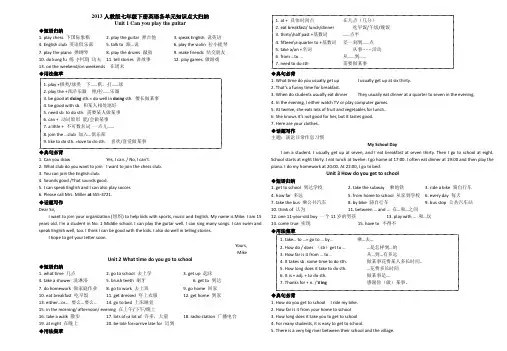
2013人教版七年级下册英语各单元知识点大归纳Unit 1 Can you play the guitar◆短语归纳1. play chess 下国际象棋2. play the guitar 弹吉他3. speak English 说英语4. English club 英语俱乐部5. talk to 跟…说6. play the violin 拉小提琴7. play the piano 弹钢琴8. play the drums 敲鼓9. make friends 结交朋友 10. do kung fu 练 (中国) 功夫 11. tell stories 讲故事 12. play games 做游戏 13. on the weekend/on weekends 在周末 ◆用法集萃◆典句必背1. Can you draw Yes, I can. / No, I can’t.2. What club do you want to join I want to join the chess club.3. You can join the English club.4. Sounds good./That sounds good.5. I can speak English and I can also play soccer.6. Please call Mrs. Miller at 555-3721. ◆话题写作 Dear Sir,I want to join your organization (组织) to help kids with sports, music and English. My name is Mike. I am 15 years old. I’m a student in No. 1 Middle school. I can play the guitar well. I can sing many songs. I can swim and speak English well, too. I think I can be good with the kids. I also do well in telling stories.I hope to get your letter soon.Yours, MikeUnit 2 What time do you go to school◆短语归纳1. what time 几点2. go to school 去上学3. get up 起床4. take a shower 洗淋浴5. brush teeth 刷牙6. get to 到达7. do homework 做家庭作业8. go to work 去上班9. go home 回家 10. eat breakfast 吃早饭 11. get dressed 穿上衣服 12. get home 到家13. either…or… 要么…要么… 14. go to bed 上床睡觉 15. in the morning/ afternoon/ evening 在上午/下午/晚上 16. take a walk 散步 17. lots of=a lot of 许多,大量 18. radio station 广播电台19. at night 在晚上 20. be late for=arrive late for 迟到 ◆用法集萃◆典句必背1. What time do you usually get up I usually get up at six thirty.2. That’s a funny time for breakfast.3. When do students usually eat dinner They usually eat dinner at a quarter to seven in the evening.4. In the evening, I either watch TV or play computer games.5. At twelve, she eats lots of fruit and vegetables for lunch..6. She knows it’s not good for her, but it tas tes good.7. Here are your clothes. ◆话题写作主题:谈论日常作息习惯My School DayI am a student. I usually get up at seven, and I eat breakfast at seven thirty. Then I go to school at eight. School starts at eight thirty. I eat lunch at twelve. I go home at 17:00. I often eat dinner at 19:00 and then play the piano. I do my homework at 20:00. At 22:00, I go to bed.Unit 3 How do you get to school◆短语归纳1. get to school 到达学校2. take the subway 乘地铁3. ride a bike 骑自行车4. how far 多远5. from home to school 从家到学校6. every day 每天7. take the bus 乘公共汽车8. by bike 骑自行车9. bus stop 公共汽车站10. think of 认为 11. between … and … 在…和…之间 12. one 11-year-old boy 一个11岁的男孩 13. play with … 和…玩 14. come true 实现 15. have to 不得不 ◆用法集萃 ◆典句必背1. How do you get to school I ride my bike.2. How far is it from your home to school3. How long does it take you to get to school4. For many students, it is easy to get to school.5. There is a very big river between their school and the village.1. play +棋类/球类 下……棋,打……球2. play the +西洋乐器 弹/拉……乐器3. be good at doing sth.= do well in doing sth. 擅长做某事4. be good with sb. 和某人相处地好5. need sb. to do sth. 需要某人做某事6. can + 动词原形 能/会做某事7. a little + 不可数名词 一点儿……8. join the …club 加入…俱乐部9. like to do sth. =love to do sth. 喜欢/喜爱做某事1. take… to …= go to … by… 乘…去…2. How do / does (sb )get to … …是怎样到…的3. How far is it from … to … 从…到…有多远4. It takes sb. some time to do sth. 做某事花费某人多长时间。
人教版七年级英语下册Unit 3 重点知识点总结

人教版七年级英语下册Unit 3 重点知识点总结人教版七年级英语下册Unit 3 重点知识点总结Unit 3 Why do you like koalas?一、词组want to do sth .想要做某事want sb to do sth 想要某做某事want sth 想要某物Let sb do sth 让某人做某事d of 有几分种类a kind of 一种……years old …年龄如:ten years old 十岁like to do sth 喜欢做某事like doinglay with … 与...一起玩be quiet 安静during the day 在白天at night 在夜间have a look at.. 看…一个...另一个二、句型(1)、-why do you like pandas?-Because they’re very cu(2)、-Why dose he like koalas?-Becauare kindg.(3)、-Where are l?-Lions auth Africa.(4)、-What animals do you like?-I like elepha三、日常交际用语(1)、-Let’l(2)-Why do you walions?-Becaare very cu(3)-Do you like giraffes?I do./ No,I don’t(4)-Whaanimal do you like?_I like dog+ 名词的复数.表示没有特定的数量范围+名词的复数表示有特定的数量范围.(5)-Why are you looking at me?-Because you are very cu(6)-Let us play games. –Great!L。
人教版初中英语七年级下册Unit3SectionB教材全解
人教版初中英语七年级下册Unit3SectionB教材全解Unit 3 How do you get to school?Unit 3 Section B教材全解1.bus stop 公共汽车站【重点注释】stop,此处用作名词,意为“车站;站点”。
例如:at a/the bus stop在公共汽车站。
stop一般指的是小站,停车点,如路边的停车站点;station指的是总站,大型的车站,at a bus/train/subway station。
例如:They wait for Jim at the bus stop.他们在公共汽车站等吉姆。
Where si the bus station?公共汽车站在哪儿?Stop talking,please.请停止(正在)说话(这个事)。
They stop to smoke a cigarette.他们停下来(原来干的事),(然后)抽了根烟。
I must stop smoking.我必须戒烟了(我必须停止正在抽烟这个事)。
2.Mary wants to know where Bob lives.玛丽想知道鲍勃住在哪儿。
Mary wants to know what he thinks of the trip.玛丽想知道他(鲍勃)认为这段旅程怎么样。
【重点注释】①Mary wants to know where Bob lives.玛丽想知道鲍勃住在哪儿。
本句含有一个由连接词where引导的宾语从句。
在复合句中用作宾语的从句叫宾语从句。
无论主句是陈述句还是疑问句,宾语从句都必须使用陈述语序,即“主句+连词+宾语从句(主语+谓语+……)”句式。
如果主句的谓语动词是一般现在时,从句的谓语动词可根据需要,选用相应的任何时态。
例如:Please tell me who knows the answer.请告诉我谁知道答案。
Do you know which class he is in?你知道他在哪个班级吗?I don’t know when he will come back.我不知道他将何时回来。
人教版七年级下册英语Unit 3 教学设计
人教版七年级下册英语Unit 3 教学设计一. 教材分析人教版七年级下册英语Unit 3以“日常活动”为主题,通过介绍日常生活中的活动,让学生学会描述自己的日常安排和兴趣爱好。
本单元的核心词汇有play, watch, read, write, listen to, cook等,核心句型为“What do you do on…? I usually…”和“Do you like…? Yes, I do./ No, I don’t.”。
本单元旨在培养学生用英语进行简单交流的能力,提高他们的语言运用能力。
二. 学情分析七年级的学生已经掌握了基本的英语语法和一定数量的词汇,具备了一定的听说读写能力。
但部分学生在语言运用方面还存在一定的困难,特别是在口语表达和听力理解方面。
因此,在教学过程中,教师需要关注学生的个体差异,调动他们的学习积极性,引导他们主动参与课堂活动。
三. 教学目标1.知识目标:学生能够掌握本单元的核心词汇和句型,正确运用“Whatdo you do on…? I usually…”和“Do you like…? Yes, I do./ No, I don’t.”进行日常交流。
2.能力目标:学生能够在真实情境中运用英语描述自己的日常活动和兴趣爱好,提高他们的语言运用能力。
3.情感目标:培养学生对英语学习的兴趣,增强他们的自信心,使他们更加积极主动地参与课堂活动。
四. 教学重难点1.重点:学生能够熟练掌握并运用本单元的核心词汇和句型进行日常交流。
2.难点:学生能够在真实情境中运用英语描述自己的日常活动和兴趣爱好。
五. 教学方法1.任务型教学法:通过设计各种真实的任务,让学生在完成任务的过程中运用英语,提高他们的语言运用能力。
2.情境教学法:创设各种日常活动的情境,让学生在真实的情境中学习英语,增强他们的学习兴趣。
3.小组合作学习:学生进行小组讨论和合作,培养他们的团队精神和沟通能力。
六. 教学准备1.教材:人教版七年级下册英语教材。
[全]人教版七年级英语下册unit3单词、知识梳理、词汇句型精讲
人教版七年级英语下册unit3单词、知识梳理、词汇句型精讲Unit3 How do you get to school?1Unit 3单词(音标)train [tren] n.火车bus [bs] n.公共汽车;公交车subway ['sbwe] n.地铁take the subway 乘地铁ride [rad] v.骑n.旅程bike [ba k] n. 自行车ride a bike 骑自行车sixty ['skst] num.六十seventy ['sevnt] num.七十eighty ['et] num.八十ninety['nant] num.九十hundred ['hndrd] num.一百minute['mnt] n.分钟far [fɑ] adv. & adj. 远;远的kilometer ['kl,mit(r)] n.公里new [nju] adj. 新的;刚出现的every ['evr] adj. 每一;每个every day 每天by [ba] prep. (表示方式)乘(交通工具)by bike 骑自行车drive [drav] v. 开车car [kɑ] n.小汽车;轿车live[lv] v. 居住;生活stop [stɑ:p][stp] n. 车站;v. 停止think of 认为cross [krs] v.横过;越过river ['rv] n.河;江many ['men] adj. & pron.许多village ['vld] n.村庄;村镇between [b'twin] prep.介于…之间between…and…在……和……之间bridge [brd] n.桥boat [bt] n.小船ropeway ['rpwe] n.索道year [j] [ j] n.年;岁afraid ['fred] adj.害怕;惧怕like [lak] prep.像;leave [liv] v.离开dream [drim] n.梦想;睡梦v.做梦true [tru] adj.真的;符合事实的come true实现;成为现实Dave[deiv] 戴夫(男名2 Unit3 知识梳理◆短语归纳1. get to school 到达学校2. take the subway 乘地铁3. ride a bike 骑自行车4. how far 多远5. from home to school 从家到学校6. every day 每天7. take the bus 乘公共汽车8. by bike 骑自行车9. bus stop 公共汽车站10. think of 认为11. between…and…在…和…之间12. one 11-year-old boy 一个11岁的男孩13.play with…和…玩14. come true 实现15. have to 不得不◆用法集萃1. take…to…= go to…by…乘…去…2. How do/does sb get to…? 某人是怎样到…的?3. How far is it from…to…? 从…到…有多远?4. It takes sb. some time to do sth. 做某事花费某人多长时间。
人教版七年级英语下册unit3(详细内容)
人教版七年级英语下册Unit 3 How do you get to school一、单词回顾1、train[treɪn]火车2. bus 公交车3、subway['sʌbweɪ]地铁4、ride[raɪd]v.骑n.旅rode. [rəʊd]ridden.['rɪdn.]5、bike[baɪk]自行车6、sixty['sɪkstɪ]六十7、seventy['sev (ə)ntɪ]七十8、eighty['eɪtɪ]八十9、ninety['naɪntɪ]九十10、hundred['hʌndrəd]一百11、far[fɑː]很12、minute['mɪnɪt]分钟13、kilometer['kɪlə,mitɚ]公里14、new[n juː]新的15、every ['evrɪ]每一个16、by[baɪ]通过,被17、drive[draɪv]开车18、live [lɪv]活的,生动的19、stop[stɒp]停止20、cross[krɔs]交叉21、river ['rɪvə]河,江22、many ['menɪ]许多23、village[' vɪlɪdʒ]村庄,村民24、between[bɪ'twiːn]介于…之间25、bridge[brɪdʒ]桥26、boat [bəʊt]小船27、ropeway['rop,we]n. 索道空中缆索28、year[jɪə]n. 年;年度;岁29、afraid[ə'freɪd]害怕;惧怕30、like [laɪk]像;怎么样(介词)31、leave [liː v]离开;left (lea ve的过去式)32、dream[driːm]梦想;睡梦33、true[truː]真的;符合实际的二. 词汇辨析:1. take/spend/pay/costspend,cost,take和pay都可以表示“花费”,但用法却不尽相同。