
the gerundPPT
2.具有名词的特征,在句中可充当主语,宾语,表语,定语.
(1)主语:表示的意义比较抽象或者是习惯性的(不定式表示 的意义是比较具体的动作,特指将来的动作.) eg. 1). Talking means no holes.(空谈无济于事) 2). Seeing is believing. 3). Swimming is good for our health. 4). Learning English well is not easy.
(3)定语
(A)动名词:表示它所修饰的名词的用处,如用fo 它的位置放所修饰词前面. (B)分词:表示它所修饰的名词正在进行的动 作.分词和所修饰的词有逻辑上的主谓关系. (C)不定式:表示的动作性较强,所修饰的词往往 是动作的承受者(逻辑主语),放所修饰词的后面.
eg: a sleeping car = a car for sleeping a sleeping child = a child who is sleeping I have something to do Do you have anything to say? Our teacher uses a very good teaching method.
注意:动名词短语做主语时,可用it做形
式主语,而把动名词短语放到谓语之后.
eg. 1). It’s no use talking about it now. 2). It’s no good learning English words by heart without how to use them. 3). it’s worthwhile(值得做的)discussing the question. 另外:good, need, use, worthwhile, shame, dangerous, a waste of 常用动名词做真正主语. eg: there’s no good, use, harm, hurry (in) doing (There’s no joking about the matter.)
注意:有些动名词和被它所修饰的名词经常连在一
起连用,已经成为合成名词:swimming pool; waiting room; boiling-point; dining-room; reading-room. etc.
(4)宾语
(A)做动词的宾语(只能接动名词做宾语的动词)
妹 不 吃 咖 啡
m: mind; miss e: enjoy; escape; excuse; ensure(保证;担保); evade(逃避;躲避) p: practise; pardon(原谅;宽恕);postpone(推迟) s: stop; suggest; stand(经受;持久) k: keep a: avoid(避免);admit(承认);appreciate(感激;欣赏) r: resist(抵抗); risk(冒险) f: finish; favour(支持,赞成); forgive; fancy(想象,设想) (delay(推迟); imagine)
B. 语态:动名词逻辑上的主语表示的是动作的承受者时, 用被动语态. eg. 1). He came to the party without being invited. 2). He remembers being taken to Beijing at the age of 10. 3). We are all excited for having been praised.
(B)做介词的宾语(常见接动名词的动词短语)
be busy (in); give up; can’t help; put off; feel like; keep on; be/get/become used to; look forward to; devote oneself to; have trouble/difficulty (in); succeed (in); prevent/stop/keep sb. from; be tired of; be fond of; insist on(坚持); persist in(坚持); be active in(做…积极); be afraid of; excuse sb. for; forgive sb for; thank sb for; be surprised/astonished/terrified at; be interested in; be proud of; be delighted in(做…欣喜); spend in; set about(开始,散步,攻击,着手)
The Gerund
动名词
动名词
动名词的基本形式和现在分词相同(v+ing) 一.特征:兼有动词和名词的特征. 1.具有动词的某些特征. (1)可带宾语,可用状语修饰
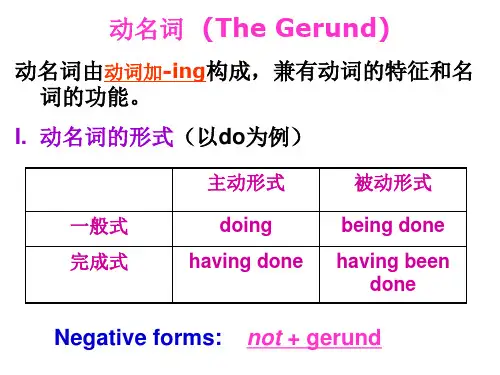
eg. 1). I have finished writing a letter. 2). We’ve thinking of doing our work better and better. (2)有时态和语态的变化 主动 一般式 doing 完成式 having done 被动 being done having been done
A.时态: 一般式表示的动作在谓语动词表示的动作发生同时或之 后发生;完成式表示的动作在谓语动词表示的动作发生 之前发生. eg. 1). He enjoys listening to music. 2). She regretted having missed the film. 3). She dreams of becoming a teacher. 4). He was praised for having done a good deed. 注意:有时用一般式来代替完成式. eg. 1). Thank you for telling me the news. 2). After working for 3 hours, he began having a rest.
(2)表语:动名词做表语与分词做表语的区别
分词:说明主语性质或特征,主语与分词间是逻辑上的主 动关系,用现在分词;若为逻辑上的被动关系,则为过去 分词. 动名词:说明主语内容.主语为名词,表示一般性经常性 的动作,用动名词;表示动作的一次性,用不定式. eg: 1). Our duty is serving the people. (主表可互换) 2). What he likes is making jokes. 3). His hobby is painting. 4). The story is interesting.
(1)主语:表示的意义比较抽象或者是习惯性的(不定式表示 的意义是比较具体的动作,特指将来的动作.) eg. 1). Talking means no holes.(空谈无济于事) 2). Seeing is believing. 3). Swimming is good for our health. 4). Learning English well is not easy.
(3)定语
(A)动名词:表示它所修饰的名词的用处,如用fo 它的位置放所修饰词前面. (B)分词:表示它所修饰的名词正在进行的动 作.分词和所修饰的词有逻辑上的主谓关系. (C)不定式:表示的动作性较强,所修饰的词往往 是动作的承受者(逻辑主语),放所修饰词的后面.
eg: a sleeping car = a car for sleeping a sleeping child = a child who is sleeping I have something to do Do you have anything to say? Our teacher uses a very good teaching method.
注意:动名词短语做主语时,可用it做形
式主语,而把动名词短语放到谓语之后.
eg. 1). It’s no use talking about it now. 2). It’s no good learning English words by heart without how to use them. 3). it’s worthwhile(值得做的)discussing the question. 另外:good, need, use, worthwhile, shame, dangerous, a waste of 常用动名词做真正主语. eg: there’s no good, use, harm, hurry (in) doing (There’s no joking about the matter.)
注意:有些动名词和被它所修饰的名词经常连在一
起连用,已经成为合成名词:swimming pool; waiting room; boiling-point; dining-room; reading-room. etc.
(4)宾语
(A)做动词的宾语(只能接动名词做宾语的动词)
妹 不 吃 咖 啡
m: mind; miss e: enjoy; escape; excuse; ensure(保证;担保); evade(逃避;躲避) p: practise; pardon(原谅;宽恕);postpone(推迟) s: stop; suggest; stand(经受;持久) k: keep a: avoid(避免);admit(承认);appreciate(感激;欣赏) r: resist(抵抗); risk(冒险) f: finish; favour(支持,赞成); forgive; fancy(想象,设想) (delay(推迟); imagine)
B. 语态:动名词逻辑上的主语表示的是动作的承受者时, 用被动语态. eg. 1). He came to the party without being invited. 2). He remembers being taken to Beijing at the age of 10. 3). We are all excited for having been praised.
(B)做介词的宾语(常见接动名词的动词短语)
be busy (in); give up; can’t help; put off; feel like; keep on; be/get/become used to; look forward to; devote oneself to; have trouble/difficulty (in); succeed (in); prevent/stop/keep sb. from; be tired of; be fond of; insist on(坚持); persist in(坚持); be active in(做…积极); be afraid of; excuse sb. for; forgive sb for; thank sb for; be surprised/astonished/terrified at; be interested in; be proud of; be delighted in(做…欣喜); spend in; set about(开始,散步,攻击,着手)
The Gerund
动名词
动名词
动名词的基本形式和现在分词相同(v+ing) 一.特征:兼有动词和名词的特征. 1.具有动词的某些特征. (1)可带宾语,可用状语修饰
eg. 1). I have finished writing a letter. 2). We’ve thinking of doing our work better and better. (2)有时态和语态的变化 主动 一般式 doing 完成式 having done 被动 being done having been done
A.时态: 一般式表示的动作在谓语动词表示的动作发生同时或之 后发生;完成式表示的动作在谓语动词表示的动作发生 之前发生. eg. 1). He enjoys listening to music. 2). She regretted having missed the film. 3). She dreams of becoming a teacher. 4). He was praised for having done a good deed. 注意:有时用一般式来代替完成式. eg. 1). Thank you for telling me the news. 2). After working for 3 hours, he began having a rest.
(2)表语:动名词做表语与分词做表语的区别
分词:说明主语性质或特征,主语与分词间是逻辑上的主 动关系,用现在分词;若为逻辑上的被动关系,则为过去 分词. 动名词:说明主语内容.主语为名词,表示一般性经常性 的动作,用动名词;表示动作的一次性,用不定式. eg: 1). Our duty is serving the people. (主表可互换) 2). What he likes is making jokes. 3). His hobby is painting. 4). The story is interesting.
合集下载
Gerund
Verb filling
found crying 1. Dusk ________(find) Lily ________ (cry) in the street because of hunger. 2. Mike works at a garage and so spends much lying time ________ (lie) under motorcars. being asked 3. "A party!" she cried, " I love ____________ (ask) to parties. 4. Be careful while crossing the street. Don't being knocked forget _____________ (knock) over by a bike last week.
Negative forms:
not + gerund
动名词的时态: ☆ 动名词的时态 A. 一般时 doing We enjoy watching football. We object to attending the lecture. B. 完成时 having done E.g. He was praised for having saved the drowning man. 动名词的被动态: ☆ 动名词的被动态 A. 一般时 being done B. 完成时 having been done E.g. He came in without being asked. I don't remember having been given such a large sum of money.
5.I'll consider ______(see) Mr. Bush at the office seeing this afternoon, but I'm not sure if I have the time. 6. If no one answer the front door, why not knocking try___________ (knock) at the back door. 7. I really regret __________ (waste) so much wasting time_________ (play) TV-video games. playing 8. He didn't feel well and suggested being given ____________(give) a good medical examination. 9.Football seems ________ ( excite) to most of exciting the boy. feeling 10. I can't help ______ ( feel) anxious about his health.
了不起的盖茨比英文总结ppt

1920s, beginning from 1919 to the Crash at the end of 1929. It refers to the “Twenties” of this century. These ten years were, for Americans, a time of carefree(无忧无虑的) prosperity (繁荣), isolated from the world’s problem, bewildering(令人 困惑的) great social change, and a feverish(狂热) pursuit( 追求) of pleasure. These were the ten years when the First World War was just over, when new inventions and manufacturing (制造业)techniques greatly changed.
of the 1920s. He finished four novels: This Side of Paradise
(人间天堂), The Beautiful and Damned(美丽与诅咒),
The Great Gatsby(了不起的盖茨比) (his best known), and
Tender Is the Night(夜色温柔). A fifth, unfinished novel,
2021/10/10
ቤተ መጻሕፍቲ ባይዱ11
Summary of the book
The day of the meeting arrives. Nick's house is perfectly prepared. When the former lovers meet, their behaviour is slightly nervous, but shortly, the two are once again comfortable with each other, leaving Nick alone. As the afternoon progresses, the three move the party from Nick's house to Gatsby's, where he takes special delight in showing Daisy his meticulously(精心地) decorated house, and Daisy is deeply interested in Gatsby's possession.
of the 1920s. He finished four novels: This Side of Paradise
(人间天堂), The Beautiful and Damned(美丽与诅咒),
The Great Gatsby(了不起的盖茨比) (his best known), and
Tender Is the Night(夜色温柔). A fifth, unfinished novel,
2021/10/10
ቤተ መጻሕፍቲ ባይዱ11
Summary of the book
The day of the meeting arrives. Nick's house is perfectly prepared. When the former lovers meet, their behaviour is slightly nervous, but shortly, the two are once again comfortable with each other, leaving Nick alone. As the afternoon progresses, the three move the party from Nick's house to Gatsby's, where he takes special delight in showing Daisy his meticulously(精心地) decorated house, and Daisy is deeply interested in Gatsby's possession.
动名词作主语和宾语(57张PPT)

need,demand,want,require在表 示“需要”时,用v.ing的主动形式表被 动,或用不定式的被动形式。
repairing. The car needs
to be repaired. 这辆汽车需要修理。 The sick woman required taking good care of / to be taken good care of. 这位生病的妇女需要很好地照顾。
1) 做出努力是值得的。
It’s worth making the effort.
2) 和夏洛克争辩是没有什么用的。
___It_i_s_u_s_e_l_e_s_s_t_r_y_in_g__to__a_r_g_u_e____ with Shylock.
3) 跟你在一起工作是令人愉快的。 _____It_i_s_a__p_le_a_s_u_r_e_w__o_rk_i_n_g__w_i_th__y_o_u_._______ 4)玩电子游戏是浪费时间。 It's a waste of time p_l_a_y_in_g__c_o_m__p_u_te_r__g_a_m_e_s. .
1. Since then, finding ways to grow more rice
has been his life goal.
subject
2. He enjoys listening to violin music, playing
mah-jong, swimming and reading. object
country.
动名词直接置于句首主语的位置上。
1) 捉弄别人是我们万万不能干的. __P_l_a_y_in_g__t_ri_c_k_s_o_n__o_t_h_e_rs_ is something we
the gerund

放在一些短语之后: B 放在一些短语之后 look forward to/ devote…to can’t help doing(禁不住)/ feel like doing prefer doing to doing/ take care of insist on/ give up doing can’t help doing / feel like doing put off /delay doing … / be worth doing get down to doing/ set about thanks to/owing to/due to
Practice :
表语 3. __________ 1). My job is teaching you English. 2). Seeing is believing. (To see is to believe.)
定语 4. _________ 1). There is a swimming pool in our school. 2). The cave was a good hiding place for Crusoe.
1. 动名词作主语:
e.g. Seeing is believing. Walking and swimming are good exercises. It’s no use/no good/no need/fun…doing sth. It’s useless/…doing sth. There is no doing( knowing/joking/telling)… e.g. It is no use sending him over. There is no joking about the matter.
gerund

有些动词后面 + doing / to do 意义有区别 stop When the teacher came into the classroom, the students stopped talking at once. When the teacher came into the classroom, the students stopped to listen to her. go on I was doing my homework before supper. After supper, I went on doing my homework. After supper, I went on to watch TV.
(2)介词或介词短语的宾语 ) look forward to, stick to, object to, lead to, , devote… to Is there any hope of catching the early flight? The young teacher was devoted to teaching the blind.
b).与用于进行时态 与用于进行时态
It’s beginning to snow.
c). 主语是物不是人
Spring came on, and the snow began to melt.
d). 后接不定式被动式
The dam(水坝)started to be built last year. (水坝)
Gerunds (动名词) 动名词)
Brief introduction of the Gerund 1. 形式 一般式 完成式
.
v+ing (否定 not doing ) 否定 主动 被动 doing being done having done having been done
The Great Gatsby 了不起的盖茨比英文ppt

The of the novel
• In order to protect themselves,Daisy and Tom plot to shift the blame to Gatsby,saying Gatsby has an affair with Myrtle and he kills her eventuanlly.Myrtle’s husband George Wilson breaks into Gatsby’s house and shots him to death.The Buchanans escape,and the only two persons attending Gatsby’s funeral are Nick and Gatsby’s father,who reads the news in newspaper.
The author of The Great Gatsby
Francis Scott Key Fitzgerald (September 24, 1896 – December 21, 1940) was an American author of novels andshort stories, whose works are the paradigmatic writings of the Jazz Age, a term he coined. He is widely regarded as one of the greatest American writers of the 20th century.
The Great Gatsby has resulted in a number of film adaptations.
The Great Gatsby in 2013, by Baz Luhrmann – starring Leonardo DiCaprio, Tobey Maguire, Carey Mulligan, and Joel Edgerton.
非谓语动词ppt课件
16
Key to Part 1:
1.not to have seen him 2.to have given you so much trouble 3.to be dreaming 4.to have been studying 5.to be better treated 6.being interrupted 7.having been there 8.Having reviewed his lessons
主动态
被动态
一般式
to do
to be done
完成式 进行式
to have done to be doing
to have been done
无
完成进行式 to have been doing
无
7
1. 不定式的动作与谓语动词同时发生时,用一般式。
He wanted to see you.
2. 强调不定式的动作在谓语动词之前发生时,用完成形式。
• 非谓语动词具有动词的功能,如可以有自己的宾 语,但不具有语法上的动词性质,如没有人称和数 的变化。 Growing flowers is my hobby. Thank you for helping us. I hope to see you again.
5
• 使用非谓语动词的条件: 在一个句子中,已经存在一个谓语动词,而又没 有连词的情况下,其他的动词就需要使用非谓语 形式。
17
非谓语动词在句中充当的成分
不定式 动名词 现在分词 过去分词
主语 ★ ★
宾语 ★
★
宾补
★
表语 ★
★
定语
★★
状语 ★
★
★
★★
Key to Part 1:
1.not to have seen him 2.to have given you so much trouble 3.to be dreaming 4.to have been studying 5.to be better treated 6.being interrupted 7.having been there 8.Having reviewed his lessons
主动态
被动态
一般式
to do
to be done
完成式 进行式
to have done to be doing
to have been done
无
完成进行式 to have been doing
无
7
1. 不定式的动作与谓语动词同时发生时,用一般式。
He wanted to see you.
2. 强调不定式的动作在谓语动词之前发生时,用完成形式。
• 非谓语动词具有动词的功能,如可以有自己的宾 语,但不具有语法上的动词性质,如没有人称和数 的变化。 Growing flowers is my hobby. Thank you for helping us. I hope to see you again.
5
• 使用非谓语动词的条件: 在一个句子中,已经存在一个谓语动词,而又没 有连词的情况下,其他的动词就需要使用非谓语 形式。
17
非谓语动词在句中充当的成分
不定式 动名词 现在分词 过去分词
主语 ★ ★
宾语 ★
★
宾补
★
表语 ★
★
定语
★★
状语 ★
★
★
★★
TheGreatGatsby了不起的盖茨比PPT课件
background The novel takes place following the First
World War. American society enjoyed prosperity(繁荣兴旺) during the “roaring” 1920s as the economy soared(飞升). At the same time, Prohibition(禁止禁令), the ban on the sale and manufacture of alcohol as mandated(命令,指令) by the Eighteenth Amendment(修正草案)made millionaires out of bootleggers(私卖酒). After its republishing in 1945 and 1953, it quickly found a wide readership and is today widely regarded as a paragon (模范)of the Great American Novel, and a literary classic. The Great Gatsby has become a standard text in high school and university courses on American literature in countries around the world and is ranked second in the Modern Library's lists of the
Nick-Daisy‘s cousin
Tom-Daisy‘husban d
Jorden-a friend of Daisy
五年级-unit-12-the-gaint's-gardenPPT课件
.
No entry !
The giant builds a tall wall around his garden . Now the children cannot play in his garden .
.
Soon Miss Spring comes . She brings beautiful flowers and birds , but she does not bring any to the giant’s garden .
.
One morning , the giant hears some lovely sounds. He sees some beautiful flower too . The giant is very happy .
.
The giant finds some children in his garden. They are coming through a hole. They bring Miss Spring to his garden.
Unit 12 The giant’s garden
.
giant [ˈdʒaɪənt] 巨人
.
wall [wɔ:l]
墙;围墙
.
kind
[kaind]
有好的;体贴的
.
through [θru:]
穿过
.
no entry [ˈentri]
禁止进入
.
(be) kind to …
对……友好
.
knock down [nɒk] [daʊn] 推到;拆掉
a beautiful garden .
Children like to play in the garden .
No entry !
The giant builds a tall wall around his garden . Now the children cannot play in his garden .
.
Soon Miss Spring comes . She brings beautiful flowers and birds , but she does not bring any to the giant’s garden .
.
One morning , the giant hears some lovely sounds. He sees some beautiful flower too . The giant is very happy .
.
The giant finds some children in his garden. They are coming through a hole. They bring Miss Spring to his garden.
Unit 12 The giant’s garden
.
giant [ˈdʒaɪənt] 巨人
.
wall [wɔ:l]
墙;围墙
.
kind
[kaind]
有好的;体贴的
.
through [θru:]
穿过
.
no entry [ˈentri]
禁止进入
.
(be) kind to …
对……友好
.
knock down [nɒk] [daʊn] 推到;拆掉
a beautiful garden .
Children like to play in the garden .
1课件The ---dog
With this thought, he tried to get the other dog's bone. And as he did, his own bone fell into the water! Now he had nothing at all.
8
Read and circle.
A Greedy Dog
骨头
Long long ago, there was a dog. He found a bone, so he was happy.
1
分享
贪婪的
But he was a greedy dog. He didn’t want to share his bone.
2
抖动它 的翅膀
A fluffy white cat was sitting by a flower. The dog didn’t stop. He wouldn’t share his bone with a cat!
4
He came to a narrow bridge. He kept going, he wanted to eat his bone at home.
5
its shadow 它的影子
过桥
As he was crossing the bridge. He looked down and saw a big dog in the water. 6
比我的骨头大 “Look!” said to
himself. "That dog in the river has a bone, too. It’s bigger than my bone. If I could get away from him, I would really eat well later!"