
初中英语_Module 6 Hobbies unit1 Do you collect anything教学设计学情分析教材分析课后反思
Module 6 HobbiesUnit 1 Do you collect anything?教学设计教学目标:1.知识目标:学生能学会并正确使用下列单词和词组,如:fan, stamp, coin, notes, have a look, value, valuable…2.能力目标:①学生能够听懂有关爱好的谈话,并能从中提取信息。
②学生能够询问他人的爱好、介绍自己的爱好,并表达自己的看法。
3.情感目标:①启发学生收集东西关注的不是价值而是意义。
②引导学生培养良好的兴趣爱好,促进学生的全面发展。
学情分析本模块是对“业余爱好”相关知识的学习,这是一个既有意义,又能引起学生兴趣的话题,是培养学生兴趣、爱好的良好素材。
初中二年级学生对这一类已早有体会,话题、内容都贴近现实生活,整体难度不大,所以学生在学习的过程中也不会感觉太吃力。
教材分析本模块的主题是“爱好”,教材中所选的对话、短文及拓展阅读讨论的都是学生的爱好,贴近学生的生活实际,容易引起学生的共鸣、激发学生的兴趣。
同时,本模块安排的教学内容可带领学生系统地、更深入地学习有关“爱好”的具体内容,不但能促进学生的身心成长,还能培养兴趣、拓展视野、丰富头脑。
Unit1的主题是“Do you collect anything?”主要以第3部分的对话为核心内容,展开对新单词、短语、句型和语法的学习,在认识、理解和掌握知识点的基础上,辅以听、说、写的练习,让学生通过学习、练习,能学有所用、学有所得。
教学步骤:Warming upT: What do you like doing when you are free?S: I like …T: So your hobby is …T:What’s your hobby?S:My hobby is …【设计意图】通过师生问答,让学生说出更多的爱好,在幻灯片中出示新学单词,从而让学生学会对爱好的表达,为下一步的听力扫除障碍。
ProcedureStep1 【Activity 1】小听力(一)Listen to the tape and check (√)the things they collect.【设计意图】小听力部分主要针对Tony一家人的爱好展开,以打对勾的形式出现,在降低听力难度的同时增加学生们的听力成就感和自信心。
(二)Listen again ,choose the answer to the question.1. What does Tony’s mum want him to do?2. Which hobby does Tony think is expensive?3. Which hobby do you think takes up the most space?【设计意图】通过再次听,让学生理解听力内容的主要大意。
Step2【Activity 3】大听力一听:Listen and answer the questions.1、What are they talking about ?2、Where does the dialogue take place?Read and answer the questionsLingling’s hobby: ___________________Betty’s hobbies: _____________________Tony’s hobby: _______________________二听:Why do they collect?【设计意图】①本部分按照先总后分的顺序展开,先来探索他们共同的爱好---收藏,然后转到他们各自的藏品是什么,为什么收藏等这些问题上,让学生们由浅入深一步步来探索,实现了师生情感上的共鸣和升华。
Step3 Character reading and complete the passage with the correct form of the words in the box.Many people collect things, like postcards and toys. They like to put them (1) __________ special to look at. Lingling collects fans and keeps them on a (2) ____ in her bedroom. Betty collects (3) _____ and notes, such as British (4) ______ and US (5) ______. She also collects stamps from all over the world. Tony collects tickets, but Betty thinks that you cannot do anything with old tickets. Lingling thinks that people also enjoy collecting things to (6) _________ something important in their lives.【设计意图】通过本活动,锻炼了学生对语言的正确输出,巩固了本单元的重点词汇,同时还可以加深学生对对话的理解,掌握文章的主要大意。
Step 4 Work in pairs, ask and answer.Survey and report .【设计意图】通过对话,让同学们就“爱好”这个话题进行问答,能够更深入的了解彼此,同时也实现了语言输入向输出的转变Step 5 Summary【设计意图】让学生对本节课所学习的内容进行总结回顾,加深印象。
Step6 Homework以“My Hobby”为题写一篇短文,60~80词。
提示:What is your hobby?Why do you like it?What do you do about it?What does the hobby bring you?What will you do in the future?【设计意图】要求学生加强对已学知识的巩固和掌握。
十、教学反思:设计时教学目标明确、利用图片、多媒体使教学重点突出、利用直观的图片、多媒体辅助、表格操练使得难点突破有效。
教学活动的设计也是由浅入深层层推进的,词汇教学本着由音到图再到形、由学到练、由词到句再到对话的原则设计的,课堂学生学习主动性强,学习效果也很明显。
但最后汇报调查内容的输出活动由于时间有限,没能让学生在课堂上表现出来,很是遗憾。
学情分析本模块是对“业余爱好”相关知识的学习,这是一个既有意义,又能引起学生兴趣的话题,是培养学生兴趣、爱好的良好素材。
初中二年级学生对这一类已早有体会,话题、内容都贴近现实生活,整体难度不大,所以学生在学习的过程中也不会感觉太吃力。
效果分析课件制作精美,展示比较顺畅。
通过练习学生会表达自己的爱好。
通过分析文章先总后分的结构,使学生对作者的写作思路有了清晰的脉络,让学生们由浅入深一步步来探索,实现了师生情感上的共鸣和升华。
通过让学生做activity4,学生能够掌握课文的主要大意,并能够正确运用本课词汇。
通过结对练习,能够对爱好相关的句子进行语言的输出。
教材分析本模块的主题是“爱好”,教材中所选的对话、短文及拓展阅读讨论的都是学生的爱好,贴近学生的生活实际,容易引起学生的共鸣、激发学生的兴趣。
同时,本模块安排的教学内容可带领学生系统地、更深入地学习有关“爱好”的具体内容,不但能促进学生的身心成长,还能培养兴趣、拓展视野、丰富头脑。
Unit1的主题是“Do you collect anything?”主要以第3部分的对话为核心内容,展开对新单词、短语、句型和语法的学习,在认识、理解和掌握知识点的基础上,辅以听、说、写的练习,让学生通过学习、练习,能学有所用、学有所得。
Module6 Unit1评测练习班级_______ 姓名________成绩____________一.单项选择1. Your room is a bit of a mess. Please ___ now.A. tidy up itB. tidy it upC. take up itD. take it up2. -- May I ___ your book?-- Mine is missing.A. have a lookB. have a look atC. lookD. hear3. The fan with a long history is _____.A. valueB. valuableC. wonderful4. The Christmas tree ______ too much room of the living room.A. takes upB. puts on.C. takes off.D. takes over.5. She likes drinking ______orange juice before meals.A. a bit.B. a little ofC. a few.D. a bit of.6. My friend showed _____ some old photos of his family.A. myB. IC. meD. mine二、由汉语意思完成句子1. They_____ _____too much space. 它们占了太多空间。
2. You’d better go to the factory and______. 你最好到厂里去看一看。
3. Let me________the map. 让我看看这张地图。
4. He _____an honest boy. 他肯定是一个诚实的孩子。
5. His fans are______yours. 他的扇子和你的一样有价值。
三、用所给词的正确形式填空:1. Does ling ling collect _________(anything)?2. Tony’s mum wants him ________(tidy) up his room.3. There were lots of books on these ______(shelf) along the walls.4. Many students have lots of ________(hobby)5. I can’t believe I am ________(real) going to meet the pop star.6. Tony has all kinds of _________(activity) such as sailing and climbing.7. Tom runs as _______ as lucy. (fast)8. There are two bad ________(tooth) in my mouth.9. I saw some boys _______(play) basketball when I passed the playgroud.10. They stopped _________(chat) and got ready for the meeting.四、按要求做题:1. Tony’s mum wants him to tidy up the room. (提问)______________________2. Betty will show me some stamps. (同义句)Betty will show some stamps ______ ______.3.He had to give up his hobby because of his job.(否定句)He ______ ______ ______ give up his hobby because of his job.4.Tom doesn’t run as fast as Lucy. (同义句)Lucy run _______ _____ Tom课后反思本堂课的教学目标落实得很好,学生对本节课的内容基本掌握。
初二下外研版Module 6 Hobbies》Unit 1 Do you collect anything_(共17张PPT))
Tony bus ticket, train ticket
Listen again and complete the sentences or answer the questions.
1. Lingling gets the fans from __o_th_e_r__p_e_o_p_le_. 2. Lingling thinks coins and notes must be __v_a_lu_a_b_l_e___. 3. How many books of stamps has Betty collected?
If you don’t have any collections, please write a passage about your partern’s collections.
Six or seven books of stamps. 4. Does Tony’s collections cost a lot?
No. His hobbies doesn’t cost as much as Betty’s. 5. Why does Tony collect tickets?
Lingling
60 fans, as presents, because…
Betty
coins and notes, valuable, stamps, all over the world, 6 or 7 books of …
Tony
tickets, cost, remember (places/something important)…
Unit 1 Do you collect anything?
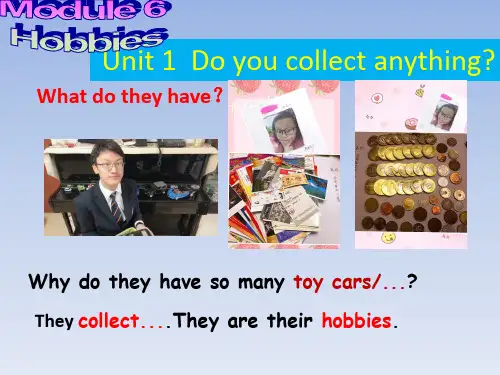
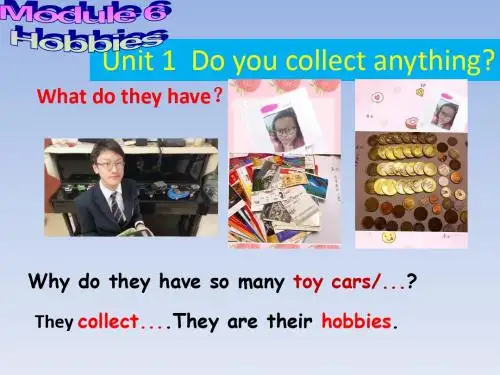
What do they have?
Why do they have so many toy cars/...? They collect....They are their hobbies.
外研社版八年级下学期Module 6 Hobbies Unit 1 Do you collect

外研社版八年级下学期Module 6 Hobbies Unit 1 Do you collect anything教案Module 6 HobbiesUnit 1 Do you collect anything教案锦囊提纲挈领教学目标 1. 能理解关于爱好的会话 2. 能从关于爱好的会话中获取信息3. 能询问别人的爱好以及谈论自己的爱好重点词汇stamp, shelf, as, coin, note, pound, dollar, must, valuable, with, value, just, fan, have a look, a bit of a mess, give sb. sth. as presents, tidy up, show sb. sth., such as, as much as, in their lives重点句型①What does Tony’s mum want him to do ②Which hobby do you think takes up the most space ③I collect coins and notes, you know, like British pounds and US dollars.④They must be really valuable.⑤I’ll show you my stamps too.⑥Sorry, it’s a bit of a mess.⑦People often give me fans...词汇扫描1. shelf n. 隔板;架子【点拨】shelf是一个可数名词,其复数形式为shelves。
on the shelf 意为“在架子上”。
如:There are two shelves in my father’s study.在我爸爸的书房里有两个书架。
【延伸】以f或fe结尾的名词变复数时,把f或fe改成v,再加-es。
初中英语_Module 6 Hobbies Unit 1 Do you collect anything教学设计学情分析教材分析课后反思

Module 6 HobbiesUnit 1 Do you collect anything?教学目标Teaching aims:知识目标:Grasp the key words and phrases.(重点词、短语)技能目标:Listening skill:To understand conversations involving talking about one’s hobbies.Speaking skill: To talk about one’s hobbies. (谈论爱好)情感目标:We should be polite to the others.(通过谈论不同的爱好,学会尊重他人,与他人友好相处)Teaching difficulties: To talk about one’s hobbies freely. Teaching Aids: Multi-MediaStep 1 Warming up and lead in1. Free talkT: What do you like doing when you are free?S: I like …(dancing/painting/ watching TV/ playing volleyball/ looking after animals)T: So your hobby is …(Different people have different hobbies.)2 GuessingGuess what the teacher’s hobby is.I collect stamps.So my hobby is collecting stamps. Do you collect anything? 【设计意图】:从谈论学生喜欢的日常活动开始,逐步引入主题,激发学生学习兴趣。
通过猜测教师的兴趣爱好,导入课题。
Step2 Presentention1. Show some pictures and learn some new words.2.SpeakingA: Do you collect anything?B: Yes,…/No,… .A: What do you like collecting?B: I like collecting ________.A: Why do you like them?B: Because _____________.【设计意图】:完成新单词的教学。
Module6HobbiesUnit1Doyoucollectanything教案

二、核心素养目标
1.提高学生的语言素养:通过学习本单元,使学生能够熟练运用一般现在时态的疑问句和否定句,用英语询问和描述个人爱好,提高口语交流和表达能力。
2.增强学生的文化意识:通过了解不同国家的爱好,拓展学生的国际视野,培养他们对文化差异的敏感性和尊重。
Module 6 Hobbies Unit 1 Do you collect anything教案
一、教学内容
Module 6 Hobbies Unit 1 Do you collect anything
1.本单元主要围绕“爱好”这一主题展开,学习如何用英语询问和描述个人爱好。
2.掌握与本单元相关的词汇:collect, stamp, coin, postcard, hobby, interesting, exciting, boring等。
三、教学难点与重点
1.教学重点
-词汇:本节课的核心词汇包括stamp, coin, postcard, hobby等,这些词汇是谈论爱好时必须掌握的基本词汇,需要教师在课堂上重点讲解和练习。
-句型:一般现在时态的疑问句和否定句,如“Do you collect…?”, “I don't collect…”以及“Do you like…?”等,是本节课的核心句型,学生需要熟练掌握并能在实际情境中运用。
-词汇理解:学生对某些爱好类词汇的含义可能不够清晰,如“stamp”对于现代学生来说可能较为陌生。
-口语表达:在真实情境中,学生可能不知道如何开始和维持关于爱好的对话,需要教师提供足够的机会和指导。
举例:
a.在讲解否定句时,教师可以通过对比展示,强调“I don't”和“He/She doesn't”的用法,并通过练习让学生掌握。
外研版初二英语下册Module 6 Hobbies Unit 1 Do you collect a

单词拼写根据句意及首字母或汉语提示完成句子中的单词【1】It's too hot today. You can use the ________ on the desk.【2】________ a teacher, Lucy spends much time with her students.【3】Can you find an EnglishChinese dictionary on the ________?【4】I want to buy some ________ for the letters.【5】—There is no money in my pocket. Can you lend me one ________(英镑)?—No problem!【答案】【1】fan【2】As【3】shelf【4】stamps【5】pound【解析】【1】句意:今天太热。
你可以用桌子上的风扇。
根据前句句意可知,空处的词应是名词“风扇”,其英文为fan,故答案为fan。
【2】句意:作为一名老师,Lucy花费很多的时间和她的学生在一起。
根据后句句意可知,Lucy做的事情是作为老师该做的事,所以空处的词应是介词“作为”,英文为as,故答案为as。
【3】句意:你能在书架上找到英汉字典吗?根据句意和介词on的提示,空处的词应是名词“书架”,英文为shelf,故答案为shelf。
【4】句意:我想买一些邮票寄信。
根据介词短语for the letters的提示可知,想买的东西应是“邮票stamp”,stamp,是可数名词,前面有some修饰,所以要用复数stamps,故答案为stamps。
【5】句意:——我兜里没钱了。
你能借给我一英镑吗?——没问题。
空处的词在数词one之后,应为名词;结合汉语提示,空处的词应是pound,故答案为pound。
用所给单词的正确形式填空用括号内所给单词的适当形式填空【1】The carpet is extremely________(value).【2】She takes a parttime job here and gets paid 16________(dollar)an hour.【3】He has read every book on these ________(shelf).【4】Father dug up some old ________(coin)in the garden when he was planting a tree.【5】We had a ________(wonder)time on the beach.【答案】【1】valuable【2】dollars【3】shelves【4】coins【5】wonderful【解析】【1】句意:这块地毯非常贵重。
初二下外研版Module 6 Hobbies》Unit 1 Do you collect anything_(共17张PPT))
ticket
fan
stamps
Activity 1 Listen and complete the chart.
Tony
√
Tony’s mum
Tony’s dad
√
√ √
√ √
Activity 2
1. What does Tony’s mum want him to do?
She wants him to tidy up his room.
Because when he looks at them, he can remember some wonderful places.
Take notes about the important information .
Lingling Betty Tony
Read
Retell with the pictures and your information.
bus tickets
stamps
How
as presents from all over from other the world
people
and train tickets from travelling
How many 60 6 or 7 books of stamps
Why She likes them. They’re valuable.
Retell the dialogue with the mind map on the blackboard.
初中英语_Module 6 Hobbies unit1 Do you collect anything教学设计学情分析教材分析课后反思
Module 6 HobbiesUnit 1 Do you collect anything?教学设计教学目标:1.知识目标:学生能学会并正确使用下列单词和词组,如:fan, stamp, coin, notes, have a look, value, valuable…2.能力目标:①学生能够听懂有关爱好的谈话,并能从中提取信息。
②学生能够询问他人的爱好、介绍自己的爱好,并表达自己的看法。
3.情感目标:①启发学生收集东西关注的不是价值而是意义。
②引导学生培养良好的兴趣爱好,促进学生的全面发展。
学情分析本模块是对“业余爱好”相关知识的学习,这是一个既有意义,又能引起学生兴趣的话题,是培养学生兴趣、爱好的良好素材。
初中二年级学生对这一类已早有体会,话题、内容都贴近现实生活,整体难度不大,所以学生在学习的过程中也不会感觉太吃力。
教材分析本模块的主题是“爱好”,教材中所选的对话、短文及拓展阅读讨论的都是学生的爱好,贴近学生的生活实际,容易引起学生的共鸣、激发学生的兴趣。
同时,本模块安排的教学内容可带领学生系统地、更深入地学习有关“爱好”的具体内容,不但能促进学生的身心成长,还能培养兴趣、拓展视野、丰富头脑。
Unit1的主题是“Do you collect anything?”主要以第3部分的对话为核心内容,展开对新单词、短语、句型和语法的学习,在认识、理解和掌握知识点的基础上,辅以听、说、写的练习,让学生通过学习、练习,能学有所用、学有所得。
教学步骤:Warming upT: What do you like doing when you are free?S: I like …T: So your hobby is …T:What’s your hobby?S:My hobby is …【设计意图】通过师生问答,让学生说出更多的爱好,在幻灯片中出示新学单词,从而让学生学会对爱好的表达,为下一步的听力扫除障碍。
外研版英语八年级下册Module6-Hobbies重点解析
Module 6 HobbiesUnit 1 Do you collect anything?知识点拨:1.Do you collect anything?collect v. 收集= have a collection of …(1). Collecting stamps is Mike’s hobby.= Mike’s hobby is collecting stamps.collect money 集资collect information 搜集信息(2). They are collecting money for the poor children.他们正在为贫困儿童捐款.(3). He wants to be a great collector.他想成为一名伟大的收藏家.collection n. 收藏品,收集物 a collection of …的收藏品(4). She selected a diamond ring from the collection.她从收藏品中挑选了一枚钻石戒指。
(5). Tom has got a very good collection of coins.汤姆收集了不少硬币.2.tidy up 整理,收拾(代中名中后)3.(1). He began to tidy up his desk and finish off the week's work.4.他开始整理书桌,结束一周的工作。
5.(2). The room is too dirty. Please tidy it up tomorrow.6.(3). Please help tidy up the dinner table.= Please help tidy the dinner table.(4). There are so many books on the table. I’ll tidy them up.3.Which hobby do you think takes up the most space?你认为哪种爱好占用最多的空间?do you think 在句子中作插入语,意为“你认为,你觉得”【拓展】do you think 后的句子要用陈述语序。
外研八下英语Module6Hobbies朗读精讲+知识点总结
Module 6 HobbiesUnit 1 Do you collect anything?【对话翻译】玲玲:嗨,大家好!进来找地方坐下。
不好意思,(家里)有点乱。
我来把这些扇子放到架子上。
贝蒂:让我看一看。
你有这么多扇子。
玲玲:是啊,大约六十把。
贝蒂:你从哪儿得到它们的?玲玲:它们大部分是礼物。
大家经常给我扇子作为礼物,因为他们知道我喜欢扇子。
你收集什么东西吗?贝蒂:是的,我收集硬币和纸币,你知道,比如英镑和美元。
玲玲:硬币?它们一定很值钱。
我可以看看它们吗?贝蒂:当然可以!我还要给你看看我的邮票。
我收集了世界各地的邮票。
我已经有六七本集邮册了。
托尼:我的爱好没有你们的那么费钱——我收集票、公共汽车票和火车票!贝蒂:用废弃的票你不能做任何事情!托尼:我知道,但当我看到它们时,我会记起一些美好的地方。
玲玲:是的!它们的价值并不总是重要的。
人们也收集东西而仅仅为记住他们生命中某些重要的事情。
Module 6 HobbiesUnit 2 Hobbies can make you grow as a person.课文翻译:戴维的爱好很多学生都有爱好,比如阅读、绘画、种菜和照看动物。
有些爱好是休闲的,有些是忙碌的。
爱好可以促使你成长,培养你的兴趣,并帮助你学习新技能。
戴维史密斯是一名学生,他的爱好之一是写作。
在2010年夏天,他参加了一个为期四周的夏令营。
除了像航行和爬山这样常见的活动以外.还有一门写作课程。
“老师是一位作家,她让我们谈论我们的生活、讲有趣的故事。
然后她鼓励我们写在营地的经历。
”回到学校后,戴维以一个16岁男孩的生活为题材写了一个故事,并于2012年成书出版。
许多年轻人喜欢他的书,戴维因此成为了一名成功的年轻作家。
载维很幸运,因为他的爱好给他带来了快乐和成功。
但写作不是他唯一的爱好,他还对许多其他事情感兴趣。
“我也喜欢打排球,”戴维说,“我花了一部分业余时间在校队打排球。
或许在我将来的书中我会写一写我的排球队。
初中英语_Module 6 Hobbies unit1 Do you collect anything教学课件设计
dollar n. 美元['dɒlə]
collecting coins and notes,like British
--Their hobbies are__p_o_u_n_d__s_a_n_d__U_S__d_o_ll_a_r_s_.___________.
valuable ['væljʊbl] 值钱的
Make a survey (Work in pairs, ask and answer.)
A: What’s your hobby, Eric? B: My hobby is reading books. A: Why do you enjoy your hobby? B: It can make me happy and
A.toy car B.postcard
C.stamp
3. Which hobby do you think takes up the most
space?
A.toy car
B.postcard
CБайду номын сангаасstamp
Look at the activity 3 quickly and find the answer.
tickets
--What’s her hobby?
--Her hobby is__c_o_ll_e_c_ti_n_g__p_o_st_c_a.rds.
postcard
notes n. 纸币 [nəʊt]
coin n. 硬币 [kɒɪn]
pound n. 英镑 [paʊnd]
--What are their hobbies?
Lingling’s hobby: __c_o_ll_e_c_ti_n_g_f_a_n_s______ Betty’s hobbies: _c_o_ll_e_c_ti_n_g_c_o_i_n_s_、__n_o_t_e_s__