
Module7Unit2课件-外研版七年级英语上册2
×
2. Alice checks emails at home. Nhomakorabea×
3. Mike likes playing computer games.
√
4. Mike and his parents use their home computer. ×
Fill in
the Name Share Have What do the do or not PC
检查邮件
games
玩游戏
information 搜索信息
the Internet 上网
movies
看电影
tickets
买票
travel plans 制定旅行计划
Check the true sentences
1. Jack’s father uses the computer every Friday night.
passag √
to check../make…/buy …
eJack: listen to …and watch…
× Alice
×
Search for …,do homework and check..../ see and talk
to …
Mike × √
Send email…/play computer games. But sometimes…
Jack
√
blanks Father: talks to…/goes on…
√
to check../make…/buy …
Jack: listen to …and watch…
× Alice
×
Search for …,do homework and check..../ see and talk
to …
Mike × √
Send email…/play computer games. But sometimes…
When
Every Friday night
On Sundays
Retell
the Name Share Have What do the do or not PC
Jack
√
Father: talks to…/goes on…
Read and match the question with the person.
1 Who can use the computer on Sunday? Mike
2 Who shares a computer with his father?
Jack 3 Who has a friend in Australia?
the following information. 4. Do you have a computer at home? 5. Do you share it with someone? 6. What do you do on your computer?
When
Every Friday night
On Sundays
Let’s make a survey in your group.
Questions
Name Name Name
12
3
1.Do you have a computer at home?
2.How often do you use a computer?
Module 7 Computers
Unit 2 When do you use a computer?
Free talk
1.Have you got a computer in your home? 2.How do you use a computer to write an
email? 3.What else can you do on a computer?
3. What do you do on your computer?
4. What don’t you do on your computer?
Homework
1. Retell the passage with the help of the table. 2. Finish the survey. 3. Write a similar passage about yourself with
Alice
Competition--- who can find the most phrases
buy check go on make play share talk to search for watch work for
a company 在一家公司上班
a computer 共用一台电脑
customers 和顾客讲话
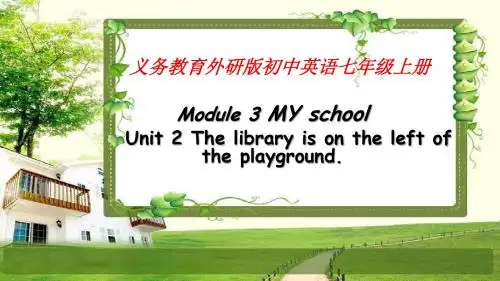
外研版七年级英语上册《 Unit 2 The library is on the left of the playground.》优质课课件_25
behind
classroom building
Office building
on the left of library
in front of
sports hall middle
playground science building
1. The library is ___o_n__th__e_le_f_t_o_f_____ the playground.
4. There's a gate in fr_o_n__t of the library. 5. I like playing basketball on the _p_l_a_y_g_r_o_u_n. d
6. Betty is on the ri_g_h_t_ of Daming. 7. Mike is b_e_h_i_n_dLucy.
hall.
5. The dining hall is _o_n__t_h_e_r_i_g_h_t_o_f__ the classroom building.
6. The school offices are __b_e_h_in_d____ the library. 7. The sport hall is ___b_e_t_w_e_e_n__ the science
B. between
C. in front of
D. on the right
( D ) 3. What’s on the ____ of the building?
A. front
B. between
C. near
D. right
( D ) 4. This is the classroom building
外研版九年级英语上册课件:Module 7 Unit 2 (共37张PPT)
要点思维导图1 拓展
举例
Do you know why they were surprised to meet their teacher in the museum? 你知道为什 么他们对在博物馆遇见他们的老师感到很惊讶吗?
You will be surprised at his progress. 你 会惊讶于他的进步。
教材例句 It is written in everyday English … 它是用日常 英语写的……(教材第58页)
要点思维导图
举例 Cooking is an everyday job. 做饭是一项日常工作。 We have breakfast every day. 我们每天都吃早饭。
应用 用everyday或every day填空 1.We should practise ___e_v_e_r_y_d_a_y__ English __e_v_e_r_y__d_a_y__. 2.This is an __e_v_e__r_y_d_a_y__ dress. I wear it __e_v_e_r_y__d_a_y__.
用法 pay for在此意为“为……付出代价;受惩罚”。
拓展 pay与for搭配还可以表示“花费;为……付钱”,与 之易混的动词有cost, spend, take,它们的用法如下:
举例
You'll have to pay for your crime. 你得为你 的罪行付出代价。
I paid a very high price for the house. 我 付了很高的价钱买下了这房子。
13、He who seize the right moment, is the right man.谁把握机遇,谁就心想事成。2021/9/82021/9/82021/9/82021/9/89/8/2021 •14、谁要是自己还没有发展培养和教育好,他就不能发展培养和教育别人。2021年9月8日星期三2021/9/82021/9/82021/9/8 •15、一年之计,莫如树谷;十年之计,莫如树木;终身之计,莫如树人。2021年9月2021/9/82021/9/82021/9/89/8/2021 •16、教学的目的是培养学生自己学习,自己研究,用自己的头脑来想,用自己的眼睛看,用自己的手来做这种精神。2021/9/82021/9/8September 8, 2021 •17、儿童是中心,教育的措施便围绕他们而组织起来。2021/9/82021/9/82021/9/82021/9/8
初中英语外研版七年级上册《Module 2 what's your number》课件PPT
Betty: It’s seven two six, eight one five. Daming: What’s your number, Tony? Tony: It’s seven nine one, four five six. Daming: My number is nine four two,
’s名词所有格:表示名词之间的所有关系。
构成: 1.单数名词后+’s Mary’ s pen 2.以s结尾的复数名词+’ the students’ book 3.不以s结尾的复数名词+’ s Children’s Day 4.若表示两个人共同所有,最后一个名词+’s,若表示两个人各自拥 有,两个名词后面都+’s Tom and Mike’s room Tom’s and Mike’s rooms
I can say
一年级一班 七年级二班 八年级三班 九年级四班
Class One
Grade One
Class Two
Grade Seven
+ Class Three
Class Four
Grade Eight Grade Nine
先说班级再说年级,注意首字母都要大写。
Let’s learn
123 45
上21世纪教育网 下精品教学资源
Let’s count
__o_n_e___ cat __f_i_ve___ books _t_h_re_e__ cups __f_o_u_r__ pencils __t_w_o__ erasers __te_n__ students e_i_g_h_t_ soccers __s_ix__ pens
外研版七年级英语下册《Module7 Unit2》优质课课件(共33张PPT)

living room somewhere you relax at home
bathroom somewhere you wash your body.
work in pairs
- where were you born? - I was born in… - Who was your first teacher? - My first teacher was… - What was she/he like? - She/He was strict(friendly,kind…)
Who are they?
John Adams and his son John Quincy Adams
3.When was Betty there for the last time?
In 2020.
Time to read! 多层阅读 二读:分段阅读课文 ①读第一段完成下题
1. How old is Betty King? 12/twelve.
Time to read!
③读第四、五段完成下题 1. 找出短语“回去,回到”go__b_a__c_k___ 和“期待,期望”lo_o_k__fo__rw__a_r_d__to____
2. It was great_t_o__p_la_y__(play) there. 该句的主语是:_t_o_p_l_ay__th_e_r_e______.
Time to talk!
The house today
is There be
are
The old houses
There be
was were
Match the key words with each paragraph.
初中英语外研版七年级上册《Unit 2 What’s your number》课件PPT
1
2
3
one two three
4
5
four
five
6
7
six
seven
8
9
10
eight
nine ten
Game 1 用英语快速大声读出你所见到的数字
1
8
3
9
zero
6
2
0
7
5
4
10
02 新知讲解
新的 学生 这里 在…里面 电话 号码
new student here in number
telephone
Unit 2 What’s your number?
Module 2 My English lesson
外研版初中英语七年级上册课件
CONTENT
复习巩固
教学重点
新知讲解
拓展练习
01 复习巩固
课前回顾
1.C_lo_s_e_your book. 2.O_p_e_n_your book. 3.S_it__down. 4.L_is_t_e_n_to your teacher. 5.P_u_t_up your hand. 6.S_ta_n_d__up. 7.D_r_a_w__a picture.
04 拓展练习
Make a survey about your classmates' phone number.
Names 1 2 3 4
Student numbers
Unit 2 What’s your number?
Module 2 My English lesson
外研版初中英语七年级பைடு நூலகம்册课件
课文导航 1 one 2 two 3 three 4 nine
外研版七年级英语上册Module 7 unit2 When do you use a compute

外研版七年级英语上册Module 7 unit2When do you use a computer?教案A teaching plan for Book 7A Module7 Unit2一、教学内容分析本模块的话题是让学生了解一些电脑方面的知识及如何使用电脑。
语法结构是一般现在时的特殊疑问句学习。
词汇主要是与电脑有关的单词。
上网是学生感兴趣的活动,借助这一话题展开讨论,通过讨论让学生掌握一般现在时特殊疑问句的结构与基本用法。
二、教学目标认知目标:熟练掌握有关电脑的词汇及用语,掌握一般现在时特殊疑问句的用法。
要求学生贴近生活,结合实际中电脑的有关知识加以学习。
技能目标:要求学生能听懂有关电脑方面的简单词汇;听懂一般现在时的特殊疑问句;能就电脑的使用进行简单的问答;能读懂基本句序及问答;根据阅读内容能修改有错误信息的句子;同时也能简单表述计算机的使用。
所有这些要求学生多听,多说。
多练,在练中加深理解。
情感目标:通过学习,要求学生提高学习电脑和英语的兴趣,促进学生适应时代的发展,进一步培养学生的良好情感。
三、教学知识重点1. Students will be able to use the new words: game, share, often,Internet, check, train, travel, plan, ticket, music, movie, search, information, email, send, sometimes.2. Students will be able to use the new phrases: buy tickets, check email, go on the Internet, make travel plans, play games, share a computer, talk to customers, search for information, watch movies.四、教学过程Step1 Warming up1. Listen to a song Dad, Where are we goingThen ask “Do you like the song ” “What’s the name of the song ” “Have you watched the programme Dad, Where are we going ” “Where do you watch the programme, on TV or on the computer ”I watch the programme on the computer, because it starts at 9:10 in the evening on TV, it’s too late.2. Play a gameSo, we can watch our favourite programmes on the computer, the computer is very useful. Is the computer so important for you Now I’ll ask you some questions, if your answer is “Yes”, please stand up.Do you have a computer at homeDo you usually use a computerDo you like computersDo you play computer gamesStep 2 RevisionWhat do you know about the computer We have learned something about the computer in Unit1, let’s revise it.Can you say the parts of the computerHow can we write our homework on the computerStep3 PresentationExcept watching our favourite programme and doing homework on the computer, what other things do we do on the computerDiscuss in groups: What do you do with the computerAsk a student of one group to give their opinion.Teach the new words if students can say some. (eg. Internet, check, send, email, ticket, movie, search, information, game…)Do you know what does Rose do with the computer I have got a computer at home, I share a computer with my family. I often go on the Internet. I like travelling. So sometimes when I want to go somewhere, I will use the computer to help me.Present the phrases below like this,First I make travel plans and search for information then I buy tickets on the internet and check the times of the train, I always download some music and movies, so I can listen to the music and watch movies on the way, and I also can send emails to friends and play computer games on my way. It is the computer that makes my travelling so interesting.Step4 reading1. There are three students they also like the computer, they are Jack, Alice and Mike, let’s watch the video ( file: / / / D:\\Download\\M7U2\\M7U2.swf" \t "_parent )and answer some questions about them, please don’t open your books. (Activity1)2. Now please open your books, read the passage carefully and check the true sentences. (Activity2)3. Read again and try to find the phrases and match two parts of the phrases, after matching, please try to translate the phrases. (Activity 3)4. Now we know we can do lots of things on the computer, let’s complete the passage with the correct form of the words from the box according to the passage. (Activity4)Step5 Enjoy readingRead the passages freely.Step6 Discussion (group work)In the programme Dad, where are we going, the five children must hand in their computer and mobile phones.Watch, think and discussion (group work)1.When do they use a computer at home2.What do they do on the computer3.Do they think the computer and Internet are important in their life WhyReport like this:They use the computer ________. They often________ on the computer, they think the computer and internet are/aren’t very important, because _______________.Homework:Level A:1.Review the new words and expressions.2.Read the passage fluently.Level B:3.Write down what you have discussed about the five children in Dad, where are we going.板书设计:Module 7 Unit 2When do you use a computergo on the Internet what do you do with the computermake travel planssearch for informationbuy tickets share…with…check the times of the train often download music and movies sometimes watch moviessend emails to friendsplay computer games PAGE2。
新外研版七年级上册英语 Module 7 Unit 2 教学课件
面的最新消息。 可数名词,通常指口头传递或书写的消 message 息。
第十九页,共二十四页。
新课讲解
例 Just search the Internet. You can get almost all the ____B____ you need.
Point
no computer 没有电脑
此句中的no修饰后面的名词computer。
在英语中,为了更简洁地表达句意,常把no直接放在名词前面,no 则相当于not a/an或not any。所以,此句也可以这样表达:There is not a computer in my home.
第十六页,共二十四页。
computer with your parents! share
第十页,共二十四页。
新课讲解
5 Writing
Answer the questions.
1 Does your father/mother use a computer?
Yes,he/she does.
2 What do you do on a computer? Write my homework.
I have a computer at home.
第十二页,共二十四页。
新课讲解
Language point 1
Point
plan/plæn/n.计划
plan作动词,常用短语plan to do sth.表示“计划做 某事”。
eg:She plans to do her homework this evening. 她计划 今晚做家庭作业。
A.no any B.no C.no a D.not a
外研版七年级上册英语Unit 2 Can you help me, please 优秀课件
课堂小结
归纳
• Structure —Can you help me?—Yes; —Can you see that again?—Yes; —Thank you.—You are welcome. • Key Words help, of course, classroom, know, say, that, again, welcome • Key sentences —Can you help me,please,Lingling? —Yes,of course— Can you say that again,please? —Yes. It's C-L-A-S-S-R-O-O-M. • Expressions
A:How do you spell it? B:... A:Thank you. B:You're welcome.
新课讲解 6 Write.
A: Can
you help me,please?
B:Yes, of
course
.
A:How do
you spell “
B:It's DESK.
desk ”?
—You're welcome.不用谢。
新课讲解
例
欢迎来北京。
_W__e_l_c_o_m_e__ ____t_o___Beijing.
【解析】“欢迎到……”用 “Welcome to ...”。
新课讲解 2 Listen and point.
新课讲解
3 Read and match.
1. Can you help me,please? 2. How do you spell “desk”? 3. Can you say that again, please? 4. Thank you. Now listen and check.
外研版七年级英语上册课件Module 7 Computers
新课讲解
Lingling:OK,what's next? Betty: Next,you write your
homework in the new document. Use the keyboard. Lingling:What do I do next? How do I save the document? Betty: You click “save”,and write a name for it. Lingling:Where do I write the name? Betty: Write it in the box .OK,then click “save” again. Lingling:OK. Finally,how do I print my document? Betty: Click “print” and “OK”.
新课讲解
一说
8 Pronunciation and speaking
Listen and repeat.
/aʊ/ how mouse /f/ finally first
/əʊ/ home open /v/ of save
新课讲解
一说
9 Work in pairs. Ask and answer questions about computers.
新课讲解 7 Find the words from the box in the conversation. Write the words they go with.
open print save use write
open a new document 1 use __t_h_e_k__ey_b__o_a_rd______ 2 write _t_h_e_n_a_m__e__________ 3 save __t_h_e_d__o_cu__m_e_n_t_____ 4 print__t_h_e__d_o_c_u_m_e_n_t_____
外研版七年级上册Module_7_Unit_2教学设计
Grade7 Module7 Unit2教学目标•知识目标1、语言目标:1)学会用英语按时间顺序描述一天的学校生活My school day 2)能够读懂有关学校生活的文章并完成相关问题。
2、教学重、难点:(1)时间的表达法(2)表示时间的介词in、on、at的用法(3)正确运用一般现在时描述经常性或习惯性的动作(4)一般现在时中I、you、we、they的肯定句和否定句(5)连词and用法3、难点突破一般现在时的概念学习。
具体特点:1)、表示现在的状态,如He's Zhang hai. I'm Lubing.2)、表示经常性或习惯性的动作。
3)、行为动词一般现在时的肯定句和否定句,如Igo to school at six. I don 'go to school on Sun day.4)、in、on、at在表示时间的用法:in the morni ng on Sun day at four让学生观察,然后加以总结归纳。
二•情感态度:乐于谈论学校生活,培养良好的学习愿望和兴趣。
三、学习策略:1、能够在同学之间积极运用所学英语就学校生活进行表和交流。
2、留心学校学习过程中使用的日常英语。
教学过程:Step1:Warm ing up教师:What day is it today?学生:It 'Mo nday (Tuesday \Wed nesday \ Thursday \ Friday \ Saturday \ Sun day)Revise : the days of the week。
教师:When is your scie nee En glish/ Chin ese/ less on?学生:at 8:00am.\9:15am\10:10am.\1:35pm.\3:20pm----本部分复习相关词汇及时间表达法,调动学生的学习情绪,并积极引导学生形成有效的学习方式。