
广州英语沪教牛津版八年级(上册)Unit2讲义及练习
Unit 2 Numbers1. 许下/违背诺言_____________________2. the rest of_____________________3. 开始意识到_____________________4. A long time ago_____________________5. 从那以后_____________________6. play chess_____________________7. copy down_____________________ 8. follow one’s advice_____________________ 9. 发生_____________________ 10. 想要做某事_____________________11. 不但…而且…_____________________ 12. make sb do sth_____________________13. 禁不住做某事_____________________ 14. make good use of_____________________ 15. 命令某人做某事_____________________ 16. all year around_____________________Step One Reading& Listening1.Check some Maths problems.【考点聚焦】(1)check 及物动词,“检查,核实”(2)【拓展】 check 的相关短语(3) check in__________ check out__________ check up___________I will meet Jane at the station, please _________ what time she will arrive.A. countB. chooseC. checkD. Catch(2)problem可数名词,“问题,难题”辨析:problem 与question(1)have problems in doing sth. 做某事有困难(2)_________________. 没问题。
The food safety is a serious _______ in our country. We should try to solve it.A. subjectB. programC. problemD. question2.The king’s favourite game was chess.【考点聚焦】favourite “最喜欢的”,通常位于名词前作定语, 没有比较级和最高级形式,在含义上相当于________What’s sb’s favourite... ? =_____________________?【拓展】也可用作名词,意为“最喜欢的人或物”This book is my favourite.(1)one day“某一天,有一天”辨析:one day与some dayE.g. I think, my dream will come true_____________________。
E.g. ___________ the old man was very ill.(2)challenge sb. to sth. 向某人挑战......【拓展】challenge sb. to do sth. 向某人挑战做某事,激励某人做某事[完成句子]1. 你为什么要检查卧室呢?Why do you ________ the bedroom?2. 聪明的人总是能及时的解决难题。
Someone who is _______always solve the _______ in time.3. 你想向他挑战吗?Do you want to ________ him?4. 这张书桌大约100厘米长The desk about100_______ ________.4. The King promised the old man, “ You can have any prize if you win the game. ”(1)①promise sb. sth. =______________________.She promised me the book.② promise to do sth.They promised________(come)to the party on time.③ promise也可以作名词,make a promise意为“________________”如: My mother made a promise to buy a new bike for me.( ) He promised ________ old friend during his stay in Tianjin.A. seeB. seeingC. sawD. to see(2)if,意为“如果”,引导条件状语从句。
表示在某条件下,某事很可能发生。
如:If you ask him,he will help you. 如果你请他帮忙,他会帮你的。
( Part A) ( Part B)上述的Part A为条件状语从句,Part B 为主句。
从句可以放在主句前,也可以放在主句后。
当从句置于主句前时,从句后就加逗号。
如:He will help you if you ask him.【拓展】 If引导的条件状语从句(1)引导条件状语从句最常用的连词是if, 常用的if条件状语从句表示在某种条件下,某件事很可能发生,条件是可能存在的,主句中某种情况发生的概率也是很高的。
E.g. If you ask him, he will help you.E.g. If you have finished the homework you can go home.(2)另外,If从句还可以表示不可能实现的条件或根本不存在的条件,也就是一种虚拟的条件或假设。
从句多用一般过去或过去完成时,表示对现在或过去的一种假设。
E.g. If I were you, I would invite him to the party.E.g. I would have arrived much earlier if I had not been caught in the traffic.另外还要注意if条件句的时态搭配有以下几种情况:(1) if 从句用一般现在时,主句用一般将来时,e.g. If he runs, he’ll get there in time.(2)if 从句用一般现在时,主句用may/might/can,E.g. If it stops snowing, we can go out.(3) if 从句用一般现在时,主句用must/should,E.g. If you want to lose weight, you must/should eat less bread.(4) if 从句用一般现在时,主句用一般现在时,E.g. If you heat ice, it turns to water. (也可用will turn)(5) if 从句用现在进行时,主句用一般将来时,E.g. If you are looking for Peter, you’ll find him upstai rs.(6) if 从句用现在完成时,主句用一般将来时,E.g. If you have finished dinner, I’ll ask the waiter for the bill.单项选择( ) 1. If there________ no buying and selling of animals, there_______ no killing in nature.A. is; will heB. will be; will beC. is; isD. will be; is( ) 2. _________, I'll go shopping alone.A. If she comesB. If she won't comeC. If she doesn't come( ) 3. The students ____ have a sports meeting this weekend if it _____.A. won’t; rainsB. will; rainsC. won’t; will rainD. are going to; is going to rain( ) 4. If you _____ to the party, you’ll have a great timeA. will goB. wentC. goD. going( ) 5. –What are you going to do tomorrow?--We’ll go to the library tomorrow if it ___.A. isn’t rainB. rainC. won’t rainD. doesn’t rain( ) 6. What will you do if you _____ to the old folk’s home visit?A. goB. wentC. goingD. will go( ) 7. If I eat ____ food, I’ll be very fat.A. too manyB. many tooC. too muchD. much too( ) 8. I’ll give the book to him if he ___ here next Sunday.A. will comeB. comesC. is comingD. came5... And then double the amount for each of the rest of the squares.rest 此处用作名词,“剩余部分”,the rest 作主语时,谓语动词的单复数要视作具体情况而定,如果所指代的为可数名词,则视为复数;如果所指代的为不可数名词,则视为单数。
the rest of... “...... 的剩余部分”,作主语时谓语动词的单复数取决于of后面的名词形式。
One of the books ______written in Chinese, and the rest _______in English.The rest of the money________ donated to charities.6. Would’t you like gold or silver instead?难道你不想要金子或银子代替?instead副词,意为“代替;顶替”。
(完整版)牛津版沪教版英语八年级(上)Unit2Numbers词句讲解+练习+答案

Unit 2 Numbers词汇讲解1. number(1) number用作可数名词,意为“数字”。
例如:We often use Arabic numbers in our daily life. 在我们的日常生活中,经常使用阿拉伯数字。
(2) number还可意为“号码”。
如果放在数字的前面,常缩写为NO。
例如:Her telephone number is 281-9176. 她的电话号码是218-9176.I study in NO. 4 middle school. 我在第四中学上学。
【拓展】(1) a number of 意为“许多”,后面接可数名词的复数形式,谓语动词用复数形式。
number前面可以用large,great,small等修饰,构成a large number of; a small number of等。
例如:I have a number of letters to write. 我有许多信件要写。
A large number of students in our school are from the countryside. 我们学校许多学生来自农村。
A small number of students in our class went swimming yesterday.昨天我们班一小部分学生去游泳了。
(2) the number of意为“……的数量”,后接可数名词复数,谓语动词用单数形式。
例如:The number of people speaking Chinese is larger than that of those speaking English.说汉语的人数要大于说英语的人数。
2. checkcheck作及物动词,意为“检查;核实”。
例如:Our teachers check our homework every day. 我们的老师们每天都检查我们的作业。
最新牛津版广州版八年级英语上册unit-2课文重点、语法点分析与练习

第二讲Unit 2 Numbers【学习目标】1.学习Uint 2的重难点词、短语、句型:2.情态动词should, ought to 的用法。
【难点、重点分析】(一)、重点单词、短语1.Read a story about numbers.读一个关于数字的故事。
Number此处用作可数名词,意为“数字”。
Number还可表示“号码”。
We often use Arabic numbers in our daily life.在我们的日常生活中我们经常使用阿拉伯数字。
What’s your telephone number?你的电话号码是多少?拓展:number还可用作及物动词,意为“标序号;给……编号”。
Please number the pictures.请给这些照片编上序号。
2.Check some Maths problems.检查一些数学题。
(1).check及物动词,意为“检查;核实”。
Our teachers check our homework every day.我们的老师们每天给我们检查作业。
Please check the answers.请核实答案。
拓展:check 的相关短语:Check in登记;检票 check out办请手续后离开 check up检查(2).Problem可数名词,意为“问题,难题”。
He worked out the Maths problem.他算出了那道数学难题。
These are the problems of youth.这些是青少年的问题。
辨析:problem与question【拓展】(1).have problem(in)doing sth.做某事有困难They have some problems (in) getting there on time.他们准时到达那儿有些困难。
(2).No problem.没问题。
—Can you help me ?你能帮助我吗?—No problem.没问题。
沪教牛津版-英语-八上- Unit 2 Lesson 2 Eating Out text

Unit 2 Lesson 2 Eating Out text教学目标:Teaching objectives:Ⅰ. Knowledge and skills:1.Students will be able to master some sentence pattern.2.Students will be able to talk about foodⅡ.Progress and Methods:1.Students will be able to develop their abilities of learning independently,cooperation with others and sharing with others.2.Students will be able to learn how to use the knowledge into practice.3. Students will be able to develop their abilities of listening, speaking and reading. Ⅲ.Emotions an d values:1.Students will be able to arouse the interest of learning English.2.Students will be able to develop the communicative skills about how to use the newwords and phrases.3.Students will be able to know how to order food in a Western restaurant. Language focus and difficult points:To take ordersTeachi ng procedures:Ⅰ.Pre-task:Warming-up:Tuning In1) Listen to some people ordering food in the restaurant. Tick the food and drinksthat they would like to have.2) Answer some questiona)What is this?( It’s a menu)b)Do you often eat out? How often do you eat our?c)Which menu is for a Chinese restaurant? Which is for Western restaurant?d)How many parts does a menu for a Western restaurant have?(Four.) And what arethey?(Starters, main courses, drinks and desserts.)3) Match:_______ the first course of a meal a. drink_____ the main part of a meal b. main course_____ a sweet course or dish at the end of a meal c. starter ____ a liquid like beer or Sprite d. dessert.Ⅱ.While-task:1, Look at the pictures, and answer these questions①Where is Zhang Jun?②Has Zhang Jun booked a table?③Who has he invited to dinner? Why?2, Listen to the text , and fill in the tableWhat ‘s the speciality of theNew Century Restaurant?steakWhat do Zhang Jun and Helen order? For starters: two cups of mushroom soup For main course: two steaksFor dessert: two pieces of chocolate cakeFor drinks: a Coke and an apple juiceHow w ould Helen like thesteak?Rare medium well-doneHow much does the meal cost? £15.8Who pays the bill? Zhang Jun Helen Do DutchWho leaves the tip? Zhang Jun Helen3,Read after the tape and then correct the table with desk mate4.Play a role to read the text5.Underline some important phrases and sentences in the text.6.Notes of the text.Notes①speciality 特色菜(英国英语), specialty (美国英语)②We will have tow cups of mushroom soup for starters, two steaks for the main course, two pieces of chocolate cak e for dessert, and a Coke and an apple juice .dessert n. 甜点既可以作可数名词, 也可以作不可数名词, 但在词组for dessert中,一般使用不可数名词.。
牛津版沪教版英语八年级(上)Unit 2 Numbers 语法讲解+练习+答案
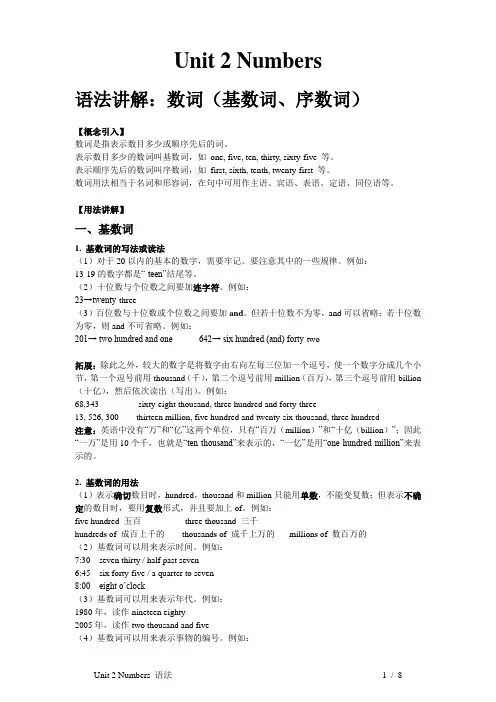
Unit 2 Numbers语法讲解:数词(基数词、序数词)【概念引入】数词是指表示数目多少或顺序先后的词。
表示数目多少的数词叫基数词,如one, five, ten, thirty, sixty-five 等。
表示顺序先后的数词叫序数词,如first, sixth, tenth, twenty-first 等。
数词用法相当于名词和形容词,在句中可用作主语、宾语、表语、定语、同位语等。
【用法讲解】一、基数词1. 基数词的写法或读法(1)对于20以内的基本的数字,需要牢记。
要注意其中的一些规律。
例如:13-19的数字都是“-teen”结尾等。
(2)十位数与个位数之间要加连字符。
例如:23→twenty-three(3)百位数与十位数或个位数之间要加and。
但若十位数不为零,and可以省略;若十位数为零,则and不可省略。
例如:201→ two hundred and one 642→ six hundred (and) forty-two拓展:除此之外,较大的数字是将数字由右向左每三位加一个逗号,使一个数字分成几个小节,第一个逗号前用thousand(千),第二个逗号前用million(百万),第三个逗号前用billion (十亿),然后依次读出(写出)。
例如:68,343 sixty-eight thousand, three hundred and forty-three13, 526, 300 thirteen million, five hundred and twenty-six thousand, three hundred注意:英语中没有“万”和“亿”这两个单位,只有“百万(million)”和“十亿(billion)”;因此“一万”是用10个千,也就是“ten thousand”来表示的,“一亿”是用“one hundred million”来表示的。
2. 基数词的用法(1)表示确切数目时,hundred,thousand和million只能用单数,不能变复数;但表示不确定的数目时,要用复数形式,并且要加上of。
沪教牛津版-英语-八上-Unit 2 Lesson 2 Eating Out so that

教学目标:Teaching objectives:Ⅰ. Knowledge and skills:1.Students will be able to master the adverbial clause of result (so…that). Ⅱ.Progress and Methods:1.Students will be able to learn how to use the knowledge into practice. Ⅲ.Emotions and values:1.Students will be able to arouse the interest of learning English. Language focus and difficult points:To master the adverbial clause of result (so…that).Teaching procedures:Ⅰ.Warming-up:ⅡRevisi on1. Recite the text.2. Check the homework.3. Prepare for the new words and expressions for Lesson TwoⅢWritingWrite at least 60 words about the topic Eating out” Use t he word cuessave time more delicious food very convenienta bigger variety of food, good for making friendsvery expensive noisy not clean waste timeso---that/such--that引导的结果状语从句中文: 如此---以至于-----so+ a./ad.+ that----such + n. + that----Read the sentences and answer the questions belowThe food was so delicio us that we enjoyed the dinner very much.He ate so quickly that he got a stomachache.She was so happy that she sang all the way.It is such a heavy box that nobody can move it away.Questions:How many clauses does each of the above sentences have?Which clause tells us the result? The that clause or the main clause?What kink of word can we use after so? An adject ive or an adverb?Exercises:1. The service of that restaurant was very good. I would call again.2. The waiter was very nice. Mr. Smith left him a 20 per cent tip.3. Helen was very kind to Zhang Jun. She helped him a lot during his stay in London.4. The roast chicken was very tasty. I liked it very much.5. Restaurant food is very expensive. Some people pack their lunch to work every day.6. The customers were very pleased with the service. They left very big tips.7. The Chinese painting is very beautiful. Everyone likes it.8. Polly’s lecture was very interesting. It attracted a large audience.9. The girl is so clever that she can work out the problem herself. (enough t o)10. The man was so tired that he couldn’t walk any farther. (too--to)11. The steak was so salty that I could hardly eat it .(too--to)12. Sally is so tall that she can reach the lights.(enough to)13. The porter looks very strong. He can easily carry the heavy box. (enough to)14. The restaurant is so small that it can’t hold twenty customers. (too--to)Ⅲ.Post-task:Homework1. Prepare for Writing。
沪教牛津版-英语-八上-:Unit2教案3
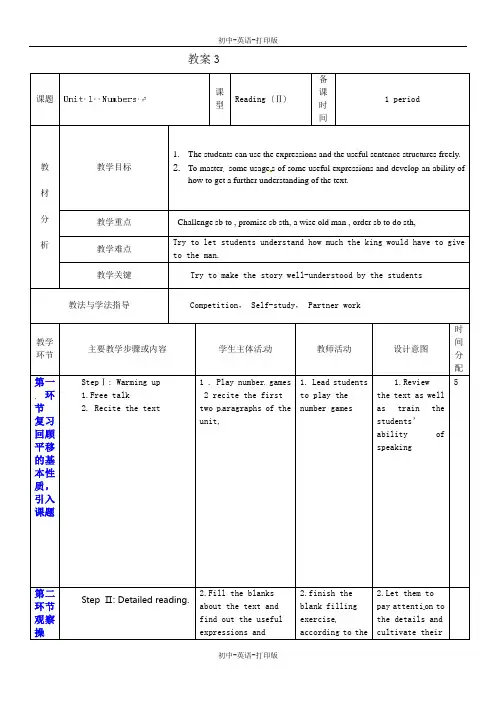
教案3课题课型Reading (Ⅱ)备课时间1 period教材分析教学目标1.The students can use the expressions and the useful sentence structures freely.2.To master some usage s of some useful expressions and develop an ability ofhow to get a further understanding of the text.教学重点Challenge sb to , promise sb sth, a wise old man , order sb to do sth,教学难点Try to let students understand how much the king would have to giveto the man.教学关键Try to make the story well-understood by the students教法与学法指导Competition, Self-study, Partner work教学环节主要教学步骤或内容学生主体活动教师活动设计意图时间分配第一环节复习回顾平移的基本性质,引入课题StepⅠ: Warming up1.Free talk2. Recite the text1 . Play number games2 recite the firsttwo p aragraphs of theunit,1. Lead studentsto play thenumber games1.Reviewthe text as wellas train thestudents’ability ofspeaking5第二环节观察操Step Ⅱ: Detailed reading. 2.Fill the blanksabout the text andfind out the usefulexpressions and2.finish theblank fillingexerciseaccording to the2.Let them topay attenti on tothe details andcultivate their作、探索归纳平移的作法StepⅢ:Important phrases and Sentence structureslearning. structures in the textlike :India , wise, prize,grain , double , collect,realized, square3. Make sentences withthese importantpoints in the text andtake notes of theexplanati ons of theimportant points:challenge him to a game,order his men to ,realize the problem ,have enough rice to ,a long time ago , andso on , copy downtext , and missthe importantphrases anddifficult pointin the blankfillingexercise3. Show somepictures by PPT,and expl ain theusage of theimportantphrases and themain lan guagepoints ,thebasicstructures ofthe text. Thenprepare severalpaper whichcontain thesentence madewith theimportantphrasesability ofthinking.3.To develop thestudents’ability ofcooperation andto make everysu re studenttake part in thework.第三环节课堂练习StepVI: Mor e practice 4. Use the right formsof the expressions tofinish the sentences.5. Translate theChinese sentencesinto English by usingthe important phrasesin the text4.Give them anexample to dothe exercise.5. work in groupto check theanswers.4. to consolatethe usage of thekey points ofthe text5. let studentsuse the usefulexpressionsthey learned第四环节课时小结StepⅥ: sum up7.write down andremember theimportant points ofthis class.6.Show a PPT andsum up the mainpoints of thetext and leadstudents to readit.第五环节课后作业Step V: Homework 1. remember theimportant points andprepare for thedictation2. Make sentences withthe important pointsand structureslearned in this class课堂教学流程Free talk→ Reciting→ Get the important points and play games →Useful-structure→ Exercise。
沪教牛津版8上U2L2 (教师版)
7. —The book Journey to the West is very popular.
—Yeah, more than
students in our school bought it.
A. three hundred
B. twelve
C. twenty
D. twentieth
【答案】 C
6
解析: 考查数词。根据句意,火车九点抵达,现在是八点四十,因此还有二十分钟,故选C。
100以上的数字
【读一读】试试看能否找出这些词的变化规律?
101→ a (one) hundred and one 230→ two hundred and thirty 513→ five hundred and thirteen 678→ six hundred and seventy-eight 999→ nine hundred and ninety-nine
【写一写】 从20~90整十位数,
含义 11 12 13 14 15 16 17 18 19
基数词
twenty thirty forty fifty sixty seventy eighty ninety
含义
20 30 40 50 60 70 80 90
21-99的非整数
【读一读】试试看能否找出这些词的变化规律? 21→twenty-one 32→thirty-two 55→fifty-five 74→seventy-four
叫基数词 e.g., 6只狗,3个人, 10台电脑……
2
3. 序数词
e.g., 第一名 第五年 北京第二实验小学
叫序数词
四、数词词形
1. 基数词的词形
沪教牛津版-英语-八上-:Unit2教案2
教案2课题课型Reading备课时间1 period教材分析教学目标1. students can know the usage of the numbers in our dailylife2. Develop the reading ability and speaking skills教学重点Let students know how important the numbers are in our daily life.教学难点learn about the diff erent forms of numbers教学关键Make the text more interesting and easier to learn教法与学法指导Reading co mpetition, cooperation, self-study.教学环节主要教学步骤或内容学生主体活动教师活动设计意图时间分配第一环节复习回顾平移的基本性质,引入课题Step one: Free talk :Find out the numbers in yourdaily life1.Find out where youcan see numbers in youdaily life ?Then answer thequestions in Part B1. Finish PartA ,fill in theblank of thepictures1.To arousethe interest andlead them toget into thetopic of thisunit.5第二环节观察操作、探索归纳平移的作法Step two: Fast reading 2. Read the textquickly and answer thequestions2. Show thequestion:a. In whichcountry thestory happened?b. What was theking’sfavouritehobby?c. What did the2.Let thestudents get thegeneral idea ofthe text..25Step three: while-reading. Reading comprehension. 3. Read the text indetails and finish theblank fillingexercise in a sheet,then check theanswers ,after that ,try to designquestions accordingto the text and askyour classmates toanswer it .Then let students havea try to count how muchrice the man couldget?4. Talk in group : Canyou tell someinteresting storiesabout numbersman want if hewon the game?d.Who win thegame?e. How much ricedid the man winat last?3. hand out thesheet and designthe blankaccording to theimportantinformation.Then check theanswers withstudents4. share someinterestingstories aboutnumb ers withstudents3.To make themget familiarwith the detailsof the text andtrain theirability ofreading4.train thestudentsspeakingability andcooperationability.Step four: Discussion第三环节课堂练习Step five: exercise 5.Finish theexercise i n Part Cand D5.Help them tofind the detailsin the text.5. To train thestudents’readingability .5第四环节课时小结step Six: Sum up 6 Sum up :Numbers arevery important in ourdaily life. We shoulduse it carefully .6. Show a PPT tosum up : numberscan be used toshow time, tell usthe amount ofthings , and canindentify therooms etc.6. Prepare forthe writing5第五环节课后作业 Homework 1. Read the textfluently2. write a passageabout the usage ofnumbers in our dailylifeHand out asheet whichcontain therequest ofwriting thepassageStrengthen thecomprehensionof the text.课堂教学流程Free talk --- Preparation ---Reading competition ----- Discussion—exercise—sum up--Homework .效果评价与反思。
沪教牛津版-英语-八上-:Unit2教案6
教案6课题课型Writing备课时间1 Period教材分析教学目标1.Learn to finish a report by using nubers教学重点Master the correct use of numbers教学难点 Know the correct numbers of the students in the chart 教学关键 Try to write the numbers in figures ,not in words教法与学法指导Self-study, Cooperation, Group work.教学环节主要教学步骤或内容学生主体活动教师活动设计意图时间分配第一环节复习回顾平移的基本性质,引入课题StepⅠ:Free talk andpreparation for wr iting1. Talk the numbers ofthe students ofdifferent classes andmake a chart to showit1. After thestudents makethe chart , showit to others .Befor e that ,give them thedetailednumbers ofdifferentclasses in theschool1.To a rousetheir interestabout the class5第二环节观察操作、探索归纳平移的作法StepⅡ: complete the sentencesabout the pictures3. Find out thenumbers and fill inthe blanks3.help stu dentsto find out thenumbersaccording todifferentmonths3.To train theirability toexpress as wellas improve theirspeakingability and toget ready forthe writing andtrain theirability to10cooperate.第三环节课堂练习Step III: WritingStep IV: Check the passage 4.Before writing ,find out the numbersaccording to theyears, and begin towrite the passage ,pay attention to thetenses4.Show thenumbers and thematched yearson PPT, thenremindstudents to payattention totheirhandwritingand check them istakesstudents make4.To train thestudents’writing ability.15第四环节课时小结Step five Sum upHow to organize the writing.5. Sum up the usage ofnumbers in our dailylife.5.List thebeautifulsentences theywrite in thepassages5.Let them getfamiliar withthe writ ing.5第五环节课后作业1. Recite the passage which given as a sample .课堂教Free talk and preparation →Fill in the blank →write a pa ssage—Check the writhing. 学流程效果评价与反思。
沪教牛津版-英语-八上-:Unit2教案1
教案1课题课型NEW WORDS备课时间1 period教材分析教学目标1.Let students know the meaning of the new words andcan use the words to make sentences2.Train the students ability of cooperation教学重点The pronunciation and the usages of the new words: wise, challenge,promise, amount , instead, realize, correctly,教学难点instruction, India, grain , prize, double , accident教学关键Let all the students can read the words and know the meaning ofthe new words教法与学法指导Use some pictures and games and PPT教学环节主要教学步骤或内容学生主体活动教师活动设计意图时间分配第一环节复习回顾平移的基本性质,引入课题Step one: Warming up.Freely talk: When do you seenumbers in your daily life?Tell where you can seenumbers in your dailylife and find out theimportance of numbers1.show somepictures ofsome placeswhere we canfind numbers onthe PPT toarouse thestudentsinterest to talkabout them.1.To arousethe interest andlead them toget into thewords of the newwords5第二环节观察操作、探索归纳平移的作Step two: Newwords.Read the new words.2. Read the news wordsaccording to thesyllables and learnhow to pronounce it3. Put the new words ina number games and2.Play theMP3 o f the newwords for themand lead them toread in a properway.3.Design anumber gam es and2.Let thestudents readsthe wordscorrectly.3.To make themget familiar20法Step three: Play numbergames to remember thenew wordsStep four: Key wordslearning. play games .try to remember thenew words as quicklyas you can, with thehelp of the groupleader, then checkwith each otherwhether you rememberthe words or not .4. Work in groups tolearn the usage of thekey words, helpful ,anywhere, finally,nothing , arrive at,lead sb to , fallasleep , get down, byoneself, wake up5. match the new wordsand the pictu res shownon the pptplay a numbergames to helpthe studentswhen they havetrouble inreading the newwords4.Show the PPTof the meaningof th e key wordsand let ss makemore sentenceswith th e newwords5. check the wordsand give themmarks for thegroupswith thepronunciationand the spellin gof the newwords.4. Train thestudents’ability tocooperate. Letthe students indifferent levescan take part inthe activity.5.Provie thechances tostudents to showthemselves andpractice thespeakingability.Step five: have a competition第三环节课堂练习Step six: exercise1. use the correct forms ofthe words to fil l in theblanks like :My mother doesn’t allow me____( go) out at night.6. Finish theexercise given onthe sheet.6.Collect themistakes in thestudents’exercise.6. to consulatethe usages ofthe new words10第四环节课时小结step SevenHow many words do youmaster?Write them down in yoursheet7. Remember the wordsyou learn and spellthem out7.Give them apiece of paperto write thewords.7.To de velop thestudents’ability of self–checking.5。