
Unit 1 Where did you go on vacation (Grammar focus--3c)
含-body的复合不定代词与含-one的复合不定代词在功能和意义上 完全相同,可以互换。只是用-body时显得较通俗些,多用于口语 中,用-one时显得较文雅些,更常见于正式场合及书面语中。
2. 因为some一般用于肯定句,any一般用于否定句或
疑问句,no表示完全否定,因此由some, any, no与one,-body, -thing 组成的复合代词的用法也一样。 somebody,someone,something一般用于肯定句,而 anybody,anyone,anything一般用于否定句、疑问句 或条件句。 --Did you buy anything special? --Yes, I bought something for my father. --No, I didn’t buy anything. (I bought nothing) Someone is singing in the next room. Does anyone live in the old house? Did you go out with anyone ? No one knows his name. Would you like something to eat? 表示邀请时,疑问句里可用something.
1.Everything tasted really good!所有的东西尝起 来真的很好吃! taste在此为系动词,意为“尝起来”,其后接形容
词。
a. The food tastes really great.食物尝起来棒极了。 b. The milk tasted terrible.牛奶尝起来很糟糕。 2.Did everyone have a good time? 大家玩得开心吗 have a good time = enjoy oneself = have fun 玩得开心 (+ doing) eg: We had a good time visiting the Great Wall. enjoyed ourselves visiting = We ______ ________ ______the the Great Wall. had _____ fun visiting = We ____ _____the Great Wall.
3a
Fill in the blanks with the words in the box And practice the conversation
Linda: Did you do________ anything fun on your vacation, Alice? Alice: Yes, I did. I went to Sanya. anyone Linda: How did you like it? something Alice: Well, it was my first time there. So __________ everything was really interesting. anything anyone Linda: Did you go with__________? everything Alice: Yes, I did. I went with my sister. nothing Linda: Did you go shopping? Alice: Of course. I bought _________ for my parents, but something nothing __________ for myself. Linda: Why didn’t you buy__________ anything for yourself? anything I liked. Alice: I didn’t really see _________
今天下午我没什么特殊的事可做。
b. There is _________ nothing ______ much ___ to _____ do ,so I go to bed early.没什么事可做,因此我就早早睡觉了。 拓展:nothing…but…意为“除……之外什么也没有; 只有”。but后可接名词或动词原形。 a. I had nothing but a cup of tea this morning.我今天早 上只喝了杯茶。 b. I had nothing to do but watch TV.我无事可做,只有 看电视。
3)、两个n.并列,分别有“ ’s ”,表示“ 分别有 ”。 例: Alice’s and Bob’s fathers (表示两人各自的爸爸)
4)、两个n.并列,只有一个“ ’s ”,表示“ 共同 有 ”。 例: Alice and Bob’s father (表示两人是同一个爸爸) 5)、表示 无生命的n. 一般和of 构成短语。 例:a map of China 一幅中国地图
Unit1. Where did you go on vacation?
Grammar Focus
Where did you go on vacation? I went to New York City.
Did you go out with anyone? No, No one was here. Everyone was on vacation. Did you buy anything Yes, I bought something for special? my father. No, I bought nothing. How was the food? Did everyone have a good time? Everything tasted really good Oh, yes. Everything was excellent
复合不定代词的用法
1.不定代词some, any, no, every与-one, -body, -thing 构
成复合不定代词。 somebody 某人 someone 某人 something 某物,某事 nobody 没有人 no one 没有人 nothing 没有东西
anybody 任何人 anyone 任何人 anything 任何事物 everybody 每人 everyone 每人 everything 一切
1.Did you go shopping? 你们去购物了吗? go shopping意为“去购物;去买东西”, do some shopping.(同义短语)
eg: I usually go shopping on Sundays.
我通常星期天去购物。 拓展:“go + doing”形式表示“去做某事”, 常用于表达从事某一体育活动或休闲活动。 go bike riding 骑自行车旅行 go climbing去爬山 go skating去滑冰 go hiking去远足 go sightseeing去观光 go fishing去钓鱼 go swimming去游泳 go camping去野 go boating去划船 go surfing去冲浪 go skateboarding去进行滑板运动
3. 复合不定代词都具有单数的含义,因此通常 被看成是单数第三人称。当它们充当句子的主 语时,其后的谓语动词用单数形式。 如:
____ everyone here today? 今天,大家都到齐
了吗? (bபைடு நூலகம்)
Nothing ___ difficult if you put your heart into it. 世上无难事,只怕有心人。 (be) Nobody/No one _______(know) his name.
名词所有格:表示 “ …的 ”
1)、单数n.词尾加“ ’s ”,复数n.词尾若没有s,也加 “ ’ s ”。 例: a girl’s pen 一个女孩的钢笔 children’s room(s) 孩子们的房间
2)、复数n.以s 结尾的词,直接加“ ’ ”。
例:students’ books
学生们的书
There _____ something or somebody near us.(作主语)
(be)
4. 形容词修饰这些复合不定代词,形容词必须 后置。如:
There is something wrong with your ears
Is there anything interesting on TV tonight? interesting修饰anything I have something important to tell you. Is there anything else in the box? --Let's give her something different to eat . --Something English? I know fish and chips! Would you give me something to drink?
the name of the story那个故事的名字
3.The only problem was that there was nothing much to do in the evening but read.
唯一的问题是晚上除了读书没什么事可做。
nothing much to do意为“没什么事可做”。 a. I have_________ afternoon. nothing ______ much ___ to _____this do
2.I went to a friend’s farm in the countryside with my family.
我和家人一起去了乡下一个朋友的农 场.
a friend’s farm是名词所有格形式。 一般情况下,表示“有生命的人或物”的 名词后面加’s,表示所属关系。 eg: The red bike is Alice’s.自行车是爱丽斯的。
Unit 1 Where did you go on vacation课文翻译
Section A, 2d
里克:嗨,海伦。
好久不见。
海伦:你好,里克。
是的,上个月我去度假了。
里克:噢,你去什么有趣的地方了吗?
海伦:是的,我和我家人去贵州了。
里克:哇!你们去看黄果树瀑布了吗?
海伦:是的,我们去了。
它太壮观了!我们在那里拍了好多照片。
你怎么样?上个月你做什么特别的事情了吗?
里克:没做什么。
我大部分时间呆在家里看书、休息。
Section B,2b
7月15日,星期一
今天早上我和家人抵达马来西亚槟城。
天气晴朗炎热,于是我们决定去宾馆附近的海滩。
我和姐姐尝试了滑翔伞,我感觉自己就像一只鸟。
这太令人兴奋了!午饭我们吃了非常特殊的东西—马来黄面,可真是好吃呀!下午,我们骑自行车去了乔治市。
如今那里有许多新的建筑,但是许多老房子依然还在。
在乔治市的一处古老的地方—海跳街,我们看到了一百年前中国商人们的房子。
我在想这里过去的生活是什么样子呢。
漫步在乔治市真是很享受。
7月16日,星期二
一天的差异是多么大呀!我和爸爸决定今天登槟城山。
我们本想徒步到山顶,但是天下起了小雨,于是我们决定乘坐火车。
因为人太
多,我们等了一个多小时的火车。
当我们到达山顶的时候,雨下得真大。
我们没有带雨伞,结果我们(被淋得)又湿又冷,真是糟透了!并且因为糟糕的天气,底下的东西我们什么都看不到。
爸爸没有带足够的钱,所以我们只吃了一碗米饭和鱼。
因为我太饿了,饭的味道尝起来还真是不错!。
Unit1Wheredidyougoonvacation(4课时教案)
1.理论介绍:首先,我们要了解一般过去时和旅行词汇的基本概念。一般过去时是用来描述过去发生的事情的时态,而旅行词汇则是我们在描述旅行经历时会用到的关键词汇。
2.案例分析:接下来,我们来看一个具体的案例。这个案例展示了如何用一般过去时和旅行词汇来描述一段假期旅行。
3.重点难点解析:在讲授过程中,我会特别强调一般过去时的动词变化和旅行词汇的运用这两个重点。对于难点部分,我会通过举例和比较来帮助大家理解。
然而,我也注意到在讲解一般过去时和旅行词汇的过程中,部分学生对动词过去式的变化规则掌握不够熟练,这在课堂练习中表现得尤为明显。为此,我计划在下一节课开始前,用更多实例和互动游戏帮助学生巩固这部分知识。
此外,在实践活动和小组讨论中,学生们表现出了很高的积极性。他们能够运用所学知识进行实际情境的对话练习,展示了对一般过去时的运用和理解。但在引导讨论过程中,我意识到需要进一步关注学生的个体差异,对基础较弱的学生给予更多关注和指导,以提高他们的自信心和参与度。
Unit 1 Where did you go on vacation(4课时教案)
一、教学内容
《Unit 1 Where did you go on vacation》共分为四个课时,教学内容主要包括:
1.第一课时:引入本单元主题,学习询问和回答假期旅行的地点。重点词汇包括:beach, mountain, camp, city, visit等。学习一般过去时的用法,如:“I went to the beach.”
(三)实践活动(用时10分钟)
1.分组讨论:学生们将分成若干小组,每组讨论一个与假期旅行相关的实际问题。
2.实验操作:为了加深理解,我们将进行一个简单的角色扮演活动。这个活动将演示如何在实际对话中使用一般过去时和ห้องสมุดไป่ตู้行词汇。
八年级新目标上unit_1_Where_did_you_go_on_vacation_知识点
Unit 1 Where did you go on vacation?一、重点短语:1.为某人买某物2.只能做某事3.到达某地4.决定去做某事5.尝试做某事尽力去做某事6.忘记做过某事忘记做某事7.喜欢做某事8.想去做某事9.开始做某事10.停下来去做另一件事停止做某事11.继续做某事12.告诉某人(不要)做某事二、辨析1.because of 介词短语,“因为,由于”,后接名词、代词或动名词,不能接句子。
because 连词,“因为”,引导状语从句,表示直接明确的原因或理由。
He can’t take a walk the rain.I don’t buy the shirt it was too expensive.2. too many,too much,much too1)too many “太多”,后接可数名词复数。
2)too much “太多”,修饰不可数名词或修饰动词作状语。
如:Don’t talk too much.3)much too “太”,修饰形容词或副词。
.如:You’re walking much too fast小结:分辨三者的口诀:too much, much too, 用法区别看后头:much 后接不可数,too 后修饰形或副。
Mother bought eggs yesterday.We have work to do every day.The hat is big for me.3.bored :“厌倦的;感到无聊的”,一般在句中修饰人,作表语。
boring:“无趣的;令人厌烦的;单调的”,一般在句中修饰事或物,可作表语和定语。
I'm with what he said. I find the story very .类似词语:辨析:exciting与excitedexciting 意为“令人兴奋的,使人激动的”,一般修饰某物。
excited 意为“感到兴奋的,激动的”,一般修饰某人。
Unit1--Where-did-you-go-on-vacation
The songs sound beautiful.这些歌曲听起来 很优美。
过得高兴,玩得愉快
have a good\great\fun time (=enjoy oneself)
They had a good time yesterday.= They enjoyed themselves yesterday.
find—found找到
2.不定代词和不定副词的用法
some
body
any
one
every thing
no
where(疑问副
词)不定代词和不定副词
(1)左边的some、any、every、no与右 边的body、one、thing构成不定代词, some、any、every、no与右边的疑问副 词where构成不定副词;
2. 回顾一下在3b中所回答的问题的情况,然后 将这些句子按恰当的逻辑顺序排列在一起, 形成条理清晰的一段文字。
3. 可根据旅行经历再加一些恰当想像的句子。 4. 再次,阅读一遍短文,看有没有错误的句
子。
假如你和你的家人在四月八号这天参观了北 京,请你以日记的形式把这天的经历及感受 记录下来。 提示:1. 早上:参观颐和园(爬万寿山;在 昆明湖划船) 2. 中午:吃北京烤鸭 3. 下午: 逛王府井大街 参考词汇:颐和园 the Summer Palace; 万寿山 Longevity Hill;昆明湖Kunming Lake;王府井大街 Wangfujing Street;风 景 scenery
1. 定基调 体裁:应用文(日记);日记的主体部分为 记叙文 时态:谈过去的经历时,用一般过去时。 人称:写个人经历时,用第一人称。
Unit 1 Where did you go on vacation
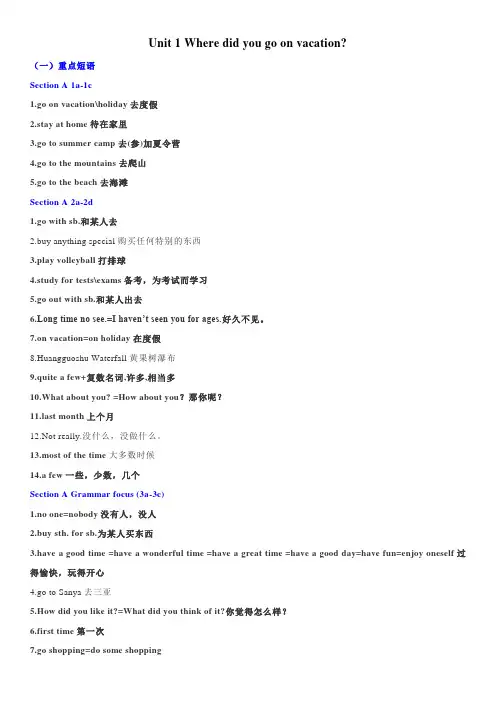
Unit 1 Where did you go on vacation?(一)重点短语Section A 1a-1c1.go on vacation\holiday去度假2.stay at home待在家里3.go to summer camp去(参)加夏令营4.go to the mountains去爬山5.go to the beach去海滩Section A 2a-2d1.go with sb.和某人去2.buy anything special购买任何特别的东西3.play volleyball打排球4.study for tests\exams备考,为考试而学习5.go out with sb.和某人出去6.Long time no see.=I haven’t seen you for ages.好久不见。
7.on vacation=on holiday在度假8.Huangguoshu Waterfall黄果树瀑布9.quite a few+复数名词,许多,相当多10.What about you? =How about you?那你呢?st month上个月12.Not really.没什么,没做什么。
13.most of the time大多数时候14.a few 一些,少数,几个Section A Grammar focus (3a-3c)1.no one=nobody没有人,没人2.buy sth. for sb.为某人买东西3.have a good time =have a wonderful time =have a great time =have a good day=have fun=enjoy oneself过得愉快,玩得开心4.go to Sanya去三亚5.How did you like it?=What did you think of it?你觉得怎么样?6.first time第一次7.go shopping=do some shopping去购物8.of course=certainly=sure当然9.buy sth. for oneself为自己买东西10.in the family在家里11.in the countryside在乡下,在农村12.the only problem唯一的问题13.bye for now就此别过,该说再见啦14.at a restaurant在一家饭店15.keep a diary写日记16.Hong Kong香港Section B 1a-1e1.best friend最好的朋友,好朋友2.fun park游乐场,娱乐公园Section B 2a-2b1.what activities什么活动2.arrive in到达大地点3.arrive at到大小地点4.get to到达5.this morning这天早上,今天早上6.try paragliding尝试滑翔伞运动,尝试跳伞活动7.feel like感觉,觉得8.Malaysian yellow noodles马来西亚黄面条9.ride bicycle to+地点,骑自行车到某地10.a lot of=lots of=many/much许多11.new buildings新的建筑物(楼房)12.many of...许多......13.the house of......的房子14.Chinese trader中国商人15.from 100 years ago 从100年以前16.in the past在过去17.walk around the town=walk all over the town在小镇上四处走走18.go to Penang Hill去槟城山19.walk up to徒步走到20.a little一点,一些21.take the train乘火车22.wait for等候,等待23.too many people许多人,太多人24.too many许多,太多(修饰复数名词)25.get to the top到达山顶26.because of因为,由于27.28.have one bowl of rice吃一碗米饭29.taste great吃起来很美味Section B 2c-2est week上周,上个星期2.go paragliding去跳伞3.on the beach在海滩上4.wait a long time for等了很长时间5.bring an umbrella带伞,带雨伞6.the next day第二天7.That’s not all.那还不算,那不是全部,不止这些。
Unit 1 Where did you go on vacation 全单元教案
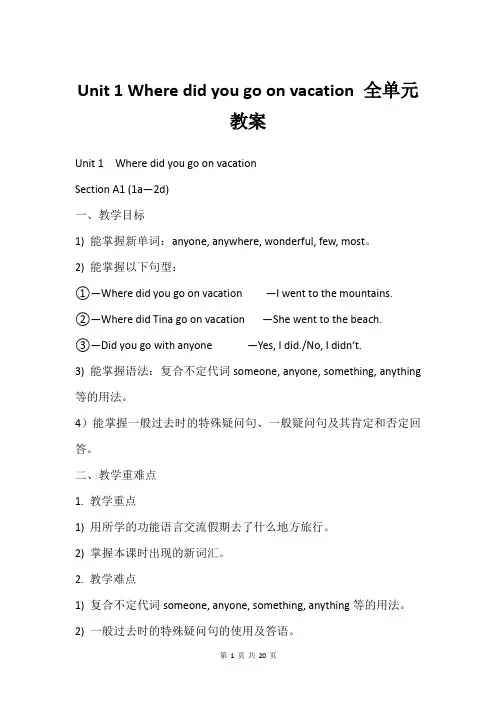
Unit 1 Where did you go on vacation 全单元教案Unit 1 Where did you go on vacationSection A1 (1a―2d)一、教学目标1) 能掌握新单词:anyone, anywhere, wonderful, few, most。
2) 能掌握以下句型:①—Where did you go on vacation —I went to the mountains.②—Where did Tina go on vacation —She went to the beach.③—Did you go with anyone —Yes, I did./No, I didn’t.3) 能掌握语法:复合不定代词someone, anyone, something, anything 等的用法。
4)能掌握一般过去时的特殊疑问句、一般疑问句及其肯定和否定回答。
二、教学重难点1. 教学重点1) 用所学的功能语言交流假期去了什么地方旅行。
2) 掌握本课时出现的新词汇。
2. 教学难点1) 复合不定代词someone, anyone, something, anything等的用法。
2) 一般过去时的特殊疑问句的使用及答语。
三、教学过程1. Lead-in观看有关旅行的动画视频,进入本课时的主题——谈论过去的假期去了什么地方及做了些什么事情。
2. Presentation1)Show some pictures on the big screen. Let students read the expressions.2) Focus attention on the pictures. Ask: What can you see Say: Each picture showswhat a person did in the past. Name each activity and ask students to repeat:stayed at home, went to New York City, visited my uncle, went to summer camp,went to mountains, went to the beach, visited museums.Now, please match each phrase with one of the pictures next to the name of theactivity. Point to the sample answer.Check the answers. Answers: 1. f 2. b 3. g 4. d 5. c 6. a 7. e 3. Listening1) Point to the picture on the screen.Say: Look at the Picture A. Where did Tina go on vacation She went to mountains.Ask: What did the person do in each picture2) Play the recording the first time.3) Play the recording a second time.Say: There are three conversations. The people talk about what they did on vacation. Listen to the recording and write numbers of the names in the right boxes of the picture.4) Check the answers.4. Pair work1) Point out the sample conversation. Ask two students to read the conversation to the class.2) Now work with a partner. Make your own conversation about the people in the picture.3) Students work in pairs. As they talk, move around the classroom and give any help they need.4) Let some pairs act out their conversations.5. ListeningTell students that they will hear a conversation about three people’s talking about their vacations. Listen for the first time and fill in the chart. Then listen again and check Yes or No.1) Let students read the phrases in the chart of 2b.2) Play the recording the first time. Students listen and fill in the chart.3) Play the recording a second time for the students to check “Yes, I did.”or “No, I didn’t. ”4) Check the answers with the students.6. Pair work1) Let two students read the conversation between Grace, Kevin and Julie.2) Let students work in pairs and try to role-play the conversation.3) Ask some pairs to act out their conversations.7. Role-play1) First let students read the conversation and match the people and the places they went to.2) Let students act out the conversations in pairs.3) Some explanations in 2d:Long time no see. anywhere interesting took quite a few photosWhat about... anything special Not really.I just stayed at home most of the time to read and relax.Homework:用英语询问你的一位好朋友,她(他)假期去了哪里?看到了什么?并将此对话写在作业本上。
人教版英语八年级上第一单元Unit1Wheredidyougoonvacation知识点梳理
人教版英语八年级上第一单元Unit1Wheredidyougoonvacation知识点梳理Unit 1 Where did you go on vacation?知识梳理一、词型转换Section A1.wonder →(adj.) wonderful2.I →(反身代词) myself3.you →(反身代词) yourself4.yourself →(pl.) yourselves5.seem →(pt.) seemedSection B1.activity →(pl.) activities2.decide →(n.) decision3.try →(pt.) tried4.bike →(同义词) bicycle5.build →(n.) building6.difference →(adj.) different7.like →(反义词) dislike8.below →(反义词) above二、短语归纳Section A1.go to Central Park 去中央公园2.on vacation 在度假3.buy something special 买特别的东西4.meet someone interesing 遇见有趣的人5.go out with someone 和某人一起出去6.take quite a few photos 拍相当多的照片7.most of the time 大多数时间8.go shopping 去购物9.keep a diary 记日记10.of course 当然;自然Section B1.have a good time 玩得高兴;过得愉快2.go to the beach 去海滩3.feel like 感觉像4.the houses of the Chinese traders 中国商人的房子5. a lot of new buildings 许多新的建筑物6.in the past 在过去7.over an hour 一个多小时8.too many people 太多的人9.get to the top 到达顶部10.because of the bad weather 因为不好的天气11.one bowl of fish 一碗鱼肉12.another two hours 另外两个小时13.the top of the hill 山顶14.learn something important 学习重要的东西Self Check1.go to the countryside 去乡下2.in the shopping center 在购物中心3.have a fun time 玩得高兴;过得愉快4.after three hours 三个小时以后5.keep going 一直走6.twenty minutes later 20分钟后重点句子1.Where did you go on vacation?你去哪儿度假的?2.Long time no see.好久不见。
Unit-1-Where-did-you-go-on-vacation短语、重点句型、作文
Unit 1 Where did you go on vacationSection A一、短语1. be/go on vacation = take a vacation度假2. stay at home/school 呆在家3. go (out) with ... 和...一起(出)去4. take photos (of ...) (给...)拍照5. quite a few + 可数名词复数= many + 可数名词复数相当多,不少6.taste/feel/sound/look good 尝起来/感觉起来/听起来/看起来好7. have a good time = enjoy oneself 过得愉快,玩得开心8. Of course 当然,一定9. in the countryside 在乡下10.keep a diary 记日记11.go shopping 去购物12. seem (to be) + 形容词/名词好像是... seem to do sth. 好像做某事13. most of the time大多数时间go to summer camp 去夏令营14. nothing... but...只有...,除...之外什么也没有15. buy sth. for sb. = buy sb. sth. 为某人买某物16. be/get bored with ... 对...感到厌烦二、重点句型1. -Where did you go on vacation? 你在哪度的假?-I went to the mountains. 我去山上了。
2. -Oh, really? Did you go with anyone?真的吗?你跟别人一起吗?-Yes, I went with my mother. 是的,我跟我妈妈一起。
3. Long time no see. 好久不见。
4. Did you do anything special last month?你上个月做什么特别的事情了?5. I just stayed at home most of the time to read and relax. 我大部分时间只是待在家里看书和放松。
Unit1 Where did you go on vacation
Unit1 Where did you go on vacation?1.Where did you go on vacation? 这是一个一般过去时的特殊疑问句,其句式结构为“特殊疑问句+一般疑问句”其中where在句中作状语Where are you from?Iam from Xiamen.常见的疑问句词有what, who, whose, which, when, where, how, what time, what color, how much, how many等。
当特殊疑问句作主语时,句子的语序与陈述句的语序相同。
当特殊疑问句作句子的宾语,状语时,应用疑问词+一般疑问句的语序Who will give us a talk?(做主语)When do you get up every day?(时间状语)On vacation在假期中强调正在度假或休假The Smiths are on vacation.2.I went to the mountains.Go to+地点表示去。
Go to the beach, go to summer camp, go to Beijing2.过去式和动词原形一样的词有:Hurt, cost, let, put, cut, read3.原形以ow/aw结尾,过去式变为ew结尾Know-knew, grow-grew, draw-drew, throw-threw4.将动词原形中的I 改为O,变为过去式的动词Ride-rode, drive-drove, write-wrote5. 将动词原形中的I 改为a,变为过去式的动词swim-swam, give-gave drink-drank, ring-rang, begin-began, sing-sang6过去式以ought或aught结尾的动词Think-thought, buy-bought, bring-brought, fight-fought, teach-taught, catch-caught7.有些以eep或-end结尾的动词,过去式要改为ept或-entKeep-kept, sweep-swept, sleep-slept,lend-lent,spend-spent, send-sent8.Did you go with anyone?你和别人一起去的吗?这是实义动词过去时态的一般疑问句。
Unit 1 Where did you go on vacation重点词汇
Unit 1 Where did you go on vacation?一、单元重点短语1.go on vacation 去度假2.stay at home待在家里3.quite a few 相当多4.most of the time 大部分时间5.keep a diary 记日记6.buy sth. for sb.为某人买某物7.have a good time玩得愉快8.of course当然9.meet someone interesting遇见一些有趣的人10.arrive in 到达11.decide to do sth. 决定做某事12.feel like 感受到,给...的感觉13.wait for the train等火车14.get to the top到达顶部15.because of因为16.another two hours另外两个小时二、单元重点词汇详解1.wonderful /ˈwʌndəfl/ (adj.)精彩的,绝妙的近义词:good; nice; enjoyable反义词:bad; terrible; awful词汇变形:wonderfully (adv.)We had a wonderful time last night.What a wonderful gift!2.few /fju:/ (pron.&adj.) 不多,很少词汇辨析:few/a few/ little/a littleThe problem is so hard. Few students can work it out.There are a few apples in the fridge. We needn’t buy any.There is little milk in the fridge. We need to buy some.He knows a little English. And he can talk with foreign(外国的) people.●●●●few/a few/ little/a little辨析表3.seem /si:m/ (v.)好像;似乎;看来词汇用法:You seem happy.(seem +adj.)He seems a nice man. (seem +n.)He seemed to be sleeping.(seem+to do)It seems that everyone here likes the little girl. (It seems/seemed that...)4.bored /bɔ:d/ (adj.) 厌倦的,烦闷的词汇辨析:bored/ boring“使/令...”动词-ed/-ing构成一组形容词;-ed结尾的意为“ 让/令人感到...样的”;-ing结尾的意为“ 感到...样的”。