
高中英语Unit 2 Sailing the oceans Using Language
Unit 2 Sailing the oceansPart One: Teaching DesignPeriod 3: A sample lesson plan for Using Language (THE GREATEST NA VIGATIONAL JOURNEY: A LESSON INSURVIV AL)AimsTo help students read the passage THE GREATEST NA VIGATIONAL JOURNEY: A LESSON IN SURVIV AL To help students to use the language by reading, listening, speaking and writingProceduresI. Warming up by learning something about William BlighWilliam Bligh in 1814Vice Admiral of the Blue William Bligh, FRS (9 September 1754 - 7 December 1817) was an officer of the British Royal Navy and colonial administrator. He is best known for the famous mutiny that occurred against his command aboard HMA V (His Majesty's Armed Vessel) Bounty and the remarkable voyage he made to Timor on the Bounty's launch after being set adrift by the mutineers. Many years after the Bounty mutiny he was appointed Governor of New South Wales, with a brief to clean up the corrupt rum trade of the NSW Corps. He had some success in his task but quickly faced opposition which culminated in the Rum Rebellion led by John Macarthur. Although William Bligh was certainly not the vicious man portrayed in popular fiction, some claim his over-sensitivity and acid tongue damaged what would have otherwise been a distinguished career.II. Reading for formsRead the text THE GREATEST NA VIGA TIONAL JOURNEY: A LESSON IN SURVIV ALon page 17 to: cut/ the sentence into thought groups, blacken the predicative, darken the connectives and underline all the useful expressions.THE GREATEST NA VIGATIONAL JOURNEY:A LESSON IN SURVIV ALIII. Copying expressions and making sentencesIV. Listening and speaking about Viking sailing and Polynesian seamenThe name Viking is a borrowed word from the native Scandinavian term for the Norse warriors who raided the coasts of Scandinavia, the British Isles, and other parts of Europe from the late 8th century to the 11th century. Vikings traveled to the west and Varangians, who were best known as the Varangian Guards of the Byzantine emperors, to the east. This period of European history (generally dated to 793 - 1066 AD) is referred to as the Viking Age.The word “Viking” was introduced to the English language with romantic connotations in the 18th century. Today, somewhat controversially, the word is also used as a generic adjective, referring to the Viking Age Scandinavians. The medieval Scandinavian population, in general, is more properly referred to as Norse.Where is Polynesia?A division of Oceania including scattered islands of the central and southern Pacific Ocean roughly between New Zealand, Hawaii, and Easter Island. The larger islands are volcanic, the smaller ones generally coral formations.Now go to page 19. L et’s go to listen to something about Viking sailing the oceans. While listening try to circle those aids in the box on page 19 that the early sailors used to find their ways at sea. Now you shall listen to the tape once again to fill in the chart on page 19.On page 20 there are four sayings from Polynesian seamen.What does each of them mean?Now in pairs talk about each of the sayings.V. Closing down by Zheng He, a great Chinese sailorCheng Ho or Zheng He (both: jŭng' hʊ') , 1371–c.1433, admiral, diplomat, and explorer during China's Ming dynasty. At 10 he was captured by Chinese troops in Yunnan, castrated, and sent into the army. He rose in the ranks, became an officer, and in 1404 was named Grand Eunuch by Emperor Yung-lo. The following year the emperor selected him to lead the first of seven epic expeditions (1405–33) that served to expand Chinese political influence and increase its tribute and trade. Sailing to SE Asia (1405–07), he commanded 62 ships laden with porcelain, lacquer, silk, gems, and other luxury goods. Subsequently commanding treasure fleets ranging from about 50 to more than 100 vessels, some of which were 500 ft (153 m) long, he also later sailed to India, Sri Lanka, Arabia, E Africa, and Egypt. On his fourth voyage (1413–15), Cheng returned with envoys from 30 foreign states who rendered homage to the emperor and sailed home on his sixth voyage (1421–23). Although China returned to an isolationist policy after the emperor's death (1424), Cheng made one last voyage (1431–33). A controversial theory posits that Cheng discovered the New World during his 1420s voyage, some 70 years before Columbus.。
高中英语 Unit 2 Sailing the oceans Sailing the oceans教

第一部分《金色教案》教学设计说明About the topic and the structures单元话题和结构本单元的话题是“大海航行”,介绍了航海知识和航海探险逸事。
通过学习学生应该了解:我国历史上就是航海的先驱国,自古以来一直处于领先地位,对航海技术的发展有着杰出的贡献。
目前,我国已成为世界上的航运大国,正向着世界航运强国推进。
实现航运强国的历史重任落在你们这一代身上。
本单元还将学习“不同动词形式作谓语”。
《金色教案》教学设计在单元课时划分上与课本保持一致,即“阅读课、知识课、运用课三课时/三课型划分”。
但在实际教学过程中,我们建议教师依据学生基础、教学条件、学校安排的因素,对课本、对《金色教案》教学设计重新划分课时、裁剪、拼接使用我们提供的材料,以便“物尽所用”,达到最佳教学效果。
教师也可以按照我们提出的“实际教学过程课时划分建议”进行教学。
Period 1 Reading 阅读课Warming Up 部分教师可以选择“了解航海家”、“了解郑和”、“了解马克·波罗”等形式激发背景知识、为其后的阅读作好词语、结构和心理的准备。
教师可补充:西周天子穆王乘“八骏西行三万里”(《穆天子传》);孔子率70弟子周游列国;庄王与惠子游于濠梁之上;秦始皇统一中国后,多次巡游、封禅;张骞衔命出使西域,打开了中国通往西方的丝绸之路;张骞自中原使往西域,直达今之中亚;司马迁弱冠之年走出书斋,自长安起步,足及豫、鄂、湘、赣、浙、苏、鲁、川、滇等省份;法显、宋云、惠生、玄奘西行求法取经,长途跋涉,直达今之印度;郑和的舰队7渡印度洋,摇达东非;徐霞客在中华大地上的履痕,遍及19个省市区,直涉各地的偏、远、险、幽之境。
Pre-re ading向学生介绍有关“navigational instruments”,为其后的阅读做心理的铺垫和准备。
补充:中国很早就可以通过观测日月星辰测定方位和船舶航行的位置。
郑和船队已经把航海天文定位与导航罗盘的应用结合起来,提高了测定船位和航向的精确度,人们称“牵星术”。
2020学年高中英语Unit2SailingtheoceansSectionⅣUsingLangu

2019-2020学年高中英语Unit 2 Sailing the oceans Section ⅣUsing Language讲义新人教版选修9编辑整理:尊敬的读者朋友们:这里是精品文档编辑中心,本文档内容是由我和我的同事精心编辑整理后发布的,发布之前我们对文中内容进行仔细校对,但是难免会有疏漏的地方,但是任然希望(2019-2020学年高中英语Unit 2 Sailing the oceans Section ⅣUsing Language讲义新人教版选修9)的内容能够给您的工作和学习带来便利。
同时也真诚的希望收到您的建议和反馈,这将是我们进步的源泉,前进的动力。
本文可编辑可修改,如果觉得对您有帮助请收藏以便随时查阅,最后祝您生活愉快业绩进步,以下为2019-2020学年高中英语Unit 2 Sailing the oceans Section ⅣUsing Language讲义新人教版选修9的全部内容。
Section ⅣUsing LanguageⅠ.阅读P17-18课文内容,从三个选项中选择最佳答案1.Why didn’t Captain Bligh finish the voyage with them?A.Because he wasn’t skillful enough。
B.Because he was deposited into a small boat.C.Because he was seriously ill.2.They can’t get a correct reading f rom the quadrant as .A.the quadrant was brokenB.the boat moved so quicklyC.the boat moved constantly3.What was the hardest to cope with for them?A.The bad weather。
高中英语 Unit 2 Sailing the oceans A sample lesson pla
高中英语 Unit 2 Sailing the oceans A sample lesson plan for Using Language 教案新人教版选修9Period 3 A sample lesson plan for Using Language(THE GREATEST NAVIGATIONAL JOURNEY: A LESSON IN SURVIVAL)IntroductionLanguage is learned to be used in and for communicatio n.So in this period we shall have the students read a narrative writing about sailing at se a. Then they listen and speak about Viking sailing and Polynesian seame n. In the end they are helped to rewrite the story on page 17.Objectives■To help students read the passage THE GREATEST NAVIGATIONAL JOURNEY:A LESSON IN SURVIVAL on page 17■To help students listen and speak about Viking sailing and rewrite the text just readProcedures1. Warming up by learning something about William BlighWilliam Bligh in 1814Vice Admiral of the Blue William Bligh, FRS (9 September 1754 - 7 December 1817) was an officer of the British Royal Navy and colonial administrator. He is best known for the famous mutiny that occurred against his command aboard HMAV (His Majesty's Armed Vessel) Bounty and the remarkable voyage he made to Timor on the Bounty's launch after being set adrift by the mutineers. Many years after the Bounty mutiny he was appointed Governor of New South Wales, with a brief to clean up the corrupt rum trade of the NSW Corps. He had some success in his task but quickly faced opposition which culminated in the Rum Rebellion led by John Macarthur. 2. Reading for formsRead the text THE GREATEST NAVIGATIONAL JOURNEY: A LESSON IN SURVIVALon page 17 to: cut/ the sentence into thought groups, blacken the predicative, dark enthe connectives and underline all the useful expressions.3. Copying expressions and making sentencescatch in a dilemma, risk certain death, sit close together,face an uncertain future, have no charts, take with sb., set the course, make sure, stay on that course, keep to a straight course, in addition, keep sb. work out the position, take a great deal of time, cope with, drive sb. mad, preserve one’s good spirits, talk hopefully about, g et worse, sink into…, take one’s minds off one’s stomachs and thirst, keep sb. alive, set loose, have fever, show the hardships, suffer the hardships, escape the jaws of death, complete the greatest navigational feat of all time4. Listening and speaking about Viking sailing and Polynesian seamen●The name Viking is a borrowed word from the native Scandinavian term for the Norse warriors who raided the coasts of Scandinavia, the Bri tish Isles, and other parts of Europe from the late 8th century to the 11th century. Vikings traveled to the west and Varangians, who were best known as the Varangian Guards of the Byzantine emperors, to the east. This period of European history (generally dated to 793 - 1066 AD) is referred to as the Viking Age.●Where is Polynesia?A division of Oceania including scattered islands of the central and southern Pacific Ocean roughly between New Zealand, Hawaii, and Easter Island. The larger islands are volcanic, the smaller ones generally coral formations.Now go to page 19. Let’s go to listen to something about Viking sailing the oceans. While listening try to circle those aids in the box on page 19 that the early sailors used to find their ways at se a.Now you shall listen to the tape once a gain to fill in the chart on page 19.On page 20 there are four sayings from Polynesian seame n.What does each of them mean? Now in pairs talk about each of the sayings.5. Closing down by writing, by imitation, a passage of your own based on the text on page 17A possible versionI am proud to have traveled with my father on his journey of over 60 days through about 4,000 kilometers in an open car across China in 2006. Our outward journey in the car to Hainan had been filled with the kind of incidents that I thought would be my stories when I returned home.But how wrong I was! On our departure from Taiyuan,some of the bad men took over the car. They deposited my father onto a small bike to 1et us find our own way home.But what else was to be done? We on the road were caught in a dilemma.Once we were far away from the bad men,our routine the following three days was the same.At sunrise and sunset my father measured our position listening to the local new on the radio and set the course /using the signs along the road.It was extremely diff icult for us to get a correct direct ion from the radio as the bike moved constantly.I used a system called “people reckoning”.I knew there were villages directly northwest of our original positio n. So my task was to make sure we discover any of the villages. As you can see now from the map we kept to a str aight course pretty well. In addition, my father kept me busy singing songs to overcome our tiredness. Although this took a great deal of strength, it didn’t matter. Songs were, after all, what I had a lot of!You could not imagi ne a more disturbing sight than what we looked like when arriving in Yaojiagou over three days after being robbed of our open car.Our clothes were torn,we had fever and our faces showed the hardships we had suffered.But after a rest,some good meals and some new clothes,everything changed.We couldn’t stop talking about our journey and everybody wanted to hear about it.We were the heroes who had escaped the jaws of death by completing the greatest traveling feat of all time!。
高中英语 Unit2《Sailing the Oceans》课件5 新人教版选修9
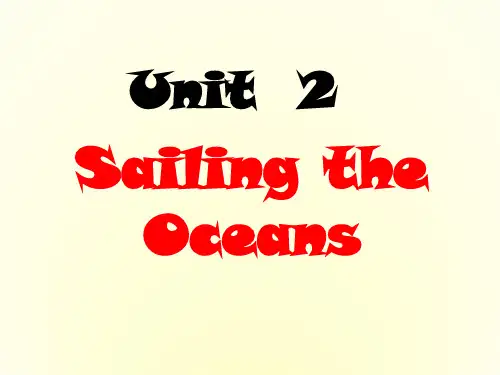
What is the difference between a navigator and an explorer?
Navigator
sea
nautical instruments
find new islands or continents
Navigator is somebody who finds the position and plots the course of a ship using maps and instruments.
Chinese culture, but also developed
many trade links with the other countries.
Marco Polo was the only person to provide information about China to the outside world. His journey around Asia lasted 24 years. He reached further than any of his predecessors, travelling beyond Mongolia and into China. Finally he wrote his adventures down and his book was published and became a
sextant
The sextant is a navigational instrument for measuring the angle between the horizon and some object in the sky.
quadrant
nautical chart
高中英语 Unit 2 Sailing the oceansA History of Sailing
A History of Sailing Boat and A History of Steamboat Authoredby Academician Yan You PublishedA History of Sailing Boat and A History of Steamboat, two books authored by Professor Yan You, an academician of Chinese Academy of Sciences and a famous expert on the design and construction of naval architecture and ocean structure and a historian of science and technology, were published by Shanghai Jiao Tong University Press. These two books are part of the series of books intended to publicize science and have a pretty high value in science.Professor Yan You has been devoted to the manufacturing, education and research of naval architecture and held a long-term position of the deputy director of China Society of Naval Architecture and Ocean Engineering and China Society of Ocean Engineering. Since the year 1962, he has been dedicated to the research on the history of naval architecture in China and the world with a series of papers like the Brief History of the Development of the Naval Architecture in China. In these newly published books, Professor Yan provided a vivid picture of the characteristics and the development history of the sailing boats and steamboats in China and the world with concise words and a large number of pictures.By comparison with the books of this kind in China, this series of books place an emphasis on the development history of the naval architecture and ocean engineering in the eastern countries. The Silk Road on the Sea, the Western Voyage of Zheng He (a great Chinese ocean explorer in the Ming Dynasty) and the South Island dialect speakers’ naval achievements are all introduced in the books with the false information removed from the skeptical events in the history, which reflects an old scientist’s spirit of seeking truth in scientific research.1。
20162017学年高中英语Unit2SailingtheoceansPeriodⅣUsingLan
Unit 2 Sailing the oceans Period Ⅳ Using LanguageⅠ.单词拼写【导学号:15680041】1.Can you give me some (背景) on the situation?2.A strong man will bear (困苦) without complaining.3.Working in the sun soon gave us a (口渴).4.He could never have (预见) that one day his books would sell in millions.5.Humans are sensitive to (逐渐的) changes of brightness and color.6.Did that ever cause (紧张) in your relationship?7.I'd like to (存入) two hundred dollars.8.He was faced with the (进退两难困境) of whether or not to return to his country.9.The only (缺点) to the project is its expense.10.Toni (估算) that it must be about three o'clock.【答案】 1.background 2.hardship 3.thirst4.foreseen 5.gradual 6.tension 7.deposit8.dilemma 9.drawback 10.reckonedⅡ.阅读理解ALondon,England(CNN)—The youngest person to sail solo around the world returned home on Thursday from his 30,000mile,282day ocean journey.Mike Perham,17,sailed into Lizard Point in Cornwall,the southernmost point in Britain,at 9:47 a.m.,his race team said.“It feels absolutely brilliant,” Mike told CNN by phone hours before crossing the finish line.“I'm really,really excited to be going across the line at last.It doesn't feel like long since I crossed it first.”Mike se t off on his roundtheworld trip on November 18,2008.He has been sailing his yacht,,singlehandedly,though a support team has been sailing next to him along the way.The teen has now achieved the title of Youngest Sailor to Circumnavigate the Globe Solo,according to the Guinness World Records.Mike learned how to sail when he was seven years old from his father,Peter and at age 14,he sailed across the Atlantic alone.The teenager's school—which Mike describes as “highly supportive” of histrip—has redesigned his coursework to fit in with his trip.It also gave him some coursework to do during “quiet moments,” according to Mike's Web site.There haven't been many of those quiet moments.Repeated autopilot failures forced him to stop for repairs in Portugal,the Canary Islands,South Africa,and twice in Australia,according to his Web site.Bad weather in the Southern Ocean—between Australia and Antarctica —forced Mike to battle 50ft waves and 57 mph winds.He said at one point,a “freak wave”picked up the boat and turned it on its side.“My feet were on the ceiling at the time,” he told CNN.“That was a really hairy moment,and I was certainly thinking,‘Why am I here?’ But we took the sails off and the day after I thought,‘This is brilliant!’”Mike describes his father as his biggest hero,always supportive of what he wanted to achieve.Peter Perham said he wasn't too worried about his son facing dangerous situations at sea,as long as he knew what to do and stayed safe.【语篇解读】本文是一篇新闻报道。
高中英语Unit2SailingtheoceansSectionⅠWarmingUpReading—
The cross-cultural educational experience focuses on the Mississippi and China’s longest river,the Yangtze.
been________method(s) to find longitude by the 17th century.
A.two
B.three
C.one
D.no
5.What’s the main idea of the passage? A.Why early seaman wanted to sail the ocean. B.There is useful information in an encyclopedia. C.Early sailing men went exploring the seas using their skills and simple instruments. D.Latitude and longitude are important to plot a ship’s position. 答案:1-5.AADAC
1._____a_t____ the mercy of 2.work ___o_u_t_____ 3.compare sth.___w_i_t_h____ sth. 4.in __r_el_a_t_io_n___ to... 5.make __m_i_s_ta_k_e_s__
受……支配 制定出 把……与……相比较 与……相关联 犯错误
高中英语知识讲解:Unit+2+Sailing+the+oceans+2 Unit+2 Section+Ⅱ —Language+Points含答案
Section ⅡWarming Up & Reading—Language PointsThe voyages of travellers before the 17th century show that they were not at the mercy of the sea even though they did not have modern navigational aids.17世纪以前的航海记录显示,尽管没有现代航海技术的帮助,他们(旅行者们)也不是任凭海洋摆布的。
(1)voyage①He made a voyage to Japan.他航行至日本。
②I wish you a happy voyage.祝你航行平安。
[自我探究]voyage是名词,意为航行,(尤指)航海,航天。
单词意义区别trip指定期的较短的往返旅行journey表示去某地所花的时间和旅行的距离,尤其指较长距离的定期旅行;多指陆地旅行travel泛指从一地到另一地的“旅行,游历”(用单数形式,不加定冠词)。
指“国外的游历、游记”时常用复数形式,但前面不加many或数词修饰,它也可以用作动词tour“周游,观光,旅游;考察”,指周游若干地方,有一定的旅行路线,最后又回到出发地voyage指海上航行或太空旅行。
是可数名词③We went on a trip to the mountains.我们到山里去旅游了。
④We had a long journey ahead of us.我们前面的旅程还很长。
⑤Foreign travel never really appealed to him until he retired.他到退休后才真正对出国旅行产生了兴趣。
⑥We went on a 10-day tour of central Africa.我们到中非游玩了10天。
⑦This is a voyage of exploration.这是一次探索之旅。
高中英语 Unit2《Sailing the oceans》教案(1) 新人教版选修9
英语:Unit2《Sailing the oceans》教案(1)(新人教版选修9)分课时教案The First Period SpeakingTeaching Aims:a. Key words and expressionsnavigate, navigator, navigation, navigational; explore, explorer, exploration b. Talk about sailing the oceans.Teaching Methods:Discussion to arouse the students’ interest in sailing and exploring the oceans. Individual, pair or group work to make every student work in class.Teaching Aids:The multimedia; a tape recorder; the blackboardTeaching Procedures:Step1 GreetingsGreet the whole class as usual.Step2 RevisionCheck the homework exercises.Step 3 PresentationPresent the students a map of the world and tell them “Today we are going to learn a new unit “Sailing the oceans”. Then ask them to turn to page 11 and give them a few minutes to have a discussion.Step 4 DiscussionIn pairs discuss the questions on page11.This discussion is intended for students to explore the difference between a navigator and an explorer. This difference is important to establish because it encourages students to appreciate shades of meaning in the definitions f words and also because it establishes the idea of categories.After a few minutes, ask some pairs to speak out their result of the discussion. Then sum up and check the answers.A navigator explores new routes across the sea.An explorer discovers new places on land.A navigator is somebody who finds the position and plots the course of a ship, an aircraft, a car, etc, using maps and instruments. An explorer is somebody who travels into or through a place in order to learn about it. Very often navigators are also explorers.In history there are four famous voyage explorers in the world, including Zheng He in China, James Cook in England, Christopher Columbus in Spain and Abel Tasman in Holland.In this unit we’ll talk about Zheng He, James Cook and some other explorers like Marco Polo and Captain Bligh.Step 5 Pre-speakingAsk the students if they want to know some famous navigators and explorers. Then present them some pictures and some related information about them.About Zheng He.About Marco PoloAbout James CookAbout Ferdinand MagellanStep 6 SpeakingAfter showing the students the pictures and their background information, ask the students to think about the question: How do you think seamen found their way before modern accurate methods of navigation were invented? If time is limited, this can be left as their homework.Step 7 Homework1. Read the new words.2. Preview Reading SAILING THE OCEANS on page 12.The Second Period ReadingTeaching Aims:a. Learn and master the key words and expressionsvoyage mercy minimum nowhere pole overhead offshore accelerate outward longitude latitude precise simplify portable shortcoming updated tendency reliableat the mercy of, even though, work out, be used to, in relation to, aim to , …b. Train the students’ reading ability. Let the students have some knowledge of early navigational methods. Explain how seamen explored the oceans and what kind of navigational instruments were used to sailors before the 17th century when they were navigating the open seas without seeing the land.Teaching Difficult Points:How to help the students understand the reading passage better.How to im prove the students’ reading ability.Teaching Methods:Scanning the text to get the general idea of it.Carefully reading to finish the Comprehending exercises on page 14.Discussion after reading to make the students understand the text better. Teaching Aids:The multimedia; a tape recorder; the blackboardTeaching procedures & waysStep1 GreetingsGreet the whole class as usual.Step2 RevisionCheck the homework exercises.Step3 Pre-readingShow the students some pictures to see if they can identify the early navigational instruments seamen used and explain how they used.Step 4 DiscussionDiscuss the questions on page11.Step 5 Listening and comprehendingAfter listening to the contents of the text do the comprehending exercises on page 14&15.Step 6 ExplanationAfter comprehending, it is a good time to deal with the new words and language points in this part, esp. the following:voyage mercy minimum nowhere pole overhead offshore accelerate outward longitude latitude precise simplify portable shortcoming updated tendency reliableat the mercy of, even though, work out, be used to, in relation to, aim to , Step7 DiscussionLet’s the students have a discussion by working in pairs or in groups.Topic: Imagine you are on a boat with twenty-nine other people. You have a small box for your personal things but it can only hole ten items. What would you need for a week’s journey across the North Sea to England?Step8 SummaryThis reading explains how seamen explored the oceans and what kind of navigational instruments were used to sailors before the seventeenth century when they were navigating the open seas without seeing the land.Step9 HomeworkFinish the exercises about using words and expression on page61.The Third Period Extensive ReadingTeaching Aims:a. Learn and master the key words and expressionsincident departure crew deposit dilemma drawback dusk routine pretty starvation extreme psychologically tension gradually foresee thirst hardshipb. Train the students’ reading ability.Teaching Difficult Points:a. How to help the students understand the reading passage better.b. How to improve the students’ reading ability.Teaching Methods:Scanning the text to get the general idea of it and do some other comprehending exercises.Discussion after reading to make the students understand the text better. Teaching Aids:The multimedia; a tape recorder; the blackboardTeaching procedures & waysStep1 GreetingsGreet the whole class as usual.Step2 RevisionCheck the homework exercises.Suggested answers to Exercise3:I have gradually accepted the routine at school now that I am in the advanced class and make my own study plan.The drawback of using that girl for the advertising was her square jaw which made her look unfriendly.Mathematics is a subject which demands precise and accurate work.In the park I saw a small boy holding the string of a kite overhead, which was rising and falling at the mercy of the wind.That explorer wanted to secure his place in history by being the first man to reach the South Pole.Step3 Readinga. Listen to the passage and then let them do some true or false questions according to the text.1. I was forced to join Captain Bligh in the small boat.2. After the crew took over the ship “Boundy”, Captain Bligh was allowed to take with him a chart , a compass and a quadrant.3. It was very difficult for us to get a correct reading from the quadrant as the boat moved constantly during the course.4. Captain Bligh used a system called “dead reckoning” and he knew there was land directly southwest of their original position.5. We completely believed Captain Bligh when he talked hopefully about what we would do when we got back to England.6. Captain Bligh was as weak as the rest of us but he was determined not to give up.7. Captain Bligh kept us busy and tried to take our minds off our stomach and thirst all the way.8. We finally escaped the jaws of death and arrived in Timor over fifty days after being set loose in our small boat.Answers: (FFTFFTTF)b. Give the students a few minutes to read the passage again and then get the general idea of the text.This is the storey of Captain Bligh’s amazing journey across the Pacific Ocean in an open boat with his followers after another group of sailors under Fletcher Christian had taken over the ship. Later Captain Bligh and his men made for the island of Timor using a combination of navigational skill and “dead reckoning”, which is guessing the correct direction. The voyage lasted over 40 days and was one of the greatest examples of survival at sea.c. Explain some difficult sentences, phrases and words.Key phrases:1. in addition 另外There was an earthquake and, in addition, there were tsunamis.除了地震之外,还有海啸。
高中英语Unit 2 Sailing the oceans Reading
Unit 2 Sailing the oceansPart One: Teaching DesignPeriod 1: A sample lesson plan for reading(SAILING THE OCEANS)AimsTo help students read about sailing the oceansTo help students learn about the predicateProcedures■Warming up by leaning about navigatorWhat is a navigator?A navigator is the person onboard a ship responsible for the navigation of the vessel. On aircraft, the position may also be referred to as a flight officer. The navigator's responsibilities include planning the journey, advising the captain (or pilot) while en route, and ensuring that hazards or obstacles are avoided.What is exploration?Exploration is the act of searching or traveling for the purpose of discovery, e.g. of unknown regions, including space (space exploration), or oil, gas, coal, ores, water (also known as prospecting), or information.Exploration has existed as long as human beings, but its peak is seen as being during the Age of Exploration when European navigators travelled around the world.In scientific research, exploration is one of three purposes of research (the other two being description and explanation). Exploration is the attempt to develop an initial, rough understanding of some phenomenon.■Warming up by talking about Zheng He's Seven VoyagesIn July 11, 1405, the eunuch Zheng He of the Ming Dynasty royal court set out on his first overseas voyage.In the following 28 years, this navigator proceeded to carry out six more voyages, accompanied by a huge entourage of nearly 30,000 people. By traveling throughout Southeast Asia, and around the Indian Ocean tothe Red Sea and East Africa, he also landed at over thirty different nations.He was the earliest largest scale navigation in world history, coming more than halfa century earlier than Columbus'famous exploits...■Warming up by looking and listeningHello, class. Do you know this man? Yes, he is Marco Polo. Marco Polo (1254-1324), is probably the most famous Westerner traveled on the Silk Road. He excelled all the other travelers in his determination, his writing, and his influence. His journey through Asia lasted 24 years. He reached further than any of his predecessors, beyond Mongolia to China. He became a confidant of Kublai Khan (1214-1294). He traveled the whole of China and returned to tell the tale, which became the greatest travelogue.I. Pre-readingWhat are navigational instruments?●Navigational instruments were built in the age of exploration to guide the explorers to their destinations.●navigational instrument - an instrument used for navigating◇artificial horizon, flight indicator, gyro horizon - a navigational instrument based on a gyroscope; provides an artificial horizon for the pilot◇compass - navigational instrument for finding directions◇depth finder - navigational instrument used to measure the depth of a body of water (as by ultrasound or radar)◇inclinometer - an instrument showing the angle that an aircraft makes with the horizon◇instrument - a device that requires skill for proper use◇asdic, echo sounder, sonar - a measuring instrument that sends out an acoustic pulse in water and measures distances in terms of the time for the echo of the pulse to return; sonar is an acronym for sound navigation ranging;asdic is an acronym for anti-submarine detection investigation committeeII. Reading for formsRead the text SAILING THE OCEANS on page 12 to: cut/ the sentence into thought groups, blacken the predicative, darken the connectives and underline all the useful expressions.SAILING THE OCEANSWe may well wonder/ how seamen explored the oceans/ before latitude /and longitude made it possible /to plot a ship's position/ on a map.The voyages of travelers/ before the 17th century /show that /they were not at the mercy of the sea /even though they did not have modern navigational aids.So/ how did they navigate so well? Read these pages/ from an encyclopedia.Page l:page 2:III. Copying useful expressions and making sentencesYou are going to copy in your notebook all the useful expressions and make sentences of your own with them.IV. Transforming informationNext you are going to read the text again to complete the chart below.V. Closing down by reading more about sailing the oceansSailing the oceansFor thousands of years, people have been sailing across the oceans and around the world. Knowledge of ocean currents and wind patterns has allowed people to reliably reach their destinations even after crossing huge expanses of open ocean.In this photograph, a sailboat uses wind and currents to move among the islands of Micronesia. Before modern navigational techniques were developed, navigators in the South Pacific relied on stick charts to indicate island locations relative to winds andcurrents.Today, racing sailboats is a sport, and teams test their skills by racing around the world. Navigation now relies on satellites, but knowledge of wind patterns, ocean currents, and potential obstacles in unfamiliar waters is still essential for sailing.In this investigation, you'll plot a course for racing around the world in a sailboat. You'll explore some of the obstacles you might encounter on your route; then you'll have the opportunity to revise your route to improve your speed.。