
人教版三年级下册英语-Unit 4 第4课时 B let's learn课件
人教版(PEP)Unit 3 Weather第4课时B Let’s learn
人教版PEP小学英语四年级下册Unit 3 Weather第4课时B Let’s learn & Let’s play教案一、教学设计(一)教学目标1.语言知识学生能够听、说、认读五个描述天气的单词;能够在语境中正确运用这五个单词描述天气状况;能够在语境中理解world、Sydney、London、Moscow、Singapore的意思并能正确发音;能够熟练询问或描述天气情况如:“What’s the weather like in … ? It’s …. ”2. 语言技能能够听、说、认读并在情境中运用以下词汇:rainy, snowy, windy, cloudy, sunny, world;能够在实际情况中熟练运用“What’s the weather like in … ?询问和运用“It’s...in... ”来描述不同地方的天气情况。
3.文化意识了解世界各地各具代表性的气候;了解有关天气预报常用符号。
提醒学生注意观察天气变化,了解世界各重要城市的天气差异。
4.情感态度通过学习本课时学生能关心日常天气变化,能够对气候特点和天气情况进行描述并能及时提醒家人、朋友根据天气变化更换衣服。
培养学生善于观察,增进学生之间的交流,形成团结互助的课堂气氛。
5. 学习策略1、利用图片、多媒体课件等辅助教学,并运用多媒体创设情景,让学生在具体的情境中学习、理解、记忆和运用语言;2、通过歌曲、游戏、小组合作,激发学生参与课堂活动的积极性;培养学生的学习兴趣,发展合作学习的能力。
(二)教学内容分析1.教材内容的地位、作用与意义PEP人教版小学英语四年级下册教材在内容的设计上和前两个单元都有一定的联系,都与学生的日常话题有关,学校,时间和天气。
本节课是PEP人教版小学英语四年级下册Unit 3《Weather》Part B:Let’s learn. Let’s play 本课通过天气预报员预报世界各重要城市的气温与天气情况,呈现了描述天气特点的形容词的词形和意义,学生能够听、说、认读上述单词,能够熟练运用功能句: It’s…in…来介绍不同城市的天气特征。
英语人教版三年级下册Unit 4 B Let's learn PPT
ball
Presentation
Bounce a ball.
Presentation
Where is the ball?
Is It’s it under under the the chair? chair. Yes, it is.
Presentation
Guess: what’s in the box?
map
cap
Practice
Practice
Let’s do
Congratulations! 恭喜你闯关成功, 你是最棒的!
Summary
单词:
帽子 cap 小汽车 car 球 ball 船 boat 地图 map
句子:我的小船在哪? 它在你的玩具盒里吗?不,它不在。
Where is my boat? Is it in your toy box? No, it isn’t.
boat
Presentation
Row a boat.
Presentation
Where is the boat?
Is it on the chair? No, it isn’t.
Is it under the chair? Yes, it is.
Presentation
Guess: what’s in the box?
car
Presentation
Drive a car.
Presentation
Where is the car?
Is it esentation
cap
Put on a cap.
Presentation
Put on a cap.
Presentation
人教PEP四年级英语上册Unit4_B_Let’s_learn优秀课件

Game2 Words and numbers
phone fridge
1
2
bed table sofa
3
4
5
Let’s learn
Waห้องสมุดไป่ตู้ch and say
Let’s play
活动 My room 简单画出自己的房间,并向同桌描述。
My room This is my room. It has a _____ bed. The bed is ______. …
打开U4 B Let’s learn 单词训练,即学即练, 检测当堂学习情况。
本节课学习的的重点内容有:
1.在四线三格中正确抄写本节课所 学单词。 2.登录“优教同步学习网”,预习 B Read and write。
Are they near the phone? No, they aren’t.
phone
Are they on the table? No, they aren’t.
table
Are they on the fridge? Yes, they are.
fridge
Game1 大小声
phone fridge bed table sofa
Review Where are the books? They are on the desk.
John lost his keys. Where are the keys?
Are they on the bed? No, they aren’t.
bed
sofa
Are they on the sofa? No, they aren’t.
人教PEP四年级上册
Unit4 My home
人教PEP版五年级下册英语精品教学课件 Unit 3 第4课时Part B Let's learn
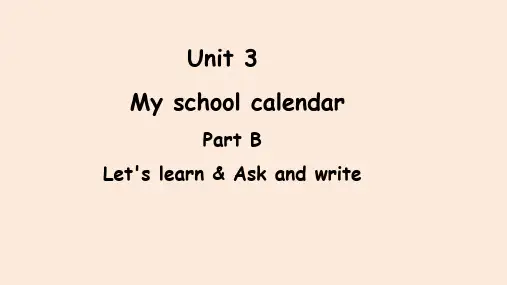
Look and say
When is _A_m_e_r_ic_a_n_T__ha_n_k_s_g_iv_in_g__D_a_y____? It's in __N_o_v_e_m_b_e_r___.
Look and say
When is _C_h_r_is_t_m_a_s_? It's in _D_e_c_e_m_b_e_r__.
圣诞节
Use the pattern to ask your partner.
0
5
25
10 20 15
开始
—When is .0.. ? —It's in...
the winter vacation the sports meet the singing contest the school trip
余的月份缩写都是前面三个字母加点,首字母仍 需大写,注意缩写形式的月份一般不能用于句中。
Homework
1.背诵并尝试默写本单元单词。 2.完成相应课时的内容。
Let's learn
When is MidAutumn Day?
It’s usually in September or October.I’ll eat mooncakes with my family.
句型结构:主语+will+ 动词原形(+其他)
描述某人将要做某事,是一般 将来时,表示将要发生的动作。
新人教版PEP小学英语三年级下册第四单元partA-let's-learn说课+授课复习课程
教学步骤和设计
我的整个教学过程主要分为 热身(Warm-up)、 呈现(Presentation)、 操练(Practice)、 巩固(Consolidation) 四个部分来进行。
(一)热身(Warm-up)
1、Greeting.
2、 Talking.( 出示课件,one picture about Mike)课前导入采用Free talk的形式更有利于学 生从母语环境迅速进入英语学习状态。通过创设 情境的方式讨论图片问题,自然过渡到新课。
(二)呈现(Presentation)
1、The words
1)学习单词desk、chair:通过询问在zip的房间 看到了什么自然引出单词desk和chair。 2)通过zip的三个问题呈现今天的句型,从而引 出方位介词on、in、under。
3、教学手段
根据学生的年龄特点和本课内容,我主要采用实 物、图片、单词卡片以及教师丰富的体态语言等 教学手段进行教学,它们能活化教材,辅助教师 对教学内容进行有序讲解,在讲解的过程中,能 充分利用有效的教学时间,改善信息的传递方式, 增强信息的传递能力,使外语学习变得生动活泼, 加深学生对教学内容的理解。
三年级下册
Unit 4 Where is My Car?
Part A Let’s learn
说 课稿
145269030邱素贞
说教材分析 说教法、学法
说教学目标 说教学重点难点
说教学步骤与设计 结束
一、说教材
本课内容出自新PEP教材三年级下册第四单元《Where is my car ?》,第二课时包括Let’s learn。主要教学五 个单词in、 on、 under、chair 、 desk,并能根据指令 做出相应的动作。教学实践中我们发现:基于学生学习心 理和各阶段身心发展特点,很多相关的知识点采取了分散 教学的方法,让学生循序渐进地掌握。本单元是学生学习 PEP教材过程中,第二次遇到关于方位的话题,是上册运 用英语谈论方位的巩固和延续,为以后学习其他方位词作 铺垫,起着承上启下的作用。本课时是单词和句型的教学。
人教版PEP小学英语三年级下册Unit4单元教材分析及教案
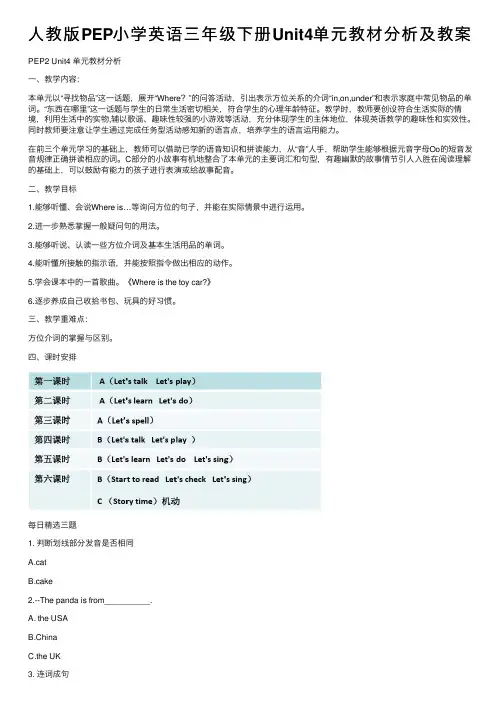
⼈教版PEP⼩学英语三年级下册Unit4单元教材分析及教案PEP2 Unit4 单元教材分析⼀、教学内容:本单元以“寻找物品”这⼀话题,展开“Where?”的问答活动,引出表⽰⽅位关系的介词“in,on,under”和表⽰家庭中常见物品的单词。
“东西在哪⾥”这⼀话题与学⽣的⽇常⽣活密切相关,符合学⽣的⼼理年龄特征。
教学时,教师要创设符合⽣活实际的情境,利⽤⽣活中的实物,辅以歌谣、趣味性较强的⼩游戏等活动,充分体现学⽣的主体地位,体现英语教学的趣味性和实效性。
同时教师要注意让学⽣通过完成任务型活动感知新的语⾔点,培养学⽣的语⾔运⽤能⼒。
在前三个单元学习的基础上,教师可以借助已学的语⾳知识和拼读能⼒,从“⾳”⼈⼿,帮助学⽣能够根据元⾳字母Oo的短⾳发⾳规律正确拼读相应的词。
C部分的⼩故事有机地整合了本单元的主要词汇和句型,有趣幽默的故事情节引⼈⼊胜在阅读理解的基础上,可以⿎励有能⼒的孩⼦进⾏表演或给故事配⾳。
⼆、教学⽬标1.能够听懂、会说Where is…等询问⽅位的句⼦,并能在实际情景中进⾏运⽤。
2.进⼀步熟悉掌握⼀般疑问句的⽤法。
3.能够听说、认读⼀些⽅位介词及基本⽣活⽤品的单词。
4.能听懂所接触的指⽰语,并能按照指令做出相应的动作。
5.学会课本中的⼀⾸歌曲。
《Where is the toy car?》6.逐步养成⾃⼰收拾书包、玩具的好习惯。
三、教学重难点:⽅位介词的掌握与区别。
四、课时安排每⽇精选三题1. 判断划线部分发⾳是否相同A.catB.cake2.--The panda is from__________.A. the USAB.ChinaC.the UK3. 连词成句①he ②Is ③father ④your ⑤(?)______________________________________________________ PEP Book2 Uni4 Where is my car?Part A Let’s talk⼀、教学内容PEP Book2 Unit4 A Let’s talk and Let’s play⼆、教学⽬标1.能听懂、会说并理解句⼦Where's ...? It's in / on / under....2.在创设的情景中,能⽤ Where's ...? 询问某物在哪⾥,并做简单回答。
人教PEP版小学四年级下册英语精品教学课件 Unit 2 第4课时Part B Let's lear
Free talk What’s the first thing we do in the morning?
What time does Mike get up? Let’s have a look.
?
New phrases
起床 一词多义:get up 也表示站起来 I get up at 6:25 every morning.
This is Mike's Day,Can you talk about it?
It's 6:25 a.m. It's time to get up. It's 7:30 a.m. It's time to go to school
It's 4:00 p.m. It's time to go home.
3.如果分钟数超过30分钟,可以用“60-(原分钟数)+to(差)+(原钟点 数+1)”表示,意为“差几分到几点”。 例如:6:54 six to seven
Exercise
选词填空。
go to school get up go to bed go home
1.It’s 7:30 a.m. It’s time to _____g_e_t_.up 2.It’s 8:00 a.m. It’s time to _____g_o__t_o__s_c.hool 3.It’s 5:00 p.m. It’s time to ______g_o__h_o_m_e_. 4.It’s 8:30 p.m. It’s time to _____g_o__t_o_b__e.d
Unit 2 What time is it?
Part B Let’s learn & Let's play
三年级英语下册第一单元课件Unit 4 (6课时)
二、看图片,在正确的答案前打“√”。 (1) Is it on the chair?
√ Yes, it is. No, it isn't.
(2)Is it under the bag? Yes, it is.
√ No, it isn't.
本节课我们学习了以下知识,请同学们一定加 强巩固,以便能和同学们进行灵活交流哦!
考向2 答语 “It’s+介词短语.”用于回答单个物 品的位置。“It’s”是“It is”的缩写形 式,it代替问句中提到的物品。
例句: —Where is my pen? 我的钢笔在哪里?
—It’s in your book. 它在你的书里。
读对话,选择与其相符的图片。
( A ) —Where is my car?
知识点2 Have a good time! 玩开心点儿!
考向 用法:本句是口语中常见的祝福用语。是 当对方去参加宴会或晚会、去外地游玩、 参加某项活动时,向对方说的祝福语。
例句:—I will go to Beijing.我将要去北京。 —Have a good time! 玩开心点 儿!
同义句:Have fun!玩开心点儿!
—It’s on the desk.
A.
B.
知识点3 Silly me! 我真傻!
考向 意义及用法 “Silly me!’意为 “我真傻!”。当你发现自己 处于尴尬的境地时,可以用 “Silly me!”来 自嘲;当你为自己的行为感到懊悔时,也 可以使用它来表达自己的心情。
例句:—Where is my pencil? 我的铅笔在哪里? —It’s in your hand.在你的手里。 —Silly me! 我真傻!
人教版(PEP)三年级英语下册Unit 4《Where is my car》课件
Look at the dog. It’s _c_u_t_e__. It has __a_l_o_n_g_b_o__d_y___.
The dog has a long body.
Try to read out(读出) these words. Can you find the same thing(共同点)?
Bomb game!(炸弹游戏)
Let's learn
Where is …? It’s in/on/under the …
Let's do
( B ) 1.Where is the pencil box?
( A ) 2.Where is the bag?
A. It’s on the desk. B. It’s in the bag.
( C ) 3.Where is the ruler? C. It’s under the chair.
1.The book is _o_n_ the _c_h_a_ir_. 2.The ruler is _i_n_ the _p_e_n_c_i_l _b_o_x_.
on
unde r
in desk
(熟读38页课文5遍,并试着与同桌演一演。)
2. Try to say the story to your parents. When you come across the difficulties, you can use Chinese.
(试着将这个故事说给父母听,不会说的部分可用中文。)
人教版(PEP)小学三年级英语下册
人教版(PEP)小学三年级英语下册
Unit 4 Where is my car?
Part A Let’s learn & Let's do
Unit 4(第4课时 Section B 1a-2b)(导学案)-七年级英语上册(人教版)
1.What’s your class timetable today? Write down the subjects.1.Let’s look at others’ information on the message board.①Where is the text from?____________________________________________________________②What’s the topic of the text?____________________________________________________________③What can you see on the message board?____________________________________________________________2.What can you predict from their usernames?____________________________________________________________3.1b Read the message board about the students’ favourite subjects. Underline all the school subjects each student has.____________________________________________________________________________________________________________________________________________________________________________________4.1c Read again and complete the table.5.Read again and answer the questions.① What subjects do Mike and Binbin both have?____________________________________________________________② How does Mike feel about music?____________________________________________________________③ What does Wu Binbin learn in his maths class?____________________________________________________________④Do you like music or maths? Why?____________________________________________________________6.Read again and complete the mind map.1.2a Discuss the following questions in groups and complete the mind map with your own2.2b Write a message using your information and post it on the board.3.Let’s thinkWhy do we have to learn so many subjects?What can you learn from different subjects ?____________________________________________________________一、用所给词的适当形式填空【参考答案】1.Watch the video and find out Sherry’s class timetable.2.Fill in Sherry’s class timetable1.What’s your class timetable today? Write down the subjects.1.Let’s look at others’ information on the message board.①Where is the text from?They are two posts(帖子)from the Internet.②What’s the topic of the text?Maybe they are about different subjects.③What can you see on the message board?There are two users.Mike Davis and Wu Binbin.2.What can you predict from their usernames?Maybe Mike’s favourite subject is music.Maybe Wu Binbin’s favourite subject is math.3.1b Read the message board about the students’ favourite subjects. Underline all the school subjects each student has.4.1c Read again and complete the table.5.Read again and answer the questions.① What subjects do Mike and Binbin both have?Maths,history,English,and IT.② How does Mike feel about music?Music always makes him happy.③ What does Wu Binbin learn in his maths class?He learns how to work out maths problems in class.④Do you like music or maths? Why?I (don’t) like music/maths because...6.Read again and complete the mind map.1.2a Discuss the following questions in groups and complete the mind map with your own。