
九年级英语unit1知识点
8.succeed in doing 9.try (not) to do sth 10.help sb (to) do 11.learn from… 12.find out find it +adj + to do sth 13.give a report 14.work with a group 15.write down
as well, too, either, also的用法 区别 My pronunciation improved as well. He is wise. His wife is wise, too. I don’t pronounce the words well. He doesn’t do either. He likes physics. I also like it .
10.Knowledge- Knowledgeable 11.bore—boring—bored 12.hide—hid—hidden 13.Understand—understanding
have a better understanding of…
14.ability--abilities
1.Pay ( no ) (more) attention to… 2.Pay for… 3.connect….with… 4. be born with… 5.keep (on) doing sth 6.be afraid of doing sth=be afraid to do sth 7.what\ How about doing sth?
e from…=be from 17.depend on 18.key words 19.spoken English 20.keep a diary 21 .use an English dictionary 22 .make mistakes in grammar 23.explain …to sb 24.be stressed out 25.on one’s own 26.bit by bit
27.Instead of doing sth 28.worry about … 29.in common 30.do grammar exercises 31. fall in love with… 37.fall over\ down 38.fall into… 39.fall off… 40.fall behind sb
动词不定式用法;作定语 I don’t have a partner to practice English with. I don’ well. 作后置定语: Everyone is born with the ability to learn.
1.wise—wisely Wise—wiser—the wisest 2.slow—slowly 3.quick--quickly 4.easy—easier—the easiest 5.create—creative 6.active—actively 7. activity—activities 8.take an active part in… 9.more active—the most active
初中英语人教新目标九年级全一册unit1知识点

九年级英语全一册unit1知识点【重点单词】1.conversation n.对话have conversation with sb.与某人交谈2.pronounce v.发音pronunciaiton n.发音Please tell me how topronounce the word.What’s the pronunciation of the word “text”?【重点短语】1.ask sb.for help 请求某人的帮助2.read the textbook 读课文3.improve one’s speaking skills 提髙某人说的能力4.spoken English 英语口语5.get the main ideas 抓住主题6.make word cards制作单词卡片7.listen to tapes 听磁带8.read word by word逐字逐句地读9.be patient耐心点儿10.the secret to language learning语言学习的秘密11.be afraid to do sth.不敢做某事12.fall in love with…爱上……13.body language肢体语言14.look them up in a dictionary在词典里查阅它们15.take notes记笔记16.memorize sentence patterns记句型17.make mistakes in grammar犯语法错误18.learning habits学习习惯19.have sth.in common有.......共同,点20.pay attention to注意21.get bored变得无聊22.connect… with.….把.......与.......联系起来23.write down key words摘抄重点词24.after class课后25.be interested in…对……感兴趣26.in class在课堂上27.do sth.on one’s own 独立做某事28.do sth.bit by bit慢慢地做某事29.do sth.over and over again一遍又一遍地做某事30.worry about …为……而担忧31.depend on依赖;取决于32.Practce makes perfect.熟能生巧。
Unit1语法知识点九年级英语上册

学生教师上课内容九年级上册Unit 1复习学科英语第()课时年级初三上课时间Unit 1课堂教学知识点Unit1 Topic1一. 语法:一) 现在完成时1. 定义:现在完成时是过去发生并且已经完成的动作对现在造成影响或后果,过去某一时间开始并一直持续到现在并且有可能还会持续的动作或状态。
2.时间词:already、just、ever、never、before、yet、in recent years / months…、in the past …years / months…、※※※so far、for + 时间段、since + 时间点/ 句子(already,just多用于肯定句中,ever,yet,never多用于疑问句和否定句中)3. 公式:主语+ have / has + V过去分词+ 其他4. 句式:肯定句:主语+ have / has + 过去分词+ 其他否定句:主语+have / has + not + 过去分词+ 其他一般疑问句:Have / Has + 主语+ V过去分词+ 其他?Yes, 主+ have / has. 或No, 主+ haven’t / hasn’t.特殊疑问句:特殊疑问词+ 一般疑问句(have / has……)5. 动词过去分词变化规则:(1) 规则变化:a. 一般情况加ed,如:helped worked played cleaned等;b. 以不发音的字母e结尾直接加d,如:used等;c. 以“辅音字母+ y ”结尾,变y为i,再加ed,如:tried studied cried carried等;注:“元音字母+ y”结尾,直接加ed;d. 以重读闭音节结尾,末尾只有一个辅音字母,双写该辅音字母,再加ed,如:dropped stopped planned除y与w结尾的;(2) 不规则变化背九上课后不规则表二) have gone to / have been to二.灵活运用(一)1.though / although 与but 不能同时出现;( because 与so不能同时出现)2.succeed in doing sth (be successful in doing sth.) 成功做某事3.not only……but also……不仅……而且……4.afford sth. 负担某物;afford to do sth. 买得起某物;5.little / a little few / a few 注:so many / much / few / little that6. 复习感叹句(常出现相关词汇:progress / experience; excellent等)1) How + 形容词/ 副词+ ( 主语+ 谓语) !2) What + a / an + 形容词+ 名词单数+ (主语+ 谓语)!What + 形容词+ 名词不可数或名词复数+ (主语+ 谓语)!(二)1.must 如:It must be fun. (还有两个表猜测用法的情态动词:may /can’t )2.take part in = join in = be in 与join区别3.不定代词+ adj. 如:something meaningful4.spend 、take、cost、pay5.in the 1960s 二十世纪六十年代in the early / late 1960s 二十世纪六十年代初/ 末6.7.others, the others , other, the other,another用法8.enough + n. adj. / adv. + enough9.put on、put up、put away三.词性转换rapid rapidly succeed success successful successfullymedicine medical please pleased (un) pleasantpleasure四.固定搭配1. take place发生,进行2. make (rapid) progress 取得(快速的)进步3. keep in touch with sb. 和某人保持联系(get in touch with sb. 和某人取得联系)4. see the changes oneself (herself / himself /……) 亲眼见证变化5. in recent years 在近几年6. satisfy people’s needs 满足人们的需求7. play chess 下象棋8. have a chance to receive a good education 有机会接受好的教育9. enjoy good medical care 享受好的医疗护理10. far away 远离的,遥远的11. by letter or telegram 通过信件或电报(by + Ving) ※※※12. play an important part in people’s lives / doing sth. 在人们的生活中/做某事起重要的作用13. in one’s spare / free time 在某人的空闲时间14. have no time to travel没时间旅行15. places of interest名胜古迹16. W hat’s more 而且17. volunteer activities 自愿者活动18. ring roads 环路19. more than forty years = over forty years 四十多年20. by the way顺便说一下五.重点句型1. Did you have a good summer holiday? 你有一个愉快的暑假吗?2. How was your trip? 你的旅行怎么样?3. Great changes have taken plac e there and my hometown has bee more and more beautiful.那儿发生了巨大的变化并且我的家乡变得越来越美了。
初三英语九年级unit 1知识点小结
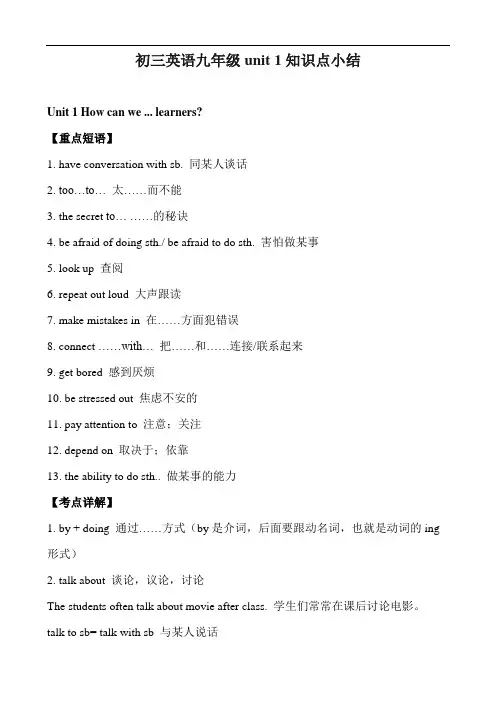
初三英语九年级unit 1知识点小结Unit 1 How can we ... learners?【重点短语】1. have conversation with sb. 同某人谈话2. too…to…太……而不能3. the secret to………的秘诀4. be afraid of doing sth./ be afraid to do sth. 害怕做某事5. look up 查阅6. repeat out loud 大声跟读7. make mistakes in 在……方面犯错误8. connect ……with…把……和……连接/联系起来9. get bored 感到厌烦10. be stressed out 焦虑不安的11. pay attention to 注意;关注12. depend on 取决于;依靠13. the ability to do sth.. 做某事的能力【考点详解】1. by + doing 通过……方式(by是介词,后面要跟动名词,也就是动词的ing 形式)2. talk about 谈论,议论,讨论The students often talk about movie after class. 学生们常常在课后讨论电影。
talk to sb= talk with sb 与某人说话3. 提建议的句子:①What/ how about +doing sth.? 做…怎么样?(about后面要用动词的ing形式,这一点考试考的比较多)如:What/ How about going shopping?②Why don't you + do sth.? 你为什么不做…?如:Why don't you go shopping?③Why not + do sth. ? 为什么不做…?如:Why not go shopping?④Let's + do sth. 让我们做…...吧。
九年级英语unit1语法知识点
九年级英语unit1语法知识点九年级英语Unit 1语法知识点对于九年级的学生来说,英语学习基础已经打下了坚实的基础,Unit 1则是在此基础上进一步拓宽语法知识的阶段。
在这个单元中,有许多重要的语法知识点需要掌握,下面将为大家详细介绍。
1. 一般现在时一般现在时是英语中最基本的时态,用来表达经常性的行为、习惯、常识等。
它的构成主要是根据句子的主语使用动词的原形,而且第三人称单数的主语要加上“-s”。
例如:She often goes to the park on Sundays.2. 现在进行时现在进行时表示目前正在进行的动作,它的构成主要是由“be”动词加上现在分词来表示。
同时,现在进行时也可以用来表示即将发生或即将安排的动作。
例如:He is studying English in the library.3. 一般过去时一般过去时用来表示过去发生的动作或存在的状态。
它的构成主要是根据句子的主语使用动词的过去式,同时肯定句中要使用助动词“did”。
例如:They visited their grandparents last weekend.4. 过去进行时过去进行时表示在过去某个时间段正在进行的动作。
它的构成主要是由“was/were”动词加上现在分词来表示。
例如:I was watching TV when he called me.5. 一般将来时一般将来时主要用来表达将来的动作或事情。
它的构成主要是由“will/shall”加上动词原形来表示。
例如:We will have a picnic next Sunday.6. 情态动词情态动词可以用来表达能力、可能性、推测以及许可等。
常见的情态动词有can、may、must、shall、will等。
值得注意的是,情态动词后面的动词使用原形。
例如:You must finish your homework.7. 句型及从句九年级的学生还需要学习掌握一些常见的句型和从句的用法。
英语九年级全一册unit1知识点
英语九年级全一册unit1知识点英语九年级全一册Unit 1 知识点【导言】英语九年级全一册的Unit 1主要涉及到一些语法知识和词汇,让我们一起来学习吧!【一、词汇知识点】1. 被动语态(Passive Voice)被动语态是在句子的谓语动词中,将动作的承受者置于动作前,用以强调动作的承受者。
被动语态的构成是:be + 过去分词。
例如:Active Voice: The cat chased the mouse.Passive Voice: The mouse was chased by the cat.在被动语态中,主动句中的主语变为被动句中的宾语,而主动句中的宾语则变为被动句中的主语。
2. 非谓语动词(Non-finite Verbs)非谓语动词包括不定式、动名词和现在分词等形式。
它们在句子中可以充当主语、宾语、表语、定语和状语等成分。
例如:To swim is my favorite sport.(不定式作主语)I enjoy swimming.(动名词作宾语)3. 直接引语和间接引语(Direct and Indirect Speech)直接引语是将别人的原话直接引述出来。
间接引语是将别人的原话转述出来,并用自己的话进行表达。
在转化时,需要注意动词的时态、人称和时态。
【二、语法知识点】1. 定语从句(Relative Clauses)定语从句是用来修饰名词或代词的从句。
在定语从句中,关系代词用来引导从句并在从句中充当一定的成分。
例如:The book that I borrowed from the library is very interesting.在这个句子中,定语从句“that I borrowed from the library”修饰名词“book”。
2. 名词性从句(Noun Clauses)名词性从句可以充当句子的主语、宾语、表语和同位语等。
常见的引导词有“that”,“whether”,“if”,“when”,“where”等。
人教版九年级英语Unit1知识点总结
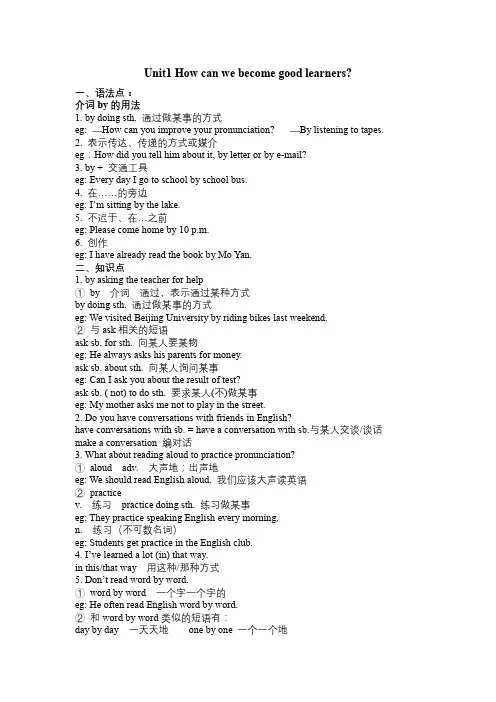
Unit1 How can we become good learners?一、语法点:介词by的用法1. by doing sth. 通过做某事的方式eg: —How can you improve your pronunciation? —By listening to tapes.2. 表示传达、传递的方式或媒介eg:How did you tell him about it, by letter or by e-mail?3. by + 交通工具eg: Every day I go to school by school bus.4. 在……的旁边eg: I’m sitting by the lake.5. 不迟于、在…之前eg: Please come home by 10 p.m.6. 创作eg: I have already read the book by Mo Yan.二、知识点1. by asking the teacher for help①by 介词通过,表示通过某种方式by doing sth. 通过做某事的方式eg: We visited Beijing University by riding bikes last weekend.②与ask相关的短语ask sb. for sth. 向某人要某物eg: He always asks his parents for money.ask sb. about sth. 向某人询问某事eg: Can I ask you about the result of test?ask sb. ( not) to do sth. 要求某人(不)做某事eg: My mother asks me not to play in the street.2. Do you have conversations with friends in English?have conversations with sb. = have a conversation with sb.与某人交谈/谈话make a conversation 编对话3. What about reading aloud to practice pronunciation?①aloud adv. 大声地;出声地eg: We should read English aloud. 我们应该大声读英语②practicev. 练习practice doing sth. 练习做某事eg: They practice speaking English every morning.n. 练习(不可数名词)eg: Students get practice in the English club.4. I’ve learned a lot (in) that way.in this/that way 用这种/那种方式5. Don’t read word by word.①word by word 一个字一个字的eg: He often read English word by word.②和word by word类似的短语有:day by day 一天天地one by one 一个一个地6. Well, be patient. It takes time.patientadj.耐心的①be patient with sb. 对某人有耐心eg: Our teachers are patient with us.②be patient to do sth. 有耐心做某事eg: Teachers should be patient to teach students.n. 病人eg: There are many patients in the hospital.7. The more you read, the faster you’ll be.the+比较级,the+比较级越…… 越……eg: The more you practice, the better you can understand.8. Why did Wei Fen find it difficult to learn English?find it + adj. + (for sb.) + to do sth. 发现做某事(对于某人)是…make it + adj.+ (for sb.) + to do sth. 使(某人)做某事成为…think it + adj. + (for sb.) + to do sth. 认为做某事(对于某人)是…feel it + adj. + (for sb.) + to do sth. 感觉做某事(对于某人)是…eg: Computers make it easier to keep in touch with friends.电脑使我们获得消息更容易了。
九年级英语一到三单元知识点
九年级英语一到三单元知识点Unit 1 How can we become good learners?一、重点单词。
1. textbook (n.) 教科书;课本。
2. conversation (n.) 交谈;谈话,常用于短语“have a conversation with sb.”(与某人交谈)3. aloud (adv.) 大声地;出声地。
区别于“loud”(adj. 大声的,常用来修饰名词,如a loud voice)和“loudly”(adv. 喧闹地,侧重于嘈杂、喧闹的声音)。
例如:Read aloud to practice pronunciation.(大声朗读来练习发音。
)4. pronunciation (n.) 发音;读音。
例如:His pronunciation is very good.(他的发音很好。
)5. sentence (n.) 句子。
6. patient (adj.) 有耐心的;n. 病人。
常用搭配“be patient with sb.”(对某人有耐心)。
例如:Our teacher is patient with us.(我们的老师对我们很有耐心。
)7. expression (n.) 表达(方式);表示;表情。
例如:Facial expressions can show our feelings.(面部表情能展示我们的情感。
)二、重点短语。
1. make word cards 制作单词卡片。
2. listen to tapes 听磁带。
3. ask the teacher for help 向老师求助。
4. read aloud 大声朗读。
5. have conversations with 与……交谈。
6. give a report 作报告。
7. word by word 逐字地。
8. the secret to... ……的秘诀。
例如:The secret to success is hard work.(成功的秘诀是努力工作。
初三英语第一单元知识点整理
初三英语第一单元知识点整理第一单元知识点整理如下:1.问候与介绍:- 问候:Hello!Hi!Good morning/afternoon/evening!- 介绍自己:My name is… I am … years old. I am from…- 介绍他人:This is my friend… He/She is…- 询问对方信息:What's your name? How old are you? Where are you from?2.国家和国籍:- 表示国家:China, the United States, Japan, etc.- 问国籍:Where are you from? I am from…3.询问个人信息:- 姓名:What is your name?- 年龄:How old are you?- 地方:Where are you from?4.表示身体部位与健康问题:- 身体部位:head, eye, nose, mouth, hand, foot等。
- 健康问题:I have a headache/cold/sore throat, etc.5.家庭成员:- 父亲:father- 母亲:mother- 兄弟姐妹:brother, sister- 祖父母:grandfather, grandmother6.职业:- 医生:doctor- 教师:teacher- 学生:student- 工程师:engineer,等等。
7.学科与科目:- 英语:English- 数学:Math- 历史:History- 地理:Geography8.时间和星期:- 时间:What time is it? It is … o'clock.- 星期:Monday, Tuesday, Wednesday, Thursday, Friday, Saturday, Sunday9.课程表达:- 上课:have classes, have English/Math/History class- 做作业:do homework10.日常活动和爱好:- 做早操:do morning exercises - 看电视:watch TV- 打篮球:play basketball- 弹吉他:play the guitar。
初中英语 人教版 九年级全一册 Unit 1 知识点
九年级Unit 1Grammar1.介词引导的方式状语(扩充by 的用法)1. by +n. 通过by+ doing 在句中作方式状语,常用来表示“以,靠,借助,通过,用”某种方法或手段达到某种预期的目的。
Eg. I made a coat with my own hands. It was made by hand, not by machine.我亲手做了一件外套。
它不是由机器做的,而是手工做成的。
You can realize your dream by working hard.通过努力,你可以实现你的梦想。
2. with+ n. (有形)表示用某种工具或身体的某个部位。
Eg. He often writes with his left hand.他常常用左手写字。
3. through +n. 指方法或手段时,“经由,通过,以”/+空间n.Eg. We can see many stars in the sky through telescopes.通过望远镜我们可以看到天空中的许多星星。
4. in+ n. 表示用某种材料或语言Eg. Please answer this question in English.请用英语回答这个问题。
5. on+n. (交通工具或电信工具)在电话中常用on/over the phoneEg. I have learned many English songs on TV.我通过电视学了很多英文歌。
by 作介词的用法(扩充)(1)by+ doing “用……手段方式”(2)by+交通工具, “乘坐……交通工具”(3) by+地点n. 表方位, “在……旁边”(4)by+时间n. “到时候”(5)by 用于构成被动语态,表示“被,由”。
have free talk with sb. 与某人闲谈take notes 记笔记It's no use doing sth.做某事徒劳无益It's known to all that+从句,表示“众所周知……”It+be+过去分词+主语从句,it作形式主语代替that从句2.It 的用法(作形式主语, 形式宾语,代词)1.作形式主语动词不定式、动名词或主语从句作主语时,通常把它们放在谓语之后,而将it 置于句首,作形式主语1. It is/was +adj.+(for sb.) to do sth.表示做某事对某人来说怎么样,侧重于事件对人的影响常用easy, difficult, hard, important, possible, wise等形容词作表语。
仁爱版英语九年级Unit1Topic1知识点
Unit 1 Topic 1(Grade Nine )Ⅰ、词组及用法1、take place 发生,举行(指计划或安排好的)是不及物动词短语,不能用于被动语态happen 发生(指偶然发生):sth happeneg. The party will take place on Friday night.The earthquake happened on May 12th 20082、have/has been to … 去过某地(人已回)have/has gone to … 去了某地(人未返回)eg. I have been to Beijing. 我去过北京He has gone to the bookstore. 他去书店了3、so …that … 如此…以至于…(引导结果状语从句)可以与too …to … 句型相互转换eg. She is so old that she can ’t look after herself.=She is too old to look after herself.4、by the way 顺便问/提一下in this/that way 通过这/那种方式on the way (to+地点) 在(去某地)的路上5、learn …from … 从…中学到…learn a cot from our teachers.6、have (no )time to do sth 有(没有)时间去做某事7、⎩⎨⎧⋯eyes own s one'with see 眼看见oneself 亲 sth see eg. I saw him playing football myself.8、in the+整十的年份+s …世纪…年代in the 1980s 在20世纪80年代9、the living conditions 生活条件10、enough 用法修饰名词可前可后:enough food =food enough修饰形容词或副词后置:big enough ,fast enough11、have the/a chance to do sth 有机会做某事12、leisure activities 业余活动13、keep in touch with …与…保持联系(强调所处状态) get in touch with …与…取得联系(强调动作)lives here alone ,so he wants to get in touch with his old friends.14、far away 遥远(常放句末作后置定语)work in a city far away.far away from+某地离…遥远eg. Their school is far away from here.*如果前有具体数字,far要去掉eg. His home is 9 kilometers away from the school.15、develop 动词:发展,发达developed 形容词:发达的,发展的developing 形容词:发展中的development 名词:发展China is a developing country.16、satisfy(v.)使满意——satisfied(adj.)满意的satisfy sb. 使某人满意satisfy people’s needs 满足人们的需求eg. Well try to satisfy all the guests.be satisfied with …对…感到满意eg. Her parents are satisfied with her exam results.17、not only…but also…不但…而且…连接并列主语时,谓语动词用就近原则Not only my friends but also I am interested in the book.18、care(n.)照料,照顾medical care医疗保健patient care病人护理take care of sb/sth 照顾某人/物=care for…care(v.)关注,在意care about sb/sth 在意某人/物19、make progress 取得进步make great/rapid progress 取得重大/快速进步20、succeed in sth/doing sth 成功做某事21、dream about 梦想,展望22、play a part/role(in sth)在…发挥重要作用,在…扮演重要角色eg. The computer plays an important part in our lives.23、play hide―and―seek 玩捉迷茂24、meet to play cards 聚在一起玩牌25、in one’s spare/free time 在某人的空闲时间26、team sports 团体运动27、in the open air 在户外,露天28、roll iron rings 滚铁环29、go roller skating 滑旱冰30、make a tour abroad 去国外旅游Ⅱ、辨析though ,although ,even though ,even if 都是连词,意为“虽然,尽管,即使”,引导让步状语从句,不与but ,however 连用eg. Though/Although he is only three years old ,he knows a lotⅢ、语法:现在完成时1、结构:助动词have/has+动词的过去分词2、定义:表示过去发生或已经完成的某一动作对现在造成的影响或结果3、常与just ,already ,yet ,ever ,never ,beforefor+一段时间since …,so far ,by now ,these daysin recent years ,in the past …years 等连用4、Tom has already seen the film.(陈述句)Tom hasn ’t seen the film yet.(否定句)⎩⎨⎧t.hasn' he ,has./No he Yes,)一般疑问句( yet?film the seen Tom Has 5、参看课本124Ⅳ、范文Great Changes in My HometownIn the past ten years ,great changes have taken place in my hometown. People in my hometown are living a happy life with the development of our country.Now people in my hometown have lived in beautiful and tall buildings. Roads are getting wider and wider. People ’s living conditions are getting better and better. What ’s more ,children have studied in modern schools and they are getting a good education.I feel very excited about the changes in my hometown and I think my hometown will become.。