
外研版-英语-八上-外研版导学案:Module11 2单元 第一课时
Module 11 Way of life
Unit 2 In England, you usually drink tea with milk.第一课时学习目标:1. 深入把握有关传统生活习俗的单词和短语。
2. 自主学习,探究共赢;提升学生的阅读能力和技巧。
3. 了解英国风俗习惯和社会行为等不同文化,激情投入,疯狂朗读。
学习重点:阅读能力,阅读技巧的提升。
学习难点:用第一人称描述和介绍你家乡的风俗习惯。
学法指导:1.借助课本和辅导材料,深入理解对话并尝试总结知识结构。
2完成时间30分钟。
课前预习
在课文中划出下列的词汇对照音标(P142, TB),朗读以上单词。
认真预习本单元的内容
使用学法指导:
1.把课文通读两遍,先通读课文完成表层理解,再读课文勾画出文中的疑难点
2.完成时间30分钟。
教材助读:There are some different manners in different countries.In China, it’s OK to visit friends without calling ahead of time. While in the US, it’s not polite to do so.
预习自测题:
1.experiences 的意思是_________
2. enjoy my stay 度过一段愉快时光
3. talk _______ 讨论 3. for__________ 例如
4.something interesting __________
5.for_________ _________time 首次,初次
6. take ________带着,拿走
7.push one’s_______挤过去
8. have ___________tea 喝下午茶9. a light ______一顿便餐
10. a large _______ ________一个很大的水果蛋糕
11.drink tea with_____ 喝有牛奶的茶12. 传统食物_________________
13.in special ___ and _____ shop 在专卖炸鱼和土豆条的商店
14.It is delicious .味道美极了!15. stand _____ _____排队
16. I went to England last year.
I___________ ___________ _________.去年我去了英国,在那里我过得很开心。
17.Afternoon tea is __________ __________a drink, _________a light meal at around 4 pm .下
午茶不仅仅是喝茶,而是下午4点左右的一顿便餐。
18. At the bus stop you must not _________ ________ ________ _________the bus .
在公交车站,你一定不要挤着上公共汽车。
我的疑问
课内探究
情境导入
Warming up(Activity 1)
小组活动,就活动1的两幅图,谈一谈对英国习俗的了解。
小组代表发言。
质疑探究:
一、一轮阅读做题目
学习建议:限时阅读,完成表层理解题
Fast Reading: Read the passage quickly and answer the following questions.
Which sentences describe what you can in the pictures in Activity 1?
小组活动:找出与活动1 中的图片相关的句子。
小组代表把这些句子读出了。
全班反馈。
Read the passage and choose the best answers.
(1) When you are talking to your friends, you may call them____________.
a) by their first names b) Mr or Mrs
(2) When you are invited for afternoon tea,you will have_______________
a) tea b) a light meal
3) Tea in England usually has _______________in it.
a) milk b) suger
(4 ) _________________is traditional food in England .
a) Steak and potatoes b) Fish and c hips
(5) At the bus, it is important that you ___________________
a) wait in line b) smile politely
二、二轮阅读回答下列问题Careful Reading: Read the passage carefully and finish the following questions.
小组活动,两人一组开展活动,一问一答。
小组代表发言,全部反馈。
(1)What did Wang Hui notice w hen he was in English ?
(2)What is one example of the English way of life ?
(3) What do you eat for afternoon tea ?
(4) How can you eat fish and chips ?
(5)What do people do when they wai for the bus ?
三、Writing
Answer the questions about ways of life in your home town.
小组活动。
讨论下列问题,代表发言。
评价。
(1)What do you do when you meet people for the first time ?
(2)What must you say when you talk to older people ?
(3)What food do you give to visitors when they come to your home ?
(4)What do you eat during the Spring Festival ?
当堂检测
一、出下列单词
1. 经验
2. 停留
3. 三明治
4. 炸鱼和炸薯条
5. 绅士
6. 肩膀
二、翻译下面的句子
1. 明天你最好不要迟到。
2. 在图书馆禁止吃东西。
3. 汤姆妈妈生病了,他必须在家照顾她
4. 我需要一本英语书。
5. 她不仅是位老师,而且是我们的朋友。
课后反思:
______
课后训练
(1) Recite th e main news works and phases in Unit 2.
( 2)Write a passage about ways of life in your home e the four questions above to h elp you.。
新外研版八年级英语上册《Module 11 Unit 2 (第一课时)》学案
《Module 11 Unit 2 In England, you usually drink tea with milk twelve(第一课时)》学案教学目标:1.To understand an d be able to ask questions with“must/mustn’t”2.To learn the use of must/mustn’t, need/needn’t, can/can’t知识目标:1、让学生学会使用本课的单词。
2、学生能在课文中中熟练运用所学知识。
能力目标:能熟练运用本课学习的情态动词,并能准确运用。
情感目标:通过对风俗习惯话题讨论,锻炼学生用英文表达不同国家的风俗习惯,;并通过互动交流,增强跨文化意识,培养文化包容心。
教学重点:V ocabulary----- experience stay shoulder sandwich gentleman 教学难点:情态动词的用法重难点突破:以介绍为核心,通过小组活动,在听、说、读、写中使单词及句型以不同的形式反复出现,从而强化学习重难点。
教、学法:任务型教学法,讲授法,小组合作学习法,情境演练。
教具:磁带、录音机、多媒体课件。
Ⅰ、自主学习(一):学单词,跟录音或老师读单词,并掌握其拼写。
经验,经历__________ 逗留,停留______________某人_________ 三明治_____ 先生,男士_______肩膀_______(二)、重点短语(教师填写)1).互相________ 2). 与…..说话_______3.) 喝下午茶_________ 4).排队_______ 5).一顿便饭_________ 6).拿走,带走_____7 第一次____________8 了解,认识___________(三)重点句型:(教师填写)1)You must say Mr. or Mrs. when you meet someone for the first time’2)You can buy it and eat it in special fish and chip shops on the high street, or you can take it away and eat it with fighers.3)At the bus stop, you must not push your way onto the bus. Ⅱ、读写1.听读课文并回答问题,(Activity4)2.小组合作翻译课文Ⅲ、知识点归纳梳理1. not……. But他不是步行,而是乘公交车上学________________________________2.light meal让我们随便吃一顿便饭______________________________3 . take away把它带走___________谁拿走了我的书?____________________4 each other/ one another5 stand in line站成一排并出示你的借书卡(library card)_________________________Ⅳ、复述课文I went to England last year. I noticed …For example, you must ….when you meet someone…,When you get to know each other better or when they ask youto, you can…One day, we visited … and …. together. Afternoon tea isnot….but…We ate sandwiches and…In England, youusually … So I tried to drink tea with milk too.…. is traditional food in England. You can…, or youcan ! It is delicious!At the bus stop, you must…. You need to… Sometimespeople are slow to …板书设计:Module 11 Unit 21.V ocabularyexperience;经验,经历stay: 逗留,停留shoulder;肩膀sandwich: 三明治gentleman: 先生,男士2.情态动词的用法Must/mustn’t ,can/can’tneed/needn’t课后反思:。
2022年外研版八上《Module 11 Unit 1 》导学案
Module 11 Way of lifeUnit 1 In China, we open a gift later.第一课时一、学习目标:1. 初步感知国内外的各种生活习俗, 以及一些有关习俗的常用表达2. 自主学习, 探究共赢;学会分析与总结的方法并学以致用3. 激情投入, 惜时高效, 体验进步的快乐二、学习重点: 能听懂对话内容并能流利地朗读对话和表演对话三、学习难点: 能流利地朗读对话和表演对话课前预习使用说明与学法指导:首先自学拼读单词, 初步掌握单词形式变换, 单词和短语的识记以自学为主, 小组合作为辅导预习自测一、自读课文对话, 试着理解, 然后找出并勾画一下短语1. _________________ 一副国际象棋2. _________________ 电子游戏机3. _________________ 清扫卫生4. _________________ 在春节的第一天5. _________________ 打破东西6. _________________ 理发二、重点句型1. _______________________多么令人惊奇的事!2. ___________________________________________ 我认为我不应该现在翻开它.3. ________________________你不必等!4. _______________________你不是认真的吧!5. ___________________________________________ 在春节期间你最好不要理发.我的疑问课内探究一、情境导入:Look at some pictures and say: Which one do you like to be a gift on your birthday?二、洗耳运动:逐步完成Activity 1 & 2三、听读活动Listen and read1. Listen and read with these questions:What does Lingling get as the birthday gift?Does she open it immediately?What else is different from the US or the UK?2. Read aloud by yourselves and check the sentences in Activity3. Correct the false ones.3. Complete the text in Activity4.4. Read aloud by yourselves again and role-play the conversation.四、语音学习:逐步完成Activity 5, 6 & 7掌握情态动词的肯定及否认形式的发音:must / mustn’t ; need / needn’t ; should / shouldn’t ; had better / had better not五、质疑探究找出对话中八个含情态动词的句子, 标注情态动词并翻译句子:___________________________________________________________________________________________ ___________________________________________________________________________________________ ___________________________________________________________________________________________ ___________________________________________________________________________________________ ___________________________________________________________________________________________ _________________________________________________________________________________________________________________________________________________________________________________六、当堂检测1. 大年初一我们不准扫地.We_______________________________________on the first day of the Spring Festival.2. 你必须在九点之前回到家.You___________________________________ before nine o’clock.3. 你可以等等我吗?我很快就来._____________________? I’m coming soon.4. 你不会是认真的, 一定是在开玩笑.You ______________________. You _______________________.课后反思:课后训练单项选择1. Here’re some juice and bread.You _______ be hungry and thirsty after such a long walk.A. canB. mustC. mayD. might2. Mingming _______ some gifts on his birthday party yesterday.A. receiveB. receivedC. acceptD. accepted3. It was such a ________ that he jumped up and down the chair.A. surpriseB. surprisedC. surprisingD. in surprise4. Dumplings taste ________ and a great number of people like them.A. goodB. wellC. badD. badly5. You’d better use chopsticks ________ noodles.A. asB. toC. forD. with6. The two pictures are not the same. There are so many __________ between them.A. difficultB. difficultiesC. differencesD. different7. I’m really glad __________ friends with you.A. areB. beC. beingD. to be8. In China, we celebrate a lot of __________ festivals every year.A. taditionB. traditionsC. traditionalD. traditionally9. A large population may cause many problems, _________, serious pollution.A. such asB. for exampleC. in factD. as well10. You _______ point someone with your fingers. It’s quite rude〔无礼的〕.A. needn’tB. couldn’tC. mustn’tD. don’t have to第二课时一、学习目标:1. 扎实掌握对话中词汇和短语及情态动词can, must, need 的用法, 提升综合语言运用能力2. 自主学习, 探究共赢;学会分析与总结的方法并学以致用3. 激情投入, 惜时高效, 体验进步的快乐二、学习重点:重点词汇、短语及情态动词can, must, need的学以致用三、学习难点:重点词汇、短语及情态动词can, must, need的学以致用课前预习使用学法指导:借助课本和辅导材料, 深入理解对话并尝试总结知识结构.预习自测完成以下短语及句子, 注意句子标点符号的使用1. 真意外! ________________________2. 你不用等待. ______________________3. 双手接礼物_____________________4. 多注意……_______________________5. 例如___________________________6. 在春节的第一天___________________7. 倒霉;霉运_____________________ 8. 你最好不要剪头发_________________9. 你不是认真的吧_________________我的疑问课内探究质疑探究: 感慨句What a surprise ! 真是个惊喜!此句是一个由what引导的感慨句, 被强调局部是________________________, 原句的完整表达是What a surprise it is!也就是说原句省去了主谓局部.总结:感慨句的表达:①what引导的感慨句, 被强调局部是名词或名词短语, 有两个结构:What a / an + adj. + 可数名词单数(+ 主语+ 谓语)!What + adj. + 可数名词复数/ 不可数名词(+ 主语+ 谓语)!②how引导的感慨句, 被强调局部是形容词或副词,How + adj. / adv. + a /an + 可数名词单数(+ 主语+ 谓语)!How + adj. / adv. (+ 主语+ 谓语)!在表达同一意义时, 两种类型可以互相转换. 例如:What a nice present it is ! = How nice the present is ! 多漂亮的礼物啊!牛刀小试:________ (What / How) beautiful the house is!________ (What / How) quickly Tony worked out the maths problem.________ (What / How) sweet juice it is!________ (What / How) a useful book it is!________ (What / How) lovely friends I’ve got!It is an interesting book. 〔改为感慨句〕___________________________________________________________________________The students are playing football happily. 〔改为感慨句〕___________________________________________________________________________当堂检测一、单项选择:1.------Must I getup tomorrow morning ?------No, you _______.A. mustn’tB. needn’tC. may notD. can’t2. You __________t alk with food with food in your mouth. It’s impolite.A. mustn’tB. can’tC. don’tD. won’t3.----- Whose tennis racket is this ?------Look ! Jerry’s name is on it . It ______be his .A. shallB. mustC. can’tD.Mustn’t4. -------________you swim ?-------- Yes, but I’m not a good swimmer .A. CanB. MayC. NeedD. Must5. ------_______Listen ! Is Miss Li singing in that hall ?-------- No, it______be her. She has gone to London .A. couldn’tB. shouldn’tC. won’tD. can’t二、用immediately ,tradition, chopsticks, gift, serious 完成以下句子.1. Chinese people always use_________not knives and forks.2. Christmas is the_______festival in western countries.3. Nothing________.Take the medicine and have a good rest,and you will be better soon.4. You have got a high fever .We had better go to school _________________.5. On her birthday party ,she has got plenty of birthday _________________..课后反思:课后训练背诵1单元单词, 短语Unit 3 Language in use学习目标1、会读并应用本课的新词汇和短语2、稳固运用本模块第一、二两单元的重点词汇和句型.3、熟练掌握过去进行时when,while,as的用法并灵活应用.学习重点:本模块的重点词汇和句型.学习难点:过去进行时的用法.使用说明与学法指导:1.尝试总结知识结构.2. 完成时间30分钟.教材助读:情景导学资料课前预习对照音标〔P185,TB, 大声朗读一下词汇和短语. 大声朗读句型, 熟读每篇课文.预习自测:写出下面的词组1. 降落2. 大量的3. 不得不4. 迅速作出决定5. 肩并肩6. 沉睡, 睡着7, 像平常一样8. 注意9. 伤了某人的膝盖10. 在痛苦中;痛苦地课内探究预习情况检查. 小组内核对答案. 核对68-70页答案质疑探究一、本模块重点短语:1. 在拐弯处round the corner2. 打聊天talk on the phone3. 及时in time 按时on time4. 从自行车上摔下来fall off a bike5. 注意pay attention (to…)6. 并排地side by side7. 骑自行车ride a bike 8. 过马路cross the road9. 快乐做某事be glad to do soth. 10. 撞了一个男孩hit a boy11. 拿起;拣起pick up 12. 拾起, 捡起pick up13. 能够be able to 14. 发送某物给某人send sth. to sb.15. 讲故事tell a story 16. 为……做好准备get ready for …17. 第二天the next day 18. 给某人看某物show sb. sth.19. 变得更糟get worse 20. 几个, 一些a few 几天前a few days earlier 21. 最后in the end / at last 22. 很痛苦地in great pain23. 像往常一样as usual 24. 为了, 以便so that / in order that25. 带某人到某地take sb. to sp. 26. 在将来in the future27. 给……拍照take a photo of照相take a photo / take photos28.在从学校回家的路上on the way home from school 29. 发生事故have an accident二、本模块语法过去进行时when,while,as的用法区别当堂检测:一、完成句子1. 他们那时不在打排球They________ ________ volleyball at that time.2. 正当他们在说话的时候, 老师进来了While they________ ________, the teacher came in .3. 昨晚从8点到10点他一直在画画.He________ ________ ________ 8:00 to 10:00 yesterday evening.4. 骑自行车时使用时危险的It’s ________ ________ ________ your mobile phone while you are riding a bike .5. 不要在拐弯时行使太快________ ________ too________ when you are________ ________ ________.二、用词的适当形式填空1. I was________ (wait) _______ ( cross) the road.2. I am glad ________ _______ (say ).3. Please pay attention to _________( listen )carefull.三、用适当的介词填空4. The car stopped ________time.5. You should come to school _________ time.6. Don’t ride sid e ________ side.7. He fell _______ the bike.8. The driver was talking _______ his mobile phone.课后训练语法专练1. Don’t make any noise. The teachers ______ a meeting.A. are havingB. is havingC. haveD. will have2. While I was sleeping at home, he ______ in his living room.A. was playing computer gamesB. is playing comouter gamesC. plays computer gamesD. play computer games3. She lived there before she _______ to China.A. cameB. comesC. comeD. coming4. I must go now. Li Lei ________ me at the school gate.A. waits toB. is waiting toC. is waiting forD. waits for5 ---- I was at the cinema at nine o’clock yesterday evening . What about you?---- I _______ TV at home .A. am watchingB. was watchingC. will watchD. watched6. Judy with her brother ______ computer games when her mother came back.A. were playingB. are playingC. was playingD. is playing。
2022年外研版八上《Module 11 Unit 2》导学案
八年级上册英语讲学稿课题:Module 11 Way of lifeUnit 2 In England, you usually drink tea with milk.课型:新授(Listening, reading, speaking and writing)方案课时:2 实际课时:主备人:审核人:【学习目标】知识目标:词汇experience, stay, someone, sandwich, chip, onto, gentleman, shoulder;短语for the first time, fish and chips, way of life, traditional food;句型 1. …you must say Mr or Mrs when you meet someone for the first time.2. You can buy it and eat it in special fish and chip shops on the high street, or you can take it away and eatit with your fingers!3. At the bus stop you must not push your way onto the bus.技能目标:〔1〕能读懂介绍某地风俗、社会行为的文章;〔2〕能够写一篇介绍家乡的风俗习惯的短文.情感态度:增强跨文化意识, 培养文化包容心.文化意识:了解并尊重其他国家的传统习俗和生活方式.学习重难点:〔1〕能读懂描述经历的文章, 了解作者提到的经历与中国人习惯之间的差异.〔2〕情态动词can, must, need的用法.【学习过程】★课前预习I think I can(我能行)重点单词:1. 经历, 经验_____________2. 逗留, 停留______________3. 某人, 有人______________4. 三明治________________5. 炸薯条________________6. 到……之上_____________7. 先生, 男士_________________ 8. 肩, 肩膀________________重点短语:9. 首次, 初次__________________ 10. 炸鱼加炸薯条______________________11. 生活方式____________________ 12. 下午茶________________________13. 传统食物____________________ 14. 排队________________________重点句型:15. I ____________ my ________, and I noticed something interesting with the English__________ ________. 我很享受这段逗留时光, 并且注意到了一些有趣的英国生活方式.16. When you _______ to know _______ ________ better or when they ask you _____, you_______ just ________ their first name.当你们更好地相互了解时, 或者是当他们让你这么做时, 你可以只称呼他们的名字.17. You ______ buy it and eat it in __________ fish and ship shops on the ________ _______, or you _______ _______ it _________ and eat it with your fingers!你可以在高速公路上特定的炸鱼加炸薯条商店买到, 并在店里食用;或者是带走, 用手拿着吃.18. You _________ to ________ in a line and _______ your turn. 你需要排队等待轮到你.19. Afternoon tea is _______ _________ a drink ________ a light meal at around 4 pm.下午茶不仅仅是喝饮料, 而且是下午四点左右吃的一顿便餐.★自主探究I. experience的用法.→知识归纳:为“经验〞的含义时, experience是________〔可数/不可数〕名词. 为“经历〞的含义时, experience是________ 〔可数/不可数〕名词.II. notice的用法.→知识归纳:notice的意思是:__________, 为及物动词. notice的主要用法有:notice sb./sth. 注意到某人/某物notice that 从句注意……notice sb. doing sth. 注意到某人正在做某事notice sb. do sth. 注意到某人做了某事例如:①Everyone noticed that Tom made great progress.打架注意到汤姆取得了很大的进步.②I noticed Rose’s father repair her car yesterday.我看到罗斯的父亲昨天给她修车了.III.辨析for example与such as的异同.→知识归纳:两个短语都有__________的意思. for example用来举例说明某一论点或情况, 一般只列举同类人或物中的“一个〞为例, 作插入语, 可位于句首、句中或句末. such as用来列举事物时, 一般列举同类人或事物中的几个例子, 插在被列举的事物与前面的名词之间, as后面不可有逗号.例如:① Ball games, __________________, have spread around the world.例如, 球类运动已经在世界各地传播开了.I like many kinds of fruits, __________________ apples, pears and grapes.我喜欢许多种水果, 例如苹果、梨和葡萄.★学后/教后反思:_____________________________________________________________★课堂学习研讨Step 1 检查预习情况Step 2 阅读理解1. Talk about the pictures (Activity 1)2.听录音, 找出作者提到的经历并连线. (Activity 2)Para. 1 Afternoon teaPara. 2 Something interesting I noticedPara. 3 Manners at the bus stopPara. 4 The way you called peoplePara. 5 Fish and chip3.阅读课文, 选择正确答案. Activity 24.朗读课文5.说说你还知道哪些外国习惯和中国有所不同?Step 3 Writing (Activities 4, 5, 6)Step 3 Writing★稳固练习I. 单项选择.( ) 1. The English teacher said that we ________ hand in our homework before Tuesday.A. canB. needC. mustD. may( ) 2 Ms Liu is ________ a teacher ________ a very good friend of ours.A. but; andB. just; butC. not just; butD. either; or( ) 3. Hurry up! Someone is ________ you at the school gate.A. wait forB. waiting forC. wait atD. waiting at( ) 4. ---Where is Tom?---I ________ him ________ the room just now.A. notice; enteredB. notice; enteringC. noticed; enterD. noticed; entered( ) 5. ________ the black bag and bring me the orange one.A. Take awayB. Take inC. Take out ofD. Get out ofII. 完形填空.Manners (举止) are important to keep good relations (关系) among people. 6 likes a person with bad manners. A person with 7 manners never 8 people when they are 9 trouble. Instead, he tries to help them. When he asks for something, he says “Please〞. And when he 10 others’ help, he usually says “Thank you〞. He does not interrupt (打搅) others when they are talking. He doesn’t 11 loudly in public. When he 12 , he uses a handkerchief (手绢). 13 a student, it is bad manners to be late for class. 14 you are late, you should say 15 to the teacher.( ) 6. A. Someone B. No one C. Anyone D. One( ) 7. A. sad B. certain C. bad D. good( ) 8. A. smiles B. laughs at C. looks at D. says to( ) 9. A. on B. from C. in D. as( ) 10. A. gives B. looks C. sees D. gets( ) 11. A. talk B. tell C. jump D. think( ) 12. A. sneezes(打喷嚏) B. smokes C. drinks D. eats( ) 13. A. And B. So C. With D. For ( ) 14. A. Because B. If C. Although D. Then( ) 15. A. sorry B. thank you C.OK D. not at allIII. 阅读理解.“Cool〞is a word with many meanings. Its old meaning is used to express a temperature that is a bit cold. As the world has changed, the word has many different meanings.“Cool〞can be used to express feeling of interest in almost anything.When you see a famous car in the street, you will say, “It’s cool.〞You many think, “He is so cool!〞when you see your favourite football player.We have quite a few meanings of the word “cool〞. You can use it instead of many words such as “new〞“handsome〞or “surprising〞. There is an interesting story we can use to show the way the word is used. A mother asked his son to say something about his favourite film star. The little boy could only say, “He is very cool.〞But there are many other words which can be used to describe a person. So the story also shows a scarcity (缺乏) of words. Without “cool〞, some people have no words to show what they want to say. Can you think of many other ways that make your life as colourful as the word “cool〞? I can. What about you? Have a try. You’ll find them also very cool.( ) 16. We know the word “cool〞has had ________.A. only one meaningB. no meaningsC. many different meaningsD. the same meanings( ) 17. In the passage, the word “express〞(Paragraph 2) means _______.A. seeB. showC. knowD. feel( ) 18. If you are ________ something, you may say, “It’s cool.〞A. interested inB. angry aboutC. afraid ofD. unhappy with( ) 19. The writer gives an example to show he is ________ the way the word is used.A. pleased withB. strange toC. worried aboutD. careful with( ) 20. In the passage, the writer wants to say that the word “cool〞________. A. can be used instead of many words B. easily means something interestingC. can make your life colourfulD. may not be as cool as it seems★学后/教后反思:_____________________________________________________________Unit 3 Language in use学习目标1、会读并应用本课的新词汇和短语2、稳固运用本模块第一、二两单元的重点词汇和句型.3、熟练掌握过去进行时when,while,as的用法并灵活应用.学习重点:本模块的重点词汇和句型.学习难点:过去进行时的用法.使用说明与学法指导:1.尝试总结知识结构.2. 完成时间30分钟.教材助读:情景导学资料课前预习对照音标〔P185,TB, 大声朗读一下词汇和短语. 大声朗读句型, 熟读每篇课文.预习自测:写出下面的词组1. 降落2. 大量的3. 不得不4. 迅速作出决定5. 肩并肩6. 沉睡, 睡着7, 像平常一样8. 注意9. 伤了某人的膝盖10. 在痛苦中;痛苦地课内探究预习情况检查. 小组内核对答案. 核对68-70页答案质疑探究一、本模块重点短语:1. 在拐弯处round the corner2. 打聊天talk on the phone3. 及时in time 按时on time4. 从自行车上摔下来fall off a bike5. 注意pay attention (to…)6. 并排地side by side7. 骑自行车ride a bike 8. 过马路cross the road9. 快乐做某事be glad to do soth. 10. 撞了一个男孩hit a boy11. 拿起;拣起pick up 12. 拾起, 捡起pick up13. 能够be able to 14. 发送某物给某人send sth. to sb.15. 讲故事tell a story 16. 为……做好准备get ready for …17. 第二天the next day 18. 给某人看某物show sb. sth.19. 变得更糟get worse 20. 几个, 一些a few 几天前a few days earlier21. 最后in the end / at last 22. 很痛苦地in great pain23. 像往常一样as usual 24. 为了, 以便so that / in order that25. 带某人到某地take sb. to sp. 26. 在将来in the future27. 给……拍照take a photo of照相take a photo / take photos28.在从学校回家的路上on the way home from school 29. 发生事故have an accident二、本模块语法过去进行时when,while,as的用法区别当堂检测:一、完成句子1. 他们那时不在打排球They________ ________ volleyball at that time.2. 正当他们在说话的时候, 老师进来了While they________ ________, the teacher came in .3. 昨晚从8点到10点他一直在画画.He________ ________ ________ 8:00 to 10:00 yesterday evening.4. 骑自行车时使用时危险的It’s ________ ________ ________ your mobile phone while you are riding a bike .5. 不要在拐弯时行使太快________ ________ too________ when you are________ ________ ________.二、用词的适当形式填空1. I was________ (wait) _______ ( cross) the road.2. I am glad ________ _______ (say ).3. Please pay attention to _________( listen )carefull.三、用适当的介词填空4. The car stopped ________time.5. You should come to school _________ time.6. Don’t ride side ________ side.7. He fell _______ the bike.8. The driver was talking _______ his mobile phone.课后训练语法专练1. Don’t make any noise. The teachers ______ a meeting.A. are havingB. is havingC. haveD. will have2. While I was sleeping at home, he ______ in his living room.A. was playing computer gamesB. is playing comouter gamesC. plays computer gamesD. play computer games3. She lived there before she _______ to China.A. cameB. comesC. comeD. coming4. I must go now. Li Lei ________ me at the school gate.A. waits toB. is waiting toC. is waiting forD. waits for5 ---- I was at the cinema at nine o’clock yesterday evening . What about you?---- I _______ TV at home .A. am watchingB. was watchingC. will watchD. watched6. Judy with her brother ______ computer games when her mother came back.A. were playingB. are playingC. was playingD. is playing。
2022外研版英语八上Module11Unit1导学案一
2022-2022外研版英语八上Module 11:Unit 1导学案一Module 11 The weatherUnit 1 It may be cold tomorrow【学习目标】1. 掌握下列单词和短语:cloud, shower, centigrade, degree, temperature, freezing, snowy, joke, wet, night, windy, probably, sunny, cool, dry, cloudy, at the moment, come on, better get going, you lot.2.掌握并灵活运用下列句子:1) You must be joking.2) It may not be even cold.3) It might be windy.4) It’ll be probably not and sunny.3.让学生初步感知may/might可能性的表述【学习任务】Task 1 Make today’s weather reportHere’s an example.Good morning! Here’s the weather report for some big cities in the world.Beijing is cloudy. It’s very cold, so wear warm clothes when you go out. In Guangzhou there’s beautiful sunshine. People will feel cool in the daytime. It is sunny in New York, but there’s a strong wind in the afternoon. It will be rainy in Sydney but very hot . The day after tomorrow will be sunny.That’s the weather report for today. Thank you for listening.【温馨提示】要大胆地多说多讲。
外研版-英语-八上-外研版:Module11 2单元 导学案2018春)
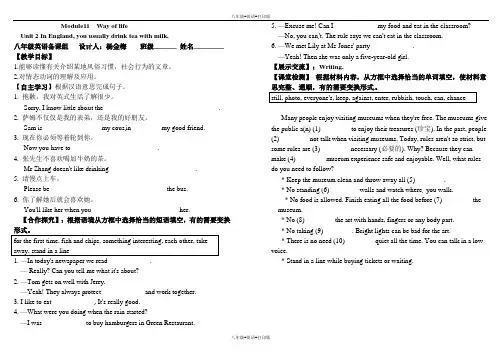
八年级-英语-打印版八年级-英语-打印版Module11 Way of lifeUnit 2 In England, you usually drink tea with milk.八年级英语备课组 设计人:杨金梅 班级_________ 姓名____________ 【教学目标】1.能够读懂有关介绍某地风俗习惯,社会行为的文章。
2.对情态动词的理解及应用。
【自主学习】根据汉语意思完成句子。
1. 抱歉,我对英式生活了解很少。
Sorry, I know little about the ________ ________ ________ ________. 2. 萨姆不仅仅是我的表弟,还是我的好朋友。
Sam is ________ ________ my cous in ________ my good friend. 3. 现在你必须等着轮到你。
Now you have to ________ ________ ________. 4. 张先生不喜欢喝加牛奶的茶。
Mr Zhang doesn't like drinking ________ ________ ________. 5. 请慢点上车。
Please be ________ ________ ________ ________ the bus. 6. 你了解她后就会喜欢她。
You'll like her when you ________ ________ ________ her.【合作探究】:根据语境从方框中选择恰当的短语填空,有的需要变换形式。
for the first time, fish and chips, something interesting, each other, take away, stand in a line1. —In today's newspaper we read ____________. — Really? Can you tell me what it's about?2. —Tom gets on well with Jerry.—Yeah! They always protect ____________ and work together. 3. I like to eat ____________. It's really good. 4. —What were you doing when the rain started?—I was ____________ to buy hamburgers in Green Restaurant.5. —Excuse me! Can I ____________ my food and eat in the classroom? —No, you can't. The rule says we can't eat in the classroom.6. —We met Lily at Ms Jones' party ____________. —Yeah! Then she was only a five-year-old girl. 【展示交流】:Writing.【课堂检测】 根据材料内容,从方框中选择恰当的单词填空,使材料意思完整、通顺,有的需要变换形式。
【最新】外研版八年级英语上册Module11 Unit2 第一课时导学案
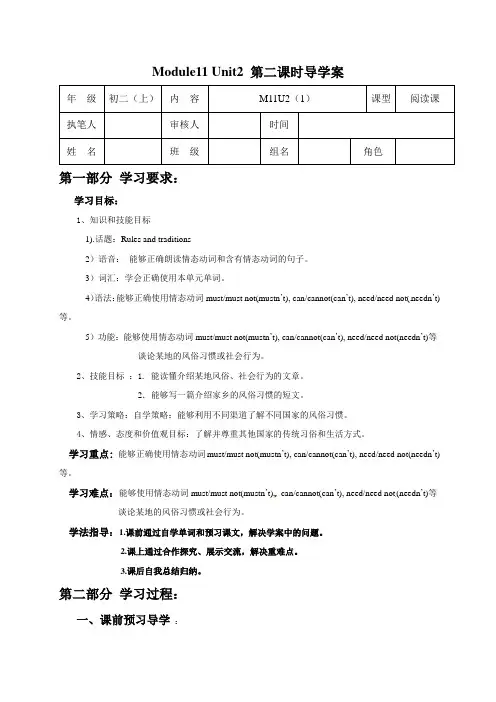
Module11 Unit2 第二课时导学案第一部分学习要求:学习目标:1、知识和技能目标1).话题:Rules and traditions2)语音:能够正确朗读情态动词和含有情态动词的句子。
3)词汇:学会正确使用本单元单词。
4)语法:能够正确使用情态动词must/must not(mustn’t), can/cannot(can’t), need/need not(needn’t)等。
5)功能:能够使用情态动词must/must not(mustn’t), can/cannot(can’t), need/need not(needn’t)等谈论某地的风俗习惯或社会行为。
2、技能目标:1. 能读懂介绍某地风俗、社会行为的文章。
2.能够写一篇介绍家乡的风俗习惯的短文。
3、学习策略:自学策略:能够利用不同渠道了解不同国家的风俗习惯。
4、情感、态度和价值观目标:了解并尊重其他国家的传统习俗和生活方式。
学习重点:能够正确使用情态动词must/must not(mustn’t), can/cannot(can’t), need/need not(needn’t)等。
学习难点:能够使用情态动词must/must not(mustn’t),can/cannot(can’t), need/need not(needn’t)等谈论某地的风俗习惯或社会行为。
学法指导:1.课前通过自学单词和预习课文,解决学案中的问题。
2.课上通过合作探究、展示交流,解决重难点。
3.课后自我总结归纳。
第二部分学习过程:一、课前预习导学:(一)根据汉语写单词并在课文中划出这些单词或短语:名词(n.)逗留;停留__s tay__三明治;夹心面包片__sand wich___炸土豆条;炸薯条______________先生;男士______________肩;肩膀______________代词(pron.)某人;有人______________介词(prep.)到……之上;向……之上______________短语首次;初次______________炸鱼加炸薯条______________拿走_______________拍某人肩膀_________________喝下午茶________________在公共汽车站_________________ 等公共汽车________________排队________________上车_______________(二)跟磁带朗读本单元课文三遍,把你认为重要的句子和不理解的句子写在下面,你能划出重要或不理解的地方吗?————————————————————————————————————————————————————————————————————————————————————————————————————————————————————————————————————————————————————————————————————————————————————二、课堂学习研讨(一)预习展示交流(二)合作探究I.Read and choose the correct answer.( )1 When you are talking to your friends, you may call them .a) by their first names b) Mr. or Mrs( )2 When you are invited for afternoon tea, you will havea) tea b) a light tea( )3 If you drink tea in England, it will usually contain .a) milk b) sugar( )4 The traditional food in England is .a) steak and potatoes b) fish and chips( )5 At a bus stop, it is important that you .a) wait in line b) smile politelyII. DH---P99---I三、当堂训练巩固单项填空( ) 1.One of us __ go to school yesterday.A. wasn’tB. doesn’tC. didn’t( ) 2. ___ you stay at home last Sunday ?A. DoB. Were C . Did( ) 3.She took my pen without ___ me.A. askB. askingC. asked( ) 4. They decide ___ hard from now on.A. studyB. to studyC. studying( ) 5.This concert _____ a popular song.A. began inB. began toC. began with学生小结:教师小结:使用情态动词must/must not(mustn’t), can/cannot(can’t), need/need not(needn’t)等谈论某地的风俗习惯或社会行为。
外研版初中英语八年级上册《Module 11》模块教学设计(含课时设计)
4)You needn’t wait.
5)pay much attention to …
6) you mustn’t break anything.
7) You must only use ted paper forhongbaobecause red means luck.
句型结构:… you must say Mr or Mrs when you meet someone for the first time.
You can buy it and eat it in special fish and chip shops on the high street,
or you can take it away and eat it with your fingers!
and solve together.
6. Read.
Have the students read together.
8.
学习对话,让学生理解对话内容。
通过听力训练,让学生熟悉新单词和短语。
为进一步的听说学习做好铺垫。
让学生带着任务(问题)去听对话并找到答案,有助于培养和提高学生更加准确地听取信息的能力。通过小组活动提高学生间的自主、合作学习,让学生充分地实践运用语言,并激发学生创造性思维的发展。
6. Read.
Have the students read together.
1. Listen and number the words as you hear them.
2. Finish Activity2.
3.The students watch carefully and find out the answer:
外研版-英语-八上-Module11 2单元 When’s the第一课时 学案
Module 11 The weather (Period 1)Unit 2 When ’s the best time to visit your town or country?【学习目标】:1、 识记下列单词和短语:camera, umbrella, pleasant, get cooler, from time to time, fall,travel around, take photos of, compared to …2、 理解下列重点句子:(1) Bring a good map because you may want to travel around.(2) It ’s a good idea to bring your camera because you may want to take photos of the autumnleaves.(3) It ’s pleasant to visit Alaska in July and August but it may be cool in the evening.(4)【学前漫步】:二、根据首字母和汉语提示完成单词1. The USA is a very big country to _____ (参观).2. The best plan is to a_____ in New England in September.3. Xinjiang is in the _____ (西北) of China.4. We should remember to w_____ some warm clothes in winter.5. Tom is very lazy. He is late for school from time t_____ time.【随堂学步】:Step1 Warming upLook at the pictures (Activity 1) and review how to talk about the weather.A: What can you see in the Picture one?B: I can seeA: What’s the weather like?B: The weather isStep 2 Fast-Reading1. Read the passage and answer the questions. (快速阅读文章,回答问题。
山东省夏津实验中学外研版八年级英语上册Module11 Unit 2导学案(无答案)
课题:M11U2 课时:1课时一、自主学习(一)明确目标:1.学习目标:(1)单词experience, stay, someone , sandwich, gentleman, shoulder, (2)短语:each other互相for the first time首次; 初次fish and chips炸鱼加炸薯条traditional food传统食物(3)句型:(1)You must say Mr or Mrs when you meet someone for the first time.(2)You can buy it and eat it in special fish and chip shops on the high street, or you can take it away and eat it with your fingers!(3)At the bus stop, you must not push your way onto the bus.2.学习重难点:情态动词must, can, need等的用法(二)自主探究Ⅰ. 单词拼写1. sandwich (n. ) ________________2. shoulder (n. )________________3. 经历; 经验(n. ) _____________4. 逗留; 停留(n. )______________5. 某人; 有人(pron. ) ________________Ⅱ. 短语互译1. 互相__________other2. 带走; 拿走take________3. have afternoon tea ________________4. push one’s way ________________5. wait for ____________III. 句型填词1. 比如, 初次与人见面时, 你必须称呼(他们)先生或女士。
外研版八年级英语上册教案 M11U2 第一课时
基于课程标准的“教学评一体化”设计课时备课卡学习目标通过本课时学习,学生能够:1.在语境中理解并运这些词汇:stay, experience, for the first time, shoulder等,使用情态动词must/mustn’t, can/can’t, need/needn’t 等谈论某地的风俗习惯或社会行为。
2.读懂介绍英国生活方式的文章,找出段落主旨大意并获取关于greeting people、having afternoon tea、eating traditional food及waiting at the bus stop的具体信息。
3.了解并尊重其它国家的传统习俗和生活方式,增强跨文化意识。
评价任务评价标准1.在活动中猜出哪个国家并且能描述其生活方式。
(指向目标1)能正确说出国家及其风俗习惯。
2.回答问题链,采用不同的阅读方法分段阅读获取具体信息。
(指向目标2、3)准确写出答案,能有自己独到的见解并进行分享。
3.运用情态动词表达观点,回答问题。
(指向目标2)准确写出答案。
4.完成回答问题。
(指向目标2、3)能根据文章的内容正确选出答案。
教学过程教学环节教学活动评价要点Step1 Presentation Ⅰ. PresentationShare some photos of England.Look at the photos and guess:Which country is it?【设计意图】通过展示英国照片,激发对本课的兴趣,导入主题。
2.Predict English way of life (people,clothes, food, sports…)能根据图片猜测国家的名字,并列举出其生活方式。
Step 2 Pre-reading Ⅱ. Pre-reading( A.1)Look at the pictures and talk about what you can see.能描述图片的内容。