
新版PEP六年级上册unit2 A Let's learn
二、选择填空
• 1、How ____ you go to the park? A、did B、does C、do • 2、You can go _____ subway. A、buy B、on C、by • 3、My home is near. I go to school _____. A、on foot B、by plane C、by ship • 4、—How do you go to the USA? —I go ____ by plane. A、/ B、to C、it
jeep by jeep
foot
on foot
Foot, foot, foot, on foot; Bus, bus, bus, by bus; Plane, plane, plane, by plane; Taxi, taxi, taxi, by taxi; Ship ,ship ,ship, by ship; Subway, subway, subway, by subway; Train, train, train, by train; Bike, bike, bike, by bike; Car, car, car, by car; Jeep, jeep, jeep, by jeep.
Unit2 Ways to go to school Period1
柳林乡九年一贯制学校 Miss Yang
plane by plane
taxi by taxi
subway by subway
train by train
bike by bike
car by car
ship
ቤተ መጻሕፍቲ ባይዱ
by ship
三、判断下列单词划线部分读音是 (×)否(√)相同。
• • • • • • • (√ ) (√ ) (× ) (√ ) (× ) (√ ) (× ) 1、name 2、pig 3、 bike 4、team 5、foot 6、but 7、stop plane big dish deal school bus go
Let’s chant.
Consolidation
• by+交通工具 表示乘坐……(交通工具) 但是步行必须用on foot来表示 • get to+具体地点,表示到达……(什 么地方) get + there, 意思是到达那里
检测练兵
• 一、翻译下列单词、短语和句子。 1、步行 2、乘出租车 3、乘火车 4、乘出租车 5、乘轮船 6、乘飞机 7、乘小汽车 8、乘吉普车 9、乘自行车 10、乘地铁 11、自然公园 12、到达 13、到达那里 14、让我们一起去自然公园吧。 15、你怎样从中国到达美国?
新版PEP小学英语六年级上册Unit2-A-Let's-learn
常用频度副词用法表解:
mes 有时 30﹪
ever
几乎 不
5﹪
从不
0
﹪
﹪
4.He is hardly ever late for school. 〔他上学几乎不迟到〕. 5.We is never go out at night. 〔我们在晚上从不出去〕 6.Sometimes I come by bike.
come to +地点(地点是副词时,to省略,如:come here〔来这儿〕come there〔去那 儿〕 come home〔回家〕等. 2.小议频度副词用法: 频度副词在句中一般位于行为动词之前,be动词之后.但有时也放在句首加强语 气。对频度 always usuall often someti Hardly never 单词
A riddle(谜语):
It’s long and big. It can take(乘坐) many people. It sounds “Wu wu wu…”.
train
Train train, by train.
I go to … by train.
It’s I go to subway. … by subway.
(乘,坐,骑…)
Taxi taxi, by taxi.
I c to +地方 by taxi.
It’s a taxi.
Boat boat, by boat.
I go to … by boat.
It’s a boat.
It’s ship. I Ship go to ship, …a by by ship. ship.
Goodbye!பைடு நூலகம்
英汉对照
人教PEP版英语六年级上册 Unit 2【Let’s learn; Write and say】(教

第一課时課时内容A Let’s learn; Write and say課时分析本課时是人教版六年级上册第二单元第一課时.围绕“交通方式”这一话题展开,主要学习关于交通方式词组by plane, by train, by taxi, by ship, on foot, by bus, by subway以及运用句型How do we get there? ...谈论交通方式选择.保持学生学习英语兴趣,树立学好英语信心.第一課时是本单元首課时,是整个单元基础.本課时重点是四会词组掌握以及能够运用四会词组讨论交通方式.本課时包括Let’s learn 和Write and say两个版块.Let’s learn通过Mrs Smith和学生们谈论下周三如何去自然公园场景呈现了四会词组词形和意义.此情境是与学生实际生活相关,话题很能引起学生兴趣.Write and say 版块是一个综合性语言运用活动.学生可以通过这个活动结合自己实际巩固运用A部分所学词汇和句型.本課时虽然是新授課,但是单词foot, bus, taxi, bike, plane在三年级教材中已经学过,为本課学习打下了很好基础.在设计本課教学过程时,采用引导学习和自主学习相结合方式,运用情景教学法、愉快教学法、合作学习法等教学方法,调动全体学生学习积极参与,培养学生学习兴趣.課时目标(1)能够听、说、读、写词组:by plane, by train, by taxi, by ship, on foot, by bus, by subway (2)能够听、说、读、写句型How can you get there? By bus.(3)能够结合句型How do we get there? By bus/...谈论交通方式选择.(5)保持学生学习英语兴趣,树立学好英语信心.課时重难点1.重点(1)能够听、说、读、写词组:by plane, by train, by taxi, by ship, on foot, by bus, by subway(2)能够听、说、读、写句型How can you get there? By bus.(3)能够结合句型How do we get there? By bus/...谈论交通方式选择.2.难点能够灵活运用句型How can you get there? By bus/...谈论交通方式选择.教学准备多媒体課件、图片、卡片、录音机、磁带教学过程Step 1 Warm up1. GreetingT: Good morning, everyone.Ss: Good morning, teacher.T: How are you?Ss: I’m fine, thanks. And you?T: Very well, thanks. What’s the weather like today?Ss: It’s...T: How do you feel?Ss: ...T: Now before our class, let’s play a game.设计意图:师生之间交流,拉近了与学生之间距离.2. Play a game.T: What’s this? Guess!S1: A ...?S2: A ...?师生玩“猜单词”游戏.将小汽车、脚、自行车、公共汽车图片遮住一部分,学生猜出单词. 教学资源:課件设计意图:游戏设计既让学生们快速进入学习状态,同时又复习了和本課相关单词.Step 2 Lead inLet’s chanta.T: Good, boys and girls. I have a chant for you. Let’s listen .教师播放歌谣,学生倾听.b. 再次播放录音,学生轻声吟唱.教学资源:課件设计意图:吟唱歌谣激发了学生学习兴趣,复习和巩固和已学词汇,同时为Let’s learn学习做好铺垫.Step 3 Presentation1. Teaching “on foot, by bus, by taxi, by subway, by plane, by train, by ship”.(1) Teaching “on foot, by bus, by taxi, by subway”.T: My home is far from our school. I come to school by car. How do you come to school?(教师板书by car, 然后根据学生来上学不同方式指名说,教师板书by bus, by bike, on foot)S1: By bus.S2: By car.S3: by bike.S4: On footT: We have many ways to come to school.(齐读板书词组)What else? Look at the picture. We can come by...Ss: Taxi.(板书by taxi,学生拼读)T: We can come by...(課件呈现地铁图片)Ss: Subway.(板书by subway, 联系单词way和u发音规则,学生试着拼读.指名读,带读by subway,齐读)(2) Teaching “by plane, by ship”T: In fact, when go outside, we have many ways to go to many places. (教师指板书,学生认读词组)We can also go...(課件呈现飞机图片)Ss: By plane.(指名拼读,带读,分组拼读,齐拼读)T: We can also go...(課件呈现轮船图片)Ss: By ship.(板书by ship, 利用i拼读规则,学生自己试着拼读.指名读,带读,拼读,齐读.联系单词sheep,比较二者发音不同,强调ship中i发音和sheep中ee发音.)(3) 听录音跟读词组.(4) 升降调读词组.(5) 两人练读词组.(6) 记忆词组.(7)观察词组,找规律.by +交通工具,表示乘……教学资源:課件、录音机、磁带设计意图:教学单词subway, ship,引导学生联系旧知,运用拼读规则认读单词,培养学生拼读能力和知识灵活运用能力.2. Learn the dialogue.(1)呈现A Let’s learn 版块Mrs Smith和学生们讨论场景.T: Who are they?Ss: Mrs Smith, Mike, Sarah, Amy and Wu Yifan.T: Yes. What are Mrs Smith and her students talking about? Can you guess?S1:...S2:...(请几名学生猜测)T: They are going to the nature park next Wednesday.How do they get there? Guess!S1: By bus?S2: By car?...(学生们猜测.)(課件呈现思维导图,帮助学生梳理几个要素:时间,地点和交通方式.)(2)小组讨论不可能采取交通方式,说明理由,然后分组.(3)听录音跟读录音.(4)自读課文,解决问题.How do they get to the nature park?(5)分角色朗读課文,表演課文.(6)背诵課文.(7)创编对话,指组练习.参考句型:A: Let’ s go to the ______.B: Great/Ok/Hooray.A: How do we get there?B: ________.教学资源:課件、录音机、磁带设计意图:学生自学对话,表演对话,创编对话,提高了学生自主学习能力,加深了对对话理解.. Step 4 Practice1. Play games.(1) 教师出示词组词卡请学生快速认读.所有词组读过一遍后,教师在某词组处停住,提问学生:What’s next? 学生根据记忆说出下一个词组及汉语.(2) 请一名学生到台前抽取图片,其他学生根据图片说出词组.教学资源:词卡、图片设计意图:通过不同游戏形式练习Let’s learn词汇,使学生达到熟练程度.2. Write and say(1)教师布置学生在From一列写出自己出发地,在To一列写出目地,然后根据实际情况选择适当交通工具.(2)两人一组交流出行方式.句型:A: How do you get to ...from...?B: On foot/By...(3)指几组练习.设计意图:巩固运用A部分所学词汇,做到活学活用.Step 5 SummaryT: What did you learn about this lesson? 学生自由说,教师总结.1. 学习了交通方式词组:by plane, by train, by taxi, by ship, on foot, by bus, by subway2. 乘某种交通工具:介词by+交通工具3. 学习了谈论交通方式句子:—How do you/ we/ get there?—On foot/By...设计意图:鼓励学生积极发言,帮助学生整理和归纳,加强学生记忆.課堂作业一、看图片,写出相应交通方式.1. 2. 3. 4._____________ _____________ _____________ _____________二、单项选择.( )1.—Let’s go to the zoo.—_________.A. ThanksB. GreatC. Bye( )2.—How do you get there?—_________.A. By footB. On feetC. On foot( )3. I go to school _________train.A. onB. byC. in三、写一写.1. —How do you get to the USA from China?—_______ _______.2. —How do you ______ ______ the park from your home? —______ _______.3. —__________________________________________? —______ ______.板书设计Unit Two Ways to schoolA Let’s learncarbikebussubwayAnswers: 一、1. by plane 2. by bus 3. by ship 4. by taxi 二、1.B 2. C 3.B 三、1. By plane 2.get to, By subway 3. 略. A: Let’s go to the ________. B: Great/ Ok/Hooray! A: How do we get there? B: _______. China the USA the park your homeby+交通工具train (乘……)taxiplaneon foot。
六上Unit2_A_Let’s_learn课件
Can they go by train?
by train
ai / / wait rain paint
Can they go by subway?
No. There is no subway station (地 铁站)near my home.
Can they go by taxi?
No. The school is near the supermarket.
人教PEP小学英语六年级上册
Unit2 Ways to go to school
Part A Let’s learn
SUPERMARKET
BOOKSTORE
NATURE PARK
SCIENCE MUSEUM
Can they go by plane? No.
Can they go by ship? No.
Listen and number.
2 by bus 1 on foot 3 by car 8 by ship 4 by taxi 6 by plane 5 by subway 7 by train
1. Talk about your National Day holiday plan with your friends. If you’re going to travel to somewhere, how do you get there?
2. Listen to the tape of P15.
3. Copy the phrases of Let’s learn and recite them.
Yes, my home is far.
on foot
SUPERMARKET
by bus
人教PEP版英语六年级上册Unit 2 A let’s learn课件
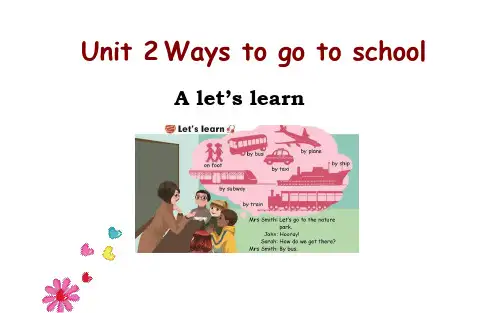
A let’s learn
I come to school on foot.
I come to school by bike.
How do you come to school?
How do you come to school? I come to school… .
……
Homework:
亲爱的读者: 春去春又回,新桃换旧符。在那桃花盛开的地方,在 这醉人芬芳的季节,愿你生活像春天一样阳光,心情 像桃花一样美丽,感谢你的阅读。
They want to go to the sea. How do they go to the sea?
First they go to the sea by bike.
Then they go to And they go to the sea on foot. the sea by bus.
by train
Do you know other vehicles?
Electric bike • motorbike
• jeep
CRH =China Railway High-speed
• They want to go to the sea. • How do they go to the sea?
从全国的情况来看,已建有地铁或已开工建设地铁的 城市有:北京、上海、成都、杭州、广州、天津、大 连、深圳、南京、武汉、重庆、长春等。
How do you go to__? I go __. What about you? I go __
by bike
by car
by taxi
by bus
人教版(PEP)六年级英语上册Unit2 A let's learn课件

by ship.
What's missing?
Make a dialogue A:How do you get to ... from... ? B:By bus/plane/taxi/ship/train... . How do you get to ... from... ? A:By bus/plane/taxi/ship/train... .
Means of transportation (交通方式)
Try to do it!
l n by p__a__e
by c___ ar
u by b__s
i e by b__k__
by s__i__ h p
by __ubw__ s a y __
by __r__i__ t a n
o __t o on f__
Warm-up:
1. Sing a song.《How do you go to school?》
I go to school by bus. I go to school by bus. I can go to school on foot, but it is very far. How do you go to school? How do you go to school? Can you go by ship or train? How do you go to school?
by plane
pl a t e
by train
by bus
How do you get to Beijing zoo from Palace Museum?
( Now you are in Beijing .)
by subway
PEP小学英语六年级上册Unit2 PartA Let's learn 教学设计

PEP小学英语六年级上册Unit2 PartA Let's learn 教学设计一、教材分析本单元的教学内容为“Let's learn”,主要介绍了一些数字、颜色、形状等基本的英语单词。
本单元既注重学生对单词的记忆,又注重学生的发音和表达能力。
通过音、像、词相结合的方式,让学生轻松愉快地学习英语。
二、教学目标1.知识与技能目标:本课要求学生能掌握基本的颜色、数字和形状的单词,并能够正确地发音和表达。
2.过程和方法目标:通过教师浅显易懂的语言和亲切的表情动作,让学生进入英语的学习状态,尽量使学生不觉得语言的严肃繁琐。
3.情感态度目标:培养学生对英语学习的兴趣,增强学生自信心和英语交流能力,让学生能在日常生活中自然而有意义地使用所学英语。
三、教学重难点1.教学重点:颜色、数字、形状的单词的掌握。
2.教学难点:数字的正确读法,形状单词的记忆。
四、教学过程1.导入环节(5-10分钟)(1)教师打趣地问学生:Hello, boys and girls! How are you today?(同学交换问候)。
(2)教师带领孩子们唱儿歌《See You Later》。
See you later, alligator.After a while, crocodile.Bye-bye, butterfly.Give a hug, ladybug.See you soon, raccoon.Out the door, dinosaur.Take care, polar bear.Wave good-bye, butterfly.(3)教师介绍本节课的学习内容:颜色、数字、形状。
2.学习环节(30-35分钟)(1)教师出示数字卡片(1-10)并读出数字,让学生跟着朗读。
让学生学习1-10的数字,并学会与数字对应的手指个数表示法。
(2)教师出示颜色卡片(red, yellow, green, blue, orange, purple, pink, brown, black, white)并说出颜色,让学生跟着朗读并模仿教师的发音。
pep六年级英语上册unit2A Let's learn课件
means of transportation (交通方式)
—How do you go to Canada? —I go to Canada …
bus
taxi
train
plane
ship
subway
train subway
train
subway
subway
train
“by +交通工具”表示出行方式
plane ship by bike bus train subway
乘 飞机 乘 轮船 骑 自行车 乘 公共汽车 坐 火车 乘 地铁
你怎样到达……?
例如: How do you get to Changchun? 你怎样到达长春? How do you arrive at the bookstore? 你怎样到达书店? How do you arrive in the city? 你怎样到达这个城市?
频率副词(表示次数的多少)
by bike by bus by train by subway by plane by ship on foot
“by +交通工具”构成的短语,尽管在汉语
意思上好像是一个表示动作的短语,但它不能在句 中做谓语,这一点要特别注意!
“take +交通工具”构成的短语,通常以take a … 的形式出现,可以在句中做谓语,例如:
询问交通方式的句型 How do you go to school? 你怎样去上学? How do you go to …? 是一个询问交通方式的句型, 根据主语的人称和数的变化,助动词可以用do 或者does。
PEP人教版六年级英语上册《Unit2_A_Let’s_learn教学设计》
Unit 2 A Let’s learn 教案设计( A Let’s learn Write and say)一、教学目标(一) 认知目标1. 能够听、说、读、写短语:on foot,by bus, by plane, by taxi, by ship, by subway, by train。
2. 能用句型How do you get to…? 来询问别人的出行方式,并能够用句子By...进行回答。
(二) 能力目标1. 能灵活运用所学句型及短语。
2. 了解各种出行方式的利弊、需要注意的事项及如何选择恰当的出行方式。
(三) 情感目标培养学生的学习兴趣和积极的学习态度。
二、教学重难点(一) 重点掌握Let’s learn部分的重点词汇:on foot, by bus, by plane, by taxi, by ship, by subway, by train。
突破方法:小组合作,自主识记、拼写,突破重点。
(二) 难点运用句型How do you get to …?和By ...并能替换关键词进行问答。
突破方法:反复练习,小组合作进行情景对话,突破难点。
三、教法与学法引导法,点拨法,小组合作法。
四、教学准备1. 教师准备多媒体课件、单词卡片、A. Let’s learn课文情景动画或音频MP3。
2. 世界地图,各类玩具(汽车、自行车等) ,taxi头饰。
四、教学过程Step 1:Warm-up1. 教师将学生分成几个小组,利用多媒体课件出示句子,让学生看一眼后遮掉句子后一名学生朗读句子,比一比哪组最快完成游戏,每组派一人做监督员。
方,然后小组成员以接龙形式每人说一个单词将句子连接完整,如:How do you come to school? (老师利用多媒体出示句子,让学生看一眼)S1: howS2: doS3: youS4: comeS5: toS6: schoolS7: How do you come to school?2. 教师拿出世界地图,一边让学生指出几个常见国家的地理位置,一边说出相应的英语单词。
英语人教版六年级上册Unit2_A_Let’s_learn教学设计
Unit 2 A let’s learn 教案设计( A Let’s learn Write and say)一、教学目标(一) 认知目标1. 能够听、说、读、写短语:on foot,by bus, by plane, by taxi, by ship, by subway, by train。
2. 能用句型How do you get to…? 来询问别人的出行方式,并能够用句子By...进行回答。
(二) 能力目标1. 能灵活运用所学句型及短语。
2. 了解各种出行方式的利弊、需要注意的事项及如何选择恰当的出行方式。
(三) 情感目标培养学生的学习兴趣和积极的学习态度。
二、教学重难点(一) 重点掌握Let’s learn部分的重点词汇:on foot, by bus, by plane, by taxi, by ship, by subway, by train。
突破方法:小组合作,自主识记、拼写,突破重点。
(二) 难点运用句型How do you get to …?和By ...并能替换关键词进行问答。
突破方法:反复练习,小组合作进行情景对话,突破难点。
三、教法与学法引导法,点拨法,小组合作法。
四、教学准备教师准备多媒体课件、单词卡片、A. Let’s learn课文情景动画,这些资料都可以在优教班班通平台上找到,老师可以下载整理使用。
四、教学过程Step 1:Warm-up1. 教师将学生分成几个小组,利用多媒体课件出示句子,让学生看一眼后遮掉句子后一名学生朗读句子,比一比哪组最快完成游戏,每组派一人做监督员。
方,然后小组成员以接龙形式每人说一个单词将句子连接完整,如:How do you come to school? (老师利用多媒体出示句子,让学生看一眼)S1: howS2: doS3: youS4: comeS5: toS6: schoolS7: How do you come to school?2. 教师拿出单词卡片,一边让学生指着,看着,一边说出相应的英语单词。
人教PEP版小学英语六年级上册教学设计(Unit2 A.Let's learn)
教学课件说明(A.Let’s learn)Let’s learn一、复习(review)1.通过问题“what kind of vehicles do you know?”复习上节课所学的交通工具的单词。
2.通过图片展示,复习上交通工具的单词。
二、学习新知1.巩固交通工具的单词的同时,学习交通方式的短语。
2.通过呈现图片,练习交通方式的短语。
3.归纳“交通工具”变“交通方式”,学习“by+交通工具”表示出行方式。
4.深入讲解“by+交通工具”,并与“take+交通工具”进行区分。
三、练习1.观察图片,让学生说出表示出行方式的短语,进行巩固练习。
2.将短语放在“How do you go to …?”的句型中练习,加深练习与记忆。
3.让学生结合自身实际,回答自己的出行方式。
4.Pair work:学生之间互相询问,巩固操练前面所学的短语。
四、学习新句型1.学习“询问交通方式的句型”,并给出示例。
2.学习频率副词。
3.将频率副词和交通方式的短语结合,学生根据图片练习。
4.将“How do you go to …?”,交通方式的短语以及频率副词结合,深入练习。
5.学习课本“Let’s learn”部分的对话。
五、练习通过单词,短语,句型的练习,巩固本节课所学内容。
六、Homework课外作业的布置。
让学生回归课本,通过作业的形式,巩固本次课所学内容,并为下次课的学习做准备。
PEP小学英语六年级上册重点单词和句型练习一、重点单词Unit 1:by ( ) foot( ) bike( ) bus( ) train( ) how( )go to school() traffic()traffic light()traffic rule()stop()wait() get to()Unit 2library( ) post office( ) hospital( ) cinema( ) turn( ) bookstore( ) where( ) please( )next to( ) right ( ) left( ) straight( )then ( )Unit 3next week( ) this morning( ) this afternoon( )this evening ( ) comic book( ) post card( )newspaper( ) buy( )Unit 4hobby( ) ride a bike--riding a bike( ) dive--diving( )play the violin—playing the violin( ) make kites—making kites( ) collect stamps—collecting stamps( ) live –lives( ) teach--teaches( ) go--goes( ) watch--watches( ) read--reads( ) does doesn’t=does notUnit 5singer( ) writer( ) actor( ) actress( ) artist( ) TV reporter( ) engineer( ) accountant( ) policeman( ) salesperson( ) cleaner( ) where() work()Unit 6rain( ) cloud ( ) sun( ) stream( ) come from( ) seed( ) soil( ) sprout ( ) plant( )should ( ) then( )Unit 1: ▁▁(经,乘) ▁▁(脚) ▁▁(自行车) ▁▁(公共汽车) ▁▁(火车)▁▁(怎样) ▁▁▁▁(上学)▁▁▁▁(交通)▁▁▁▁▁▁(交通灯)▁▁▁▁▁▁(交通规则)▁▁(停,停车站)▁▁(等待)▁▁▁▁(到达)Unit 2 ▁▁▁▁(图书馆) ▁▁▁▁(邮局) ▁▁▁▁(医院) ▁▁▁▁(电影院)▁▁(转弯) ▁▁▁▁(书店) ▁▁▁(在哪里,到哪里) ▁▁▁(请)▁▁▁(与…相邻) ▁▁▁ (右边) ▁▁(左边) ▁▁▁(成直线地) ▁▁▁(然后)Unit 3 ▁▁▁▁▁(下周) ▁▁▁▁▁(今天上午) ▁▁▁▁▁(今天下午)▁▁▁▁ (今天晚上) ▁▁▁▁(漫画书) ▁▁▁▁(明信片) ▁▁▁▁ (报纸) ▁▁▁(购买)Unit 4▁▁▁(爱好) ▁▁▁▁▁--▁▁▁▁▁▁(骑自行车) ▁▁▁--▁▁▁(跳水) ▁▁▁▁▁▁—▁▁▁▁▁▁▁(拉小提琴) ▁▁▁▁▁—▁▁▁▁▁▁▁(制作风筝) ▁▁▁▁▁▁—▁▁▁▁▁▁(集邮) ▁▁▁–▁▁▁(居住)▁▁▁▁--▁▁▁▁(教) ▁▁--▁▁▁(去) ▁▁▁--▁▁▁(看)▁▁--▁▁▁(读,看) does doesn’t=▁▁▁▁Unit 5▁▁▁▁(歌唱家,歌手) ▁▁▁▁(作家) ▁▁▁▁(男演员) ▁▁▁▁(女演员) ▁▁▁▁(画家) ▁▁▁▁(电视台记者) ▁▁▁▁(工程师) ▁▁▁(会计) ▁▁▁▁(男警察) ▁▁▁▁▁▁(销售员) ▁▁▁(工作)▁▁▁▁(清洁工) ▁▁▁▁(在哪里,到哪里)Unit 6▁▁▁(雨) ▁▁▁ (云) ▁▁▁(太阳) ▁▁▁▁(河,溪) ▁▁▁▁(来自,从…来) ▁▁▁(种子) ▁▁▁(土壤) ▁▁▁ (苗,芽) ▁▁▁(植物,种植) ▁▁▁(应该) ▁▁▁▁(然后)二、单词分类1)交通方式:by bus, by train, by subway, by ship, by plane, by car, on foot2)文具书籍:dictionary, newspaper, comic book, post card3)职业:singer, writer, TV reporter, actor, actress, engineer, accountant, salesperson, policeman, policewoman,artist, cleaner4)V-ing形式:riding a bike, collecting stamps, diving, making kites, playing the violin5)第三人称单数形式:lives,teaches, watches, goes, does, doesn’t6)公共场所:library,post office, cinema, hospital, science museum, bookstore7)方位:east, west, south, north, turn left, turn right, go straight8)交通灯; red light, yellow light, green light9)自然:sun, cloud, rain, vapour, stream六年级上册四会句子1.你是怎样去上学的?▁▁▁▁▁▁▁▁2.通常我走路去上学。