
四年级英语下册MODULE10unit1教案外研版
(外研版)四年级英语下册教案Module10
Unit 1 Sam fell off his bike.
Teaching aims:Sam and I went for a bike ride yesterday.
and then...?
Teaching importance:Describing an accident
Teaching difficulities:Using the simple past tense of irregular and regular verbs to talk about past activities.
Teaching Tools:Recorder
Teaching Steps:
Step one : Warm up
sing a song.
Step two:listen and point
1. Ask questions about the pictures in Chinese,e.g. What was Daming thinking about in Picture 1? What was he thinking about in picture
2?What was Daming thinking about in picture
3? How did Sam carry the watermelon in picture
4? What happened to Daming in the last picture? What did the girls do in the last picture?
2. Write the words'then','and' and'so'on the board.Explain that these words link sentences or clauses together.Say that 'so'indicates result,e.g. I went to bed at 11p.m., so I was late for school.Point out that 'and' means 'following this' Show the example in Pictures5and 6,i.e.Then Sam fell off his bike!And the watermelon bumped my head! The adverb
'then'means'after that'.We often use 'then'when we are giving a sequence of instructions. Step three:Tell the story
1)Write the following on the board:
I ate ten nangoes,so...
I didn't do my homework,so...
I cleaned my teeth and then I...
I fell over and...
2)Have the students work in pairs and complete the sentences.Explain that there is no one correct answer for this exercise,however,the sentences must be grammatically corret and they must make sense.
Example Answers:
I ate ten mangoes, so I was sick/went to bed/went to the doctor.
I didn't do my homework, so my mother was angry/the teacher was angry.
I cleaned my teeth and then I went to bed/watched TV/read a book.
I fell over and hurt my knee/I cried.
Step four: Homework
Review Module( Unit 1)
Teaching aims:Review
Teaching importance:Review
Teaching difficulities:Review
Teaching Tools:Recorder
Teaching Steps:
Step one : Warm up
sing a song.
Step two:Look at the map and say.
1)Tell the students to imagine that the top of their desk (the flat part that they write on )is like a map with north at the top(this is the ide of the desk farthest away from the students),south at the bottom (this is the side closest to the students),west to the left and east to the right.
2)Have the students get out their coloured pencils.
3)Explain to the students that you are going to give instructions on where to place the pencils and they have to follow those instructions.
e.g.put a red pencil in the south,please.
Put a blue pencil in the north ,please.
Do a lot of examples with the students.
Step three:What will they do?
1)Tell the students that you are going to choose a student and then say a day. The student has to say what he or she will do on that day.
e.g.T:Sunday.
S:I will visit my grandmother.
T:Tuesday.
S:I will play football.
2)Do a lot of examples.Then have the students continue the activity in pairs. They should take turns to say the days.
3)Point out that they can make up what they will do ; it doesn't have to be true.
Step four: Homework。
外研版四年级英语下册《Module 10 Unit 1》精品教案教学设计优秀公开课
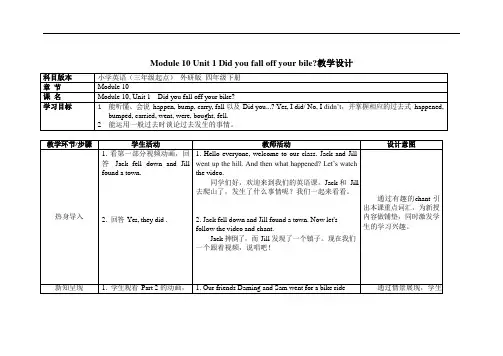
创编对话,进一步加强对本课重点句型的训练。
分步训练
2.
两两一组,创编对话。
2. Now let’s look at another picture. What are they talking about? Complete the sentences, ask and answer with your partner.
Module 10 Unit 1 Did you fall off your bile?教学设计
科目版本小学英ຫໍສະໝຸດ (三年级起点) 外研版 四年级下册
章 节
Module 10
课 名
Module 10,Unit 1Did you fall off yourbike?
学习目标
1.能听懂、会说happen,bump,carry,fall以及Didyou...?Yes,Idid/ No,Ididn’t,并掌握相应的过去式happened, bumped, carried, went, were, bought,fell.
同学们好,欢迎来到我们的英语课。Jack和Jill
去爬山了,发生了什么事情呢?我们一起来看看。
通过有趣的chant引出本课重点词汇,为新授内容做铺垫,同时激发学生的学习兴趣。
热身导入
2.回答Yes,they did .
2. Jack fell down and Jill found a town. Now let's follow the video andchant.
作业布置
今天我们学习了一些词汇的过去式形式,并且会用过去式谈论过去发生的事情。课后请用本节课学习的句型采访两个家人或朋友,他们昨天做过什么。
课堂内容小结
外研版英语四年级下册Module 10 Unit 1单元教案与反思
Module 10玉壶存冰心,朱笔写师魂。
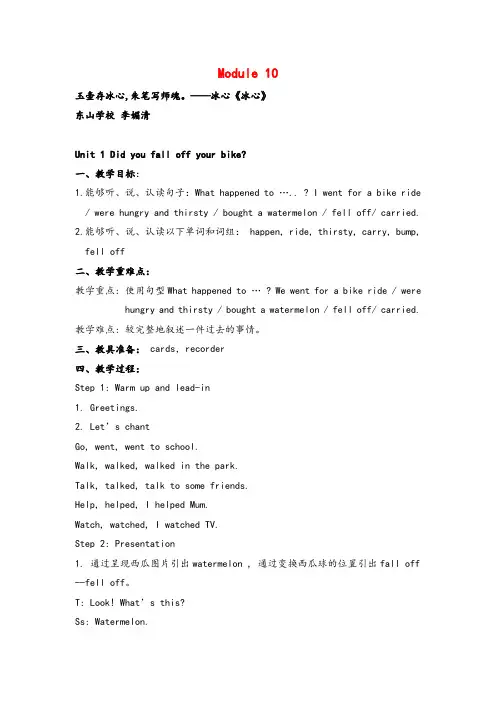
——冰心《冰心》东山学校李媚清Unit 1 Did you fall off your bike?一、教学目标:1.能够听、说、认读句子:What happened to ….. ? I went for a bike ride / were hungry and thirsty / bought a watermelon / fell off/ carried.2.能够听、说、认读以下单词和词组: happen, ride, thirsty, carry, bump, fell off二、教学重难点:教学重点: 使用句型What happened to … ? We went for a bike ride / were hungry and thirsty / bought a watermelon / fell off/ carried. 教学难点: 较完整地叙述一件过去的事情。
三、教具准备: cards,recorder四、教学过程:Step 1: Warm up and lead-in1. Greetings.2. Let’s chantGo, went, went to school.Walk, walked, walked in the park.Talk, talked, talk to some friends.Help, helped, I helped Mum.Watch, watched, I watched TV.Step 2: Presentation1. 通过呈现西瓜图片引出watermelon , 通过变换西瓜球的位置引出fall off --fell off。
T: Look! What’s this?Ss: Watermelon.T: Where is the watermelon?S: …T: Now, where is it? (把西瓜球放在头顶,球不一心掉下来)Oh ,What happened?(引出fall off --fell off)通过师生互相传球的方式操练fall off ----fell off2.一个学生把球传给老师时,不小心把球砸到老师头上。
外研版(一起)四年级英语下册教案教案Module10Unit1教案

外研版(一起)四年级英语下册教案教案Module10Unit1教案Module 10 Unit 1I’ll send you a postcard.教学模式介绍探究式教学模式是指在教学过程中,要求学生在教师指导下,通过以“自主、探究、合作”为特征的学习方式对当前教学内容中的主要知识点进行自主学习、深入探究并进行小组合作交流,从而较好地达到课程标准中关于认知目标与情感目标要求的一种教学模式。
其中认知目标涉及与学科相关知识、概念、原理与能力的掌握;情感目标则涉及思想感情与道德品质的培养。
探究式课堂教学模式的教学环节:创设情境——启发思考——自主(或小组)探究——协作交流——总结提高设计思路说明【创设情境】在这一部分里面,学生将会看到一段关于I send postcard 的视频。
这一视频旨在帮助学生快速进入本课的教学场景。
【启发思考】本部分中,老师和学生将一起讨论他们暑假要去哪里,导入be going to do这一句型表示将来的打算。
通过这一部分也可以帮助学生积累主要国家的名称。
【自主或小组探究】此部分将主要学习本课的对话,聚焦be going to do 表达已成型的将来打算。
在对话学习完成之后,学生将操练be going to do。
【协作交流】本部分中,学生将首先对对话进行角色扮演,继续熟悉并巩固已学的知识,然后小组合作调查成员在暑假的打算。
【总结提高】本部分的意义在于总结本课所学到的知识,补充学生需要的新知识。
就本课而言,主要是表达将来的几种句型。
教材分析本课是新标准小学英语一年级起点第八册的内容。
本节课主要是运用will和going to的一般将来时展开多种教学活动的,目的是让学生能正确表达即将做的事或计划做的事。
设计这节课旨在增加学生学习英语的兴趣,养成良好的语感和发音基础,发挥他们的想象力,能综合运用英语思维表达自己的情感。
教学目标【知识与能力目标】1.能够掌握单词及短语:postcard send a postcard go back to plan2.能够掌握句型:I will send you a postcard. I’m going to speak English every day.【能力目标】1.能够掌握will 在英语中的需用;并能与be going to 进行类比训练。
四年级英语下册 Module10 Unit1(4)教案 外研版

外研版四年级英语下册教案Module10 Unit1 Sam fell off his bikeFunction: preparing for a visit abroad.Target Langue: Question words: who ,what, where ,when .Main Point :Where are you going to go ?What are you going to do ?When are you going to go ?Who’s going to go with you ?Teaching aids : Recorder , cards pictureTeaching steps:Warm up1 Tell the students to get into groups of four or five.Imagine that they are going to take their bag to go to New York. Get them to imagine all the things that they would take .2 One student in each grope needs to make the list of the suggestions that the rest of the group make.3 After a while get one student in each group to call out the ideas. And the teacher should write them on the board.二、Learn in1.On the board write the following sentences:Where are you going to go ?What are you going to do ?When are you going to go ?Who’s going to go with you ?2.New tell the students to copy down the sentences ,.Then read the dialogue. At last complete the answers.3.Now ask the students to close their books. Tell them that you are going to play the dialogue one part a time and they have to tell you who is speaking .4.Divide the class into three groups .listen the dialogue againe .One group should each take a piece of paper and write down the word New York. The second group should each takea piece of paper and write down the words ‘clothes, shoes ,present ,ticket, passport, toothbrush. The third group should take a piece of paper and write down ‘seven o’clock’.5 Now tell the students that you are going to start say the sentence and the correct group should stand up and say the end the sentence. They must listen to the sentence very carefully.三、PracticeOpen your AB, turn to page 38,complete the exercise 1,Read and answer the question.四、Play a game :DiscussionStudent A: If we are going to live in a desert for several days. What are we going to take? Are we going to take …?Student B/C/D : Yes , we are ./No, we aren’t. We are goingto take ….五、HomeworkRead the dialogue to your parents .。
四年级下册英语教案-Module 10 Unit 1 I'll send you a postcar
四年级下册英语教案-Module 10 Unit 1 I’ll send you apostcard.∣外研社(一起)教学目标•听懂并能正确发音并模仿对话里的单词和句子。
•知道如何通过写明信片表达自己的心情和感受。
•掌握并学会使用时间状语和时态。
教学重点•学会使用时间状语和时态。
•掌握表达感情和心情的单词和短语。
教学难点•能够适当地使用英语表达个人的情感和想法。
•听懂并能正确发音并模仿对话里的单词和句子。
教学内容词汇•send•card•postcard•letter•sorry•happy•love•friend句型•I’ll send you a postcard.•I’m sorry to hear that.•I’m happy to hear that.•With love.•To my friend.教学过程观看影视资料在开始上课前,您可以带领学生观看一些相关的影视资料,以便激发学生学习英语的兴趣和热情。
导入新课通过将英语卡片或图片等教具放入贴有英文字母表的纸制信封中一次性性呈现给学生,让学生猜测信封里可能是什么内容。
约定情感展示的好方式在做预热的同时,分享您个人的一些样例卡片,比如:自己和家人出去旅游拍照和写明信片的情景,用鲜明的样例探究如何通过明信片表达情感。
对话呈现进行对话呈现,通过表演一个旅游的场景,模仿写明信片的整个流程,包括:•选择明信片的图片和风景•输入收件人的地址和称呼(切换人称)•发送信息,表达情感和对活动的评价熟练掌握和练习分发并退出教学材料,展示街景和风景。
让学生亲手去练习填空,以便对词汇掌握和运用的更加熟练。
教学后活动通过让学生在家培养写明信片的习惯,培养学生良好的语言表达习惯,提高学生的发音和口语表达能力。
教学评价在教学结束后,您可以组织学生进行模拟演练,以了解他们是否理解今天的教学内容。
您还可以听取他们的反馈和建议,以不断提高教学质量。
英语外研新标准(一起)四年级下册- Module 10 Unit 1 I'll 教案.
1.语言知识与技能目标:
①.能够谈论自己的暑假出行计划。②.全体学生能运用:Where will you go? I’ll send you a postcard. I’m going to visit London等句型.③全体学生能够理解并运用:plan send you a postcard等单词和短语且强化已学语音。
3.Read the sentences and then fill in the blanks.
4.To master the meaning and the pronunciation of this text.
1.To get the general idea of this text.
外研版《小学英语》(一起)四年级下册
Module 10 Unit 1 I’ll send you a postcard Lesson 1教学设计
执教教师:何倩执教班级:天府第四中学四年级X班
教材分析
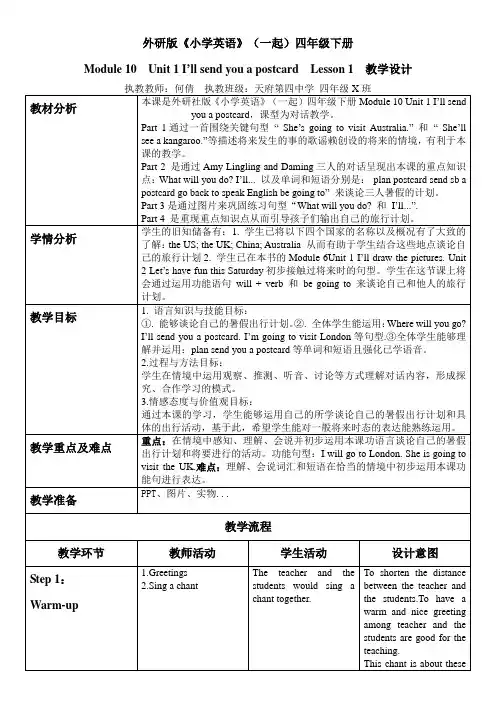
本课是外研社版《小学英语》(一起)四年级下册Module 10Unit1 I’ll send you a postcard,课型为对话教学。
2.过程与方法目标:
学生在情境中运用观察、推测、听音、讨论等方式理解对话内容,形成探究、合作学习的模式。
3.情感态度与价值观目标:
通过本课的学习,学生能够运用自己的所学谈论自己的暑假出行计划和具体的出行活动,基于此,希望学生能对一般将来时态的表达能熟练运用。
教学重点及难点
重点:在情境中感知、理解、会说并初步运用本课功语言谈论自己的暑假出行计划和将要进行的活动。功能句型:I will go to London. She is going to visit the UK.难点:理解、会说词汇和短语在恰当的情境中初步运用本课功能句进行表达。
外研版四年级英语下册Module10Unit1Didyoufalloffyourbike教案设计
Module 10 Unit 1 Did you fall off your bike【教学目标】1.继续学习用一般过去时谈论过去发生的事情。
2.培养学生听说读写和运用所学词汇句型进行交流的能力。
3.让学生快乐地学习英语。
【教学重点】1.句型What happened to…? I ...yesterday.2.词和词组happen thirsty then watermelon carry bump went ride bought fell off【教学难点】1.动词过去式的特殊型。
2.and 和 then的用法。
3.词组fall off的用法。
【教学准备】PPT课件,音频、视频、单词卡片等。
【教学过程】一、Warming up and Revision1.Free talkT:Hello,boys and girls. Welcome to our English class. Are you ready?Ss: Yes.T: Where did you go last weekend?How did you go there ?Ss:...2. Revision教师呈现以前学过的地点和交通工具的图片。
学生看图片,完成对话。
3.Listen and chant.(1)教师播放动画,学生感知动画内容。
(2)教师出示图片讲解单词fall和fell,短语fall off和fall down。
(3)教师用同样的方式讲解单词town,find和found。
(4)学生听录音,跟唱歌谣。
二、Presentation1.Listen,point and find "Did you...?".(1)教师播放动画,请学生找出句型: Did you...?(2)教师出示大明头受伤的图片,并提问:What happened to Daming?引出单词happened。
教师讲解单词happened(3)教师用同样的方式讲解其他单词。
新外研版英语四年级下册Module 10 Unit 1教案
Module 10Unit 1 Did you fall off your bike?一、教学目标:1.能够听、说、认读句子:What happened to ….. ? I went for a bike ride / were hungry and thirsty / bought a watermelon / fell off/ carried.2.能够听、说、认读以下单词和词组:happen, ride, thirsty, carry, bump, fell off二、教学重难点:教学重点: 使用句型What happened to …? We went for a bike ride / were hungry and thirsty / bought a watermelon / fell off/carried.教学难点: 较完整地叙述一件过去的事情。
三、教具准备:cards,recorder四、教学过程:Step 1: Warm up and lead-in1. Greetings.2. Let’s chantGo, went, went to school.Walk, walked, walked in the park.Talk, talked, talk to some friends.Help, helped, I helped Mum.Watch, watched, I watched TV.Step 2: Presentation1. 通过呈现西瓜图片引出watermelon , 通过变换西瓜球的位置引出fall off --fell off。
T: Look! What’s this?Ss: Watermelon.T: Where is the watermelon?S: …T: Now, where is it? (把西瓜球放在头顶,球不一心掉下来)Oh ,What happened?(引出fall off --fell off)通过师生互相传球的方式操练fall off ----fell off2.一个学生把球传给老师时,不小心把球砸到老师头上。
外研版四年级下册英语教案module10教案
外研版四年级下册英语教案module10教案本文是()教案频道为大家整理的《外研版四年级下册英语教案module10教案》,供大家学习参考。
外研版四年级下册英语教案module10教案(一)(外研版)四年级英语下册教案Module10Module 10 AccidentsUnit 1 Sam fell off his bike.Teaching aims:Sam and I went for a bike ride yesterday.and then...?Teaching importance:Describing an accidentTeaching difficulities:Using the simple past tense of irregular and regular verbs to talk about past activities. Teaching Tools:RecorderTeaching Steps:Step one : Warm upsing a song.Step two:listen and point1 Ask questions about the pictures inChinese,e.g. What was Daming thinking about in Picture 1? What was he thinkingabout in picture2?What was Daming thinking about in picture3? How did Sam carry the watermelon in picture4?What happened to Daming in the last picture? What did the girls do in the last picture?2 Write thewords'then','and' and'so'on theboard.Explainthat these words link sentences or clauses together.Say that 'so'indicates result,e.g. I went to bed at 11p.m.,so I was late for school.Point out that 'and' means 'following this'Show the example in Pictures5and 6,i.e.Then Sam fell off his bike!And the watermelon bumped my head! Theadverb'then'means'after that'.We often use'then'when we are givinga sequence of instructions.Step three:Tell the story1)Write the following on the board:I ate ten nangoes,so...I didn't do my homework,so...I cleaned my teeth and then I...I fell over and...2)Have the students work in pairs and complete the sentences.Explain that there is no one correct answer forthis exercise,however,the sentences must be grammatically corret and they must make sense.Example Answers:I ate ten mangoes, so I wassick/went to bed/went to the doctor.I didn't do my homework, so my mother was angry/the teacher was angry.I cleaned my teeth and then I went to bed/watched TV/read a book.I fell over and hurt my knee/I cried.Step four: Homework【外研版四年级下册英语教案module10教案】Unit 2 Sam had lots of chocolate biscuits.Teaching aims:Sam had lots ofchocolate biscuits yesterday,【外研版四年级下册英语教案module10教案】so today he's got a stomachache.Teaching importance:Talking about illnessesTeaching difficulities:Using conjunctions 'so'and'and' to link ideasTeaching Tools:RecorderTeaching Steps:Step one : Warm upsing a song.Step two:Listen and pointExplain to the students that you are going to call out the names of the characters and they have to say what they did or had yesterday.Examples:T:Lingling.S:Lingling had a headache.T:Sam.S:Sam had lots of chocolate biscuits.Follow the same procedure but ask about today.Examples:T:Lingling.S:Lingling has got a fever.T:Sam.S:Sam has got a stomachache.Step three:Let's chant.1)Free talk:Have the students look at the pictures and say what the chant is about.Ask the students what they do when they are sickbut not seriouslyill,e.g.go to bed, take medicine,go to the doctor.2)Play the spoken version of the chant and get the students to repeat the words.3)Play the second version and let the students listen or they can say the chant along with the music.4)Divide the class into three groups.Each group has to say one verse of the chant.5)Have each student get a large piece of paper.The studnets in each group should look at their verse and write thelast word in the verse on their piece of paper,e.g. Group A shouldwrite'cold'.6)Tell the studetns that when they say their verse,they haveto hold up their word when it is repeated in the last line.7)Get the class to say the chant with each group saying theirverse and holding up their word at the appropritate time.8)Have the students change the names in the chant.As'Tommy'and'Lingling 'each have two syllables,you must use two-syllable names as substitutes,e.g.Amy,Daming.Thename 9;Ben'has one syllable so you can use 'Tom'or'Sam'as a substitute.Then have the students say the chant again with the new names.Step four: HomeworkModule 9 教材分析:在之前学习的基础上,开始对一般过去时的问句进行学习。
四年级下册英语教案-Module10 Unit 1 I'll send you a postcard 外研版
Module 10 Unit 1 I’ll send you a postcar d.【教学目标】1.知识与能力目标Words: will, going to, speak, send, visitSentences: I’m going to ….We’ll…I’ll…2.情感态度目标Help the students know how to make a plan for one thing.Help the students to have a good habit to plan everything.【教学重难点】The main points: 将来时态的理解和应用.The difficult points: 将来时态的一般疑问句和特殊疑问句的问答.【教学准备】pictures, tape-recorder, CD-ROM.【教学过程】Step 1 Warm upa) Game: listen, do and repeat: play football, play basketball, sing …b) Free talk: What did you do yesterday?What will you do tomorrow? I’ll …Step 2 Presentation and practice1.Learn “going to”:T: What will you do this summer?S: I will …T: I will go to Beijing this summer. I am going to go to Beijing this summer. ( B.B: will = going to )S: I’m going to …(Help the Ss to answer the questions and talk about their plans use “going to”. )2.Practice of “going to”:T: I’m going to speak English this summer. What are you going to do this summer?S: I’m going to …Play a game: ask and answer one by one.S1: I’m going to … What are you going to do?S2: I’m going to … What …?3.Learn “send postcard”:This summer I am going to go to Beijing. Beijing is beautiful, I’ll send you a postcard from Beijing.(Teach: send, postcard)(Make a sentence: I’ll s end you a postcard from _____ )4.Presentation of the dialogue:1) Listen and answer the questions:Where is Amy going to go this summer?What is Amy going to do this summer?What will Daming do?Will they send a postcard to Daming?2) Li sten, point and find “will, going to”.3) Read the sentences “I’m going to …” “I’ll …”4) Read the dialogue.Step 3 Consolidation and extension1.Act the dialogue.2.Finish an exercise:This summer, Amy is going to go back to ______. ______ is going to go, too. Lingling is ______ to speak _____ every day. Maybe Damiong ______ visit his grandpa’s _______. He will _____ a postcard from China.Amy and Lingling will send a ______ from England.3.Make a survey:Name going toDaming visit a farmStep 4 SummaryDo you know to say your plan? Do you remember the children’s plan?Step 5 Homework1.Listen to the tape and read after it for 5 times.2.Try to act the dialogue with your friends3.Talk about your summer vocation plan.Step 6 Blackboard designModule 10 Unit 1I’ll send you a postcar d.I’m going to …I’ll send you a postcard from…。