
外研版七下Module_11_Body_language_Unit_1_They_touch_noses
French
British
5 Work in groups. Talk about what you do and say when you meet.
•your teacher •your head teacher •your parents after school •your best friend •your best friend’s parents •your favourite film star •a visitor to your school •an American •a Russian
That’s because you were not careful enough. 那是因为你但是不够细心。
4 Listen and repeat.
/ tʃ / Chinese each French teacher touch /ʃ / /pl/ British shake people
/fr/
Which country may use these body language?
Which country may use these body language?
In China
Which country may use these body language?
In Russia
Which country may use these body language?
—What are they doing?
—They ’re shaking hands.
Then listen and read
Lingling: We’re going to have some Russian teachers at school tomorrow, and I’m welcoming the visitors. How do I do that? Betty: Lingling. you know, in Russia, people usually kiss three times, left, right, left. Lingling: What! No, I didn’t know that. We Chinese often shake hands and smile when we meet visitors, and sometimes we nod our heads. But we never kiss. Only parents and children do that. do? Betty: They touch noses!
Now complete the table with the correct form of the words from the box.
India kiss Russia together touch visitor
In China, people shake hands and smile. kiss when American people shake hands and sometimes _____ they together India In ______,people put their hands_________ and nod meet visitor _____. their heads. Russia In ________,people kiss each other three times touch Maori people _______noses.
Betty: That’s because people do different things in different countries. Lingling: So what do people in the US usually do when they meet? Betty: In the US some people shake hands, and some kiss or hug each other. In India people put their hands together and nod their heads. And do you know what Maori people in New Zealand do when they meet? Lingling: No. What do they do? Betty: They touch noses!
American way
Shake hands
hug
Indian way
Put hands together and nod heads
Maori people
Touch noses
They touch noses! 他们互相碰鼻子! 碰鼻礼是毛利人传统的打招呼方式, 也是一种表达真挚问候的礼仪。行礼时, 相互问候的两个人要鼻尖相碰,表示交换 双方的呼吸,使之融合在一起。毛利人是 新西兰的原住民,他们有自己独特的生活 方式和文化。
People and languages Chinese Japanese British American French Australian Canadian Russian German Indian
汉译英
握手
碰鼻子 点头
shake hands
touch noses nod head
互相
微笑
2. That’s because people do different things in different countries.
That’s because….. 是一个常用句式,其中,that 表示 刚刚谈到的内容。 注意,这里要用that,而不能用 this , 因为this 表示将 要谈及的内容。如:
【解析】选C。
2.Which sign means “No Photos”?
【解析】选C。禁止拍照。
3.Tom!________ talk loudly. My little brother
is sleeping. A. Do B. Does
C. Don’t
D. Doesn’t 【解析】选C
4.—Sorry for being late again. —_______here on time next time, or you’ll be punished.
A. Be
B. Being C. To be D. Been
【解析】选A。
5.Hurry up, or you will miss the train.(改为 同义句) _______you ________ hurry up, you will miss the train.
【解析】If;don’t 。祈使句 +or+ 简单句。可
转换为if引导的条件状语从句的复合句。
6.看图写句子 Which school rule is the boy breaking?
答案:Don’t listen to music in class.
答案:Don’t sleep in class
答案:Don’t use cell-phone in class
Language aims
1. To master the words and expressions in this lesson. 2. To process main information of body language. 3. To talk about body language.
1 Match the pictures with the words and expression from the box.
each other smile
赛一赛!
bow
bow
kiss
shake
smile
nod
hug
Chinese
American
Russian
Japanese
Indian
Maori
shake hands
Chinese way
Shake hands and smile
Kiss Russian way Kiss three times
Language points
1. in Russia, people usually kiss three times. “times” 在这里表示次数, three times 表示 “三次” 在英文中, 一次, once 两次, twice 三次以上都用“times” 如: My mother goes shopping once a week. 我妈妈每周购物一次。
In the US/In America
Which country may use these body language?
In India
Which country may use these body language?
In New Zealand
hug
touch nose
smile
kiss
bow kiss shake shake hands smile British German Germar Russia Russian what nod head hug each each other
n. 游客,观光者 n. 俄罗斯 n.俄罗斯人 int. 什么(表示惊奇) v. 点(头) n. 头,头部 v. 拥抱,紧抱 pron. 各个,每个 互相;彼此
11
Unit 1 They touch noses!
v. 鞠躬,弯腰 v. & n. 吻,亲吻 v. 摇晃 握手 v. & n. 微笑 adj. 英国的,英国人的 n. 德国人;德语 adj. 德国(人)的;德语的 n. 日本人;日语 adj. 日本(人)的;日语的 日本
2014年春外研版七年级下Module11 Unit3课件

8
Practice
Ⅰ.用所给单词的正确形式填空 1. Many visitors ______ (visit) came to China to see the Great Wall. Don’t forget (not forget) to close the door when you leave. 2. ___________ learning (learn) English. 3. This is the best way of ________ to say (say) goodbye when they left. 4. They waved ______ play ( play) if you don’t finish your homework. 5. You can’t ______
较强烈的语气时,可以用感叹号。
4
Work in pairs. Talk about do’s and don’ts in a foreign country. Stand in line.
Shake hands.
Do’s
Say “please” and “thank you”. Open doors for others. Look at people when you talk. Be on time.
I want to know where _____ he lives _____.
13
Homework
Finish the workbook.
14
Seeing is believing. 百闻不如一见。
15
He sits next to his mother. ————————————
11
外研版七年级下册英语Module 11 Unit 1 They touch noses! (3)

4. Theyusually__k_is_s____ ( 亲 吻 )whentheymeetothersforthefirsttime.
5. Thereisalwaysabig____sm__i_le_ ( 微 笑 )onmyteacher’sface.
二、根据汉语意思完成句子, 并背记英语句子 6. 毛利人见面时碰鼻子。
OurEnglishteacheris_______________withayoung
man.
19. 请把那些红苹果放在一起。 Please______p_u_ttheredapples________. together
20. 他们见面时经常点头。 Theyoften_____n_o_d_t_h_e_i_r_h_e_a_dws hentheymeet.
ouch
6【点拨】 kiss意思为“亲吻”。这里指
妈妈吻了吻婴儿的脸。注意用过去式。
8. Theywenttothetheatertyesotegredtahye.r
9. Hetoldusthegoodnewswithas. mile 10. Theoldfriendshwhentheymet.
ugged
IntheUSsomepeosphlae_k_e_h_a_n_d_s_________, andsomekissoerahcuhgo_t_h_e_r_________.
9. 在印度, 人们把手放在一起并点头。
InIndia,
people___p_u_t___theirhands__________a nd_t_o_g_et_h_e_r_nthoedirheads.
A. because
B. before
C. until
2023年外研版七年级英语下册Module 11 Unit 1习题(附答案)
Module 11 Unit 1习题(20分钟50分)Ⅰ. 根据句意及首字母提示完成单词(5分)1. The mother k________ the baby on the face and went out.2. Jimmy comes from Russia. He is R________.3. Don’t t________ the things on the desk. They’re useful.4. The old friends h________ when they met again.5. Don’t worry. We can help e________ other.Ⅱ. 用所给词的适当形式填空(5分)1. My pen friend is a______(France)girl.2. She always wears______(fun)glasses.3. He told stories of Zheng Chenggong to the______(visit).4. Many______(Germany)students are coming to our school to study Chinese.5. Each of them never______(get)a holiday.Ⅲ.单项填空(10分)1. Our teacher came into the classroom______.A. with smileB. in smilesC. with a smileD. in a smile2. ______of the boys has got a pen and some paper.A. EachB. EveryC. AllD. Nobody3. —Can you speak______?—Of course. My mother is a______.A. Russia; RussiaB. Russia; RussianC. Russian; RussianD. Russian; Russia4. —______should we do when we meet a Maori friend? —Well, touch noses, I think.A. HowB. WhatC. WhyD. When5. We ______ a meeting tomorrow.A. haveB. going to haveC. are going to haveD. hadⅣ. 完成句子(10分)1. 老师们总是对我们微笑。
外研版七年级下册英语M11 Body language 习题课件Period 1 Unit 1 A

Ⅱ.综合能力提升练
( D )1. Youshouldsay “________”whensomebodyhelpsyou.
B.is
C.have
B.them C.him
D./ D.any D.pears D.has D.her
A
Ⅱ.综合能力提升练
三、阅读理解。
Americanpeopleliketosay
“Thankyou”
whenothershelpthemorsaysomethingkind.
Peopleofmanycountriesdoso,
too.
It'saverygoodhabit( 习 惯 ). Youshouldsay
“Thankyou”
whensomeonepassesyouthesaltonthetable,
orwhensomeonesaysyoudoyour
Ⅱ.综合能力提升练
workwell, oryoubuyanicething, oryourcityisbeautiful. “Thankyou”isusednotonlybetweenfriends, butalsobetweenparentsandchildren, brothersandsisters, husbandsandwives.
shake InRussiapeopleusuallykissthree_________4( 次 数), left, righstm, lieleft. The
times
Ⅱ.综合能力提升练
_A__m_e_r_i_ca_n__5( 美 国 的 ) peopleusuallyshakehands,
andsome__________6( 吻 ) or__________7( 拥 抱 )
外研版七年级下册英语精品教学课件 Module 11 Body language Unit 1

2. That’s because people do different things in different countries. (教材P66)
That’s because….. 是一个常用句式,意为“那是因为……”其中,that 表示刚刚谈到的内容。 注意,这里要用that,而不能用 this , 因为this 表示将要谈及的内容。 e.g. ---Mum, why do I always make the same mistake?
India kiss Russia together touch visitor
In China, people shake hands and smile
American people shake hands and sometimes (1) ____k_i_ss_
In (2) ____I_n_d,iapeople put their hands (3) ___t_o_g_e_t_her and nod their heads
bow kiss shake shake hands smile British German Japanese
v. 鞠躬,弯腰
v. & n. 吻,亲吻
v.
摇晃
握手
v. & n. 微笑
adj. 英国的,英国人的
n. 德国人;德语 adj. 德国(人)的;德语的
n. 日本人;日语 adj. 日本(人)的;日语的
5. Work in pairs. Talk about what you do and say when you meet:
• your teacher • your head teacher • your parents after school • your best friend • your best friend’s parents • your favourite film star • a visitor to your school • an American • a Russian
外研版七年级英语下 Module_11__Body_language_Unit_2__Here_are_some_ways_to_welcome_them_hhh.
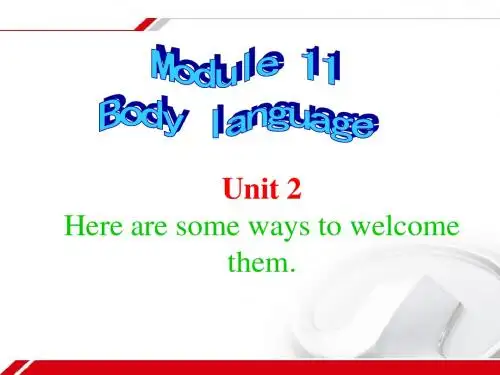
shake hands and smile when they meet. They usually __________
Where are they from?
Maybe
They are from America. They are American. How do they greet? They usually _______________ shake _________ kiss _______________________ hands, when they meet. or hug each other
In Greece, it’s not at all polite! In fact, it’s very rude.
wave to say goodbye be careful in fact
挥手告别 小心 事实上
语法讲解----祈使句
But be careful!
1.—Don’t be late again, Mike? —_______________. A. No, I don’t C. Sorry, I won’t B. Don’t worry D. I don’t know
Maybe
Where are they from? They are from New Zealand. They are Maori. How do they greet?
They touch noses.
You know, when we meet others, we often use our body to greet each other. Now, let learn about our body.
head
ear
外研版英语七年级下册Module11Unit2Here+are+some+ways+to
语言点精析
要点1:(P68)You can stand close to people in the Middle East but don't stand too close to North Americans!
在中东,你可以站得离人们近些,但是不要站得离北美人 太近!
【重点探究1】 close作副词,意为“接近地”,常用短语:close to意为 “离……近”。
( T )5.In Greece, it isn't polite to wave to say goodbye.
二、请认真阅读教材P68课文内容,把下面的短文补充完 整
Here are some 1.___w_a_y_s__ to welcome new foreign students.In 2.___B_r_i_ta_i_n___,people don't like to touch others, but in South America, they like to 3.___h_o_l_d__ your arm so you can't 4.__m__o_v_e__ away.Remember to 5.___g_iv_e___ someone from North America lots of 6.___p_e_r_s_o_n_a_l__ space.In some countries, it isn't 7.___p_o_li_t_e___ to look at people when you talk.And it isn't polite to 8.___w_a_v_e__ to say goodbye in Greece.In 9.___f_a_c_t __,it's quite 10.__r_u_d_e___.
外研版七年级下英语Module11 Unit1、2复习试卷
七年级英语下册Module 11 U1复习卷一.重点单词默写: (得分:_______)1.英雄2.桥:3.建造:4.博物馆:5.在—的上面:6.地球:7.太空,空间:8.新闻:9.以前:10.儿子:二、重点词组默写:(得分:________)1认为,想起________________2. 穿过(从中间) _______________3. 穿过(桥/ 马路) ____________4.从事_______________ 5 几天前_______________三、知识点归纳:1. over go through go across从空间穿过: __________ 穿过马路或街道: __________ 在……上面: __________2. 几个介词: ago, later, last fora. 用于一般过去时, 表示---以前: 时间段+__________, 如:两小时以前:_____________b.表示上…: ______+时间, 如: 上周二: __________, 去年________;做动词时,表示_____.c. 表示…以后: 时间段+_______, 如: 两年后_____________; 表示再见See you _________!d. 持续一段时间: __________+时间段四、课堂练习选择填空( )1. Spring ________________ three months every year.A. lasted forB. last forC. lasts for( )2. We are middle school students now, but we were pupils _____________.A. at the momentB. two years agoC. the next year( )3. Look out! It’s dangerous _________________ the road when the traffic lights are red.A. go throughB. to acrossC. to go across( )4. Shakespeare _________ on 23 April and ___________ on the same day 52 years later.A. be born, diedB. was born, was diedC. was born, died( )5. The sunshine shone into the room ________ the windows.A. overB. throughC. across完成句子:1.---你觉得这本书怎么样? ---不错, 它令我回忆起我的儿童时代.---How do you like the book?--- It’s a nice book. I ________________ my childhood after reading it.2. 那些俄国人决定要徒步穿越这个森林.Those Russians ______________________________________ the forest on foot.3. 十年前他是做什么的? 他是一名铁路工程师.What did he _______________________ ten years ago? He was a railroad engineer.4.十年后你会是干什么的? What will you do ___________________________?5. 对盲人来说, 过马路是危险的._____________________for the blind to ______________________ the street.七年级英语下册Module 11 U2复习卷一.重点单词默写: (得分:_______)1.日期2.到达:3.持续,最后:4.着陆,陆地:5.第三:6.火车,训练:7.人:8.丈夫:9昨天:10.中间:二、重点词组默写:(得分:________)1. 送---进入_______________2. 开始做某事.,从事--______________3 休息一下____________4.到达___________ 5. 上周___________三、知识点归纳:1. (某人)做某事是……的: It is/was +____________ for sb.+ _____________2. 表示……的, 词与词间用连线: 如38岁的: ______________;3. 次数times: 1次:__________ 2次______________3次_________4次____________问次数用how many times 或__________4. return: 表示返回, 回来/回去________________ = _____________________.表示归还---东西给某人_________________四、课堂练习选择填空( )1. The famous national hero is a _____________________ husband.A. 40 years oldB. 40-years-oldC. 40-year-old( )2.--- _______ do you want to be in the future? --- I want to be a person ____Mother Teresa.A. What, likeB. What, asC. How, with( )3. --- How_____________ did you return to you hometown every year? --- Twice a year.A. many timesB. how oftenC. long( )4. _______ a student, we must try our best to study English hard.A. BeB. AsC. like( )5. After resting for a few hours, he had a meal and _________ on the programme.A. start workingB. was start to workC. started working完成句子:1. 医生告诉他这种药每天服三次.The doctor told him to take the medicine ______________________________.2. 对Phelps菲尔普斯来说, 学游泳是最容易的.It’s___________________________________________ to learn to swim.3. 七年前,中国开始发射人进太空.Seven years ago, China _______________________________ persons into the space.4. 他每周休息一天, 每天休息8小时.He ______________________________ every week and rested for eight hours..5. 当我回学校时, 我把钱还给她了.When I ________________________ school, I __________________the money to her .。
七年级英语下册Module11BodylanguageUnit2Herearesomewaystowelcomethem同步测试(新版)外研版(含答案)
Unit 2 Here are some ways to welcome them.A组基础知识一、根据音标写单词1. /m/2. /s mwe/3. /f r n/4. /maθ/5. /brItn/二、根据句意及汉语提示完成句子1. Danny is a very (有礼貌的) boy.2. Oh, Mum!Please give me some (个人的) space!3. It’s (无礼的) to speak to your parents in that way.4. —What is Xu Gang (握着) in his right hand?—Sorry, I don’t know.5. I go to school on (脚,足).三、用所给词的适当形式填空1. It’s (polite) to t alk loudly in the reading room.2. The (Britain) people speak English.3. You must be (care) when you cross the road.4. What about (go) for a ride in the park?5. (not be) late for class, boys and girls.四、句型转换1. You can’t eat candy in class. (改为祈使句)candy in class.2. Please give me an eraser. (改为同义句)Please an eraser .3. It rained yesterday. They didn’t go to the concert. (合并为一句)It rained yesterday, they didn’t go to the concert.4. To keep the classroom clean and tidy is important. (改为同义句)important the classroom clean and tidy.5. Stand too close to North Americans. (改为否定句)too close to North Americans.B组能力提升一、阅读理解Different countries have different customs in giving presents.In China you must never give a clock to a Chinese person, because the sound of the word “clock”is similar to the sound of “death”. Also, don’t wrap(包裹) a present in white, black or blue paper, because they are the colours for funerals(葬礼). Don’t give a knife, because something sharp can cut a friendship.In Russia if you give flowers as presents, you have to give an odd number of them(one, three, five, etc.) because even numbers of flowers are for funerals.In Germany if you are invited to dinner, a bunch of flowers is a good present to take to your dinner hostess(女主人), but don’t take her red roses because it means you are in love with her. Don’t take thirteen of anything because it’s an unlucky number. Don’t take an even number of anything, either. Don’t wrap your presents in whit e, brown or black paper.()1. According to the passage, must never be given to Chinese people as presents.A. flowersB. clothesC. foodD. clocks()2. People don’t wrap presents in black or white paper in .A. GermanyB. ChinaC. both China and GermanyD. both China and Russia()3. What does the underlined word “even” mean in Chinese in the passage?A. 偶数的B. 奇数的C. 甚至D. 平坦()4. What present can you take to your dinner hostess in Germany?A. Thirteen of s omething.B. Flowers except red roses.C. An even number of something.D. Something wrapped in brown paper.()5. Which is the best title for the passage?A. Foreigners’ PresentsB. Giving Flowers as PresentsC. Different Customs in Giving PresentsD. Don’t Give Thirteen of Anything as Presents二、用方框中所给单词或短语的适当形式填空Apolite move wave bring body1. My best friend to Beijing last year.2. We usually to say goodbye when our friends leave.3. A nose is a part of a .4. In some places, it’s not to look at people all the time when you talk to them.5. Little Peter his father’s mobile phone to school yesterday.Bnot at all point at in fact personal space close to6. Don’t let the students do too much homework. Please give them more .7. The teacher the blackboard and said, “You must look carefully.”8. , I don’t like to tou ch little dogs.9. The girl is shy with them.10. The British don’t like to stand each other.三、根据短文内容及汉语提示完成短文What do we do if we have something to tell others or if we want to learn something fromothers? Yes, we1 (使用) our language, that is, either spoken language or written language. But in2 (事实), there is another kind of language and it is also very3 (重要的). Do youknow what it is? Yes, that is4 (身体) language. Can you tell me something aboutbody language? For example, if you5 (赞同) with what I said just now, what do you do? And if you d on’t agree with whatI said, what do you do? But 6 (有时) the same gesture means different things indifferent 7 (国家). For example,8 (某处) in the world 9 (点头) head doesn’t mean YES. So if you visit a 10 (外国的) country, only speakingits language very well isn’t enough.四、语法填空阅读下面短文,按照句子结构的语法性和上下文连贯的要求,在空格处填入一个适当的词或使用括号中词语的正确形式填空(每空不多于2个单词)。
七年级英语下册Module11BodylanguageUnit1Theytouchnoses同步课件外研版
Ⅰ.从方框中选词填空,有的需要变换形式,每词限用一次
bow,shake,together,Russian,smile
1.He usually
to others because he is Japanese.
2.She
the juice before she drank it.
3.He met ten
3. (2017安徽芜湖二十九中期中)Our teacher says that many
(visit)
will come to our school next day.
4.She wanted to try Japanese food and
(India)food.
5.—What did they do?
例 根据汉语意思完成句子。每空一词
他向我微笑,并和我握手。
He smiled at me and
me.
解析 本题考查shake hands with sb.的固定搭配。
答案 shook hands with
知识点二 nod的用法 nod作动词,意为“点(头)”,可以作及物动词,也可以作不及物动
词。例如: He nodded when I asked if he understood. 当我问他是否懂了的时候,他点了点头。 She nodded her head when she passed me in the street. 她在街上与我擦肩而过时向我点了点头。 拓展 nod one's head 点头 注意 nod的过去式和过去分词是nodded,要双写结尾的d。有的动词的 过去式和过去分词要双写结尾的辅音字母,如stopped,dropped等。
Ⅱ.单项选择