
人教版 九年级全册 Unit 3 Section B 2a-2d
Where is the post office?
Pardon me, could you please tell me where to
park my car?
It’s very important to know how to ask for help politely.
How can we make polite
By adding “excuse me” or “pardon me” at the beginning of the question. e.g. When does the bus leave? → Excuse me, when does the bus leave?
By using “could” instead of “can” in questions. e.g. Can you help me? → Could you help me?
1. you ask a stranger for information 2. you ask your brothers or sisters 3. you ask your teacher about something
Listen and read. What is the main idea of the passage?
Read paragraph 2 and answer the question.
What do we need to think about when we talk to different people?
We need to think about whom we speak to or how well we know them.
n. 发言者
Good speakers change the way they
speak in different situations. …
Paragraph 3 Usually polite questions are longer.
Paragraph 4 However, it is important to learn how to use the right language in different situations.
T: Is it important to know _h_o_w__t_o_a_s_k__fo_r_ h_e_l_p_p__o_li_te_l_y_?
L: Of course. It is not enough to _ju__st__a_sk__a_ q__u_e_st_i_o_n_c_o_r_r_e_c_tl_y.
your elders. ➢…
Zhang Ming is traveling in the USA. He wants to go to a small town but he doesn’t know the way. What should he do?
Excuse me. Could you tell me where the East Town is?
them with your partner.
➢ In a foreign country. ➢ In public places like a bank, a post
office, a library, a shopping mall, etc. ➢ At school. ➢ At home, especially when speaking to
home
ready, OK?
7. Could you possibly tell me
the way to the village
B
street
school?
Tom is talking about polite requests with his friend Lucy. Complete their conversations according to the article.
Para. 3 Para. 4
c) Good English speakers need to know how to communicate well with other people.
d) The choice of language depends on the situation and the relationship between the speakers.
restrooms are?
Direct questions
Polite requests
2. When is the school trip?
3. Peter, tell me your e-mail address.
4. Where’s the post office?
2. Excuse me, Mr. West. Do you know when the school trip is?
Sorry.rIecqaune’tshteslp?
you.
Sure. There’s an underground
parking lot over there.
Where do you need to make
2
a polite requests? Think of some possible situations. Discuss
A. What to do when you meet with difficulties.
B. How to get along well with others. C. What to do when you fail. D. How to ask for help politely.
2b Read the article and find the topic sentence for each paragraph.
And direct questions sounds _le_s_s_p__o_li_te_. Usually polite questions are longer. Sometimes we need to _sp__en__d_t_im__e_l_e_a_d_i_n_g _in_t_o__a_r_e_q_u_e_s_t_. T: It might seem more difficult to __s_p_e_a_k_ _p_o_li_t_el_y__th_a_n__d_i_re_c_t_ly_. But using the right language in different situations will help you c_o_m__m__u_n_ic_a_t_e_b_e_t_t_e_r_w_i_t_h_o_t_h_e_r_p_e_o_p_l_e.
where the nearest
B
station is?
home
street
any public place/home
street
Request
Person Place
5. Excuse me, do you know what time it begins,
movie B theater
please? 6. Let me know when you’re A
Request
Person
Place
1. Will you pass the salt? A
2. Do you know where I
can change some
B
money, please?
3. Could you tell me what just happened? A/B
4. Can you please tell me
By adding “please” at the end of a question. e.g. Could you help me, please? (NOT “Please, could you help me?”)
2d Read the requests below. In the second column, write A if you would say it to someone you know and B if you would say it to a stranger. In the last column, write where you think these people are.
Read paragraph 1 and answer the question.
What else do we need to learn besides asking a question correctly when you ask for help?
We need to learn how to be polite when we ask for help.
Find the main idea of each paragraph.
Para. 1
a) Use more words to help you sound more polite.
Para. 2
b) It is important to know how to ask for help politely.
人教版 九年级全册 Unit 3 Section B 2a-2d
2020/9/12
1. Read to learn when and how to make polite requests.
2. To learn to choose and use suitable language.
3. To learn the words and expressions.
3. Peter, could you please tell me your e-mail address?
人教 九年级全一册Unit3Section B(2a---2d)

paragraph2
1.What should we do when we are talking with different people?
We should change the way we speak.
Translate the phrases.
make polite requests 提出客气的请求
ask for help
求助;寻求帮助
sound less polite 听起来不太礼貌
a direct question 直接的问题
such as
例如;比如
e-mail address
电子邮件地址
help.( F )
4.Sometimes we don’t need to lead to a
request.( F )
paragraph4
Why is it important to use the right language in different situations?
Because this will help us communicate better with other peple.
2.What might the expressions you use depend on?
We use might depend on whom you are speaking to or how well you know each other.
If you need help with your homework, how would you ask these people?
人教版英语九年级全册Unit3SectionB2a2d优秀教学案例

4.教师根据评价结果,调整教学策略,以满足学生的不同需求,提高教学质量。
四、教学内容与过程
(一)导入新课
1.利用图片、视频等多媒体教学资源,展示与本节课相关的情景,激发学生的学习兴趣,引发学生的思考。
2.学生认真完成作业,检查自己的学习成果,发现不足,及时进行调整。
3.教师批改作业,及时给予反馈和评价,帮助学生提高作业质量。
4.教师根据学生的作业完成情况,了解学生的学习状况,调整教学策略,提高教学质量。
五、案例亮点
1.情景创设:本节课通过展示图片、视频等多媒体教学资源,创建了真实且生动的情景,让学生身临其境。这样的情景创设不仅激发了学生的学习兴趣,还提高了学生的参与度,使得学生能够更好地理解和运用所学知识。
2.学生围绕讨论主题,积极发表自己的观点,进行互动交流,培养团队合作能力。
3.教师巡回指导,关注学生的讨论情况,及时给予反馈和指导,帮助学生解决问题。
4.各小组汇报讨论成果,教师对各组的讨论情况进行评价,给予肯定和鼓励。
(四)总结归纳
1.教师引导学生对所学知识进行总结归纳,梳理知识体系,提高学生的理解能力。
2.学生通过总结归纳,巩固所学知识,形成系统化的认知结构。
3.教师通过提问、讨论等方式,检查学生对所学知识的掌握情况,及时发现并解决学生的学习问题。
4.教师对本节课的学习内容进行简要回顾,强调重点和难点,为学生的复习和巩固提供指导。
(五)作业小结
1.教师布置作业,要求学生运用所学知识,完成相关练习,巩固所学内容。
3.学生通过学习英语,拓宽视野,了解不同的文化,培养跨文化交际的能力。
人教版九年级英语全册Unit3SectionB2a~2d教学设计
针对以上学情,教师在教学过程中应关注个体差异,采取分层教学,提供有针对性的指导。同时,注重激发学生的学习兴趣,培养他们的自信心和团队精神,为学生的全面发展奠定基础。
三、教学重难点和教学设想
(一)教学重难点
1.重点:
-掌握本节课的核心词汇和短语,如:destiny, talent, confidence, opportunity等。
2.难点:
-对一般过去时和现在完成时的区别和运用进行深入理解。
-在实际语境中灵活运用目标词汇和句型进行表达。
-提高听力理解能力,特别是在处理语速较快、信息量较大的听力材料时。
-阅读理解中,对文章细节和隐含信息的捕捉以及推理判断能力的培养。
(二)教学设想
1.教学策略:
-采用任务型教学法,设计真实、有意义的任务,激发学生的兴趣和参与度。
5.培养阅读技巧,如快速阅读、细读、推理等,提高阅读理解能力。
(二)过程与方法
在本章节的教学过程中,学生将通过以下方式培养英语能力:
1.通过小组合作,进行课堂讨论,培养学生主动思考和合作交流的能力。
2.利用听力材料,进行听力训练,提高学生的听力技巧和注意力。
3.采用任务型教学法,设置各种真实语境,让学生在实际运用中掌握目标知识。
-帮助学生了解自己的优势和梦想,增强自信心。
3.教学过程:
-教师提出讨论问题,学生进行小组讨论。
-每个小组选派代表进行汇报,其他学生认真倾听,给予评价和反馈。
(四)课堂练习
1.教学活动设计:
-设计听力练习,让学生听懂并获取关键信息,如:人物的经历、梦想等。
-设计阅读练习,让学生运用阅读策略,理解文章深层含义,进行推理判断。
英语人教版九年级全册Unit 3 Section B 2a-2d
Read Paragraph 4, fill in the blanks(using adj or adv) It might seem ___m_o_r_e_d_i_ff_ic_u_lt__ to speak __p_o_li_te_l_y____ than ___d_i_re_c_t_ly___. However, it is ____im_p_o_r_t_an_t_ to learn how to use the ___r_ig_h_t_____ language in ___d_i_ff_e_re_n_t__ situations. This will help you communicate ___be_t_te_r______ with other people.
Reading Practice
Ask for information or help is a very common and necessary 1.__a__c_t_iv__i_ty_____, especially when we 2. ___v__is_i_t_____ a foreign country. Learning to use correct language is not enough, we need to learn how to be 3.___p_o__li_t_e__ when we
人教新目标九年级全册Unit3SectionB2a—2d
Paragraph 4
It might seem more difficult to speak politely than directly .
Read paragraph 1 and answer the question.
What else do we need to learn besides asking a question correctly when you ask for help?
say it to someone you know and B if you would say it to a stranger. In the last column, write where you think these people are.
Request
Person Place
1. Will you pass the salt?
n. 发言者
Good speakers change the way they
speak in different situations. …
Paragraph 3 Usually polite questions are longer. They include expressions such as “Could you please …?” or “May I ask …?” It sounds more polite to say, “Peter, could you please tell me your e-mail address?”…
the school trip is?
3. Peter, tell me 3. Peter, could you
your e-mail
人教新目标九年级全册 Unit 3 (Section B 2b-2d)课件(共18张PPT)
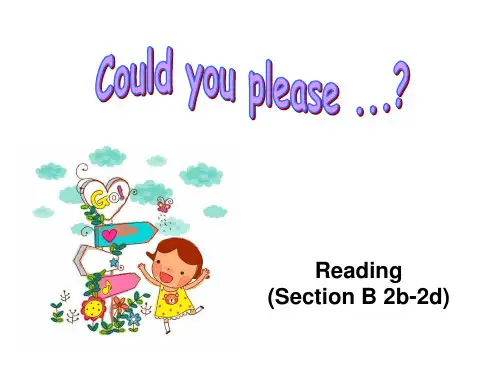
Both are correct English, but the first one sounds less polite. Because it is a very direct question.
2. Is it enough to just ask a question correctly?
4. What might the expressions you use depend on?
They might depend on whom you are speaking to or how well you know them.
5. How to make questions more polite?
Add expressions such as "Could you please...? or "May I ask...?" . Sometimes we need to spend time leading in to a request.
6. Why is it important to learn how to use the right language in different situations?
Paragraph 1
When you visit a foreign country, it is important to know how to ask for help politely.
人教九年级英语unit3 Section B 2a2d(共19张PPT)
2.
When is the school trip?
Excuse me , Mr West , do you know when the school trip is ?
Pardon me , could you please
3. Where’s the post office? tell me where to park my car?
这也会有助于你们大家更好地学语言,或者任 何你们希望说的其他语言。
2/4/18
词组any other 意义为“任何其他 的”注意起在比较等级中的运用。
如: 他在班上个头最高。 He is the tallest in the class.
或He is taller than any other student in the class. 或He is taller than the other students in the class.
“Peter, could you please tell me your e-mail address?”
than “Peter, tell me your e-mail address”.
Sometimes we even need to spend time leading in to a
request. For example, with a stranger on the street, we might first say, “Excuse me, I wonder if you can help
人教九年级英语上册 Unit 3
Could you please tell me where the restrooms are?
Section B 2a~2d
人教版英语九年级全一册-Unit 3 Section B (2a-2d)教案
九年级Unit 3 Could you please tell me where the restrooms are?Section B 2a-2d Could you please...?教学设计Teacher :Analysis: This unit is about asking for information politely. This reading passage is telling us where should we need to make polite requests and how. Students have learned how to say politely in Section A and they will keep learning how to make polite requests in the reading passage. They will be interested in talking rudely and politely and compare with different ways of speaking. So the teacher will design these kinds of activities for them to learn better.Objectives:1. Language skillsStudents will be able to make polite requests according to different situations and different people.Students will learn how to make polite requests.Students will be able to rewrite impolite requests.2. Language knowledgeStudents will be grasp these new words and sentence structures, politely, request, direction, correct, polite, direct, speaker, impolite, Could you please...? May I ask...? Excuse me, I wonder if you can help me. I’m sorry to trouble you, but...Students will be able to speak politely, gently and slowly when making request.3. AffectsStudents will be able to choose and use suitable language based on cultural knowledge, such as in a foreign country, in public places, at school and at home.4. Cultural awarenessStudents will be able to learn to ask politely and pay attention to the body language and remember to say thank you.Students will learn not to ask rude questions, such as age, salary or use rude gestures.5. Learning strategyStudents will be able to realize the wrong ways they are using in daily life and correct them. Students will be able to get information from the pictures given from the passage.Focuses:Students will be able to choose and use suitable language based on cultural knowledge, such as in a foreign country, in public places, at school and at home.Students will be able to rewrite impolite requests.Difficulties:Students will be able to learn to ask politely and pay attention to the body language and remember to say thank you.Students will be able to realize the wrong ways they are using in daily life and correct them. Students will be able to get information from the pictures given from the passage.Teaching process:So let’s take a look at the structure of the passage. First paragraph, the writer leads in the topic. ...Step 3 Close-readingT: So what examples does the writer give us to lead in the topic? Request 1 VS Request 2Topic: When we visit a foreign country, we need to ask for help_________ and _________.T: How can we speak politely? What does a good speaker do? What examples does the writer give us as good speakers?When is the school trip?Excuse me, Mr. West. Do you know when the school trip is?T: Whom do we usually say it to?Why?Tip 1: Good speakers change the way they speak depending on__________________ and ___________________.T: How can we make questions longer and more polite?Could you please...?May I ask...?Excuse me, I wonder if you can help me.I'm sorry to trouble you, but.......Tip 2: Longer questions can be more ______ and we need to spend time ___________________before asking for help.PracticeWhat are you going to say to them if you are thirsty? Can you talk about it with your partner?What does the writer tell us in the end?Why do we need to speak politely? 细读阶段,通过找作者给出的例子一步步带出话题和make polite requests 的两个方法。
人教版九年级英语全册Unit3 sectionB 2a~2d课件
ask for help.
C: 正确的
Read Para2 carefully, and answer the questions.
How
do good learners change the way
they speak in
different situations?
depends on how well they know each
Key Phrases
礼貌地寻求帮助
_____a_sk__f_o_r_h_e_l_p_p_o_l_it_e_l_y_
改变方式
______c_h_a_n_g_e__t_h_e_w_a_y____
在不同情境下
_________i_n_d__if_fe_r_e_n_t_s_i_tu_ations
直接的问题
OK?
B
7. Could you possibly tell me the way to the village school?
Place on the street at home/movie
theater at home
on the street
Read Para3 carefully, and answer the questions.
Homework
Imagine you are going on a short study vacation in America .What would you like to know before you go? Write an e-mail to your teacher to ask some matters(注意事项).
What can we learn from Mary's experience ?
Unit3SectionB(2a_2d)课件人教版英语九年级全册
They went along one street, turned down another, 26 . a square and at last, after about half an hour, they arrived at the post office. Mr. Smith couldn’t understand 27 the old woman found her way. “It is wonderful,” he said. “But how do you find the way in the thick fog?” ( C )26. A. looked up B. put on C. passed by D. laid out
一二三四五
convenience he become bring travel rush sudden direction many postcard There was never a railroad accident when Owney was on the train. Wherever he went, post officers made a dog tag(标签) for him. And then it would be 37. convenient for others to know where he had traveled. The National Postal Museum has 38. more than 1,000 Owney tags that show all the places Owney visited.
story.
一二三四五
15. 在我们社区有一个地下超市。 There is an underground supermarket in our neighborhood.