
译林版7年级上册Unit1词汇句型语法 知识点整合
7上U1知识点
重点词汇
(1)名词
e-dog电子狗 grade年级
student学生 reading阅读
classroom教室 dancing跳舞,舞蹈
looks相貌,容貌 age年龄
swimming游泳 hobby业余爱好
master主人;大师 classmate同班同学
glasses复]眼镜
(2)形容词
slim苗条的 glad高兴的
cute可爱的;讨人喜欢的
(3)代词
everyone每人,人人 play football踢足球
like music喜欢音乐 fly kites放风筝
be good at擅长 ... years old…岁
be from..来自于……;是……的人
good morning/ afternoon/ evening早上/下午/晚上好
after school放学后 all the lessons所有的功课
wear glasses I眼镜 live with..和…住
Class1, Grade7七年级(1)班 love reading喜欢阅读
二、重要句型
1.- What 's your name?你叫什么名字? -My name is Hobo。
我的名字叫霍波。
2.- Are you my master?你是我的主人吗? Yes,I am。
是的,我是你的主人。
3. I’m12 Years old.我12岁。
4. I have short hair。
我留着短发。
5. I love reading。
我爱阅读。
6. I often play football after school我经常放学后踢足球
7. He is good at Maths。
他擅长数学。
8. Sandy does not have long hair。
桑迪没有留长发。
9. Sandy is tall and slim。
桑迪又高又苗条。
10.Are you happy?你/你们高兴吗? Yes. I am/we are是的,我/我们高兴。
11. Our school is nice。
我们学校很漂亮/好看。
12. I come from Nanjing我来自南京/我是南京人。
三、核心语法
学会使用be动词
A.be动词的基本形式:am/is/are
B.be动词的基本含义:be动词可以作“是”讲,有时也可以不翻译出来。
C.be动词(amis/are)一般现在时态的肯定句、否定句、疑问句句型结构及其回答
1)肯定句:主语+am/is/are+表语(名词/形容词/数词/副词/介词短语等)。
如:
Heis12 years old.他12岁
2)否定句:主语+am/is/are+not+表语。
如:
He is not in the classroom。
他不在教室里。
3)一般疑问句及其回答
一Am/Is/Are+主语+表语?
-Yes,主语+am/is/are。
No,主语+am/is/are not.如
-Are you a new student?—你是新来的学生吗
- Yes. I am.是的,我是。
/No,I am not不,我不是。
4)特殊疑问句及其回答
疑问词/词组+am/is/are+主语?
主语+am/is/are+表语。
如
-What is your father?你爸爸是做什么工作的?
-He is a doctor。
—他是一位医生。
D使用be动词的注意点:人称代词与be动词的缩写形式。
1)在肯定句和一般疑问句的否定回答中,人称代词可以与be动词缩写。
但是在一般疑问句的肯定回答中,be动词与第一人称代词I不能用缩写形式。
如:
Are you a new student?你是新来的学生吗? Yes,lam。
不能写成Yes,I’m
2)在否定句中,be动词可以与人称代词或副词not缩写。
但是当主语是第一人称单数代词时,be动词只能与人称代词1缩写。
如:
I'm not a new student。
不能写成Iamn' t a new student。
(无amn't用法)
3)当单数名词作主语被作为群体看待时,be动词要用复数形式。
如
My family are all volunteers。
我的家人都是志愿者。
4)在 there be结构中,be动词必须和后面紧跟的主语单复数形式保持一致,即遵循“就近原则”。
如:
There is a map of China on the wall.墙上有一张中国地图。
There’s a bottle of milk and two bottles of juice on the table.桌上有一瓶牛奶和两瓶果汁。
There are some books and a cup of water on the table.桌上有些书和一杯水。
牛津译林版七年级英语上册Unit1归纳知识点汇总
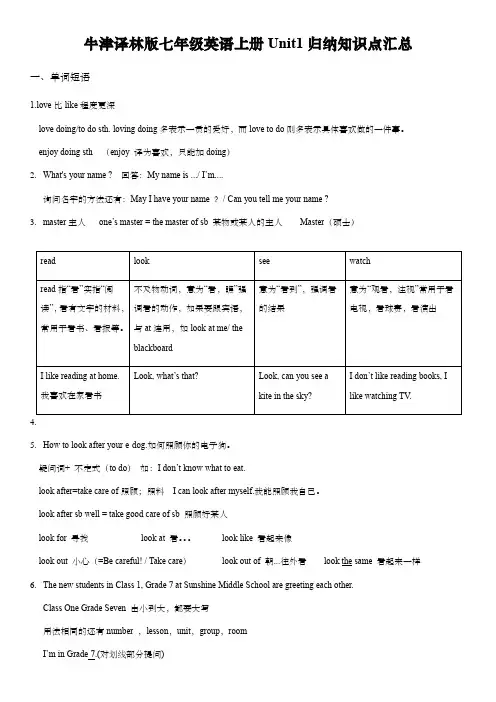
牛津译林版七年级英语上册Unit1归纳知识点汇总一、单词短语1.love比like程度更深love doing/to do sth. loving doing多表示一贯的爱好,而love to do则多表示具体喜欢做的一件事。
enjoy doing sth (enjoy 译为喜欢,只能加doing)2.What's your name ? 回答:My name is .../ I’m....询问名字的方法还有:May I have your name ?/ Can you tell me your name ?3.master主人one’s master = the master of sb 某物或某人的主人Master(硕士)4.5.How to look after your e-dog.如何照顾你的电子狗。
疑问词+ 不定式(to do)如:I don’t know what to eat.look after=take care of照顾;照料I can look after myself.我能照顾我自己。
look after sb well = take good care of sb 照顾好某人look for 寻找look at 看。
look like 看起来像look out 小心(=Be careful! / Take care)look out of 朝...往外看look the same 看起来一样6.The new students in Class 1, Grade 7 at Sunshine Middle School are greeting each other.Class One Grade Seven 由小到大,都要大写用法相同的还有number ,lesson,unit,group,roomI’m in Grade 7.(对划线部分提问)What/ Which grade are you in?Our school has six grades.我们学校有6个年级。
译林版初中英语七年级上册期中复习Units1-4单元知识点梳理归纳

译林版初中英语七年级上册期中复习Units1-4单元知识点梳理归纳译林版初中英语七年级上册Unit 1 This is me!单元知识点梳理【重点短语】1.look after take care of 照顾2.on the first day 在第一天3.Class 1,Grade 7 七年级1班4.play football 踢足球5.after school 放学后6.become from 来自7.be good at do well in 擅长8.fly kite s 放风筝9.go home 回家10.listen to music 听音乐11.play a game 玩游戏12.wear glasses 戴眼镜13.at school 在学校14.all the lessons 所有的课程15.talk about 谈论16.over there 那里17.a lot of hobbies 许多爱好【用法集萃】1.lovelike doing sth 喜欢做某事2.let’s +动词原形让我们……3.I amMy name is 我叫……4.welcome to +地点欢迎来到……5.This is...... 这是……6.be good at do well in doing擅长做某事7.in Class…Grade…在几年级几班8.live with…in…和……住在……9.I’m …year old. 我……岁了。
10.I have…hair.我留着……头发【重点句型】1.What’s your name?你叫什么名字?2.Nice to meet you! 很高兴见到你。
3.I love reading. 我喜欢阅读4.Now let’s meet our new classmates. 现在让我们认识下我们的新同学。
5.I often play football after school.放学后我经常踢足球。
七年级上册英语译林u1知识点
七年级上册英语译林u1知识点英语作为一门重要的语言,在我们学习生活中一直扮演着重要的角色。
对学习英语的初学者,我们需要了解一些基本的知识点。
本文将带领大家逐一了解七年级上册英语译林U1的知识点。
一、基本语法1. 一般现在时态:表示现阶段的状态,或者经常发生的事情。
例如:I study every day.(我每天学习。
)2. be动词的用法be动词有三种形式:am, is, are。
例如:I am a student.(我是一名学生。
)3. 一般过去时态:表示过去发生的事情。
例如:I studied yesterday.(我昨天学习了。
)4. 疑问句疑问句中需要在句首加助动词,但be动词例外。
例如:Do you like English?(你喜欢英语吗?)5. 否定句在句子前加上not,表示否定。
例如:I do not like math.(我不喜欢数学。
)二、基本词汇1. numbers(数字)2. colors(颜色)3. days of the week(一周的日子)4. months(月份)5. seasons(季节)6. school subjects(学校科目)7. classroom objects(教室物品)8. family members(家庭成员)9. nationalities(国籍)三、日常用语1. 问候语Greeting(问候)是日常生活中常用的交流方式,例如:Good morning!(早上好!)Good afternoon!(下午好!)Good evening!(晚上好!)2. 自我介绍当我们遇到新的人时,需要进行自我介绍,例如:Hello, my name is XXX.(你好,我的名字是XXX。
)3. 感谢和赞美当收到帮助或者赞美时,需要用到以下语句:Thank you very much.(非常感谢你。
)You are very kind.(你非常善良。
)四、阅读技巧1. 理解文章主题通过文章中的关键词语和段落结构,可以帮助我们理解整篇文章的主题。
Unit1知识点梳理2023-2024学年牛津译林版英语七年级上册
第一讲 7A Unit1 Language Point 梳理一.Unit 1 重点语法1.would like / love sth.想要某物例句:Would you like some water?肯定回答:Yes, please. Yes, I’d like / love to.否定回答:No, thanks.2.would like / love to do sth.想要做某事例句:Would you like to drink some water?肯定回答: Yes, I’d like / love to.否定回答:I’d like / love to, but …… .3.糖葫芦形容词结构:数词+ 名词(单数) + (形容词)例:80foothigh 80 英尺高fiveinchtall 5英寸高的7yearold 7岁的注意:①名词必须用单数②只能放在名词前作定语,不能放在be 动词后作表语。
4.read/look/see/watch几个“看”的用法和区别:look 强调看的动作①系动词。
译作看起来,后接形容词。
She looks happy.②不及物动词。
译作看,词组:look at…,用副词修饰。
Tom looked at me angrily.see 及物动词,译作看到,无进行时态,强调看的结果。
watch 及物动词,译作观看,注视。
强调观看正在进行中的,发生变化的活动过程,常用于看电视、看球赛、看演出等。
read 及物动词,译作阅读。
强调看文字内容的东西,常用于看书、看报纸、看杂志等。
5.疑问代词what、which、who 及疑问副词how、when 、where可以和动词不定式连用。
what to do 做什么which to do 做哪个who to do 如何做how to do 谁做when to do 什么时候做where to do 在哪里做6.“疑问词+ to do” 结构经常放在know,learn,see ,ask等动词后做宾语。
牛津译林版七年级英语上册Unit1词汇语法知识点汇总(附综合检测卷)

牛津译林版七年级英语上册Unit1词汇语法知识点汇总Unit 1 This is me知识精讲必背词汇age n. 年龄cute adj. 可爱的;讨人喜欢的hobby n. 业余爱好dancing n. 跳舞,舞蹈swimming n. 游泳master n. 主人;大师grade n. 年级student n. 学生reading n. 阅读classmate n. 同班同学slim adj. 苗条的over 在……上classroom n. 教室二、重点词汇1. master noun & verb /ˈmɑːstər/1). n. a person who is very skilled in a particular job or activity大师,名家;专家例句:He was a master of disguise.他是个伪装大师。
This painting is clearly the work of a master.这幅画显然是名家的作品。
2). v. to learn how to do something well精通,掌握例句:She lived in Italy for several years but never quite mastered the language. 她在意大利住了好几年,但一直没怎么学好意大利语。
He quickly mastered the art of interviewing people.他很快就掌握了采访的艺术。
2. member noun /ˈmembər/1). a person, animal, or thing that is part of a group成员,一分子例句:The lion is a member of the cat family.狮子是猫科动物。
Representatives of the member states will be meeting next week.成员国代表将于下周会晤。
值得推荐牛津译林版7年级上册Unit1知识点整合 词汇句型语法练习
7上U1知识点重点词汇(1)名词e-dog电子狗 grade年级student学生 reading阅读classroom教室 dancing跳舞,舞蹈looks相貌,容貌 age年龄swimming游泳 hobby业余爱好master主人;大师 classmate同班同学glasses复]眼镜(2)形容词slim苗条的 glad高兴的cute可爱的;讨人喜欢的(3)代词everyone每人,人人 play football踢足球like music喜欢音乐 fly kites放风筝be good at擅长 ... years old…岁be from..来自于……;是……的人good morning/ afternoon/ evening早上/下午/晚上好after school放学后 all the lessons所有的功课wear glasses I眼镜 live with..和…住Class1, Grade7七年级(1)班 love reading喜欢阅读二、重要句型1.- What 's your name?你叫什么名字? -My name is Hobo。
我的名字叫霍波。
2.- Are you my master?你是我的主人吗? Yes,I am。
是的,我是你的主人。
3. I’m12 Years old.我12岁。
4. I have short hair。
我留着短发。
5. I love reading。
我爱阅读。
6. I often play football after school我经常放学后踢足球7. He is good at Maths。
他擅长数学。
8. Sandy does not have long hair。
桑迪没有留长发。
9. Sandy is tall and slim。
桑迪又高又苗条。
10.Are you happy?你/你们高兴吗? Yes. I am/we are是的,我/我们高兴。
牛津译林版七年级上册英语Unit1知识点总结
牛津译林版七年级上册英语Unit1知识点总结Unit 1 This is me!1.How to look after your e-dogIf you want to take care of your electronic dog。
you need to know how to do it。
"How to" is a n word followed by an infinitive verb。
"Look after" means to take care of something or XXX.2.Good evening.Good evening" XXX。
It is different from "good night," which is used when XXX.3.XXXIf you enjoy playing football after school。
you can say that you love it。
"Love/like doing something" XXX。
while "love/like to do something" emphasizes a one-time n.For example。
"She loves watching TV。
but today she loves to listen to music." "Love" can be used as a verb to mean "like" or "enjoy," as in "He loves his parents" or "She loves music." It can also be used as a noun to mean "n" or "beloved," as in "a mother's love for her children" or "fall in love with XXX."nally。
(完整版)苏教版新译林英语7年级上册语法总结
7年级上册语法总结Unit 1动词be的一般现在时1、表示一种事实:He is 11 years old他. 11 岁了。
I am from China.我来自中国。
2、表示一种状态〔经常存在〕:He goes fishing every weekend他.每个周末都去垂钓。
We usually go to school at 7:00我.们平时 7 点上学。
3、Be 动词与主语保持一致:I am a teacher.He/She is a worker. It is a little dog.They/We/You are dancers.Be 动词变化依据原那么,口诀:我是 am,你是 are,is 用于他、她、它 , 复数都是 are.4、主语是第三人称单数时,动词的变化:一般都 +s比方:open opens以sss结尾的动词, +es比方:watch watches xshch辅音字母 +y 结尾的动词, y ies比方:study studies④辅音字母 +o 结尾的动词, +es比方:go goes5、一般现在时的句型变换否认句 be+notShe is in the kitchen.~She is not in the kitchen.They are in the classroom.~Theyare not in the classroom.一般疑问句 be 提前She is in the kitchen.~Is she in the kitchen?—— Yes,she is.—— No,she isn’t.They are in the classroom.~Are they in the classroom?—— Yes,they are.—— No,they aren’t.Unit 2行为动词的一般现在时用法例句I go to school at 7:00 every morning.经常性、习惯性的动作The earth moves around the sun客观事实目前的爱好、能力等She sings very well.1、行为动词形式变化主语行为动词第一人称复数〔we〕/第二人称复原形数〔you〕/第三人称复数〔They〕例句We do our homeworkat home.You have lunch at school. They play basketball after school.第三人称单数〔 He、She、It 〕2、句型变换否认句: do+not/does +not 第三人称单She does her 数homework in theevening.You don’tgo to school on Sunday.He doesn’twork in this shop.句首增加 do/doesDo you play basketball after school?Does John speak Chinese?Unit 3人称代词1、我们常用人称代词表示人或物2、人称代词主格、宾格形式单数复数主格宾格主格宾格第一人称I Me We Us第二人称You You You YouHe Him They Them 第三人称She HerIt It3、主格在句中做主语,一般用在动词前宾格在句中做宾语,一般用在动词、介词后4、有好几个人称代词并列出现时,序次以下:单数: 231 原那么—— you、he and I复数: 123 原那么—— we、you and theyUnit 4表示时间的介词 in、on、at介词用法例子in一天中的早 /中/晚 In the morning/afternoon/evening月份In January/February/March/April季节In Spring/Summer/Autumn/Winter年份In 2021/2021on星期On Sunday/Monday/Tuesday某一天On 1 September某一天的早 /中/晚 On a cold morning/Sunday afternoon特定节日 /一天On Children’s Dayat某一时辰At 8:00年龄At 12 years old频度副词:always>usually>often>sometimes>seldom>neverUnit 5特别疑问句特别疑问词含义例句what什么What‘s your name?Class/grade哪个班级、年级What class/grade are you in? what colour什么颜色What colour do you like?time几点What time is it?when什么时候When do you usually get up? where哪里Where do you live?who谁Who is the man in a blue sweater?why为什么Why are you always late for school?whose谁的Whose pen is this?which哪一个Which is better,the red one or the blue one?how怎么样How do you go to school?many多少〔可数〕How many students are there in your class?much多少〔不能数〕How much milk do you drinkevery day?old几岁How old are you?how often多长时间一次How often do you go to the library?long多长How long is the Yangtze River?多久How long do you watch TVevery day?far多远How far is your home from school?tall多高How tall is the building?注意: when 和 what time 的差异What time 咨询的是详尽时间, when 能够是详尽时间也能够是大体时间。
七年级英语上册unit1词组及短语归纳牛津译林版
实用精品文献资料分享七年级英语上册unit1词组及短语归纳(牛津译林版)七年级英语上册unit1词组及短语归纳(牛津译林版)1 读/看这本书 read this book2 照顾 look after 怎样照顾你的电子狗 how to look after your e-dog3 (与)某人交朋友 make friends (with sb.)4 第一天△the first day5 向某人作自我介绍△introduce oneself to sb.6 在七年级一班in Class 1, Grade 7= in Class One, Grade Seven7 热爱读书 love reading love/like/enjoy doing sth. 喜爱做某事喜爱踢足球love playing football 8 喜欢听音乐 like listening to the music 9 喜爱玩电脑游戏 enjoy playing computer games 10 来自…… come from …= be from… 11 努力学习(工作) work hard 12 擅长于…;在…主面做得好 be go od at… = do well in… 13 在阅读兴趣小组/参加英语兴趣小组 in the Reading Club/ in the English Club 14 戴眼镜 wear glasses 15 开始认识这些学生 get to know the students 16 早上好。
/下午好。
Good morning./ Good afternoon. 晚上好。
(晚上见面) Good evening. 晚安。
(睡前告别) Good night.17 做笔记 make notes 18 出生 be born 19 踢足球/打羽毛球 play football/badminton 20 在足球场 on the football field。
牛津译林版七年级上册英语Unit1知识点汇总
牛津译林版七年级上册英语Unit1知识点汇总7A Unit 1 This is me!一.【精选短语】1. how to look after your e-dog如何照顾你的电子狗(1)疑问词+动词不定式(2)look after=take care of 照顾,照料2. Good evening.晚上好。
(晚上见面问候语)→比较:Good night.晚安。
(晚上分别时用语)3. love playing football after school喜爱放学后踢足球【知识链接】Love/like doing sth.喜欢做某事,强调习惯上的喜欢;Love/like to do sth.强调的是某一次的行为。
e.g. She loves watching TV, but today she loves to listen to music. Love的用法⑴vt.喜爱e.g. ①He loves his parents. (不能用like代替love)②She loves music.她爱好音乐。
⑵vt.热爱e.g. We love our motherland.我们热爱祖国。
⑶n.爱;挚爱a mother’s love for her children母亲对孩子的爱②fall in love with sb爱上…,e.g. He fell in love with her.③我们可在书信的结尾处看到例如Love Mary这样的署名,意思是With my love, Mary,一方面表示情感,一方面表示道别。
【用法拓展】lovely美丽的;可爱的e.g. lovely hair秀发,a lovely girl美丽的少女4. be good at sth/doing sth=do well in sth/doing sth擅长;在某方面表现好【知识链接】⑴He is good at telling funny jokes.⑵She always does well in English.5. wear glasses戴眼镜→ wear后接服装、装饰品等,表示“穿、戴”。