
人教版高中英语必修一Words and expressions UNIT 4
right away 立刻马上
• • • • 语气稍弱于at once 可用于过去或将来时态。 He didn't reply right away as he didn't have a ready answer yet. 他没有马上回答,因为他还没有一个现成的答案。
• • • • • •
right now 现在、此时此刻,也有立即、马上、即刻的意思。 一般用于现在或者将来时态。 He's studying right now. 他正在学习。现在 I’ll call him right now/away. 我即刻就打给他。将来
event 事件
the events of Black Wednesday “黑色星期三”事件 万一发生…;如果是那样子的话;假若… In the event that In the event of In the event of fire, ring the alarm bell. 事件(尤指)特殊事件,重大事件
如果着火, 就按警铃。
In the event (that) our team wins, there will be a celebration. 如果我队获胜, 我们将庆祝一番。 in any event 在任何情况下,不管怎样,无论如何..都 You shouldn't cheat in the exam in any event. 无论如何,你都不应当考试作弊。
• make ends meet 收支相抵
• I figured that we could make both ends meet this month. • 我觉得我们这个月的收支能相抵。
nation 民族,国家,国民 英 ['neɪʃ(ə)n] 美['neʃən]
• The whole nation is in great happiness. • 举国欢腾。国民 • Australia is an English speaking nation. • 澳大利亚是一个讲英语的国家。 国家 • The nation was kept in subjection. 【n. 隶属;服从;征服】 • 这个民族已经沦为附庸。民族
smelly 发臭的
• He had extremely smelly feet. • 他的脚臭气熏天。 • “Smelly Cat”(臭臭猫) • v.闻 • smell • n.气味 • smell
farmyard n. 农家庭院;农场;农家
• There is a lawnmower in this farmyard. • 在这个农家庭院里停着一台草坪机。
• in the end 最后,结果; • He calmed down in the end. • 他的情绪终于平定下来。 • come to an end 结束,终止; 完事; 期满; 平息; • It has not come to an end even after three years. • 三年了,事情还没落局。
injure 损害,伤害 vt.
• I did not injure him. • 我没有弄伤他。 • Several policemen were injured in the accidents. • 几名警察在事故中受伤。(被动,被伤,被弄伤) • • • • • 名词:injury do sb an injury/do an injury to sb 伤害某人 Just don't try dancing to it - you'll do yourself an injury. 不要试图跟着它跳舞 ---- 你会伤着自己的.
burst out+doing 后接动名词
• 突然进入某种状态或发生某种情况 • The poor woman burst out crying. • 这个可怜的女人突然哭起来。 • The children burst out laughing. • 孩子们突然笑起来。
million 百万
• 两百万: • two million • millions of: • 数百万 • 十亿: • billion • 十三亿: • 1.3billion
brick 砖,砖块
Words and Expressions
Unit 4
earthquake n. 地震;大动荡
• The bridge broke down in last earthquake. • 那座桥在上次地震中坍塌了。 • quake • vi. 震动;颤抖 • n. 地震;颤抖 • I just stood there quaking with fear. • 我站在那儿,吓得发抖。
dirt 污垢,泥土
• I drove along the dirt road. • 我行驶在一条土路上。 • adj 脏的: • dirty • • • • 灰尘 n.: dust 布满灰尘的 adj. : dusty
ruin v. 使破产,毁灭 n. 废墟,毁灭;
• v.毁坏破坏使泡汤 • 毁了我们的假期/生活/友谊 • ruin our vacation/life/lives/friendship • The bad weather ruined our vacation. • 坏天气使我们的假期泡汤了。 • v.使破产 • ruin sb
• adj. national 国家的,民族的 ['næʃnəl] • 全运会:the na运河,水道 [kəˈnæl]
• 苏伊士运河 • Suez Canal [ˈsju(:)iz] [kəˈnæl] • The Panama Canal joins two oceans. [ˈpænəmɑ:] • 巴拿马运河连通两大洋。 • The canal is blocked. • 该运河阻塞不通。
• n.幸存,生存; 遗物; 遗风
• chance of survival 幸存的几率 存活的几率
destroy 破坏,毁坏,消灭 v.
• The building was completely destroyed. • 大楼遭到了彻底毁坏。建筑物被彻底毁坏了。 • • • • 过去式: destroyed 过去分词: destroyed 现在分词: destroying 第三人称单数: destroys
crack 裂缝,使裂开
• There's a crack in the glass. n. • 这块玻璃有一条裂痕。 • The ground was full of cracks in the summer. n. • 夏天地上都是裂痕。 • He cracked the nuts with a hammer. v. • 他用锤子击破/砸开坚果。
burst into +sth 后接名词
• 突然进入某种状态或发生某种情况 • • • • • • • • She burst into tears. 她突然哭了起来。 He burst into laughter. 不可数 他突然笑起来。 The entire hall burst into thunderous cheers. 全场发出了雷鸣般的欢呼。 burst into flames: 突然着火
in ruins 严重受损,破败不堪
Our economy lay in ruins. • 我们的经济陷入瘫痪/严重受损。 • Within Germany, the city of Berlin lay in ruins. • 在德国,柏林市已经满目疮痍/破败不堪。
suffering 苦难,痛苦 n.
• It has caused terrible suffering to animals. • 那给动物们带来了可怕的灾难。 • They began to recover from the pain and suffering. • 他们开始从苦痛折磨中恢复过来。 • suffer
from
heart disease 患心脏病
survivor 幸存者,残存物 n.
• Officials said there were no survivors of the plane crash.
• 官员说这次飞机失事无一人生还。 • 动词:survive • vi.幸存,活下来; • vt.幸存;艰难度过;比…活得长,经历…之后还存在; • When the market economy is introduced, many factories will not survive. • 引入市场经济后,许多工厂将无法生存/面临倒闭。 • 名词:survival
pipe n. 管;烟斗;笛
• steel pipe 钢管 heat pipe 热管;热导管
burst 爆裂,突然爆发
• The driver lost control when a tire burst. • 轮胎爆裂时司机失去了控制。 • The oil burst out of the ground. • 石油从地下喷出来。
• It looks as if it isn't clean enough to swim here. 真实的,陈述语气 • 看起来这儿的水好像不干净,不宜游泳。
at an end 结束 终结
• Everything is at an end. • 一切都结束了。 • at the end of 在...末尾,在...尽头 • They broke up at the end of the trip. • 他们在旅行结束的时候分手了。 • by the end of 到......末 • By the end of next month,I will finish reading this book. 将来 • 到下个月末,我将读完这本书。
人教版英语必修一第四单元pronunciation

人教版英语必修一第四单元pronunciationUnit 4 PronunciationPronunciation is an essential component of language learning. It plays a vital role in effective communication as it helps convey meaning and ensures clarity in spoken language. In this unit, we will explore the pronunciation patterns and principles in English, and discuss various techniques to improve our pronunciation skills.1. Vowel SoundsVowel sounds are crucial to English pronunciation. They contribute to the overall intelligibility of spoken language. English has a wide range of vowel sounds, and it is important to understand and practice their correct pronunciation. Paying close attention to vowel quality, duration, and stress can significantly enhance our spoken fluency.2. Consonant SoundsConsonant sounds help shape the rhythm and flow of spoken English. They add depth and clarity to our speech. English has several consonant sounds that may differ from those in other languages. Mastering the correct pronunciation of these sounds can be challenging, but with consistent practice and guidance, we can improve our spoken accuracy.3. Word StressEnglish words often consist of stressed and unstressed syllables. Understanding word stress is crucial because it affects how we articulate and comprehend speech. Proper word stress can make our pronunciation morenatural and help us convey meaning effectively. Regular practice of word stress patterns will significantly enhance our spoken language skills.4. IntonationIntonation refers to the rise and fall of pitch in spoken language. It adds emotional and grammatical meaning to our speech. Understanding and using intonation correctly can help express nuances, indicate questions or statements, and emphasize specific words or phrases. Practicing intonation patterns will make our speech more engaging and natural.5. Minimal Pairs and Tongue TwistersMinimal pairs and tongue twisters are fun and effective tools to improve pronunciation. Minimal pairs are pairs of words that differ in only one sound, such as "cat" and "cut." By practicing minimal pairs, we can train our ears to distinguish subtle sound differences and improve our pronunciation accuracy. Tongue twisters, on the other hand, challenge our tongue and lips' coordination, leading to better articulation and clarity in spoken language.6. Listening and MimickingListening to native English speakers and mimicking their pronunciation is an invaluable technique for improving our pronunciation skills. By immersing ourselves in natural speech patterns and attempting to replicate them, we can acquire a more authentic and fluent pronunciation. Regular exposure to English audio materials, such as songs, podcasts, and movies, can significantly enhance our listening and speaking abilities.7. Pronunciation Apps and Online ResourcesIn today's digital age, there are numerous pronunciation apps and online resources available that can assist us in our pronunciation journey. These tools offer interactive exercises, audio recordings, and feedback, helping us identify and correct our pronunciation errors. Incorporating these resources into our language learning routine can provide valuable guidance and practice.In conclusion, pronunciation is a fundamental aspect of learning English. By understanding and practicing various pronunciation patterns and techniques, we can enhance our spoken fluency, clarity, and overall communication skills. With consistent effort and exposure to authentic English speech, we can achieve a more natural and confident pronunciation. Remember, practice makes perfect!。
高中英语人教版必修一Unit4《Earthquakes》教案

Unit 4 Earthquakes1.Knowledge:Learn and master the new words and expressions in this period.Words:Ability:1.Train the students’ listening ability.2.train the students’ listening ability.3.Train the students’ ability to use the Internet to search for some usefulinformation.4.Train the students’ ability to cooperate with others.Emotion:1.Know the damage that an earthquake2.Know the ways to reduce the losses of an earthquake.Teaching important pointsTrain the students’ speaking ability by describing, talking and discussion. Difficulties:Train the students’ listening ability.Step1 Warming-upT:Do you know what happened in the Indian Ocean at the end of last year? It shocked or we can say frightened the whole world.S: A terrible tsunami broke out there on 26th December. More than 200 000 people were killed.T: Yes. It is said that it is the biggest in the fore decades. A tsunami is an undersea earthquake. Then have you heard of any land earthquakes? Would you please list some? 学.科.S: We can often hear that earthquakes occur in Japan. In 1906, an earthquake struck San Francisco, USA. About 700 people died in the earthquake and the fires. And as many as 250 000 people lost homes.T: But do you know any famous earthquakes that happened in our county?S: The Tangshan Earthquake that happened in 1976.T: Can you tell me what mighty happen in an earthquake? You may look at the two pictures on Page 25.Step 2 ListeningT: Before we learn the passage about an earthquake, let’s first know why there are earthquakes in the world. So let’s do some listening on Page 62. listen to the tape for the first time and try to get a general idea of the passage.Listen to the tape and check the answers.( It is about the cause of earthquakes and how we can reduce losses from them.)T: Listen to the tape for the second time and judge whether the statements in Part 1 are true of false.T: Let’s check the answers. Listen again and try to correct the statements that are false.T: Listen again and try to complete the table in Part 2.A few minutes later, check the answers. 学,科,网Z,X,X,K]Step 3 Homework1.Preview the reading passage on Page 26 and do exercise I in the part “Learningabout language”.2.Ask the to look for more ways of reducing losses from earthquakes. The studentscan go to the library or use the Internet to search for information. After searching for the information, each group should make a poster, informing people how to reduce the losses of an earthquake. 学_科_网Z_X_X_K]Record after teaching :_____________________________________________________________________ _____________________________________________________________________ _____________________________________________________________________ _____________________________________________________________________ _____________________________________________________________________ _____________________________________________________________________ _____________________________________________________________________ _____________________________________________________________________ _____________________________________________________________________The Second PeriodKnowledge:Learn some new, phrases and some new sentence patterns.Ability:1.learn some detailed information about an earthquake.2.improve the students’ reading ability.3.train the students’ ability to grasp key information while listening.4.train the students’ speaking ability.Emotion:1.Train the students’ ability to cooperate with others.2.Know the deadliness of an earthquake and the signs before an earthquake iscoming.3.Learn from the bravery of people in Tangshan to face the reality and rebuild thecity.Teaching important points:1 The new words and expressions.2. Learn some detailed information about an earthquake.3. Train the students’ ability to cooperate with others.4. Train the students’ speaking ability.Teaching difficulties:1 Words: shake, burst, rise, destroy, shock, fresh, injure2. Phrases: right away, at an end3. Sentence patterns:(1) It seemed/ seems that…(2) The number of sb./sth. Reached/reaches…(3)All hope was not lost.4. Improve the students’ reading ability.5. Train the students’ ability to grasp key information while listeningTeaching procedures:Step 1 Pre-readingT: Suppose you are warned of a coming earthquake. Now you have time to take only one thing. Tell your partner what you will take and the reason.T: If an earthquake is around the corner, there must be some abnormal phenomena. Carefully look at the four pictures on Page 25 and try to describe what you have seen. Step2 ListeningT: Everyone knows that an earthquake is very terrible. Today, we will learn something about the strongest earthquake in China’s history, which happened in Tangshan, Hebei, in 1976. First listen to the tape with your textbooks closed and check whether the following statements are true or false. If it is false, try to correct it.1.People in Tangshan were warned of the earthquake and didn’t go to bed that night.(F)2.People in Beijing also felt the earthquake. (T)3.More than 400 000 people were killed in the quake. (F)4.Many rescue workers and doctors were trapped under the ruins during theaftershock. (T)5.People tried to get fresh water from under the ground in Tangshan. (F)Step 3 Reading1.Finish Part 1-2 in Comprehending on Page 27.2.Finish Part 3 in Comprehending on Page 27.3.Read the passage again to get important information about Tangshan Earthquakeand fill in the blanks. ( 百思英语Page 44 )Step 4 Speaking or Reading aloudIf your students are good at English, ask them to do this exercise:Suppose one of you was a newspaper reporter, and the other was a witness of the 1976 Tangshan Earthquake. Now the newspaper reporter is asking the witness some questions. Work in pairs please.If your students are very poor in English, ask them to do this exercise:Play the tape for the students to listen and follow in order to let them know how to read the text.Step 5 Homework1.Read the text several times.2.Do exercise 3 on Page 28.3.Do exercise 2 on Page 28 in the exercise book and hang it in tomorrow.4.Learn some words and phrases in this unit and make some sentences with them.( Ss’ Book, Page 82-84)Record after teaching :_____________________________________________________________________ __________________________________________________________________________________________________________________________________________ ____________________________________________________________________ _____________________________________________________________________ _____________________________________________________________________ _____________________________________________________________________ _____________________________________________________________________ _____________________________________________________________________ _ZxxkThe Third PeriodKnowledge:1.words: crack, burst, ruin, injure, destroy, shock, last2.phrases: at an end, right away, dig out3.sentence patterns:All hope was not lost.Ability:1.Train the students’ ability to read different numbers in English.2.Learn the usage of some difficult words and expressions.3.Train the students’ ability to remove the difficulties while reading.Emotion:1.Train the students’ ability to cooperate with others.2.Know the deadliness of an earthquake and the signs before an earthquake iscoming.3.Learn from the bravery of people in Tangshan to face the reality and rebuild thecity.Teaching important points:1.Train the students’ ability to read different numbers in English.2.Train the students’ ability to cooperate with others.Teaching difficulties:1.The explanation of some difficult words and expressions.2.Train the students’ ability to remove the difficulties while reading.Teaching procedures:Step 1 Revision1.T: In the last period , we learned something about the terrible Tangshan Earthquake in 1976, which is the deadliest earthquake in China’s history. Now I am going to ask you some questions based on the Reading passage.(1)What did people in Tangshan see in the sky before the earthquake? 学|科|(2)What did people notice in the wells?(3)Did people pay any attention to these abnormal phenomena?(4)When did the earthquake begin?(5)Were there any aftershocks?(6)Did the survivors deny the city and go to live in other places?2. Check the homework (Ex2 on P28). Ask them to recite it after class.Step 2 Learning about NumbersTurn to Page 28 and look at Part 3. Match each word to the number that has the same meaning. Allow the students several minutes to finish the task. Check the answers. Step 3 Important pointsAsk the students to turn to Page 82. Ask some students to make some sentences with the words or phrases. Deal with some difficulties. You can add more phrases.Step 4 homeworkIn order to master the usage of these words and expressions, please do some related exercises.1.Finish off the two parts in Using Words and Expressions on Page 63.2.Translate the sentences on Page 63 into English. Write the English sentences inone of your exercise book and hand it in tomorrow.Record after teaching :_____________________________________________________________________ _____________________________________________________________________ _____________________________________________________________________ _____________________________________________________________________ _____________________________________________________________________ _____________________________________________________________________ _____________________________________________________________________ _____________________________________________________________________ _____________________________________________________________________The Fourth PeriodKnowledge: ZXXK]1.Learn the Attributive Clause.2.Learn the difference between Relative Pronouns for the Attributive Clauses. Ability:1.Learn to choose the correct Relative Pronouns for the Attributive Clauses.2.Train the students’ ability to report what others have said.Emotion;Train the students’ ability to cooperate with each other.Teaching important points:1.Learn the Attributive Clause.2.Train the students’ ability to report what others have said.Teaching difficulties:Learn to choose the correct Relative Pronouns for the Attributive Clauses.Teaching procedures:Step 1 revisionCheck the homework exercises.Step 2 Grammar( The teacher writes the sentence “ Workers built shelters for survivors whose homeshad been destroyed.” On the blackboard before class begins.)T: Please look at the sentence on the blackboard, paying special attention to the underlined part. What kind of clause is it?Ss: The Attributive Clause.T: Yes. The Attributive Clause tells us which person or thing (or what kind of person or thing ) the speaker means.e.g. The woman who lives next door is a teacher.A sen tence with an attributive clause contains two shorter sentences. In the sentence above, the two short sentences are: “The woman is a teacher.”And “The woman lives next door.” The Attributive Clause is the answer to the question: Which woman is a teacher?Would you try to divide the sample sentence on the blackboard into two short sentences?T: That’s right. Now try to find all the sentences with Attributive Clauses in the reading passage and divide each sentence into two short sentences.T: Next I will say s omething about the common relative pronouns.“Who”is used for people. “Which”is used for things. “That” is used for things or people. “Whose” is used instead of his/her/their/somebody’s. “Whom” is quite formal, and in most cases it is all right to use who instead. But when whom has a preposition before it, it cannot be replaced by who.Ste p 3 Practice1. Now look at Part 2 in Discovering Useful Structures on Page 28. try to complete each sentence using that, which, who, or whose.Let the students do this exercise and check the answers.2.Do more exercises in Ex 3 on Page51 in《导学》Step 4 HomeworkAfter class, read the passage on Page 64. It’s about advice on how to protect your home from an earthquake. Complete the sentences below, using who, whom, which, that or whose.Record after teaching;_____________________________________________________________________ _____________________________________________________________________ _____________________________________________________________________ _____________________________________________________________________ _____________________________________________________________________ _____________________________________________________________________ _____________________________________________________________________ _____________________________________________________________________ _____________________________________________________________________ .The Fifth PeriodKnowledge:1.Know how to write a speech.2.Know how to write a newspaper story.Ability:1.Train the students’ speaking ability.2.Train the students’ ability to search for doing something.3.Train the students’ ability to do things step by step.Emotion:1.Honor the great people of Tangshan.2.Learn to cooperate to each other.Teaching Important Points:1.Train the students’ speaking ability.2.Train the students’ ability to search for doing something.Teaching Difficulties:1.Know how to write a speech.2.Know how to write a newspaper story.3.Learn to cooperate to each other.Teaching Procedures:Step 1 RevisionT: In the last period, we learned the Attributive Clause and how to choose a proper relative pronoun. Now let’s check your homework exercises. Please open your textbooks and turn to Page 64. Look at Part 1 in Using Structures. I will ask some of you to read the sentences out.(The teacher corrects mistakes if there are any.)Step 2 Readi ng and WritingT: Read the letter on Page 29.In the blank at the beginning of the letter, write the last number of the year it is now. Then in the blank near the end of the letter, use a number to say how many years ago the quake happened.(After several minutes, the teacher checks the answers with the class.)T: Suppose you are the student who was invited to give the speech. What should you include in your speech?(Students give their different answers.)T: Y es, while writing, don’t forget to contain the information. Now I will give you 15 minutes to write the speech. You can follow the points in part 3 on this page. (While the students are writing, the teacher gets around the classroom and helps the students to deal with any difficulties that they have.)(After 15 minutes)T: Are there any volunteers to read his or her speech?( If there is nobody, the teacher asks one to read, and give some assessments.)Step 3 SpeakingT: Imagine that after your speech, Zhangsha asks you to give a short talk about the new stamps about Tangshan to honor the city. First, ask and answer the following questions in pairs.(1)What do these stamps show?(2)Do you think these stamps are very important and why?(3)Will you collect these stamps? Why and why not?(After the students ask and answer these questions in pairs.) 学科T: Now try to fill in the lines in the little talk. You can use some of the answers to the questions.T: Next I will ask one of you to read the little talk.Step 4 WritingT: By now you have learned writing a speech and a little talk. Now you are going to write an article for a newspaper about a special event that happed in your hometown. First, let’s learn some skills of writing news paper stories. Before you write, you should write an outline. This is very useful. Today, we will learn how to write an outline. Please turn to Page 31. Read the instructions in bold and pay attention to some questions I prepared to you.Q1: Why is an outline important?Q2: What should an outline include?Q3: Why is a headline important?Q4: What are the steps to finish a newspaper story?Q5: What is the feature of a newspaper story?Suggested answers:1.Because an outline will prepare you to write a better story.2. A good outline should have a headline, a list of main ideas and a list of importantdetails.3. A headline can tell the readers what the topic is, so it can attract the readers’attention since the reader may not have bought the newspaper before they read the headline.4.First, organize the main ideas. Next, put some details into each paragraph.5. A newspaper stor y gives the most important news first and the least importantnews last.T: Now let’s read the example of a newspaper story. Try to find the headline, main idea and details of each paragraph. You may work in groups of three.(After several minutes, the teacher asks the students the following questions :)Q1: What is the headline of the newspaper story?Q2: What is the main idea?Q3: What is the detailed information?T: Now turn to Page 32 and check your main ideals and detailed information.Step 5 HomeworkT: So now you know how to write a passage step by step. Prepare the outline for a short newspaper story for China Daily. Use the example to help you to organize your outline. You can first have a discussi on with your partner and decide which event you will write about. Try to write down the title, main ideas and detailed information. Then put them into a short passage.ZXXK]Record after teaching:_____________________________________________________________________ _____________________________________________________________________ __________________________________________________________________________________________________________________________________________ _____________________________________________________________________ _____________________________________________________________________ _____________________________________________________________________ _____________________________________________________________________ _____________________________________________________________________The Sixth PeriodKnowledge:Learn a passage about the San Francisco EarthquakeAbility:1. Learn to compare two similar passages.2. Train the students’ listening ability.Emotion:1. Learn to cooperate with others.2. Learn from the bravery of the people of San Francisco to face the reality. Teaching Important Points:1.Train the students’ listening ability.2. Learn a passage about the San Francisco EarthquakeTeaching Difficulties:Learn to compare two similar passages.Teaching Procedures:Step 1 RevisionT: In the second period of this unit, you learnt some detailed information about the Tangshan Eearthquake. Can you use several sentences to summarize the passage? S: Let me have a try. The terrible earthquake struck the city of Tangshan while people were sleeping. More than 400 000 people were killed or injured in the quake. After the quake, people found nearly everything was destroyed. But people in Tangshan didn’t lose heart. They rebuilt the city with the help of soldiers.T: Quite good. ZxxkStep 2 Reading and ComparingT: In the first period, we also talked about the earthquakes that happe ned in San Francisco. Today, we will learn a passage titled “The Story of an Eyewitness”, which is about the San Francisco Earthquake in 1906. It was written by Jake London, who was a famous American writer.T: First read the passage carefully. While reading, please think about the following questions:(1)How did the author feel about the earthquake?(2)How did the author feel about the people of San Francisco?(Ss read the passage, then the teacher asks someone to give their answers and checks the answers)(Answers will vary.)T: Quite good. You can keep your own answers as long as you think they are reasonable and you can find proofs from the passage.Read the first paragraph in this passage .Then go back and read again the first paragraph of the passage on Page 26. Compare the ways both writers give you details about the earthquakes. Try to finish the 4 exercises on Page 66. You may discuss i n group of three.(Ss read the two passage and finish the exercises.)(Then the teacher checks the answers.)T: Next I will play the tape of this passage for you to listen. Please pay special attention to the intonation.(After listening.)T: Now I will give you several minutes to read the third paragraph with feelings. Step 3 ListeningT: Just now we learned a passage written by an eyewitness about the terrible San Francisco earthquake in 1906. Now we will listen to a story told by a man who was a survivor of the earthquake. Listen to the tape the first time, and try to tell whether the statements in part 1 are true or false.(Teacher plays the tape for the students to listen and finish the task.)(After listening, the teacher checks the answers with the class.)T: Now let’s listen to the tape again and try to answer the questions in Part 2.(After listening, the teacher checks the answers) ZXXK]T: While listening to the tape, you should not only pay attention to the contents, but also the pronunciation and intonation. The sentences in Part 3 show us the sequence. I will play the tape again, you should mark liaison and incomplete explosion in these sentences. Then practice reading them aloud.Step 4 HomeworkT: In this class we read and listened to two stories ,both of which are about the 1906 San Francisco earthquake. The stories are true and were written for the Museum of the City of San Francisco. The museum has many such personal accounts and photos at /1906/06.html. If you are interested in them, you can surf in the site I’ve given to you.Record after teaching:_____________________________________________________________________ _____________________________________________________________________ _____________________________________________________________________ _____________________________________________________________________ _____________________________________________________________________ _____________________________________________________________________ _____________________________________________________________________ _____________________________________________________________________ _____________________________________________________________________The Seventh PeriodKnowledge:1.Learn how to make an earthquake plan.2.Learn what to contain in a personal earthquake bag.Ability:1.Train the students’ listening abil ity.2.T rain the students’ speaking ability.3.Learn to find reasons for their choices.4.Learn to sum up what they have learned in the unit.Emotion:Learn to coop erate with others.Teaching Important Points:1. Train the students’ listening ability.2. Tra in the students’ speaking ability.Teaching Difficulties:Learn to find reasons for their choices.Teaching Procedures:Step 1 GreetingsGreet the whole class as usual.Step 2 ListeningT: These days Earthquakes are always our central topic. We have learned many things about it. Up till now, earthquakes are difficult to predict. We can hardly avoid an earthquake. But actually we can do things to reduce the losses of an earthquake. Let’s look at the form on Page 66 and have a discussion about the earthquake plan with your partner.( Ss give their answers)T: What should you do if you are outside?(Ss give their answers)T: What should you do if you are in the living room?(different answers)T: What should you do if you are in the house room?(different answers)T: Next we are going to listen to the tape and write down the three “things” that are mentioned.(After listening, teacher checks the answers with the students.)T: Then let’s listen again. This time you should write down more details about each of th e “things”.(After listening, teacher checks the answers with the class. Play the tape again if necessary.)Step 3 SpeakingT: You know every family should have an earthquake bag, in which there are enough things that you can use in case of an earthquake. Here we have a list of possible items for the personal earthquake bag. Choose only eight things, which you think are the most essential, from the list. They must last you five days. Discuss with your partner.(After several minutes.)T: Now join another pair and discuss your choices. Put all the things you agree on into a final list. Discuss the other items explaining your reasons and trying to agree which ones are the most suitable.(After several minutes.)T: Each group should choose one representative. Now be prepared to present your list to the class and give your reasons for each choice.Step 4 Learning TipT: In order to learn a language well, you should do a lot of practice, including listening, speaking, reading and writing. Only when we understand what is said to us can we have a conversation with somebody. So listening to English is very important. After class, you should listen to the English news on CCTV International. You will not only get a lot of information about what is happening around the world, but also improve your listening and learn more English words and expressions. At the same, you will improve your pronunciation and intonation.Step 5 Summing upT: Now let’s sum up what you have learnt in this unit. Work with your partner. First write down what you have learned about earthquakes. Then write down the verbs, nouns, expressions and new grammar items that you have learned from this unit. Step 6 Homework1.Review Unit 4. .2.Preview Unit 5.Record after teaching:_____________________________________________________________________ _____________________________________________________________________ _____________________________________________________________________ _____________________________________________________________________ _____________________________________________________________________ _____________________________________________________________________ _____________________________________________________________________ _____________________________________________________________________ _____________________________________________________________________The End。
Unit+4+Natural+Disasters+词汇课件高一上学期英语人教版(2019)必修第一册
estimated at $6 million.
3.
destroy vt.摧毁;毁灭;消灭;破坏
➢ destroy one's confidence/ hope/ faith
摧毁某人的信心/希望/信仰
➢ destruction n.[U] 摧毁;毁灭;破坏
destructive adj. 造成破坏的;毁灭性的
no hope of recovery.
Ⅱ.一句多译:每天熬夜一定会对你的健康造成很大的影
响。
(4) Staying up late every day is certain to
affect your health greatly
_________________________.(affect)
trapped men.
[衔接写作] 补全句子
Rescue teams are using thermal imaging to locate
③ ______________
survivors of the earthquake.
救援队伍正利用热成像确定地震幸存者的位置。
2.
damage n.损失;损害 vt.损害;破坏
➢ cause/do damage to 对……造成损害;损害……
➢ damage one’s health 损害某人的健康
[巩固内化] 单句语法填空
①Several vehicles were damaged
________(damage) in the crash.
to
②The earthquake caused damage ______
come to/go to sb’s rescue=rescue sb 救援某人
2019新人教高中英语选择性必修一Unit 4 Body Language单元重点词汇课件

• The president has already given his approval (approve) to the plan.
• The conference approved his proposal (通过了他的提 议).
• Catherine’s parents didn’t approve of her marrying (赞同她嫁给) Tim.
approval n. approving adj.
赞成,赞同; 批准,认可 赞成的,赞许的
disapprove vi./vt. 不赞成,反对;不批准
1. We would be pleased if you would approve our proposal.
2. I approve of you trying to climb this mountain once again, but please be careful.
He could not distinguishb__e_t__w__e__e_n__ right and wrong. As is known to us, Mo Yan is a d__i_s_t_i_n__g__uished (distinguish)
novelist.
be ashamed of/at sth. be ashamed to do … be ashamed that…
vary between... and ... 在……与……之间变化/更迭交替
The land varies _in____ height f_r_o_____ 700 metres above sea level __t_o___m_ over 2,000 meters and is home _to__ a great variety of plants and animals.
2020-2021学年英语人教版必修第一册 Unit 4 Natural disaste
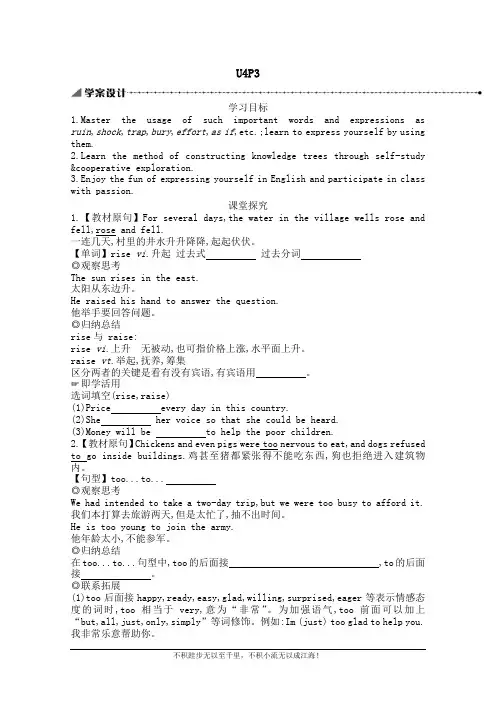
U4P3学习目标1.Master the usage of such important words and expressions as ruin,shock,trap,bury,effort,as if,etc.;learn to express yourself by using them.2.Learn the method of constructing knowledge trees through self-study &cooperative exploration.3.Enjoy the fun of expressing yourself in English and participate in class with passion.课堂探究1.【教材原句】For several days,the water in the village wells rose and fell,rose and fell.一连几天,村里的井水升升降降,起起伏伏。
【单词】rise vi.升起过去式过去分词◎观察思考The sun rises in the east.太阳从东边升。
He raised his hand to answer the question.他举手要回答问题。
◎归纳总结rise与 raise:rise vi.上升无被动,也可指价格上涨,水平面上升。
raise vt.举起,抚养,筹集区分两者的关键是看有没有宾语,有宾语用。
☞即学活用选词填空(rise,raise)(1)Price every day in this country.(2)She her voice so that she could be heard.(3)Money will be to help the poor children.2.【教材原句】Chickens and even pigs were too nervous to eat,and dogs refused to go inside buildings.鸡甚至猪都紧张得不能吃东西,狗也拒绝进入建筑物内。
高一英语必修1 unit4教案(全单元)
一.教学内容分析本单元话题为“地震”,主要描写了1976年唐山大地震,各项语言活动也都是围绕地震展开。
本单元共分八个部分。
Warming-up 部分通过两张图片引出话题“一旦地震发生,将会造成怎样的危害”,为后面的主题作了一个热身运动。
Pre-reading 部分设置了两个开放性问题,目的是增加学生的生活常识,提高他们的应变能力。
这部分为接下来的阅读作了很好的铺垫,学生可通过套乱,参阅有关地震的书籍并运用一些生活常识来回答这两个问题。
Reading 部分具体描写了1976年唐山大地震的震前、震中和震后。
作者详细描述了地震来临前的一些不正常的自然现象及动物的反常表现;地震的来势汹汹并在顷刻间将整座城市夷为平地;震后人们勇敢面对现实并及时实施抢救和重建工作。
Comprehending 部分包括三组练习,主要目的是为了帮助学生更好地理解Reading 部分的文章。
Learning about Language 部分分为两个部分:Discovering useful words and expressions和Discovering useful structures.第一部分要求学生在把握文章的基础上,掌握重点词汇的词义及时用,这更注重培养学生运用上下文猜测词义的能力。
其次还对一些复杂的数字读法进行了检测。
第二部分则结合文章学习定语从句。
Using Language 部分分为Reading ,Writing and Speaking ;Listening 和Writing 。
Reading ,Writing and Speaking 包括读一篇邀请函,写一份演讲稿和关于一套新唐山邮票的Little talk 。
Listening 部分讲述了一位地震幸存者的故事,并根据听力材料进行正误判断和回答问题,旨在培养学生获取细节的能力,并通过听来模仿标准的语音和语调。
Writing 部分要求学生报纸写一篇新闻报道,学习如何按照规范的步骤进行写作,如选择适当地标题和组织语言等。
高一英语必修一_unit4_单词
They gave up the plan in the end. (at last) at the end of,
与完成时连用 by the end of I will have learned more than 3000 English words by the end of next term.
6. ruin n.【C】倒塌的建筑物,废墟
短语:be/lie in ruins 倒塌,破败不堪
fall into ruins 衰落,败落 eg: 现在这座城市已成为一片废墟了。
The city now is/lies in ruins.
7.extreme极度的,极端的,偏激的
• extreme weather • extreme condition • extreme sports
He burst into the room without knocking at the door.
2. 他们全都突然笑起来/哭起来/唱起来. All of them burst out laughing/crying /singing. =All of them burst into laughter/tears/songs.
12.judge
n.评委,裁判员 V.断定,判定,评价 judge by/from 用于句首做状语 E.g. Judging from his accent, he must be from Chongqing.
hurt His words ______her feelings.
hurts It ______the eyes to read in the sun.
injured More than 200 people were _________in the car accident. wounded The soldiers were __________-in the battle.
新人教版高中英语必修第一册单词表word版
新人教版高中英语必修第一册单词表word版2019新人教版高中英语必修第一册单词表word版Words and expressions in Each Unit注:黑体部分为课标词和短语;白体部分为非课标词;专有名词在每单元词表后面单独列出B1 Wele Unit1. exchange /ɪksˈtʃeɪndʒ/n. 交换; 交流; 交易vt. 交换; 交流;交易; 兑换2. lecture /ˈlektʃə(r)/n. 讲座;讲课;教训vi. (开)讲座;讲课vt. 训斥3. registration /ˌredʒɪˈstreɪʃn /n. 登记;注册;挂号4. register/ ˈredʒɪstə(r) /vt.& vi登. 记;注册5. sex /seks/ n.性别6. female /ˈfi:meɪl/adj. 女(性)的; 雌性的n. 雌性动(植)物;女子7. male / meɪl/adj. 男(性)的; 雄的n. 雄性动(植)物;男子8. nationality /ˌnæʃəˈnæləti/ n. 国籍; 民族9. nation / ˈneɪʃn/ n. 国家; 民族; 国民10. designer /dɪˈzaɪnə(r)/ n. 设计者11. design / dɪˈzaɪn /n. 设计; 设计方案vt. 设计;筹划12. campus / ˈkæmpəs / n. 校园; 校区13. formal / ˈfɔ:ml / adj.正式的;正规的14. anxious / ˈæŋkʃəs /adj. 焦虑的; 不安的15. annoyed /əˈnɔɪd/adj. 恼怒的;生气的16. annoy /əˈnɔɪ/ vt. 使恼怒;打扰17. frightened /ˈfraɪtnd/adj.惊吓的;害怕的18. senior /ˈsi:nɪə(r)/adj. 级别(或地位)高的n. 较年长的人19. senior high school(美国)高中20. at last 终于; 最后21. outgoing / ˈaʊtgəʊɪŋ /adj. 爱交际的;外向的22. impression /ɪmˈpreʃn/ n. 印象;感想23. impress /ɪmˈpres/vt. 使钦佩;给...留下深刻的好印象vi. 留下印象;引人注目24. make an impression 留下好印象25. what if 如果…会怎么样呢?26. guy / gaɪ / n. 小伙子;男人;家伙27. concentrate / ˈkɒnsntreɪt /vt.&vi. 集中(注意力);聚集会神28. concentrate on 集中精力于29. experiment /ɪkˈsperɪmənt/ n. 实验;试验30. leave...alone 不打扰, 不惊动31. awkward / ˈɔ:kwə d /adj. 令人尴尬的; 难对付的32. junior / ˈdʒu:nɪə(r)/adj.地位(或职位、级别)低下的n. 职位较低者; (体育运动中)青少年33. junior high school (美国)初级中学34. explore / ɪkˈsplɔ:(r)/ vt.& vi. 探索;勘探35. confident /ˈkɒnfɪdənt/adj. 自信的;有把握的36. confidence /ˈkɒnfɪdəns/n. 信心; 信任37. forward / ˈfɔ:wə d /adv. (also forwards)向前;前进adj. 向前的;前进的38. look forward to 盼望;期待39. take notes 记笔记40. flash /[flæʃ/n. 闪光; 信号vi. 闪耀;闪光;发出信号vt. 使闪耀;发出(信号)41. flash card 教学卡片;识字卡42. organise [NAmE-ize] /ɔ:(r)gənaɪz/vt. 组织;筹备;安排;组建vi. 组建;成立43. organisation [NAmE-ization]/ˌɔ:gənaɪˈzeɪʃn/n. 组织; 团体; 机构44. goal / [gəʊl / n. 目标; 球门; 射门45. strategy /ˈstrætədʒi/ n. 策略;策划46. partner / ˈpɑ:tnə(r)/ n. 同伴; 配偶;合伙人47. improve /ɪmˈpru:v/ vt.& vi. 改进;改善48. curious /ˈkjʊəriəs/adj. 好奇的; 求知欲强的49. pany / ˈkʌmpəni/ n. 公司;商行; 陪伴50. personality /ˌpɜ:səˈnæləti / n. 性格;个性51. style / staɪl/ n. 方式; 作风52. revise / rɪˈvaɪz/ vt.& vi. 修改; 修订;复习B1 Unit 11. teenage / ˈti:neɪdʒ/adj. 十几岁的(指13至19岁); 青少年的2. teenager / ˈti:neɪdʒə(r)/n. (13至19岁之间的)青少年3. ballet /ˈbæleɪ/n. 芭蕾舞;芭蕾舞剧4. volunteer /ˌvɒlənˈtɪə(r)/ n. 志愿者5. debate /dɪbeɪt/n.辩论;争论vt.& vi辩论;争论6. prefer / prɪˈfɜ:(r)/ vt. 更喜欢7. prefer…to… 喜欢……多于……8. content / kɒntent / n. 内容;[pl] 目录; (书、讲话、节目等的)主题9. movement /mu:vmənt /n. 动作;运动; 活动10. greenhouse /gri:nhaʊs/ n. 温室;暖房11. clean up 打扫(或清除)干净12. suitable /ˈsu:təbl/ adj. 适合的;适用的13. suitable for 对……适合的14. actually /ˈæktʃʊəli/ adv. 事实上; 的确15. challenge /ˈtʃælɪndʒ/n.挑战;艰巨任务vt. 怀疑;向……挑战16. title /ˈtaɪtl/n.(书、诗歌等的)名称;标题;职称;头衔17. topic /ˈtɒpɪk/ n. 话题; 标题18. freshman / ˈfreʃmən / n.(especially NAmE)(中学)九年级学生;(大学)一年级新生19. confusing /kənˈfju:zɪŋ/adj.难以理解的;不清楚的20. confuse /kənfju:z/ vt. 使糊涂;使迷惑21. confused /kənˈfju:zd/adj. 糊涂的;迷惑的22. fluent /flu:ənt/adj. (尤指外语)流利的;熟练的23. graduate/ɡrædʒueɪt/ vi. & vt.毕业;获得学位/ɡrædʒʊət/ n. 毕业生24. remend /ˌrekəˈmend/vt. 建议;推荐;介绍25. sign up ( for sth) 报名(参加课程)26. advanced /ədˈvɑ:nst/adj. 高级的;高等的;先进的27. advance /ədˈvɑ:ns/n. 前进;发展vi. 前进;发展vt. 发展;促进28. literature / ˈlɪtrətʃə(r)/n. 文学; 文学作品29. extra-curricular /ˌekstrəkərɪkjʊlə(r)/adj. 课外的; 课程以外的29. extra /ekstrə/ adj. 额外的;附加的30. obviously /ɒbviəsli/ adv. 显然;明显地31. quit / kwɪt/ vi. & vt. (quit,quit,quitting)停止;戒掉;离开(工作职位、学校等)32. responsible /rɪˈspɒnsəbl/adj. 负责的;有责任的33. responsibility /rɪˌspɒnsəˈbɪləti/n.责任;义务34. be responsible for 对……负责任35. solution / səˈlu:ʃn/n. 解决办法; 答案36. schedule /ˈʃedju:l ;NAmE ˈˈskedʒu:l / n.工作计划;日程安排vt. 安排;预定37. editor /ˈedɪtə(r)/ n. 主编;编辑;编者38. plate /pleɪt/ n. 盘子,碟子39. adventure /ədˈventʃə(r)/ n. 冒险; 奇遇40. youth /ju:θ/n. 青年时期; 青春41. survival /səˈvaɪvl / n. 生存;幸存;幸存事务42. expert /ekspɜːt/n. 专家;行家adj. 熟练的;内行的;专家的43. behaviour /bɪˈheɪvjə(r)/n. 行为; 举止44. generation /ˌdʒenəˈreɪʃn/n. 一代(人)45. attract /ətrækt/vt. 吸引;引起……的注意(或兴趣)46. be attracted to 喜爱47. focus /ˈfəʊkəs /vi.&vt.集中(精力、注意力等);(使)调节焦距n. 中心;重点;焦点48. focus on 集中;特别关注49. addicted /əˈdɪktɪd/adj. 有瘾的;上瘾的;入迷的50. addict /ˈædɪkt/n. 对…入迷的人;吸毒成瘾的人51. addicted to 对……很入迷52. adult /ˈædʌlt/n. 成年人adj. 成年的;成熟的B1 Unit 21. castle / kɑ:sl/n. 城堡;堡垒2. apply /əˈplaɪ/ vi. &vt.申请;请求vt. 应用; 涂(油漆、乳剂)3. apply for 申请4. visa /ˈvi:zə/ n. 签证5. rent / rent/vt. 租用;出租vi. 租用;租金为n. 租金6. pack /pæk/vi. & vt. 收拾(行李)vt. 包装n. (商品的)纸包;纸袋;大包7. amazing /əˈmeɪzɪŋ/adj. 令人惊奇的;令人惊喜的8. amazed /əˈmeɪzd /adj.惊奇的;惊喜的9. arrangement /əˈreɪndʒmənt/ n. 安排;筹备10. extremely /kˈstri:mli / adv. 极其; 非常11. source /sɔ:s/ n. 来源;出处12. narrow /ˈnærəʊ/adj. 狭窄的vi.& vt.(使)变窄13. flat / flæt /adj.平坦的; 扁平的n. 公寓; 单元房14. powerful /paʊəfl /adj. 强有力的;有权势的;有影响力的15. empire /ˈempaɪə(r)/ n. 帝国16. emperor /ˈempərə(r)/ n. 皇帝17. site / saɪt / n. 地点;位置;现场18. take control of 控制; 接管19. official /əfɪʃl/adj. 官方的;正式的; 公务的n.官员;要员20. recognise [ NAmE -ize] /ˈrekəgnaɪz/ vt. 辨别出; 承认; 认可21. type /taɪp/n. 类型; 种类vi. & vt. 打字22. flight /flaɪt/ n. 空中航行; 航班;航程23. acmodation /əˈkɒməˌdeɪʃn/n. 住处;停留处;膳宿24. unique /juˈni:k /adj. 唯一的;独特的; 特有的25. path / pɑ:θ/n. 小路; 路线;道路26. destination /ˌdestɪˈneɪʃn/n. 目的地;终点27. other than 除…以外28. admire /ədˈmaɪə(r)/vt. 钦佩;赞赏29. architecture /ˈɑ:kɪtektʃə(r) /n. 建筑设计;建筑学30. architect /ˈɑ:kɪtekt / n. 建筑设计师31. brochure /ˈbrəʊʃə(r); NAmE broʊˈʃur/ n. 资料(或广告)手册32. package /ˈpækɪdʒ/n. 包裹; 包装盒vt. 将…包装好33. package tour 包价旅游34. contact /ˈkɒntækt /vt. 联络;联系n. 联系;接触35. civilisation [NAmE -ization]/ˌsɪvəlaɪˈzeɪʃn/n.文明;文明世界36. make up 构成;形成37. soldier /ˈsəʊldʒə(r)/ n. 士兵; 军人38. transport /ˈtrænspɔ:t/ n. (especially BrE)(NAmE usually transportation)交通运输系统vt. / trænˈspɔ:t / 运输;运送39. hike / haɪk /vi. 徒步旅行vt. 去……远足n. 远足; 徒步旅行40. economy /ɪˈkɒnəmɪ/ n. 经济; 节约41. economic /ˌi:kəˈnɒmɪk/adj. 经济(上)的; 经济学的42. credit /ˈkredɪt/n. 借款;信用; 称赞; 学分43. credit card 信用卡44. detail /ˈdi:teɪl /n. 细节;详情;细微之处45. check in (在旅馆、机场等)登记46. check out 结账离开(旅馆等)47. request /rɪkwest/n.(正式或礼貌的)要求;请求vt. (正式或礼貌地)要求;请求48. view / vju:/ n.视野;景色;看法49. sight /saɪt/ n.景象; 视野; 视力50. statue /ˈstætʃu:/ n. 雕塑;雕像51. BCE /ˌbi:si:ˈi:/ (=before the Commom Era)公元前52. tomb / tu:m / n. 坟墓53. unearth /unˈɜ:θ/vt. 挖掘;发掘54. ment /ˈkɒment/n. 议论;评论vi.& vt. 发表意见;评论B1 Unit 31. fitness /ˈfɪtnəs/ n.健康; 健壮;适合2. soccer / ˈsɒkə(r)/ n.足球;足球运动3. stadium / ˈsteɪdiəm/ n.(pl. stadiums or stadia)体育场; 运动场4. boxing / ˈbɒksɪŋ / n.拳击(运动)5. badminton / ˈbædmɪntən/ n.羽毛球运动6. marathon / ˈmærəθən/ n.马拉松赛跑7. event / ɪˈvent/ n.比赛项目;大事;公开活动8. e along 跟随;到达;进步;赶快9. ski / ski:/adj. 滑雪的 vi.滑雪10. host /həʊst/vt. 主办;主持n. 主人;东道主;节目主持人11. track /træk/ n. 跑道;足迹;铁路轨道vi.& vt.追踪;跟踪12. track and field 田径13. gym / dʒɪm / n. 健身房; 体育馆14. gymnastics / dʒɪmˈnæstɪks /n. 体操(训练)15. work out 锻炼;计算出;解决16. sweat / swet /vt. 使出汗;出汗弄湿vi.出汗;流汗n.汗水; 出汗17. make it 获得成功;准时到达18. legend / ˈledʒənd /n. 传奇故事(或人物);传说19. athlete /ˈæθli:t/ n. 运动员;运动健儿20. master / ˈmɑ:stə(r)/n. 高手; 主人vt. 精通;掌握21. set an example 树立榜样22. honour /ɒnə(r)/ n. 荣誉;尊重;荣幸23. glory / ˈglɔ:ri / n. 荣誉;光荣;赞美24. medal / ˈmedl/ n. 奖章; 勋章25. championship /ˈtʃæmpiənʃɪp /n. 锦标赛; 冠军赛;冠军称号26. champion / ˈtʃæmpiən/n. 冠军; 优胜者27. determination /dɪˌtɜ:mɪˈneɪʃn/ n. 决心;决定28. apart / əˈpɑ:t /adv.分离;分开;成碎片29. fall apart 破裂;破碎;崩溃30. injure / ˈɪndʒə(r)/ vt. 使受伤;损害31. injured / ˈɪndʒə d /adj. 受伤的;有伤的32. injury / ˈɪndʒəri / n. 伤害;损伤33. captain / ˈkæptɪn /n. (运动队)队长;船长;机长34. lose heart 丧失信心;泄气35. graceful /greɪsfl/adj. 优美的;优雅的36. strength / streŋθ/ n.力量;体力37. failure / ˈfeɪljə(r) /n. 失败;失败的人(或事物)38. give up 放弃;投降39. pete / kəmˈpi:t / vi. 竞争;对抗40. make sense有道理;合乎情理;表述清楚41. pretend /prɪˈtend/vi.& vt.假装;装扮42. pretend to do sth 假装做某事43. even if/though 即使;虽然44. million / ˈmɪljən / num. —百万45. cheat / tʃi:t /vi.作弊;舞弊vt.欺骗;蒙骗n.欺骗手段;骗子46. audience / ˈɔːdiəns / n.观众;听众47. positive / ˈpɒzətɪv /adj. 积极的;正面的;乐观的;肯定的48. slim / slɪm / adj. 苗条的;单薄的49. diet / ˈdaɪət /n. 规定饮食;日常饮食vi.节食50. make a difference有作用或影响51. rather / ˈrɑ:ðə(r) / adv. 相当;有点儿52. rather than 而不是53. push-up / pʊʃʌp /n. ( especially NAmE ) 俯卧撑54. cut ... out停止做(或使用、食用);剪下55. now and then有时;偶尔56. pare… with/to… 与……比较57. jog / dʒɒg /vi.慢跑n.慢跑58. stress /stres/n.压力;紧张;重音vt. 强调;重读;使焦虑不安vi. 焦虑不安59. error / ˈerə(r)] / n. 错误;差错B1 Unit 41. disaster / dɪˈzɑ:stə(r) / n.灾难;灾害2. tornado /tɔ:ˈneɪdəʊ /n.(pl. -oes or-os) 龙卷风;旋风3. drought / draʊt / n.旱灾;久旱4. landslide / ˈlændslaɪ d /n. ( landfall) (山地或悬崖的)崩塌;滑坡5. slide / slaɪ d / vi. & vt. (使)滑行;滑动6. tsunami / tsu:ˈnɑ:mi / n. 海啸7. flood / flʌ d / n. 洪水;大量vi.淹没;大量涌入vt.使灌满水;淹没8. volcanic eruption / vɒlˈkænɪk ɪˈrʌpʃn /火山喷发9. magnitude / ˈmægnɪtju:d / n. (地)震级;重大10. rescue / ˈreskju: / n.& vt. 营救;救援11. damage / ˈdæmɪdʒ /vt. 损害;破坏n.损坏;损失12. destroy /dɪstrɔɪ/ vt.摧毁;毁灭13. evacuate / ɪˈvækjueɪt /vt. 疏散;撤出vi. 撤离14. helicopter / ˈhelɪkɒptə(r)/ n. 直升机15. death/ deθ/ n. 死;死亡16. affect /əfekt/vt. 影响;(疾病)侵袭;深深打动17. shelter/ʃeltə/n.避难处;居所;庇护vt.保护;掩蔽vi. 躲避(风雨或危险)18. crack /kræk/n.裂纹;裂缝vi. & vt. (使)破裂19. as if 似乎;好像;仿佛20. ruin /ru:ɪn/ n. & vt. 破坏;毁坏21. in ruins 严重受损;破败不堪22. percent / pəˈsent /n. 百分之 ....adj. &adv. 每一百中23. brick /brɪk/ n. 砖;砖块24. metal /metl/ n. 金属25. shock /ʃɒk/n.震惊;令人震惊的事;休克vt.(使)震惊26. in shock 震惊;吃惊27. electricity / ɪˌlekˈtrɪsəti / n.电;电能28. trap /træp/vt. 使落入险境;使陷入圈套n. 险境;陷阱29. bury / ˈberi / vt.埋葬;安葬30. breathe / bri:ð / vi.& vt.呼吸31. revive / rɪˈvaɪv /vt.& vi复活;(使)苏醒32. revival / rɪˈvaɪvl/ n. 振兴;复苏33. effort /efət / n.努力;艰难的尝试;尽力34. unify / ˈju:nɪfaɪ /vi.& vt. 统一;(使)成一体35. wisdom / ˈwɪzdəm / n. 智慧;才智36. context/ ˈkɒntekst / n. 上下文;语境;背景37. suffer / ˈsʌfə(r) /vt. 遭受;蒙受vi. (因疾病、痛苦、悲伤等)受苦38. volcano / vɒlˈkeɪnəʊ / n. (pl. -oes or -os)火山39. erupt / ɪˈrʌpt /vi.& vt. (火山)爆发;(岩浆、烟等)喷出40. supply / səˈplaɪ /n.供应(量);补给;[pl.] 补给品vt. 供应;供给41. typhoon / taɪˈfu:n / n.台风42. in the open air 露天;在户外43. hurricane / ˈhʌrɪkən / n . (尤指大西洋的)飓风44. survive / səˈvaɪv/vt. 幸存;艰难度过vi.生存;存活45. power / ˈpaʊə(r) /n.电力供应;力量;控制力46. tap / tæp/vi.& vt. 轻叩;轻敲;轻拍n.水龙头;轻叩;轻敲47. pipe/ paɪp/ n.管子;管道48. whistle / ˈwɪsl /vi.吹口哨;发出笛声vt.吹口哨n. 哨子(声);呼啸声49. emergency/ iˈmɜ:dʒənsi /n. 突发事件;紧急情况50. calm / kɑ:m /adj.镇静的;沉着的vt. 使平静;使镇静50. aid / eɪ d /n.援助;帮助;救援物资vi.& vt. (formal)帮助;援助51. kit / kɪt / n. 成套工具;成套设备52. first aid kit 急救箱53. on hand 现有(尤指帮助)54. crash / kræʃ/vi.& vt. 碰撞;撞击n. 撞车;碰撞55. sweep /swi:p/vt. & vi. ( swept,swept) 打扫;清扫56. sweep away 消灭;彻底消除57. wave / weɪv /n.海浪;波浪vi.& vt.挥手;招手58. strike / straɪk /vi.& vt. (struck, struck/stricken) 侵袭;突击;击打n.罢工;罢课;袭击59. deliver/ dɪˈlɪvə(r) /vt. & vi.递送;传达vt. 发表60. summary /ˈsʌməri / n. 总结;概括;概要61. effect / ɪˈfekt / n. 影响;结果;效果62. length/ leŋθ/ n.长;长度B1 Unit 51. billion / ˈbɪljən / n.十亿2. native / ˈneɪtɪv /adj.出生地的;本地的;土著的n.本地人3. attitude / ˈætɪtju:d ; NAmE ætitu:d/ n.态度;看法4. reference / ˈrefrəns / n.指称关系;参考5. refer/rɪˈfɜ:(r)/vi.提到;参考;查阅vt.查询;叫……求助于6. refer to 指的是;描述;提到;查阅7. system / ˈsɪstəm / n.体系;制度;系统8. despite / dɪˈspaɪt / prep.即使;尽管9. ups and downs 浮沉;兴衰;荣辱10. factor /ˈfæktə(r)/ n.因素;要素11. based /beist/adj.以(某事)为基础的;以……为重要部分(或特征)的12. base /beɪs/vt.以...为据点;以....为基础n.底部;根据13. date back (to) ... 追溯到14. bone /bəʊn/ n.骨头;骨(质)15. shell/ʃel/ n.壳;壳状物16. symbol / ˈsɪmbl / n. 符号;象征17. carve /kɑ:v / vi.& vt.雕刻18. dynasty /ˈdɪnəsti; NAmE dai-/ n. 王朝;朝代19. variety /vəˈraɪətɪ/n. (植物、语言等的)变体;异体;多样化20. major / ˈmeɪdʒə(r) /adj.主要的;重要的;大的n.主修课程;主修学生vi.主修;专门研究21. no matter where, who, what, etc.不论……;不管……22. dialect /daɪəlekt/ n. 地方话;方言23. means /mi:nz/ n.方式;方法;途径24. classic / ˈklæsɪk /adj.传统的;最优秀的;典型的n. 经典作品;名著25. regard / rɪˈgɑ:d /n. 尊重;关注vt. 把... 视为;看待26. character /kærəktə(r)/n. 文字;符号;角色;品质;特点27. calligraphy / kəˈlɪɡrəfi / n.书法;书法艺术28. global /gləʊbəl/ adj. 全球的;全世界的29. affair / əˈfeə(r) /n.公共事务[复数];事件;关系30. appreciate /əpri:ʃieɪt /vt.欣赏;重视;感激;领会vi.增值31. specific /spəˈsɪfɪk/ adj.特定的;明确的;具体的32. struggle / ˈstrʌgl / n.& vi.斗争;奋斗;搏斗33. tongue /tʌŋ/ n.舌头;语言34. point of view 观点;看法35. semester / sɪˈmestə(r) / n.学期36. gas /ɡæs/ n.汽油;气体;燃气37. petrol /petrəl/ n. (NAmE gas ) 汽油38. subway /sʌbweɪ/n.(BrE underground ) 地铁39. apartment /əpɑ:tmənt/ n.(especially NAmE)公寓套房(=flat)40. pants / pænts / n. [pl.] (BrE )内裤;短裤;(especially NAmE)裤子41. beg /beg/ vt. 恳求;祈求;哀求42. equal /i:kwəl /n.同等的人;相等物adj. 相同的;同样的43. gap /gæp/ n.间隔;开口;差距44. demand/ dɪˈmɑ:nd /n.要求;需求vt. 强烈要求;需要vi.查问45. vocabulary / vəkæbjʊlərɪ ;NAmE –leri / n.词汇46. description /dɪˈskrɪpʃn/ n.描写(文字);形容47. relate / rɪˈleɪt / vt.联系;讲述。
人教版 高中英语 必修一 Unit 4 Earthquakes 单词课件 44PPT
Unit 4 Earthquakes
Words and Expressions
1. earthquake n. 地震;大动荡 /ˈɜːθkweɪk/ 复数 earthquakes
2. quake /kweɪk/
n. 震动;震荡 vi.震动,颤抖,哆嗦
3. right away 立刻;马上
3) frighten sb/sth off 吓走,吓跑 4) frighten sb away 吓走
frightening frightened
adj. 令人恐惧的 adj. 受恐吓的,受惊吓的
1) be frightened of (doing) sth. 害怕(做)某事
2) be frightened at/by sth. 因某事而害怕
2) There were millions of people there. 那里人山人海。
3) Two million pounds was withdrawn from the account.
两百万英镑从该账户中被提取。
11. event n. 事件; 大事; 比赛项目 /ɪˈvent/
incident:意为"事件,事变",用于表示突发事件或
22. survivor n. 幸存者;生还者
/səˈvaɪvə/ survive v.幸存
He was the only survivor of the earthquake. 他是地震唯一的幸存者
23. destroy vt. 破坏;毁坏;消灭 /dɪˈstrɔɪ/
destruction n.破坏;毁坏;消灭
The earthquake almost completely destroyed the city. 地震几乎彻底毁了这座城市。
Unit 4 Words and expressions 高中英语人教版(2019)选择性必修第一册
6. (2021·新高考全国I卷阅读) When the explorers first set foot upon the continent of North America, the skies and lands were alive with an astonishing variety of wildlife. [翻译]
13. educate vt. 教育;训练→__e_d_u_c_a_te_d___adj. 受过教育的;有教养的 →__e_d_u_c_a_ti_o_n__n. 教育;教育学;训练→_e_d_u_c_a_t_io_n__a_l adj. 教育的;有教 育意义的→__e_d_u_c_a_t_o_r__n. 教师;教育工作者;教育家 14. tendency n. 趋势;倾向→__t_e_n_d__v. 趋向;走势 15. lower vt. 把…放低;降低;减少 adj. 下面的;较小的→__l_o_w___adj. 低的,矮小的;低洼的;沮丧的;下贱的 adv. 低声地;谦卑地 16. occupy vt. 占据;占用→_o_c_c_u_p_a_t_io_n__n. 占领;工作;职业 →__o_c_cu__p_ie_d___adj. 使用中;忙于;被占领的 17. distract vt. 分散(注意力);使分心→_d_is_t_r_a_c_ti_o_n_n. 分心;分散 18. anxiety n. 焦虑;担心;害怕→_a_n_x_i_o_u_s__adj. 焦虑的;不安的
空的 27. distinguish v. 区分;辨别→_d_is_t_in_g_u__is_h_e_d_adj. 卓越的;杰出的 28. identical adj. 相同的→__id_e_n_t_i_ca_l_l_y_adv. 相同地→ identify v. 证明; 表明;认出→ identity n. 身份;同一性 29. clarify vt.使更清晰易懂,阐明,澄清→_c_la_r_i_f_ic_a_t_io_n__n. 阐明,澄清 30. imply vt. 意味着,暗示→ implication n. 暗示,言外之意