
2017人教版英语八年级上Unit1知识点
2017人教新目标八年级上册Unit 1 知识点整理
Unit 1 Where did you go on vacation? Section A
1.去山上go to the mountains
2.去夏令营go to summer camp
3.去海滩go to the beach
4.去纽约go to New York City
5.参观博物馆visit museums
6.呆在家里stay at home
7.去中心公园go to Central Park
8.买特别的东西buy something special (不定代词something, 修饰的形容词special 放在
它后面)
9.遇到有趣的人meet someone interesting (同上)
10.做有趣的事情do something interesting/fun
11.为考试做准备study for tests
2d
12.好久不见。
Long time no see. (口语,不用在书面语中)
13.在度假be on vacation
14.度假take a vacation
15.去有趣的地方go somewhere interesting
16.看见黄果树瀑布see Huangguoshu Waterfall
17.相当多quite a few+ 可数名词复数形式
18.拍相当多的照片take quite a few photos
19.—Did you do anything special last month?
—Not really. (really 用于否定句以减弱语气)
20.大部分时间我只是呆在家里看书放松。
I just stayed at home most of the time to read and relax.
Grammar Focus
21. I d idn’t see anything I liked.我没看见任何我喜欢的东西。
22. The only problem was that there was nothing much to do in the evening but(除了)read. 唯
一的问题是晚上除了看书就没有别的事情可做了。
除了你我没有别的朋友。
盒子里除了一张卡片什么都没有。
除了看书他从不做任何事情。
23. No one seemed to be bored. 似乎没人觉得无聊。
seem 联系动词似乎,看来,好像
You seem happy.
Mr. Green doesn’t seem to like the idea.
You seem to be happy.
He seems (to be) a nice man.
They seem to know what they’re doing.
= It seems that they know what they are doing.
23.记日记keep a diary
U1 Section B
1.多好吃的食物啊!What delicious food (it is)!
2.一部激动人心的电影an exciting movie
3.一件昂贵的/便宜的连衣裙an expensive/cheap dress(东西贵/贱expensive/dear/cheap/)
4.The price of the dress is high/low. (价格高/低high/low)
2a, 2b
5.发觉……很惬意find sth. enjoyable
6.做某事很开心have a good/nice/great time (doing sth.)
7.arrive in+大地方/at +小地方arrive in Penang in Malaysia ; arrive at the park/theatre/my home
8.决定(不)做某事decide (not) to do sth.
9.尝试做某事try doing sth. 尝试滑翔伞运动try paragliding
设法做某事try to do sth. (不一定成功了)/manage to do sth.(成功了)
10.我觉得自己就是只小鸟。
I felt like I was a bird. (feel—felt)
11.骑车去某地ride a bicycle/bicycles to sp. (ride—rode)
12.……中有很多many of the +名词的复数形式many of the old building s
13.看见一百年前中国商人的房屋see the houses of the Chinese traders from 100 years ago
14.What is life like here now? 现在这儿的生活怎样?
What was life like here in the past? 过去这儿的生活怎样?
I wonder +what life was like here in the past? (注意两部分合并后句子的语序发生了变化)
15.一天的差异是多么大啊!What a difference a day makes!
多么好的一天啊!What a lovely day (it is)!
他们是多么好的人啊!What nice people they are!
16.too many people/books 太多人/书too many+可数名词复数形式太多……
17.too much water 太多水too much+不可数名词太多……
18.much too tired/hungry 太累/饿much too+形容词太……
19.因为天气恶劣,我们看不见下面的东西。
Because of the bad we ather, we couldn’t see anything below.
= Because the weather was bad, we couldn’t see anything below.
20.bring enough money (enough 足够的,放在名词前)
Tom is old enough to go to school. (enough 放在形容词后)
21.the Palace museum 故宫博物院
22.Beijing hutong 北京胡同
23.Tian’anmen Square 天安门广场
24.Beijing duck 北京烤鸭
25.buy something special 买特别的东西
26.learn something important 学到重要的东西。
人教版八年级英语上册unit1-10知识点总结
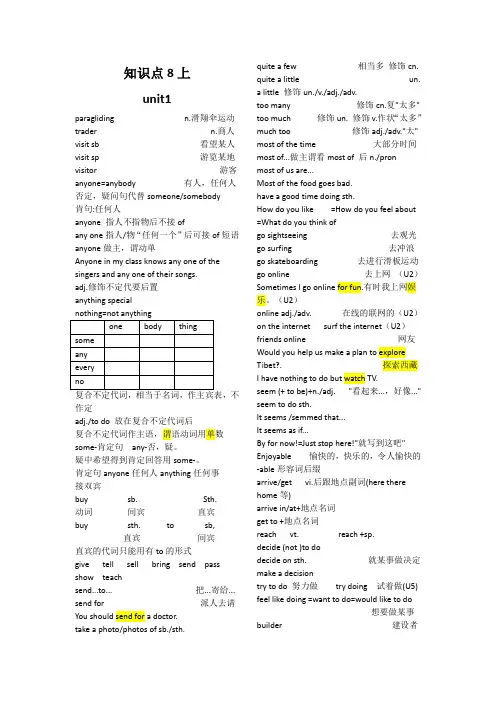
知识点8上unit1paragliding n.滑翔伞运动trader n.商人visit sb 看望某人visit sp 游览某地visitor 游客anyone=anybody 有人,任何人否定,疑问句代替someone/somebody肯句:任何人anyone 指人不指物后不接ofany one指人/物“任何一个”后可接of短语anyone做主,谓动单Anyone in my class knows any one of the singers and any one of their songs.adj.修饰不定代要后置anything special作定adj./to do 放在复合不定代词后复合不定代词作主语,谓语动词用单数some-肯定句any-否,疑。
疑中希望得到肯定回答用some-。
肯定句anyone任何人anything任何事接双宾buy sb. Sth.动词间宾直宾buy sth. to sb,直宾间宾直宾的代词只能用有to的形式give tell sell bring send pass show teachsend...to... 把...寄给... send for 派人去请You should send for a doctor.take a photo/photos of sb./sth. quite a few 相当多修饰cn. quite a little un.a little 修饰un./v./adj./adv.too many 修饰cn.复"太多" too much 修饰un. 修饰v.作状“太多”much too 修饰adj./adv."太" most of the time 大部分时间most of...做主谓看most of 后n./pronmost of us are...Most of the food goes bad.have a good time doing sth.How do you like =How do you feel about =What do you think ofgo sightseeing 去观光go surfing 去冲浪go skateboarding 去进行滑板运动go online 去上网(U2)Sometimes I go online for fun.有时我上网娱乐。
人教版八年级上册英语Unit1关键知识总结
人教版八年级上册英语Unit1关键知识总结本文档是关于人教版八年级上册英语Unit1的关键知识总结,以下是重点内容的概述。
1. 单词研究本单元的重要单词有:- morning 早晨- afternoon 下午- evening 晚上- yesterday 昨天- today 今天- tomorrow 明天2. 语法知识本单元的语法知识包括以下内容:2.1 一般现在时一般现在时表示现在的状态、惯、真理等。
一般现在时的动词形式一般不变,主语为第三人称单数时要加上-s或-es。
例句:- I go to school every day.2.2 短语动词短语动词是由动词和副词、介词等组成的短语。
短语动词可以有两种形式:及物动词和不及物动词。
例句:- Turn on the light.- Get up early.3. 对话练本单元的对话练是为了提高学生的口语交流能力。
通过模拟真实情景对话,学生可以巩固所学的词汇和语法知识。
对话练的话题包括:- 介绍自己的日常活动- 询问他人的日常活动- 询问天气情况- 讨论未来计划4. 阅读理解本单元的阅读理解是为了提高学生的阅读和理解能力。
通过阅读文章,学生可以研究新的词汇和句型,并从中获取信息。
阅读理解的题型包括:- 阅读短文并回答问题- 根据短文内容判断正误- 选择正确的答案- 完成句子等以上是人教版八年级上册英语Unit1的关键知识总结。
希望这份文档对您的学习有所帮助!。
人教版英语八年级上册unit 1

人教版英语八年级上册unit 1一、重点单词。
1. anyone.- 词性:不定代词,意为“任何人”,用于否定句和疑问句中。
例如:Did you meet anyone interesting at the party?(你在聚会上遇到有趣的人了吗?)2. anywhere?- 词性:副词,意为“在任何地方;无论何处”。
例如:I can't find my keys anywhere.(我到处都找不到我的钥匙。
)3. wonderful.- 词性:形容词,意为“精彩的;绝妙的”。
例如:We had a wonderful timeat the concert.(我们在音乐会上度过了一段美妙的时光。
)4. few.- 词性:形容词,意为“不多;很少”,修饰可数名词复数,表示否定意义。
例如:There are few apples on the tree.(树上几乎没有苹果了。
)- 区别:a few表示“一些;几个”,表示肯定意义。
例如:There are a few students in the classroom.(教室里有几个学生。
)5. most.- 词性:形容词,意为“最多的;大多数的”。
例如:Most students like English.(大多数学生喜欢英语。
)- 也可作副词,意为“最;非常”。
例如:This is the most beautiful flower.(这是最漂亮的花。
)6. something.- 词性:不定代词,意为“某事;某物”,用于肯定句中。
例如:I have something important to tell you.(我有重要的事情要告诉你。
)7. nothing.- 词性:不定代词,意为“没有什么;没有一件东西”。
例如:There is nothing in the box.(盒子里什么都没有。
)8. everyone.- 词性:不定代词,意为“每人;人人;所有人”。
人教英语八年级上册 1单元知识点笔记
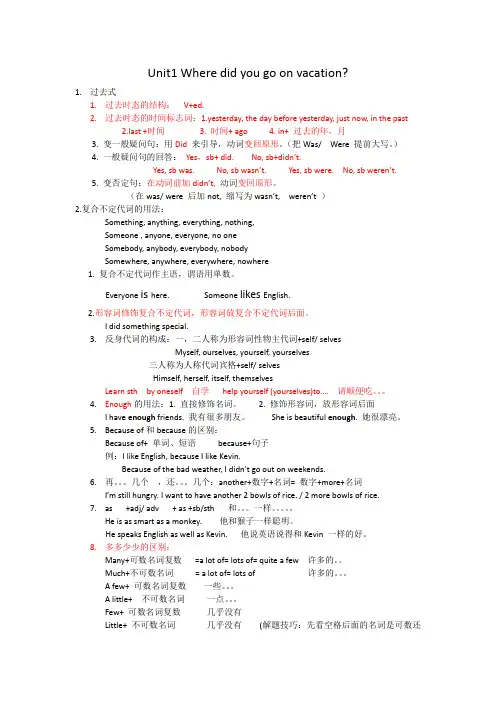
Unit1 Where did you go on vacation?1.过去式1.过去时态的结构:V+ed.2.过去时态的时间标志词:1.yesterday, the day before yesterday, just now, in the pastst +时间3. 时间+ ago4. in+ 过去的年,月3. 变一般疑问句:用Did来引导,动词变回原形。
(把Was/ Were 提前大写。
)4. 一般疑问句的回答:Yes,sb+ did. No, sb+didn’t.Yes, sb was. No, sb wasn’t. Yes, sb were. No, sb weren’t.5. 变否定句:在动词前加didn’t,动词变回原形。
(在was/ were 后加not, 缩写为wasn’t, weren’t )2.复合不定代词的用法:Something, anything, everything, nothing,Someone , anyone, everyone, no oneSomebody, anybody, everybody, nobodySomewhere, anywhere, everywhere, nowhere1. 复合不定代词作主语,谓语用单数。
Everyone is here. Someone likes English.2.形容词修饰复合不定代词,形容词放复合不定代词后面。
I did something special.3.反身代词的构成:一,二人称为形容词性物主代词+self/ selvesMyself, ourselves, yourself, yourselves三人称为人称代词宾格+self/ selvesHimself, herself, itself, themselvesLearn sth by oneself 自学help yourself (yourselves)to…. 请顺便吃。
人教版八年级上册英语Unit 1知识点梳理及语法讲义(教师版)

八年级上册英语Unit 1知识点与语法精讲精练词汇梳理(一)完成单词梳理:名词:1. hen母鸡 2. pig 猪 3. diary 日记;记事簿4. activity 活动5. paragliding 滑翔伞运动6. bird 鸟7. bicycle 自行车8. building 建筑物;房子9. trader 商人10. difference 差别;差异11. top 顶部;表面12. umbrella 伞;雨伞13. hill 小山;山丘14. duck 鸭动词:1. seem 好像;似乎;看来 2. decide 决定;选定 3. wonder 想知道;琢磨4. wait 等待;等候代词:1. anyone 任何人 2. something 某事;某物 3. nothing 没有什么4. everyone 每人;人人;所有人5. myself 我自己;我本人6. yourself 你自己;您自己7. someone 某人副词:1. anywhere 在任何地方形容词:1. wonderful 精彩的;绝妙的 2. bored 厌倦的;烦闷的3. enjoyable 有乐趣的;令人愉快的4. wet 湿的;潮湿的5. hungry 饥饿的兼类词:1. few (adj/pron)不多;很少 2. most (adj/adv/pron)最多;大多数3. try (n/v)尝试;设法;努力4. below (prep/adv)在……下面5. enough (adj/adv)足够的(地)6. dislike (v/n)不喜爱(的事物)7. as (adv)像……一样(conj)当……时;如同(二) 词汇变形小结:1. wonder (v. 想知道) — wonderful (adj. 精彩的;绝妙的) — wonderfully (adv. 精彩地)2. bore (v. 使……厌烦) — bored (adj.厌倦的)— boring (adj.令人厌倦的)3. diary (n. 日记) — diaries (复数)4. enjoy (v. 喜爱) — enjoyable (adj. 有乐趣的;令人愉快的)5. activity (n. 活动) — activities (复数)6. decide (v. 决定) — decision (n. 决定)7. build (v. 建造) — building (n. 建筑物;房子)8.trade (n/v贸易;买卖) — trader (n. 商人)9. difference (n. 差别;差异) — different (adj. 不同的)10. wait(v. 等候;等待) — waiter (n. 男服务员) — waitress (n. 女服务员)11. like(v. 喜欢)— dislike 反义词(v.不喜欢)【练一练】用所给词的适当形式填空1.–Mom. I plan to wash clothes by ___myself____(I) this summer vacation.- Good girl! Go for it.2.Can you tell me some __differences___(different) between the two pictures?3.The students have quite a few activities (activity) after class. They can sing, dance and play basketball.4.I think it will be a very enjoyable (enjoy) trip for you to travel to Beijing.5.His cousin is a trader (trade), selling fruit and vegetables.6.The TV show is really boring (bore). I don’t want to watch it.7.As a teacher, Mr. Green always tries to make his lessons _enjoyable__(enjoy).8.This film is _wonderful___ (wonder). I like to see it very much.9.I can look after __myself____(my). Don’t worry about me.10.You must look after __yourself____(you) well while I'm away, Tom.(三) 短语攻关:go on vacation去度假stay at home 待在家里go out 出去quite a few 相当多;不少most of the time大部分时间of course当然have a good time=enjoy oneself 玩得高兴feel like 给……的感觉;感觉像take photos 拍照;照相keep a diary 写日记buy sth for sb 买某物给某人decide to do sth 决定做某事something important 重要的事find out 找出;查明in the past 在过去make a difference 产生影响;起作用enjoy doing sth喜欢做某事too many 太多arrive at/in 到达because of 因为;由于wait for 等待;等候start to do /doing sth开始做某事知识点梳理1.We took a few photos there.我们在那里拍了很多照片。
人教版英语八年级上册第一单元知识点总结

Unit11. 疑问词how的用法(1)用什么手段,方法/交通工具How did he do it? / I don’t know how to swim.How do you come to school?(2) 情况如何(指身体健康状况)How are you?(3) how many,how much表示“多少”how many后接可数名词复数,how much接不可数名词。
(4) how often是对动作发生的“次数”提问,询问的是频率“多久一次”(5) How old...? 询问年龄How old are you? I am five.(6) How about…? ……如何?……怎么样?How about going to the movies?2. time表示不可数名词,意为“时间”。
What time is it?表示可数名词,意为“次数,倍数”--------注意“次数”的表达方法一次 once,两次 twice,三次或三次以上用基数词加上times:three times、five times、one hundred times.表示“……几次”的表达方法是:once a day/ a week/ a month/ a year twice a day/ a week/ a month/ a year 3.How often do you shop?/How often do you exercise?--------exercise v/n shop v/ n1)He often exercises on weekends. We often do / take exercise(做运动)on weekends.2)We often shop on weekends. There are many shops in the neighborhood.4. As for homework, most students do homework every day.------as for意为“就……而论”,“至于”5. want to do sth. 想要做某事want sb. to do sth. 想要某人干某事ask sb. to do sth. 叫某人做某事tell sb. to do sth. 告诉某人去做某事help sb. (to) do sth. 帮助某人做某事6. be good for...表示“对……有益(有好处)”be bad for... 对……有害/无益It's good for us to do more reading. 多读书对我们有好处。
人教版八年级上册英语Unit 1 知识点语法归纳总结
Unit 1 Where did you go on vacation?1.短语归纳2.典句必背3.用法集萃(1)—Where did you go on vacation? 你去哪里度假了?—I went to the mountains. 我去爬山了。
❖Where did you...? 是一般过去时的特殊疑问句,其句式结构为:疑问词+did+主语+动词原形+其他成分?其中did是助动词,没有人称和数的变化,实义动词要用原形。
例:What did you do yesterday afternoon? 你昨天下午干什么了?I played tennis with my friend. 我和我的朋友一起打网球了。
❖on vacation意为“在度假”。
例:My family went to Hainan on vacation last year. 我家人去年去海南度假了。
(2)Oh, did you go anywhere interesting? 哦,你去什么有趣的地方了吗?❖anywhere是副词,意思是“任何地方;无论何处”,常用于否定句、疑问句或条件状语从句中。
例:I cannot find it anywhere. 我在什么地方都没找到它。
Are you going anywhere tonight? 今晚你要去什么地方吗?If you go anywhere, take me with you. 你要是去什么地方,带我一起去。
❖若是肯定句中说某个地方,应用somewhere。
例:I remember seeing him somewhere. 我记得在哪儿见过他❖somewhere/anywhere有时与修饰语连用,这时候,其修饰语要置于somewhere/ anywhere之后。
例:You can go anywhere interesting if you want. 如果你想,你可以去任何一个有趣的地方。
人教版八年级英语上册第一单元知识点归纳
Unit1 Where did you go on vacation?一、书本重要语法点梳理go on vacation去度假 stay at home待在家里go to the mountains去爬山 go to the beach去海滩visit museums 参观博物馆 go to summer camp去参观夏令营quite a few相当多 study for为……而学习go out出去 most of the time大部分时间taste good尝起来很好吃 have a good time玩得高兴of course当然 feel like给……的感觉;感到go shopping去购物 in the past在过去walk around四处走走 because of因为one bowl of…一碗…… the next day第二天drink tea喝茶 find out找出;查明go on继续 take photos照相something important重要的事 up and down上上下下come up出来 buy sth. for sb. / buy sb. sth. taste + adj. 尝起来…… look+adj. 看起来……nothing…but+动词原形除了……之外什么都没有seem+(to be)+ adj. 看起来……decide to do sth.决定去做某事 stop doing sth. 停止做某事try doing sth.尝试做某事 try to do sth.尽力去做某事forget doing sth.忘记做过某事 forget to do sth.忘记做某事enjoy doing sth.喜欢做某事 want to do sth.想去做某事start doing sth.开始做某事 start to do sth.dislike doing sth. 不喜欢做某事 keep doing sth.继续做某事Why not do. sth.?为什么不做……呢?so+adj.+that+从句如此……以至于……tell sb. (not) to do sth. 告诉某人(不要)做某事语法:不定代词1)something,anything,nothing,everything是指物的不定代词。
人教版八年级英语上册 Unit 1 知识点
人教版八年级英语上册Unit 1知识点Unit 1 How often do you exercise?1.What do you usually do on weekends? 你周末常常做什么?(1)这是一个由疑问词what引导的特殊疑问句。
前一个do为助动词,构成疑问句结构,后一个do为实义动词(或叫行为动词),意思是“做;干”。
注意:助动词do要随着主语的人称、时态和数的不同作出相应的变化。
如:▲What does she do on weekends? 周末她做什么?(2)usually为频率副词,意思是“通常;经常”,与often意思相近,但程度有别。
【辨析】:频率副词always, usually, often, sometimes, hardly ever, never【拓展】频率副词always的用法:在所有的频率副词中,always语气最强,表示“总是;永远”。
①always可用于进行时态,表示“老是;总是”,是一种加强语气的说法,含有“气愤;不满;不耐烦;赞赏”等感情色彩。
如:▲ He is always coming late. 他总是迟到。
(埋怨)▲ He is always helping others. 他总是帮助别人。
(赞扬)②always通常放在be动词后面,行为动词前面,一般不放在句首。
但为了强调或在祈使句中,也可放在句首或放在整个谓语前面,有时甚至置于句末。
如:▲ Always pay attention to your pronunciation. 要始终注意发音。
③always与not连用时,表示部分否定,意思是“不一定总是;未必”等。
如:▲Honesty is not always the best policy. 诚实未必永远是上策。
(3)on weekends 意思是“在周末”,也可说成at (the) weekends, 此处的weekends指星期六和星期日。
人教版初二英语八年级上册Unit1知识点
人教版初二英语八年级上册Unit1知识点Unit1 Where did you goon vacation?【重点语法】不定代词:不指名代替任何特定名词或形容词的代词叫做不定代词。
用法注意1.some 和any+可数名/不可数名。
some 多用于肯定句,any多用于否定句、疑问句和条件从句。
有些问句中用some,不用any, 问话者希望得到对方肯定回答。
2. 由some, any, no,every 与body, one, thing构成的复合不定代词作主语时,其谓语动词用三单。
3. 不定代词若有定语修饰,该定语要置于其后:如:something interesting【重点短语】1. buy sth for ab./ buy sb. sth 为某人买某物2. taste + adj. 尝起来……3. nothing...but + V.(原形)除了……之外什么都没有4. seem + (to be) + adj 看起来5. arrive in + 大地方/ arrive at + 小地方到达某地6. decide to do sth. 决定做某事7. try doing sth. 尝试做某事/ try to do sth. 尽力做某事8. enjoy doing sth. 喜欢做某事9. want to do sth. 想去做某事10. start doing sth. 开始做某事=begin doing sth.11. stop doing sth. 停止做某事区分:stop to do sth. 停下来去做某事12. dislike doing sth. 不喜欢做某事14. so + adj + that + 从句如此……以至于……16. tell sb. (not) to do sth. 告诉某人(不要)做某事17. keep doing sth. 继续做某事18. forget to do sth. 忘记去做某事/ forget doing sth 忘记做过某事【词语辨析】1. take a photo/ take photos 拍照quite a few+名词复数“许多…”2. seem + 形容词看起来…... You seem happy today.seem + to do sth. 似乎/好像做某事I seem to have a coldIt seems + 从句似乎..…. It seems that no one believe you.seem like ... 好像,似乎….. It seems like a good idea.3. arrive in +大地点= get to= reach+地点名“到达......”arrive at +小地点(注:若后跟地点副词here/there/home, 介词需省略,如:arrive here; get home)4. feel like sth 感觉像…feel doing sth. 想要做某事5. wonder(想知道)+疑问词(who, what, why)引导的从句。