
《Unit 1 Cultural Heritage Discovering Useful Structure》课件(三套)
(1)Were well trained by their masters __w__h_o___ had great
experience with caring for these animals? (2)On the edge of the jacket, there is a piece of cloth
(9).Hong Kong-Zhuhai-Macao Bridge _w_h_i_c_h__is the world’s longest cross-sea bridge opened to public traffic at 9 am Wednesday.
which引导的定语从句)世界上最长的跨海大桥港珠澳大桥, 在星期三的九点 开始通车。
定语从句的位置:通常在先行词(在主句中)后。
定 语 从
关系 代词
指人 指物
who(主语、宾语),whom(宾语), that(主语、宾语), whose(定语)
that(主语、宾语),which(主语、宾语)
句
whose(定语)
的
where (地点状语)
引 导
关系 副词
when (时间状语)
词
why (原因状语)
感知以下句子,完成方框下的小题
1.This is the best TV set that is made in China. 2.Please just tell me anything that you know about the author of the book. 3.The boy and his dog that were believed to be lost in the wood were rescued this morning. 4.John is the boy whose legs were badly injured in the accident. 5.This is a place where children can play without danger. 6.We all look forward to the day when a simple medical test can find cancer while it is still small. 7.The reason why she was late for the exam was that she got stuck in a traffic jam.
关系词可以省略的几种情况 (1)定语从句的先行词在定语从句中作宾语时, 关系词通常 省略。 I have taken with me the two books (that/which) you asked me to return to the City Library. 我把你要我送还给市图书馆的那两本书带走了。
of coming true.
(6)Their child is at the stage _w__h__e_r_e___ she can say individual words
but not full sentences.
(7). Do you know the man ___w__h_o___ spoke at the meeting just now? (8) . The train ___w__h__ic__h_/_t_h_a_t____ has just left is for Shenzhen.
(2)“数词+ of + which/whom”引导定语从句 这种结构常用来引导非限制性定语从句, 有时候也可
以把“of + which/whom”置于数词前。数词包括百分数和 基数词。 (3)“the+名词+ of which/whom”引导非限制性定语从句
这个结构中, of which/whom充当定语, 修饰前面的名 词, 整个结构相当于“whose+名词”引导的定语从句。
_t_h_a_t/_w__h_ic_h_ gives off light in the dark.
(3) The students benefitting most from college are those __w_h_o_/t_h_at_ are totally engaged(参与)in academic life.
(1)“代词+ of + which/whom”引导非限制性定语从句 这个结构中, 代词常常为all, each, one, many, much, most,
some, none, both等,
“代词+ of + which/whom” 通常在定语从句中__作___主__语_______, 说
明整体中的一部分。
有时候也可把“of+which/whom”置于代词前。
It is reported that two schools, both of ___w__hi_c_h__are being built in my hometown, will open next year. 据报道, 在我的家乡两所学校都正在建设中, 将于明 年投入使用。
(16).Thursday sees us make the short journey to Paris _w__he_r_e_ we will visit Disneyland Paris park. (17).painted many pictures _w_h_e_re__ the main colors are blue and pink. (18).Her children have come to a stage _w__h_er_e_ they can speak out single words instead of sentences.
(4)表示“所有”关系或“整体中的一部分”时, 通常用 介词of。 Julie was good at German, French and Russian, all of which she spoke fluently. 茱莉亚擅长德语、法语和俄语, 这三样她都说得流利。
【温馨提示】 在定语从句中, 有一些含介词的动词短语不可拆 开使用, 如look after, look for等。 The babies whom the nurses are looking after are very healthy. (正确) The babies after whom the nurses are looking are very healthy. (错误)
(2)先行词是way, reason, time, place等且它们在定语从句 中分别作方式、原因、时间和地点状语时, 其后定语从句 的相应关系词that/in which, why/that, when, where等可以 省略。
The way (that/in which) you look at the problem is wrong. 你看待问题的方式是错误的。
(12)I visited the village ____w__h_ic_h__/t_h_a_t_____is famous for its
beautiful scenery. (作主语) 我参观了因美丽的景色而闻名的村庄。
(13).One afternoon ______w_h__en______ I was in primary
先行词 关系词
1. 先行词: 被定语从句修饰的词叫先行词。 2. 关系词: 引导定语从句的词叫关系词。 3. 关系词通常有下列三个作用: (1)引导定语从句; (2)代替先行词; (3)在定语从句中担当一个成 分。 4. 关系代词在从句中作主语、宾语、定语或表语; 关系副词在 从句中作状语。
关系代词和关系副词的区别
(4)“the+形容词比较级(最高级)+ of + which/whom”引导非 限制性定语从句
There are two buildings, the larger of ___w_h__ic_h___stands
nearly a hundred feet height. 这儿有两座建筑物, 较大的那座几乎有100英尺高。
(10).I grew up in a small village ___w_h_e_r_e_______everybody knew me.
where引导的定语从句)我在一个小镇上长大, 那里的每一个人都认识我。
(11)I visited the village w__h_e_re__many children couldn’t go to school because of poverty. (作状语) 我参观了因为贫困很多孩子不能上学的村庄。
定语从句中关系代词和关系副词的判断方法:
用法
根据从句的谓语 动词
依据
若是及物动词, 后面若无宾语, 用关系 代词; 若是不及物动词, 则用关系副词
根据关系词在从 句中作的成分
把关系词放进定语从句中, 若作主语或 宾语用关系代词; 若作状语用关系副词
当关系代词在定语从句中作介词的宾语时, 我们通常用
(3)由and, but, or等并列连词连接两个或两个以上的定语从 句修饰同一个先行词时, 第一个关系词可以省略, 但第二、 三个一般不可以省略 The reason (why/that) he wanted to sell his house was that he needed a lot of money for his operation. 他想卖掉房子的原因是他的手术需要很多钱。
school, I was walking by the school playground. (14).The little problems ____th_a_t_/w__h_i_ch___ we meet in our daily lives may be inspirations for great inventions. (15).The reason ___w__h_y____he resigned was that he didn’t get on well with the boss.
高一英语人教版Unit 1 Cultural Heritage Discovering课件

Discovery
例句
关 关系词在
先行词 系 从句中的
词
成分
Temples and other cultural sites were taken down piece by piece, and then moved and put back together again in a place where they were safe from the water.
place
where 地点状语
Discovery
Temples and other cultural sites were taken down piece by piece, and then moved and put back together again in a place where they were safe from the water.
Observation
After listening to the scientists who had studied the problem, and citizens who lived near the dam, the government turned to the United Nations for help.
主语
Discovery
例句
关 先行词 系
词
Water from the dam would likely damage a number of temples and destroy cultural relics that were relics that an important part of Egypt’s cultural heritage.
Unit1 Cultural Heritage高中英语人教版(2019)必修第二册

Rewrite the sentences using relative clauses.
Enrich your life today,yesterday is ow is mystery
He showed me a photo in his room. It was a photo of a famous cultural relic in Egypt. The photo that/which he showed me in his room was a photo of a famous cultural relic in Egypt.
The documents about the cultural relics from overseas are under the desk. I found them yesterday.
adj.海外的adv.在海外
The place where I found the documents about the cultural relics from overseas yesterday are under the desk.
Rewrite the sentences using relative clauses.
Enrich your life today,yesterday is ow is mystery
2. This temple was first built during the Qin Dynasty. The time when this temple was first built is Qin Dynasty.
6. This is the reason _t_h_a_t_/_w_h_i_c_h_ he gave.
Unit1CulturalHeritageDiscoveringUsefulStructures课件

7.当关系代词在定语从句中充当表语时
只能用which的情况 1.前面有介词
2.引导非限制性定语从句
只能用who的情况 1.当先行词是one, ones, anyone, those等代词时
2.在there be句型中
• 小粉P13 (活学活用3) • (1)that • (2)which • (3)that • (4)which
n.共和国
2. The project team helped protect the national parks in the United Republic of Tanzania. It was formed by members from fifteen countries.
The project team whose members were from fifteen countries helped protect the national parks in the United Republic of Tanzania.
限制性定语从句与非限制性定语从句的区别
小粉P12
限制性定语从句
非限制性定语从句
形式 与主句之间不用逗号隔开 与主句之间常用逗号隔开
功能 对先行词进行限定和修饰,对先行词加以附加说明,为
如果省略,所修饰的先行 先行词补充信息,即使去掉
词往往不明确
也不会影响先行词的明确性
先行词 名词或名词性词组
翻译
常译成前置定语
• Perhaps the best example is shown by UNESCO,which runs a programme that prevents world cultural heritage sites around the world from disappearing.非限制性定语从句
Unit1CulturalHeritageDiscoveringUsefulStructures课件
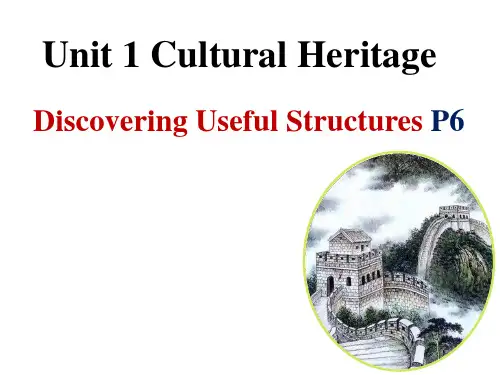
The cultural heritage is something _t_h_a_t__ has existed for a long time, and it tells people about the past.
Peking
Opera
The
Kite
intangible cultural heritage
popular traditional folk arts
(中国最受欢迎的传统民俗艺术之一) has a long history of more than
2000 years. People often beautify their homes with paper cuttings __t_h_a_t__w_a_s__w_id__e_sp_r_e_a_d__p_a_r_t_i_c_ul_a_r_ly__d_u_r_i_n_g_t_h_e__M__in_g_(特别在
2. The project team helped protect the national parks in the United Republic of Tanzania. It was formed by members from fifteen countries.→ The project team w__h_o_se__m_e_m__b_e_r_s_w_e_r_e_f_ro_m_ _fi_ft_e_e_n_c_o_u_n_t_ri_e_s_h_e_l_p_e_d_p_r_o_te_c_t_t_h_e_n_a_t_io_n_a_l _p_a_r_ks__in__th_e__U_n_it_e_d_R__e_p_u_b_lic__o_f_T_a_n_z_a_n_ia_.__
solve
新教材高中英语Unit1CulturalHeritageSectionCDiscoveringUs
the key to the door 门的钥匙 the solution to the problem 问题的解决办法
新教材高中英语
2021/4/17
Unit1CulturalHeritageSectionCDiscoveringUsefulStructures
5
课件新人教版必修第二册
新教材 高中英语 必修第二册 Unit 1 Cultural Heritage
gain entrance to 获得进入……的许可
an entrance fee 入场费
entrance examinations 入学考试
◆词语积累
enter vt. 进入;参加
enter for 报名参加
enter the room 进入房间
◆学法点拨
the + n. +to 结构:
the answer to the question 问题的答案
(3) His sudden entrance (enter)took everyone by surprise.
◆单句写作
(4) The entrance to (……的入口)the meeting room has already been closed.
(5) After he found the entrance to (……的入口)the building,he entered the hal(l 进入大厅) without making a sound.
新教材 高中英语 必修第二册 Unit 1 Cultural Heritage
Unit 1 Cultural Heritage
Section C Discovering Useful Structures
2019统编人教版高中英语必修第二册unit-1《Cultural-Heritage》全单元教案教学

【2019统编版】人教版高中英语必修第二册Unit 1《Cultural Heritage》全单元备课教案教学设计Unit 1 Cultural HeritagePeriod 1 Listening and Speaking【教材分析】Listening and Speaking introduces the topic of “Take part in a youth project”.The listening text is an interview about an international youth cultural heritage protection project. More than 20 high school students from seven countries participated in the project. The reporter interviewed two participants Stephanie and Liu Bin. By listening to the text, students can understand the significance of cultural heritage protection, and teenagers can use their knowledge, combine their own interests and advantages, etc. to participate in the action of cultural heritage protection.Listening and Talking introduces the theme of “Talk about history and culture”.The listening text is a dialogue between two tourists and tour guides when they visit the Kremlin, Red Square and surrounding buildings. The dialogue focuses on the functional items of “starting a conversation”, which is used to politely and appropriately attract the attention of the others, so as to smoothly start a conversation or start a new topic. The purpose of this section is to guide students to understand the history and current situation of Chinese and foreign cultural heritage in their own tourism experiences or from other people’s tourism experiences, explore the historical and cultural values, and be able to express accurately and appropriately in oral communication.【教学目标】1. Guide students to understand the content of listening texts in terms of the whole and key details;2. Cultivate students’ ability to guess the meaning of words in listening; discuss with their peers how to participate in cultural heritage protection activities.3. Instruct students to use functional sentences of the dialogue such as “I beg your pardon, but…” “Forgive me for asking, but…” and so on to start theconversation more politely and appropriately.【教学重难点】1. Guide students to understand the content of listening texts in terms of the whole and key details;2. Cultivate students’ ability to guess the meaning of words in listening; discuss with their peers how to participate in cultural heritage protection activities.3. Enable students to use the functional items of “starting a conversation”, which is used to smoothly start a conversation or start a new topic.【教学过程】Part 1: Listening and SpeakingStep 1: Lead inThe teacher is advised to talk about the meaning of the word “Heritage”.Boys and girls, before our listening, let’s work in pairs and discuss the meaning of the word “Heritage”.What does the word “heritage” mean? Share your ideas about your understanding of it and you can use examples to illustrate your meaning.Heritage means the traditional beliefs, values, customs, etc. of a family, country or society.For example, the Great Wall is the heritage of China.Step 2: PredictionAfter their small talk, the teacher can ask students to predict what the listening text is about by looking at the pictures.The listening text is probably about how to protect a famous heritage site by some students.Step 3: Summary of the main ideaThen play the radio which is about an interview about an international youth cultural heritage protection project. And after finishing listening for the first time, the students need to solve the following tasks.1. Listen to the conversation and sum up the main idea.Youths from seven countries are working together to protect cultural relics on Mount Tai.2. Listen again and help the reporter to complete the interview notes.International youth project, 23 high school students from 7 countriesMount Tai, one of the most famous mountains in ChinaIt has been protected for more than 3,000 years.22 temples, around 1,800 stones with writing on themStep 4: Guessing the meaning of the unknown wordsListen to the conversation again and use the context to guess the meaning of the words below. Tell the reasons why you guess so.Preserve: to protectReason: the word means the same of a word I knowPromote: to help sth to happen or developReason: The word is explained by the speakerStep 5: Speaking ProjectWork in pairs or groups and role play a conversation.Suppose you are a reporter and interviewing the students who devote their time to protecting the heritage.Reporter: It is said that you are one of the volunteers to preserve the pine trees on Mount Huang. What are you guys doing?V olunteer: We are making some signs which are designed to educate people to protect the pine trees.V olunteer: Besides, we took a lot of pictures of pine trees and create an app which aims to promote people’s awareness of protecting the precious trees.Reporter: Sounds great and anything else?V olunteer: We often wear volunteer clothes and send some brochures in the park to call on more people to protect the trees.Reporter: Does your hard work pay off?V olunteer: Definitely. More and more tourists are now stopping carving names on the trees or climbing the trees.Part 2: Listening and TalkingStep1: Listen to the tape, which is about a dialogue between two tourists and a tour guide when they visit the Kremlin, Red Square and surrounding buildings for the first time, and then ask the students to solve the following tasks.1. Listen to the conversation and answer(1).Where are the speakers?On a street.(2).What are they doing?Sightseeing.2. What do you know about the Kremlin and Red Square? Listen again and complete the fact sheet.Step 2: Speaking ProjectActivity 3 on page 7.Work in groups. Choose a cultural site that you like and role-play a conversation between some tourists and their tour guide. Take turns to play the different roles.Step 3 HomeworkAccording to Activity 3, write down a conversation between the tourist and his/her guide.Unit 1 Cultural HeritagePeriod 2 Reading and Thinking【教材分析】1. This section focuses on “Understanding how a problem was solved”, which is aimed to guide students to analyze and discuss the challenges and problems faced by cultural heritage protection during the construction of Aswan Dam, as well as the solutions. On the basis of understanding, students should pay attention to the key role of international cooperation in solving problems, and attach importance to the balance and coordination between cultural heritage protection and social and economic development. Students are encouraged to face challenges actively, be good at cooperation, and make continuous efforts to find reasonable ways and means to solve problems.【教学目标】1. Enable students to understand the main information and text structure of the reading text;2. Motivate students to use the reading strategy “make a timeline” according to the appropriate text genre;3. Enable students to understand how a problem was solved;4. Enable students to understand the value of protecting cultural heritage by teamwork and global community;【教学重难点】1. Guide students to pay attention to reading strategies, such as prediction, self-questioning and scanning.2. Help students sort out the topic language about protecting cultural relics and understand the narrative characteristics of “time-event” in illustrative style3. Lead students to understand the value of protecting cultural heritage by teamwork and global community;【教学过程】1. PredictionStep 1 Predicting the main idea of the passageLook at the title and the pictures, and then predict what the passage will be about.Q: What will be talked about?Step 2: Fast reading tasksTask of the first fast reading:Read quickly and figure out the key words of each paragraph.•Paragraph 1: challenge•Paragraph 2: proposal led to protests•Paragraph 3: committee established•Paragraph 4: brought together•Paragraph 5: success•Paragraph 6: spiritTask of the second fast reading:1. Why did the Egyptian government want to build a new dam in the 1950s?2. Why did the building of the dam lead to protests?3. How did the government save the cultural relics?4. Which one can describe the project?A. Successful.B. Negative.C. Useless.D. Doubtful.5. What can be learned from the Aswan Dam project?Step 3: Careful reading tasksRead more carefully and answer the following questions.1. What do “problems” refer to and what do “solutions” refer to?2. Find out the numbers in paragraph four and explain why the author used exact numbers instead of expressions like many?3. What can you infer from “Over the next 20 years, thousands of engineers and workers rescued 22 temples and countless cultural relics”?4. What can you infer from “Fifty countries donated nearly 80 million to the project”?The project cost a lot of money.5. Before the building of the dam, what problems did the Nile River bring to theEgyptian?6. What words can you think of to describe the working process of the project?Step 4: ConsolidationDivide the passage into three parts and get the main idea of each part.Part 1 (Paragraph 1)The introduction of the topicKeeping the right balance between progress and the protection of cultural sites is a big challenge.Part 2 (Paragraphs 2-5)The process of saving cultural relics•Big challenges can sometimes lead to great solutions.•The Egyptian government wanted to build a new dam, which would damage many cultural relics.•The government turned to the UN for help.•Experts made a proposal for how to save cultural relics after a lot of efforts and the work began.•Cultural relics were taken down and moved to a safe place.•Countless cultural relics were rescued.•The project was a success.Part 3 (Paragraph 6)The summary of the textThe global community can sometimes provide a solution to a difficult problem for a single nation.Step 5: Critical thinking:1. How to deal with the construction and the protection of cultural relics?2. As students, what should we do to protect our cultural relics?Step 6: summaryStep 7 Homework:Review what we have learned and find out the key language points in the text.Unit 1 CULTURAL HERITAGEReading for Writing【教学目的与核心素养】1. Get students to have a good understanding of some features about a news report by reading the text.2. Instruct students to write a summary about a news report properly using some newly acquired writing skills in this period.3. Develop students’ writing and cooperating abilities.4. Strengthen students’ great interest in writing discourses.【教学重难点】1. Stimulate students to have a good understanding of how to a summary about a news report2. Cultivate students to write a news report properly and concisely.【教学过程】Step 1 Lead inDo you think it is necessary for us to circulate our cultural heritage to the world? Why or why not?Do we need to learn more about other countries’ cultural heritage? Why or why not?Step 2 Read to discover details concerning the main body of the news report Read the news report and then solve the questions below.1. What are the researchers and scientists trying to do?(The researchers and scientists are trying to increase knowledge and appreciation of China’s ancient cultural heritage.)2. What modern technology are they using?(They are using digital photography to record a collection of images.)3. Why are so many people interested in the Mogao Caves?(People are interested in the Mogao Caves because they have long been a meeting point for different cultures and are part of the history of many countries.)4. What do you think of the researcher’s opinion in the last paragraph?(I agree with the researcher’s opinion. Understanding our own and other cultures is a great way to understand ourselves and others.)Have the Ss discuss the questions in groups and then share their answers to the class.Step 3: Study the organization and language features1. Read the news report again and find these parts.A. Lead sentenceLanzhou, 9 August 2017. A group of researchers and scientists from China and other countries are working together ... China’s ancient cultural heritage.B. Direct quote“Appreciating one’s own cultural heritage is very important for understanding ourselves. Appreciating the cultural heritage of other countries is very important for international communication and understanding.”C. ParaphraseThey are recording and collecting digital images of cultural relics from the Mogao Caves, which were a key stop along the Silk Road throughout China’s ancient history. Nearly 500,000 high-quality digital photographs have been produced since the international project started in 1994.D. Background informationThe Mogao Caves have long been a meeting point for different cultures and are part of the history of many countries.E. Reporting verbsF. Words to show comparison and/or contrastToday, the caves are just as interactional as they were at the time when people travelled the Silk Road.2. Underline the relative clauses that the writer uses to identify the following.A. thingsThey are recording and collecting digital images of cultural relics from the Mogao Caves, which were a key stop along the Silk Road throughout China’s ancient history.B. peopleAs one researcher who is working on the project explains, “Appreciating one’s own cultural heritage is very important for understanding ourselves. Appreciating the cultural heritage of other countries is very important for international communication and understanding. ”C. timeToday, the caves are just as interactional as they were at the time when people travelled the Silk Road.Step 4 Post reading for further summary and understanding1. Why does the writer use the quote in the report?The writer uses quotes in order to make the news report more concise, authentic and persuasive.2. Explain your understanding of the sentences: “Appreciating one’s own cultural heritage is very important for understanding ourselves. Appreciating the cultural heritage of other countries is very important for international communication and understanding.”We should learn and understand our own cultures, which is vital for us to know ourselves and be proud of our profound and extensive cultural heritage. Meanwhile, we should understand and appreciate other cultures, trying to be open-minded. This way, we can deepen each other’s understanding and respect.Step 5 HomeworkWrite a news report about Li Hua who works to protect our cultural heritage using the following notes and you can add details to make the news report more concise and detailed.▪Name: Li HuaPlace: Xi’anProfession: a senior high school teacher▪wants to preserve cultural heritage:▪protect old houses▪takes photos of old buildings▪helps repair buildings▪looks for cultural relics▪ interviews old people▪ shows cultural relics to the public ▪ writes about the buildings …Section ⅤWriting关于文化遗产保护的新闻报道文体感知1.新闻报道是对最近发生的重大事件、重要人物进行简要而迅速地报道。
高一英语人教版Unit 1 Cultural Heritage Discovering教学设计
课程基本信息
课例编号
学科
英语
年级
高一
学期
秋季
课题
Unit 1 Cultural Heritage Discovering Useful Structures
教科书
书名:普通高中英语教科书英语必修第二册
7’
Practice
1.学生以填空的练习形式,掌握定语从句中关系代词和关系副词的作用,教师随后讲解;
2.学生练习重组句子,用定语从句改写两个句子,教师随后讲解;lication
1.教师使用定语从句给几个名词下定义,学生来猜;
2.学生尝试使用定语从句给人或物下定义;
教学难点:
通过运用定语从句细致地描述人或物,体会定语从句在语义表达中的作用。
教学过程
时间
教学环节
主要师生活动
2’
Observation
教师引导学生观察句子,并发现句子中的关系代词和关系副词。
7’
Discovery
学生重读课本第4页的课文,找出所有的定语从句,并分析从句
的先行词,关系代词或关系副词,以及关系词在定语从句中的成分。
出版社:人民教育出版社出版日期:2019年6月
教学人员
姓名
单位
授课教师
指导教师
教学目标
教学目标:
1.通过观察和分析定语从句,归纳关系代词及关系副词的用法和省略情况;
2.通过运用定语从句细致地描述人或物,体会定语从句在语义表达中的作用。
教学重点:
通过观察和分析定语从句,归纳关系代词及关系副词的用法和省略情况
3.学生总结定语从句的功能。
《Unit 1 Cultural Heritage Discovering Useful Structure》课件(三套)
先行词 关系词
1. 先行词: 被定语从句修饰的词叫先行词。 2. 关系词: 引导定语从句的词叫关系词。 3. 关系词通常有下列三个作用: (1)引导定语从句; (2)代替先行词; (3)在定语从句中担当一个成 分。 4. 关系代词在从句中作主语、宾语、定语或表语; 关系副词在 从句中作状语。
关系代词和关系副词的区别
school, I was walking by the school playground. (14).The little problems ____th_a_t_/w__h_i_ch___ we meet in our daily lives may be inspirations for great inventions. (15).The reason ___w__h_y____he resigned was that he didn’t get on well with the boss.
(2)“数词+ of + which/whom”引导定语从句 这种结构常用来引导非限制性定语从句, 有时候也可
以把“of + which/whom”置于数词前。数词包括百分数和 基数词。 (3)“the+名词+ of which/whom”引导非限制性定语从句
这个结构中, of which/whom充当定语, 修饰前面的名 词, 整个结构相当于“whose+名词”引导的定语从句。
(3)由and, but, or等并列连词连接两个或两个以上的定语从 句修饰同一个先行词时, 第一个关系词可以省略, 但第二、 三个一般不可以省略 The reason (why/that) he wanted to sell his house was that he needed a lot of money for his operation. 他想卖掉房子的原因是他的手术需要很多钱。
Unit1CulturalHeritageDiscoveringUsefulStructures教案
下定义是定语从句的一个重要应用场景,活动3是更灵活和开放地运用定语从句来下定义。此处还可扩展教科书内容,让学生利用定语从句对更多熟悉的事物下定义,如party、exam、birthday、cousin等,也可以选取跟本单元主题有关的重点词汇,如temple、cultural relic、environmentalist等。该活动可以游戏方式进行,教师要对学生输出语句的准确性进行指导与点拨。
2.describe people or things in greater detail.
教学
主题
本板块的教学主题为“更细致地描写人或事物”(Describe people or things in greater detail)。学生在学习必修第一册限制性定语从句的的基础上,进一步复习并熟练掌握限制性定语从句的形式、意义和功能,能够在交际中正确运用这类从句进行口头和书面表达,更加具体生动地描述人和事物。
关系词在从句中充当什么成分?
鉴于学生已学过定语从句,这里有必要指导学生归纳总结定语从句的用法。按照先行词在句பைடு நூலகம்的功能及关系代词在从句中的功能分类,主要有以下四种:
Functionsof head noun
Functions of relative pronoun
OS
先行词在主句中作宾语
关系代词在从句中作主语
You can do anything (that) you set your mind to.(OO)
All that glitters is not gold.(SS)
Time (that) you enjoy wasting is not wasted time.(SO)
Unit1CulturalheritageDiscoverusefulstructures教学设计-
Consolidate the knowledge and skills students have learned in this lesson.
作业
1.Write a position to introduce a kind of cultural relic. Use attributive clauses to describe the main characters.
2. Try to draw a ive clause and non attributive clause
Thinking qualities
重点
Help students identify the usage of relative pronouns and relative adverbs in attributive clauses.