
北师大版英语九年级全册【同步练习】Unit 1 Lesson 1
Unit 1 LanguageLesson 1 Body language同步练习1. The reporter said that the UFO east to west when he saw it.A. travelsB. traveledC. was travelingD. has traveled2. the computer, I surf the Internet once a week.A. As forB. As inC. As fromD. As of3. His father's bad habits made to him.A. differentB. a differenceC. differencesD. difference4. --- Julie said she sent you a birthday card yesterday. Have you got it?--- Oh, really? I haven't my mailbox yet.A. examinedB. reviewedC. testedD. checked5. He goes to work by bus.A. not at allB. no longerC. not longerD. not any longer1. The boy is from Japan. He speaks J.2. We think it's r to stare at others.3. In w (西方) countries people play jokes on each other on April Fools' Day.4. She invented a new m of teaching English.5. I often take n in English class, and I write down important words and sentences.1. 顺便问一下,你喜欢我送的礼物吗?, do you like the giftI you?2. 它对你的日常生活有影响吗?Does it to your everyday life?3. 汤姆不会再犯这样的错误了。
Tom will make such a mistake.4. 今天美国仍有大量的树木在继续被砍伐。
Today, too many trees are still being in the USA.5. You can have a bed, (至于) him, he'll have to sleep onthe floor.It was my first day at Grade 6. And the first lesson was1 English. When I was doingnothing, Mr. Gough, our new English teacher, walked into the 2 .To my surprise, he held up a book, The Collected Works of Edgar Allan Poe, and asked if anyone had 3 it. I put my hand up, because Poe was my favorite writer. Mr. Gough asked if I really understood 4 the writer tried to say in his book. My 5 made him smile, and he asked me to write an article on that subject.After that, English classes became a new interest for me. Mr. Gough thought that students had to 6 a play to understand it. "Don't just read it." he said.As time 7 we developed a real friendship. He encouraged me to be a 8 in the future. When I left school, he said to me, "You have a gift for writing, Tony, and one day you'll come to realize how 9 it is. Make use of it if you want your life to be complete."Now I'm a writer and every time I sit down to write 10 I think of Mr. Gough. He was more than just an English teacher, because he also taught me useful lessons in life.1. A. boring B. exciting C. interesting D. lively2. A. bookshop B. classroom C. supermarket D. cinema3. A. watched B. seen C. looked D. read4. A. if B. when C. what D. how5. A. diary B. report C. reply D. article6. A. work out B. act out C. put out D. come out7. A. passed B. walked C. disappeared D. burned8. A. teacher B. driver C. waiter D. writer9. A. useful B. beautiful C. careful D. thankful10. A. anything new B. something new C. new anything D. new somethingAGreen is an important color in nature. It is also the color of most growing plants. Sometimes the word green means young, fresh and growing. Sometimes it describes something that is not yet ripe(成熟的) or finished. For example, a greenhorn is someone who has no experience, who is new to a situation. In the fifteenth century, a greenhorn was a young cow or ox whose horns had not yet developed. A century or so later, a greenhorn was a soldier who had not yet had any experience in battle. By the eighteenth century, a greenhorn had the meaning it has today—a person who is new in a job.Someone who has the ability to grow plants well is said to have a green thumb. The expression comes from the early 1900s. A person with a green thumb seems to have a magic touch that makes plants grow quickly and well. You might say that the woman next door has a green thumb if her garden continues to grow long after your plants have died.The Green Revolution is the name given some years ago to the development of new kinds of rice and other grains. The new plants produced much larger crops. The Green Revolution was the result of hard work by agricultural scientists who had green thumbs.Green is also the color used to describe the powerful emotion, jealousy(嫉妒). The green-eyed monster is not a frightening creature from outer space. It describes the unpleasant feeling a person has when someone has something he wants. A young man may suffer from the green-eyed monster if his girlfriend begins going out with someone else. Or, that green-eyed monster may affect your friend if you get a pay raise and she does not.1. From the second paragraph, we can conclude(得出结论) that .A. a greenhorn refers to (指的是) a horn of a young cow or oxB. a word has different meanings in the same centuryC. the language develops with time going byD. a greenhorn means a soldier who hasn't had any experience in battle today2. If a person has a green thumb, he or she probably .A. suffers from an illness in the thumbB. does well in growing plantsC. has a thumb in green colorD. has wonderful magic and energy3. If Green has a beautiful dress that Mary likes very much, .A. Green may suffer from the green-eyed monsterB. Mary is probably a girl with a green thumbC. Green is probably called a greenhorn.D. Mary may suffer from the green-eyed monsterBGreen is an important color in nature. It is the color of grass and the leaves on trees. It is also the color of most growing plants.Sometimes, the word "green" means young, fresh and growing. For example, a greenhorn is someone who has no experience. In the 15th century, a greenhorn was a young cow or an ox whose horns(角) had not yet developed. A century later, a greenhorn was a soldier who had no experience in war. By the 18th century, a greenhorn had the meaning it has today—a person who is new in a job.Someone who is good at growing plants is said to have a green thumb(大拇指). The expression comes from the early 20th century. A person with a green thumb can make plants grow quickly and well. The Green Revolution (绿色革命) is the name given some years ago to the development of new kinds of rice and other grains. It was the result of hard work by agricultural scientists who had green thumbs.Green is also the color used to describe the powerful feeling—jealousy(嫉妒). The green eyed monster is not a dangerous animal from outer space. It is an expression used about 400 years ago by the British writer William Shakespeare in his play Othello. It describes the unpleasant feeling when someone has something he wants.In most places in the world, a green light is a signal(信号) to move ahead. In everyday speech, a green light means approval(赞成) to continue with a project.4. A new solider was called a greenhorn in the century.A. 15thB. 16thC. 18thD. 20th5. A person with a green thumb .A. is good at growing plantsB. really has a green thumbC. has no experience in warD. is new in a job6. A man may meet the green eyed monster if .A. he sees a dangerous animalB. he can't get somethingC. he reads a sad playD. his friend gets a prize that he wants7. This passage doesn't mention the history of the expression " ".A. a green thumbB. a greenhornC. the green eyed monsterD. a green light8. Which would be the best title of the passage?A. Green, the Color of Grass and TreesB. The Stories About the Color "Green"C. Green, a Sign of ApprovalD. Different Meanings of "Green"参考答案CABDB1. Japanese2. Rude3. Western4. Method5. Notes1. By the way, sent2. make a difference3. no longer4. cut down5. as forABDCC BADABCBD BADDD。
北师大版英语九年级Unit 1 Language单元同步练习
Unit1 Language一、单项选择1、The reporter said that the UFO east to west when he saw it、A、 travelsB、 traveledC、 was travelingD、 has traveled2、 the computer, I surf the Internet once a week、A、 As forB、 As inC、 As fromD、 As of3、His father's bad habits made to him、A、 differentB、 a differenceC、 differencesD、 difference4、--- Julie said she sent you a birthday card yesterday、 Have you got it?——- Oh, really? I haven't my mailbox yet、A、 examinedB、 reviewedC、 testedD、 checked5、He goes to work by bus、A、 not at allB、 no longerC、 not longerD、 not any longer6、More than 100 workers from the Wangjialing Coal Mine in Aprilthis year、A、 is savedB、 are savedC、 was savedD、 were saved7、--- Does she like singing English songs?—-- Yes、 She to sing English songs in her room、A、 often doesB、 is often heardC、 often hears8、Put your hands behind your back、Don’t sp eak、We’ll inten minutes、A、 backB、 be backC、 are backD、 are back to you9、——— Cathy, can you answer the door? I the room、--—I’m coming, mum、A、 cleanB、 cleanedC、 have cleanedD、 am cleaning10、She looks very but I can’t remember her name、A、 similarB、 familiarC、 friendlyD、 strange11、It's a custom in China to have some tea or other drinks before themeal 、A、 servesB、 servedC、 is servedD、 will be served12、Many old people take a walk after supper have good health、A、 in order thatB、 as a resultC、 becauseD、 in order to13、I my homework;I guess I can’t join you、A、 don't finishB、didn’t finishC、haven’t finishedD、 won't finish14、——- Do you miss Mr Chen?——— Yes, I do、, have you ever heard of him since he left?A、 By the wayB、 On the wayC、 In the way15、The plans they made well、I’m sure they’ll succeed soon、A、 come outB、 work outC、 go outD、 put out二、单词拼写(单句首字母填空)16、 The boy is from Japan、 He speaks J 、17、 We think it's r to stare at others、18、 In w (西方) countries people play jokes on each other on April Fools' Day、19、 She invented a new m of teaching English、20、 I often take n in English class, and I write down important words and sentences、21、 If you want to reach a high s in spoken English, you will have to work hard、22、——— Dad,my iPad doesn’t work、———Don’t worry、 Let me c it for you、23、 Everything is not f to me, for I come here for the first time、24、 Do you know the proverb "One f can’t lift a small stone、"?25、 Ed plans to visit one of E countries, such as France, Germany or Britain、三、单词拼写(根据中文提示拼写单词)26、 He looks so (熟悉的) but I can't remember his name、27、 He (点头) to me in greeting when I entered the room、28、 He has one (肩膀) a little higher than the other、29、The grandchild nods his head to show his (同意) to his grandpa、30、 I agree, but Wei Ming feels (不同地)、31、 There was nothing but (寂静) in the room、32、It’s (粗鲁的) to make noises while eating in China、33、 Please (检查) your test paper before you hand it in、34、 I worked out the maths problem with this (方法)、35、 The book I want is right at the (底部) of the shelf、四、翻译(根据中文提示完成句子)36、顺便问一下,你喜欢我送的礼物吗?, do you like the giftI you?37、它对你的日常生活有影响吗?Does it to your everyday life?38、汤姆不会再犯这样的错误了。
九年级英语全一册同步训练Unit 1 综合测评(含答案)

Unit1综合测评(分数: 100分时间: 90分钟)第一卷听力部分(15分)Ⅰ.听句子,选择与所听句子相符合的图片(5分)Ⅱ.听两段较长对话,选择最佳答案(5分)听第一段对话,回答第6~7小题。
6.What kind of skills does the boy want to improve?A.His speaking skills.B.His reading skills.C.His writing skills.7.What does the girl do to help the boy?A.She lends him a dictionary.B.She lends him a grammar book.C.She teaches him how to keep a diary.听第二段对话,回答第8~10小题。
8.Does the girl ever go to the English Corner?A.Yes, she does.B.No, she doesn’t.C.We don’t know.9.What’s the most important thing for the girl?A.She should open her mouth and speak up.B.She should make friends with others.C.She should join an English club.10.What does the man advise the girl to do first?A.Find a pen pal.B.Talk with one or two students.C.Speak aloud to herself first.第二卷笔试部分(85分)Ⅳ.单项选择(10分)16.— do you usually get the information about it?—By searching for the news on the Internet.A.WhyB.WhereC.WhenD.How17.—Sir, do you think I can do the job?—It’s hard for us to measure your before we see your work.A.abilityB.relationC.inventionD.expression18.I don’t have a partner to practice English on the weekend.A.toB.withC.aboutD.for19.It takes a long time to master it, so please be .A.quickB.creativeC.loudD.patient20.I didn’t catch what you said just now. Can you it again?A.replyB.reviewC.repeatD.refuse21.You don’t have to every new word in the dictionary while reading.A.look forB.look atC.look upD.look after22.If you want to study well, you must what the teacher says in class.A.worry aboutB.be born withC.pay attention toD.fall in love with23.I think is very hard for me a foreigner.A.that; to understandB.it; understandC.it; to understandD.that; understand24.She seldom spoke English after class, for she was afraid mistakesgrammar.A.make; ofB.of making; ofC.make; inD.of making; in25.As the old saying goes,“.”So practice more, and you’ll make more progress.A.It’s a piece of cakeB.It serves you righte it or lose itD.Practice makes perfectⅤ.完形填空(10分)You may think that English dictionaries have been used for many, many centuries. In fact, an English dictionary you 26today wasn’t made until the Qing Dynasty (清朝). Three men did most of the important 27 work on dictionaries. They spent nearly all their lives trying to 28 words for their dictionaries. For them, it was a wonderful journey. The largest dictionary in the world is the Oxford English Dictionary. The 29 for this dictionary came from an important meeting in Britain in 1857.Twenty-two years later, Oxford University asked James Murray to be the editor (编辑、编者) of its new dictionary.Murray had never been to 30. At the age of fourteen, he left his village school in Scotland and taught himself while working in a bank. 31 he became a great teacher. After Oxford gave him the job, Murray had a small house 32 in his garden to do the work. Every morning, Murray got out of bed at five o’clock and 33 in the small house several hours before breakfast. Often he would work into the night. Murray hoped to finish the new dictionary in ten years. But after five years, he was 34 adding words for the letter “A”! He worked on the dictionary 35 he was very old.Forty-four years later, in 1928, other editors finished the dictionary.26.A.write e C.copy D.miss27.A.early B.boring C.easy D.difficult28.A.spell B.collect C.invent D.make29.A.way e C.idea D.prize30.A.school B.cinema C.village D.college31.A.Ever since B.Since then C.So far ter32.A.built B.sold C.broken D.drawn33.A.read B.wrote C.worked D.thought34.A.already B.still ually D.always35.A.if B.because C.until D.unlessⅥ.阅读理解(30分)AIt seems more and more Americans want schools to teach foreign languages to children younger than five years old. The most popular way to teach these young children another language is called immersion (沉浸式语言教学法).Children in immersion programs hear only the new language in the classroom. The children play games, sing songs and talk to one another in the new language. Some experts (专家) say immersion programs are the most effective (有效的) way for young children to learn a language. But there can be a problem when children in the United States begin to learn another language at such an early age. Not many elementary schools continue to teach a foreign language. Only seven of the fifty states require (要求) schools to teach a foreign language to students between the ages of six and twelve. Language experts say it is easier for younger children to learn a language. Still, American schools generally do not begin to teach foreign languages until secondary schools. By then, students are about thirteen years old.American schools face difficult choices about the cost of educational programs. The government has increased support for foreign language study in its education law called No Child Left Behind.At the college, the Modern Language Association says more students than ever are studying foreign languages and more languages are being studied now than in the past. Spanish is the most widely (广泛地) taught in American colleges and universities. French, German, Chinese and Italian are also popular.36.The most popular way to teach the American children another language is called .A.taskB.speakingC.immersionD.listening37.Where is Spanish the most widely taught?A.In American colleges and universities.B.In American secondary schools.C.In American high schools.D.In American elementary schools.38.Students in immersion programs can do the following things EXCEPT .A.talking to one another in the new languageB.hearing their native languageC.playing games in the new languageD.hearing the new language39.Which of the following is TRUE according to the passage?A.The government doesn’t support this program.B.All schools will take part in the immersion program.C.It’s the best for children to learn a foreign language at an early age.D.Not many elementary schools continue to teach a foreign language.40.What is the passage mainly about?A.Foreign language teaching in America.B.Foreign language teaching ways in America.C.Foreign language teaching in American universities.D.Foreign language teaching in American high schools.BWhen you are learning a language, listening, speaking and writing are important, but reading can also be very helpful. When you read, you cannot only learn some new words, but also learn how to use them. When you read a passage, it gives you a good example for writing.Here are some good reading tips.Firstly, try to read at the right level (水平). Read something that you can understand. If it is too hard for you, it is not interesting.Secondly, try to understand the new words. If there are four or five new words on a page, don’t use a dictionary. Instead, try to guess their meanings as you read. Mark (做标记) them with a pencil. Then look them up in a dictionary when you finish reading, and write them in your own vocabulary book. Try to remember them.Thirdly, try to read for a short time once a day. Fifteen minutes or half an hour every day is better than two hours every Sunday. For example, you can read before you go to bed, or after you get up or at lunchtime.Lastly, read something that interests you. Choose a newspaper, a book or a magazine about a subject that you like. It will be easy enough for you to understand.41.The underlined word “tips” in the passage means “” in Chinese.A.末端B.小费C.处所D.建议42.How many reading tips does the writer give us?A.Six.B.Five.C.Four.D.Three.43.If you meet a few new words on a page while reading, you can .A.stop readingB.guess the meanings at firstC.write them down at onceD.look them up right away44.Which of the following is TRUE according to the passage?A.Reading a lot can help you write better.B.It is useful for you to read for long once a week.C.When you read, you can only learn some new words.D.Try to read something hard to make your English better.45.Which is the best title for the passage?A.How to look up a new wordB.How to make reading betterC.How to remember new wordsD.How to choose something to readCHi Brad,It’s good to hear from you again. I find that I’m not good at writing compositions. It’s hard for me to prepare the form of a composition and organize sentences. ①Could you tell me how to deal with this problem? I would really appreciate it if you offer me some good methods.Best wishes,Cindy Hi Cindy,A composition is really a story and any story is told to an audience. There is a form for this and it has three parts. First, tell them (the audience)what you are going to tell them. Then tell them, and finally tell them what you told them. Parts One and Three are short and most of the information is in Part Two. It works like this.Let’s say you are asked to write a 200-word composition about your visit to the Great Wall. You would begin with an opening sentence or two saying something like “The Great Wall of China is a national ②landmark that is famous around the world. I visited it last summer and I want to tell you about it.” That uses about 25 words to tell them what you are going to tell them.The second part would be about 150 words and would contain information about the Great Wall such as how long it is, when it was built, who built it and why, and the fact that it is one of the seven wonders of the world and you would talk about how you felt and what you thought when you visited this national treasure. This is telling them.Finally, you would use about another 25 words to say something like “That was my first visit to the Great Wall and it was a very emotional experience to actually touch something so old and famous. ③每个中国人应至少参观长城一次。
初中英语北师大版九年级全册《unit1 1lesson1 body language 》课件
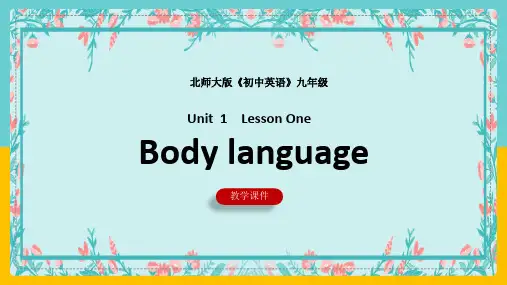
3rd –reading 4 Complete the table according to the text.
How many smile faces 能 够 匹 配 能 够 阅 读 文 能 够 比 较 流 利 的 能够在组员帮
can you get ? ( ) 肢 体 语 言 章 回 答 相 关 阅读课文
助下复述课文
和其意义 问题
Excellent
Good
Not bad
Homework
1. 听录音大声朗诵课文 2.将复述的课文内容整理 在作业本上。
is used differently , in western cultures, in Asian countries
as important as communicate with
Talk about the body languages and meanings in the text in pairs
用be used to do 连接
Nod your head 点头
show agreement
Shrug your shoulder 耸肩
show you don’t care about something
Kiss sb on the cheek 亲脸
greet each other
Shake hands
Body language is an important form of communication that is used everyw3. Read Para. 1 and answer the question.
北京北师大实验中学初中英语九年级全册Unit 1经典习题(课后培优)

一、选择题1.What does the sign mean?A.With a speed limit of 40 KM per hourB.Lift speed limit of 40 KM per hourC.Below the speed limit of 40 KM per hourD.Mustn’t drive below the speed limit of 40 KM per hour B解析:B【详解】句意:这个标志的意思是什么?考查常识。
A. With a speed limit of 40 KM per hour用每小时40KM的速度;B. Lift speed limit of 40 KM per hour提升每小时40KM的速度;C. Below the speed limit of 40 KM per hour在每小时40KM以下的速度;D. Mustn’t drive below the speed limit of 40 KM per hour不得低于每小时40公里的限速驾驶;根据交通标志可知这是解除限速的;故选B。
2.—This room is too small. I’d like to ask for .—Sure.We have rooms available here.A.another B.the other C.one D.it A解析:A【详解】句意“这个房间太小了,我想索要另一个。
-好的,我们这里有一个可用的房间”。
A.(无范围)另一个;B.(两者中)另一个;C.一个;D.它(代指上文中出现的同一个事物)。
根据句意可知,表示换一个房间,而不是上文中出现的房间;且本句话中,没有说是两者中的一个,用another,译为“另一个”,故选A。
3.—I found ▲ in the room.Where have they gone?—They've gone to Dave's birthday party.A.nobody B.somebody C.anybody D.everybody A解析:A【详解】句意:——我发现房间里一个人也没有。
北师大版英语九年级全册:Unit 1 Lesson1 Body Language-教案

Unit 1 LanguageLesson 1 Body language【教学内容】本单元的中心话题是“身势语”。
“热身” 部分以列表对比的形式引导学生了解有声语言与身势语之间的对应关系。
“对话” 部分建议学生结合身势语和有声语言把一些动作表演出来,既有趣味性,又有体验实践性。
“听力” 部分是以听的形式进一步向学生介绍了肢体语言的交际功能以及部分东西方手势语的区别。
【教学重点】a.帮助学生了解、掌握日常生活中常用的一些身势语。
b.让学生能结合口语及身势语来表达自己的思想。
c.训练学生通过听、说练习提高自己的听力水平。
【教学难点】a.身势语的中外文化的区别及其动作的正确表达。
b.学生课外查阅资料的能力培养。
【教学目标】1.理论依据新课标提出:英语课程的学习,既是学生通过英语学习和实践活动,逐步掌握英语知识和技能,提高语言实际运用能力的过程;又是他们陶冶情操、拓展视野、丰富社会经历、开发思维能力和提高人文素养的过程。
2.语言知识与技能目标a.熟练掌握与“身势语”话题相关的常用词汇及主要语言表达形式。
b.学生之间能交流、合作,共同就given topics较好地完成一些开放性话题。
c.使学生能根据key words把相关事实和信息联系起来。
3.情感态度与文化意识目标a.充分发挥情感教学的优势。
b.加强学生的团体协作意识。
c.了解东、西方文化的区别。
【教学方法】1.“任务型”教学的设计理念。
2.英语教学和情感教育的有机结合。
3.利用现代教育技术,拓宽学生学习学习和运用英语的渠道。
【设计构想】英语作为基础教育课程之一,历来备受重视。
面对新形式及新的时代要求,更应该以培养创新精神和实践能力为重点,强调新课程要促进每一位学生个体的身心发展,培养并促进学生良好品德的行成,从而使学生们能更好的适应日新月异的社会和时代。
然而,我们学生的英语能力相对比较薄弱,底子不够雄厚,学英语的态度也不够重视,导致整体的英语水平不高。
北师大版初中英语九年级Unit1单元测试试卷-含答案01
Unit 1 Language单元测试一、从下面各题所给选项中,选择最佳选项。
1. The ________ is the lowest part of something.A. topB. middleC. bottom2. My teacher has given me useful suggestions and I want to thank him from the ________ of my heart.A. bottomB. conditionC. wayD. surface3. My home is in a small village at the ________ of a huge mountain.A. edge(边缘)B. pathC. bottom4. Match the body languages with the nationality.to touch nosesA. AmencanB. ChineseC. RussianD. Maori people in New ZealandE. Indian从下面各题所给选项中,选择最佳选项。
5. In the following words, which underlined letter has a different sound from the others?A. planetB. apartmentC. factory6. In Sanya, you can enjoy all the water sports, or ________ lie on the beach.A. simplyB. hardlyC. nearlyD. especially7. —Oh, you like reading about star signs.—Not really. I read about them ________ for fun.A. usuallyB. especiallyC. nearlyD. simply8. /klaɪm/A. commonB. climbC. classmateD. complete从下面各题所给选项中,选择最佳选项。
北师大版初三英语上册Lesson 1
Main sentences: You might want to read a book about memory. You should also find out how the details. I agree I feel working in groups is also. I think review regularly helps me memorize English vocabulary.
They had a hard time supporting the family. 他们一度难以维持生计。
have a good time 玩得高兴 过得愉快 They had a good time in the Summer Holidays. 他们暑假过得很愉快。
First, it will help you concentrate on the most important parts when you learn the knowledge. 首先在你学习知识时,它可以帮你把注 意力集中到重要的内容上。
Write a letter to Jack.
How improve your memks.
Other people ______find it easier to might remember things in the morning. might You ______want to read a book about memory. might Some people ______remember the capital city of other countries using a song.
2.good bad long short fat thin fast slow beautiful ugly
北师大版九年级英语全一册同步练习题Unit 1 Lesson 1
Unit 1 Language Lesson 1 Body language同步练习1. The reporter said that the UFOeast to west when he saw it.A. travelsB. traveledC. was travelingD. has traveled2. the computer, I surf the Internet once a week.A. As forB. As inC. As fromD. As of3. His father's bad habits made to him.A. differentB. a differenceC. differencesD. difference4. --- Julie said she sent you a birthday card yesterday. Have you got it?--- Oh, really? I haven't my mailbox yet.A. examinedB. reviewedC. testedD. checked5. He goes to work by bus.A. not at allB. no longerC. not longerD. not any longer1. The boy is from Japan. He speaks J .2. We think it's r to stare at others.3. In w (西方) countries people play jokes on each other on April Fools' Day.4. She invented a new m of teaching English.5. I often take n in English class, and I write down important words and sentences.1. 顺便问一下,你喜欢我送的礼物吗?, do you like the giftI you?2. 它对你的日常生活有影响吗?Does it to your everyday life?3. 汤姆不会再犯这样的错误了。
北师大版英语九年级全册【教学课件】Unit 1 Lesson 1
北京师范大学出版社 九年级 | 全册
nod v. 点头 e.g. He just nodded, but didn’t speak. 他只是点了点头,没有说话。 agreement n. (意见或看法)一致; 协定 finger n. 手指 silence n. 安静;沉默
北京师范大学出版社 九年级 | 全册
Nationality: American; Australian; British; Canadian; Indian Both: Chinese; English, French, German; Japanese, Russian
北京师范大学出版社 九年级 | 全册
Look at the photos and discuss the questions.
北京师范大学出版社 九年级 | 全册
shoulder n. 肩,肩膀 Asian adj. 亚洲人的 n. 亚洲人 certain adj. 某种;肯定 e.g. Keep your book a certain distance from your eyes. 书和眼睛要保持一定的距离。 traveller n. 旅行者
北京师范大学出版社 九年级 | 全册
Most people use gestures and body language in addition to words when they speak. Hand gestures, i.e., gestures performed by one or two hands, is the most numerous kind of gestures. Can you name the expressions shown by the hands below?
北师大英语九年级 unit 1 Lesson 1
New words 1. simply 仅仅/简单地 2. nod 点头 3. agreement 一致/协定 4. finger 手指 5. silence 安静/沉默 6. differently 不同地 7. western 西方的 8. shrug 耸肩 9. shoulder 肩膀 10. Asian 亚洲人的 11. bow 鞠躬 12. greet 打招呼
People nod their heads to show agreement and put their fingers up to their mouths to ask for silence.
Read Para. 2 and answer the questions.
2. How do people in the West show they don’t understand? People shrug their shoulders to show they don’t understand.
It’s OK.
You are very good. / Well done! Say “ yes”
Do you know the meanings of the following facial expressions?
angry sad
happy
tired
Read one’s mind (察言观色).
No, they aren’t.
5. Which of the following sentences is NOT TRUE in Europe A. Women and children are kissed on each cheek by family members in the street. B. Friends bow when they meet in the street. C. New friends are often greeted with a kiss on the cheek by Europeans at parties. D. Two men usually shake hands and put their free hand on each other’s shoulders. 6. What should you be careful about?