
译林版小学英语六年级(上册)Unit3Holidayfun
What did Liu Tao do for the National Day holiday?
Liu Tao went to __S_h_a_n_gh_a_i __. He went to the __B_u_n_d__ and the _S_ha_n_g_ha_i_M_u_s_e_um_. He saw many _in_t_e_re_s_ti_n_g _t_hi_ng_s_.
Read the whole dialogue
朗读对话,注意人物的语音语调哦!
Liu Tao and Mike _c_a_m_e_ back to school after the National Day _h_o_li_d_a_y_. They are talking about their holidays. Liu Tao _v_is_i_te_d__ his aunt in Shanghai. He went to the _B_u_n_d__ and _v_is_i_te_d_ the Shanghai _M__us_e_u_m__. He saw many _i_nt_e_r_e_st_i_n_g _ things.
Mike: Hello, Liu Tao! Where did you go for the holiday? I called you, but you weren’t at home.
Liu Tao: I went to Shanghai and visited my aunt. Mike: What did you do there? Liu Tao: We went to the Bund and visited the Shanghai
Star Lake. We picked some oranges and went fishing. Liu Tao: Did you catch any fish? Mike: Yes, I did. I caught a big fish! Liu Tao: That’s great. Why did you call me? Mike: Because I wanted to give you the fish. Liu Tao: Where’s the fish now? Mike: I ate it!
Liu Tao: I went to Shanghai and visited my aunt. Mike: What did you do there? Liu Tao: We went to the Bund and visited the Shanghai
Museum. I saw many interesting things.
fish.
went fishing
Where‘s the fish now? Mike ate it.
ate eat过去式
Liu Tao: How was your holiday, Mike? Mike: It was great fun. Our family went to a farm near
Museum. I saw many interesting things.
did do过去式
Where did you go for the holiday? I went to Shanghai and visited my aunt.
What did you do there?
We went to the Bund and visited the Shanghai Museum.
How was Mike’s holiday? It was great fun.
Where did he go for the holiday?
His family went to a farm.near Star Lake.
星星湖
lake湖,湖泊
What did he do on the farm?
How were their holidays?
How were their holidays?
They were great fun.
极大的乐趣
Would you like to know more about his holiday?
Tips:Read the dialogue and underline the questions. 阅读P26对话,划出相关的问句。
holiday 假日,节日
What is your favourite holiday? It’s….
National Day holiday 国庆节假期
The students came back to school after the National Day Holiday.
(在……之后)Let’s源自talk something about our National Day holiday.(和同桌说说你的假期经历吧!)
A: Where did you go for …? B: I went/visited….
A: What did you do there? B: I …(ed)….
A: Did you …? B: Yes, I did. / No, I didn’t.
1.有感情地朗读课文,并进行录音传入班级QQ。 2.将课文对话改编成英语小故事,讲给家长听。 3. 将课上新编的对话故事写下来。
知识回顾 Knowledge Review
the Bund
上海(外滩)
museum 博物馆 the Shanghai Museum
上海博物馆
many interesting things
weren’t=were not
Mike: Hello, Liu Tao! Where did you go for the holiday? I called you, but you weren’t at home.
He picked some oranges. Did you pick any oranges?
Yes, I did. No, I didn’t.
What else did he do on the farm?
抓,捉
Did you catch any fish?
big catch过去式
He caught a
What did Mike do for the National Day holiday?
Mike went to a _f_a_r_m___. He picked some _o_r_an_g_e_s_. He went __f_is_h_in_g_ too. He caught __a__b_ig__f_is_h___
译林版小学英语六年级上册Unit3 Holiday Fun说课稿
译林版小学英语六年级上册Unit3 Holiday Fun 说课稿一、教材分析1. 教材内容本次课程所使用的教材是译林版小学英语六年级上册Unit3 Holiday Fun。
该单元主要包括以下内容:•掌握单词:holiday, Christmas, New Year’s Day, Halloween, Easter •掌握句型:What do you do on/about …?•学习问答句的用法•学习正确地运用所学单词和句型谈论节日活动2. 教学目标本节课的教学目标:•掌握所学单词和句型•熟练运用问答句形式•学生能描述和谈论不同的节日活动二、教学重难点1. 教学重点•掌握所学单词和句型•熟练运用问答句形式2. 教学难点•学生能描述和谈论不同的节日活动三、教学过程1. 导入活动通过放置五个装有不同节日装饰品和食品的盒子,让学生以组为单位,依次选择一个盒子展示盒子里面的物品,并告诉大家这是什么节日里会用到的。
教师可以反复强调新单词,如Christmas、Halloween、Easter等。
2. 新词和句型学习板书单词和句型,让学生跟读。
老师给学生们一些写出所学单词和句型的锻炼题目,例如:•请写出这些节日的英文名称:春节、复活节、中秋节。
•在这些节日里,你会做什么?你可以写出来吗?当学生完成练习之后,老师可以请一些学生上来表演他们的答案。
并指出正确和错误的所在。
3. 问答练习老师现在要用问答形式,让学生练习运用所学单词和句型。
学生可以两两搭档,或者分组,用所学单词和句型进行问答。
例如:What do you do on Halloween?我会制作南瓜灯!What about you?我会使用面料服装!Do you like Halloween? (题目我会使用南瓜灯经常或只有在一个特定的场合上会问到)答案:Yes, I love it! It’s really fun.(我是第一次之后可能会问)4. 小组讨论让学生以小组为单位,讨论其他节日的活动和具体庆祝方式。
译林版(三起)英语六年级上册Unit 3 Holiday fun Revision 课件
eg. Was Mike happy? Yes, he was.
Let’s summarize
What did Mike do on the farm?
Where did Mike go for the holiday? How was the holiday?
一般过去时特殊疑问句结构: 特殊疑问词+一般疑问句 回答时要使用动词过去式。
Let’s summarize
Did Mike catch any fish?
一般过去时的一般疑问句
What did Mike do on the farm?
Where did Mike go for the holiday? How was the holiday?
一般过去时的特殊疑问句
Let’s summarize
Wow! That was great! What did your family do yesterday?
Tim visited Jim. They ___p_la_y_e_d__w_i_t_h_t_o_y_c_a_r_s___. My parents __w__e_re__ at home. My mother _c_o_o_k_e_d_ the yummy fish. My father ___c_l_e_a_n_e_d_t_h_e_c_a_r___.
Let’s talk Where did they go?
They __w_e_n_t_ to the Car Museum. They __sa_w____ many cool cars.
What did our friends do for the holiday?
Let me tell you! I saw some pictures from the Wechat.
Unit3Holidayfun(单元解读)六年级英语上册(译林版三起)
UNIT 3 Holiday fun单元解读一、单元内容体现的课标理念本单元在英语核心素养的育人价值下进行,本单元教学内容为译林版《英语》六年级上册第三单元Holiday Fun,属手“人与自我”和“人与社会〞主题范畴,涉及“生活与学习”、“社会服务”、人际沟通”主题群,“生活的自我管理”、“健康文明的生活方式”、“个人感受与见解〞等子主题。
1.语言能力:学生能理解课文story time内容,是教材中叙事性语篇的教学单元。
Unit 3Holiday fun主要讲述的是“假日趣事”,假期生活是孩子们乐于讨论的话题之一。
通过学习,学生应该能够熟练地用一般过去时讲述各自假日里发生的趣事。
学生在对话、问答、讨论、讲述以及表演等活动中,可以提升学习能力和语用能力,发展思维品质。
在本单元的教学中,课前老师可以鼓励学生从自己所在的城市、自己去过的城市或是感兴趣的城市入手,搜集著名景点和基本概况,最后分享自己出游的经历和趣事,开阔学生的视野,让学生在英语活动中增强文化自信,提升综合语言运用能力。
本单元的教学重难点是学习、掌握以did引导的一般过去时的一般疑问句和以What,Where,How, Why引导的特殊疑问句以及部分不规则动词过去式的构成。
教学过程中,可以在具体情境中学习与话题holiday有关的内容,并在具体情境中学习和运用一般过去时的一般疑问句和特殊疑问句及其回答,鼓励学生用一般过去时交流假期话题,分享假期趣事。
熟练掌握句型中升调和降调的区别,提升英语的阅读能力。
2.文化意识:讲述了英国学校的三个学期,该语篇旨在让学生了解更多的英国文化,体验文化的多样性,培养学生比较中外文化异同的能力。
3.思维品质:能够运用所学语法知识提出问题,学会思考。
让学生在情境中学会交际,在交际中学会语言。
4.学习能力:注重趣味拓展阅读。
乐于学习和模仿发音,敢于尝试。
在语境中视听结合利用提供的学习资源完成学习任务。
在学习中,培养学生良好的听、说、读习惯,让学生懂得不能太虚荣,要诚实。
【单元热点难点】译林版(三起)英语六年级上册Unit 3 Holiday fun 语法重点(含解析)
【单元热点难点】译林版(三起)英语六年级上册Unit 3 Holiday fun 语法划重点1. 语法精讲01、一般过去时的各种句型转换:(1)一般疑问句及其肯定和否定回答:含有行为动词的一般过去时的一般疑问句结构Did +主语+动词原形+其他?e.g.: A: Did you catch any fish? B: Yes, I did./No, I didn’t.否定句:主语+didn’t +动词原形+其他e.g.: We didn’t have lessons yesterday. 我们昨天没有上课。
含有be动词的一般过去时的一般疑问句Was/Were +主语+其他?e.g. : A: Was the book over there just now? B: Yes, it was./No, it wasn’tA: Were the students in the library yesterday? B: Yes, they were./ No, they weren’t.否定句:主语+ wasn’t / weren’t +其他e.g.: You weren’t hungry at all. 你一点也不饿。
(2)由Where, What和Why 引导的特殊疑问句的问答:A: Where did you go for the holiday? B: I went to a farm.(重在回答地点)A: What did you do for the holiday? B:I visited the Shanghai Museum.(重在事情。
)A:Why did you call me? B: Because I wanted to give you the fish. (重在陈述原因。
)(3)由How引导的特殊疑问句的问答:A:How was your holiday? B: It was great fun.02、有关动词过去式的变化:不规则动词有:(前一单元出现过的不再重复。
译林版(三起)六年级英语上册Unit 3 Holiday fun单元知识知识点复习
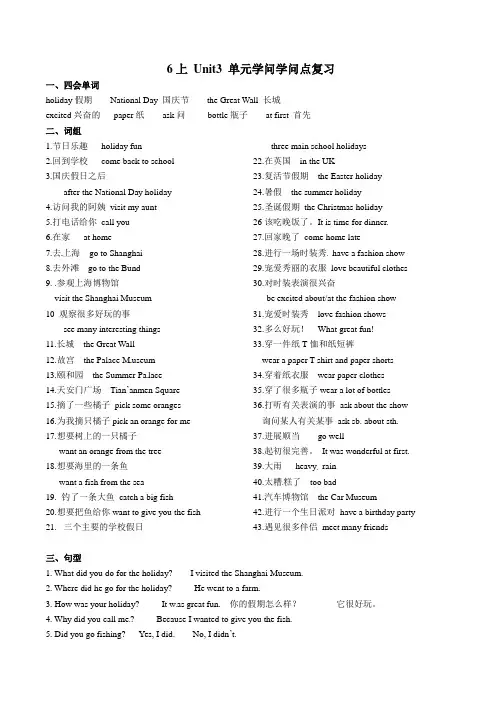
6上Unit3 单元学问学问点复习一、四会单词holiday假期National Day 国庆节the Great Wall 长城excited兴奋的paper纸ask问bottle瓶子at first 首先二、词组1.节日乐趣holiday fun2.回到学校come back to school3.国庆假日之后after the National Day holiday4.访问我的阿姨visit my aunt5.打电话给你call you6.在家at home7.去上海go to Shanghai8.去外滩go to the Bund9. .参观上海博物馆visit the Shanghai Museum10 观察很多好玩的事see many interesting things11.长城the Great Wall12.故宫the Palace M useum13.颐和园the Summer Pa lace14.天安门广场Tian’anmen Square15.摘了一些橘子pick some oranges16.为我摘只橘子pick an orange for me17.想要树上的一只橘子want an orange from the tree18.想要海里的一条鱼want a fish from the sea19. 钓了一条大鱼catch a big fish20.想要把鱼给你want to give you the fish21. 三个主要的学校假日three main school holidays22.在英国in the UK23.复活节假期the Easter holiday24.暑假the summer holiday25.圣诞假期the Christmas holiday26该吃晚饭了。
It is time for dinner.27.回家晚了come home late28.进行一场时装秀have a fashion show29.宠爱秀丽的衣服love beautiful clothes30.对时装表演很兴奋be excited about/at the fashion show31.宠爱时装秀love fashion shows32.多么好玩!What great fun!33.穿一件纸T恤和纸短裤wear a paper T-shirt and paper shorts34.穿着纸衣服wear paper clothes35.穿了很多瓶子wear a lot of bottles36.打听有关表演的事ask about the show 询问某人有关某事ask sb. about sth.37.进展顺当go well38.起初很完善。
六年级英语上册素材-Unit3 Holiday fun课文翻译 译林版(三起)
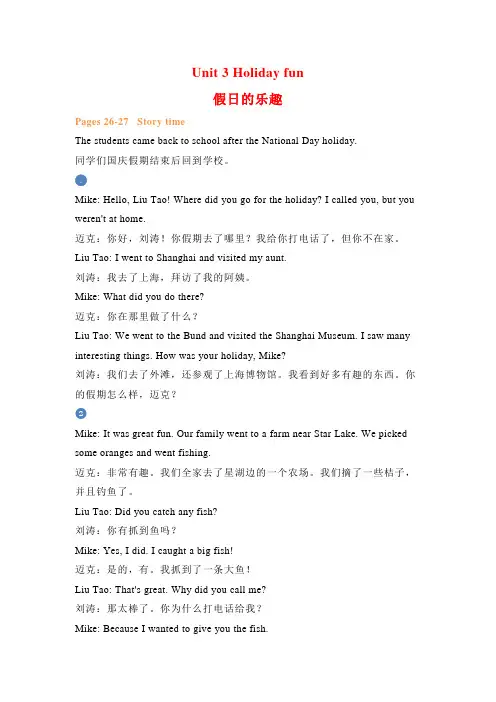
Unit 3 Holiday fun假日的乐趣Pages 26-27 Story timeThe students came back to school after the National Day holiday.同学们国庆假期结束后回到学校。
❶Mike: Hello, Liu Tao! Where did you go for the holiday? I called you, but you weren't at home.迈克:你好,刘涛!你假期去了哪里?我给你打电话了,但你不在家。
Liu Tao: I went to Shanghai and visited my aunt.刘涛:我去了上海,拜访了我的阿姨。
Mike: What did you do there?迈克:你在那里做了什么?Liu Tao: We went to the Bund and visited the Shanghai Museum. I saw many interesting things. How was your holiday, Mike?刘涛:我们去了外滩,还参观了上海博物馆。
我看到好多有趣的东西。
你的假期怎么样,迈克?❷Mike: It was great fun. Our family went to a farm near Star Lake. We picked some oranges and went fishing.迈克:非常有趣。
我们全家去了星湖边的一个农场。
我们摘了一些桔子,并且钓鱼了。
Liu Tao: Did you catch any fish?刘涛:你有抓到鱼吗?Mike: Yes, I did. I caught a big fish!迈克:是的,有。
我抓到了一条大鱼!Liu Tao: That's great. Why did you call me?刘涛:那太棒了。
译林版六年级上Unit 3 holiday fun
Unit3 holiday fun夯实基础一、掌握词汇:1.holiday假期2. call 打电话3. excited (某人)感到兴奋的4.interesting(某事或某物)有趣的5. paper 纸6. ask 问7. star星星8. Bund 外滩9. bottle 瓶子二、掌握词组:1. come back to school 回到学校2. National Day 国庆节3. visit his aunt 探望他的阿姨4. go to the Bund 去外滩5. visit the Shanghai Museum 参观上海博物馆6. great fun 十分有趣7. many interesting things 许多有趣的事物8. go to the farm 去农场9. pick some oranges 摘橙子10. go fishing 去钓鱼11. catch a big fish 捉了一条大鱼12. live in 居住在13. Great Wall 长城14. Palace Museum 故宫15. Summer Palace 颐和园16. Tian’anmen Square 天安门广场17. the Easter holiday 复活节假期18. the Summer holiday 暑假19. the Christmas holiday 圣诞假期20. come home late 回家晚了21. go well 进展顺利22. fashion show 时装秀23. at first 起初24. heavy rain 大雨三、掌握重点句型:1.—What did you do for the holiday? 你假期都做了些什么?—I visited the Shanghai Museum. 我参观了上海博物馆。
2.—Where did you go for the holiday? 假期你去了哪里?—I went to Shanghai and visited my aunt. 我去上海探访了我的阿姨。
译林版小学英语六年级上册Unit3 Holiday Fun教案
译林版小学英语六年级上册Unit3 Holiday Fun教案一、教学目标1.能听,说,读,写本单元的词汇:holiday, fun, camper, picnic, bike, ride, swim, beach, musical, band。
2.能正确运用本单元所学的句型和语言交际用语,来表述有关节假日活动的内容。
3.能听懂简单的节假日活动的对话和文章。
二、教学重难点1.词汇:holiday, fun, camper, picnic, bike, ride, swim, beach, musical, band。
2.句型:“What did you do on your holiday?”及其回答。
3.阅读理解和听力训练。
三、教学过程A. Warming-up1.教师通过图片或活动道具引导学生回忆并介绍不同种类的节假日:New year, Spring Festival, Summer holiday, Labor Day, National Day, Christmas Day 等。
2.老师出示一张全家出游的图片,请学生逐一描述图片中的人、物、活动等,教师引导学生回忆新单元的单词和句型。
B. Presentation1.教师用图片及真实情境来介绍拼音/写出新单元关键词:–holiday/vacation–fun–camper–bike–ride–swim–beach–picnic–musical–band2.通过教师自编单词卡、播放配套磁带等方式呈现单词的发音和意义,学生一起跟读、默读,并运用普通话朗读。
3.教师通过图片或其他实物展示有关节假日活动的情境场景,引导学生用新单词和句型来描述及交流,层层递进,达到运用语篇性语言的目的,如:–What did you do on your holiday?–I went camping.–Did you have any fun?–Yes, I rode my bike and went swimming.C. Practice1.角色扮演–教师出示对话或图片,让学生模仿使用新单词和语言交际用语。
Unit 3 Holiday fun (上)(说课稿 学案 附答案)译林版(三起)英语六年级上册
Unit 3 Holiday Fun (上)一、说课稿1. 教材分析本课是译林版(三起)英语六年级上册 Unit 3 的第一课。
本单元主要学习有关假期活动的词汇和句型,包括“have fun”, “go skiing”, “go fishing”等。
本节课教学内容是第一篇课文 Holiday Fun,讲述了一家人在假期中进行了各种有趣的活动,通过课文,学生能够学习一些新的词汇和句型,同时也能够了解到英国人在假期期间的一些典型活动。
2. 教学目标•学习和掌握课文中的单词和短语。
•通过课文理解英国人在假期中的典型活动。
•学会表达自己在假期中的活动和感受。
3. 教学重难点•教学重点:学生能够准确理解教材中的单词和短语,例如go hiking, have a barbeque等。
•教学难点:学生能够运用所学知识表达自己在假期中的活动和感受。
4. 教学准备课件、单词卡片、图片等。
5. 教学过程Step 1. Lead-in通过图片和简单的问答形式引导学生谈论假期中的活动。
•What do you usually do on holidays?•Have you ever gone skiing / hiking / fishing?Step 2. Pre-reading出示单词卡片,导入并教授一些生词和短语,例如 hiking, barbeque, fishing等。
Step 3. While-reading1.首先,播放录音,让学生跟读课文,注意读音和语调。
2.其次,让学生阅读并回答几个问题:•Where did the family go on holiday?•What did they do there?•Did Amy have fun fishing?•How was the weather on the last day?•What did they do on the last day?Step 4. Post-reading1.根据课文内容完成填空题,巩固所学单词和短语。
译林版小学英语六年级(上册)Unit3_Holiday_fun
Task 1: 写出下列动词过去式的原形.
came—— come weren’t---- aren’t visited-----visit did----- do went----- go saw----- see picked---- pick caught---- catch ate------ eat didn’t = did not
按要求完成下列句子。 1. I went to the Great Wall this morning.(对画线部分提问) __w_h_e_r_e__did you __g_o_____ this morning? 2. David eats some oranges on the farm every year. (用last year改成句子) David___a_te__s_om__e_o_r_an_g_e_s_o_n_t_h_e_f_a_r_m__la_s_t _y_e_ar___. 3. She got a postcard from her e-friend last Sunday. (改为否 定句) She __d_id_n_’t___ ___g_e_t___ a postcard from her e-friend last Sunday. 4. saw, interesting, I, many, in, things, Bund, the (.)(连词成句) __I_s_a_w__m_a_ny__in_t_e_re_s_t_in_g_t_h_i_ng_s__in_t_h_e_B_u_n_d_. _____ 5. I caught some fish .(改为一般疑问句) __D_id_____ you___c_a_tc_h__an_y_______fish?