
新教材九年级英语unit_9 单词讲解
2. lyrics n. 歌词
I prefer music that has great lyrics. 3. Australian n. 澳大利亚人 adj. 澳大利亚(人)的 他是一位澳大利亚的男孩。 He is an Australian boy.
4. electronic adj. 电子的,电子设备的
All students prefer to take the bus rather than walk.
= All students prefer taking the bus to walking.
=All students would rather take the bus than walk.
A 3. Some of my classmates _______ cartoons _______ documentaries. A. prefer ... to B. would rather ... than C. like ... better D. like ... less A 4. She prefers to eat outside rather than ____ at home. A. cook B. cooking C. to cook D. cooks
1. Not all the tourists from Japan _______ Western food to Chinese food. B A. like B. prefer C. enjoy D. love
B 2. I prefer skiing to _______. The snow makes me excited. A. cycles B. cycling C. cycled
Unit 9
I like music that I can dance to.
单词讲解
Section A -- Words
1.prefer
to choose sth because you like it better. v. 更喜欢 like sth better
prefer– prefers-- preferring--preferred
electricity n. 电,电能 电子音乐 electronic music
5. suppose v. 推断,料想
suppose sb to do sth. suppose + 从句 eg. 1.They suppose him to know the truth. 2. --Where is Jenny? -- I don’t know. I suppose she is still at work. be supposed to do sth. 应该做某事 = should do sth. eg. I am supposed to leave now. suppose + n. + (to be ) + adj. 原以为… She had supposed him (to be ) very rich.
10. war n. 战争,战争状态 1)在那场战争中死了多少人? How many people died in that war? The First / Second World War 反义词 peace
11. stick v. 粘贴,将…刺入 stick – stuck -- stuck eg. They stuck the map on the wall. stick to 坚持,固守 eg. 1)It’s right to stick to the rules. 2) If you stick to studying hard, you will get good scores. stick into 把…插进… eg. Don’t stick your chopsticks into your food.
Prefer doing sth to doing sth
prefer sth.= like sth. better prefer to do sth.
更喜欢某物 宁愿做某事(强调特定 情况或具体动作)
prefer A to B prefer doing A to doing B prefer doing
6. smooth adj. 悦耳的,平滑的
1) The girl likes smooth music. 2)The water was as smooth as glass. 水平如镜。 3) The surface of the ice is so smooth. smoothly adv. 平稳地,平静地
14. ending n. 结尾,结局 反义词 beginning n. A good beginning makes a good ending. 善始者善终。 15. documentary n. I don’t like documentaries, but I like sitcoms.
15. drama n. 戏, 剧 TV drama modern drama eg. 当我难过时,我不看记录片和戏剧。 When I am down, I don’t watch documentaries or dramas.
16. plenty pron. 大量,众多 plenty of 大量,充足 1)plenty of +可数名词复数 2)plenty of + 不可数名词
17. shut v. 关闭,关上 shut– shut –shut shut the door / window shut off 关闭,停止运转 shut up 闭嘴 eg. Shut off the TV when you are studying. 18. superhero n. 超级英雄 superheroes
12. down adj. 悲哀,沮丧 be down / feel down eg. I feel down about the trouble. let …down 使…失望 I won’t let you down. 同义词 sad
13. dialog = dialogue n. 对话,对白 同义词 conversation Can you hear the dialog? make a dialog
7. spare
adj. 空闲的,不用的 v. 抽出,留出 in one’s spare time = in one’s free time 在某人的空闲时间 eg. 1) What do you do in your spare time? 2) You can stay with us tonight. We have a spare room. spare sb sth = spare sth for sb 把某物分给某人 eg. Can you share me a cup of water? spare the time to do sth. 抽出时间做某事 eg. I can’t spare the time to help you tody.
VS
I prefer playing basketball to playing football!
prefer doing sth to doing sth
prefer
Noun
prefer sth
Prefer sth to sth
Verb
prefer doing sth prefer to do sth
Which one do you like better, bananas or oranges?
I like bananas better! ‖ I prefer bananas!
prefer sth
I prefer bananas to oranges!
prefer A to B
exercises
8. director n. 导演,部门负责人 direct adj. 直接的,直率的 directly adv. 直接地,坦率地 eg. Zhang Yimou is a film director.
9. case n. 情况,实情 1)This is not the case in China. 在中国事实并非如此。 in that case 既然那样,假使那样的话 eg. 1)In that case , call the police. 2) -- There is no coffee. -- In that case we’ll have tea.
prefer + that 从句(should +do ,should 可省) prefer to do sth. rather than do sth.
比起B来更喜欢A 喜欢A而不喜欢B 宁愿做A而不愿做B 更喜欢做某事
更喜欢… 喜欢做…而不喜欢做… 宁愿做…而不愿做…
prefer to do sth rather than do sth = prefer doing sth to (doing) sth = would rather do sth than do sth
我更喜欢咖啡
I p re fe r c o ffe e r fru its to c a n d ie s .
prefer doing sth 更喜欢做某事 prefer to do sth 宁愿做某事, 强调特定情况或具体动作
I prefer walking. I prefer to walk. He prefers swimming. He prefers to swim.
19. once in a while 偶尔地,间或 同义词 = sometimes = from time to time = now and then
20. intelligent adj.有才智的,聪明的 同义词 = wise = clever eg. She is an intelligent girl.
【人教版】九年级英语课文单词知识点精讲第九单元ppt

plenty of 大量;充足 shut v. 关闭;关上
shut off 关闭;停止运转
superhero n. 超级英雄
Superheroes always save the world.
once in a while 偶尔地;间或 while.
I’ve only met him once in a
prefer 更喜欢
prefer sth. (to sth. )更喜欢……(与……相比)
I prefer coffee to juice.
prefer to do sth. (rather than do sth.) 宁愿做某事(相比于做某事)
I preferred to stay at home rather than go out.
moving adj. 动人的;令人感动的 perform v. 表演;执行 games.
Our team performed very well in the yesterday's He won a lot of prizes in his lifetime.
lifetime n. 一生;有生之年
sadness n. 悲伤;悲痛
pain n. 痛苦;苦恼
I felt a deep sadness.
She was clearly in a lot of pain.
reflect v. 反映;映出
Their actions clearly reflect their thoughts. His performance was very moving.
It’s a classic case of bad planning.
in that case 既然那样;假使那样的话 —I’ve made up my mind.—In that case, there’s no point discussing it.
九年级英语unit9重点知识点

九年级英语unit9重点知识点Unit 9: Key Concepts in 9th Grade EnglishEnglish is one of the most widely spoken languages in the world, and being proficient in it is essential for communication, education, and career opportunities. In the 9th grade, students are introduced to various key concepts that build upon their previous knowledge and enhance their understanding of the English language. This article highlights some of the key knowledge points covered in Unit 9 of the 9th grade English curriculum.1. Vocabulary Expansion: Building a Strong LexiconExpanding vocabulary is crucial to effective communication. In Unit 9, students learn new words and phrases that are relevant to different aspects of everyday life. This includes vocabulary related to technology, sports, entertainment, and much more. Engaging in activities such as reading books, newspapers, and online articles, or even watching movies or documentaries in English, can significantly contribute to vocabulary expansion.2. Grammar: Polishing Language MechanicsGrammar forms the framework upon which effective communication is built. Unit 9 focuses on fine-tuning grammar skills, such as understanding verb tenses, subjunctive mood, conditional sentences, and reported speech. Students learn to apply these rules in both written and spoken forms, enabling them to express themselves with clarity.3. Speaking and Listening: Effective Communication SkillsDeveloping strong speaking and listening skills goes beyond textbook learning. Unit 9 provides opportunities for students to engage in discussions and debates, honing their ability to communicate their thoughts and opinions effectively. Practicing active listening, paying attention to intonation, stress, and pronunciation helps students understand spoken English better and improves their overall comprehension skills.4. Reading Comprehension: Extracting MeaningUnit 9 places emphasis on improving students' reading comprehension skills. Students learn strategies such as skimming and scanning, context clues, and identifying the main idea and supporting details. These techniques enable them to extract meaning from a variety of texts, including literature, informational articles, and opinion pieces.Encouraging students to read widely in their free time helps reinforce these skills.5. Writing: Crafting Engaging TextsEffective writing entails being able to express thoughts coherently and engagingly. In Unit 9, students learn to write different types of texts, including narratives, descriptive essays, and persuasive arguments. They also refine their abilities in generating relevant ideas, organizing their writing, and using appropriate language features. Regular writing practice, such as keeping a journal, can greatly improve writing skills.6. Literature: Exploring Literary DevicesUnit 9 delves into the world of literature, exposing students to various literary genres and devices. Students analyze prose, poetry, and drama, examining elements like plot, character development, figurative language, theme, and symbolism. Exploring literary works not only enhances critical thinking skills but also fosters imagination.7. Cultural Understanding: Embracing Diversity and PerspectiveLanguage and culture are inseparable. Unit 9 aims to cultivate cultural understanding by exploring different English-speakingcountries, their traditions, customs, and celebrations. Students are encouraged to appreciate the rich diversity of cultures, fostering tolerance and empathy.Unit 9 in 9th-grade English provides a comprehensive foundation for building language skills. By focusing on vocabulary expansion, grammar mechanics, effective communication, reading comprehension, writing, literature, and cultural understanding, students develop a holistic understanding of the English language and foster a lifelong love for learning and using English effectively.。
人教版九年级英语unit 9单词讲义

人教版九年级英语单词讲义Unit91.prefer / prɪ'fɜ:(r) / v. 更喜欢更喜欢like sth better prefer A to B_______prefer to do sth. rather than do sth. ______prefer doing sth. to doing sth.I prefer playing basketball to playing football._______________________2.lyrics / 'lɪrɪks / n. (pl.) 歌词I prefer music that has great lyrics.我更喜欢有好的歌词的歌。
3.Australian / / adj. 澳大利亚(人)的n.澳大利亚人He is an Australasian boy.______________4.electronic/ ɪˌlek'trɒnɪk / adj. 电子的;电子设备的名词electricity electronic music电子音乐5.suppose / sə'pəʊz / v. 推断;料想suppose sb. to do sth.________ be supposed to do sth.=should do sth.应该做某事I am supposed to leave now.=I should leave now.6.smooth / smu:ð / adj. 平滑的;悦耳的The water was as smooth as glass.水平如镜。
副词smoothly平稳的,平静的7.spare / speə(r) / adj. 空闲的;不用的v.抽出;留出spare time=free time_________ Spare sb. Sth.=spare sth, for sb.把某物分给某人Can you share me a cup of water?spare time to do sth.抽出时间做某事。
九年级英语9单元知识点
九年级英语9单元知识点Unit 9: Key Concepts in 9th Grade EnglishIn this unit, we will explore some key concepts and important knowledge points in 9th grade English. This unit will cover various topics, including grammar, vocabulary, reading comprehension, and writing skills. Let's delve into each of these areas in detail.1. GrammarGrammar plays a crucial role in mastering any language. In 9th grade English, students focus on consolidating their understanding of tenses, sentence structures, parts of speech, and verb forms. It is essential to grasp these concepts to construct accurate and meaningful sentences. Additionally, students learn about relative clauses, reported speech, and conditional sentences at an intermediate level.2. VocabularyDeveloping a strong vocabulary is vital for effective communication. In the 9th grade, students enhance their vocabulary by learning new words and phrases, including synonyms, antonyms, idioms, and collocations. Building a wide range of vocabulary enables students toexpress themselves more precisely and fluently in both spoken and written English.3. Reading ComprehensionReading comprehension is the ability to understand and interpret written texts. In 9th grade, students continue to develop their reading skills by analyzing various types of texts, such as news articles, short stories, and literary excerpts. They practice identifying main ideas, making inferences, and recognizing textual features like tone, purpose, and author's perspective. These skills help students comprehend and appreciate different texts at a deeper level.4. Writing SkillsEffective writing involves expressing ideas coherently and structuring them logically. In the 9th grade, students learn to write different types of compositions, such as essays, narratives, and argumentative texts. They focus on organizing their ideas, using appropriate transitions, and refining their writing style. Moreover, students learn how to incorporate evidence and examples to support their arguments and enhance the overall credibility of their written work.5. Speaking and ListeningWhile reading and writing are essential skills, 9th grade English also emphasizes oral communication. Students practice speaking and listening through discussions, presentations, and group activities. These activities help improve their pronunciation, fluency, and ability to express thoughts clearly. Additionally, listening activities enhance their comprehension skills as they learn to understand spoken English in different contexts.6. Test PreparationIn the 9th grade, students begin preparing for standardized tests, such as the End-of-Term exams or language proficiency tests. They receive guidance on exam strategies, time management, and question-solving techniques. Practice tests and mock exams are administered to familiarize students with the test formats and help them develop effective test-taking skills.ConclusionUnit 9 of 9th grade English covers a broad range of knowledge points and concepts. By mastering grammar, vocabulary, reading comprehension, writing skills, speaking, and listening, students will develop strong language abilities. These skills serve as a foundation for further language learning and effective communication. With consistentpractice and dedication, students can excel in their English studies and become confident English speakers and writers.。
人教版新目标九年级英语第九单元复习课件

6.定语从句观察两个句子,看看有什么区别: an interesting book 形容词interesting做定语修饰book a book that is interesting 句子做定语修饰book 定义:复合句中,修饰某一名词或代词的从句叫做定语
从句。定语从句要跟在所修饰的名词或代词后面,被定 语从句修饰的名词或代词叫做先行词。定语从句一般用 关系代词who,that,which和whose来引导,放在从 句的句首使从句与主句相连,并在句中担当一定的成分。 I like music that I can dance to. (作宾语)
这个男孩有许多图画。
It took me plenty of/a lot of/lots of/much time to finish it. 我完成它花了许多时间。
Section A
[辨析] plenty of, lots of / a lot of, many与much (1)plenty of前面没有冠词,既可以修饰可数名词的复数形 式,也可以修饰不可数名词,只能用于________ 肯定句 中,不能用 于否定句和疑问句中。 可数名词的复数 形式, (2)a lot of与lots of后面既可以修饰________________ 不可数名词 。 也可以修饰____________ (3)many后面接__________________ 可数名词的复数 形式。 不可数名词 。 (4)much后面接____________
64. 描绘了一幅…画 65. 唤起某人最深的伤痛
二.用法集萃
1.prefer的用法 【1】prefer A to B、A与B相比较,比较喜欢A 例:I prefer English to Chinese. I prefer fish to meat. 【2】prefer doing A to doing B,A与B相比,比较喜欢 做A 例:I prefer swimming to running. 【3】prefer to do A rather than do B,A与B相比,比 较喜欢做A 例:I preferred to stay behind rather than go with you. 【4】词组prefer not to do “不愿意做……”
九年级英语Unit9 知识点
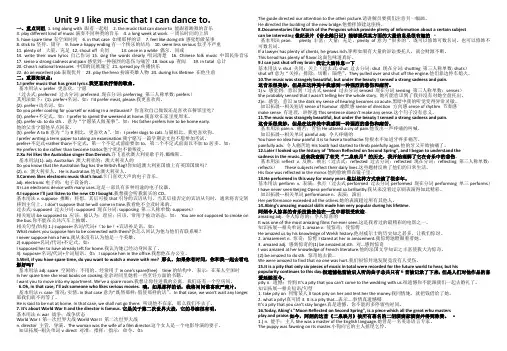
Unit 9 I like music that I can dance to.一、重点词组1. sing along with 跟着一起唱 2. the music that can dance to 能跟着跳舞的音乐3. play different kind of music演奏不同种类的音乐4. a long week at work 一周长时间的上班5. have spare time有空闲时间6. in that case 如果那样的话7. feel like doing sth感觉想做某事8. stick to坚持,固守9. have a happy ending有一个快乐的结局10. seem less serious似乎不严重11. plenty of 大量,充足12. shout off 关闭13. once in a while 偶尔,间或14. write their own lyrics 自己作词15. sing the words clearly 唱词清楚16. Chinese folk music 中国民俗音乐17. sense a strong sadness and pain感觉到一种强烈的悲伤与痛苦18. look up 查阅19. in total 总计20. China’s national treasures 中国的民族瑰宝21. spread joy传播快乐22. do an excellent job表现优异23. play the hero扮演英雄人物24. during his lifetime 在他生前二。
重要知识点:1.I prefer music that has great lyrics.我更喜欢抒情的歌曲。
基本用法v. prefer 更喜欢,宁愿(过去式: preferred 过去分词: preferred 现在分词: preferring 第三人称单数: prefers)其用法如下:(1). prefer+名词。
(完整版)新版新目标英语九年级unit9知识点总结.docx
Unit9 I like music that I can dance to.1.prefer v 更喜;更喜 ;宁愿 = like...better 在分 preferring、去式 preferred prefer sb/sth 更喜某人或某物prefer to do sth 宁愿做某事,更喜做某事prefer doing A to doing B宁愿做A而不愿做Bprefer sb to do sth宁愿某人做某事prefer A to B喜A而不喜B to 是介He prefers apples to bananas. prefer to do A+ rather than + do B 宁愿做 A 而不愿做 B=would rather do A than do B prefer sb to do sth 宁愿某人做某事2. dance to 随着⋯ ..跳舞to 介按照,随着sing to和着...唱歌The children danced to the music of the band.the music that can dance to 能跟着跳舞的音3. along with=together with 伴随着sing along with 跟着一起唱4.play different kind of music 演奏不同种的音5.spare adj 空的,不用的 spare time=free time 空in one’s spare time 在某人的空里have spare time有空v 抽出,空出房等spare sb time 某人出6. in that case 即使那的,既然那in this case 如果 (的 )in case of 要是 ...,在 ...的候in case 万一 , 以防 , 免得,in any case 无如何 ,不管怎 =whatever happenssuch being the case既然如此 ,情况既然是in no case不in nine case out of ten 十有八九,大体上7.feel like doing sth 感想做某事8.stick v n.棍,棒,手杖1)持后加言,点,原,划,定等的名stick to doing sth 持做某事2)粘,附着于 ;将..刺入stick a fork into a potato 把叉子叉土豆stick sth on sth3)不移开,不偏离,不离4)跟,随;留在⋯附近Stick to me, or you'll get lost.跟着我走,不然你会迷路的。
人教版九年级全册英语Unit9 SectionB 知识讲解+专题练习学案(含答案)
Unit9 SectionB知识讲解1.sense v.感觉到,意识到sense n.意识,感觉2.pain n.疼痛,努力。
painful adj.痛苦的;疼痛的;令人不快的3.look up (在字典,参考书中,通过电脑)查阅,抬头看look at看……look for寻找look out 当心look round 环视look through 审核look into检查look the same看上去很相像look like看上去像……look after照看,照顾4. It is a pity that only six pieces of music in total were recorded for the future world to hear, but his popularity continues to this day.(1) pity n.遗憾,怜悯(2) total n.总数,合计5. The piece had a simple name,Erquan Yingyue (Moon Reflected on Second Spring),but it was one of the most moving pieces of music that I’ve ever heard."one of the +形容词或副词最高级+名词复数"意为"最……之一"。
that引导的是定语从句,pieces of music为先行词,先行词有形容词的最高级the most moving修饰,关系代词只能够使用that。
专题练习一、单项选择1.Because of the subway, it’s ________ for my father to get to his company on time. A.nervous B.convenient C.moving D.strange 2.Emily is mad about dogs. She keeps six dogs in her tiny apartment.A.pities B.prefers C.loves3.History is really ________. How am I going to stay awake in class?A.boring B.moving C.exciting D.popular 4.—The singer's new song has won high ________ from the public.—Yes. It simply moves ________ people.A.pride; millions B.prize; million of C.advice; millions of D.praise; millions of 5.—Did you hear the news that the price of Bitcoin ________ new high?—Bitcoin? I know nothing about it.A.hits B.drives C.raises D.reflects二、完型填空Erquan Yingyue was written 6 Abing, a folk musician who was born in the city of Wuxi in 1893. His mother died 7 he was very young. Abing’s father taught him to play many musical instruments, 8 the drums, dizi and erhu, and by age 17, Abing was known 9 his musical ability. However, after his father died, Abing’s life grew 10 . He was very poor. Not only that, he developed a 11 illness and became blind. For several years, he had no home. He lived on the streets and played music to make money. Even after Abing got 12 and had a home again, he continued to sing and play on the streets. He 13 in this way for many years.Abing played music that could touch the 14 of people. When we listen to his music, we can sense both the beauty and sadness in it. It makes us think about the wounds and pain that we have experienced in the past. By the end of his life, he could 15over 600 pieces of music. He wrote many of them himself. It is a pity that only six pieces of music in total were recorded for the future world to hear, but his popularity continues to this day.6.A.in B.by C.for7.A.when B.who C.which8.A.for example B.such as C.such9.A.as B.for C.of10.A.bad B.badly C.worse 11.A.seriously B.serious C.strong 12.A.married B.marry C.marries 13.A.perform B.performed C.performing 14.A.hearts B.heart C.heartes 15.A.plays B.play C.playing三、阅读单选Beijing Opera is our national opera. It came into being after 1790 and has a history of over 200 years. Its music and singing came from Xipi and erhuang in Anhui and Hubei. There are four main roles in Beijing Opera: Sheng, Dan, Jing and Chou. Beijing Opera is fullof famous stories, beautiful facial paintings, wonderful gestures and fighting. Some of the stories are from history books, but most are from famous novels. The people in the stories usually can’t agree with each other. They become angry, unhappy, sad and lonely. Sometimes they are frightened and worried. Then they find a way to make peace with each other. Everyone is usually happy in the end.Beijing Opera is an important part of Chinese culture. In China it used to be popular with old people while young people didn’t like it very much. However, more young people are becoming interested in it nowadays. And more people around the world are learning about Beijing Opera’s special singing, acting and facial paintings.16.How many years does Beijing Opera have in 2017?A.207B.217C.227D.237 17.Beijing Opera’s _______ came from Xipi and erhuang in Anhui and Hubei.A.music and singingB.acting and fightingC.music and actingD.singing and fighting18.What’s the end of each story in Beijing Opera?A.angry B.sad C.Happy D.frightened and worried 19.Which of the following is TRUE?A.Beijing Opera used to be popular with old people and young people.B.More people at home and abroad are interested in Beijing Opera nowadays.C.Beijing Opera isn’t a part of Chinese culture.D.There are five main roles in Beijing Opera.20.What’s the best title of the passage?A.The History of Beijing OperaB.Beijing OperaC.The Roles of Beijing OperaD.The Changes of Beijing Opera四、用所给单词的正确形式填空用所给单词的适当形式填空21.This is a piece of wonderful music and I'm _____ (move) by the music.22.Most of classmates think Erquan Yingyue is ______ (strange) beautiful.23.I learn English by _______ (my).24.After finishing school, Tom continued _______ (play) the piano.25.Not only Tom but also Mary and Lucy _______ (be) our friends.五、完成句子根据汉语意思用定语从句来完成句子, 每空词数不限。
Unit9+课文重点基础知识讲练 人教版九年级英语全册
Unit 9 I like music that I can dance to.一、单词讲解带答案1.prefer v. 更喜欢2.lyrics n. (pl.) 歌词3.Dance to 随着...跳舞4.Sing along with...跟着...唱歌5.Australia n.澳大利亚6.Electric adj. 电的;用电的7.Suppose v. 推断;料想8.smooth adj. 悦耳的;平滑的9.Spare adj. 空闲的10.d irect v. 指向11.D irector n.导演;部门负责人12.C ase n. 情况;实情13.W ar n. 战争;战争状态14.S tick v. (stuck/stuck) 粘贴;将...刺入15.s tick to 坚持;坚守16.D own adv. 向下17.D ialog=dialogue 对话;对白18.E nding n. (故事、电影等)结尾;结局19.D ocumentary n. 纪录片20.D rama n. 戏;剧21.P lenty of 大量的;众多的22.S hut off 关闭;停止运转(大型电器或设备)23.O nce in a while偶尔地;间或24.I ntelligent adj. 有才智的;聪明的25.S ense v. 感觉到;意识到n. 感觉;意识26.sense sth感觉到某物27.S ad adj. 悲伤的28.P ain n. 痛苦;疼痛;苦恼29.R eflect v. 反映;映出30.M ove v. 移动31.P erform v. 表演;执行32.P ity n. 遗憾;怜悯v. 同情;怜悯33.T otal n. 总数;合计34.I n total 总共;合计35.M aster n. 大师;能手;主人36.P raise n./v. 表扬;赞扬37.R ecall v. 回忆起;回想起38.W ound n. 伤;伤口;创伤v.使(身体)受伤;伤害39.W orld War II第二次世界大战答案1.prefer v. 更喜欢过去式/过去分词:preferredprefer sth. 更喜欢...prefer A to B. 和B相比较更喜欢A. to 为介词。
九年级全一册unit9知识点
九年级全一册unit9知识点Unit 9 Knowledge Points in 9th GradeIntroductionUnit 9 in the ninth-grade syllabus covers a range of knowledge points that are essential for students' understanding and application of various skills. In this article, we will explore some of the key concepts and topics covered in this unit, focusing on language skills, grammar structures, and reading comprehension.Vocabulary ExpansionOne vital aspect of Unit 9 is expanding vocabulary. Students are introduced to new words and phrases related to a wide range of themes, such as technology, environmental issues, and current affairs. They learn to use context clues and root words to decipher the meaning of unfamiliar words, which enhances their reading comprehension skills. Additionally, practicing word forms, synonyms, and antonyms helps students grasp the nuances of language, improving their overall communication skills.Grammar StructuresUnit 9 also delves into various grammar structures that are necessary for accurate and effective communication. Students study the usage of tenses, such as simple past, present perfect, and future continuous, to express events, actions, and states accurately. Additionally, they learn about reported speech and indirect questions, enabling them to convey information accurately and respectfully.Reading ComprehensionUnit 9 provides students with reading passages that challenge their comprehension skills. The texts cover a range of genres, including narratives, informational articles, and opinion pieces, exposing students to different writing styles and perspectives. The passages are written at an appropriate difficulty level, allowing students to develop their reading skills while still being engaged. They also encourage critical thinking as students analyze the texts, identify key ideas, and make inferences.Writing SkillsUnit 9 focuses on developing students' writing skills by teaching them various writing formats. Students learn to write formal letters, opinion essays, and descriptive compositions. They explore the appropriate structure, tone, and language features required for each writing style. By refining their writing techniques, students are better equipped to express their ideas clearly and persuasively.Listening and Speaking SkillsUnit 9 also emphasizes the development of listening and speaking skills through various activities. Students engage in group discussions, debates, and presentations, enabling them to express their opinions confidently and articulately. By actively listening to their peers' ideas and perspectives, students learn to respect differing viewpoints, thereby fostering a culture of open-mindedness and mutual understanding.Cultural UnderstandingApart from language skills, Unit 9 also incorporates cultural understanding. Through discussions and activities, students gain insight into different cultures, traditions, and perspectives around the world. This not only expands their worldview but also promotes cultural sensitivity and appreciation.ConclusionUnit 9 in the ninth-grade syllabus provides a comprehensive and holistic approach to language learning. Through vocabulary expansion, grammar structures, reading comprehension passages, writing skills, and active listening and speaking activities, students develop essential skills for effective communication. Moreover, the incorporation of cultural understanding cultivates open-mindedness and enables students to navigate a diverse and interconnected world. By mastering the knowledge points covered in Unit 9, students are well-prepared for further language learning and challenges in the future.。