
外研版(三起)-英语-四年级上册-Module 8 Unit1 参考
外研版-英语-三年级上册-外研版三年级 Module 8 Unit 1 教材全解
Module 8 School 学校Unit l What time does school start?学校几点开始(上课)?教学目标:1、能听、说、读并掌握句型:What time do you get up? I get up at half past seven. What time does school start? My school starts at eight o’clock.2、能熟练运用所学句型What time do you ?/ What time does ?来询问关于日常生活的话题,并能进行正确回答。
教材详解知识详解重难点1.如何询问做某事的具体时间—What time…?课文应用:What time does school start?学校几点开始(上课)?句型结构What time…?重点解析“what time”意为“几点;什么时候”,用来询问做某事的具体时间。
答语中具体时间的前面要用介词at。
要点提示“What time is it?”用来询问钟表上的具体时间,回答时一般用“It is+具体时间.”。
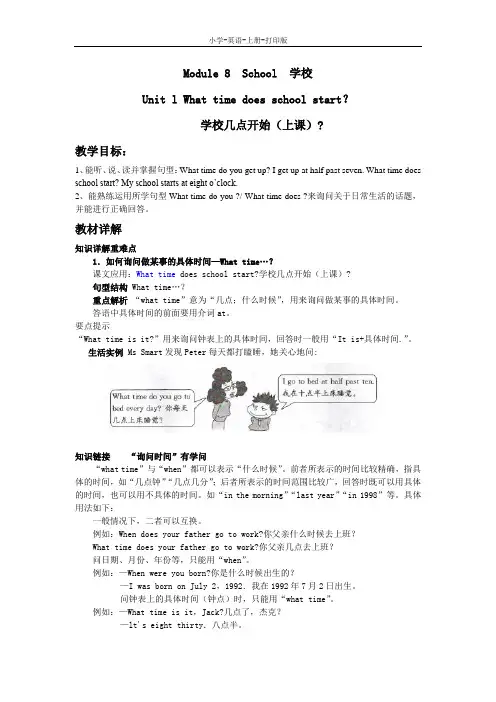
生活实例 Ms Smart发现Peter每天都打瞌睡,她关心地问:知识链接“询问时间”有学问“what time”与“when”都可以表示“什么时候”。
前者所表示的时间比较精确,指具体的时间,如“几点钟”“几点几分”;后者所表示的时间范围比较广,回答时既可以用具体的时间,也可以用不具体的时间。
如“in the morning”“last year”“in 1998”等。
具体用法如下:一般情况下,二者可以互换。
例如:When does your father go to work?你父亲什么时候去上班?What time does your father go to work?你父亲几点去上班?问日期、月份、年份等,只能用“when”。
例如:—When were you born?你是什么时候出生的?—I was born on July 2,1992.我在1992年7月2日出生。
外研版(三起)四年级英语上册Module 8 Unit 1 课件

Language points
visit /'vɪzɪt/
书写
vi+sit(坐下)= visitt
中文意思 参观,拜访
短语搭配 visit sb.拜访某人;visit someplace参 观某地
I want to visit my uncle. 我想去拜访我的叔叔。
例句
Do you want to visit my school? 你想参观我的
t
短语 a pair of socks 一双短袜 例句 I want a pair of socks. 我想要一双袜子。
Read again and find “going to”.
★We're going to visit Hainan tomorrow. ★We're going to get up at 5 o'clock. ★We're going to visit Hainan. ★I'm going to swim in the sea. ★I'm going to visit my grandpa. ★I'm going to swim too.
到……的时候了
★句型结构: Time for+名词. ★这是一个省略句,完整句是“It's time for+名词.”。 例:Time for class. 上课了。
Time to do sth.到做某事的时间了。这个 表达可以和”Time for+名词.”进行同义句转 换。 例:Time to go to school.
What are they going to do?
OK! Let's have a look together.
外研版(三起)-英语-四年级上册-Module 8 Unit 1 We are going to go to Hainan.教学反思

Module 8 Unit 1 We are going to go to Hainan.教学反思本课的教学内容围绕“制定旅行计划”展开,通过课堂教学,学生能了解一般将来时的表达形式之一“be going to”句型,能正确应用该句型表达自己的计划安排。
教学内容的安排上十分明显地体现了任务型教学的思想,任务从chant中两个小男孩的计划、课文中人物的计划、教师的家庭计划,到学生们谈论小组计划,整堂课围绕课标进行,环环紧扣,以导到学,以培养学生语言应用能力为宗旨,以学生为主体,以活动为主线,以任务为中心,同时充分利用多媒体资源,给学生以形象、直观的信息,使知识的呈现生动有趣,还利用多媒体进行多样化的操练,从而提高教学质量和学习效率,不断激发学生的创造性思维。
我考虑到学生心理与认知规律,用与本课语法相近,同样后面接动词原形的情态动词can的句型来热身,让学生动起来更好的融入课堂,又能够自然进入新课的学习,整合新旧知识,再由chant导入,紧扣题目,由浅入深,层层递进。
并且在教学过程中充分利用G roup work这一教学活动形式,运用飞机前进的方式对学生进行有效的分组教学评价,既是对本课新词plane的运用与强化,又使学生的学习积极性得到了很大的提升。
对本课的重点词汇的教学采用自然拼读法、猜词法、句意推断法、图片呈现法等多种方式,并利用点读笔、单词点读卡和白板录音对本课的目标语句进行教读,让学生感受和跟读原汁原味的英语发音,配以英语四线格手写方式呈现,顺应四年级学生需注重规范书写的要求。
课文学习结合多媒体手段创设性的进行情景分段教学,让学生更加身临其境,根据学生知识掌握层次设制阶梯型形式多样的问题,让学生边思考边学习。
到并用给动画配音的方式让学生分角色朗读,寓学于乐。
训练巩固阶段让学生以组为单位进行讨论,并按照完成的先后顺序逐组进行展示,照顾到全体学生,都参与到了课堂的活动中来。
最后任务完成阶段的转盘游戏,既是对获胜小组的奖励,又在游戏中再次巩固和运用了本课用于制定计划的重点语句,把课堂气氛推向高潮,取得了教学效果的最大化,师生双方运用了电教设备,充分体现其在教学中的优势。
外研版(一起)四年级英语上册教案Module8Unit1(4)

Let the Ss have more practice.
教学活动设计
设计意图
2.Listen to the tape.
And read after the tape.
en did they come? They came last Wednesday. What did she play? She played the flute.
Point to each sentences in turn.
Explain that Chinese meaning of the sentences.
教学目标
1.To master the part one of the dialog and understand the meaning of it.
2.listening and reading the text
3.Make the students grasp new words of this module
Read them one by one
2.Call children to the front of the class to trace the sentences.
Encourage them to do actions.
三、Practice
Activity 3Practice
1.Look at the picture.
外研版(一起)四年级英语上册
Module8Unit1 What did sheplay?
课题
Module8 Unit1 What did she play?
课时
三年级上册英语-Module8Unit1Isitamonster外研版(三起)
三年级上册英语Module 8 Unit 1 Is it a monster 外研版(三起)教学内容本课为三年级上册英语Module 8 Unit 1的内容,主要围绕“Is it a monster?”这一主题展开。
学生将学习如何询问和描述物体的特征,包括形状、颜色等。
通过本课的学习,学生能够理解并运用相关的词汇和句型,如“Is it?”和“Yes, it is./No, it isn't.”,并能进行简单的问答练习。
教学目标1. 学生能够听懂、会说、会读本课的生词和句子。
2. 学生能够运用所学句型询问和描述物体的特征。
3. 学生能够理解并运用本课所学的词汇和句型进行简单的问答练习。
4. 学生能够通过本课的学习,培养英语学习的兴趣和自信心。
教学难点1. 学生对“Is it?”和“Yes, it is./No, it isn't.”句型的理解和运用。
2. 学生对生词的掌握和运用。
3. 学生对物体特征的描述和表达。
教具学具准备1. 多媒体设备,用于播放课件和视频。
2. 教学卡片,用于展示和复习生词。
3. 彩色笔,用于标记和突出重点内容。
4. 学生用书和练习册。
教学过程1. 导入:通过图片或视频引入本课的主题“Is it a monster?”,激发学生的兴趣和好奇心。
2. 新课内容展示:利用多媒体设备展示本课的生词和句子,引导学生跟读和模仿。
3. 句型练习:通过师生互动、小组合作等形式,让学生练习“Is it?”和“Yes, it is./No, it isn't.”句型。
4. 角色扮演:学生分组进行角色扮演,模拟情景对话,巩固所学内容。
板书设计1. Module 8 Unit 1 Is it a monster?2. 重点词汇和句子:以表格或列表形式展示,突出重点。
作业设计1. 听力练习:听课文录音,完成相应的练习题。
2. 口语练习:模仿课文对话,进行角色扮演。
3. 写作练习:根据所给情景,运用所学句型进行写作练习。
【外研版】四年级英语上册(三年级起点)各单元故事翻译
【外研版】四年级英语上册(三年级起点)各单元故事翻译Unit 1: My Family 我的家人My Family- Hi, I'm Amy. This is my family.- This is my dad. He can cook and play soccer.- This is my mom. She can sing and dance.- This is my brother. He can draw and swim.- This is my sister. She can play the piano and ride a bike.- We love our family!Unit 2: My School 我的学校My School- Hi, I'm Tony. This is my school.- This is the library. We can read books here.- This is the playground. We can play basketball here.- This is the art room. We can draw pictures here.- I love my school!Unit 3: My Friends 我的朋友My Friends- Hi, I'm Mike. These are my friends.- This is Tim. He is funny and kind.- This is Lily. She is smart and helpful. - This is Sam. He is tall and friendly.- This is Emma. She is cute and talented. - We have fun together!Unit 4: My Hobbies 我的爱好My Hobbies- Hi, I'm Sarah. These are my hobbies. - I like reading. It's interesting.- I like drawing. It's relaxing.- I like dancing. It's fun.- I like playing soccer. It's exciting.- I enjoy my hobbies!Unit 5: My Toys 我的玩具My Toys- Hi, I'm Jack. These are my toys.- This is my teddy bear. It's soft and cuddly.- This is my toy car. It's fast and colorful.- This is my doll. It's pretty and cute.- This is my robot. It's cool and futuristic.- I love playing with my toys!Unit 6: My City 我的城市My City- Hi, I'm Lisa. This is my city.- This is the park. It's green and beautiful.- This is the zoo. It's full of animals.- This is the museum. It's interesting and educational. - This is the shopping mall. It's big and busy.- I'm proud of my city!Unit 7: My Home 我的家My Home- Hi, I'm Tom. This is my home.- This is the bedroom. I sleep here.- This is the living room. I watch TV here.- This is the kitchen. I eat here.- This is the bathroom. I take a shower here.Unit 8: My Daily Routine 我的日常生活My Daily Routine- Hi, I'm Emily. This is my daily routine.- In the morning, I brush my teeth and wash my face. - Then I have breakfast and get dressed.- I go to school and have classes in the daytime.- In the evening, I do my homework and have dinner. - I enjoy my daily routine!Unit 9: My Body 我的身体My Body- Hi, I'm Ben. This is my body.- This is my head. I have two eyes and a nose. - This is my mouth. I have teeth and a tongue. - This is my arm. I can wave it.- This is my leg. I can jump with it.- I take care of my body!Unit 10: My Feelings 我的感受My Feelings- Hi, I'm Alice. These are my feelings.- I feel happy when I play with my friends.- I feel sad when I lose a game.- I feel scared when I watch a scary movie.- I feel excited when it's my birthday.- I express my feelings!总结:以上是【外研版】四年级英语上册(三年级起点)各单元故事的翻译。
四年级上册英语教案-Module8 Unit1 We’re going to visit Hainan. 外研社(三起)
2.点读课文。Listen, point to find “going to”.
在此过程中,学习新词:plane, get up, o’clock, sea
【设计意图】通过同学们听找过程导入新知词汇学习,自然顺畅,且降低了学习难度。
3.点读课文。Listen and answer
Show your finger, please. Ready?
点读并让学习模仿跟读活动1课文。
【设计意图】由节奏感强的chant热身,同学们初步感知新知的同时,调动学习兴趣。
3)T: That’s his plan. He’s going to visit the zoo. How about yours? Look! This is a map of our China! There are many beautiful places. Let’ see.播放视频风景。I’m going to visit Beijing. Where’re you going to visit? We can use “ I’m going to visit______”板书重点句型。
Yes! You listened so carefully! He says:出示课件
“Hello. What’s your name?”
Sam answer: I’m Sam. I’mfromthe ___点读学习from。
引导同学们学会向他人介绍自己。
【设计意图】同学们带着问题再次听课文,有效突破重难点知识的学习与理解。
2.学生能够使用“be going to”句型描述即将做的事情。
能力目标:学生能听懂并能口头运用We’re going to visit Hainan tomorrow. I’m going to swim in the sea.这类语句描述即将做的事情。
外研社英语四年级上册-mod8-1【声音字幕同步PPT】
Some English children came to China last week.一些英国的孩子上周来中国了。
Did they come for the music competition? 他们来参加音乐比赛吗?
Yes, they did.是的,他们是。 When did they come?他们什么时候来的? They came last Wednesday. 他们上周三来的。 Look, this girl won the gold cup.看,这个女
At the zoo, what did you see? 在动物园,你 看了什么?
I saw a pig under the tree. 我看到树下有一头 猪。
2 Listen, point and find "when, what".2 听录
Look, Amy. 看,埃米。
Some English children came to China last week.一些英国的孩子上周来中国了。
也会赢得比赛的。
Look, Amy. 看,埃米。
Some English children came to China last week.一些英国的孩子上周来中国了。
Did they come for the music competition? 他们来参加音乐比赛吗?
Yes, they did.是的,他们是。 When did they come?他们什么时候来的? They came last Wednesday. 他们上周三来的。
外研社英语四年级上册-mod8-1
Module 8第八模块 Unit 1 When did they come?第一单元 他们什
外研版(三起)英语四年级上册全册同步练习(20套)附答案
Module 1 Unit 1 Go straight on.一、选出与所给单词是同类的一项。
() 1. right A. B. C. () 2. you A. B. C. () 3. up A. B. C. () 4. dog A. B. C.() 5. cinema A. B. C.二、红花配绿叶。
A. B. C. D. E.1. 2. 3.()()()4. 5.()()三、根据图片选择对应的短语。
() 1. A. turn left B. turn right() 2. A. go straight on B. behind the door() 3. A. next to a supermarket B. on your right() 4. A. in the tree B. behind the tree() 5. A. on your left B. beside the cinema 四、给下列句子或对话选择合适的图片。
() 1. Turn left. You can see the zoo. A.() 2. Where is the cinema? B.() 3. The cat is lost. C.() 4. It's next to a park. D.()5.—Where are you?—We're behind the door. E.五、情景交际。
()1.当你想要问路时,你应该先说:________A. Excuse me.B. Sorry.()2.当体育老师发出指令“Turn left. ”时,你应该:________A.向右转。
B.向左转。
()3.你想要去超市,但是不知道路,你应该问:________A. Where's the supermarket?B. Is it a supermarket?()4.当你想要表达感谢时,你应该说:________A. Thank you so much.B. You're welcome.()5.当别人问你的家庭住址时,你应该说:________A. I'm on your left.B. I live at No. 2 Park Street.答案:一、1. B 2. B 3. C 4. C 5. A二、1. C 2. A 3. B 4. E 5. D三、1. B 2. A 3. A4. B点拨:behind the tree 意为“在树后”。
外研四上 Module 8 Unit 1
Module 8 Unit 1 We’re going to visit Hainan.一、英汉互译。
1. 起床__________2. 在大海里___________3. 在五点钟___________4. 乘飞机___________二、单项选择。
()1. I’m _____ to visit Beijing tomorrow.A. goB. goingC. goes()2. This is ______ swimsuit.A. LilyB. Lily’sC. Lilys()3. We ____ going to swim in the sea.A. isB. areC. am三、用am,is,are填空。
1. I _____ going to visit Hainan.2. Amy ____ going to do her homework.3. He ___ playing in the park.4. We ____ going to visit the pandas.四、连词成句。
1. am, going, swim, I, to, tomorrow (.)__________________________2. is, from, Xiaoyong, China (.)_____________________3. are, going, We, visit, to, tigers, the (.)_________________五、阅读短文,判断正(T)误(F)。
It’s Sunday today. I’m going to watch a football match tomorrow. The football match is going to start at four o’clock in the afternoon. Lucy and Peter are going with me.We’re going there by bus. We are going to go home at half past six in the evening. ()1. It’s Saturday today.()2. I’m going to watch a football match tomorrow.()3. The match is going to start at three o’clock in the afternoon.()4. I’m going there with Lucy and Peter.()5. We’re going there on foo t.。