
湘少版六年级上册英语复习资料1-12(自己整理)
湘少版六年级上册英语复习资料Unit1 Whatdidyoudoduringtheholidays?一、读单词,并写出它们的汉语意思。
learnwordsandsentencesplaygames practiselisteninglearnwriting speakduring holiday二、写出下列动词的汉语意思和过去式。
汉语意思过去式汉语意思过去式do havego learntake readspeak teachtalk practiselisten visitwrite三、读出下列句子,并写出它们的汉语意思。
1.描述过去发生的动作,动词要用过去式态。
(yesterday,duringtheholidays,lastyear,lastweek⋯)例如:A:Whatdidyoudoduringtheholidays?I practiced listening.I played games.2.现在进行时:be动词(am,is,are)+动词-ing例如:A:What are you reading?B:I’mreading anEnglishstorybook.3.a+辅音音素an+元音音素(Aa,Ee,Ii,Oo,Uu)inEnglish用英语例如:Annewrote astorybookinEnglish duringtheholidays.4.to+代词宾格(me,you,him,her,us,them)例如:Readit tous.Unit2Katiealwaysgetsupearly.一、写出下列单词或词语的汉语意思。
getup havebreakfastwavegoodbye returnhomedoherhomework belateforschool readanewspaper gotobedalways sometimes before playchess takeawalk gotoschool weekday often neverafter二、写出下列动词的第三人称单数形式。
get wave return have go doplay三、读出下列句子,并写出它们的汉语意思。
在一般现在时中,当主语为第三人称单数时,动词要用第三人称单数形式。
1.Katiealways gets upearly.2.Katieoften does herhomeworkbeforedinner.3.Katiesometimes plays chess withherfather afterdinner.4.Katienever takes awalk.5.on+天,at+时,in+月,季,年weekdays,shealwaysgetsup 6:30a.m.6.Shewavesgoodbye tohermother.7.She isnever lateforschool.Unit3Ilikemycomputer.一、写出下列单词或短语的汉语意思。
emailmyfriends sendgreetingssearchforalotofthingsfindoutaboutcounties二、读出下列句子并写出它们的汉语意思。
1.can+动词原形A:Whatcanwedoonthecomputer?B:Wecan email ourfriendsonthecomputer.Wecan play gamesonthecomputer.Wecan search foralotofthings.Wecan send greetings to ourfriends.2.Youcanalsofindoutaboutcountries intheworld.3.Isaw aninterestingbird inabookyesterday.4.NowIcansearchforalotofthings aboutit.5.It’sveryfast.Itwillhelpyou alot.6.Peter’sfather bought himacomputer for hisbirthday.7.Hecoulddo alotof things with thiscomputer.8.Let’s+动词原形Let’stry itnow.Unit1-3复习试题一、单项选择()1.Iam astorybook.A.readB.readingC.reads()2.I astorybookduringtheholidays.A.writeB.wroteC.writing()3.Ihave Englishbook. A.a B.an C.the()4.Pleasereaditto . A.I B.we C.me()5.Katiealways breakfastat7:00. A.have B.has C.had ()6. Lilyreturnshome 5:00p.m. A.at B.on C.in ()7. Ioftenplaybasketball Sunday. A.at B.on C.in ()8. Thestudentswavegoodbye theirteachersafterschool.A.toB.withC.on()9. Anneplayschess herfatherafterdinner.A.toB.withC.on()10.Wecan eachotheronthecomputer.A.emailB.emailsC.emailed()11.I’mhungry.Let’s breakfast. A.have二.连词成句。
B.hasC.had1.like my I computer(.)2.gets Katie early up always(.)3.do during the what did you holidays (?)4.search alotof things we for can computer on the(.)5.read many I during books holidays the (.)6.sometimes Peter TV at watches 7:00p.m.Unit4theMid-AutumnFestivaliscoming.一.写出下列单词或短语的汉语意思。
theMid-AutumnFestivalredbean nuts centre tastelotusseednearbytypemooncake 二.写出下列句子的汉语意思。
1.TheMid-AutumnFestivaliscoming.2.therebe(is/are)有,表存在3.Let’sgoandhavealook.4.A:Whichtypedoyoulike?B:Iliketheoneswithlotusseeds.5.A:Howmuchisaboxofmooncakes?B:It’s50yuan.6.Thismooncaketastesgood.7.enjoy+动词-ingIenjoyeatingmooncakes.Ienjoylookingatthemoon.8.I’dlikeaboxoflotusseedmooncakesandaboxofredbeanmooncakes.Unit5Itwillbesunnyandcooltomorrow.一.写出下列单词或短语的汉语意思。
Weatherforecast sunnycool warmclear windrain snowAlightsnow astrongwind aheavyrain alightrain三、写出下列句子的汉语意思。
描述未来的天气:1.Itwillbe+形容词+时间,地点Itwillbesunnyandwarmtomorrow.ItwillbeclearinShanghai.2. therewillbe+名词+时间,地点TherewillbealightsnownextMonday.TherewillbeastrongwindinXi’an.3. Itwill+动词原形+时间地点ItwillraintomorrowinChangsha.4. It’stimefor theweatherforecast.Unit6Iwillbringabigbottleoforangejuice.一.写出下列单词或短语的汉语意思。
bottle boxcan barorangejuice Cokefruit peanutcandy cakechocolate picnicbring meetwaitfor afewsome milk二.汉译英。
一瓶橘子汁几罐可乐几条巧克力三瓶牛奶一盒蛋糕一些糖果一些花生一些水果三.写出下列句子的汉语意思。
1.Theweatherisgettingcoolandnice.2.Wecan haveapicnic inthepark.3.A:Whatarewegoingtobring forthepicnic?B:Iwillbringafewbarsofchocolate.4.A:Whenshallwemeet?B:Let’smeetattheparkat9:00a.m.5.Ican’twaitfortomorrowtocome.Unit4-6复习试题一.单项选择。
()1.Let’sgoandhavea .A.see B.watch C.look()2.Ienjoy tea. A.drink B.drinking C.drinks()3.---- isaboxofmooncake?----It’s24yuan.A.HowoldB.HowmanyC.Howmuch()4.----Which doyoulike?----Iliketheoneswithlotusseeds.A.typeB.colourC.shop()5.Thismooncake good. A.taste B.tastes C.tasted ()6. Itwillbe andwarminSanya.A.sun B.sunny C.thesun ()7. It’stime theweatherforecast. A.to B.in C.for ()8. Thewindinwinterisso thatjustfewstudentsgotoschool.A.strongB.lightC.heavy()9. willbeaheavyraintomorrow. A.There B.It C.This ()10.I bringsomebarsofchocolate.A.am B.don’t C.will ()11.Don’t forme.Iwillgetthereverylate.A.look B.getC.wait ()12.TheMid-AutumnFestivalis es ing e()13. Itwillbeclear Shanghai.A.onB.in C.out()14. Therewill alightsnownextThursday. A.isB.areC.be ()15. Iwillbringthree ofapplejuicehere.A.barsB.bottlesC.pieces 二.连词成句。
湘少版六年级上册英语复习资料

湘少版六年级上册英语复习资料Unit 1 What did you do during the holidays?During the holidays。
we had a lot of activities。
We learned words and sentences。
played games。
and practiced listening。
Some of us even learned writing and read many books。
We also took the time to speak and talk with our friends and family。
It was a fun and productive time.Unit 2 Katie always gets up early.Katie is a very punctual person。
She always gets up early and has breakfast before going to school。
She never wants to be late for school。
so she makes sure to do her homework and read a XXX。
XXX weekdays。
she often goes to bed early to prepare for the next day。
When she leaves for school。
she always waves goodbye to her family.Unit 2 My day一、写出下列单词或短语的汉语意思。
起床,做作业,下棋,散步,泡茶1.get up2.do homework3.play chess4.take a walk5.make XXX1.I always wake up early in the morning.2.Before dinner。
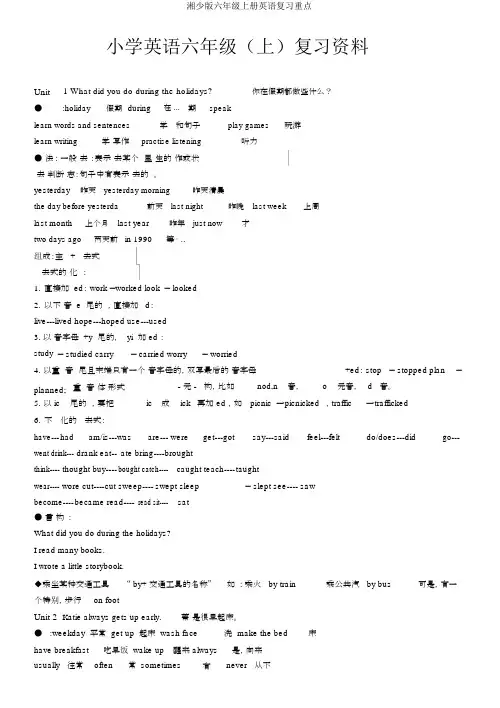
湘少版本小学六年级的上册的英语总结复习重点.doc

WORD格式小学英语六年级(上)复习资料Unit 1 What did you do during the holidays?●词汇 :holiday 假期 during 在 ... 期间learn words and 学习单词和句playsentences 子gameslearn 学习写practise 练习听力writing 作listening你在假期都做些什么?speak 说玩游戏●语法 : 一般过去时:表示过去某个时间里发生的动作或状态过去时判断标志:句子中有表示过去的时间。
yesterday 昨天 yesterday morning昨天早上the day before yesterda last night前天昨晚last week 上周last month 上个last justyear 去年now刚才月two days ago 两天前 in 等, .1990+ 动词过去.构成:主语式动词过去式的变化规则:1. 直接加ed : work—worked look—looked2.以不发音 e 结尾的单词,直接加d:live lived hope---hoped---use--- used3. 以辅音字母+y结尾y 为 i加的,变ed:study—studied carry—carriedworry—worried+ed: stop — stopped 4. 以重读闭音节结尾且末尾只有一个辅音字母的,双写最后的辅音字母 plan — planned; 重读闭音节体现形式为辅- 元 - 辅结构,例如nod,n为辅音,o为元音,d为辅音。
5. 以 ic结尾的动词,要ic变成再加ed,如→ picnicked,把ick picnic traffic→ trafficked6.不规则变化的动词过去式:have- am/is- was are- ge--- g ot fe ---felt go---went drink----- had -- -- were t say--- said el do/does---did drank eat--ate broughbring---- tthink- thought bought caught taugh--- buy---- catch---- teach---- twear-- wore cut---- cut swept sleep —----slept see-- sweep sawsitbecome-- read-- ----- became -- read - sat●语言结构:What did you do during the holidays?专业资料整理WORD格式I read many books.I wrote a little storybook.◆乘坐某种交通工具“ by+交通工具的名称” 如:乘火车by train乘公共汽车by bus但是,有一个特殊,步行on footUnit 2 Katie always gets up early.凯蒂总是很早起床。
湘少版六年级上册英语复习重点
小学英语六年级(上)复习资料Unit 1 What did you do during the holidays?你在假期都做些什么?● :holiday假期during在 ...期speaklearn words and sentences学和句子play games玩游learn writing学写作practise listening听力● 法 : 一般去:表示去某个里生的作或状去判断志:句子中有表示去的。
yesterday昨天yesterday morning昨天清晨the day before yesterda前天last night昨晚last week上周last month上个月last year昨年just now才two days ago两天前in 1990等⋯ ..组成:主 +去式去式的化:1.直接加 ed: work —worked look — looked2.以不音 e 尾的,直接加 d:live---lived hope---hoped use---used3.以音字母 +y 尾的, yi 加 ed :study— studied carry— carried worry— worried4. 以重音尾且末端只有一个音字母的,双写最后的音字母+ed: stop— stopped plan—planned;5. 以 ic重音体形式尾的,要把ic成- 元 - 构,比如ick再加ed,如nod,n 音,picnic →picnickedo元音,,trafficd 音。
→trafficked6.不化的去式:have---had am/is---w as are---were get---got say---said feel---felt do/does---did go---went drink---drank eat--ate bring----broughtthink----thought buy----bought catch----caught teach----taughtwear----wore cut----cut sweep----swept sleep— slept see----sawbecome----became read----read sit----sat● 言构 :What did you do during the holidays?I read many books.I wrote a little storybook.◆乘坐某种交通工具“ by+ 交通工具的名称”如 : 乘火 by train乘公共汽 by bus可是,有一个特别,步行on footUnit 2 Katie always gets up early.蒂是很早起床。
湘少版六年级英语上册全册知识点汇总
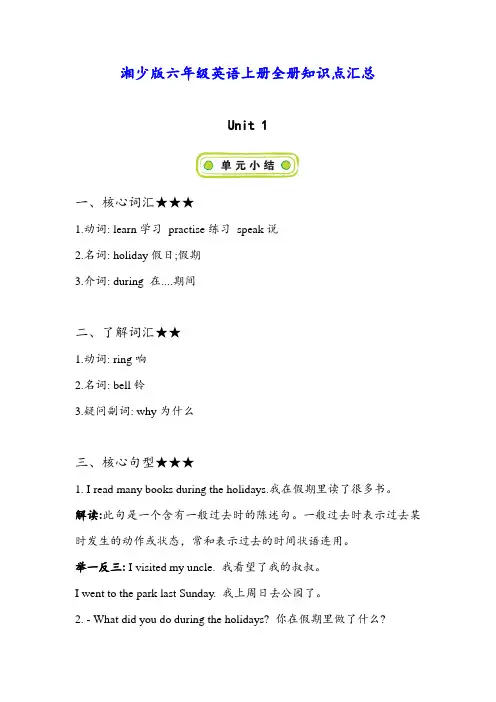
湘少版六年级英语上册全册知识点汇总Unit 1一、核心词汇★★★1.动词: learn学习practise练习speak说2.名词: holiday假日;假期3.介词: during 在....期间二、了解词汇★★1.动词: ring响2.名词: bell铃3.疑问副词: why为什么三、核心句型★★★1. I read many books during the holidays.我在假期里读了很多书。
解读:此句是一个含有一般过去时的陈述句。
一般过去时表示过去某时发生的动作或状态,常和表示过去的时间状语连用。
举一反三: I visited my uncle. 我看望了我的叔叔。
I went to the park last Sunday. 我上周日去公园了。
2. - What did you do during the holidays? 你在假期里做了什么?- I learnt writing. 我学习写作了。
解读:问句是一般过去时的特殊疑问句。
答语为一般过去时的陈述句。
举一反三: - What did you do yesterday? 你昨天做什么了?- I played with my friends. 我和我的朋友们玩了。
3. Why didn't you run around the tree? 你为什么不绕着树跑?解读:此句是一个一般过去时的特殊疑问句,why为特殊疑问词,意为“为什么”,用于向对方询问原因,一般要用“Because ..”来回答。
举一反三: Why didn't you go out to play? 你为什么没有出去玩?四、了解句型★★1,The students are talking about their holidays.学生们正在讨论他们的假期。
解读:此句是一个现在进行时的陈述句。
现在进行时表示正在进行或发生的动作。
举一反三: He is watching TV.他正在看电视。
自用新湘少版六年级英语上下册复习资料

六年级上册英语复习资料一、单词:after 在…之后bar条,棒bean 豆子bottle 瓶子bring 带来call 打电话candy糖果clay 黏(泥)土clear 晴朗的cough 咳嗽drop 滴;掉下email 电子邮件feel 感觉fever 发烧film 电影fresh 新鲜的fruit 水果greet 问候hall 大厅heavy 大量的light 轻柔的;灯idea 主意just只是;仅仅learn 学习lotus莲花merry欢乐的never 从不often 经常picnic 野餐plan 计划play 戏剧;玩rain 雨;下雨rest 休息return 返回save 节约seed种子send 发送slow 慢的speak 说taste 尝than比type 类型wait 等待waste 浪费wave 挥手weak 弱的well 好的world 世界二、短语play games玩游戏learn writing学习写作practice listening练习听力wave goodbye挥手再见be late for school上学迟到read a newspaper读报纸play chess下棋take a walk散步get up起床have breakfast吃早餐email my friends给朋友发邮件send greetings发送问候go shopping去购物have a look看看light rain小雨heavy rain大雨light snow小雪a bottle of一瓶 a box of一盒three boxes of peanuts三盒花生make cakes做蛋糕help old people on the road帮助老人过马路make them happy让他们快乐get on or off the bus上下车plant more trees多植树have a cough咳嗽have a fever发烧take medicine吃药have a good rest休息see a doctor看医生drink more water多喝水see/watch a film看电影三、句子:Unit 1. What did you do during the holidays?假期中你做了什么?---What did you do during the holidays?假期中你做了什么?---I learnt writing. 我学习写作。
新湘少版六年级上册英语复习资料

新湘少版六年级上册英语复习资料Unit1 What did you do during the holidays?假期你做什么了?单词:learn words and sentences 学习单词和句子playgames 玩游戏learn writing 学习写作practise listening 练习听力句型:what did you do during the holidays?假期你做了什么?I read many books.我看了许多书。
语法:动词过去式的变化规则一、规则动词的过去式变化规则①一般情况动词词尾直接加-ed。
如:work—worked play—played②以不发音的-e结尾的动词,动词词尾加-d。
如:live—lived taste—tasted③以辅音字母+y结尾的动词,把y变为i,再加-ed。
如:study—studied cry—cried④以一个辅音字母结尾的,重读闭音节动词(即Vivi常说的辅元辅结构)双写词尾辅音字母,再加-ed.如:stop—stopped clap—clapped二、不规则变化动词没有变化规律,需要童鞋们好好识记。
如:go—went make—madeget—got buy—boughtlearn—learnt do—didtake—took have—hadread—read speak—spoketeach—taught say—saidUnit2 Katie always gets up early凯蒂总是很早起床词汇:(频度副词:always总是、often常常、sometimes有时、never从不)get up 起床return home 回家take a walk 去散步do her homework 做她的家庭作业have breakfast/lunch/dinner吃早/ 中/ 晚餐play chess 下象棋wave goodbye 挥手再见read a newspaper 读报纸be late for school 上学迟到句型:Peter always gets up at 7:00 a.m。
湘少版六年级上册英语复习重点
湘少版六年级(Ji)上册英语复习重点Unit 1 What did you do during the holidays? 你在假(Jia)期都做些什么?●词(Ci)汇:holiday 假期 during 在(Zai)...期间 speak 说learn words and sentences 学习单词和句(Ju)子 play games 玩游戏learn writing 学习(Xi)写作 practise listening 练习听力●语(Yu)法:一(Yi)般过去时:表示过去某个时间里发生的动作或状态过去时判断标志:句子中有表示过去的时间。
yesterday昨天yesterday morning昨天早上the day before yesterda前天last night 昨晚last week上周last month上个月last year去年just now刚才two days ago两天前in 1990 等…..构成:主语+动词过去式动词过去式的变化规则:1.直接加ed:work—worked look—looked2.以不发音e结尾的单词,直接加d:live---lived hope---hoped use---used3.以辅音字母+y结尾的,变y为i加ed:study—studied carry—carried worry—worried4.以重读闭音节结尾且末尾只有一个辅音字母的,双写最后的辅音字母+ed:stop—stopped plan—planned;重读闭音节体现形式为辅-元-辅结构,例如nod,n为辅音,o为元音,d为辅音。
5.以ic结尾的动词,要把ic变成ick再加ed,如picnic→picnicked,traffic→trafficked6.不规则变化的动词过去式:have---had am/is---was are---were get---got say---said feel---felt do/does---did go---went drink---drank eat--ate bring----broughtthink----thought buy----bought catch----caught teach----taughtwear----wore cut----cut sweep----swept sleep—slept see----sawread----read sit----sat●语言结构:What did you do during the holidays?I read many books.I wrote a little storybook.◆乘坐某种交通工具“by+交通工具的名称” 如:乘火车by train 乘公共汽车by bus 但是,有一个特殊,步行on footUnit 2 Katie always gets up early.凯蒂总是很早起床。
湘少版英语六年级上册重点知识表 精选全文完整版
可编辑修改精选全文完整版湘少版英语六年级上册重点知识表Unit 1 What did you do during the holidays ?你在假期里做了什么?单词:during 在……期间 holiday 假日;假期 learn 学习practise 练习 speak 说短语:learn words and sentences 学习单词和句子play games 玩游戏 during the holidays 在假期里learn writing 学习写作 write a storybook 写一本故事书practise listening 练习听力 stand up 起立句型:——What did you do during the holidays?你在假期里做了什么? ——I read many books.我读了很多书。
I visited my grandparents.我去看望了我的爷爷奶奶。
I played games with my friends.我和朋友们一起玩了游戏。
补充:动词的过去式:talk-talked 谈论 practise-practised 练习 listen-listened 听 climb-climbed 爬 do-did 做 have-had 有 go-went 去learn-learnt 学习 take-took 拿 read-read 读 speak-spoke 说teach-taught 教 write-wrote 写 run-ran 跑Unit2 Katie always gets up early.凯蒂总是很早起床。
单词:always 总是 weekday 平日 often 常常;时常 after 在……之后 wave 挥手 return 返回 sometimes 有时 never 从不 短语:wave goodbye 挥手再见 take photos 拍照be late for school 上学迟到 draw pictures 画画do my/her/his homework 做作业 have breakfast 吃早餐read a newspaper 读报纸 after/before dinner 吃晚餐后/前 play chess 下棋 return home 回家take a walk 散步 help my parents 帮助父母 句型:Peter always get s up at 7:00 a.m.皮特总是早上七点起床。
新湘少版六年级上册英语复习资料
新湘少版六年级上册英语复习资料Unit 1 ★动词过去式变化规律:1. 一般情况下,直接在动词词尾加ed. 如:talk—talked说listen—listened听play —played玩climb—climbed爬2. 以不发音的e结尾,在动词词尾加d. 如:practise—practised练习3. 以辅音字母加y结尾的动词,变y为i再加ed. 如:study—studied学习,研究4. 以一个辅音字母结尾的重读闭音节词,双写最后一个辅音字母,再加ed. 如:stop—stopped停止5. 不规则动词没有规律,需要特殊记。
如:do-did have—had go—went learn—learnt take—took read—read speak—spoke teach—taught stand—stood sit—sat say—said run—ran is, am—was are—were write--wrote★单词、短语during 在…期间holiday 假期learn words and sentences学习单词和句子play games玩游戏learn writing学习写作practice listening练习听力★句子时态:一般过去时,表示过去某个时间里发生的动作或存在的状态。
主要有动词的过去式来体现,其标志词是过去的时间。
如:yesterday昨天last night昨晚last week上周last year 去年等等。
1. What did you do during the holidays? 假期间你做了什么?--I read many books./ I learnt writing. / I wrote a little storybook in English./ I visited my grandparents.Unit 2 ★单词、短语weekday工作日after在…之后before在..之前always总是,经常often时常sometimes有时never从不wave goodbye挥手再见be late for school上学迟到read a newspaper读报纸play chess下棋take a walk散步get up起床have/has breakfast吃早餐return home回家Unit 3 ★单词、短语world国家email my friends给朋友发邮件send greetings发送问候search for a lot of things查找许多东西find out about countries查找国家★句子I like my computer.我喜欢我的电脑。
湘少版六年级上册英语复习重点
六年级英语复习总汇重点知识点:Unit 1 The children are playing in the park●词汇:swing 秋千slide滑梯bench长凳angry生气的bark狗叫chain链子bite咬stone石头cry哭●语法:现在进行时:表示现在正在进行的动作。
构成:am /is /are + 动词现在分词●语言结构:The children are playing in the park. 孩子正在公园玩。
Lingling is sitting on a swing.玲玲正在荡秋千。
An old man is sitting on a bench.. 一个老人正坐在长凳上。
Mingming is climbing up the slide. 明明正在爬滑梯。
Unit 2 Katie always gets up early.●词汇:get up起床 wash face 洗脸 make the bed 铺床 have breakfast 吃早餐wake up 醒来 always 总是,一直 usually 通常 often 经常,常常never 从不,从未,从来没有 late 迟的,晚的I’m late. 我迟到了.family 家庭 wave 挥手go to bed 上床睡觉●语法:一般现在时。
一般现在时:表示经常性习惯性动作.当主语是第三人称单数的时候,谓语动词也要用第三人称单数形式。
●语言结构:Katie always gets up early every day. Katie总是每天起得很早。
He usually waves them goodbye. 他总是挥手再见。
She always washed her face at 6:05 am.她总是在六点零五分洗脸。
英语中,表示在具体的某个时刻前,必须加介词“at” 如:在六点钟at six o’clockUnit 3 Let’s go to the Underwater World●词汇: picnic 野餐 library 图书馆 science story 科学故事go to the Underwater World 去海底世界 go to the library 去图书馆go to the park 去公园 talk about 讨论、谈论go to the shopping centre 去购物中心 go to the beach 去海滩●语法:由“Let’s+动词原形…”构成的祈使句。