
人教新目标八年级上册Unit7Willpeoplehaverobots_SectionB2a—2e课件
Paragraph 4__________________________________
Scanning Pay attention to the key words in the sentences. ►Complete the sentences about what robots can do now.
Skimming
match each paragraph with the question it discusses.
Will robots think like humans in the future?
What will robots be like in the future? What can robots do today?
Listen and try to retell the article.
Discuss in groups
Do you think you will have your own robot?
If so, what does it look like and what do you want it to do ?
For many Robots will even be able to talk like scientists humans in 25 to 50 years.
Para 4 complete the diagram.
Robots in the future
How long:__h_u_n_d_r_e_d_s _o_f _y_ea_r_s_ Shapes :_h_u_m__an_s___
Predicting
Do you think you will have your own robot?
What can we learn from the article? A. It’s about a movie. B. It’s about the robot scientist James White. C. It’s about the robots in the future.
Everything will be _p_o_s_s_i_b_l_e. Nothing will be__i_m__p_o_s_s_ib_le.
Knowledge is power! Let’s shape the worlde the chart
Different ideas about robots in the future.
For some scientists
It will be difficult to make them really think like a human.
They will never be able to wake up and know where they are.
do cleaning do shopping help you with your homework teach you a language drive you to school plant trees clean water
…...
We never know what will happen in the future.
人教新目标八年级 Unit7Willpeople
What do robots look like?
humans animals huge arms ……
What can robots do?
talk walk
run dance cook build cars ……
Do you think you will have your own robot?
Reading strategy: Look at the title and the picture, and predict what you will read about.
Find out the topic sentence(中心句)of each paragraph(段落).
A topic sentence is usually the first or last sentence of a paragraph.
some scientists d_i_s_a_g_r_e_. James White believes that robots will not be ableeto do the _s_a_m__e__ things as we can. For
example, he thinks that robots will __n_o_t___ be able to wake up and know where they are. Which side do you __a_g_r_e_e_ with?
What are robots like in movies?
Paragraph 1__________________________________
Paragraph 2__________________________________
Paragraph 3__________________________________
Some robots are very human-like. They can walk and _d__a_n_c_e_ like people. Some scientists think that in the future they will __m_a_k__e_ robots more like humans. This may not _h_a_p_p_e_n_ in the near future, but at some point, robots will even be able to __t_a_lk___ like people. However,
Careful reading Para 1 & 2 Answer the questions.
1. What are robots like in movies?
n.仆人
They are like human servants. 2. What can robots do today?
They can help to build cars and do simple jobs over and over again. 多次,反复地
with words from the article. 指导:
➢ 此类短文填空题,考查同学们全面掌握短文 内容,以及综合运用语言的能力。
➢ 首先,应将通读本段文字,掌握大意。可知 在短文中列举了科学家们的两种观点。
➢ 然后,根据2b中短文的内容填空。
Post-reading Fill in the blanks with the words from the articles.
_a_n_im__a_ls___-in India:_s_n_a_k_e_s_ use for:_h_e_lp__lo_o_k_f_o_r_p_e_o_p_le_u_n_d_er buildings Possible/impossible?
2d Fill in the blanks in this paragraph
1. Robots cacannbbuuilidld___c__a_r__s_____ in fafacctotorrieiess. 2. They can do __s_i_m___p__l_e___ jobs mmaannyytitmimeessaanndd
never get bored.
3. Some ccaann___w___a_l_k____ and ___d__a_n__c_e____. 4. Some ccaannhheelplp__l_o__o_k_ _f_o__r_ ppeeooppleleuunnddeerr__b__u__il_d__i_n_.gs
人教新目标八年级上册Unit 7 Will people have robots?Unit 7 Se
Ask and answer
A:_W_i_ll_ people _h_av_e_robots in their homes in 100 years? B:Yes, __th_e_y_ __wi_ll__.
Ask and answer
A:_W_i_ll_ _th_e_re_ __b_e _only one country in the future? B:No, _t_he_r_e _ _w_o_n’__t .
Exercising
根据句意及所给首字母提示,补全句中所缺单词。
Many fish in the river died because of water p_o_l_lu_t_i_o_n____.
Exercising
根据句意及所给首字母提示,补全句中所缺单词。
Who knows what will happen in the f_u_t_u_r_e_?
paper
pollution pollute
future 2117 年
How will the world be different 100 years from
1a now? Read these predictions. Check ( √ ) A ( for
agree) or D ( for disagree).
Will there be less pollution
in the future? [‘fjuː tʃə(r)]
[pə 'luː ʃ(ə)n]
n.将来;未来
----Yes, there will. ----No, there won’t.
pollute v.污染
[pə 'luː t]
八年级英语上册-Unit-7-Will-people-have-robots备课教案-(新版)人教新

一、教材分析
单元教材分析:will + 动词原形 来表达一般将来时态。 学会表达自己对未来的看法;学会谈论自己未来的打算。
二、学情分析
1.八年级处于思维活跃期,对学习本单元有好处,可以进一步开阔学生视野。
2.本单元总体知识结构比较单一,内容相对比较简单。
教学重点:
教学重点:
1)学习掌握一般将来时态的意义和结构。
2) 掌握There be句型的一般将来时态的结构。
(含教法学法、媒体应用等)
教学难点
教学难点:
掌握more/fewer;more/less的用法。
情态动词will + 动词原形来表达一般将来时态。
(同属教学重难点的,在本栏书写)
五、课时安排
三、教学目标
(结合课标)
知识技能
学会表达自己对未来的看法;学会谈论自己未来的打算。。
过程方法
首先进行集中识字,为本单元的学习作好铺垫。其次,采用情景交际法和任务型教学法并充分利用听力材料和阅读材料,训练和提高学生的听力和阅读水平。在听读的基础上创设语言情景和合作探究的方式加强读写训练。培养学生的听、说、读、写综合能力。
Period 1 Se-2d 听说课
Period 3 Section A Grammar Focus-3c语法课
Period 4 Section B1a-1e 听说课
Period 5 Section B2a-2e 阅读课
Period 6 Section B3a-3c阅读课
Period 7 self check and unit review
六、知识结构
七、其它补充
情感态度价值观
人教版英语八年级上册Unit7Willpeoplehaverobots
八年级上Unit7 Will people have robots?on computer在电脑上on paper在纸上live to do 200 years old活动200岁free time空闲时间in danger处于危险之中on the earth在地球上play a part in sth.参与某事space station太空站look for寻找computer programmer电脑编程员in the future在未来hundreds of许多;成百上千the same…as…与……一样over and over again多次;反复地get bored感到厌烦的wake up醒来fall down倒塌will+动词原形将要做……fewer/more+可数名词复数更少/更多……less/more+不可数名词更少/更多……have to do sth.不得不做某事agree with sb.同意某人的意见such+名词(词组)如此……play a part in doing sth. 参与做某事There will be + 主语+其他将会有……There is/are +sb./sth.+doing sth.有……正在做某事ake sb. do sth. help sb. with sth.帮助某人做某事try to do sth. 尽力做某事It’s+ adj.+for sb. to do sth. 对某人来说,做某事……的。
( )1.The students in our school learn English computers .A. atB. in C .on D.to( )2.I hope there will be pollution in the future .A.moreB.manyC.fewerD.less( )3. People visit Mount Tai every day .A.Two hundredsB.Hundred ofC.Hundreds D,Hundreds of( )4.People will make robots the housework in the future .A.doB.to doC.doingD.to doing( )5.Everyone in our class world peace .A.loveB.lovingC.lovesD.to love( )6. A football match next month .A.There isB.There hasC.There will beD.There will have( )7.How long will dogs live ? A.be B.to be C.on D.for( )8.There are some girls in the room .A.dancingB.danceC.dancesD.danced( )9.The child isn’t old enough to himself . A.wear B.dress C.put on D.be in( )10.It’s important the piano well .A.of him to playB. For him to playC.of him playingD.for him playing11. 预测未来可能很难。
人教新目标八年级上册英语《Unit 7 Will people have robots?》Secti

人教新目标八年级上册英语《Unit 7 Will people have robots?》Section B_教学设计2一. 教材分析《Unit 7 Will people have robots?》Section B 包含了一个阅读理解和两个活动。
本节课主要通过阅读一篇关于未来机器人的文章,让学生掌握一般将来时的用法,并能够运用本课所学知识进行简单的未来预测。
文章内容丰富,插图生动,能够激发学生的学习兴趣。
二. 学情分析八年级的学生已经掌握了英语学习的基本语法和词汇,对于一般将来时也有了一定的了解。
但部分学生在阅读理解方面仍有困难,需要教师的引导和帮助。
此外,学生们的口语表达和写作能力也需要进一步提高。
三. 教学目标1.能够理解文章的主旨大意,掌握一般将来时的用法。
2.能够运用本课所学知识进行简单的未来预测。
3.提高学生的阅读理解能力和口语表达能力。
四. 教学重难点1.一般将来时的用法。
2.提高阅读理解能力,理解文章的主旨大意。
五. 教学方法采用任务型教学法,让学生在完成任务的过程中,自然而然地学习和掌握知识。
同时,运用启发式教学法,引导学生主动思考,提高他们的阅读理解和口语表达能力。
六. 教学准备1.打印文章,准备教材。
2.准备与文章内容相关的图片或视频,以便在课堂上进行展示。
3.准备一些问题,用于引导学生进行思考和讨论。
七. 教学过程1.导入(5分钟)利用图片或视频展示未来机器人的场景,引导学生思考:Do you like robots? Why? 让学生自由发言,表达自己的观点。
2.呈现(10分钟)给学生分发文章,让他们独立阅读。
在阅读过程中,教师可适时提出一些问题,帮助学生理解文章内容。
例如:What will happen in the future?How do people feel about robots?3.操练(10分钟)学生分组,根据文章内容,进行角色扮演。
要求学生运用一般将来时进行对话,模拟未来的场景。
人教新目标八年级英语上册Unit 7 Will people have robots知识点汇总
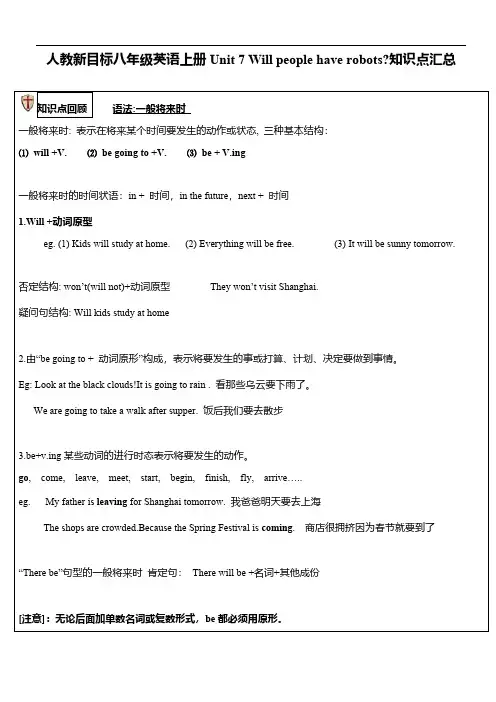
知识点回顾语法:一般将来时一般将来时: 表示在将来某个时间要发生的动作或状态, 三种基本结构:⑴will +V. ⑵be going to +V. ⑶be + V.ing一般将来时的时间状语:in + 时间,in the future,next + 时间1.Will +动词原型eg. (1) Kids will study at home. (2) Everything will be free. (3) It will be sunny tomorrow.否定结构: won’t(will not)+动词原型They won’t visit Shanghai.疑问句结构: Will kids study at home2.由“be going to + 动词原形”构成,表示将要发生的事或打算、计划、决定要做到事情。
Eg: Look at the black clouds!It is going to rain . 看那些乌云要下雨了。
We are going to take a walk after supper. 饭后我们要去散步3.be+v.ing某些动词的进行时态表示将要发生的动作。
go, come, leave, meet, start, begin, finish, fly, arrive…..eg. My father is leaving for Shanghai tomorrow. 我爸爸明天要去上海The shops are crowded.Because the Spring Festival is coming. 商店很拥挤因为春节就要到了“There be”句型的一般将来时肯定句:There will be +名词+其他成份[注意]:无论后面加单数名词或复数形式,be都必须用原形。
要点讲解Will there重点短语it will be difficult to do sth.不同意某人重点搭配重点短语Section A:1.play a part in saving the earth2.in 100 years3.on computers4.live to be….years old5.less free time6.world peace7.be free8.in great danger9.in the future10.move to other planetsSection B:1.fly rockets to the moon乘火箭到月球→fly up into the sky2.on a space station3.be able to…4.look for5.look like6.take a holiday7.the meaning of…..8.wake up….9.one day10.hundreds of11.over and over again12.do the same things as humans13.fall down14.seem impossible15. as a reporter语法聚焦----Will people use money----No, they won’t. Everything will be随堂练There ______a splendid football event(.I hope we'll study ______ home ______computers in the future.in;We should play a part in ______the party.organizingWe will have ______ free time next year than this year.Michael or Tony?______ ______ be a soccer match this weekend?.我们今天下午要为英语考试作准备。
人教版八年级上册 Unit 7 Will people have robots_Section
1.Learn how to write the article.
2.Finish 3b and correct the answers.
3.Finish writing articles and some Ss present theirs.
–I will work in…
(2)难点:用所学的知识来进行写作,尤其是一般将来时。
四、教学方法
任务型教学法以及多媒体辅助教学、教师讲解归纳法以及小结归纳等方法。
五、教学工具
多媒体、录音机、课本、教案等。
六、教学流程
Teaching Steps
Teachers’Activities
Students’Activities
2.Ask the Ss to finish 3a.
3.Check the answers.
4.Explain some key points.
1.Listen to the teacher carefully and finish 3a.
2.Correct the answers.
Step Three:
(1)重点:
①熟记和运用probably、during、holiday、though、as、keep、take a holiday
等词汇。
②掌握和运用本节课的重要目标语言:
-What will you be in 20 years?-I will be a/an… -Where will you work?
WritingPractice
1.Show the article in 3a and organize the writing frame.
八年级英语上册 Unit 7 Will people have robots教案 (新版)人教新目标版
Unit 7 Will people have robots?Section A 1 (1a-2d)一、教学目标:1. 语言知识目标:1) 能掌握以下单词: paper, pollution, prediction, future, pollute, environment, planet, earth, plant, part, play a part2) 能掌握以下句型:① What will the future be like?Cities will be more polluted. And there will be fewer trees.② Will people use money in 100 years?③ Will there be world peace?④ Kids will study at home on computers.⑤ They won’t go to school.2) 能了解以下语法:will + 动词原形来表达一般将来时态。
3)学会表达自己对未来的看法;学会谈论自己未来的打算。
2. 情感态度价值观目标:通过引导学生展望未来,及对未来生活的设计,来达到前景教育的目的,同时也通过对前景的设想,让学生在潜移默化中反省自己的现状,使之对目前的学习、生活习惯作适当的调整,并不断的改善自己的现状,使学生的理想观和价值观更为科学,更具发展价值。
二、教学重难点1. 教学重点:1) 学习掌握一般将来时态的意义和结构。
2) 掌握There be句型的一般将来时态的结构。
2. 教学难点:掌握more/fewer;more/less的用法。
情态动词will + 动词原形来表达一般将来时态。
三、教学过程Ⅰ. Lead-in1. 在大屏幕上向学生展示一些机器人的图片,让学生们说出谈论自己的未来的工作,对工作的打算等:What do you want to be when you grow up?Ss: I want to be a scientist.T: How are you going to do that?Ss: I’m going to study science hard.….2. 学生们根据图片来引导出机器人这一话题。
人教新目标八年级上册英语《Unit 7 Will people have robots?》Secti
人教新目标八年级上册英语《Unit 7 Will people have robots?》Section A_教学设计1一. 教材分析人教新目标八年级上册英语《Unit 7 Will people have robots?》Section A主要讨论了未来社会人们的生活将会随着科技的发展而发生变化,其中涉及到机器人在日常生活中的应用。
本节课主要通过阅读和听力练习来培养学生的语言技能,提高他们的阅读理解和听力理解能力。
教材内容丰富,贴近学生的生活,能够激发学生的学习兴趣。
二. 学情分析八年级的学生已经掌握了基本的英语语法和词汇,具备一定的阅读和听力理解能力。
他们在学习过程中善于发现问题、解决问题,并且具备一定的合作意识和团队精神。
但是,部分学生在英语学习中存在发音不准确、词汇量不足等问题,需要教师在教学过程中给予关注和指导。
三. 教学目标1.知识目标:学生能够掌握本节课的重点词汇和句型,理解文章大意,提高阅读和听力理解能力。
2.能力目标:学生能够在日常生活中运用所学知识进行简单的交流,提高语言运用能力。
3.情感目标:学生能够培养对科技发展的兴趣,树立正确的价值观,关注未来社会的发展。
四. 教学重难点1.重点:本节课的重点是让学生掌握关键词汇和句型,能够运用所学知识进行阅读和听力理解。
2.难点:学生需要理解文章中关于未来社会和机器人的描述,能够正确运用所学知识进行实际操作。
五. 教学方法1.任务型教学法:通过设定各种任务,让学生在完成任务的过程中运用所学知识,提高语言运用能力。
2.情境教学法:创设生活情境,让学生在真实的环境中感受和理解语言。
3.小组合作学习:鼓励学生互相合作,共同完成学习任务,提高团队协作能力。
六. 教学准备1.教师准备:备好相关教学资料,如PPT、教学视频等。
2.学生准备:预习本节课的单词和句型,提前了解相关背景知识。
七. 教学过程1.导入(5分钟)教师通过向学生展示一些机器人图片,引导学生谈论机器人,激发学生的学习兴趣。
八年级英语上册 Unit 7 Will people have robots?(第2课时)说课稿
八年级英语上册 Unit 7 Will people have robots?(第2课时)说课稿一. 教材分析《八年级英语上册》Unit 7 “Will people have robots?” 是人教版新目标英语教材的一个单元。
本单元主要围绕未来科技的发展,特别是机器人在日常生活中的应用进行讲解。
通过本单元的学习,学生可以掌握一般将来时的被动语态,提高自己的听说读写能力,并激发他们对未来科技的想象和思考。
二. 学情分析八年级的学生已经掌握了英语学习的基本语法和词汇,具备一定的听说读写能力。
他们对新科技充满好奇,善于接受新鲜事物,但同时也可能对一些抽象的概念和语言表达感到困惑。
因此,在教学过程中,我们需要关注学生的个体差异,因材施教,激发他们的学习兴趣和积极性。
三. 说教学目标根据《义务教育英语课程标准》和教材内容,本节课的教学目标如下:1.知识目标:学生能够掌握一般将来时的被动语态,理解与未来科技相关的词汇和表达。
2.能力目标:学生能够在真实情境中运用所学知识进行交流,提高听说读写能力。
3.情感目标:激发学生对未来的想象和思考,培养他们对科技发展的积极态度。
四. 说教学重难点1.教学重点:学生能够熟练运用一般将来时的被动语态进行表达。
2.教学难点:学生能够准确理解与未来科技相关的词汇和表达,以及在真实情境中运用所学知识进行交流。
五. 说教学方法与手段本节课采用任务型教学法,结合情境教学法和分组合作学习法,利用多媒体教学手段,激发学生的学习兴趣,提高他们的参与度和积极性。
六. 说教学过程1.导入:通过展示一段关于未来科技的短片,引发学生对未来的想象,激发他们的学习兴趣。
2.呈现:教师通过PPT展示本节课的主要内容,引导学生关注一般将来时的被动语态和与未来科技相关的词汇。
3.操练:学生分组进行角色扮演,运用所学知识进行对话,教师给予指导和反馈。
4.巩固:学生完成一组有关未来科技的练习题,检测他们对知识的掌握程度。
八年级英语上册 Unit 7 Will people have robots?第一课时教学案 (新版)人教新目标版
Unit 7 Will people have robots学习目标:1.掌握本课的重要词汇短语及句子:将、会——机器人——树木——纸张——每件事物——较少的——污染——活到——免费——一百年后——更少的人——空闲时间——更少污染—2.掌握以下重要句型1.People will have robots in their homes.2. People won’t use money, everythi ng will be free.3. Books will only on computers not on paper.4. Kids won’t go to school.They’ll study at home on computers.5. There w ill only one country.6. People will live to be 200 years old.学习重难点:本课出现的生词及短语:2) 能正确运用“Will +动词原形”和There will be +名词表示将来。
能力目标:初步认识will表示一般将来时的用法和there be 句型表示一般将来时的用法。
复习可数名词和不可数名词并能正确使用more, fewer和less。
教学过程:S tep1 RevisionRevise the contents learnt last period and have a dictation.Step2 展示交流教师在黑板上画一个时间轴,标记出three years ago、now、in 100 years,让学生先看前两个时间点,描述出自己的情况。
讨论:预言一百年后的世界将是什么样子??然后听录音,选出你所听到的单词,并把下面的句子读熟。
1.People will have ro bots in their homes.2. People won’t use money, everything will be free.3. Books will only on comp uters not on paper.4. Kids won’t go to school.They’ll study at home on computers.5. There will only one country.6. People will live to be 200 years old.Step3 对话练习。