
高中英语:Unit 1 Women of achievement Reading(人教版高中必修4)
高一英语同步练习:必修4 Unit1 Women of achievement第2课时Reading实战演练一、阅读课文回答下列问题。
1. What did the group do first in the morning? They __________.A. went into the forest slowlyB. left the chimp family sleeping in a treeC. observed the family of chimps wake upD. helped people understand the behaviour of the chimps2. Why did Jane go to Africa to study chimps in the wild? Because shewanted________.A. to work with them in their own environmentB. to prove the way people think about chimps was wrongC. to discover what chimps eatD. to observe a chimp family3. From the passage we know the bond between members of a chimp family____.A. is very strongB. is a little weakC. doesn’t existD. is the strongest of all the animals.4. The chimps show love in their family by _______ each other.A. touchingB. feedingC. feeding or cleaningD. feeding or touching5. Where did Jane Goodall suggest the chimps be left?__________A. In the wildB. In the zoo.C. In cagesD. In Africa6. What can we infer from the text?A. Jane Goodall's mother lives with her.B. Jane Goodall loves animals and tries to protect them.C. Jane Goodall looks down upon men.D. Jane Goodall doesn't like to work with other women of her age.二、翻译下列句子:1. However, the evening makes it all worthwhile.——————————————2. Everybody sits and waits in the shade of the trees while the family begins to wake up and move off.——————————————3. She spent years observing and recording their daily activities.——————————————4. She has argued that wild animals should be left in the wild and not used for entertainment.——————————————三、判断句子对错1. Without any university training, she has achieved what she wanted. ()2. She supposes that people should use chimps for entertainment. ()3. She has spent less than forty years helping people understand her work. ()4. She has built many homes for the wild animals to live in. ()四、翻译短语:1. 离开;启程;出发________2. 为….而战_____________3.(想法、问题)涌上心头____4. 人类_____________5. 而不是;胜于__________6. 过着…的生活__________7. 自言自语____________8. 查阅、参看___________9. 为…做准备___________10. 决定做_____________反馈检测一、完成句子1. 我打算出国学习。
I ___________ abroad.2. 他昨天在会上发表了讲话。
He ______________________ at the meeting yesterday.3. 她昨天偶然遇到了她的朋友。
She _________________________ her friend yesterday.4. 当你不认识这些词时,可以参考一下字典。
When you don’t know the words, _________________. 5. 你应该继续写你的新书。
You should ______________________.6. 他们试图说服他参加。
They tried ________________________.二、阅读理解:Alice always wanted to be a singer. Music was the most important thing in her life and, to tell you the truth, she took lessons for years, and practiced every day, but in spite of all this, her voice didn’t improve. Honestly, it didn’t get better, it just got louder.Her teacher finally gave up and stopped the lessons, but Alice refused(拒绝)to give in, and one day she decided to give a concert and invited her teacher to attend.The teacher was very worried about what to say after the concert. She knew it would be terrible and it was. She didn’t want to tell a lie, but she didn’t want to hurt Alice’s feelings, either. Finally, she got an idea and went backstage (后台) to greet her pupil.“Well,” said Alice, “what did you think of my singing?”“My dear,” said the teacher, “you’ll never be better than you were tonight.”1. Alice wanted to be a singer because she___________.A. was good at singingB. could do nothing but singC. had a good teacherD. was most interested in music2. Alice’s teacher stopped the lessons because_________.A. Alice didn’t make any improvement in singingB. Alice’s voice became louder and louderC. Alice didn’t work hard enoughD. Alice was so proud and wouldn’t listen to her3. What made Alice decide to give a concert?A. She wanted to prove that her teacher was wrong.B. She wanted to please her teacher.C. She was sure that she could sing beautifully.D. Somebody else wanted her to do so.4. What is really meant by saying “You’ll never be better than you were tonight.”?A. You gave a wonderful concert tonight.B. You won’t make any improvement in future.C. You have never sung so well before.D. You did much better before than tonight.5. If Alice’s teacher had told a lie, she might have said_______.A. “I don’t like the concert.”B. “You have made no progress.”C. “The concert tonight is terrible.”D. “Your concert tonight is excellent.三、短文改错:Nobody likes staying at the home on a public holiday, 1. ______ specially, if the weather is fine. Last August we decided 2. ______to spend on the day in the country. The only difficulty 3. _______was that million of other people had just the same idea. 4. _______We moved out of the city slowly behind a long line 5. _______of cars, as at last we came to a quiet country road 6. ________ and, after some time, stopping on a farm far from the 7. _______ town. We had been brought plenty of food with us 8. ________ and we took them out of the car. Now everything was 9. _______ ready so that we sat down near a path at the foot of a hill. 10. _______第2课时实战演练一、1-6 CAACAB二、翻译:1、然而到了傍晚这一切都是值得的。
高一英语Unit 1 Women of achievement人教实验版知识精讲

高一英语Unit 1 Women of achievement人教实验版【本讲教育信息】一. 教学内容:Unit 1 Women of achievement1. 词汇:observe argue spend only2. 语法:主谓一致二、重、难点讲解1. observe vt 观察,觉察到,遵守,庆祝She actually observed chimps as a group hunting a monkey and then eating it.e.g. He observed keenly, but says little。
他观察敏锐,但很少说话。
She observed his actions with interest. 她很感兴趣地观察他的行动。
The police observed the man entering /enter the bank.警方监视着那个男子走进银行的情况。
No matter which country you travel to, you should observe the law of the land.无论你去哪个国家,你都应遵守该国法律。
Do you observe Christmas Day in China?中国人过圣诞节吗?注意:表示“注意,观察〞时,observe 的用法。
接省去to的动词不定式作宾补,表主动,表动作经常性,或已经过去。
接doing, 表主动,表动作正在进展。
接过去分词,表被动,表动作已经过去。
e.g. His neighbour observed a stranger go/going into his house.他的邻居看到一个陌生人进入他家。
She observed a monkey eaten by the chimps.她观察到一只猴子被黑猩猩吃掉。
相关词汇:observer n. 观察者,遵守者,评论者observation n. 观察,评论辨析:notice, observe, watch, catch sight ofnotice 是与物动词,表示“注意到〞、“无意中发现〞。
英语:unit1《women-of-achievement》reading-课件(1)(新人教版必修4)

“为什么不……”
e.g Why not ask her?
carry on (with) sth.
carry on doing sth.
“进行……, 继续进行……”
Carry on with your work while I’m away.
Carry on working while I’m away.
在条件状语从句中,要用一般现在时代替一般将来 时,are to survive 刚好是一般现在时,表示假设.在 如此干燥的天气里,如果要让花存活,就必须给他 们浇水.
2. It was a small book explaining how to ... explain后接名词、代词、从句、wh+to do作宾语。
Post reading
1. For whom and for what purpose did Lin Qiaozhi write a small book about how to look after babies? She wrote a small book for mothers in the countryside who were not able to get to a hospital easily. It was to help them look after their babies properly.
高中英语 unit 1 Women of achievement_ reading课件 新人教必修1
Soong Chingling (1893-1981), China
She was an inventor and a scientist from Poland.
She is the only woman scientist who was awarded two Nobel Prizes.
fighter by the UN
video中外著名科学家 珍妮·古道尔
•1、纪律是集体的面貌,集体的声音,集体的动作,集体的表情,集体的信念。 •2、知之者不如好之者,好之者不如乐之者。 •3、反思自我时展示了勇气,自我反思是一切思想的源泉。 •4、在教师手里操着幼年人的命运,便操着民族和人类的命运。一年之计,莫如树谷;十年之计,莫如树木;终身之计,莫如树人。 •5、诚实比一切智谋更好,而且它是智谋的基本条件。 •6、做老师的只要有一次向学生撒谎撒漏了底,就可能使他的全部教育成果从此为之失败。2022年1月2022/1/162022/1/162022/1/161/16/2022 •7、凡为教者必期于达到不须教。对人以诚信,人不欺我;对事以诚信,事无不成。2022/1/162022/1/16January 16, 2022 •8、教育者,非为已往,非为现在,而专为将来。2022/1/162022/1/162022/1/162022/1/16
Listen to the tape and then match the main idea with each paragraph.
Para 1 Para 2 Para 3 Para 4
Jane’s efforts to protect the animals
高中英语 Unit1 Women of achievement Secti

感顿市安乐阳光实验学校Section IV 单元知识小结一、单元知识总结:(一) 重点短语1. 使自己关心某事 _________________________2. 离开,启程,出发 _________________________3. 过着……的生活 _________________________4. (想法、问题等)涌上心头 _________________________5. 将一生致力于…… _________________________6. 有共同之处 _________________________7. 装扮成…… ________________________8. 为……而奋斗 _________________________9. 制定出 _________________________10.取得博士学位 _________________________11. 蔑视,瞧不起 _________________________12. 查阅;参考;谈到 _________________________13. 安定下来 _________________________14. 值得付出的 _________________________15.保护……免受伤害 _________________________16. 碰巧,凑巧 _________________________17. (偶然)遇见;碰见 _________________________18. 继续,坚持 _________________________19. 做某方面的研究 _________________________20. 吸引了我的目光 _________________________21. 降低死亡率 _________________________22. 使……免受疾病(之苦)_________________________23. 为某人设计或准备的 _________________________24. 被摆到次于……的位置 _________________________25. 照看,照料 _________________________(二) 重点句型1.致力于……贡献于……__________________________________________2.突然想到__________________________________________3.为……设计的__________________________________________4.only+状语放句首,句中用部分倒装。
(完整版)人教版英语必修四课文电子版
Unit 1 Women of achievementReadingA STUDENT OF AFRICAN WILDLIFEIt is 5:45 am and the sun is just rising over Gombe National Park in East Africa.Following Jane’s way of studying chimps, our group are all going to visit them in the forest. Jane has studied these families of chimps for many years and helped people understand how much they behave like humans. Watching a family of chimps wake up is our first activity ofthe day. This means going back to the place where we left the family sleeping in a tree thenight before. Everybody sits and waits in the shade of the trees while the family beings towake up and move off. Then we follow as they wander into the forest. Most of the time, chimps either feed or clean each other as a way of showing love in their family. Jane warnsus that our group is going to be very tired and dirty by the afternoon and she is right.However, the evening makes it all worthwhile. We watch the mother chimp and her babies play in the tree. Them we see them go to sleep together in their nest for the night. Werealize that the bond between members of a chimp family is as long as in a human family.Nobody before Jane fully understood chimp behaviour. She spent years observing and recording their daily activities. Since her childhood she had wanted to work with animals in their own environment. However, this was not easy. When she first arrived in Gombe in 1960, it was unusual for a woman to live in the forest. Only after her mother came to helpher for the first few months was she allowed to begin her project. Her work changed theway people think about chimps. For example, one important thing she discovered was that chimps hunt and eat meat. Until then everyone had thought chimps ate only fruit and nuts.She actually observed chimps as a group hunting a monkey and then eating it. She also discovered how chimps communicate with each other, and her study of their body language helped her work out their social system.Four forty years Jane Goodall has been outspoken about making the rest of the world understand and respect the life of these animals. She has argued that wild animals should be left in the wild and not used for entertainment or advertisements. She has helped to set upOnce I special places where they can li v e safely. She is leading a busy life but she says: “stop, it all comes crowding in and I remember the chimps in laboratories. It’s terrible. I t affects me when I watch the wild chimps. I say to myself, ‘Aren’t they luck?’ And then Ithink about small chimps in cages though they have done nothing wrong. Once you have”seen that you can never forget…She has achieved everything she wanted to do: working with animals in their ownive in the forest as men environment, gaining a doctor’s degree and showing that women can lcan. She inspires those who want to cheer the achievement of women.Using languageWHY NOT CARRY ON HER GOOD WORD?I enjoyed English, biology, and chemistry at school, but which one should I choose tostudy at university? I did not know the answer until one evening when I sat down at thecomputer to do some research on great women of China.By chance I came across an article about a doctor called Lin Qiaozhi, a specialist inwomen’s diseases. She lived from 1901 to 1983. It seemed that she had been very busy inher chosen career, traveling abroad to study as well as writing books and articles. One ofthem caught my eye. I was a small book explaining how to cut the death rate from havingand caring for babies. She gave some simple rules to follow for keeping babies clean,healthy and free from sickness. Why did she write that? Who were the women that LinQiaozhi thought needed this advice?I looked carefully at the text and realized that it wasintended for women in the countryside. Perhaps if they had an emergency they could notreach a doctor.Suddenly it hit me how difficult it was for a woman to get medical training at that time.That was a generation when girl’s education was always placed second to boys’.Was she somuch cleverer than anyone else? Further reading made me realize that it was hard work anddetermination as well as her gentle nature that got her into medical school. What made hersucceed later on was the kindness and consideration she showed to all her patients. Therewas story after story of how Lin Qiaozhi, tired after a day’s work, went late at night to deliv a baby for a poor family who could not pay her.By now I could not wait to find out more about her. I discovered that Lin Qiaozhi haddevoted her whold life to her patients and had chosen not to have a family of her own.Instead she made sure that about 50,000 babies were safely delivered. By this time I wasvery excited. Why not study at medical college like Lin Qiaozhi and carry on her good work?It was still not too late for me to improve my studies, prepare for the university entranceexaminations, and…Unit 2 Working the landA PILNEER FOR ALL PEOPLEAlthough he is one of China’s most famous scientists, Yuan Longping considers himself afarmer, for he works the land to do his research. Indeed, his sunburnt face and arms and hisslim, strong body are just like those of millions of Chinese farmers, for whom he hasstruggled for the past five decades. Dr Yuan Longping grows what is called super hybridrice. In 1974, he became the first agricultural pioneer in the world to grow rich that has ahigh output. This special strain of rice makes it possible to produce one-third more of thecrop in the same fields. Now more than 60% of the rice produced in China each year is fromthis hybrid strain.Born in 1930, Dr Yuan graduated from Southwest Agricultural College in 1953. Sincethen, finding ways to grow more rice has been his life goal. As a young man, he saw thegreat need for increasing the rice output. At that time, hunger was a disturbing problem inmany parts of the countryside. Dr Yuan searched for a way to increase rice harvests withoutexpanding the area of the fields. In 1950, Chinese farmers could produce only fifty milliontons of rice. In a recent harvest, however, nearly two hundred million tons of rice wasproduced. These increased harvests mean that 22% fo the world’s people are fed from just 7% of the farmland in China. Dr Yuan is now circulating his knowledge in India, Vietnamand many other less developed countries to increase their rice harvests. Thanks to hisresearch, the UN has more tools in the battle to rid the world of hunger. Using his hybridrice, farmers are producing harvests twice as large as before.Dr Yuan is quite satisfied with his life. However, he doesn’t care about being famous.He feels it gives him less freedom to do his research. He would much rather keep time forhis hobbies. He enjoys listening to violin music, playing mah-jong, swimming and reading.Spending money on himself or leading a comfortable life also means very little to him.Indeed, he believes that a person with too much money has more rather than fewer troubles.He therefore gives millions of yuan to equip others for their research in agriculture.Just dreaming for things, however, costs nothing. Long ago Dr Yuan had a dream aboutrice plants as tall as a peanut. Dr Yuan awoke from his dream with the hope of producing akind of rice that could feed more people. Now, many years later, Dr Yuan has anotherdream: to export his rice so that it can be grown around the globe. One dream is not alwaysenough, especially for a person who loves and cares for his people.Using LanguageCHEMICAL OR ORGANIC FARMING?Over the past half century, using chemical fertilizers has become very common in farming.Many farmers welcomed them as a great way to stop crop disease and increase production.Recently, however, scientists have been finding that long-term use of these fertilizers cancause damage to the land and, even more dangerous, to people’s health.What are some of the problems caused by chemical fertilizers? First, they damage theland by killing the helpful bacteria and pests as well as the harmful ones. Chemicals alsostay in the ground and underground water for a ling time. This affects crops and, therefore,animals and humans, since chemicals get inside the crops and cannot just be washed off.ime. Many of theseThese chemicals in the food supply build up in people’s bodies over tchemicals can lead to cancer or other illnesses. In addition, fruit, vegetables and other foodgrown with chemical fertilizers usually grow too fast to be full of much nutrition. They maylook beautiful, but inside there is usually more water than vitamins and minerals.With these discoveries, some farmers and many customers are beginning to turn to organicfarming. Organic farming is simply farming without using any chemicals. They focus onkeeping their soil rich and free of disease. A healthy soil reduces disease and helps cropsgrow strong and healthy. Organic farmers, therefore, often prefer using natural waste from animals as fertilizer. They feel that this makes the soil in their fields richer in minerals andso more fertile. This also keeps the air, water and crops free from chemicals.Organic farmers also use many other methods to keep the soil fertile. They often changethe kind of crop in each field every few years, for example, growing corn or wheat and thenthe next year peas or soybeans. Crops such as peas or soybeans put important minerals back into the soil, making it ready for crops such as wheat or corn that need rich and fertile soil. Organic farmers also plant crops to use different levels of soil, for example, planting peanutsthat use the ground’s surface followed by vegetables that put down deep roots.Someorganic farmers prefer planting grass between crops to prevent wind or water from carryingaway the soil, and then leaving it in the ground to become a natural fertilizer for the nextyear’s crop. These many different organic farming methods have the same goal: to growngood food and avoid damaging the environment or people’s health.Unit 3 A state of English humourReadingA MSTER OF NONVERBAL HUMOURAs Victor Hugo once said, “Laughter is the sun that drives winter from the human face and up to now nobody has been able to do this better than Charlie Chaplin. He brightenedthe lives of Americans and British through two world wars and the hard years in between.He made people laugh at a time when they felt depressed, so they could feel more contentwith their lives.Not that Charlie’s own life was easy!He was born in a poor family in 1889. his parents were both poor music hall performers. You may find it astonishing that Charlie was taughtto sing as soon as he could speak and dance as soon as he could walk. Such training was common in acting families at this time, especially when the family income was oftenuncertain. Unfortunately, his father died, leaving the family even worse off, so Charlie spenthis childhood looking after his sick mother and his brother. By his teens, Charlie had,through his humour, become one of the most popular child actors in English. He couldmime and act the fool doing ordinary everyday tasks. No one was ever bored watchinghim— his subtle acting made everything entertaining.As time went by, he began making films. He grew more and more popular as hischarming character, the little tramp, became known throughout the world. The tramp, a poor, homeless man with a moustache, wore large trousers, worn-out shoes and a small round black hat. He walked around stiffly carrying a walking stick. This character was a social failurebut was loved for his optimism and determination to overcome all difficulties. He was the underdog who was kind even when others were unkind to him.How did the little tramp make a sad situation entertaining? Here is an example from oneof his most famous films, The Gold Rush. It is the mid-nineteenth century and gold has just been discovered in California. Like so many others, the little tramp and his friend have rushed there in search of gold, but without success. Instead they are hiding in a small hut on the edge of a mountain during a snowstorm with nothing to eat. They are so hungry thatthey try boiling a pair of leather shoes for their dinner. Charlie first picks out the laces and eats them as if they were spaghetti. Then he cuts off the leather top of the shoe as if it were the finest steak. Finally he tries cutting and chewing the bottom of the shoe. I he eats each mouthful with great enjoyment. The acting is so convincing that it makes you believe that itis one of the best meals he has ever tasted!Charlie Chaplin wrote, directed and produced the films he starred in. In 1972 he was given a special Oscar for his outstanding work in films. He lived in English and the USAbut spent his last years in Switzerland, where he was buried in 1977. He is loved and remembered as a great actor who could inspire people with great confidence.Using languageENGLISH JOKESOne person asks1. There are thousands of jokes which use “play on words” to amuse us.a question which expects a particular reply. Instead, what he gets is another kind of answer which makes the situation funny. Now read some of these customer and waiter jokes. Can you match the joke with the explanation?1. C: What’s that fly doing in my soup?W: Swimming, I think!2. C: What’s that?W: It’s bean soup.I want to know what it is now.C: I don’t want to know what it’s been.3. C: Waiter, will the pancakes be long?W: No, sir. Round.ExplanationA The first person is asking for information about time. The second person treats it as a question about shape.B The first person is angry about something and wants to say, “Why is this here?” The second person treats it as a request for information and gives an answer to the question.C The answer to the question contains a word which, when spoken, can have twomeanings.2. Some jokes are longer and tell a short, funny story. The following is one of those jokesabout the famous detective Sherlock Homes and his friend Doctor Watson. Read it anddecide which of these two kinds of jokes you like better. Give your reasons.Sherlock Homes and Doctor Watson went camping in an mountainous area. They warelying in the open air under the stars. Sherlock Homes looked up at the stars and whispered,“Watson, when you look at that beautiful sky, what do you think of?” Watson replied,of how short life is and how long the universe has lasted.”“No, no, Watson!” HomeWatson tried again. “I think of how small I am and how“what do you really think of?” Said Holmes. Watson tried a third time. “I“Try again, Watson! ” vast the sky is.” Holmes said,think of how cold the universe is and how warm people can be in their beds.” “Watson, you fool! You should be thinking that someone has stolen our tent! ”Unit 4 Body LanguageReadingCOMMUNICATION: NO PROBLEM?Yesterday, another student and I, representing our university’s student association, wentThey werethe Capital International Airport to meet this year’s international students.coming to study at Beijing University. We would taken them first to their dormitories andthen to the student canteen. After half an hour of waiting for their flight to arrive, I sawseveral young people enter the waiting area looking around curiously. I stood fro a minutewatching them and then went to greet them.The first person to arrive was Tony Garcia from Colombia, closely followed by JuliaSmith from Britain. After I met them and then introduced them to each other, I was verysurprised. Tony approached Julia, touched her shoulder and kissed her on the cheek! Shestepped back appearing surprised and put up her hands, as if in defence. I guessed that therewas probably a major misunderstanding. Then Akira Nagata from Japan came in smiling,together with George Cook from Canada. As they were introduced, George reached hishand out to the Japanese student. Just at that moment, however, Akria bowed so his noseanother cultural mistake!touched George’s moving hand.They both apologized—Ahmed Aziz, another international student, was from Jordan. When we met yesterday, hemoved very close to me as I introduced myself. I moved back a bit, but he came closer toask a question and then shook my hand. When Darlene Coulon from France came dashingthrough the door, she recognized Tony Garcia’s smiling face.They shook hand and thenkissed each other twice on each cheek, since that is the French custom when adults meetpeople they know. Ahmed Aziz, on the contrary, simply nodded at the girls. Men fromMiddle Eastern and other Muslim countries will often stand quite close to other men to talkbut will usually not touch women.As I get to know more international friends, I learn more about this cultural “bod language”. Not all cultures greet each other the same way, nor are they comfortable in thesame way with touching or distance between people. In the same way that peoplecommunicate with spoken language, they also express their feelings using unspoken“language” through physical distance, actions or posture.English people, for example, donot usually stand very close to others or touch strangers as soon as they meet. However,people from places like Spain, Italy or South American countries approach others closely andare more likely to touch them. Most people around the world now greet each other byshaking hands, but some cultures use other greetings as well, such as the Japanese, who preferto bow.These actions are not good or bad, but are simply ways in which cultures have developed.I have seen, however, that cultural customs for body language are very general—not allmembers of a culture behave in the same way. In general, though, studying internationalcustoms can certainly help avoid difficulties in today’s world of cultural crossroads!Using LanguageSHOWING OUR FEELINGSBody language is one of the most powerful means of communication, often even morepowerful than spoken spoken language. People around the world show all kinds of feelings,wishes and attitudes that they might never speak aloud. It is possible to “read” others aroundus, even if they do not intend for us to catch their unspoken communication. Of course,body language can be misread, but many gestures and actions are universal.The most university facial expression is, of course, the smile— its function is to showhappiness and put people at ease. It does not always mean that we are truly happy, however.Smiles around the world can be false, hiding other feelings like anger, fear or worry. ThereHowev er, theare unhappy smiles, such as when someone “loses face” and smiles to hide it.general purpose of smiling is to show good feelings.From the time we are babies, we show unhappiness or anger by frowning. In most placesMaking a fistaround the world, frowning and turning one’s back to someone shows anger.and shaking it almost always means that someone is angry and threatening anther person.There are many ways around the world to show agreement, but nodding the head up anddown is used for agreement almost worldwide. Most people also understand that shakingthe head from side to side means disagreement or refusal.How about showing that I am bored? Looking away from people or yawning will, in mostcases, make me appear to be uninterested. However, if I turn toward and look at someone or something, people from almost every culture will think that I am interested. If I roll my eyesand turn my head away, I most likely do not believe what I am hearing or do not like it.Being respectful to people is subjective, based on each culture, but in general it is probablynot a good idea to give a hug to a boss or teacher. In almost every culture, it is not usuallygood to stand too close to someone of a higher rank. Standing at a little distance with openhands will show that I am willing to listen.With so many cultural differences between people, it is great to have some similarities inbody language. We can often be wrong about each other, so it is an amazing thing that we understand each other as well as we do!Unit 5 Theme parksReadingTHEME PARKES—FUN AND MORE THAN FUNWhich theme park would you like to visit? There are various kinds of theme parks, with adifferent park for almost everything: food, culture, science, cartoons, movies or history.Some parks are famous for having the biggest or longest roller coasters, others for showingthe famous sights and sounds of a culture. Whichever and whatever you like, there is atheme park for you!The theme park you are probably most familiar with is Disneyland. It can be found inseveral parts of the world. It will bring you into a magical world and make your dreamscome true, whether you are traveling through space, visiting a pirate ship or meeting, yourfavourite fairly tale or Disney cartoon character. As you wander around the fantasyamusement park, you may see Snow White or Mickey Mouse in a parade or on the street.Of course Disneyland also has many exciting rides, from giant swinging ships to terrifyingfree-fall drops. With all these attractions, no wonder tourism is increasing wherever there isa Disneyland. If you want to have fun and more than fun, come to Disneyland!Dollywood, in the beautiful Smoky Mountains in the southeastern USA, is one of the mostunique theme parks in the world. Dollywood shows and celebrates America’s traditional southeastern culture. Although Dollywood has rides, the park’s main attraction is its culture. Famous country music groups perform there all year in indoor and outdoor theatres. Peoplecome form all over America to see carpenters and other craftsmen make wood, glass and ironobjects in the old-fashioned way. Visit the candy shop to try the same kind of candy thatAmerican southerners made 150 years ago, or take a ride on the only steam-engine train stillworking in the southeast USA. You can even see beautiful bald eagles in the world’s largestbald eagle preserve. And for those who like rides, Dollywood has one of the best oldwooden roller coasters, Thunderhead. It is world-famous for having the most length in thesmallest space. Come to Dollywood to have fun learning a ll about America’s historical southeastern culture!If you want to experience the ancient days and great deeds of English knights and ladies,Every area of theprinces and queens, then England’s Camelot Park is the place for you.park is modeled after life in the days of King Arthur and the Knights of the Round Table. Inone place, you can watch magic shows with Merlin the Wizard. If you want to see fightingwith swords or on horseback, then the jousting area is a good place to visit. If you do wellthere, King Arthur may choose you to fight in the big jousting tournament. Do you likeanimals? Then visit the farm area, and learn how people in ancient England ran their farmsand took care of their animals. To enter a world of fantasy about ancient England ran theirfarms and took care of their animals. To enter a world of fantasy about ancient England,come to Camelot Park!Using LanguageFUTUROSCOPE- EXCITEMENT AND LEARNINGLast week I took a journey deep into space, to the end of the solar system, and was pulledinto a black hole. Then I took a trip to Brazil and experienced surviving an airplane crash inthe jungle. After that, I joined some divers and went to the bottom of the ocean to seestrange blind creature that have never seen sunlight. For a break, I took part in some carracing and then skied down some of the most difficult mountains in the world. I ended mytravels by meeting face to face with a dinosaur, the terrible T-Rex, and survived theexperience!I did all this in one great day at Futuroscope. Opened in 1987, Futuroscope is one of thelargest space-age parks in the world. This science and technology-based theme park inFrance uses the most advanced technology. Its 3-D cinemas and giant movie screensprovide brand new experiences of the earth and beyond. Visitors can get close to parts ofthe world they have never experienced, going to the bottom of the ocean, flying through thejungle or visiting the edges of the solar system. The amazing, up-to-date informationtogether with many opportunities for hands-on learning makes the world come to life in acompletely new way for visitors. Learning centers throughout the park let visitors try theirown scientific experiments, as well as learn more about space travel, the undersea world andmuch more.I bought tickets for myself and my friends at the park’s entrance, but tickets are also available online. Futuroscope is not only for individuals, but is also the perfect mix of funand learning for class outings. Classes or other large groups that let Futuroscope know theirplans in advance can get the group admission rate. For anyone coming from out of town,Futuroscope has many excellent hotels nearly, most of which provide a shuttle service to thepark. If driving, Futuroscope is within easy reach of the freeway. Plan your trip wellbefore starting, since Futuroscope has so many shows, activities and great souvenir shops thatit is difficult to see them all. Come ready to walk a lot— be sure to wear some comfortable sneakers or other walking shoes!。
高中英语人教版必修四Unit1Womenofachievement1重点词汇
6. look down upon/on 蔑视;瞧不起→ look up to 看得
起;尊敬
7.by chance 碰巧→by accident 碰巧→by design/on purpose 故意 →come across (偶然)遇见,碰见
8. intend v.计划;打算→be intended for /be meant for 旨
9.However,the evening makes it all worthwhile. 但是到黄昏时分我们都觉得这一切都是值得的。
10. Once I stop, it all comes crowding in and I remember the chimps in laboratories. 我一旦停下来,所有的一切都会涌上心头,我就会想起 实验室的黑猩猩。
→ respectable adj.值得尊敬的 6.crowd vt.挤满→ crowded adj.拥挤的 7.kind adj.善良的→ kindness n.仁慈;好意 8.consider vt.考虑→ consideration n.考虑→
considerate adj.考虑周到的
Ⅲ.语境填词(根据提示用适当的单词或短语填空)
1.Song Qingling was a woman of great achievements (成 就).She started some organizations (组织) to care for
the welfare (福利) of the kids and women. 2.Students should observe (遵守) the school rules a的词汇以及相关短语)
1.achievement n.成就→ achieve one’s dream/goal 实现梦想/目标 2.behave vt. & vi.(举止或行为)表现→ behave oneself表现好,听话 3. observe vt.观察;遵守;庆祝→ observe the law 守法 4. respect vt. & n.尊敬→ treat sb. with respect尊敬某人 5. lead a...life 过着……的生活→ live a...life 过着……的生活
高中英语Unit1《Women of achievement》Period 1 Reading 优秀教案(人教版必修4)
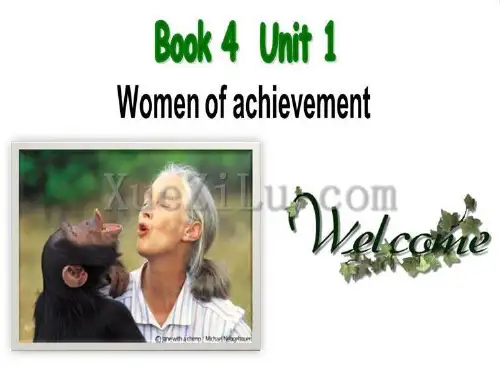
Period 1ReadingThe General Idea of This PeriodThis period includes Warming up,Reading and Comprehending of the Reading.It introduces a day of Jane Goodall and her colleagues in the forests,observing the chimps.After reading the passage the students can know about Jane Goodall’s working methods,her great achievements and her attitude towards wild animals.Reading the passage,the students can also learn some reading strategies such as predicting,skimming and drawing conclusions.Teaching Important PointsHelp he students to comprehend the story of Jane Goodall’s protecting the African wildlife.Get the students to learn from Jane Goodall’s story and come to the idea that great personality isof importance to one’s success.Learn and master some important words,phrases and sentence patterns in this period. Teaching Difficult PointsGet the students to comprehend the story and understand what Jane Goodall has done to gain the achievements.Get the students to believe that one’s personality as well as luck and ability is important to one’s success.Teaching MethodsPredicting to guess the content of the passage.Skimming to get the general idea of the text.Scanning to get detailed information and get to understand the passage better.Task-based activities to get the students to comprehend the passage and be able to debate about whether women can do a better job than men.Teaching AidsA tape recorderA multimedia computerThree Dimensional Teaching AimsKnowledge and SkillsEnable the students to comprehend the story of Jane Goodall’s protecting the African wildlife.Enable the students to learn from Jane Goodall to treat animals in a human way and come to theidea that great personality is of importance to one’s success.Learn some useful words and expressions:achieve,achievement,condition,welfare,connection,behave,behavior,worthwhile,speciali st,observe,observation argue,inspire,support,devote ... to,etc.Learn some sentence patterns:Watching a family wake up is our first activity of the day.Only after her mother came to help her for the first months was she allowed to begin her project.Process and StrategiesGroup work to encourage the students to participate in class activities.Fast reading to make the students get the main idea of the passage.Feelings and ValueFor forty years Jane Goodall has been helping the rest of the world understand and respect thelife of these animals.People will do something that can satisfy their feelings and make a better world.Teaching ProceduresStep 1 Lead-in1.Greet the students.T:Good morning/ afternoon,boys and girls!Ss:Good morning/ afternoon,Miss./Mr...2.Introduce the topic of great women.1)Show some pictures of women for the students to guess who they are and tell whether they are great women or not.T:Do you have idols?Now I would like to show you some pictures of women to see whether they areyour idols and try to tell me whether they are great women.Show some pictures of some famous people.The students might be very excited to see the pictures.They will tell their names and the reasons why they are so famous.But they will have the same point of view that they are famous and important butthey are not great women.2) Get the students to have a discussion about the qualities needed to be a great woman.T:Although they are so famous and important in a certain field,they are not great women.So what doyou think is needed in order to be a great woman?(Give the students two minutes to discuss in pairs.)T:Now what do you think is needed in order to be a great woman?Who would like to share theopinions with us?S:Let me have a try.In my opinion,a great woman should be intelligent and hard-working,otherwise she will not achieve her goals.S:I think a great woman should be determined and consistent.Because sometimes she might come across a lot of difficulties before her idea and invention are accepted by the public or otherspecialists.If she can’t stick to her opinion,she may fail in achieving her goals.S:According to me,I think a great woman should be modest and responsible.I don’t think an arrogant and irresponsible woman will become a great woman.Other students add their opinions.T:I agree with all of you.But in my opinion,most importantly a great woman should be unselfish and willing to sacrifice.Otherwise they will not overcome different difficulties and make greatcontributions to humans and our society.Do you think so?Ss:Yes.3) Talk about great women.T:Now can you name some famous women?S:I think Madam Curie is a great woman.She discovered radium(镭)with her husband and made great contributions to the field of science and also our society.She won the Nobel Prize forChemistry and Physics.T:Good.Who else would like to express your idea?S:I think Mother Teresa is a great woman.She worked in India to help the poor,took care of the disabled people and won the Nobel Peace Prize in 1979.(Some other students express their opinions.)T:Now I would like to show you some more pictures to see whether you know them and theirachievements.T:Who is she?Ss:Song Qingling.T:Who can say something about her achievements?S:She was the vice president of PRC and she worked for women and children welfare activities.T:Good.What about this one?Ss:She is Joan of Arc.S:She lived at the time when British and France fought“the Hundred Years War”.She encouraged the king crowned and showed the French army how to win the war.She was admired by the French people.T:Good.What about her?Ss:Jody Williams.T:What about her achievements?S:In 1972 she began to organize ICBL( the International Campaign to Ban Landmines) and Jody was Given the Nobel Peace Prize in 1997 for her work.T:And she?Ss:Elizabeth Fry.S:She spent most of her life helping to improve the prison conditions in Britain.She first visited Newgate Prison in London 1812 and in 1816 began her prison school in Newgate Prison.In 1818 shetalked to the leaders of Britain about life in prison and persuaded them to make the 1823 New Prison Act,which agreed to spend more money on prisoners.Besides,she published a book about what she had seen in many prisons.She won the Nobel Peace Prize in 1947.T:Good.What about this woman?Ss:She is Lin Qiaozhi.S:She is Chinese.She devoted all her life to gynaecology and obsterics.She remained single all herlife.Even when she died,she left her body for medical research.T:So we are very proud of her.What about the following one?Ss:She is Jane Goodall.T:How much do you know about her?S:She spends her time protecting animals in South Africa.T:Good.They all made great contributions to our world and inspire us.So we should admire andlearn from them.(Get the students to read the information of the six women together.)Step 2 PredictingGet the Ss to read the title and predict the main content of the passage.T:Today we are going to learn about one of the great women.Before that I would like to show you some pictures.T:What can you see in the picture?Ss:A woman and an animal.T:Who is the woman?Ss:Jane Goodall.T:What is the animal?Ss:It’s a chimp.T:What is she doing?Ss:She is kissing the chimp.T:If you meet a chimp in the forest,will you do that like Jane Goodall?Ss:No.T:(smiles) What about this picture?Ss:She is shaking hands with a small chimp.T:Will you do that like her?Ss:No./ Yes.T:And this?Ss:She is hugging the chimp and imitating its way of talking.T:Will you do that?Ss:Yes./ No./ Maybe.T:What about these pictures?Ss:She is watching the chimp with great interest.T:What do you think when you see the pictures?Ss:Admire her for her courage.T:Do you know where the photos were taken?Ss:No.T:They were taken in Gombe National Park in East Africa.T:Now let’s have a look at the title—A protector of African wildlife.After a glance at the title,whatdo you think the passage is about?S:I think the passage is about how Jane Goodall protected the wildlife in Africa and her achievements.T:Do do you agree with her?Ss:Yes/ No.T:Let’s read and find out whether you are right or wrong.Step 3 Skimming to get the general ideaGet the Ss to read the passage and find the answers to the four questions (two minutes) and try to sum up the general idea of the passage.1.Who is the protector?2.What animals were observed?3.When did Jane Goodall arrive in Gombe?How old was she?4.What was the purpose of her study?T:Now who can answer the first question?Who is the protector?S:1.Jane Goodall is the protector.T:Good.What about the second one?What animals were observed?S:2.Chimps were observed.T:The third one?When did Jane Goodall arrive in Gombe?How old was she?S:3.She arrived in Gombe in 1960 when she was 26.T:V ery good.And the last one?S:4.Her purpose was to help the rest of the world to understand and respect the life of the chimps.T:Good job.What about the general idea?S:The passage is mainly about how Jane Goodle worked with chimps in their environment and helped people understand and respect the life of these animals.T:Wonderful job.So did you get the right prediction?Ss:Yes.Step 4 Main ideasGet the students to read the whole passage and sum up the main idea of each paragraph.At the sametime,instruct them the way of finding or summing up the main idea.T:Now we have a rough idea about the passage.How will the writer introduce Jane Goodall’s story to us?How will she organize the passage?I would like you to read the story carefully and sum up themain idea of each paragraph.How can we sum up the main idea easily?S:Try to see whether there are any topic sentences,which are usually at the beginning or the end of a paragraph.If there are not any topic sentences,try to sum up the main idea according to the content of the paragraph.T:Good.Now read the passage and try to find out the main ideas.(after 4 minutes)T:How many paragraphs are there in the passage?Ss:Four.T:What are the main ideas of them?S:1.The first paragraph is about a day in the Combe National Park.S:2.The second paragraph tells us Jane’s way to study chimps and her achievements.S:3.The third paragraph tells us her attitude to the animals.S:4.The last paragraph is a short summary of the whole passage,telling us that she has achieved everything she wanted to do.T:Wonderful job.Step 5 ScanningGet the students to read the whole passage to get some detailed information.T:Now we have formed an overview of the whole passage.Next I would like you to read and get more information about Jane Goodall.Please try to find out the answers to the following questions.Ifthere are some sentences that you cannot understand,put them down and we shall solve your problems later.1.What did the group do in the morning in the forest?2.Where did Jane Goodall suggest that the chimps be left?3.What did she achieve?T:(four minutes later) Now who can answer the questions?S:1.They watched the chimps wake up in the morning in the forest.S:2.She suggested the chimps should be left in the wild.S:3.She discovered that chimps hunt and eat meat,how chimps communicate with each other andworked out their social system.(Not all the students can find the answer to the third question,or some of them can only find part of the answers.The teacher should instruct them the way of finding them accurately.First get them to find the possible sentences where the answer lies—“For example,one thing she discovered was that chimps hunt and eat meat...She also discovered how chimps communicate with each other and her study of their body language helped her work out their social system.” Remind them to pay attention to the transitional words like“one thing”,“also” and “and”.)Step 6 Competition (True or False consolidation exercises)Divide the students into four groups.Each student tries to tell whether the statements are true or false as soon as possible in order to gain points for their group.If he tells the right answer,he shall get one point.If the statement is wrong and he can tell the reason,he gets double of the point.The group that get the highest points shall be the winners and get some prizes.1.With university training,she has achieved what she wanted.2.The chimps show love in their family by talking with each other.3.She hopes that chimps can be left in the zoo.4.She supposes that people should not use chimps for entertainment.5.She has spent more than forty years helping people understand her work.6.She has not built homes for the wild animals to live in.KeyS:1.False.Because she did not study at a university to get any university training.She achieved whatshe wanted without getting any formal university training.2.False.The chimps show love to each other by either feeding or cleaning each other.3.False.Jane Goodall has argued for the chimps to be left in the wild and not used for entertainment.4.True.5.True.6.False.Because she has set up special places where the chimps can live safely.T:Good job.So we can see you have a good understanding of Jane Goodall’s life.Do you think JaneGoodall was brave to go and live in the forest?Ss:Yes.T:Would you have done what she did if you had the chance?Ss share their views.T:What can we learn from Jane Goodall?S:We should show true love to others,as well as to animals.Everything is equal,no matter what they are.It isn’t because we are human beings that we are superior to the animals.We don’t have the rightto control the other living things on the earth.They are our friends and relatives.The only difference is that we have different appearances and different intelligence.Only if we show true love towards them can we make the world a better one.S:I admire her for her belief and personality.Step 7 Story retellingDivide the students into groups of four and get them to choose a slip of paper on which their characters are designed( for example,suppose you are Jane Goodall/ Jane Goodall’s colleague/ Jane Goodall’s mother etc.).Get them to discuss and retell the passage.Try to describe what she thinks.Among the four students,one should be chosen to make a record and give a report.Step 8 Language points focus1.The students raise questions about the passage and the others try to answer the questions.When necessary,the teacher helps to illustrate.2.The students find the important words,phrases and structures from the reading and the teacher explains.Try to use effective examples to illustrate the points.After illustration,teacher can give thestudents some exercises to consolidate their understanding.Step 9 DebateAfter the explanation of the language points,the students have got the total understanding of the reading text.Then the teacher draws the students’ attention back to the text and puts forward a topic for them to discuss.Divide the students into two groups— boys and girls and let them debate with each other about the topic:Women are able to do more than men.The girls are for the idea while the boys are against the idea.Each group tries to think of as many arguments as possible to defeat the other side.After their debate,get some students to give their report for their groups.Step 10 Summary and homeworkT:Time is running out.Today we learned about Jane Goodall’s story and we have learnt a lot from her.Our world will become a more beautiful one if we all treat the animals equally and show our love to them.We will succeed in overcoming any difficulties and achieving our goals if we can be asstrong-willed as her.Homework:1.Read the passage fluently and recite the key sentences in the text.2.Retell the story of Jane Goodall.3.Finish the word exercise S:Ex 1,2&3 on Page 4 and Ex 4 on Page 5.The Design of the Writing on the BlackboardUnit 1 Period 1 A protector of African wildlifeLanguage Focus1.behave(1)vi.to act;bear oneself 行为;举止(2)vt.&vi.to bear (oneself) in a socially accepted or polite way举止适当或有礼(3)vi.(of things) to act in a particular way(指事物)有某种作用2.worthwhile adj.值得的可作定语和表语be worthy of +n.be worthy to be done3.花费spend Sb.spend sth.(on sth.)/ (in) doing sth.pay Sb.pay some money for sth.cost Sth.cost sb.some moneytake It takes sb....to do sth.4.observe(1)vi.&vt. to notice/ watch carefully 观察,注意到observe+n./pron.observe sb.doing/do sth.observe +that-clause(2)vt. to obey;to act in accordance with 遵守,顺从(3)vt. to hold or celebrate 举行(仪式等),庆祝(节日等)5.Only+状语+ 部分倒装“只有……才”6.现在完成进行时have/ has been doing7.argue (vi.) +with sb.about/over sth.同某人辩论某事argue (vt.)+n./clause(从句)/sb.to be...8.support 1) 支持2)承受3)供养Record after TeachingActivities and ResearchThis unit is about important and great women.The students may not know a lot about them,which might make the talking of the topic quite boring and difficult.In order to arouse theirinterest and creation,one activity about women of achievement is designed.Divide the students into groups of four.Assign each group to cooperate with their group mates to do some research on a certain woman of achievement.They are to find as much information as possible and as many pictures as possible by reading books,surfing the Internet or even doing an interview.They are to find out in the project the woman’s appearance,qualities and achievements,etc.Get the students to arrange what they have found in a well-organized order and make the information into a courseware or a web page,with clear and vivid pictures and examples to illustrate each point.Have the students share their courseware or web pages.Have the students write a report (entitled with“...,a woman of achievement”) on how they havecarried out the research and what they have found.Show their reports on the walls,sharing them with the class.Reference for TeachingBackground InformationWomen of Achievement1.Mother Teresa(1910-1997)Mother Teresa founded the Missionaries of Charity in 1948.Through it,she has dedicated her life to helping the poor,the sick and the dying around the world,particularly those in India.Shefounded the Kalighat Home for the Dying and a leper colony was established under her guidance.Her selfless work has brought her many awards,including the Nobel Peace Prize in 1979.2.Madame Curie (1867-1934 )Marie Curie,a great woman scientist,was born in Poland in 1867.From her early childhood Marie loved to study and hoped to become a scientist.Her interest in science was encouraged by herfather,a teacher of physics.In 1891,she left Poland for France and entered the University of Paris.Four years later,she graduated with the highest grade in her class.After graduation she remained in the same university,doing scientific research work.In order to discover something that gave off a kind of radiation,she did experiments most carefully again and again.She failed many times,but she didn’ t lose heart.Finally in 1902,she,together with her husband,succeeded in finding the radioactive element—radium.Owing to their achievement,the Curies received the Nobel Prize in Physics in 1903.In 1911,she won another Nobel Prize,this time all by herself in chemistry and thus she becamethe first woman scientist to win a Nobel awards.She died in 1934,obviously as a result of the effects of the radiations with which she worked for over 30 years.3.Elizabeth Fry ( May 21,1780-October 12,1845)Elizabeth Fry was a prison reformer,social reformer and philanthropist.She was born in a Quaker family on May 21,1780.She took an interest in her teenager years in the poor,the sick,and the prisoners.In 1812 she first visited Newgate Prison in London and was very shocked at the conditions she found there.From then on she began to work to improve prison conditions in Britain.She supplied the women of Newgate Prison with clothes and established a school and a chapel.In 1817 Elizabeth Fry and eleven others,formed the Association for the Improvement of the Female Prisoners in Newgate.The next year she was invited to give evidence to a House of Commons Committee on London Prisons.She described in detail the lives of the prisoners,and recommended that women prisoners should be looked after by women instead of men,and stressed her belief in the importance of useful employment.By the 1820s Elizabeth Fry and her work had become very well known in Britain.She faced criticism and problems at various times.Elizabeth Fry’s work was very important because it started the movement for prison improvement.Her idea was that people in prison could not change their ways and lead useful lives if you did not give them a legal way of earning money.She aimed at changing the prisoners by educating them and changing the way they were treated.Her work was mentioned as one of the reasons that the Quakers got the Nobel Peace Prize in 1947 and she was remembered in Britain by being put on the new five pound note in 2000.4.Soong Chingling (1893-1981)Soong Chingling was one of the Soong sisters,also known as Madame Sun Yet-sen.She was born into a rich Christian family which played an important role in Chinese politics in the first half of the 20th century.She and her two sisters had a good education.She went to study in Georgia,USA.In 1915 she married Dr Sun Yat-sen,founder of the Republic of China.After Sun’s death in 1925,she was elected to the Kuomingtang Central Executive Committee in 1926.After the establishment of the People’s Republic of China,she became the Vice president of the People’s Republic of China,head of the Sino-Soviet Friendship Association and Honorary President of the All-China Women’s Federation.In 1951 she was awarded the Satlin Peace Prize.From 1968 to1972 she acted jointly with Dong Biwu as head of state.On May 16,1981,two weeks before her death,she was admitted to the Communist Party and was named Honorary President of the People’s Republic of China.5.Jane GoodallJane Goodall was appointed peace messenger of the United Nations(联合国和平使者)on April 16,2002.She was famous for her creative work started 42 years ago in protecting chimpanzees in Tanzania.Goodall went to Tanzania and studied chimps from the 1960s.She went with three African helpers (and her mother for the first month) to live in the Gombe National Park in East Africa.She made friends with the local African people after setting up a clinic to help cure minor illnesses.Her life was spent following and recording the social life and relationships of the chimps.Her supplies and the care of her base camp were managed by her African helpers.Jane uncovered many aspects of chimpanzee behaviour during her first years in the Gombe National Park.Because of her research,we now know that chimpanzees hunt for meat,use tools,and have different personalities.In 1965,Jane earned her PhD in Ethology from Cambridge University.Soon she returned to Tanzania to continue her research and to establish a research ter,she became the Scientific Director of the Gombe Stream Research Centre,Tanzania.In 1977,Jane founded the Jane Goodall Institute for Wildlife Research,Education and Conservation,USA to provide support for field research on wild chimps and encourage wildlife research.6.Jody Williams (1950-USA)Jody Williams was born in the United States in 1950.After she got her Master’s degree of Arts,she went to work for two years as a language teacher in Mexico,where she for the first time saw the miserable life of the poor.She has worked for many years to help people in South America by organizing medical care (Medical Aid for El Salvador) and education (Nicaragua-Honduras Education Project).In 1992 she began to organize the International Campaign to Ban Landmines (ICBL).As an ICBL coordinator,she has written and spoken extensively on the problem of landmines and the movement to ban them.She worked with groups in different countries.In 1992 she was working with six groups but by 1997 more than 1000 groups from over sixty countries had joined ICBL.Although the organization became very large,the friendly way of organizing ICBL continued and has proved very successful.Working in a unprecedented cooperative way with governments and other international groups,the ICBL achieved its goal of an international treaty banning landmines during the diplomatic conference held in Oslo in September 1997.In 1997 ICBL was given the Nobel Peace Prize and the work of Jody Williams was recognized and rewarded.She still works for ICBL today.7.Joan of Arc (1412-1431)Joan of Arc was born in the small village of Domremy in France.She lived at the time when there was a war between England and France called “The Hundred Years War”.Joan of Arc was important because she encouraged the old French king’s son,the Dauphin,to be crowned in Rheims as the only King of France.The French people accepted him as the true king of France.Joan also showed the French army how to win battles and inspired them with the confidence to win.So Joan ofArc began the process by which the English left France and it became a country in its own right.At the time Joan lived it was considered wrong for women to fight in the army.But Joan argued that God had spoken to her and sent her to help the French army.She said God had spoken to her through two messengers and they had encouraged her in her mission.When she was captured by the English,they did not believe her stories of the messengers from God and criticized her for fightingand wearing men’s clothes.After a trial she was put to death.She was very patriotic and did inspire the French to win against the English.She showed how brave she was by what she did just like Hua Mulan in China.8.Lin Qiaozhi (1901-1983)Lin Qiaozhi was born in Xiamen in Fujian Province.Her parents were Christians and her father worked at a university of Singapore.He believed in the education of women.Lin Qiaozhi’s mother died when she was five and she went to live with her brother and his family.They fulfilled their father’s wishes by supporting her education even when they could no longer support the education of their own children.At elementary school one of her teachers noticed how quick and neat her knittingwas and encouraged her to become a doctor.1921 She entered the Peking Union Medical College.1929 She graduated from the University with a PhD degree in gynaecology.1932 She went to London University Medical School and Manchester University Medical School for further studies.1933 She studied in Vienna and then returned to China to work for women and children’s diseases.1933 She studied abroad in the USA at the Chicago University Medical School.1940 She returned to China as the Head of Gynaecology and Obstetric S:the first female head of such a department.1941 War between Japan and the USA forced the hospital to close so she opened a private hospital in the hutongs for patients.After the war she returned to the hospital when it reopened.1949 After the Liberation she went to study diseases of women in the countryside and wrote a book to help them keep their babies healthy.She was very important in inspiring women to become doctors and was one of the founders of modern gynaecology in China.She did important research and used the methods she had learned abroad to improve Chinese medicine.1983 She died leaving her body for medical research.Her work was recognized when on the 100th anniversary of her birth a copper statue to honour her was placed in the Great Hall of thePeople,Beijing.Language Points1.Jane has studied these animals for many years and helped people understand how much they behave like humans.简已经研究它们很多年了,她帮助人们了解了黑猩猩跟人类的行为是多么的相似。
高中英语 Unit 1 Women of achievement Section Ⅱ Learnin
Unit 1 Women of achievementⅠ.单词拼写根据汉语或首字母提示,写出以下单词1.The smile on her face made it all worthwhile(值得的).2.What I want to tell you is the deep love and respect (尊敬) I have for my parents.3.I don't want to argue (争论) with you.Just do what you like since you won't listen to me.4.It is necessary for a teacher to bine entertainment (娱乐) with education.5.There's a connection (关系) between smoking and heart disease.6.Inspired by the teacher's words,he is determined to study harder than ever before.7.Having a large family to support,he took up two parttime jobs in his spare time.8.You can't imagine how many people crowded into the cinema on Sundays.9.When a great earthquake hit the country,many international organizations offered to help.10.To be honest,I'm very satisfied with your good behaviour.Ⅱ.拓展词汇根据词性和汉语提示,写出以下单词1.connect vt.连接→connection n.连接;关系2.achieve vt.完成;达到→achievement n.成就;功绩3.organize vt.组织→organization n.组织;机构;团体4.behave vt.& vi.举动;(举止或行为)表现→behaviour/behavior n.行为;举止;习性5.observe vt.观察;观测;遵守→observer n.观察者→observation n.观察;观测6.argue vt.& vi.讨论;辩论;争论→argument n.争论;争辩;争吵7.entertain vt.& vi.款待;使快乐→entertainment n.款待;娱乐;娱乐表演8.inspire vt.鼓舞;激发;启示→ins piring adj.令人鼓舞的→inspired adj.有灵感的;受鼓舞的→inspiration n.灵感;鼓舞[寻规律、巧记忆]v.+tion 结尾的名词v.+ation的名词connection 连接,关系construction 建造,建设pollution 污染consideration 考虑celebration 庆祝;庆典congratulation 祝贺Ⅲ.补全短语根据提示补全以下短语1.fight for为……而奋斗2.have...in mon 与……有共同之处3.devote...to把……贡献给;致力于4.move off离开;起程;出发5.municate with与……交际/交流6.work out算出;制定出7.lead a...life 过着……的生活8.crowd in(想法、问题等)涌上心头;涌入脑海Ⅳ.选词填空选用上述短语的适当形式填空1.She tried to sleep,but too many thoughts crowded in on her.2.Devoted to his research work,the scientist has little time to spend with his family.3.Having worked out the difficult math problem,the boy felt a sense of achievement.4.We have a lot in mon,so we bee good friends.5.Although he is very rich,he still leads a simple life.背教材原句记句式结构仿写促落实1.Everybody sits and waits in the shade of the trees while thefamily begins to wake up and move off.大家坐在树荫下等待着,这时候黑猩猩们睡醒了,准备离开。
Unit1 Women of achievement-reading教案
Unit1 Women of achievement-reading教案Unit1 Wachievement-reading教案(A PROTECTOR OF AFRICAN WILDLIFE)AimsTo develop reading ability To leauseful exxt To learn about wachievement ProceduresI. Warming upWarming up by describingGood morning, class. Today we are going to read about A PROTECTOR OF AFRICAN WILDLIFE. BuI’d lw if you have ever heard of women like Elizabeth Fg Chingling, Jane Goodall, Jody Williams, Joan of Arc and Lin Qiaozhi. Now turn to page 1, look aad the captions and describe to your neighbor the wus. W? Wha? What did she do to bworld?Warming up by discussingHi, evHow did you spend your winter vacation? Did you read any books? Did you read any wachievement? What makes a woman of achievement? Now in pairs discuss the wage one. Wwomen do youa great woman? And may I have your reau?Warming up by reading aloud and translatingNu back at school, boys and girls. As you have all prepared lessons before class I shall ask six of you at randad aloud and translaaptions undagw you’ve understand these women. Zhao Yanfei, would you try reading aloud and translatingaption?: 伊丽莎白·弗赖伊是一位教友派信徒。
高中英语Unit1WomenofAchievementLanguagePointsinReading
第四册第一单元第二课时词汇导学案 编号2Unit1Book4 Women of Ac hievementLan guage Points in Readi ngAll thi ngs in their being are good for somethi ng.天生我才必有用Lear ning aims1. To lear n the fol low ing words &expressi ons:behave, shade, while, move off, worthwhile, observe 2. Try to recite and use them freely.Step1 Leadi ng-i nIn this period we will start to lear n the words and expressi ons of Un it3.First, please finish Exercises1-2 on Page2 in Win in ClassStep2 Thinking (自主学习一朗读下面的单词和句子,归纳它们的用法 )1. , and helped people understand how much they behave like humans. behave vi. & vt. 举动;(举止或行为)表现_____ n. 行为;举止O If you behave yourself, I ' ll let you eat a second cake.O Childre n should be taught to behave well (towards the guests) at table.O Child as Tom was, he was on hi s best behaviour.举止规矩;老实点儿 ___________________________________(对某人)态度、行为好/恶劣 ______________________________尽量表现得体 _________________________1) I am sorry about what I did last night--- _________________ .对不起,我昨晚表现得像个孩子2) Don ' t spoil your boy! Can ' t you ______________ ______________ ?不要溺爱孩子!难道不能让他规矩点吗?'s behaviour her fans.( 介词 ) shade of the trees while the family begins to wake遮住光线shadow n. 1) The girls are sitting in the __________ of the big tree, enjoying the _________ of the bridge in the river.2) The bad n ews cast a ______ over his fame.3) She _______ her eyes from the sun with her hand.B. while 是并列连词,意为 _________ ,表前后两者情况的对比。