
2015年6月大学英语四级考试真题(第一套)
Part I Writing(30 minutes)Directions: For this part, you are allowed 30 minutes to write an essay based on the picture below.You should start your essay with a brief description of the picture and then comment on the kid's understanding of going to school.You should write at least 120 words but no more than 180 words.Part II Listening Comprehension(30 minutes)Section ADirections : In this section, you will hear 8 short conver sat ions and 2 long conversations.At the end ofeach conversation, one or more questions will be asked about what was said.Both theconversation and the questions will be spoken only once.After each question there will bea pause.During the pause, you must read the four choices marked A., B), C.and D),and decide which is the best answer.Then mark the corresponding letter on AnswerSheet 1 with a single line through the centre.1.A.He will give the woman some tips on the game.B.The woman has good reason to quit the game.C.He is willing to play chess with the woman.D.The woman should go on playing chess.2.A.The man can forward the mail to Mary.B.She can call Mary to take care of the mail.C.Mary probably knows Sally's new address.D.She would like to resume contact with Sally.3.A.His handwriting has a unique style.B.His notes are not easy to read.C.He did not attend today's class.D.He is very pleased to be able to help.4.A.The man had better choose another restaurant.B.The new restaurant is a perfect place for dating.C.The new restaurant caught her fancy immediately.D.The man has good taste in choosing the restaurant.5.A.He has been looking forward to spring.B.He has been waiting for the winter sale.C.He will clean the woman's boots for spring.D.He will help the woman put things away.6.A.The woman is rather forgetful.B.The man appreciates the woman's help.C.The man often lends books to the woman.D.The woman often works overtime at weekends.7.A.Go to work on foot.B.Take a sightseeing trip.C.Start work earlier than usual.D.Take a walk when the weather is nice.8.A.The plane is going to land at another airport.B.All flights have been delayed due to bad weather.C.Temporary closing has disturbed the airport's operation.D.The airport's management is in real need of improvement. Questions 9 to 12 are based on the conver sat ion you have just heard.9.A.It specializes in safety from leaks.B.It is headquartered in London.C.It has a partnership with LCP.D.It has a chemical processing plant.10.A.He is Mr.Grand's friend.B.He is a safety inspector.C.He is a salesman.D.He is a chemist.11.A.Director of the safety department.B.Mr.Grand's personal assistant.C.Head of the personnel department.D.The public relations officer.12. A.Walt for Mr.Grand to call back.B.Leave a message for Mr.Grand.C.Provide details of their products and services.D.Send a comprehensive description of their work.Questions 13 to 15 are based on the conversation you have just heard.13.A.She learned playing the violin from a famous French musician.B.She dreamed of working and living in a European country.C.She read a lot about European musicians and their music.D.She listened to recordings of many European orchestras.14.A.She began taking violin lessons as a small child.B.She was a pupil of a famous European violinist.C.She gave her first performance with her father.D.She bec ame a professional violinist at fifteen.15.A.It gave her a chance to explore the city.B.It was the chance of a lifetime.C.It was a gre at challenge to her.D.It helped her learn classical French music.Section BDirections: In this section, you will hear 3 short passages.At the end of each passage, you will hearsome questions.Both the passage and the questions will be spoken only once.After youhear a question, you must choose the best answer from the four choices marked A., B),C.andD ).Then mark the corresponding letter on Answer Sheet 1 with a single linethrough the centre.Passage OneQuestions 16 to 18 are based on the passage you have just heard.16.A.There are mysterious stories behind his works.B.There are many misunderstandings about him.C.His works have no match worldwide.D.His personal history is little known.17.A.He moved to Stratford-on-Avon in his childhood.B.He failed to go beyond grammar school.C.He was a member of the town council.D.He once worked in a well-known acting company.18. A.Writers of his time had no means to protect their works.B.Possible sources of clues about him were lost in a fire.C.His works were adapted beyond recognition.D.People of his time had little interest in him.Passage TwoQuestions 19 to 21 are based on the passage you have just heard.19. A.Theft.B.Cheating.C.Air crash.D.Road accidents.20. A.Learn the local customs.B.Make hotel reservations.C.Book tickets well in advance.D.Have the right documents.21.A.Contact your agent.B.Get a lift if possible.e official transport.D.Have a friend meet you.Passage ThreeQuestions 22 to 25 are based on the passage you have just heard.22.A.Cut down production cost.B.Sell inexpensive products.C.Specialise in gold ornaments.D.Refine the taste of his goods.23.A.At a national press conference.B.During a live television interview.C.During a local sales promotion campaign.D.At a meeting of top British businesspeople.24.A.Insulted.B.Puzzled.C.Distressed.D.Discouraged.25.A.The words of some businesspeople are just rubbish.B.He who never learns from the past is bound to fail.C.There should be a limit to one's sense of humour.D.He is not laughed at, that laughs at himself first.Section CDirections: In this section, you will hear a passage three times.When the passage is read for the firsttime, you should listen carefully for its general idea.When the passage is read for thesecond time, you are required to fill in the blanks with the exact words you have justheard.Finally, when the passage is read for the third time, you should check what youhave written.Looking at the basic biological systems, the world is not doing very well.Yet economic indicators show the world is 26 Despite a slow start at the beginning of the eighties, global economic output increased by more than a fifth during the 27 The economy gre w, trade increased, and millions of new jobs were created.How can biological indicators show the 28 of economic indicators?The answer is that the economic indicators have a basic fault: they show no difference between resource uses that 29 progress and those uses that will hurt it.The main measure of economic progress is the gross national product (GNP). 30 , this totals the value of all goods and services produced and subtracts loss in value of factories andequipment.Developed a half-century ago, GNP helped 31 a common way among countries of measuring change in economic output.For some time, this seemed to work 32 well, but serious weaknesses are now appearing.As indicated earlier, GNP includes loss in value of factoriesand equipment, but it does not 33 the loss of natural resources, including nonrenewable resources such as oil or renewable resources such as forests.This basic fault can produce a 34 sense of national economic health.According to GNP, for example, countries that overcut forests actually do better than those that preserve their forests.The trees cut down are counted as income but no subtraction is made for 35 the forests.Part ⅢReading Comprehension ( 40 minutes)Section ADirections: In this section, there is a passage with ten blanks.You are required to select one word foreach blank from a list of choices given in a word bank following the passage.Read the passage through carefully before making your choices.Each choice in the bank is identified by a letter.Please mark the corresponding letter for each item on Answer Sheet2 with a single line through the centre.You may not use any of the words in the bank more than once.Questions 36 to 45 are based on the following passage.The U.S.Department of Education is making efforts to ensure that all students have equal access to a quality education.Today it is 36 the launch of the Excellent Educators for All Initiative.The initiative will helpstates and school districts support gre at educators for the students who need them most."All children are 37 to a high-quality education regardless of their race, zip code or family income.It is 38 important that we provide teachers and principals the support they need to help students reach their full 39 ," U.S.Secretary of Education Arne Duncan said." Despite the excellent work and deep 40 of our nation's teachers and principals, students inhigh-poverty, high- minority schools are unfairly treated across our country.We have to do better.Local leaders and educators will 41 their own creative solutions, but we must work together to 42 our focus on how to better recruit, support and 43 effective teachers and principals for all students, especially the kids who need them most."Today's announcement is another important step forward in improving access to a quality education, a 44 of President Obama's year of ter today, Secretary Duncan will lead a roundtable discussion with principals and school teachers from across the country about the 45 of working in high-need schools and how to adopt promising practices for supporting gre at educators in these schools.A.AnnouncingB.beneficialC.challengesmitmentponentF.contestsG.criticallyH.developI.distributingJ.enhanceK.entitledL.potentialM.properlyN.qualifiedO.retainSection BDirections: In this section, you are going to read a passage with ten statements attached to it.Eachstatement contains information given in one of the paragraphs.Identify the paragraph from which the information is derived.You may choose a paragraph more than once.Each paragraph is marked with a letter.Answer the questions by marking thecorresponding letter on Answer Sheet 2.The Changes Facing Fast FoodA.Fast-food firms have to be a thick-skinned bunch.Health experts regularly criticise them severelyfor selling food that makes peoplefat.Critics even complain that McDonald's, whose logosymbolises calorieexcess, should not have been allowed to sponsor the World Cup.These arethings fast-food firms have learnt to cope with.But not perhaps for much longer.The burgerbusiness faces more pressure from regulators at a time when it is already adapting strategies inresponse to shifts in the global economy.B)Fast food was once thought to be recession-proof.When consumers need to cut spending, the logicgoes, cheap meals like Big Macs and Whoppers bec ome even more attractive.Such "trading down"proved true for much of the latest recession, when fast-food companies picked up customers who could no longer afford to eat at casual restaurants.Traffic was boosted in America, the home of fast food, with discounts and promotions, such as $1 menus and cheap combination meals.C)As a result, fast-food chains have weathered the recession better than their more expensive competitors.In 2009 sales at full-service restaurants in America fell by more than 6% , but total sales remained about the same at fast-food chains.In some markets, such as Japan, France and Britain, total spending on fast food increased.Same-store sales in America at McDonald's, the world's largest fast-food company, did not decline throughout the downturn.Panera Bread, an American fast-food chain known for its fresh in gre dients, performed well, too, because it offers higher-quality food at lower prices than restaurants.D)But not all fast-food companies have been as fortunate.Many, such as Burger King, have seen sales fall.In a severe recession, while some people trade down to fast food, many others eat at home more frequently to save money.David Palmer, an analyst at UBS, a bank, says smaller fast- food chains in America, such as Jack in the Box and Carl's Jr., have been hit particularly hard in this downturn bec ause they are competing with the global giant McDonald's, which increased spending on advertising by more than 7% last year as others cut back.E.Some fast-food companies also sacrificed their own profits by trying to give customers better value.During the recession companies set prices low, hoping that once they had tempted customers through the door they would be persuaded to order more expensive items.But in many cases that strategy did not st year Burger King franchisees (特许经营人)sued (起诉)the company over its double-cheeseburger promotion, claiming it was unfair for them to be repuired to sell these for $1 when they cost$1.10 to make.In May a judge ruled in favour of Burger King.Nevertheless, the company may still be cursing its decision to promote cheap choices over more expensive ones because items on its "value menu" now account for around 20% of all sales, upfrom 12% last October.F.Analysts expect the fast-food industry to grow modestly this year.But the downturn is makingcompanies rethink their strategies.Many are nowintroducing higher-priced items to entice (引诱)consumers away from $1 specials.KFC, a division of Yum! Brands, which also owns Taco Belland Pizza Hut, has launched a chicken sandwich that costs around $5.And in May Burger Kingintroduced bar bec ue (烧烤)pork ribs at $7 for eight. panies are also trying to get customers to buy new and more items, including drinks.McDonald's started selling better coffee as a challenge to Starbucks.Its " McCafe" line nowaccounts for an estimated 6% of sales in America.Starbucks has sold rights to its Seattle's Bestcoffee brand to Burger King, which will start selling it later this year.H.As fast-food companies shift from "super size" to "more buys", they need to keep customer traffichigh throughout the day.Many see breakfast as a big opporttmity, and not just for fatty food.McDonald's will start selling porridge (粥)in America next year.Breakfast has the potential to bevery profitable, says Sara Senatore of Bernstein, a research firm, because the margins can be high.Fast-food companies are also adding midday and late-night snacks, such as blended drinks andwraps.The idea is that by having a gre ater range of things on the menu, "we can sell to consumersproducts they want all day," says Rick Carucci., the .chief financial officer of Yum ! Brands.I.But what about those growing waistlines? So far, fast-food firms have cleverly avoided governmentregulation.By providing healthy options, like salads and low-calorie sandwiches, they have at leastgiven theimpression of doing something about helping to fight obesity (肥胖症).These offeringsare not necessarily loss-leaders, as they broaden the appeal of outlets to groups of diners thatinclude some people who don't want to eat a burger.But customers cannot be forced to ordersalads instead of fries.J.In the future, simply offering a healthy option may not be good enough."Every packaged-food and restaurant company I know is concerned about regulation right now," says Mr.Palmer of UBS.America's health-reform bill, which Congress passed this year, requires restaurant chains with 20 ormore outlets to put the calorie-content of items they serve on the menu.A study by the NationalBureau of Economic Research, which tracked the effects on Starbucks of a similar calorie-postinglaw in New York City in 2007, found that the average calorie-count per transaction fell 6% andrevenue increased 3% at Starbucks stores where a Dunldn Donuts outlet was nearby--a sign, it issaid, that menu-labelling could favour chains that have more healthy offerings.K.In order to avoid other legislation in America and elsewhere, fast-food companies will have tocontinue innovating (创新).Walt Riker of McDonald's claims the change it has made in its menumeans it offers more healthy items than it did a few years ago."We probably sell more vegetables,more milk, more salads, more apples than any restaurant business in the world," he says.But therecent proposal by a county inCalifornia to ban McDonald's from including toys in itshigh-calorie"Happy Meals", bec ause legislators believe it attracts children to unhealthy food, suggests there isa lot more left to do.46.Some people propose laws be made to stop McDonald's from attaching toys to its food specials for children.47.Fast-food finns may not be able to cope with pressures from food regulation in the near future.48.Burger King will start to sell Seattle's Best coffee to increase sales.49.Some fast-food firms provide healthy food to give the impression they are helping to tackle the obesity problem.50.During the recession, many customers turned to fast food to save money.51.Many people eat out less often to save money in times of recession.52.During the recession, Burger King's promotional strategy of offering low-priced items often proved ineffective.53.Fast-food restaurants can make a lot of money by selling breakfast.54.Many fast-food companies now expect to increase their revenue by introducing higher-priced items.55.A newly-passed law asks big fast-food chains to specify the calorie count of what they serve on the menu.Section CDirections: There are 2 passages in this section.Each passage is followedby some questions orunfinished statements.For each of them there are four choices marked A., B), C.andD ).You should decide on the best choice and mark the corresponding letter on AnswerSheet 2 with a single line through the centre.Passage OneQuestions 56 to 60 are based on the following passage.If you think a high-factor sunscreen (防晒霜)keeps you safe from harmful rays, you may be wrong.Research in this week's Nature shows that while factor 50 reduces the number of melanomas(黑瘤)and delays their occurrence, it can't prevent them.Melanomas are the most ag gre ssive skin cancers.You have a higher risk if you have red or blond hair, fair skin, blue or green eyes, or sunburn easily, or if a close relative has had one.Melanomas are more common if you have periodic intense exposure to the sun.Other skin cancers are increasingly likely with long-term exposure.There is continuing debate as to how effective sunscreen is in reducing melanomas the evidence is weaker than it is for preventing other types of skin cancer.A 2011 Australian study of 1,621 people found that people randomly selected to apply sunscreen daily had half the rate of melanomas of people who used cream as needed.A second study, comparing 1,167 people with melanomas to 1,101 who didn't have the cancer, found that using sunscreen routinely, alongside other protectionsuch as hats,long sleeves or staying in the shade, did give some protection.This study said other forms of sun protection not sunscreen seemed most beneficial.The study relied on people remembering what they had done over each decade of their lives, so it's not entirely reliable.But it seems reasonable to think sunscreen gives people a false sense of security in the sun.Many people also don't use sunscreen properly applying insufficient amounts, failing to reapply after a couple of hours and staying in the sun too long.It is sunburn that is most worrying recent research shows five episodes of sunburn in the teenage years increases the risk of all skin cancers.The good news is that a combination of sunscreen and covering up can reduce melanoma rates, as shown by Australian figures from theirslip-slop-slap campaign.So if there is a heat wave this summer, it would be best for us, too, to slip on a shirt, slop on (抹上)sunscreen and slap ona hat.56.What is people's common expectation of a high-factor sunscreen?A.It will delay the occurrence of skin cancer.B.It will protect them from sunburn.C.It will keep their skin smooth and fair.D.It will work for people of any skin color.57.What does the research in Nature say about a high-factor sunscreen?A.It is ineffective in preventing melanomas.B.It is ineffective in case of intense sunlight.C.It is ineffective with long-term exposure.D.It is ineffective for people with fair skin.58.What do we learn from the 2011 Australian study of 1,621 people?A.Sunscreen should be applied alongside other protection measures.B.High-risk people benefit the most from the application of sunscreen.C.Irregular application of sunscreen does women more harm than good.D.Daily application of sunscreen helps reduce the incidence of melanomas.59.What does the author say about the second Australian study?A.It misleads people to rely on sunscreen for protection.B.It helps people to select the most effective sunscreen.C.It is not based on direct observation of the subjects.D.It confirms the results of the first Australian study.60.What does the author suggest to reduce melanoma rates?ing both covering up and sunscreen.B.Staying in the shade whenever possible.ing covering up instead of sunscreen.D.Applying the right amount of sunscreen.Passage TwoQuestions 61 to 65 are based on the following passage.Across the rich world, well-educated people increasingly work longer than the less-skilled.Some65% of American men aged 62 -74 with a professional de gre e are in the workforce, compared with32% of men with only a high-school certificate.This gap is part of a deepening divide between the well-educated well-off and the unskilled poor.Rapid technological advance has raised the incomes of the highly skilled while squeezing those of the unskilled.The consequences, for individuals and society, are profound.The world is facing an astonishing rise in the number of old people, and they will live longer than ever before.Over the next 20 years the global population of those aged 65 or more will almost double, from 600 million to 1.1 billion.The experience of the 20th century, when greater longevity (长寿)translated into more years in retirement rather than more years at work, has persuaded many observers that this shift will lead to slower economic growth, while the swelling ranks of pensioners will create government budget problems.But the notion of a sharp division between the working young and the idle old misses a new trend, the growing gap between the skilled and the unskilled.Employment rates are falling among younger unskilled people, whereas older skilled folk are working longer.The divide is most extreme in America, where well-educated baby-boomers (二战后生育高峰期出生的美国人)are putting off retirement while many less-skilled younger peoplehave dropped out of the workforce.Policy is partly responsible.Many European governments have abandoned policies that used to encourage people to retire early.Rising life expectancy (预期寿命), combined with the replacement of generous defmed-benefit pension plans with less generous defined-contribution ones, means that even the better-off must work longer to have a comfortable retirement.But the changing nature of work also plays a big role.Pay has risen sharply for the highly educated, and those people continue to reap rich rewards into old age bec ause these days the educated elderly are more productive than the preceding generation.Technological change may well reinforce that shift: the skills that complement computers, from management knowhow to creativity, do not necessarily decline with age.61.What is happening in the workforce in rich countries?A.Younger people are replacing the elderly.B.Well-educated people tend to work longer.C.Unemployment rates are rising year after year.D.People with no college de gre e do not easily find work.62.What has helped deepen the divide between the well-off and the poor?A.Longer life expectancies.B.A rapid technological advance.C.Profound changes in the workforce.D.A growing number of the well-educated.63.What do many observers predict in view of the experience of the 20th century?A.Economic growth will slow down.ernment budgets will increase.C.More people will try to pursue higher education.D.There will be more competition in the job market.64.What is the result of policy changes in European countries?A.Unskilled workers may choose to retire early.B.More people have to receive in-service training.C.Even wealthy people must work longer to live comfortably in retirement.D.People may be able to enjoy generous defined-benefits from pension plans.65.What is characteristic of work in the 21st century?puters will do more complicated work.B.More will be taken by the educated young.C.Most jobs to be done will be the creative ones.D.Skills are highly valued regardless of age.Part ⅣTranslation ( 30 minutes)Directions: For this part, you are allowed 30 minutes to translate a passage from Chinese into English.You should write your answer on Answer Sheet 2.中国是世界上最古老的文明之一。
2015年6月英语四级考试真题及答案(第1套)
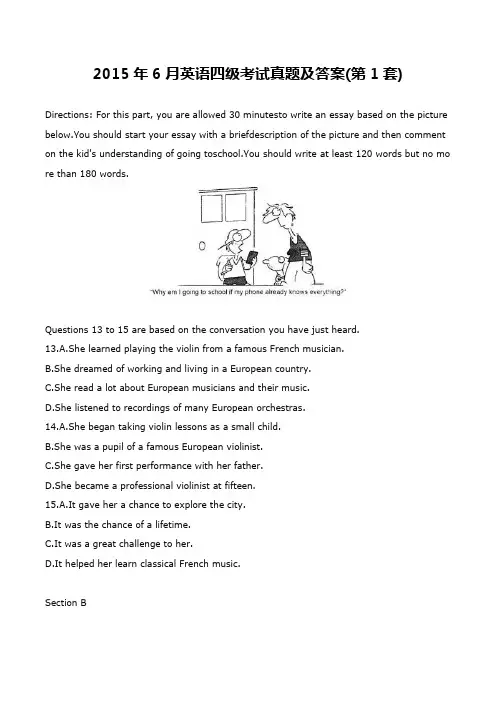
2015年6月英语四级考试真题及答案(第1套)Directions: For this part, you are allowed 30 minutesto write an essay based on the picture below.You should start your essay with a briefdescription of the picture and then comment on the kid's understanding of going toschool.You should write at least 120 words but no mo re than 180 words.Questions 13 to 15 are based on the conversation you have just heard.13.A.She learned playing the violin from a famous French musician.B.She dreamed of working and living in a European country.C.She read a lot about European musicians and their music.D.She listened to recordings of many European orchestras.14.A.She began taking violin lessons as a small child.B.She was a pupil of a famous European violinist.C.She gave her first performance with her father.D.She became a professional violinist at fifteen.15.A.It gave her a chance to explore the city.B.It was the chance of a lifetime.C.It was a great challenge to her.D.It helped her learn classical French music.Section BDirections: In this section, you will hear 3 short passages.At the end of each passage, you willhearsome questions.Both the passage and the questions will be spoken only once.After youheara question, you must choose the best answer from the four choices marked A., B), C.and D).Then mark the corresponding letter on Answer Sheet 1 with a single linethrough t he centre.Passage OneQuestions 16 to 18 are based on the passage you have just heard.16.A.There are mysterious stories behind his works.B.There are many misunderstandings about him.C.His works have no match worldwide.D.His personal history is little known.17.A.He moved to Stratford-on-Avon in his childhood.B.He failed to go beyond grammar school.C.He was a member of the town council.D.He once worked in a well-known acting company.18.A.Writers of his time had no means to protect their works.B.Possible sources of clues about him were lost in a fire.C.His works were adapted beyond recognition.D.People of his time had little interest in him.Passage TwoQuestions 19 to 21 are based on the passage you have just heard.19.A.Theft.B.Cheating.C.Air crash.D.Road accidents.20.A.Learn the local customs.B.Make hotel reservations.C.Book tickets well in advance.D.Have the right documents.21.A.Contact your agent.B.Get a lift if possible.e official transport.D.Have a friend meet you.Passage ThreeQuestions 22 to 25 are based on the passage you have just heard.22.A.Cut down production cost.B.Sell inexpensive products.C.Specialise in gold ornaments.D.Refine the taste of his goods.23.A.At a national press conference.B.During a live television interview.C.During a local sales promotion campaign.D.At a meeting of top British businesspeople.24.A.Insulted.B.Puzzled.C.Distressed.D.Discouraged.25.A.The words of some businesspeople are just rubbish.B.He who never learns from the past is bound to fail.C.There should be a limit to one's sense of humour.D.He is not laughed at, that laughs at himself first.Section CDirections: In this section, you will hear a passage three times.When the passage is read fo r thefirsttime, you should listen carefully for its general idea.When the passage is read for t hesecondtime, you are required to fill in the blanks with the exact words you have justheard.Finally,when the passage is read for the third time, you should check what youhave writt en.Looking at the basic biological systems, the world is not doing very well.Yet economicindica tors show the world is (26) Despite a slow start at the beginning of the eighties, globalec onomic output increased by more than a fifth during the (27) The economy grew, tradein creased, and millions of new jobs were created.How can biological indicators show the 28 o feconomic indicators?The answer is that the economic indicators have a basic fault: they show no differencebetw een resource uses that(29) progress and those uses that will hurt it.The main measureof economic progress is the gross national product (GNP).(30), this totals the value of allgoods and services produced and subtracts loss in value of factories and equipment.Developed ahalf-century ago, GNP helped (31) a common wa y among countries of measuring change ineconomic output.For some time, this seemed to work (32 )well, but serious weaknesses arenow appearing.As indicated earlier, GNP includes loss in va lue of factories and equipment, but itdoes not(33 )the loss of natural resources, including nonrenewable resources such as oil orrenewable res ources such as forests.This basic fault can produce a(34 )sense of national economic health.According to GNP,for example, countries that overcut for ests actually do better than those that preserve theirforests.The trees cut down are counte d as income but no subtraction is made for (35 )theforests.Section ADirections: In this section, there is a passage with ten blanks.You are required to select on eword for each blank from a list of choices given in a word bank following the passage.Read thepassage through carefully before making your choices.Each choice in the bank is identified by aletter.Please mark the corresponding letter for each item on Answer Sheet2 with a single linethrough the centre.You may not use any of the words in the bank more than onc e.Questions 36 to 45 are based on the following passage.The U.S.Department of Education is making efforts to ensure that all students have equalac cess to a quality education.Today it is(36) the launch of the Excellent Educators for AllInitiative.The initiative will help states a nd school districts support great educators for thestudents who need them most."All children are(37 )to a high-quality education regardless of their race, zip code orfamily income.It is (38 )important that we provide teachers and principals the support theyneed to help students re ach their full (39)," U.S.Secretary of Education Arne Duncan said."Despite the excellent work and deep(40 )of our nation's teachers and principals, students inhigh-poverty, high- minority schools are unfairly treated across our country.We have to dobetter.Local leaders and educators will (41 )their own creative solutions, but we must worktogether to (42) our focus on how to bette r recruit, support and(43) effective teachersand principals for all students, especially the kids who need them most."Today's announcement is another important step forward in improving access to a qualitye ducation, a (44 )of President Obama's year of ter today, Secretary Duncan will leada roundtable dis cussion with principals and school teachers from across the country about the(45 )of working in high-need schools and how to adopt promising practices for supportinggreat e ducators in these schools.A.AnnouncingB.beneficialC.challengesmitmentponentF.contestsG.criticallyH.developI.distributingJ.enhanceK.entitledL.potentialM.properlyN.qualifiedO.retainSection BDirections: In this section, you are going to read a passage with ten statements attached to it.Eachstatement contains information given in one of the paragraphs.Identify the paragrap hfrom which the information is derived.You may choose a paragraph more than once.Eachp aragraph is marked with a letter.Answer the questions by marking thecorresponding letter onAnswer Sheet 2.The Changes Facing Fast FoodA)Fast-food firms have to be a thick-skinned bunch.Health experts regularly criticise thems everelyfor selling food that makes people fat.Critics even complain that McDonald's, whosel ogosymbolises calorie excess, should not have been allowed to sponsor the World Cup.Thes earethings fast-food firms have learnt to cope with.But not perhaps for much longer.Theburgerbusiness faces more pressure from regulators at a time when it is already adaptingstrat egies inresponse to shifts in the global economy.B)Fast food was once thought to be recession-proof.When consumers need to cut spending, the logicgoes, cheap meals like Big Macs and Whoppers become even more attractive.Such "trading down"proved true for much of the latest recession, when fast-food companies pick ed upcustomers who could no longer afford to eat at casual restaurants.Traffic was boosted inAmerica, the home of fast food, with discounts and promotions, such as $1 menus and c heapcombination meals.C)As a result, fast-food chains have weathered the recession better than their moreexpensi ve competitors.In 2009 sales at full-service restaurants in America fell by more than 6% , b ut total sales remained about the same at fast-food chains.In some markets, such as Japan ,France and Britain, total spending on fast food increased.Same-store sales in America atMc Donald's, the world's largest fast-food company, did not decline throughout thedownturn.Pa nera Bread, an American fast-food chain known for its fresh ingredients, performedwell, too , because it offers higher-quality food at lower prices than restaurants.D)But not all fast-food companies have been as fortunate.Many, such as Burger King, have seen sales fall.In a severe recession, while some people trade down to fast food, many oth erseat at home more frequently to save money.David Palmer, an analyst at UBS, a bank, s ayssmaller fast- food chains in America, such as Jack in the Box and Carl's Jr., have been h itparticularly hard in this downturn because they are competing with the global giantMcDon ald's, which increased spending on advertising by more than 7% last year as others cutbac k.E)Some fast-food companies also sacrificed their own profits by trying to give customersbet ter value.During the recession companies set prices low, hoping that once they had tempte dcustomers through the door they would be persuaded to order more expensive items.But i nmany cases that strategy did not st year Burger King franchisees (特许经营人)sued (起诉)the company over its double-cheeseburger promotion, claiming it was unfair for them to berepuired to sell these for $1 when they cost$1.10 to make.In May a judge ruled in favour ofBurger King.Nevertheless, the company may still be cursing its decision to promote chea pchoices over more expensive ones because items on its "value menu" now account for aro und20% of all sales, upfrom 12% last October.F)Analysts expect the fast-food industry to grow modestly this year.But the downturn isma kingcompanies rethink their strategies.Many are now introducing higher-priced items toenti ce (引诱)consumers away from $1 specials.KFC, a division of Yum! Brands, which also ownsTaco Belland Pizza Hut, has launched a chicken sandwich that costs around $5.And in MayBurger Kingintroduced barbecue (烧烤)pork ribs at $7 for eight.G)Companies are also trying to get customers to buy new and more items, includingdrinks. McDonald's started selling better coffee as a challenge to Starbucks.Its " McCafe" linenowac counts for an estimated 6% of sales in America.Starbucks has sold rights to its Seattle'sBes tcoffee brand to Burger King, which will start selling it later this year.H)As fast-food companies shift from "super size" to "more buys", they need to keepcustom er traffichigh throughout the day.Many see breakfast as a big opporttmity, and not justfor f atty food.McDonald's will start selling porridge (粥)in America next year.Breakfast has thep otential to bevery profitable, says Sara Senatore of Bernstein, a research firm, because the margins can be high.Fast-food companies are also adding midday and late-night snacks, su ch asblended drinks andwraps.The idea is that by having a greater range of things on the menu,"wecan sell to consumersproducts they want all day," says Rick Carucci., the .chief financial officerof Yum ! Brands.I)But what about those growing waistlines? So far, fast-food firms have cleverly avoidedgovernmentregulation.By providing healthy options, like salads and low-calorie sandwiches,th ey have at leastgiven the impression of doing something about helping to fight obesity (肥胖症).These offeringsare not necessarily loss-leaders, as they broaden the appeal of outlets to groups of diners thatinclude some people who don't want to eat a burger.But customers ca nnotbe forced to ordersalads instead of fries.J)In the future, simply offering a healthy option may not be good enough."Every packaged-food and restaurant company I know is concerned about regulation right now," saysMr.Pal mer of UBS.America's health-reform bill, which Congress passed this year, requiresrestaura nt chains with 20 ormore outlets to put the calorie-content of items they serve on themenu .A study by the NationalBureau of Economic Research, which tracked the effects onStarbuc ks of a similar calorie-postinglaw in New York City in 2007, found that the averagecalorie-c ount per transaction fell 6% andrevenue increased 3% at Starbucks stores where aDunldn Donuts outlet was nearby--a sign, it issaid, that menu-labelling could favour chainsthat hav e more healthy offerings.K)In order to avoid other legislation in America and elsewhere, fast-food companies willhav e tocontinue innovating (创新).Walt Riker of McDonald's claims the change it has made in itsmenumeans it offers more healthy items than it did a few years ago."We probably sell morevegetables,more milk, mo re salads, more apples than any restaurant business in the world," hesays.But therecent pr oposal by a county in California to ban McDonald's from including toys inits high-calorie"Ha ppy Meals", because legislators believe it attracts children to unhealthyfood, suggests there isa lot more left to do.46.Some people propose laws be made to stop McDonald's from attaching toys to its foods pecials for children.47.Fast-food finns may not be able to cope with pressures from food regulation in the nearf uture.48.Burger King will start to sell Seattle's Best coffee to increase sales.49.Some fast-food firms provide healthy food to give the impression they are helping totac kle the obesity problem.50.During the recession, many customers turned to fast food to save money.51.Many people eat out less often to save money in times of recession.52.During the recession, Burger King's promotional strategy of offering low-priced items oft enproved ineffective.53.Fast-food restaurants can make a lot of money by selling breakfast.54.Many fast-food companies now expect to increase their revenue by introducing higher-p riceditems.55.A newly-passed law asks big fast-food chains to specify the calorie count of what theyse rve on the menu.Section CDirections: There are 2 passages in this section.Each passage is followed by some question sorunfinished statements.For each of them there are four choices marked A., B), C.andD ). Youshould decide on the best choice and mark the corresponding letter on AnswerSheet 2 with asingle line through the centre.Passage OneQuestions 56 to 60 are based on the following passage.If you think a high-factor sunscreen (防晒霜)keeps you safe from harmful rays, you may bewrong.Research in this week's Nature sho ws that while factor 50 reduces the number ofmelanomas(黑瘤)and delays their occurrence, it can't prevent them.Melanomas are the mostaggressive sk in cancers.You have a higher risk if you have red or blond hair, fair skin, blue orgreen eyes, or sunburn easily, or if a close relative has had one.Melanomas are more common ifyou ha ve periodic intense exposure to the sun.Other skin cancers are increasingly likely withlong-t erm exposure.There is continuing debate as to how effective sunscreen is in reducing melanomas theevid ence is weaker than it is for preventing other types of skin cancer.A 2011 Australian studyo f 1,621 people found that people randomly selected to apply sunscreen daily had half the r ateof melanomas of people who used cream as needed.A second study, comparing 1,167 p eoplewith melanomas to 1,101 who didn't have the cancer, found that using sunscreen rout inely,alongside other protection such as hats,long sleeves or staying in the shade, did give someprotection.This study said other forms of sun protection not sunscreen seemed mostb eneficial.The study relied on people remembering what they had done over each decade oft heir lives, so it's not entirely reliable.But it seems reasonable to think sunscreen givespeopl e a false sense of security in the sun.Many people also don't use sunscreen properly applying insufficient amounts, failing toreap ply after a couple of hours and staying in the sun too long.It is sunburn that is mostworryin g recent research shows five episodes of sunburn in the teenage years increases the riskof all skin cancers.The good news is that a combination of sunscreen and covering up can reduce melanomara tes, as shown by Australian figures from their slip-slop-slap campaign.So if there is a heatw ave this summer, it would be best for us, too, to slip on a shirt, slop on (抹上)sunscreen andslap on a hat.56.What is people's common expectation of a high-factor sunscreen?A.It will delay the occurrence of skin cancer.B.It will protect them from sunburn.C.It will keep their skin smooth and fair.D.It will work for people of any skin color.57.What does the research in Nature say about a high-factor sunscreen?A.It is ineffective in preventing melanomas.B.It is ineffective in case of intense sunlight.C.It is ineffective with long-term exposure.D.It is ineffective for people with fair skin.58.What do we learn from the 2011 Australian study of 1,621 people?A.Sunscreen should be applied alongside other protection measures.B.High-risk people benefit the most from the application of sunscreen.C.Irregular application of sunscreen does women more harm than good.D.Daily application of sunscreen helps reduce the incidence of melanomas.59.What does the author say about the second Australian study?A.It misleads people to rely on sunscreen for protection.B.It helps people to select the most effective sunscreen.C.It is not based on direct observation of the subjects.D.It confirms the results of the first Australian study.60.What does the author suggest to reduce melanoma rates?ing both covering up and sunscreen.B.Staying in the shade whenever possible.ing covering up instead of sunscreen.D.Applying the right amount of sunscreen.Passage TwoQuestions 61 to 65 are based on the following passage.Across the rich world, well-educated people increasingly work longer than the less-skilled.S ome65% of American men aged 62-74 with a professional degree are in theworkforce, compared with32% of men with only a high-school certificate.This gap is part of adeepening divide between the well-educated well -off and the unskilled poor.Rapidtechnological advance has raised the incomes of the highly skilled while squeezing those of theunskilled.The consequences, for individuals and society, are profound.The world is facing an astonishing rise in the number of old people, and they will livelonger than ever before.Over the next 20 years the global population of those aged 65 ormore willalmost double, from 600 million to 1.1 billion.The experience of the 20th century,when gre ater longevity (长寿)translated into more years in retirement rather than more yearsat work, has persuaded many observers that this shift will lead to slower economic growth,while the swelling ranks of pensioners will create government budget problems.But the notion of a sharp division between the working young and the idle old misses a new trend, the growing gap between the skilled and the unskilled.Employment rates are fallinga mong younger unskilled people, whereas older skilled folk are working longer.The divide is most extreme in America, where well-educated baby-boomers (二战后生育高峰期出生的美国人)areputting off retirement while many less-skilled younger people have dropped out of th eworkforce.Policy is partly responsible.Many European governments have abandoned policies that used to encourage people to retire early.Rising life expectancy (预期寿命), combined with thereplacement of generous defmed-benefit pension plans with less gen erous defined-contribution ones, means that even the better-off must work longer to have a comfortableretirement.But the changing nature of work also plays a big role.Pay has risen sharply for thehighly educated, and those people continue to reap rich rewards into old ag e because thesedays the educated elderly are more productive than the preceding generati on.Technologicalchange may well reinforce that shift: the skills that complement computers , frommanagement knowhow to creativity, do not necessarily decline with age.61.What is happening in the workforce in rich countries?A.Younger people are replacing the elderly.B.Well-educated people tend to work longer.C.Unemployment rates are rising year after year.D.People with no college degree do not easily find work.62.What has helped deepen the divide between the well-off and the poor?A.Longer life expectancies.B.A rapid technological advance.C.Profound changes in the workforce.D.A growing number of the well-educated.63.What do many observers predict in view of the experience of the 20th century?A.Economic growth will slow down.ernment budgets will increase.C.More people will try to pursue higher education.D.There will be more competition in the job market.64.What is the result of policy changes in European countries?A.Unskilled workers may choose to retire early.B.More people have to receive in-service training.C.Even wealthy people must work longer to live comfortably in retirement.D.People may be able to enjoy generous defined-benefits from pension plans.65.What is characteristic of work in the 21st century?puters will do more complicated work.B.More will be taken by the educated young.C.Most jobs to be done will be the creative ones.D.Skills are highly valued regardless of age.Directions: For this part, you are allowed 30 minutesto translate a passage from Chinese in to English.You should write your answer on Answer Sheet2.中国是世界上最古老的文明之一。
2015.6 英语四级考试真题试卷(第一套)听力

1.A) He will give the woman some tips on the game.B) The woman has good reason to quit the game.C) He is willing to play chess with the woman.D) The woman should go on playing chess.2.A) The man can forward the mail to Mary.B) She can call Maiy to take care of the mail.C) Mary probably knows Sally's new address.D) She would like to resume contact with Sally.3.A) His handwriting has a unique style.B) His notes are not easy to read.C) He did not attend today's class.D) He is very pleased to be able to help.4.A) The man had better choose another restaurant.B) The new restaurant is a perfect place for dating.C) The new restaurant caught her fancy immediately.D) The man has good taste in choosing the restaurant.5.A) He has been looking forward to spring.B) He has been waiting for the winter sale.C) He will clean the woman's boots for spring.D) He will help the woman put things away.6.A) The woman is rather forgetful.B) The man appreciates the woman's help.C) The man often lends books to the woman.D) The woman often works overtime at weekends.7.A) Go to work on foot.B) Take a sightseeing trip.C) Start work earlier than usual.D) Take a walk when the weather is nice.8.A) The plane is going to land at another airport.B) All flights have been delayed due to bad weather.C) Temporary closing has disturbed the airport's operation.D) The airport's management is in real need of improvement.Questions 9 to 12 are based on the conversation you have just heard.9.A) It specializes in safety from leaks.B) It is headquartered in London.C) It has a partnership with LCP.D) It has a chemical processing plant.10.A) He is Mr. Grand's Mend.B) He is a safety inspector.C) He is a salesman.D) He is a chemist.11.A) Director of the safety department.B) Mr. Grand's personal assistant.C) Head of the personnel department.D) The public relations officer.12.A) Wait for Mr. Grand to call back.B) Leave a message for Mr. Grand.C) Provide details of their products and services.D) Send a comprehensive description of their work.Questions 13 to 15 are based on the conversation you have just heard.13.A) She learned playing the violin from a famous French musician.B) She dreamed of working and living in a European country.C) She read a lot about European musicians and their music.D) She listened to recordings of many European orchestras.14.A) She began taking violin lessons as a small child.B) She was a pupil of a famous European violinist.C) She gave her first performance with her father.D) She became a professional violinist at fifteen.15.A) It gave her a chance to explore the city.B) It was the chance of a lifetime.C) It was a great challenge to her.D) It helped her learn classical French music.Passage OneQuestions 16 to 18 are based on the conversation you have just heard.16.A) There are mysterious stories behind his works.B) There are many misunderstandings about him.C) His works have no match worldwide.D) His personal history is little known.17.A) He moved to Stratford-on-Avon in his childhood.B) He failed to go beyond grammar school.C) He was a member of the town council.D) He once worked in a well-known acting company.18.A) Writers of his time had no means to protect their works.B) Possible sources of clues about him were lost in a fire.C) His works were adapted beyond recognition.D) People of his time had little interest in him.Passage TwoQuestions 19 to 21 are based on the passage you have just heard.19.A) Theft.B) Cheating.C) Air crash.D) Road accidents.20.A) Leam the local customs.B) Make hotel reservations.C) Book tickets well in advance.D) Have the right documents.21.A) Contact your agent.B) Get a lift if possible.C) Use official transport.D) Have a friend meet you.Passage ThreeQuestions 22 to 25 are based on the passage you have just heard.22.A) Cut down production cost.B) Sell inexpensive products.C) Specialise in gold ornaments.D) Refine the taste of his goods.23.A) At a national press conference.B) During a live television interview.C) During a local sales promotion campaign.D) At a meeting of top British businesspeople.24.A) Insulted.B) Puzzled.C) Distressed.D) Discouraged.25.A) The words of some businesspeople are just rubbish.B) He who never learns from the past is bound to fail.C) There should be a limit to one's sense of humour.D) He is not laughed at, that laughs at himself first.Looking at the basic biological systems, the world is not doing very well. Yet ec onomic indicators show the world is __26__ . Despite a slow start at the beginning of the eighties, global economic output increased by more than a fifth during the _ _27__ . The economy grew, trade increased, and millions of new jobs were created. How can biological indicators show the __28__ of economic indicators?The answer is that the economic indicators have a basic fault: they show no dif ference between resource uses that __29__ progress and those uses that will hurt i t. The main measure of economic progress is the gross national product (GNP). __3 0__ , this totals the value of all goods and services produced and subtracts loss in v alue of factories and equipment. Developed a half-century ago, GNP helped __31__ a common way among countries of measuring change in economic output. For som e time, this seemed to work __32__ well, but serious weaknesses are now appearin g. As indicated earlier, GNP includes loss in value of factories and equipment, but it does not __33__ the loss of natural resources, including nonrenewable resources su ch as oil or renewable resources such as forests.This basic fault can produce a __34__ sense of national economic health. Accor ding to GNP, for example, countries that overcut forests actually do better than tho se that preserve their forests. The trees cut down are counted as income but no subtraction is made for __35__ the forests.参考答案:1-5:D C B A A6-10:B A C D C11-15:B C D A B16-20:D C B A D21-25:C B D A C26. prospering27. decade28. opposite29. sustain30. In simple terms31. establish32. reasonably33. take into account34. misleading35. using up。
2015年6月四级真题及答案解析(三套全)
2015年6月四级第一套Part II Listening ComprehensionSection A1。
A)He is pleased to sit on the committee。
B)He is willing to offer the woman a hand.C) He will tell the woman his decision later. D)He would like to become a club member。
2。
A)Their planned trip to Vancouver is obviously overpriced。
B) They should borrow a guide book instead of buying one.C) The guide books in the library have the latest information.D) The library can help order guide books about Vancouver。
3。
A) He regrets having taken the history course。
B)He finds little interest in the history books.C)He has trouble finishing his reading assignments。
D) He has difficulty writing the weekly book report。
4. A)The man had better choose another restaurant.B)The new restaurant is a perfect place for dating。
C)The new restaurant caught her fancy immediately。
D) The man has good taste in choosing the restaurant。
2015.6 英语四级考试真题试卷(第一套)听力
1。
A) He will give the woman some tips on the game. B) The woman has good reason to quit the game.C) He is willing to play chess with the woman.D) The woman should go on playing chess.2.A) The man can forward the mail to Mary。
B) She can call Maiy to take care of the mail.C) Mary probably knows Sally's new address。
D) She would like to resume contact with Sally.3。
A) His handwriting has a unique style.B) His notes are not easy to read.C) He did not attend today’s class。
D) He is very pleased to be able to help.4。
A) The man had better choose another restaurant。
B) The new restaurant is a perfect place for dating。
C) The new restaurant caught her fancy immediately。
D) The man has good taste in choosing the restaurant。
5。
A) He has been looking forward to spring。
B) He has been waiting for the winter sale。
C) He will clean the woman's boots for spring.D) He will help the woman put things away.6。
2015年6月大学英语四级真题试卷(一)(题后含答案及解析)
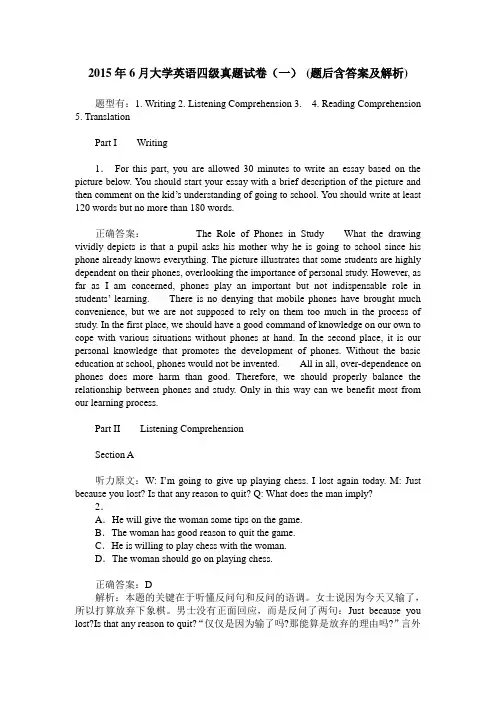
2015年6月大学英语四级真题试卷(一)(题后含答案及解析)题型有:1. Writing 2. Listening Comprehension 3. 4. Reading Comprehension 5. TranslationPart I Writing1.For this part, you are allowed 30 minutes to write an essay based on the picture below. You should start your essay with a brief description of the picture and then comment on the kid’s understanding of going to school. You should write at least 120 words but no more than 180 words.正确答案:The Role of Phones in Study What the drawing vividly depicts is that a pupil asks his mother why he is going to school since his phone already knows everything. The picture illustrates that some students are highly dependent on their phones, overlooking the importance of personal study. However, as far as I am concerned, phones play an important but not indispensable role in students’learning. There is no denying that mobile phones have brought much convenience, but we are not supposed to rely on them too much in the process of study. In the first place, we should have a good command of knowledge on our own to cope with various situations without phones at hand. In the second place, it is our personal knowledge that promotes the development of phones. Without the basic education at school, phones would not be invented. All in all, over-dependence on phones does more harm than good. Therefore, we should properly balance the relationship between phones and study. Only in this way can we benefit most from our learning process.Part II Listening ComprehensionSection A听力原文:W: I’m going to give up playing chess. I lost again today. M: Just because you lost? Is that any reason to quit? Q: What does the man imply?2.A.He will give the woman some tips on the game.B.The woman has good reason to quit the game.C.He is willing to play chess with the woman.D.The woman should go on playing chess.正确答案:D解析:本题的关键在于听懂反问句和反问的语调。
2015.6 英语四级考试真题试卷(第一套)听力

1.A) He will give the woman some tips on the game.B) The woman has good reason to quit the game. C) He is willing to play chess with the woman.D) The woman should go on playing chess。
2.A) The man can forward the mail to Mary。
B) She can call Maiy to take care of the mail。
C) Mary probably knows Sally’s new address.D) She would like to resume contact with Sally。
3.A) His handwriting has a unique style。
B) His notes are not easy to read。
C) He did not attend today's class.D) He is very pleased to be able to help。
4.A) The man had better choose another restaurant。
B) The new restaurant is a perfect place for dating. C) The new restaurant caught her fancy immediately. D) The man has good taste in choosing the restaurant.5。
A) He has been looking forward to spring.B) He has been waiting for the winter sale。
C) He will clean the woman's boots for spring。
2015年6月第一套CET-4真题
2015年6月英语四级真题与答案(第一套)Part I Writing(30 minutes)Directions: For this part, you are allowed 30 minutes to write an essay based on the picture below. You should start your essay with a brief description of the picture and then comment on the kid's understanding of going to school .You should write at least 120 words but no more than 180 words.Part II Listening Comprehension (30minutes)(请点此查看听力内容和答案)2015年6月英语四级听力真题与答案(含录音和原文)第一套一、听力录音以下为2015年6月英语四级听力录音(第一套),请同学们认真反复多次听,直到听懂为止!二、听力试题Part II Listening Comprehension (30 minutes)Section ADirections:In this section,you will hear 8 short conversations and 2 long conversations.At the end of each conversation,one or more questions will be asked about what was said.Both the conversation and the questions will be spoken only once.After each question there will be a pause.During the pause,you must read the four choices marked A),B),C)andD),and decide which is the best answer,Then mark the corresponding letter on Answer Sheet1 with a single line through the centre.注意:此部分试题请在答题卡1上作答。
2015.6 英语四级考试真题试卷(第一套)听力
1。
A) He will give the woman some tips on the game。
B) The woman has good reason to quit the game。
C) He is willing to play chess with the woman。
D) The woman should go on playing chess。
2.A) The man can forward the mail to Mary.B) She can call Maiy to take care of the mail.C) Mary probably knows Sally's new address.D) She would like to resume contact with Sally。
3.A) His handwriting has a unique style。
B) His notes are not easy to read。
C) He did not attend today’s class.D) He is very pleased to be able to help.4.A) The man had better choose another restaurant。
B) The new restaurant is a perfect place for dating。
C) The new restaurant caught her fancy immediately.D) The man has good taste in choosing the restaurant。
5。
A) He has been looking forward to spring.B) He has been waiting for the winter sale.C) He will clean the woman's boots for spring.D) He will help the woman put things away。
2015.6 英语四级考试真题试卷(第一套)听力
1。
A) He will give the woman some tips on the game。
B) The woman has good reason to quit the game. C) He is willing to play chess with the woman。
D) The woman should go on playing chess.2.A) The man can forward the mail to Mary。
B) She can call Maiy to take care of the mail。
C) Mary probably knows Sally's new address.D) She would like to resume contact with Sally.3。
A) His handwriting has a unique style。
B) His notes are not easy to read.C) He did not attend today's class.D) He is very pleased to be able to help.4.A) The man had better choose another restaurant。
B) The new restaurant is a perfect place for dating。
C) The new restaurant caught her fancy immediately。
D) The man has good taste in choosing the restaurant。
5.A) He has been looking forward to spring。
B) He has been waiting for the winter sale。
2015.6 英语四级考试真题试卷(第一套)听力
1.A) He will give the woman some tips on the game.B) The woman has good reason to quit the game.C) He is willing to play chess with the woman.D) The woman shoul d go on playing chess.2.A) The man can forward the mail to Mary.B) She can call Maiy to take care of the mail.C) Mary probably knows Sally's new ad dress.D) She woul d like to resume contact with Sally.页脚内容13.A) His handwriting has a unique styl e.B) His notes are not easy to read.C) He did not attend today's class.D) He is very pl eased to be abl e to help.4.A) The man had better choose another restaurant.B) The new restaurant is a perfect place for dating.C) The new restaurant caught her fancy immediately.D) The man has good taste in choosing the restaurant.5.A) He has been l ooking forward to spring.B) He has been waiting for the winter sal e.C) He will cl ean the woman's boots for spring.D) He will help the woman put things away.页脚内容26.A) The woman is rather forgetful.B) The man appreciates the woman's help.C) The man often l ends books to the woman.D) The woman often works overtime at weekends.7.A) Go to work on foot.B) Take a sightseeing trip.C) Start work earlier than usual.D) Take a walk when the weather is nice.8.A) The plane is going to land at another airport.B) All flights have been d elayed due to bad weather.C) Temporary cl osing has disturbed the airport's operation.页脚内容3D) The airport's management is in real need of improvement. Questions 9 to 12 are based on the conversation you have just heard.9.A) It specializes in safety from l eaks.B) It is head quartered in Lond on.C) It has a partnership with LCP.D) It has a chemical processing plant.10.A) He is Mr. Grand's Mend.B) He is a safety inspector.C) He is a sal esman.D) He is a chemist.11.页脚内容4A) Director of the safety d epartment.B) Mr. Grand's personal assistant.C) Head of the personnel d epartment.D) The public relations officer.12.A) Wait for Mr. Grand to call back.B) Leave a message for Mr. Grand.C) Provid e d etails of their products and services.D) Send a comprehensive d escription of their work.Questions 13 to 15 are based on the conversation you have just heard.13.A) She l earned playing the violin from a famous French musician.B) She dreamed of working and living in a European country.C) She read a l ot about European musicians and their music.页脚内容5D) She listened to recordings of many European orchestras.14.A) She began taking violin l essons as a small chil d.B) She was a pupil of a famous European violinist.C) She gave her first performance with her father.D) She became a professional violinist at fifteen.15.A) It gave her a chance to expl ore the city.B) It was the chance of a lifetime.C) It was a great chall enge to her.D) It helped her l earn classical French music.页脚内容6Passage OneQuestions 16 to 18 are based on the conversation you have just heard.16.A) There are mysterious stories behind his works.B) There are many misund erstandings about him.C) His works have no match worl dwid e.D) His personal history is little known.17.A) He moved to Stratford-on-Avon in his childhood.B) He failed to go beyond grammar school.C) He was a member of the town council.D) He once worked in a well-known acting company.页脚内容718.A) Writers of his time had no means to protect their works.B) Possibl e sources of clues about him were l ost in a fire.C) His works were adapted beyond recognition.D) Peopl e of his time had little interest in him.Passage TwoQuestions 19 to 21 are based on the passage you have just heard.19.A) Theft.B) Cheating.C) Air crash.D) Road accid ents.20.页脚内容8A) Leam the l ocal customs.B) Make hotel reservations.C) Book tickets well in advance.D) Have the right d ocuments.21.A) Contact your agent.B) Get a lift if possibl e.C) Use official transport.D) Have a friend meet you.Passage ThreeQuestions 22 to 25 are based on the passage you have just heard.22.A) Cut d own production cost.页脚内容9B) Sell inexpensive products.C) Specialise in gol d ornaments.D) Refine the taste of his goods.23.A) At a national press conference.B) During a live tel evision interview.C) During a l ocal sal es promotion campaign.D) At a meeting of top British businesspeopl e.24.A) Insulted.B) Puzzl ed.C) Distressed.D) Discouraged.25.页脚内容10A) The words of some businesspeopl e are just rubbish.B) He who never l earns from the past is bound to fail.C) There shoul d be a limit to one's sense of humour.D) He is not laughed at, that laughs at himself first.Looking at the basic biol ogical systems, the worl d is not d oing very well. Yet economic indicators sho w the worl d is __26__ . Despite a sl ow start at the beginning of the eighties, gl obal economic output increas ed by more than a fifth during the __27__ . The economy grew, trad e increased, and millions of new jobs we re created. How can biol ogical indicators show the __28__ of economic indicators?The answer is that the economic indicators have a basic fault: they show no difference between resou rce uses that __29__ progress and those uses that will hurt it. The main measure of economic progress is t he gross national product (GNP). __30__ , this totals the value of all goods and services produced and subtra cts l oss in value of factories and equipment. Devel oped a half-century ago, GNP helped __31__ a common wa页脚内容11y among countries of measuring change in economic output. For some time, this seemed to work __32__ w ell, but serious weaknesses are now appearing. As indicated earlier, GNP includ es l oss in value of factories and equipment, but it d oes not __33__ the l oss of natural resources, including nonrenewabl e resources suc h as oil or renewabl e resources such as forests.This basic fault can produce a __34__ sense of national economic health. According to GNP, for exampl e, countries that overcut forests actually d o better than those that preserve their forests. The trees cut d ow n are counted as income butnosubtractionis mad e for __35__ the forests.参考答案:1-5:DCBAA6-10:BACDC11-15:BCDAB16-20:DCBAD21-25:CBDAC26. prospering27. d ecad e28. opposite29. sustain页脚内容1230. In simpl e terms31. establish32. reasonably33. take into account34. misl eading35. using up页脚内容13。