
高中英语选修8Unit1Learning---about---Language
名词性从句 Noun Clause
主语从句 Subject Clause
表语从句 Predicative Clause
宾语从句 Object Clause
同位语从句 Appositive Clause
引导宾语从句的连接词: 1. 连词:whether, if, that 2. 连接代词:who, whom, whose,
what, which 3. 连接副词:when, where, why, how
宾语从句就是在复合句中作宾语的名 词性从句,通常放在主句谓语动词 (及物动词)或介词之后。
1. 作动词的宾语 She did not know what had happened. 动词+间接宾语+宾语从句 She told me that she would accept my invitation.
主语从句 Subject Clause
在一个句子中由一个句子充当的主 语,这个句子叫做主语从句。 How the book will sell depends on its author. That he is the best student in the class is obvious.
whether与if均为“是否”
Whether you like it or not, you’ll have
to do it.
主谓一致问题
主语是名词性从句, 动词通常用单数。 What I am most interested in is American movies. 我最感兴趣的是美国电影。
What you said yesterday is right. 你昨天说的是对的。
The fact that he tells lies all the time makes us surprised. There is no doubt that it will rain tomorrow. Appositive Clauses
Noun Clauses Function as a NOUN in a sentence.
b. It + be + -ed 分词+ that-从句 It is believed that… 人们相信…… It is known to all that… 众所周知…… It has been decided that… 已决定……
c. It + be +名词+ that-从句 It is common knowledge that… ……是常识 It is a surprise that… 令人惊奇的是…… It is a fact that… 事实是……
Grammar
Revise Noun Clauses
What kind of clauses are they?
What the driver of the yellow car did made me extremely angry. Why she did this is still unknown.
下列情况下只用whether: 1. 引导主语从句并在句首
Whether he will come is not clear. 2. 引导表语从句
The question is whether he’ll come. 3. 从句作介词宾语
I’m not sure about whether we’ll win. 4. 从句后有"or not"
5. The economic _b_o_o_m__ in recent years has created more job opportunities.
6. __I_ta_l_y__ shaped like a boot lies in the south of Europe.
7. We should draw a _d_i_st_i_n_c_ti_o_n_ between right and wrong.
引导名词性从句的连接词
可分为三类: 1. 连接词that, whether, if不充当从句的
任何成分。 2. 连接代词:what, whatever, who,
whoever, whom, whose, which 不仅 起到连接一个句子的作用,同时也是 从句的一个组成部分。 3. 连接副词:when, where, how, why
8. To make the crosrtheast, our ancestors suffered all kinds of _h_a_r_d_s_h_ip__.
9. The people from South or North _K__o_r_e_a_ are called Koreans.
2. His proposal was that the work (s_h_o_u_l_d_)_b_e__fi_n_i_sh__ed_(finish) in five hours.
宾语从句 Object Clause 在一个句子中由一个句子充当的 宾语,这个句子叫做宾语从句。 I worry about whether he can get over the illness. John said that he was leaving for London on Wednesday.
aircraft crossing by means of make a life rail strait Arctic
My nephew’s first holiday to the _A_r_c_t_ic_ was a delight. The scenery and the icebergs excited him. Looking across the Bering _st_r_a_i_t into Russia was something he would remember forever. To make the _c_r_o_s_s_in_g_ between these two great countries seemed as if it would take no time at all! Then he travelled across the ice _b_y_m__e_a_n_s_o_f_ a dog sled. It made the journey he had earlier done by _r_a_il____ seem very ordinary.
Subject Clauses It’s hard to forget what we have learned in his classes. Please don’t tell my mother when I’ll give her my gift. Object Clauses
That’s why I can’t follow you. The problem is that it’s very hard to catch your words. Predictive Clauses
hardship/hardness race
distinct
distinction
Adjective Italian Korean Pakistani Denish
Noun
Italy Korea Pakistan Denmark
Verb apply
Adjective applied
Noun application
主语从句常用it作形式主语放句首
用 it 作形式主语,that引导的从句是句 子的真正主语。 有以下四种不同的结构:
a. It + be +形容词+ that-从句 It is necessary that… 有必要…… It is important that… 重要的是…… It is obvious that… 很明显……
10. Nobody knows who will be __el_e_c_te_d___ as president or vice president of this country.
3 Choose the words and phrases to fill in the blanks, changing their forms if necessary.
ever seen.
3. The _m_a_j_o_r_it_y_ of us voted for Mr Red, who then became chairman of the committee.
4. The _M__in_i_s_tr_y_ of Education is one of the government departments.
表语从句需要注意的问题
1. 表语从句可以用that, why,where, when, how, whether, what, who, which 等词引导。
2. 在that引导的表语从句中,that不能 用which来替换。
3. 如果引出表语从句的名词是一些表示 “建议”或者是“命令”之类的词如
simplify
simple simplicity
mix illustrate
mixed
mixture
illustrative illustration
2 Complete these sentences, using new words from the text.
1. A _f_e_d_e_r_a_l country consists of a group of states. 2. That is the biggest _c_a_th_o_l_i_c church I have
高中英语人教版选修八Unit1AlandofdiversityLanguagepoints教案(系列二)
选修八Unit 1 A land of diversityPeriod2 Language pointsTeaching goals教学目标1. Ability goals能力目标Enable the students to learn about the word transformation between the nouns, adjectives and verbs.2. Learning ability goals 学能目标Help the students learn how to know the parts of speech according to the suffixes.Teaching difficult points教学难点Get the students to know the word formation by adding suffixes.Teaching methods教学方法Study individually, practice in groups.Teaching aids教具准备A computer and a recorder.Teaching procedures & ways教学过程与方式Step I SuffixationAsk students to fill in the charts with the proper forms of the words by practicing Activity 1 on page 4. At last, check the answers with the whole class.T: Today we’re going to learn about suffixes. Do you know what a suffix is?S1: A suffix is a particle, which is added to the end of a root.T: Good. Do you know anything more about it?S2: Generally, suffixes do not change the meaning of the root, but its part of speech. e.g. lead (v.)→leadership (n.) ill (adj.) → illness (n.)S3: Although each suffix has its own meaning, it can’t be used separately without the root.S4: However, some suffixes add new meanings to the newly formed words.e.g. meaning → meaningless think → think erT: Very good! Now who’d like to share your collected suffixes with us?Ss: The following are some of the most commonly used suffixes.1.Suffixes used as a noun signifier2. Suffixes used as an adjective signifier3. Suffixes used as a verb signifierT: Excellent! Now let’s fill in the chart with your partners. Please open your books and turn to page 4 and practice Activity 1 in Discovering words and expressions. Later we’ll check the answers with the whole class.Step III Homework1. Ask the students to finish Activities 1-3 on page 48 in the workbook.2. Ask the students to prepare for the grammar about the Noun Clauses.。
人教版高中英语选修八全册教案
选修8 Unit 1 A land of diversityPeriod 1 ReadingTeaching goalsEnable the students to talk about things about the USA.Help the students learn the huge diversity of races and cultures in America, especially in California.Teaching important and difficult pointsLearn the huge diversity of races and cultures in California.Teaching methodsFast and careful reading; asking and answering activity; individual, pair or group work.Teaching aidsA map, a blackboard and a computerTeaching proceduresStep 1 Warming up.Ask the students to describe what they learn about the USA.Group work: look at the map of the USA with your group. Write on the map the names of as manyof the following as you can. Compare your names with other groups.Step 2 Pre-readingAsk the students to tell things about California including its location, size, population, economy, history etc. What do you learn about California?Show the students some pictures and encourage students not only to say what each picture is about but how each one relates to California.Step 3 Fast readingRead through the passage and get the main idea.Reading comprehension.Ask the students the following questions:When you look at the title, what so you think of ?A land of differences. California is a land of great differences —differences in climate, in landscape and attitude.2) Why is the USA called a melting pot?There are many immigrants to the USA and there are many cultures and nationalities. So it is a place in which people, ideas, etc of different kinds gradually get mixed together.Beside each date note down an important event in Californian history.Step 4 Detail readingBeside each cultural group , write the period in which they first came to California in large numbers.Cultural groups Periods Cultural groups Periods Russians early 1800sJapanese Early 1900sChinese Late 1840s/early 1850s Cambodians From about the 1970s Africans 1800s Koreans From about the 1970 Italians Late 1800s Danish 1911Jewish1920sPakistanisFrom about the 1970sStep 5 After readingWhy is California in the 21st century such a multicultural community? (Using 3 or 4 sentences to explain. ) Step 6 HomeworkFinish “Learning about language ”on page 4.15,000 years ago 16th centure 1821 18461848 1850First settlers crossed the Bening Strait from Asia. These people are now known as Native Americans.Spanish soldiers arrived in South America.California became part of Mexico.The US declared war on Mexico.Gold was discovered in California.California became the 31st state of the US.Period 2 Extensive ReadingTeaching aims: 1. Improve Ss’ ability of reading2. 德育目标:了解美国多元文化,进一步培养学生跨文化交际意识,为终身学习奠定良好基础。
人教课标版高中英语选修8Unit1Learning about language (共36张PPT)
2020/6/3
5
1). 德国大约有八千一百万人口。 The population of Germany is about
81,000,000.
3). 我们镇五分之三的人是农民。 Three fifths of the population in our
town are farmers.
【解析】 be likely to do sth“有可能会 做某事”,likely的 主语可以为人,而 possible和probable 一般不用人作主语, 故答案为likely。
2020/6/3
15
5. In the 16th century, after the arrival of Europeans, the native people suffered greatly.
9
2) 辨析:likely, possible与probable possible指客观上有可能性,但往往含有
希望很小的意味;probable比possible可能 性稍大,有“较为可能、大概”,指有实 际依据;likely是从外表迹象判断有可能发 生的事。
2020/6/3
10
probable句型: 为 It is probable that … possible句型: 为 It’s possible (for sb.) to do
2020/6/3
25
8. Of the first Spanish to go to California, the majority were religious men, whose ministry was to teach the Catholic religion to the natives.
高中英语人教版选修八 Unit 1 Learning about Langage 讲义

优质资料---欢迎下载Unit 1 Learning about Langage学习目标 1. 通过单句改错,复习课文中考查点2. 朗读新单词单词 3.阅读理解阅读材料 4.学习重点句式结构和核心词的基本含义。
学习过程活动目的及注意点Step I Read the New Words 复习重要考查点注意提前2分钟开始7mins①When the first people arrived in that we now know as California,no one knows.②However, Native Americans are likely living in California at least fifteen thousand years ago. 然而,土著美国人有可能在一万五千年前就在加州生活着。
③Two centuries later,the spanish settled in most parts of South America and along the northwest coast of where we now call the U.S.④In the first Spanish to go to California, the majority was religious men, whose ministry was to teach the Catholic religion to the natives.在首批移居加州的西班牙人中,大部分是宗教人士,他们的职责是…⑤Some died or returned home, but most remained in California to make a life for themselves despite it is of great hardship.一些人死了或回家了,但是多数人不论多么艰苦,都留在了加州谋生。
最新人教版高中英语选修8全册教案
人教版高中英语选修8全册教案Unit 1 A land of diversityPeriod 1 ReadingTeaching goalsEnable the students to talk about things about the USA.Help the students learn the huge diversity of races and cultures in America, especially in California.Teaching important and difficult pointsLearn the huge diversity of races and cultures in California.Teaching methodsFast and careful reading; asking and answering activity; individual, pair or group work. Teaching aidsA map, a blackboard and a computerTeaching proceduresStep 1 Warming up.Ask the students to describe what they learn about the USA.Ask the students to tell things about California including its location, size, population, economy, history etc. What do you learn about California?Show the students some pictures and encourage students not only to say what each picture is about but how each one relates to California.Step 3 Fast readingRead through the passage and get the main idea.Reading comprehension.Ask the students the following questions:When you look at the title, what so you think of ?2) Why is the USA called a melting pot?Step 4 Detail readingBeside each cultural group , write the period in which they first came to California in large numbers.Step 5 After readingWhy is California in the 21st century such a multicultural community? (Using 3 or 4 sentences to explain. )Step 6 HomeworkFinish “Learning about language”on page 4.Period 2 Extensive ReadingTeaching aims: 1. Improve Ss’ ability of reading2. 德育目标:了解美国多元文化,进一步培养学生跨文化交际意识,为终身学习奠定良好基础。
人教版高中英语选修8全册教案
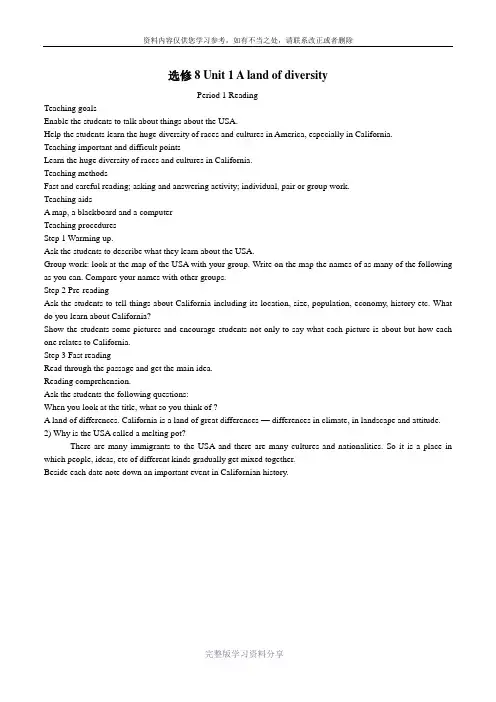
选修8 Unit 1 A land of diversityPeriod 1 ReadingTeaching goalsEnable the students to talk about things about the USA.Help the students learn the huge diversity of races and cultures in America, especially in California.Teaching important and difficult pointsLearn the huge diversity of races and cultures in California.Teaching methodsFast and careful reading; asking and answering activity; individual, pair or group work.Teaching aidsA map, a blackboard and a computerTeaching proceduresStep 1 Warming up.Ask the students to describe what they learn about the USA.Group work: look at the map of the USA with your group. Write on the map the names of as many of the following as you can. Compare your names with other groups.Step 2 Pre-readingAsk the students to tell things about California including its location, size, population, economy, history etc. What do you learn about California?Show the students some pictures and encourage students not only to say what each picture is about but how each one relates to California.Step 3 Fast readingRead through the passage and get the main idea.Reading comprehension.Ask the students the following questions:When you look at the title, what so you think of ?A land of differences. California is a land of great differences — differences in climate, in landscape and attitude.2) Why is the USA called a melting pot?There are many immigrants to the USA and there are many cultures and nationalities. So it is a place in which people, ideas, etc of different kinds gradually get mixed together.Beside each date note down an important event in Californian history.Step 4 Detail readingStep 5 After readingWhy is California in the 21st century such a multicultural community? (Using 3 or 4 sentences to explain. ) Step 6 HomeworkFinish “Learning about language”on page 4.Period 2 Extensive ReadingTeaching aims: 1. Improve Ss’ ability of reading2. 德育目标:了解美国多元文化,进一步培养学生跨文化交际意识,为终身学习奠定良好基础。
人教课标版高中英语选修8 Unit1 learning about language (共34张PPT)
从句的时态
如果主句是过去的时态(包括一般过去时, 过去进行时),
那么从句的时态一定要用相对应的过去的某种时态。
➢ When will Professor Li give us a talk? We wanted to know … We wanted to know when Professor Li would give us a talk.
主语从句
I believe (that) he is honest.
宾语从句
The question is who (which of you) will be the next speaker. 表语从句 The question how he had landed on the moon spread all over the world.
Hale Waihona Puke (3) It is + 不及物动词+从句 It seems that … 似乎…… It happened that … 碰巧…… It appears that … 似乎……
(4) It is + 过去分词+从句 It is reported that … 据报道…… It has been proved that … 已证实… It is said that … 据说……
I’d appreciate it if you come to help. 我讨厌他们满嘴食物时说话
I hate it when they talk with their mouths full of food. 2.表示喜好,憎恶类动词like ,enjoy,appreciate,dislike,hate,以
人教课标版高中英语选修8 Unit1_Learning_about_Language_名师教学设计
Unit1 learning about Language 名师教学设计英语阅读猜词技巧课的教学设计课型:技能训练课课时:一节课(40分钟)授课对象:高二文二班学生授课时间:2017年5月2日授课地点:录播室一、教学设计的背景和意义:1. 新课标和考纲的要求:猜测词义的能力是语言运用能力中非常重要的一部分,高中英语新课程标准要求高中学生能利用上下文和句子结构猜测词义(教育部,2017)。
新课程标准对合格高中毕业生阅读外语速度的要求是每分钟70—80个词,在阅读的过程中同时培养从上下文所给的信息中猜词的能力。
高考的阅读材料中可以含有3%的生词,高考试题的阅读理解部分没汉语注释的生词,往往是出题人有意识留下的题眼。
每年的高考阅读理解中有1-2个词义猜测题,近几年的高考阅读试题中词义猜测的考查力度逐步加大,要求考生阅读时能够通过上下文,结合中学生应有的常识来推测尚不熟悉的词和词组的意思。
2. 学情分析:高二学生已掌握了一定的英语阅读技巧并有一定的语篇分析能力,积累了一定的词汇量和构词法知识,有较丰富的学习经验和生活常识,但生词依然是学生英语阅读过程中遇到的最大绊脚石,它直接关系到学生的阅读兴趣能否持续。
阅读中遇到生词时,许多学生或翻阅词典或求助老师,缺乏利用语境中已知信息进行推测、判断某些生词意义的习惯和意识。
因此,通过这样的一节课来指导和训练学生掌握一定的猜词技巧和策略,对突破高考阅读理解中生词的障碍,顺利理解文章的思想内容,提高阅读速度,提高学生的捕捉文本信息能力和语篇分析能力都有非常重要的指导意义。
二、教学目标:通过“自主探究,合作讨论”的学习方式,指导学生回顾和总结猜词的技巧与策略,学会“利用经验常识猜词”、“利用构词法知识猜词”、“利用语境上下文提供的线索和标志词找寻信息猜词”,提高学生利用语境猜词的意识和能力。
三、教案设计I 教学目标Knowledge and skills知识与技能1. Acquire the techniques and strategies of word-guessing2. Use the techniques and strategies of word-guessing learnt to solve the problems. Emotion, attitude and values 情感态度价值观1. Build up confidence in guessing new words while reading2. Increase the awareness of guessing new words in reading discourses depending on t he context and enhance the skills in use.II教学重点与难点Teaching focus:1. Search for the clues and hints in the context that reveal the techniques of word-gues sing.2. Sum up the ways and the techniques to guess new words.III教学方法Communicative Approach,cooperative-learning,Inquiry-based learning,Autonomous learning,Individual work,Group discussionIV教学过程设计Teaching Procedures:Step1. A guessing game1.Prepare some papers and write one word on each paper before class.2.Divide students into two groups and choose three students from each group. One to act out the word using body language or English descriptions. One to write down the word on the blackboard. One to hold up the paper. The others in the group to guess the word.The more the better in 2 minutes.3.Ask the students a question: “When you meet a new word while reading, what would you do, ignore it, look it up in the dictionary or guess?”4. Lead in the topic of the class:How to Guess the Meaning in Reading.Step2.Reading and discussing1.Students work in groups to do some exercises.2.Cooperate in groups and inquire some ways to guess the meaning of each unknown word according to the given contexts.3.Students sum up the ways with the help of the teacher and through inquiring-learnin gStep3. Analyzing and discoveringStudents activity【课堂活动】1.Work in groups and observe the following sentences, predict the meaning of each un known word depending on contexts, and try to discover the key words (clues and hint s hidden) in the context.2.Present what the group discover and recommend the next group to continue the pres entation.3.Teacher adds and extends more informationStep4. Summarizing the rules1. Teacher and students to summarize the six ways of guessing the words.To guess the words correctly we can use the context clues:①Use synonym(同义词) Context Clues②Use Antonym(反义词) Context Clues③Use definition/ example/description clues(文中的定义或解释说明)④ Use common sense/related information clues(常识和经验)⑤Use grammar and punctuation clues(标点符号或提示词)⑥Use causes and effects relations(因果关系)⑦Use transition and contrast clues(转折和对比关系)⑧Use word-building(构词法)Step 5. Practice and consolidation1. Ask the students to do some exercises in class.2. Let the students check the answers with their partners and discuss how they finish them.3. Check the answers with the whole class one by one and point the ways of doing the exercises out for the students.Step 6. Emotion motivation.1.Words,like people,are frequently known by the company they keep.A word’s contex t or surroundings can provide clues to meanings.2.Unfamiliar words is to English reading is like what setbacks is to our life.No matter what difficulties you come across in your life, remember that as long as yo u don’t lose heart, you are sure to find a way out.3.Where there is a will, there is a way.Step 7. Homework1.Review what we learned today.2.Finish the related exercises..教学反思:本节课的设计符合高二学生的学情,以学生为本,指导学生归纳总结猜测词义的技巧与策略,提高学生利用语境猜词的意识和能力。
人教版高中英语选修八Unit1Learning about language课件
Although each suffix has its own meaning, it can’t be used separately without the root. However, some suffixes add new meanings to the newly formed words.
Suffix -ary -able -ing -ed
Adjective secondary changeable annoying excited
3. Suffixes used as a verb signifier Adjective Noun Suffix Verb
broad simple modern
aircraft crossing by means of make a life rail strait Arctic Russia was something he would remember crossing between these forever. To make the __________ two great countries seemed as if it would take no time at all! Then he travelled across the ice ___________ by means of a dog sled. It made the journey he had earlier done by _________ seem very rail ordinary. When he reached the North Pole,
aircraft crossing by means of make a life rail strait Arctic he found nothing exciting except for a sign marking the spot, but he did meet some scientists there who were studying the melting a life for themselves of the ice and making ___________ among the snowy hills and plains. After a short break he took the local ___________ aircraft to fly back to Alaska and the sea voyage back home!
人教版英语选修8讲义:Unit 1 Section Ⅲ Learning about Languag
Section ⅢLearning about Language &Using Language根据提示写出下列单词1.n.申请人2.v i. 发生;出现3.v t. 指出;标示;表明;暗示4.adj. 显而易见的;显然的;表面上的5.v i. 滑动;滑行;滑跤n. 滑动;滑倒6.v t.&n. 租用;雇用7.ad v. 无处;到处都无8.n. 处罚;惩罚9.v t.&v i. 改革;革新n. 改革;改造;改良10.adj. 感激的;感谢的【答案】 1.applicant 2.occur 3.indicate4.apparent 5.slip 6.hire 7.nowhere8.punishment 9.reform10.thankful根据提示补全下列短语1.back back背靠背2.team up 与……合作或一起工作3.mark 用线画出范围,标出……界线4.take 包括;吸收5.great/good many 许多;很多6.apply 申请;请示得到7.feel like sth. 想要做某事8.all sorts 各种各样的【答案】 1.to 2.with 3.out 4.in 5.a 6.for7.doing8.of根据提示补全下列教材原句1.我没想到……2.,the cable car system was invented by Andrew Hallidie,who wanted to find a better form of transport than horsedrawn trams.缆车系统建于1873年,是由安德鲁·哈利迪发明的,他试图找到一种比马拉轨道车更好的交通方式。
3.In 1940 the civil authorities reformed the system many more Chinese people were able to grasp the opportunity of settling in the USA.1940年当地政府改革了移民体制,这样更多的中国人就能抓住机会定居在美国。