
(完整版)人教版七年级下册英语第四单元课件
2.祈使句的否定形式是在整个结构之前加 don’t或never。如: Don’t be nervous!你不要紧张!
Practice 将下列祈使句改成否定形式。
肯定祈使句
否定祈使句
1. Sit down.
Don’t sit down.
2. Come in.
Don’t come in.
3. Eat at home.
Let’s go! Let us go home! Let him be here by 10 o’clock.
拓1.祈使句的强调形式是在整个结构之前加
do。如:
Do give my regards to your parents! 务必/一定代我向你父母问好!
• 铺床
make one’s bed
• 与某人打架 fight with sb
• 戴帽子
wear a hat/wear hats
School Rules
Don’t arrive late for class.
School Rules
Don’t run in the hallways.
School Rules
拓展
情态动词can的用法
用于疑问句中用来提出要求。例如: Can you...?“请你……好吗?”表示说话 人的请求。 Can I...?“我可以……吗?”用来征求对 方是否允许自己做某事。如在句末加上 please一词就显得更有礼貌了。例如:
没有规章制度就不能治理好国家.
follow the rules
遵守规则
keep rules
family rules 家规
break rules 违反规则 library rules
school rules 校规
图书馆规则
dining rules 就餐规则
class rules 班规
Language goals
1. 表示能力(如体力和脑力方面),意为 “能;会”等。例如: Can you speak English? 你会讲英语吗?
2. 表示请求或允许,多用在口语中,意为“可以; 能”等。例如: Can I help you? 我能帮助你吗? 用于否定句表示不允许。例如: You can’t play basketball. 你不能玩篮球。
重点短语
• ……迟到 arrive(be) late for ……
• 在走廊/餐厅 in the hallway/ dining hall
• 在教室/音乐教室 in the classroom/ music room
• 听(音乐) listen to (the music)
• 外出
go out
• 清洗餐具 do the dishes
• He gets to school on time everyday
• 她及时赶到了医院。
• She reach the hospital in time. • be sitnrsiicdte with里s面b.的;在里部的
• 他爸爸对他很严格。
• His father is strict with him.
1.第二人称祈使句通常用来向听话者发出命 令,提出要求或建议。这种祈使句的主语
you通常不表示出来,而是以动词原形开 头。如: Stand up! Don’t worry about!
拓展
祈使句
2.第一、三人称祈使句是以第一人称和第 三人称代词或者名词等作为祈使的对 象,这类祈使句通常以let为引导词表建 议。如:
talk about rules
谈论规则
break the rules
违反规则
break the school rules 违反校规
break the class rules 违反班规
拓展
祈使句
一、祈使句的分类
祈使句表请求、命令、叮嘱、邀请、劝告 等。祈使句分为第二人称祈使句及第—、 三人称祈使句两大类。
Unit 4
Don’t eat in class.
New words
hallway 走廊;过道
New words
classroom 教室
New words
rule
规则
New words
dinning 饭厅;餐厅
New words
fight
打架;争吵
Don’t fight . 不要打架. fight 战斗, 斗争, 作战
School Rules
Don’t sleep in class.
School Rules
Don’t use mobile phone in class.
School Rules
Don’t smoke. (No smoking)
We can’t rule the country without rules.
Don’t eat at home.
4. Listen to music outside.
Don’t listen to music outside. 5. Do your homework at school.
.Don’t do your homework at school.
拓展
情态动词can的用法
fight with sb. 同某人打架 fight the fire 救火
Explanation
fight 是不及物动词,其后加上with才能接 宾语。fight with sb. 意为“与某人打架”。 如: Don’t fight with your sister again.
不要再和你妹妹打架了。 They are fighting with the enemies bravely. 他们正在勇敢地同敌人战斗。
Notes : 1 arrive in / at + 地点
get to +地点 reach +地点 (到达某地方 ) 2 class 班 ,课 in class 在课堂上 have classes 上课 be late for class 上课迟到
• on time 准时
in time 及时
• 他每天准时到校。
Don’t eat in the classroom.
School Rules
Don’t listen to music in the classrooms or the hallways.
School Rules Don’t fight.
School Rules
Don’t talk in class. Don’t talk with each other in class.
2019人教版七年级英语下册Unit4_Don't_eat_in_class课件PPT(年春)教育物理

Don’t talk in class.
Don’t talk with each other in class. Stop talking in class.
Don’t play cards in school.
Don’t smoke .It’s bad for your health.
Don’t sleep in class.
Don’t fight. We can’t fight with others.
Grammar
1. 祈使句是表示请求、命令、叮嘱、号召、 劝告等的句子; 通常省略主语you; 句中谓语 动词用动词原形; 句尾一般用降调; 祈使句的
开头是动词原形。
祈使句有肯定和否定两种: e.g. Look out! 小心!
Don’t wear hats in class. Don’t dance in the classroom.
Wear a uniform.
Don’t listen to music in the classroom.
Listen to music in the music room.
Homework
Can we eat in class? No, we can’t.
Don’t eat in the classroom.
arrive late for class Can we arrive late for class? No, we can’t.
Don’t arrive late for class.
• Think about the family rules.
FAMILY RULES
Don’t talk loudly on the phone.
unit 4【复习课件】七年级英语下册单元复习(人教版)

10. I can’t relax on weekends __e_it_h_e_r___ _b_e_c_a_u_se___ I have to
learn to play the piano. 周末我也不能放松, 因为我不得不去学习弹钢琴。
重点语法
祈使句
用于表达命令、请求、劝告、警告、禁止等的句子称为 祈使句。祈使句最常用于表达命令。祈使句因对象(即主语) 是第二人称, 所以通常省略主语而以动词原形开头。祈使句句 末使用句号或感叹号。为表示语气委婉, 可在句首或句尾加 please, please放在句尾时, 前面通常加逗号。
Let me help you. 让我来帮你。
重点语法
祈使句
考题:[ 广元] —________ silent, please! You are in the library.
—I’m sorry, madam.
A. Keep
B. To keep
C. Keeping
D. Kept
重点语法
祈使句
否定祈使句的形式:
重点单词
1. rule n. 规则; 规章→____s_c_h_o_o_l_r_u_le_s___学校规则 2. arrive v. 到达→ ___a_r_r_iv_e__in_/_a_t._..__到达……
→ar_r_i_v_e_l_a_te__fo_r__sc_h上oo学l 迟到 3. fight v.& n. 打架; 战斗→ __f_ig_h__t _a_g_a_in_s_t_s_b_.和某人打斗→
→_____fo_l_lo_w__in_g____n. 下列事物
重点单词
30. learn v. 学习; 学会→ _le_a_r_n__to__d_o_s_t_h_.____学习做某事 → ____l_ea_r_n__fr_o_m__s_b_.向某人学习 → ____l_e_a_rn__a_b_o_u_t了解; 获悉
人教版七年级英语下册作业课件 Unit 4 周周清4
五、还原型阅读。(5×3分=15分) 根据短文内容,从短文后的选项中选出能填入空白处的最佳选项。选项中有一项 为多余选项。
Susan is a twelveyearold girl.She is a middle school student.She is not happy these days,because there are many rules at home and at school for her.
B( )25.What can be the best title for the passage? A.How to Be a Good Boy B.Rules in Henry's Life C.How to Make Rules D.Rules in Henry's School
四、词汇运用。(共15分) A)根据句意及汉语或首字母提示填写单词。(5×1分=5分) 26.You have to __w__e_a_r_(穿) sports shoes in P. E. class. 27.Can you call me _b_e_fo_r_e____(在……以前) 9:30 in the evening? 28.I want to l_e_a_rn__ Chinese kung fu.Can you teach me? 29.We can't play soccer in the room.Let's play o__u_t_si_d_e___. 30.It's very i__m__p_o_r_ta_n_t__ for us to do exercise every day.
二、完形填空。(10×2分=20分) There are lots of rules in Tom's school.He thinks some of them are __11__. For example (例如),they can't __12__ late;they can't run in the hallways;and they can't eat in class.All these __13__ are OK. But there are some rules Tom __14__ like.All students in his school have to __15__ the school uniform and they can't wear their own clothes.__16__ Tom thinks their own (自己的) clothes are good.At school,students can't __17__ to music.Tom doesn't like this rule.He thinks listening to music is __18__. Tom also has to __19__ some rules at home.For example,he has to do his homework first.Then he can watch TV.And he can't __20__ with his friends on school nights.He also has to clean his room every week.
2020-2021学年人教版七年级英语下册Units3---4单元重难点梳理课件
单元语法聚焦三
4.in/on+限定词+交通工具名词(在句中作状语): on a bus/bike, on the train, in his car等。 —How does Lily go to school? —She goes to school on her bike. “莉莉怎样去上学?”“她骑自行车去上学。” 5.on foot意为“步行”。 Lucy goes to school on foot every day. 露西每天步行去上学。
单元语法聚焦三
(5)how much询问不可数名词的数量时,意为“多少”;询问物 品价格时,意为“多少钱”。 How old are your grandparents?你的祖父母多大了? How many factories are there in your hometown? 你的家乡有多少工厂? How much bread is there on the table?桌上有多少面包? How much is the black and white sweater? 那件黑白相间的毛衣多少钱?
(8) by boat
(9) how far
(10) 10 kilometers
单词和词组
1、多长时间 2、三十里分钟 3、对很多学生来说 4、在一个小村庄里 5、穿过小河 6、在A和B之间 7、没有桥 8、害怕 9、实现 10、认为
1.how long 2.thirty minutes 3.for many students 4.in a small village 5.cross the river 6.between A and B 7.there is no bridge 8.be afraid e ture 10.think of
七年级下册英语Unit 4单元教案(人教版)
2. Work on 2b:
Make Sure Ss know what they should do.
Listen to the recording again. Can Alan and Cindy do these activities? Circle can or can't above.
课型
新授
课时
4
教材分析
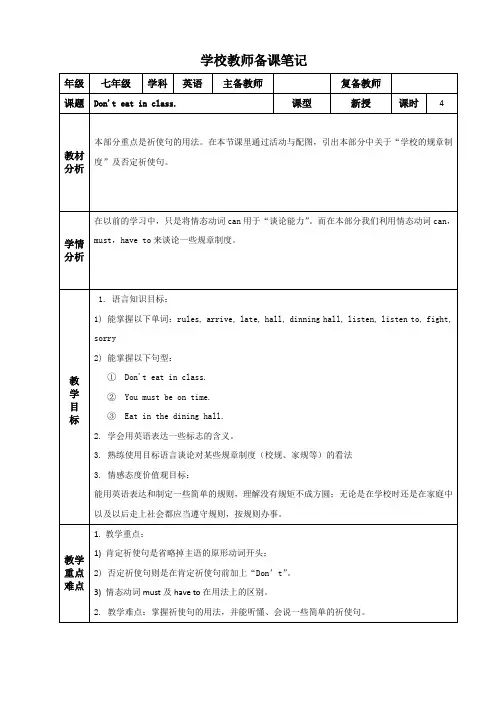
本部分重点是祈使句的用法。在本节课里通过活动与配图,引出本部分中关于“学校的规章制度”及否定祈使句。
学情分析
在以前的学习中,只是将情态动词can用于“谈论能力”。而在本部分我们利用情态动词can,must,have to来谈论一些规章制度。
教
学
目
标
1. 语言知识目标:
1) 能掌握以下单词:rules, arrive, late, hall, dinning hall, listen, listen to, fight, sorry
1. Ss work by themselves and try to write the sentences on the workbook.
教
学
目
标
1. 语言知识目标:
1) 继续练习运用如何做自我介绍及问候他人。学会从对话中获取对方的基本信息(询问他人姓名)。 能掌握以下句型:
①Don't eat in class.
②You must be on time.
③Eat in the dining hall.
2. 情感态度价值观目标:
该部分继续学习使用目标语言谈论对某些规章制度(校规、家规等)的看法。
最新人教版七年级英语下册 全册PPT课件全集(443张)

join 表示“参加;加入”,此处指加入 社团或组织,成为其中的成员。例如:
join the army 参军 join the Young Pioneer 加入少先队 join the NBA 加入美职篮
4. You are very good at telling stories. 你很擅长讲故事。 be good at sth./doing sth. … 表示“擅 长于 ……; 精通 ……”, 后面可接名词 或动词的ing形式。例如: Mr Li is good at languages. He can speak eight languages.
play basketball 打篮球 play 后跟乐器时,要加定冠词 the。如: play the guitar 弹吉它
play the piano 弹钢琴
3. I want to join the art club. 我想参加美术社团。 club 表示“俱乐部”或“社团”。在
英、 美等国,中小学校会组织各类 俱乐部 来提高学生的兴趣及才能,丰 富他们 的文化生活。相当于我国中小 学校中 的“兴趣小组”。
• 5. Well, you can join the _s_w_i_m__m_i_n_g_ (swim)
club.
• 6. Janew__a_n_ts_ (want) to join a sports club.
三、选词填空。
club can’t sounds like
speak can sports draw
Read the conversation in 2d. Fill in the chart.
Name what can does
clubs
Bob play soccer a sports club
Unit 4 第4课时(Section B 1a-1d) (课件)七年级英语下册(人教版)
1d Talk about the rules in Dave’s house.
He can’t go out on school nights.
He can’t watch TV in the evening.
1d Talk about the rules in Dave’s house.
He can’t see his friends on school days.
does his homework
Look and say
What does he often do?
practices the guitar
Look and say
What does he often do?
does the dishes
Look and say
What does he often do?
பைடு நூலகம்
every Saturday on school days every morning
before dinner after dinner
1c
Listen again. Write when Dave has to follow the rules in the chart in 1b. Choose from the phrases in the box.
Emily : Hi, Dave. Do you _w_a_n_t_t_o_w__a_tc_h__th_e__b_a_sk_e_t_b_a_ll_g_a_m__e_in the park this evening? Dave: I’d love to, but I can’ t go out_o_n_s_c_h_o_o_l_n_i_g_h_ts__. Emily: Oh, that’s too bad. Dave: Yeah, I have s_o__m_a_n_y__ru_l_e_s... Emily: Really? Dave: Yeah, I can’t __se_e__m_y__fr_i_e_n_d_s_o_n_s_c_h_o_o_l_d_a_y_s_and I have to do my homework after school.
人教版英语七年级下册 Unit 4 单元巩固与复习 课件(共25张PPT)
句型分析 1. Don’t arrive late for class. 1)这是一个表示否定的祈使句,祈使句表示请求、命令或者建议。 谓语动词用原形,句子的主语you通常省略。 句子结尾用句号,表示强烈语气的时候用感叹号, 朗读时要用降调。 可以在句末或者句首加上please, 使语气更加的缓和客气。 please 放在句首时后面不需要加逗号,放在句末时后面要加逗号。 例如:Listen to your teacher, please. 请听你的老师讲话。
Clark [kla:k]克拉克(姓;男名) Amy [eɪmɪ]埃米(女名) Molly['mɒlɪ]莫莉(女名) New York [nju: jɔ:k]纽约 arrive [ə'raɪv]v.到达 wear [weə]v.穿;戴 bring [brɪŋ]v.带来;取来 listen ['lɪs(ə)n]v.听;倾听 relax [rɪ'læks]v.放松;休息
have to 不得不have to 得不be quiet 安静
be quiet 安静
make breakfast 做早饭 make breakfast 做早饭
be noisy 吵闹
be noisy 吵闹
keep one’s hair short 留短ke发ep one’s hair short 留 play with sb. 和某人一起短玩发 play the piano 弹钢琴 play with sb. 和某人一
Don’t look out of the window. 不要向窗外看。 Please come in. = Come in, please. 请进。
(完整版)人教版英语七年级下册第四单元短语语法知识点总结及练习
(完整版)人教版英语七年级下册第四单元短语语法知识点总结及练习Unit 4Don’t eat in class【短语归纳】1.on time 准时,按时2. listen to …听……3. in class 在课上4. be late for 做……迟到5. have to 不得不6. be quiet安静7. go out外出8. do the dishes 清洗餐具9. make breakfast 做早饭10. make (one’s) bed 铺床11. be noisy 吵闹12. keep one’s hair short 留短发13. play with sb. 和某人一起玩14. play the piano 弹钢琴15. have fun 玩得高兴16. make rules 制订规则【用法集萃】1.Don’t + 动词原形+其他,不要做某事。
2.help sb. (to) do sth. 帮助某人做某事3.too many + 可数名词复数太多的……4.practice doing sth. 练习做某事5. be strict with sb. 对某人要求严格6. be strict in sth. 对某事要要求严格7. leave sth sp. 把某物忘在某地8. keep + 宾语+形容词使……保持某种状态9. learn to do sth. 学会做某事10. have to do sth. 不得不做某事┃语法探究┃┃.祈使句定义:用于表达命令、请求、劝告、警告、禁止等的句子叫__________句。
时态:使用______________时态。
结构:动词原形+其他成分+please. 否定祈使句在动词原形前面加__________ 。
如:Be quiet in the classroom, please.在教室里请保持安静。
Don't fight. 不要打架┃.情态动词have to 和must1.情态动词have to和must都表示“__________”的意思。
人教版新目标七年级英语下册Unit4说课稿
人教版新目标七年级英语下册 Unit 4 说课稿一. 教材分析人教版新目标七年级英语下册Unit 4主要围绕“日常生活”这一主题展开,通过学习本单元,学生能够掌握日常生活中的一些常用表达方式,提高他们的口语交际能力。
本单元的主要内容包括:动词短语的运用、现在进行时态的运用、日常交际用语等。
二. 学情分析七年级的学生已经掌握了基本的英语语法和词汇,但对日常生活中的一些交际用语还不太熟悉。
因此,在教学过程中,教师需要注重引导学生运用所学知识进行实际交流,提高他们的口语表达能力。
三. 说教学目标1.知识目标:学生能够掌握本单元的生词和短语,理解日常交际用语的含义和用法。
2.能力目标:学生能够熟练运用现在进行时态进行日常交际,提高他们的口语表达能力。
3.情感目标:激发学生学习英语的兴趣,培养他们积极参与课堂活动的自信心。
四. 说教学重难点1.重点:学生能够掌握现在进行时态的运用,以及日常交际用语的表达。
2.难点:学生能够灵活运用现在进行时态进行日常交际,并在实际情境中正确使用。
五. 说教学方法与手段1.教学方法:采用任务型教学法,情境教学法,分组合作学习等。
2.教学手段:利用多媒体课件、图片、卡片等辅助教学,激发学生的学习兴趣。
六. 说教学过程1.导入:通过展示图片,引导学生谈论图片中的人物正在做什么,引入现在进行时态的学习。
2.新课呈现:教师通过情境教学,展示日常交际用语,引导学生学习并掌握相关短语和表达。
3.课堂练习:学生分组进行角色扮演,运用所学知识进行实际交流,教师给予指导和反馈。
4.巩固环节:学生进行听力练习,观看相关情景对话,理解并运用日常交际用语。
5.拓展环节:学生进行小组讨论,创造性地运用所学知识,创作自己的日常交际对话。
6.总结:教师对本节课的主要内容进行总结,强调现在进行时态的运用和日常交际用语的重要性。
七. 说板书设计板书设计要简洁明了,突出重点。
主要包括现在进行时态的构成、日常交际用语的表达等。