
PEP人教版三年级英语上册《Unit6_C_Story_time重庆公开课教案》
Unit6 C Story time重庆公开课教案
执教教师:
一、教学目标
1. 能听、说、认读单词friend(s), cake, candle(s), gift(s), happy birthday, surprise.
2. 能根据阅读提示的要求默读、扫读以及看完短片并能正确地回答短文内容中的问题。
3. 通过Story time的故事理解,让学生对本单元的主要内容进行复述,然后小组合作练习并角色扮演。
二、学情分析
三年级学生刚接触英语不久,对英语充满了好奇、兴趣浓厚。
本部(Story time)以故事的形式,重现了本单元重点词汇和部分句型,并加入了一些新词和新句,目的是通过一个较为有意义的语篇,增加学生语言的输入,让学生逐步适应文本阅读。
但因为本班不是自己所教班级,学生熟悉度不够,学习效果没有达到自己想要的效果。
三、教学重难点
重点:能听说、认读单词friend(s), cake, candle(s), gift(s), happy birthday, surprise。
难点:通过Story time的故事理解,让学生对本单元的主要内容进行复述,然后小组合作练习并角色扮演。
四、教学过程
一、导入
PPT出示friends图片
T: Who can describe the picture in one word?
Ss: 朋友。
引出本课新单词friend(s),教读、抽读、拼读,并板书在四线三格中。
二、复习旧知,以旧带新
PPT出示蛋糕图片,复习巩固旧单词cake。
师教读、抽生读、拼读,并板书到四线三格中。
三、趣味识读新词
PPT出示蜡烛图片,同学们异口同声说“蜡烛”。
PPT出示can,抽生读。
再出示can + dle = ? 抽生读,教读。
四、歌曲欣赏
大家一起拍手唱歌曲:“Ten little candles”,可做手势愉快地跟着哼唱。
五、趣味识读新词
PPT出示friends + cake + candles = ?
Ss: 生日派对。
引出birthday party,师教读,抽读,拼读并板书。
PPT出示惊喜地收到礼物的图片
T: Look at her/his face. How does she/he feel? 引出新单词:“Surprise”,用心感受单词的词义,边做夸张的动作边读单词。
六、Look and answer the questions.
Let’s go the birthday party. Please open your book and turn to 65. Read and answer the questions.
Q1: Whose birthday party is it?
Q2: What can you see in the party?
Tips: 用心默读,用眼扫读。
七、Watch and answer the questions.
T: L et’s watch again and read the story.
Q1: How many gifts are from the horse?
Q2: Does Zoom know this party?
Tips: 仔细观看,找关键词,解决问题。
八、Group work
1. 组长负责,组内文明有序,组内成员相互帮助,发音标准。
有问题问组长或老师。
2. 组长负责组内分配角色,表演排练课文。
每人一个角色,可适当增加或创编台词。
时间:3分钟。
九、Extension
Cake is from western countries. In western countries, cake are their favourite food. But Chinese traditional food is noodles, because it means a long life.
十、Emotional education
On our birthday, we should say “Thanks!” to our mother, because our mother give us life. What do you want to say to your mother?
Ss: I love you.。
人教(PEP)版三年级起点三年级上册英语《Unit 6 Happy birthday! C》(一等奖课件) (16)
No picky!(不要挑食)
淘宝店铺:有亮点英语
Let’s learn
Keep a healthy diet!(保持健康饮食)
淘宝店铺:有亮点英语
淘宝店铺:有亮点英语
Unit 5 Let’s eat! Story time
淘宝店铺:有亮点英语
LooLkeatn’sd sainnsgwer
淘宝店铺:有亮点英语
Rloeoakd aannddmsaatych
I’m hungry. Let’s eat!
淘宝店铺:有亮点英语
ReadGaunedsms atch
What would Zoom like?
淘宝店铺:有亮点英语
LoLoekt’asndwantscwher
淘宝店铺:有亮点英语 WaRtecahd aannddmaantscwher
I’d like some _f_is_h_, _r_ic_e__ _C_o_k_e_ and __i_ce__cr_e_am___.
淘宝店铺:有亮点英语 LisLoteokn aannddanrsewpeerat
淘宝店铺:有亮点英语
LFoilol kinatnhdeabnlaswnkesr
淘宝店铺:有亮点英语
FLiollokinanthdeanbslwaenrks
淘宝店铺:有亮点英语
LFoiollkianndthaensbwlearnks
Think and say
淘宝店铺:有亮点英语Le源自’s watch淘宝店铺:有亮点英语
Let’s learn
淘宝店铺:有亮点英语
Let’s learn
淘宝店铺:有亮点英语
Let’s learn
I don’t eat vegetables.
PEP人教版三年级英语上册《Unit6_A_Let’s_talk名师教案》
教材版本:PEP小学英语三年级上册第六单元
课题Unit 6 Happy birthday! 备课时间
内容 A Let’s talk Count and say 主备人复备教师
一、课程标准
1. 能根据录音模仿说话。
2. 能根据图﹑文说出单词或短语。
二、教材解析
本课为会话课。
Let’s talk:本部分主要通过Sam和妈妈在蛋糕店买蛋糕的情景,呈现核心句型How many …?的语意及语用情境。
让学生在模仿、学习、表演的基础上逐步达到自然交流与真实运用的目的。
Count and say:本部分练习所学Let’s talk的重点句型How many …?,通过询问不同物品的数量,帮助学生巩固句型,使之印象深刻。
三、目标预设
1. 能够听、说、认读单词five, 初步掌握数词1-5。
2. 能在真实的情境中灵活运用句型How many …? 询问不同物品的数量并作
答,听懂、会用句型This one, please. 表达自己想要的物品。
四、重难点预设
1. 询问不同物品的数量并作答的句子:How many …? Five/…
2. 初步掌握数词1-5。
3. Sure的读音,plates的发音,five中v的发音,学生口型不易到位,教师要注
意适度强调。
五、评价设计
1. 通过开火车游戏,接龙游戏,小组合作游戏来检测目标一的达成情况。
2. 通过小组合作,师生合作,分角色表演检测目标二的达成情况。
六、教学设计
第 1 课时
教学环节教学预设。
人教PEP五年级英语上册 Unit6_C_Story_time 公开课教案
Unit6 C Story time公开课教案教学目标:1. 能够熟练运用句型“There is / are …”描述景物,以及用句型“Is / Are there …?”来询问并作答。
2. 能够通过语境听懂、会说单词:corn, koala, 以及运用短语:take pictures of/ takea picture of …3. 能够通过语境理解句子:What a nice day! Why don’t you take a picture of me? Your card is broken.4. 能整体理解故事,并创造性表演故事。
5. 激发学生热爱自然、保护自然的情感。
教学重难点:1. 能够听懂、会用故事中的单词、词组和句子。
2. 能够创造性的表演故事。
教学准备:PPT,卡片,相机等。
教学步骤:Step 1 Warm-up1. Good morning, boys and girls, how are you today? What’s the weather like today? Today is sunny, it’s warm. What a nice day!2. Today, let’s go on with Unit 6 In a nature park. Have a think. Are there any nature parks in Shiyan? What are they?3. Look, do you know these nature parks? Which one do you like? What can you see in it?【设计意图】让同学们自由的说一说十堰有哪些自然公园,这些自然公园里都有什么,活跃课堂气氛,让尽可能多的学生踊跃参与到课堂中来。
4. I like Niu Tou Shan Nature Park.Now, let’s enjoy the view of Niu Tou Mountain.The view is so beautiful, can you tell: What’s in Niu Tou Shan Nature Park?【设计意图】通过欣赏十堰本地自然公园的优美风景,巩固运用句型:There is /are …既贴近学生生活实际,又能很好地激发学生说的欲望。
Unit6Happybirthday!PartCStorytime(教案)人教PEP版英语三年级上册
Unit 6 Happy birthday! Part C Story time (教案)人教PEP版英语三年级上册教学内容本单元以“生日快乐”为主题,教学内容包括认识日期、表达生日祝福、了解生日习俗等。
通过故事时间(Story time)的学习,学生将能够理解并参与一个关于生日庆祝的简单英语故事。
教学目标1. 知识目标:学生能够听懂、会说、会读本单元的关键词汇和句子,如:“birthday”, “happy”, “cake”, “candles”等。
2. 能力目标:学生能够在图片和情景的帮助下,运用英语进行简单的生日庆祝对话。
3. 情感目标:培养学生对多元文化的认识和对庆祝活动的兴趣。
教学难点1. 正确发音和记忆本单元的关键词汇。
2. 构建简单的英语句子,用于描述生日庆祝的场景。
3. 理解并模仿英语故事中的对话和情节。
教具学具准备1. 生日蛋糕模型或图片。
2. 生日蜡烛、礼物盒等道具。
3. 彩色粉笔和黑板。
4. 故事时间(Story time)部分的教材或多媒体课件。
教学过程1. 导入:利用生日蛋糕模型或图片引起学生的兴趣,讨论生日庆祝的话题。
2. 新课展示:通过多媒体课件或教材展示本课的主要内容,讲解关键词汇和句型。
3. 小组活动:学生分组,用英语讨论如何庆祝生日,练习使用本课的词汇和句型。
4. 故事时间:播放或朗读故事,学生跟读并模仿故事中的对话。
5. 角色扮演:学生分组进行角色扮演,模拟故事中的生日庆祝场景。
板书设计板书将包括本课的关键词汇、句型以及故事情节的简图,以帮助学生更好地理解和记忆课程内容。
作业设计1.抄写并熟记本课的关键词汇。
2.用英语描述一次自己的生日庆祝活动。
3.家长协助,用英语讨论家庭成员的生日。
课后反思课后反思将着重于学生的参与度、词汇和句型的掌握情况,以及他们对生日庆祝文化的理解。
根据学生的表现,教师将调整教学方法,以便更好地满足学生的学习需求。
教学内容本单元以“生日快乐”为主题,教学内容包括认识日期、表达生日祝福、了解生日习俗等。
人教PEP三年级英语上册unit6教案
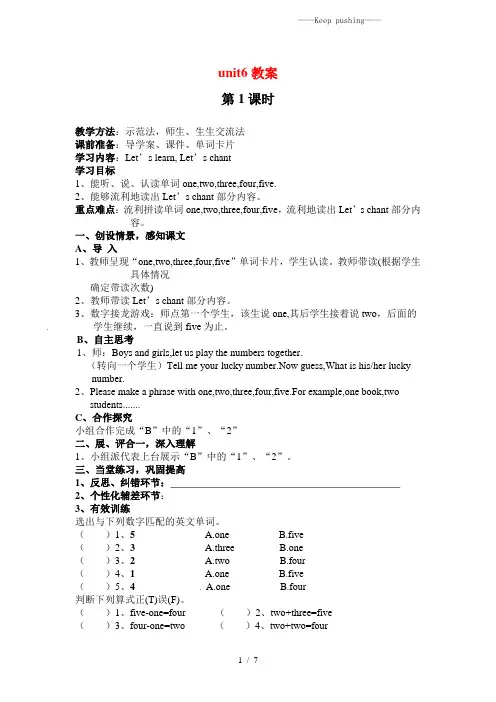
unit6教案第1课时教学方法:示范法,师生、生生交流法课前准备:导学案、课件、单词卡片学习内容:Let’s learn, Let’s chant学习目标1、能听、说、认读单词one,two,three,four,five.2、能够流利地读出Let’s chant部分内容。
重点难点:流利拼读单词one,two,three,four,five,流利地读出Let’s chant部分内容。
一、创设情景,感知课文A、导入1、教师呈现“one,two,three,four,five”单词卡片,学生认读。
教师带读(根据学生具体情况确定带读次数)2、教师带读Let’s chant部分内容。
3、数字接龙游戏:师点第一个学生,该生说one,其后学生接着说two,后面的学生继续,一直说到five为止。
B、自主思考1、师:Boys and girls,let us play the numbers together.(转向一个学生)Tell me your lucky number.Now guess,What is his/her lucky number.2、Please make a phrase with one,two,three,four,five.For example,one book,twostudents.......C、合作探究小组合作完成“B”中的“1”、“2”二、展、评合一,深入理解1、小组派代表上台展示“B”中的“1”、“2”。
三、当堂练习,巩固提高1、反思、纠错环节:______________________________________________2、个性化辅差环节:______________________________________________3、有效训练选出与下列数字匹配的英文单词。
()1、5 A.one B.five()2、3 A.three B.one()3、2 A.two B.four()4、1 A.one B.five()5、4 A.one B.four判断下列算式正(T)误(F)。
三年级上册英语学案-Unit6第6课时CStorytime|人教PEP(含答案)

教案:人教PEP三年级上册Unit 6 C Story Time一、教学目标1. 知识目标(1)能够听懂、会说、会读故事中的主要单词和句型。
(2)能够理解故事内容,把握故事情节。
(3)能够运用所学知识进行简单的日常交流。
2. 能力目标(1)能够通过图片和情景,正确使用动词的一般过去时。
(2)能够运用所学知识,进行角色扮演,表演故事。
3. 情感目标培养学生的合作意识,提高学生的学习兴趣。
二、教学内容1. 单词:go, swim, see, have, birthday, party2. 句型:—What did you do yesterday? —I went to the park. I saw some birds.3. 故事内容:C Story Time的故事,主要讲述了小明过生日,他去了公园,看到了一些鸟,然后去游泳,在家里吃蛋糕。
三、教学重点与难点1. 重点:能够听懂、会说、会读故事中的主要单词和句型。
2. 难点:动词的一般过去时的运用。
四、教具与学具准备1. 教具:PPT、图片、蛋糕模具、游泳圈等。
2. 学具:课本、练习册、单词卡片等。
五、教学过程1. 热身(5分钟)(1)和学生打招呼,询问学生昨天做了什么。
(2)学生用一般过去时回答。
2. 引入(10分钟)(1)通过PPT展示故事封面,引导学生预测故事内容。
(2)学生听故事,并回答问题。
3. 呈现(15分钟)(1)教师展示故事图片,引导学生说出单词。
(2)教师引导学生跟读句型。
4. 操练(15分钟)(1)学生分角色朗读故事。
(2)学生进行角色扮演,表演故事。
5. 巩固(10分钟)(1)学生完成练习册相关练习。
(2)学生互相交流,分享学习心得。
6. 拓展(5分钟)(1)学生用所学知识,进行小组讨论,讨论昨天做了什么。
(2)学生向全班分享讨论结果。
六、板书设计1. 动词的一般过去时板书示例:yesterday:I went to the park.I saw some birds.I went swimming.I had a birthday party.2. 故事情节板书示例:小明生日:去公园看见鸟游泳吃蛋糕七、作业设计1. 抄写故事中的主要单词和句型。
人教PEP五年级英语上册Unit6_C_Story_time 公开课教案
Unit6 C Story time公开课教案教材内容:教材:人教PEP小学英语五年级上册P65单元主题:In a nature park课型:故事课一、教材解读本课内容选自人教PEP五年级上册第六单元C部分。
本单元以In a nature park为话题展开教学,通过参观自然公园,学习关于自然公园里面有的景物,激发学生对自然公园的热爱。
五年级的学生已经掌握了关于自然事物的单词(如flower, tree等),在第五单元学生已经学习了There be ...的句型表达,能用该句型进行景物的描述。
本课时是该单元的第6课时Story time的故事教学内容,在前几个课时,学生已经学习了疑问句型Is/ Are there ...?,能够运用该句型进行事物的是否存在的询问。
因此本课时,结合There be ...以及Is/ Are there ...?句型,在完整的故事情境中进行运用。
二、教学目标1. 知识目标1) 学生能够正确流利地朗读故事内容。
2) 学生能够在故事的情境中,运用There be ...以及Is/ Are there ...?演绎故事片段。
2. 能力目标1) 培养学生听、说的能力。
2) 培养学生小组合作、互相倾听、表达的能力。
三、教学重难点学生能够在故事的情境中,运用核心语言进行故事的演绎。
四、板书设计C Story timeA visit to a nature parkThere is/ are ______.Is/ Are there ______?Yes, it is./ Yes, they are. No, it isn’t./No, they aren’t.五、设计总体思路1. 复习活动支持1:Previous on In the nature park前景提要(短文复述,复习There be句型)活动支持2:Robin咨询(Yes/No, 复习疑问句型)2. 故事体验活动支持1:Listen and tick. (整体输入)活动支持2:What’s in the house?表演(置身故事,在情境中运用疑问句型)活动支持3:Take pictures. (解决文本语言难点Why don’t you...?)活动支持4:Let’s act out. (体验故事,运用语言)3. 故事复述活动支持:Let’s make a scrapbook. (故事续尾,复述故事,语言运用)六、具体环节步骤教学步骤活动说明Step 1: Review 1. Previous on In the nature park前情提要:教师展示前几课时Zhang Peng游玩公园的地图,引导学生用There be句型进行课文复述。
pep人教版三年级英语上册第六单元教案教学设计
Unit Six Happy birthday!单元整体分析本单元是义务教育灵通版(pep)小学英语教科书三年级上册第六单元。
单元主题为Happy birthday!(生日快乐!)。
主情景图通过孩子们为Sarah六岁的弟弟庆祝六岁的生日引出本单元的主题:如何询问年龄并作答,及向别人表达生日祝福。
A部分共三页,分三课时。
第一课时为情景对话和练习部分。
Let’s talk部分中Sarah的弟弟和妈妈在为生日会做准备。
他们在买蛋糕,售货员问他们需要多少盘从而引出本单元的如何询问物品数量并作答的句式:How many ...? 数一数说一说部分中,展示了生日聚会准备的玩具、气球、蛋糕、蜡烛等物品,学生需要数一数各有多少。
在数一数中进行重点句式的问答。
第二课时为重点词汇和重点句型呈现,Sarah和Chen Jie在玩捉迷藏。
Chen Jie蒙着眼睛在数数,引出数字类三会词汇:one, two, three, four, five. Let’s chant是个与数字相关的韵句。
以孩子们跳绳为背景和主要内容,练习正数、倒数五个数字。
第三课时为语音学习,通过听一听、读一读、唱一唱,听一听、圈一圈,听一听、写一写三个活动,学习字母Uu, Vv, Ww, Xx, Yy, Zz六个字母的字形、书写及其在单词里的发音。
B部分共四页,分两课时。
第一课时仍然呈现情景对话和练习。
在Let’s talk中,John来到Sarah 家为Sarah的弟弟Sam庆贺生日。
引出重点句式:How old are you? I’m ... years old. Let’s play是个游戏活动。
学生两人一组,通过翻卡片的形式来确定自己的姓名和年龄,并进行对话问答练习,操练句式:What’s your name? How old are you? 第二课时以孩子们介绍自己的年龄来呈现数字词汇:six, seven, eight, nine, ten 以及重点句式:I’m ... years old. 并通过一个TPR动作反应活动Let’s do,来练习这些重点词汇。
PEP三年级英语上册 Unit6 第6课时 B Start to read 配套教案
Find and say
让学生仔细观察图片,圈出字母图片并数出对应字母数量。
Let students look at the picture and find out the letters. Try to find out the most letters.
Ss: …
Count and say
复习数字1-10。Review the numbers. Then lead them to count and say the numbers.
T:Look, what’s this?
Ss:Cake.
T: Yes, it’s a birthday cake. And there is a candle.(Point to the candle)
Unit6 Happy birthday!教案
第六课时(B.Start to read&C. Story time)
教学目标
1.知识目标:掌握本单元所学单词及句型;能正确完成Start to read和Let's check部分的习题。
2.能力目标:培养学生良好的听力习惯。
3.情感目标:进一步培养学生学习英语的兴趣,让学生养成良好的学习习惯。
Ask students to count the letters.
T: How many big U/V/W/X/Y/Z do you see? (Point to the letters and ask.)
Ss: …
T: How many small u/v/w/x/y/z do you see? (Point to the letters and ask.)
PEP小学英语三年级上册Unit6单元整体教学设计
PEP小学英语三年级上册Unit6单元整体教学设计Unit 6: At the ZooOutline:1. Theme: Visiting the Zoo2. objectives:a. To develop an understanding of animals at the zoob. To develop listening and speaking skillsc. To use adjectives to describe animals3. Materials needed:a. Pictures of animals at the zoob. Animal flashcardsc. Animal bookd. Worksheets for practice4. Teaching Plan:Week 1Day 1: Introduction to the Zoo- The teacher will show pictures of different animals at the zoo and ask students if they have been to one.- The teacher will introduce new vocabulary words such as lion, tiger, elephant, monkey etc.- Students will be given worksheets to practice the vocabulary. Day 2: Reading comprehension- Teacher will read a story from the animal book and ask questions to assess understanding.- Students will work in groups to create a picture of a zoo using their new vocabulary words.Day 3: Writing Practice- Teacher will teach students how to write simple sentences using the words learned.- The teacher will provide a worksheet with prompts to help them write sentences.Day 4-5: Speaking Practice- Students will work in pairs and take turns pretending to be a tour guide and visitor at the zoo.- They will practice asking and answering questions related to the zoo.Week 2Day 1: Adjectives- Teacher will introduce adjectives using sentences like "the big elephant" and "the small monkey" to describe animals.- Students will play an adjective game to practice using different adjectives to describe the animals.Day 2: Listening Comprehension- Students will listen to animal sounds and match them to the appropriate animal picture.- They will then be asked to share the sounds they heard and connect them to the animal.Day 3: Role Play- Students will work in groups to create their own zoo and come up with a story to tell visitors.- They will present their zoo story in class.Day 4-5: Review and Assessment- The teacher will provide a review test to assess students' understanding of the unit.- Students will also be given time to reflect on what they learned and what aspects they need to work on further.5. ConclusionThrough this unit, students will develop a greater understanding of animals, improve their listening and speaking skills, and learn adjectives to describe animals at the zoo. By the end of the unit, students will be able to effectively communicate and share their knowledge with others.In addition to the activities outlined in the teaching plan, there are many other ways teachers can enhance students' learning experience during the zoo unit.One way to keep students engaged is by incorporating technology into the classroom. Teachers can use videos or images of animals at the zoo to give students a virtual tour. This can help students who have never been to a zoo before get a better understanding of what they will see there.Another way to get students involved is to plan a field trip to a local zoo. Seeing the animals up close can make the learning experience more memorable and help students apply what they have learned in the classroom to real-life situations.Teachers can also connect this unit to other subjects such as science and social studies. Students can learn about the habitats of the animals, their diets, and how they interact with each other. This can lead to discussions about conservation and the impact ofhumans on the environment.To make the experience even more immersive, teachers can create a classroom zoo. Students can work together to create a diorama of different animal habitats or make animal puppets to act out stories they have learned in class. This hands-on activity can help students develop creativity and teamwork skills.It is also important to be mindful of the diversity within the classroom. Teachers can incorporate books or videos about animals from different countries or cultures. This can help students connect with their own cultural backgrounds and learn about those of their peers.Finally, teachers should remember that it is important to make learning fun. Incorporating games and activities into the unit can help students stay engaged and excited about learning. Teachers can create bingo boards with different animal pictures or have students work in teams to complete animal-themed challenges.In conclusion, the zoo unit can be a fun and enriching learning experience for students. By incorporating a variety of activities and technologies, making connections to other subjects, and being mindful of diversity, teachers can create a memorable and impactful learning experience for their students.In addition to the ideas mentioned above, teachers can encourage critical thinking and inquiry by having students conduct research projects about specific animals or animal habitats. This can be done individually or in small groups and can be presented in the form of a poster, report, or multimedia presentation.To bring a creative element to the unit, teachers can also have students create their own animal species. This activity can require students to think about the adaptation of animals to their habitats, their diets, and their unique physical characteristics. Students can present their creations to the class, complete with a drawing or model of the animal.To expand on the concept of habitat preservation, teachers can organize an eco-friendly project where students can learn about eco-friendliness and how it is important for wild animals. A project could involve creating organic wildlife corridors or habitats, promoting urban sustainable farming or designing educational posters on the subject.Zoos also have a variety of careers, and teachers can help students understand the different types of jobs and roles in the zoo – not all of them must be zookeepers. By providing students with examples of animal biologists, animal behaviorists, veterinarians, and animal rights activists, teachers can help students think about career possibilities and new career choices.Finally, teachers can create class discussions to talk about the ethical issues surrounding zoos. Zoos can be a controversial topic, and it is important for students to understand all sides of the argument. These discussions can help to prepare students to think critically and develop their skills in making informed ethical decisions.In conclusion, there are endless ways that teachers can enhancetheir zoo unit to make it an immersive and fascinating learning experience. By incorporating a variety of activities, promoting critical thinking and inquiry, and exploring ethical issues, teachers can create an unforgettable unit that not only teaches students about animals but also connects them to the animal kingdom and environmental concerns.教师可以通过多种方式提高学生对动物园学习单元的兴趣和理解。